
人教版七年级英语下册Unit 3 教案
Unit 3 How do you get to school?单元教学目标一、Teaching Aims(教学目标)1.Knowledge Object and Ability(知识与技能)(1)掌握有关交通的词汇,如take the subway/train, ride the bicycle, by bus/boat, transportation, bus stop, train station,kilometer, mile, river以及其他一些词汇。
(2)掌握由how引导的特殊疑问句,表示乘坐何种交通工具的方式.how far ,how long 引导的特殊疑问句及其答句:How do you get to school? I ride my bike.How long does it take?It takes about ...minutes.How far is it from your home to school? It’s es...(3)复习基数词及时间的表达方法.(4)了解中外文化的差异.2.Process and teaching methods(过程与方法):(1)情景交际法:本单元话题源自生活,立足这一点,充分利用学生已有的知识和经验,创设生活化的真实情境,引导学生在运用中学习语言,然后在学习新的语言知识后创造性地运用语言(为用而学,在用中学,学了能用)。
(2)任务型语言教学法:设计多种任务活动,提供给学生合作交流的空间和时间,促使学生为完成任务和同学进行合作,为完成任务进行探究学习。
(3)开放性教学策略:教师要开放性地处理教材,结合教材插入学生感兴趣的图片、电影片段等,丰富学生知识,拓宽他们视野,实现知识的整合。
3.Moral Objects(情感态度与价值观):Through learning this unit , Ss can enable them to care for each other whenever crossing the roads and pay attention to the sign of traffic二、Teaching Key points(教学重点):掌握有关交通的词汇,如take the subway/train, ride the bicycle, by bus/boat, transportation, bus stop, train station,kilometer, mile, river以及其他一些词汇。
三、Teaching Difficult points(教学难点):掌握由how引导的特殊疑问句,表示乘坐何种交通工具的方式.how far ,how long 引导的特殊疑问句及其答句:How do you get to school? I ride my bike.How long does it take?It takes about ...minutes.How far is it from your home to school? It’s es...复习基数词及时间的表达方法.四、Teaching methods(教学方法):Practicing, Listening and Role playing methods.五、单元课时安排共六个课时:第一课时:SectionA1a-1c 第二课时:2a-2d第三课时:Grammar-3c 第四课时:SectionB1a-1d第五课时:2a-self check 第六课时:practice六、单元教材分析本单元的中心话题是“transportation”,它与学生的日常生活紧密联系在一起的本课的教学围绕“谈论如何去上学”这一话题展开教学,引导学生通过本课的语言素材看图说话、句型操练、实际描述,对话表演使学生学会用英语。
本课还学习以how引导的特殊疑问句,通过问答训练,进一步提高学生听、说、读、写综合素质能力。
Period one(SectionA1a-1c)一、Teaching Aims(教学目标)1.Knowledge Object and Ability(知识与技能)1.词汇:train,bus,subway,take the subway,ride,bike,ride a bike2.句型:How do you get to school?I ride my bike.2.Process and teaching methods(过程与方法):Practicing, Listening and Role playing.3.Moral Objects(情感态度与价值观):培养学生独立自主的能力二、Teaching Key points(教学重点):Key words and phrases三、Teaching Difficult points(教学难点):Key structures四、Teaching methods(教学方法):Listening for specific information and Role playing. Pairwork.五、Teaching Aids(教学用具):a tape recorder六、教学用时:40分钟七、教学过程:●【搭桥引线】---“新旧知识、生活体验、学科渗透”+“明确目标”(搭桥)1.Greet the whole class.2、唱上学歌曲从而让学生了解交通工具.(引课):直观利用图片学习交通单词。
PPT3What’s this?It is a/an ___________.(明标)学生朗读,教学目标中的“知识与技能”,明确本节课的学习目标。
●【前置作业】“自主学习、合作学习、探究学习”+“展示交流”1.“自主学习”——通过ppt4-5 让学生独立学习take the bus 与by bus 之间的关系。
(拓展延伸)通过PPT7-8页How do you get to school?I …walk to school.go to school on foot.ride my / a / the bike to school.go to school by bike.take a / the bus to school.go to school by bus.(练习对话)2.“合作学习”——通过图片PPT9-13页让学生合作学习。
1.How does Bob get to school?He …takes the train to school.goes to school by train.2.How does Mary get to school?She …takes the subway to school.Goes to school by subway.3.集体完成1a-1b。
4.3.“探究学习”——Grammar FocusHow do you get to school?你是怎么上学去的?how 是疑问副词, 通常用来提问方式等。
含有动词的交通方式有:take the subway 乘坐地铁take the train 乘火车walk (go on foot) 步行take the bus 乘公交汽车…可以用介词by表示乘坐方式:by bus, by subway, by bike“展示交流”学生自主学习,分组合作学习讨论,探究出结果后,教师对以上问题给小组分配任务,进行展示交流,阐述观点。
教师及时给予学生指导、鼓励。
●【答疑解惑】“纠偏纠正、互答互补、答疑释难”+“授人以渔”How do you get to school?你是怎么上学去的?how 是疑问副词, 通常用来提问方式等。
含有动词的交通方式有:take the subway 乘坐地铁take the train 乘火车walk (go on foot) 步行take the bus 乘公交汽车…可以用介词by表示乘坐方式:by bus, by subway, by bike●【梳理评价】“收获体会、梳理板书、小组评价”+“达标检测”学生说出体会收获教师或学生根据学生的叙述进行知识梳理、板书,并对各小组的学习表现进行评价总结。
【达标测评】Make conversation with your partner.(根据图片完成对话)Eg:A: How do you get to school?B: I take the subway.A:_____________ A:____________B:_____________ B:____________A:_____________ A:____________B:_____________ B:____________【“教”“学’反思】Period Two(2a -2e)一、Teaching Aims(教学目标)a.Knowledge Object and Ability (知识与技能)重点词汇:sixty,seventy,eighty,ninety,hundred,minute,far,kilometer,new,byb.Target language :How long does it take…? It takes … How far is it from…to…? It’s about…c.Train students’ listening skill.2.Process and teaching methods(过程与方法):Review the conversation.Practicing,listening3.Moral Objects(情感态度与价值观):Have a beautiful handwriting.二、Teaching Key points(教学重点):a.Key wordsb. How long does it take…? It takes …How far is it from…to…? It’s about…三、Teaching Difficult points(教学难点):How long does it take…? It takes …How far is it from…to…? It’s about…四、Teaching methods(教学方法):speaking,listening, groupwork.五、Teaching Aids(教学用具):1.A tape record六、教学用时:40分钟七、教学过程●【搭桥引线】---“新旧知识、生活体验、学科渗透”+“明确目标”(搭桥)1.Greet the whole class.2、自主学习利用图片复习单词及词组。
七年级英语下册unit3教案课堂教学设计
本文将分享一份关于七年级英语下册Unit 3的课堂教学设计。
这一单元的主题是“Excuse me, where’s the post office?”,旨在帮助学生学会寻问和指示方向。
一、教学目标1.学生能够利用“Excuse me, where’s…?”和“Go straight / Turn left /Turn right / Do a U-turn…”等相关表达方式寻问和指示方向。
2.学生能够掌握交通工具和要素的相关单词和短语,如bus stop, subway, trainstation, etc.3.学生能够在交流中理解和使用地图和城市布局相关的词汇。
二、教学准备1.PowerPoint演示文稿2.学习用的绘画和游戏材料3.相关练习题和课堂活动材料三、教学步骤1.导入引入问题:幻灯片上展示一张城市地图,要求学生根据已知的地标(如学校、体育场、购物中心等)找出周围的其他地方。
2.学习交通工具和要素教师通过幻灯片展示不同的交通工具和点。
继续讨论如何利用不同的交通工具到达一个点,例如,利用地铁从学校到达电影院:Excuse me, how do I get to the movie theater?Take the subway.Where's the subway?Turn right and go straight. The station is on your left.3.教学寻问和指示方向教师在幻灯片上展示不同地理位置的照片和地图,提示学生开始学习如何问路和指路。
教师向学生展示如何使用“Excuse me, where’s…?”句型,以及“Go straight / Turn left / Turn right / Do a U-turn…”等表达方式来指示方向。
教师可以与学生分组进行角色扮演,以加强他们的语言进程和提高他们的口语表达能力。
4.练习方向、地图和城市布局相关的词汇通过游戏、图片和绘画等多种形式收集和展示不同的地图和城市布局相关的单词和短语,例如:Bus stop / Subway / Train stationNorth / South / East / WestOn the left / On the right / Across the street / Next to5.面向现实场景的实践通过现实场景的练习加强学生的学习效果。
初一七年级英语下册人教版Unit 3 How do you get to school? 单元教案、教学设计

Unit 3 How do you get to school?Learning Objectives一、Topics(话题):Transportation二、Functions (功能)Talk about how to get to places三、Structures (结构)1. How questions2. How long questions3. How far questions四、Target Language (目标语言)How do you get to school?I ride my bike.How long does it take to get to school?It takes about 20 minutes.How far is it from your home to school?It’s about two kilometers.五、V ocabulary (词汇)train, bus, subway, bike, car, boat, river, year, minute, kilometer, sixty, seventy, eighty, ninety, hundred, ride, drive, live, leave, cross take the train/bus, go by bike/subway, ride a bike, drive a car, think of, between … and …, leave home/school, come true六、Skills (技能)Listening for key informationScanning in reading七、Recycling (复习巩固)Numbers 1–30I usually …It is easy to …Thanks for …八、教材分析本单元以How do you get to school?为中心话题,主要运用How long/How far 询问“去某地的交通方式、时间、距离”,简单描述路线。
人教版初中七年级英语下册第三单元Unit 3 教案含教学反思

第3单元How do you get to school?类别课程标准要求掌握的内容话题Transportation交通方式Section A 单词train n.火车bus n.公共汽车subway n.地铁ride v.骑n.旅程bike n.自行车sixty num.六十seventy num.七十eighty num.八十ninety num.九十hundred num.一百minute n.分钟far adv.& adj.远;远的kilometer(=kilometre)(abbr.km)n.千米;公里new adj.新的;刚出现的every adj.每一;每个by prep.(表示方式)乘(交通工具) drive v.开车car n.小汽车;轿车live v.居住;生活短语get to到达take the subway 乘地铁ride a bike 骑自行车every day每天by bike骑自行车from home to school 从家到学校how far 多远句型1.—How do you get to school? 你怎样去上学?—I ride my bike.我骑自行车。
2.—How long does it take to get to school?去学校要多长时间?—It takes about 15 minutes. 大约15分钟。
3.—How far is it from your home to school? 从你家到学校有多远?语法how引导的一般现在时的特殊疑问句写作介绍自己或他人的出行方式知识目标掌握how引导的特殊疑问句。
能力目标能掌握有关乘坐交通工具的对话和谈论各种交通工具的文章,并能熟练运用“介词by+交通工具”和“take + a/an/the+交通工具”等短语,写短文。
情感目标了解现在人们的出行方式与以前发生了哪些变化;培养自己的时间观念,养成良好的守时习惯。
人教版七年级英语下册《Unit 3 How do you get to school单元教案
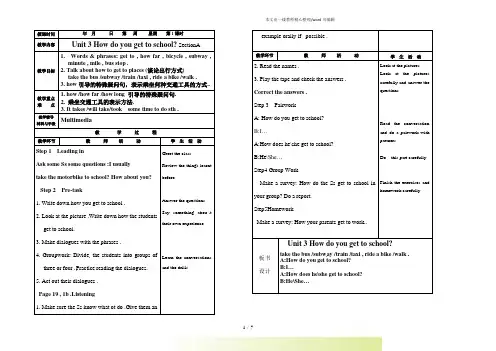
授课时间年月日第周星期第1课时教学内容Unit 3 How do you get to school? SectionA教学目标1. Words & phrases: get to , how far , bicycle , subway ,minute , mile , bus stop .2. Talk about how to get to places (谈论出行方式)take the bus /subway /train /taxi , ride a bike /walk .3. how引导的特殊疑问句,表示乘坐何种交通工具的方式..教学重点难点1. how /how far /how long 引导的特殊疑问句.2. 乘坐交通工具的表示方法.3. It takes /will take/took some time to do sth .教学辅导材料与手段Multimedia教学过程教学环节教师活动学生活动Step 1 Leading inAsk some Ss some questions :I usuallytake the motorbike to school? How about you? Step 2 Pre-task1. Write down how you get to school .2. Look at the picture .Write down how the studentsget to school.3. Make dialogues with the phrases .4. Groupwork: Divide the students into groups ofthree or four .Practice reading the dialogues. 5. Act out their dialogues .Page 19 , 1b .Listening1. Make sure the Ss know what ot do .Give them an Greet the classReview the things learntbefore.Answer the questions.Say something abou ttheir own experience.Learn the conversationsand the drills.example orally if possible .教学环节教师活动学生活动2. Read the names .3. Play the tape and check the answers .Correct the answers .Step 3 PairworkA: How do you get to school?B:I…A:How does he\she get to school?B:He\She…Step4 Group WorkMake a survey: How do the Ss get to school inyour group? Do a report.Step5HomeworkMake a survey: How your parents get to work..Look at the pictures.Look at the picturescarefully and answer thequestions.Read the conversationand do a pairwork withpartners.Do this part carefullyFinish the exercises andhomework carefully.板书设计Unit 3 How do you get to school?take the bus /subway /train /taxi , ride a bike /walk .A:How do you get to school?B:I…A:How does he\she get to school?B:He\She…教学反思授课时间年月日第周星期第2课时教学内容Unit 3 How do you get to school? SectionA 教学目标1.复习基数词及时间的表示方法.2.了解中外文化的差异.教学重点难点1.It takes /will take/took some time to do sth .2. Target language. The use of the drill.教学辅导材料与手段Multimedia教学过程教学环节教师活动学生活动Step 1 Leading in1. Greetings .2. Check the homework .Step 2 Pre –taskPage 20 , 2a.2b&2c .1. Revise the numbers .2. Teach the new word :minute .3. Play the tape for the students to finish Greet the classReview the things learntbefore.Revise the numbers .Listen to the recordingcarefully.2a&2c .Then play again and check theanswers ..4. Go over the dialogue in Page20 ,2d.Step 3 Pre-taskCheck the answer.教学环节教师活动学生活动Page 20 ,Grammar focus .1. Review the grammar box .Ask students to saythe statements and responses .2. Practice reading .Explain the usage of “take” in “take the train”and “take some time to do sth” .activityStep 4 PairworkMake a conversation about how you get toschool. Then practice in pairs.Step5 HomeworkRemember the Grammar Focus .Read the conversationand do a pairwork withpartners.Do this part carefullyFinish the exercises andhomework carefully.板书设计Unit 3 How do you get to school? Numbers: 32 40 41 50 60 70 80 90 100 Phrases:It takes /will take/took some time to do sth .教学反思授课时间年月日第周星期第3课时教学内容Unit 3 How do you get to school? SectionA教学目标1. 复习how far ,how long 引导的特殊疑问句.2. Reading practice.3. Writing practice.4.New words and phrases: town ill worry so much教学重点难点1. Key vocabulary, key phrases2. Target language. The use of the drill.教学辅导材料与手段Multimedia教学过程教学环节教师活动学生活动Step 1 Leading in1.Have Ss make sentences with “take to” .Explain the usage of “take” in “take the train”and “take some time to do sth” .Step 2 While-taskPage 21,3a .1. Pay attention to the speech bubbles .Read thequestions .2. Read the passage by the Ss. Find the answersto the questions and write the answers on thelines .Correct the answers .Step 3 Page 21, 3b .Greet the classReview the things learntbefore.Answer the questions.Say something abouttheir own experience.Learn the conversationsand the drills.教学环节教师活动学生活动1. Show Ss the example in the box .Two studentsread it to the class .2. Pairwork: Make your own conversations usingthe information in the left box.3. Ask some pairs to present the conversations tothe classStep 4 Post-taskPage 21 ,Part 4 .Groupwork.Divide the Ss into groups of three .In each group ,one is A,who look at Page 21.One is B,who look at Page 85,the other is C,who look at Page 86 .Fill in the blanks .The group who fill in the blanks first wins .Step 5 HomeworkWrite the sentences in Part 4 on the exercise books .Look at the pictures. Look at the pictures carefully and answer the questions.Read the conversation and do a pairwork with partners.Read this part carefullyFinish the exercises and homework carefully.板书设计Unit 3 How do you get to school?A:How far is it from your home to school?B:It’s…It takes/took sometime to do something.教学反思时间年月日第周星期第4课时教学内容Unit 3 How do you get to school?. SectionB教学目标1. vocabulary :bus stop bus station train station subwaystation .2. 能力目标:谈论上学的全过程。
英语人教版七年级下册Unit3 reading 教案

What can we do to make their dream come true?
6. Can the boy’s dream come true?
Why not?
1.对文章进行逐层分析,抽丝剥茧,引导学生对目标文章有一个通透的理解。
3.学生从中能够锻炼沟通合作能力。
Step3.
展示交流
(6分钟)
帮助学生用投影进行展示,聆听、欣赏并给予点评。
小组代表到教室前进行展示,并读出自己的海报内容。
通过小组合作成果的展示,学生互通有无的同时体会合作后的成就感、提高自信心并能更全面地了解交通安全。
Step4.
总结拓展
(1分钟)
总结道路安全同时拓展食品安全、用火用电安全及语言安全等,并给予简单有效的建议。然后领读名言,体会珍惜生命。
2.设置不同难度问题让各个程度的学生都能有所表现,增强自信,从而更乐意从事英语阅读。
3.最后开放型问题启迪学生思考:(1)怎样尽己所能关爱他人;(2)生命只有一次,我们要珍爱生命。怎样在上学路上珍爱生命?(引入下一个任务。)
任务2:校本阅读资料。
通过制作交通安全主题海报,进一步落实上学路上安全问题。
教学目标
语言能力目标
1)巩固表达采用怎样的交通方式去某地。
2)阅读短文,获取并整合相关信息。
3)学会表达简单的交通规则。
思维品质目标
学会关爱他人,合作共赢。
学习能力目标
强化听说读写的能力及合作学习的能力。
文化意识目标
倡导自觉遵守交通法规,珍爱生命,构建和谐的人际关系。
教学
重难点
重点
1)通过进行听、说的训练,来提高学生们综合运用所学知识的能力。
人教版新目标七年级英语下册 Unit 3 教学设计
人教版新目标七年级英语下册 Unit 3 教学设计一. 教材分析人教版新目标七年级英语下册Unit 3主要围绕着日常生活中的活动展开,包括起床、吃早餐、上学等。
本节课的主要话题是描述日常活动的时间,学会用一般现在时来描述规律性的动作,用一般过去时来描述过去发生的事情。
教材通过丰富的图片、对话和练习,帮助学生掌握日常英语口语交流的能力,同时培养学生的观察力、思维力和创造力。
二. 学情分析七年级的学生已经掌握了基本的英语语音、词汇和语法知识,具备一定的英语听说读写能力。
但部分学生对英语学习仍存在恐惧心理,缺乏自信心。
针对这一情况,教师应关注学生的个体差异,鼓励他们大胆开口说英语,并在课堂上给予及时的反馈和鼓励。
三. 教学目标1.知识目标:–学会描述日常活动的时间。
–掌握一般现在时和一般过去时的基本用法。
–增加相关词汇:wake up, get up, have breakfast, go to school 等。
2.能力目标:–能够用英语简单描述自己的日常活动。
–提高学生的英语听说能力和团队协作能力。
3.情感目标:–激发学生学习英语的兴趣,培养积极的学习态度。
–增强学生之间的友谊,培养团队精神。
四. 教学重难点•描述日常活动的时间。
•运用一般现在时和一般过去时进行口语交流。
•正确运用一般现在时和一般过去时描述自己的日常活动。
•学会在适当的情境下使用一般现在时和一般过去时。
五. 教学方法1.情境教学法:通过设定生活情境,让学生在实际语境中学习、运用英语。
2.任务型教学法:引导学生参与各种小组活动,提高学生的团队协作能力和口语表达能力。
3.激励评价法:及时给予学生反馈,关注学生的点滴进步,激发学生的学习兴趣。
六. 教学准备1.教学素材:教材、多媒体课件、录音机、磁带、相关图片等。
2.教学工具:黑板、粉笔、投影仪等。
七. 教学过程1.导入(5分钟)–教师与学生用英语进行自由谈话,引导学生谈论日常活动。
–提问:What time do you get up? What do you have for breakfast? 让学生用英语回答。
人教版七年级英语下册教案与习题:Unit 3 How do you get to school
Unit 3 How do you get to school?Section A (1a-2d)一、教学目标:1. 语言知识目标:1) 能掌握以下单词:train, bus, subway, ride, bike, sixty, seventy, eighty, ninety, hundred, far, minute, kilometer, new, every, every day2) 能掌握以下句型:①—How do you get to school? —I ride my bike.②—How does Mary get to school? —She takes the subway.2. Talk about how to get to places (谈论出行方式)take the bus /subway /train /taxi , ride a bike /walk .3. how引导的特殊疑问句,表示乘坐何种交通工具的方式。
how far, how long 引导的特殊疑问句。
4. 复习基数词及时间的表示方法。
2. 情感态度价值观目标:让学生感受到他们学习英语是为了在现实生活中进行交流,而不单纯是为了英语课和应付考试而学习,了解东西方国家出行方式的不同,以及不同的交通规则,教育学生注意交通安全, 加深对交通知识的了解。
倡导自觉遵守交通法规及礼貌,构建和谐的人际关系。
了解交通的发展,培养创新精神。
二、教学重难点1. 教学重点:1) how /how far /how long 引导的特殊疑问句.2) 乘坐交通工具的表示方法.3) It takes / sb some time to do sth .2. 教学难点:—How do you get to school? —I take the …/ride …/ walk…—How does Mary get to school? —She takes the subway.—How long does it take? —It takes forty minutes.—How far is it from… to…—It's… kilometers.三、教学过程Ⅰ. Warming-up and Lead in学生和老师进行简单的问候Ss : Good morning , teacher.T: Good morning , classT: Look at the picture. What can you see? Do you like your school? I usually get to school by bike, but sometimes on foot . How do you get to school?Ss 按实际情况作答S1: I ride my bike.S2: I go by bus.S3: ………T: Very good. You’re clever. Let’s learn Unit 4 Section A.之后板书:“Unit 4 How do you get to school?”Ⅱ. Presentation1. T: If you are here, but your school is in Shanghai. How do you get to school?Ss: I take the bus /plane/ boat / ship / car / taxiI ride a bike / motorbikeT: Do you know any other way?2. Teacher shows pictures on the big screen .归纳出行方式和常用短语.Ask some questions about how you get to…?(让学生积极主动的思考想象总结,多媒体增加趣味性,加强直观性,效果事半功倍)3. Show a picture about Part 1, on the screen.Point at girls or boys in the picture.Ask students to answer and write in the blanks.S1 : How does he / she go to school?S2 : He / She … …Ⅲ. 1aT: Look at the picture on your book. Match the words with the picture.(学生们完成1a的学习任务,然后校对答案)Ⅳ. Listening1. Make sure the Ss know what to do. Give them an example orally if possible.2. Read the names in the box.3. Play the tape and check the answers.Ⅴ. Pair workAsk two students to read the dialogue in the speech bubbles to the class. Then ask students to work in pairs. Ask and answer how students get to school in the picture.Finally ask some pairs of students to present their conversations to the class.Ⅵ. Listening1. Revise the numbers, first, zero~nine, next, ten~nineteen, then, twenty, thirty, forty…finally,twenty-one, twenty-two…Teach the new word "hundred".2. Play the tape for the students to finish 2a. Then play again and check the answersⅦ. PresentationShow a picture on the TV and explain these are your home and school.Teach: home----school How long 10 minutes How far two kilometersThen make up a dialogue to practice.A: How do you get to school?B: I usually take the bus.A: How far is it from your home to school?B: It's about two kilometers.A: How long does it take?B: It takes 30 minutes by busⅧ. Listening1. Tell Ss the following recording is about how Tom and Jane go to school.2. First, listen to the recording fill in the first column.3. Then, play the recording for the Ss again. Ss listen and complete the rest of the chart.4. Check the answers.Ⅸ. Role-play1. Read the dialogue and find the answer to these questions:①How does Jane get to school?②How far is it from home to school?③How long does it take to get to school from her home?2. Ss read the conversations and then find the answers to the questions.3. Check the answers with the class.4. Play the recording for the Ss to listen and repeat.5. Ss read the conversation then role-play the conversation.6. Let some pairs act out the conversation.Homework1. Remember the new words and expressions in this period.2. Role-play the conversation after class.Section A (Grammar Focus-3c)一、教学目标:1. 语言知识目标:1) 继续练习谈论出行方式take the bus /subway /train /taxi, ride a bike /walk .2)用不同方式练习how引导的特殊疑问句,表示乘坐何种交通工具的方式。
人教版七年级下册unit3-How-do-you-get-to-school-单元教案
Unit 3 How do you get to schoolPeriod 1教学内容与分析教学内容:Make a list ; Listen and write ; Pairkwork教学目标:1) 能够谈论:How do you get to school? 掌握各种交通工具的英语表达法。
2) 能够听、说、认读句子:A:How does Bob get to school? B:He takes the train.3) 能用熟练地运用这些句型对不同交通工具的使用进行谈论和比较。
教学重点、难点分析教学重点:能够听、说、读、写各类交通工具并在实际情景中会运用How do you get to school?句型进行交际活动。
教学难点:take ride the/ a …to + 地点= go to + 地点+ by…walk to +地点= go to + on foot教学设计Teaching proceduresStep ⅠWarming-up and Revision1.Greetings and free talk.2.RevisionStep ⅡLead in1. Listen and guess what it is.Listen and guess what it is. Revise the old words and teach the new words.2. Guessing gameThe teacher say a sentence ask the students to guess what kind of transportation it is.---It is like a bike but goes much faster. ---A motorbike.---It is like a train but goes under the ground. ---A subway.---It goes in the water. ---A ship or a boat.---It takes you about three hours to go to Beijing from Shenzhen by it. ---A plane.---It can take people to the moon. ---A spaceship.---It is very useful, you may ride it to school. ---A bike3. There are so many transportations around the world. What kind of transportation do you like to choose ?Ask how do you get to school/Shanghai/ Hangzhou/ Luqiao /Paris….?Help the students answer:I take the subway./take the bustake a minibus /take a taxitake the train / take the planetake the ship/take the carride my/a bikeride a motorbike/walkStep ⅢTo work in pairs, ask and answerAsk the students to work in pairs.A: How do you get to school?B: I walk to school. I ride a bike to school.I take a bus to school. I take a car to school.I take the subway to school. I take the train to school.Step ⅣPresentation1. First ask two students to ask and answer in pair.Then ask the other students “how does he/she get to school?”He/She takes the subway. /……rides his/her bike……walks.Step ⅤGroup workAsk the students to do group work.A: How do you get to school?B: I take the bus. / ride my bike/ bicycle./ walk.C: How does he /she get to school?He/She takes the bus/… rides his/her bike/bicyc le ./ walks.Step ⅥWork on 1a and 1b.1. To do Section A 1a look at the picture and write down the way of transportation.2. To listen to the tape and finish1b.Step ⅦPresentationAsk “h ow does Bob get to school?’ Help them answer he takes the train.Then ask “how does Paul get to school?” "He walks."Say Paul usually walks to school. He goes to school on foot.Show some pictures to students. Ask them to say like this.My father rides a bike to work every day. =My father goes to work by bike every day. Step ⅧTo work in pairs, ask and answerShow some pictures to the students then ask then to work in pairs.A: How do you get to......? B: I take/ride/walk......I get to school...by.../on...Step ⅨSummaryTake/ride the/a ...to+地点=go to +地点+by....Walk to+地点=go to +on foote.g. He often takes the subway to work.=He often goes to work by subway.注意:当home, here, there 作地点时to 不要。
2018年最新人教版七年级英语下册全册教案
2018年七年级英语下册Unit1-10全册教案Unit 1 Can you play the guitar? (2)Unit 2 What time do you go to school? (11)Unit3 How do you get to school ? (20)Unit4 Don’t eat in class. (26)Unit5 Why do you like pandas? (34)Unit 6 I’m watching TV (44)Unit 7 It’s raining! (56)Unit 8 Is there a post office near here? (66)Unit 9 What does he look like? (75)Unit 10 I’d like some noodles (86)Unit 11 How was your school trip? (93)Unit 12 What did you do last weekend? (105)2018年春七年级英语下册教案Unit 1 Can you play the guitar?一. Knowledge and abilities goals:1.vocabulary:dance,swim,sing,play chess , paint ,speak English, play the guitar2. How to use Model verb‖ can‖.3. Listening and speaking skills and communicative competence.二. Teaching method: Listening and speaking methods. Pair works.三. Moral goals: Encourage students to express their abilities.Content of courses: In this period, students will learn some names of clubs ,such as art , music, chess club, swimming club, etc. students will learn the drills :Do you want to join…club ?Can you …?四. Importance and difficulty: canTeaching Aids: A tape recorder. Some pictures. A projector Some sports things, such as volleyball, basketball, etc. Preparation test paper for lessons before class.五. Teaching Time: 4 periodsPeriod 1 (Section A: 1a-2d)授课人:______ 授课班级: _____ 授课时间:2018年___月___日____午第____节1.Knowledge Objects: Learn to talk about abilities.Know something about the culture of clubs. Can you/he..?What can you do? What club do you want to join?can, can‘t, draw, dance, swim, speak, walk.2.Teaching key point: can3. Teaching Difficult point: can4.Teaching Procedures:Step 1. Lead-inEnjoy a song I’m a musicianT: Do you want to be a musician? S:T: Can you play the piano? S…T: What can you do? S: I can…T: What about you? S:T: OK, now please show your talent and tell us what you can do.Ask one of the students come to the front and do the action. Ask other students to guess what he or she can do.Step 2. PresentationT: Look at the pictures. What are they doing? S:Step 3 Pair workLook at the pictures. Ask and answer like this:A: Can you play basketball?B: Yes, I can. / No, I can‘t.Can you…?Step 4 PresentationShow some pictures of fam ous stars. Practice the third person ―he, she, they‖T: Where can you play chess? S:T: Yes, in a chess club. This term, we have a lot of clubs. What club do you want to join? S…T: Sounds great. Can you…?S: Yes, I can/ No, I can‘tIf the answer is negative, guide students to say:S: No, I can‘t. But I can learn it from others.Step5 Pair workA: What club do you want to join?B: I want to join the…A: Can you …?B: Yes, I can . No, I can‘t. But I can learn it from others.Step 6 ListeningListen to 1bListen to 2a and 2b. Tell them to give special attention to listening activity (names of the clubs). Finish the tasks.Step 7 Pair workLook at 2b and talk about what the people can do the clubs they want to join. Step 7 Role-play the conversation 2dT: If you like telling stories. What club can you join?S: Story telling club.T: Right. Please read the conversation following the recording. Who wants to join the story telling club? Then role-play the conversation.Step 8 Explain some language points.Step 9 HomeworkReflection after class:_____________________________________________________________________ _____________________________________________________________________ _____________________________________________________________________ _________________________________Period 2 (Section A: 3a-3c)授课人:______ 授课班级: _____ 授课时间:2018年___月___日____午第____节1. Knowledge Objects: go on learning to talk about abilities.—Can you play the guitar? —Yes, I can./ No, I can't.—What can you do? —I can dance.—What club do you want to join? —I want to join the chess club.2. Teaching key points: Conclude the usage of ‗can‘; put all new language into practice through different activities.3. Teaching Difficult points: Distinguish ―say, speak, tell, talk‖4.Teaching Procedures:Step1:Greeting, Warming up and duty report.Watch a flash about the content of the Just for fun.Talk something about the flash: Why is the other boy unhappy?Introduce because of the difference of time zones, the time in different places are different.Revision: show the time in six places: Beijing, Tokyo, Paris, Los Angeles, New York, and London. Elicit the sentence pattern: What time is it?It‘s……Draw attention to the ―am‖ and ―pm‖. For instance, Beijing is seven o‘clock in the morning. We can say Beijing is seven am. Los Angeles is three in the afternoon. So we can say Los Angeles is three pm. (teacher helps students answer).Step2:Review the words learnt in the last period and add more.(1)T:Here are some Chinese, let us see what time do they usually get up/ take a shower…get up take a shower eat breakfast go to school eat lunch run go home do homework eat dinner go to bed(2)ask students to make a surveyAsk your friend 5 questions about his /her day. Then make a report.A: What time do you usually…?B: I usually…at…Step3:presentation.(1)Ben‘s day. Introduce something about Ben.Using the sentence pattern: What time does he usually get up/go to school/…Pay attention to the verb form of the third person.Discuss Do you like ben‘;s routines.(2)Show the picture of Scott. He usually gets up at 5 pm.Ask students to predict what his job is?(3)listen to the tape,and try to answer this question. then read through the passage,and match the pictures with the times.(4)read it again and fill in the chart.(5)answer the following questions1.Where does he work?2.How does he go to work?Step4:Work on 3a.(1)Read through the passage and tell me what his job is.(2)Read it again and match the pictures.(3)Answer questions:What does he do after he get up?Does he go to work after breakfast? What does he do?How does he go to work? By bus or on foot?What does he do before he goes to bed?What does―What a funny time to eat breakfast!‖mean?Step5:Follow up.T:My friend Da Bao likes Scott's work, so he gets to Sai Te Hotel . But he doesn't find him.T: There are many children in the hotel. Look, they are coming. Please ask them questions to find the real Scott.Step6:Work on part4.T:Now six people make a group, and ask the other students when they usually go to bed . The leader lines up from the earliest to the latest bedtime.T: Let's listen Group1…Group2…Step7:Work on part 3 of self –check.T: Now I want to know something about what you do on weekends. Y ou can go, ask your classmates and fill in the forms. Then you have a report.T: You may begin it like this "Ma Li gets up at …"Step8:Homework.Oral work:(1)Read 3a and recite it.(2)Go on making a survey to find out what your classmates do on weekends. Reflection after class:_____________________________________________________________________ _____________________________________________________________________ _____________________________________________________________________ _____________________________Period 3 (Section B: 1a-1f)授课人:______ 授课班级: _____ 授课时间:2018年___月___日____午第____节1. Knowledge Objects: go on learning to talk about abilities. drum, play the drum, piano, play the piano, violin, play the violin2. Teaching key points: Improve listening and speaking3. Teaching Difficult points: Improve listening and speaking4. Teaching Procedures:Step 1 Warming- up and revisionDaily greeting.Check the homework. Let some Ss report what his/her family members can do.Step 2 PresentationPlay the sound of different kinds of instruments. Let Ss guess what it is.Act and show your classmates your talent.T: Please stand in front of your classmates. Act and say what you can.S1: (sing and dance) I can sing and dance.S2: (play the drum) I can play the drum..Step 3 ListeningTell the Ss that they will listen to some sounds of the instruments. Listen and number the words [1-4] in the order of the sounds you hear in 1a.Play the recording again and check the answers.T: Now let's work on 1c. First, let one student read the words and phrases aloud.Then listen to the 1d and circle the words and phrase you hear.Check the answers:T: Now please look at the chart in 1e. What can Bill, Cindy and Frank do? What can't they do? You'll listen to the recording again. Then try to fill in the blanks. Step 4 Group workWork in groups. Take turn to talk about what Bill, Cindy and Frank can and can't do.S1: Bill can play the guitar, but he can't sing.S2: Cindy can sing and play the drum, but he can't play the piano.Teacher can walk around the classroom, and give some help to the Ss.Step 5 HomeworkMake up a conversation between a volunteer and a person who is in charge of a sports club/old people‘s home/music club.Reflection after class:_____________________________________________________________________ _____________________________________________________________________ _____________________________________________________________________ ____________________________________Period 4 (Section B: 2a-self check)授课人:______ 授课班级: _____ 授课时间:2018年___月___日____午第____节1. Knowledge Objects: go on learning to talk about abilities. also, people, help (sb) with sth, center, home, today, be good with, make, make friends, weekend, on weekends/on the weekend, teach, musician2. Teaching key points: Also, too; be good with, help with3. Teaching Dif ficult points: Describe one‘s ability4. Teaching Procedures:Step 1 Warming-upCheck the homeworkAsk some pairs to show their conversationsStep 2 ReadingFirst, show some pictures of the boys and girls and some key words in 2a.T: Here are some pictures and information about Peter, Alan and Ma Huan. Can you describe them according to the pictures and key words?S1: Guide Ss to use ―also, too‖, and distinguish how to use these two words. Give comments on Ss‘ descriptions.T: Now we‘ll read thre e ads. What's the main idea of each ad? What's each ad's title? Now let's read the three ads and select a title for each ad. Ss read carefully and try to select a title for each ad. Check the answers with the class. Step 3 Review the usage of ―tell‖,Re view and distinguish the usage and function of ―help‖T: Suppose Peter, Alan and Ma Huan want to help to do something after school. Which ad is right for him/her? Now read the descriptions in 2a and the ads in 2b again. Select a right ad for each person.Ss read the descriptions in 2a and the ads in 2b again. Try to select a right ad for each person. They can talk about the answers in their groups.Check the answers with the class.Step 4 Homework1. Recite 2a and 2b2. Finish the exercise on p6Reflection after class:____________________________________________________________________ Unit 2 What time do you go to school?1. Teaching Aims:1) Aims of Basic Knowledge:①Vocabulary: time, shower, usually, O‘clock, what time, go to schoo l, take ashower.②Grammar: What time do you…? What time does he / she…?③ Function: Use the simple tense to talk about the daily life.2) Aims of Abilities: Listening skill. Speaking skill. Reading skill. Writingskill.3) Aims of Emotion: Love life.2. Analysis of the Material:1) Brief Introduction of the teaching material:What time / When do you…?‖ ― What time / When does he…?‖2) Teaching Focus: What time do you…? What time does he/ she…?3) Teaching Difficulties: Present tense.3. Learning Methods: Make a plan. Culture.4. Teaching Methods: Student- centered. Task-based Teaching.5. Teaching Time: 4 periodsPeriod 1(Section A: 1a-2a)授课人:______ 授课班级: _____ 授课时间:2018年___月___日____午第____节Step One: Warming-upGreetingT: Good afternoon, everyone.Ss: Good afternoon, Miss Yang.Step Two: Presentation1.Adjust the time, and ask students questions.T: What time is it? Ss: It‘s 12 o‘clock. ( Write on Bb )( Help Ss to say )T: What time is it? Ss: It‘s 10:15.( Help Ss to say )2.Ask one student to come to the front, adjust the time and ask the otherstudents.S1: What time is it? Ss: It‘s 9 o‘clock.3.Teach the new words & phrases.Show some pictures of different clocks and the activities.T: I‘m very busy these days. Can you guess what time I get up / eat breakfast / go to school / run / take a shower? ( Write on Bb)T: I usually get up at 6:35. ( Teach Ss the new word ― usually‖ )S1: You usually eat breakfast at …S2: You usually run at…S3: You usually take a shower at …4.Ask Ss to do the exercise of 1a, and then check the answers.Step Three: Listening1.Show Ss the timetable of Rick‘s ( write on small Bb )Rick‘s timetableGets upEats breakfastRunsGoes to schoolTakes a showerAsk Ss listen to the recorder and fill in the chart.Then check the answers.2.Ask and answer.T: What time does Rick get up / eat breakfast / run / go to school / take a shower ?Ss: He gets up / eats breakfast / runs / goes to school / takes a shower at…( Ask Ss pay attention to the underlined phrases.)Step Four: Consolidation1.Ask Ss to look at the pictures and tell their days.Example: I usually get up at …. I eat breakfast at …. I go to s chool at …. At …, I take a shower.Step Six: Homework1.Try to remember all the words & phrases.2.Survey: Ask your classmates their routines, and give your report.3.Plan: January 1st is coming. Please plan it, and make your daywonderful.Step Seven Blackboard DesignUnit 2 What time do you go to school?What time do you go to school? I usually go to school at six thirty.go to school get dressed get up brush teetheat breakfast take a shower what timeReflection after class:_____________________________________________________________________ _____________________________________________________________________ _____________________________________________________________________ _______________________Period 2 (Section A: 2b-Grammar Focus)授课人:______ 授课班级: _____ 授课时间:2018年___月___日____午第____节1. Aims and demands :1) Language skills :Ss learn to talk about kinds of transportation, and how long it takes to go places, and how far apart places are.2) Target Language : Words : how far , get to , bicycle , subway , bus stop, train station , minute, kilometer, mile , transportation , calendarSentences: How do you get to school ? / How long does it take ? / How far is it ?3) Moral object : Through learning this unit , Ss can enable them to care for each other whenever crossing the roads and pay attention to the sign of traffic. 2. Analysis of the material:Students have learned the transportation before.. In this unit ,they need to learn more details about the transportation. At the same time ,they need to learn ―How long and How far‖ and they can use them freely.3. Teaching methods:pairwork , groupwork ,listening and speaking, practicing4, learning strategies:Personalizing Inferring vocabulary5.Teaching aids:Tape recorder, a projector or a computer6.Teaching period:Four periods.Period 3 (Section B: 3a-3c)授课人:______ 授课班级: _____ 授课时间:2018年___月___日____午第____节1. Aims and Demands: Key vocabulary, How do you get to school ? How does heget to school ?2. Teaching methods : Listening Writing Pairwork3. Teaching Aids : A tape recorder.Step I Leading inT: Good morning, everyone! You know I live far away ,so I go to school by bus every day. What about you? David, ―How often do you go to school?‖S:--------T: So we will talk about how to get to places in this unit.Step IINow I will show you pic tures and let‘s review the transportations we know. Then we will learn more about it .(take the subway) Please open your books and finish 1a.Step III1. There are five names in 1b.Now they are in the picture. We should find them.2. Play the tape .They should listen carefully and find the persons .Write the numbers next to the correct students in the picture above. After listening , check the answers together .Step IVPoint to the example in the box , ask two students to read it .then ask them to make up their conversations about how the people in the picture get to school . Teacher choose some pairs to act their conversations.Step VPracticing the listening :T: I will play two conversations The people are talking about how students get to school and how long it takes .The first time check the kinds of transportation that you hear. The second time match the time with the kinds of transportation activity 2a.Step VI1. Pay attention to the picture and dialogue.2. Make your own dialogue into pairs.3. Act it in front of the students.Step VIISummary and homework: This class we have learnt some key vocabulary and the target language .I hope after class you can survey how does your friends get to school .and pre-revise the 3a,3b.Step VIII Blackboard DesignUnit 4 How do you get to school ?How do you get to school ?How long does it take ?It takes about 10 minutes .Reflection after class:_____________________________________________________________________ _____________________________________________________________________ _____________________________________________________________________ __________________________________Period 4授课人:______ 授课班级: _____ 授课时间:2018年___月___日____午第____节课题Unit 2 What time do you go to school?(第4课时)教学批注教学设计一、教学三维目标1.知识与技能:(1)通过本单元的学习,使学生掌握相关的时间表达方法以及相关的词汇,能够就生活中的时间安排及日常活动来交谈;(2)通过情景设计来激发学生学习的学习兴趣,并培养学生的自主学习和与他人合作的精神;(3)通过谈论作息时间及日常活动,培养学生合理安排作息时间的意识。
Unit 3SectionB2a-2d教案2021-2022学年人教版英语七年级下册
Unit 3 Will people have robots?Section B 2a-2d教学设计一、教学设计指导思想和理论依据《中学英语教学大纲》指出:“中学英语教学的目的是对中学生进行听、说、读、写的基本训练,培养学生口头上、书面上初步运用英语的能力,侧重培养阅读能力”。
阅读理解是吸收书面信息的最重要手段,它能给学生提供更为丰富的教育教学资源。
现行初中教材中,阅读课文是各单元教学的核心,容量大、密度高、话题广、课时紧。
但阅读课是培养学生阅读能力的主要渠道,在教学实践中构建合理有效的阅读课堂模式,以充分调整学生的积极性和主动性是英语教学的重点。
本节课旨在创设各种机会和条件,让学生参与语言的实践活动,不断提高他们的语言运用能力。
二、教学背景分析1、教学内容分析本节课是一篇阅读课。
围绕机器人发展之路展开话题,内容主要涉及机器人的现在和未来,其中还穿插了科学家的不同观点。
篇幅较长,旨在训练发展学生的阅读能力。
同时通过对机器人现在与未来的讨论,激发、培养学生对未来生活的向往,鼓励学生为实现美好的梦想更加努力地学习。
2、学情分析优势:通过学习,学生能听懂基本的课堂指示语,经过不断的训练,学生能有效地展开课堂活动。
本节课的内容涉及机器人,学生会有很浓厚的兴趣,会对教学产生良好的影响。
困难:班级学生整体水平差异很大,部分学生词汇量不足,阅读习惯不好,导致阅读速度慢,阅读理解能力差,对整体教学带来一定困难。
因此在组织教学活动中,要注重学习策略的指导,灌输自主、合作、探究学习的思路,同时注意调整活动任务设置的梯度,使每个学生通过学习活动,都能学有所成,体验到成功。
3、教学方式、教学手段、技术设备说明本节课设计利用思维导图的形式从robots today, robots in the future两个方面梳理文章脉络,并指导学生用思维导图来复述文章,锻炼学生的归纳总结和语言表达能力。
运用“讨论-限时自读-导读-复读-讨论”的基本课堂教学模式,设计学生学习活动。