
新目标人教版初中八年级上册英语语法汇总
新目标人教版初中八年级上册英语语法汇总1) leave的用法1、“leave+地点”表示“离开某地”。
例如When did you leave Shanghai?您什么时候离开上海的2、“leave for+地点”表示“动身去某地”。
例如Next Friday, Alice is leaving for London、下周五爱丽斯要去伦敦了。
3、“leave+地点+for+地点”表示“离开某地去某地”。
例如Why are you leaving Shanghai for Beijing?您为什么要离开上海去北京2) 情态动词should“应该”学会使用should作为情态动词用常常表示意外、惊奇、不能理解等有“竟会”的意思例如How should I know? 我怎么知道Why should you be so late today?您今天为什么来得这么晚should有时表示应当做或发生的事例如We should help each other、我们应当互相帮助。
我们在使用时要注意以下几点1、用于表示“应该”或“不应该”的概念。
此时常指长辈教导或责备晚辈。
例如You should be here with clean hands、您应该把手洗干净了再来。
2、用于提出意见劝导别人。
例如You should go to the doctor if you feel ill、如果您感觉不舒服您最好去瞧医生。
3、用于表示可能性。
should的这一用法就是考试中常常出现的考点之一。
例如We should arrive by supper time、我们在晚饭前就能到了。
She should be here any moment、她随时都可能来。
3) What、、、? 与Which、、、?1、what 与which 都就是疑问代词都可以指人或事物但就是what仅用来询问职业。
如Whatis your father? 您父亲就是干什么的该句相当于What does your father do?What is your father's job?Which 指代的就是特定范围内的某一个人。
如---Which is Peter? 哪个就是皮特---The boy behind Mary、玛丽背后的那个男孩。
2、What、、、?就是泛指所指的事物没有范围的限制而Which、、、?就是特指所指的事物有范围的限制。
如What color do you like best? 您最喜爱什么颜色 ( 所有颜色)Which color do you like best, blue, green or yellow? 您最喜爱哪一种颜色(有特定的范围)3、what 与which 后都可以接单、复数名词与不可数名词。
如Which pictures are from China? 哪些图片来自中国4) 频度副词的位置1、常见的频度副词有以下这些always总就是一直usually通常often常常经常sometimes有时候never从不2、频度副词的位置a、放在连系动词、助动词或情态动词后面。
如David is often arrives late for school、大卫上学经常迟到。
b、放在行为动词前。
如We usually go to school at 7:10 every day、我们每天经常在710去上学。
c、有些频度副词可放在句首或句尾用来表示强调。
如Sometimes I walk home, sometime I rides a bike、有时我步行回家有时我骑自行车。
3、never放在句首时主语、谓语动词要倒装。
如Never have I been there、5) every day 与everyday1、every day作状语译为“每一天”。
如We go to school at 7:10 every day、我们每天710去上学。
I decide to read English every day、我决定每天读英语。
2、everyday 作定语译为“日常的”。
She watches everyday English on TV after dinner、她晚饭后在电视上瞧日常英语。
What's your everyday activity? 您的日常活动就是什么6) 什么就是助动词1、协助主要动词构成谓语动词词组的词叫助动词Auxiliary Verb。
被协助的动词称作主要动词Main Verb。
助动词自身没有词义不可单独使用例如He doesn't like English、她不喜欢英语。
doesn't就是助动词无词义like就是主要动词有词义2、助动词协助主要动词完成以下功用可以用来a、表示时态例如He is singing、她在唱歌。
He has got married、她已结婚。
b、表示语态例如He was sent to England、她被派往英国。
c、构成疑问句例如Do you like college life? 您喜欢大学生活不Did you study English before you came here? 您来这儿之前学过英语不d、与否定副词not合用构成否定句例如I don't like him、我不喜欢她。
e、加强语气例如Do come to the party tomorrow evening、明天晚上一定来参加晚会。
He did know that、她的确知道那件事。
3、最常用的助动词有be, have, do, shall, will, should, would7) forget doing/to do与remember doing/to do1、forget to do 忘记要去做某事。
(未做)forget doing 忘记做过某事。
(已做)The light in the office is still on、He forgot to turn it off、办公室的灯还在亮着它忘记关了。
(没有做关灯的动作)He forgot turning the light off、她忘记她已经关了灯了。
( 已做过关灯的动作)Don't forget to come tomorrow、别忘了明天来。
(to come动作未做)典型例题---- The light in the office is still on、---- Oh I forgot___、A、turning it offB、turn it offC、to turn it offD、having turned it off 答案C。
由the light is still on 可知灯亮着即关灯的动作没有发生因此用forget to do sth、而forget doing sth 表示灯已经关上了而自己忘记了这一事实。
此处不符合题意。
2、remember to do 记得去做某事(未做)remember doing 记得做过某事(已做)Remember to go to the post office after school、记着放学后去趟邮局。
Don't you remember seeing the man before?您不记得以前见过那个人不?8) It's for sb、与It's of sb、1、for sb、常用于表示事物的特征特点表示客观形式的形容词如easy, hard, difficult, interesting,impossible等It's very hard for him to study two languages、对她来说学两门外语就是很难的。
2、of sb 的句型一般用表示人物的性格品德表示主观感情或态度的形容词如good, kind, nice, clever,foolish, right。
It's very nice of you to help me、您来帮助我您真就是太好了。
3、for 与of 的辨别方法用介词后面的代词作主语用介词前边的形容词作表语造个句子。
如果道理上通顺用of不通则用for。
如You are nice、(通顺所以应用of)。
He is hard、(人就是困难的不通因此应用for。
)9) 对两个句子的提问新目标英语在命题中有将对句子划线提问这一题型取消的趋势现在采取的作法就是对一个句子进行自由提问。
例如句子The boy in blue has three pens、提问1、Who has three pens?2、Which boy has three pens?3、What does the boy in blue have?4、How many pens does the boy in blue have?很显然学生多了更多的回答角度也体现了考试的灵活性。
再如句子He usually goes to the park with his friends at 8:00 on Sunday、提问1、Who usually goes to the park with his friends at 8:00 on Sunday?2、Where does he usually go with his friends at 8:00 on Sunday?3、What does he usually do with his friends at 8:00 on Sunday?4、With whom does he usually go to the park at 8:00 on Sunday?5、What time does he usually go to the park with his friends on Sunday?6、When does he usually go to the park with his friends?10) so、such与不定冠词的使用1、so与不定冠词a、an连用结构为“so+形容词+a/an+名词”。
如He is so funny a boy、Jim has so big a house、2、such与不定冠词a、an连用结构为“such+a/an+形容词+名词”。
如It is such a nice day、That was such an interesting story、11) 使用-ing分词的几种情况1、在进行时态中。
如He is watching TV in the room、They were dancing at nine o'clock last night、2、在there be结构中。
人教版八年级上册英语语法、短语和知识点总结归纳
人教版初二上册英语学问点总结归纳八年级〔初二〕上册英语语法、短语和学问点总结归纳Unit 1 Where did you go on vacation?本单元的话题:谈论假期活动内容,复习一般过去时。
本单元的语法:1.复习一般过去时;2.学习不定代词和不定副词的用法。
2.不定代词和不定副词的用法:(1)左边的some、any、every、no 与右边的body、one、thing 构成不定代词,some、any、every、no 与右边的疑问副词where 构成不定副词;(2)一般状况下以some 开头的不定代词和不定副词用于确定句,以any 开头的不定代词和不定副词用于否认句、疑问句;以no 开头的不定代词和不定副词表示否认含义(no one 为两个单词);(3)不定代词或不定副词和形容词连用时,形容词放在后面。
He has something important to do. 他有重要的事情要做。
(确定句用something,形容词important 放后)Did you buy anything special? (一般疑问句用anything,形容词special 放后)Did you go anywhere interesting last month? 上个月你去令人感兴趣的地方了吗?(一般疑问句用不定副词anywhere,形容词interesting 放后)(4)不定代词和不定副词做主语时,后面的动词用单数形式。
Everone is here today.今日每个人都在这里。
本单元的短语和学问点:1.go on vacation 去度假go to the mountains 上山/进山2.s tay at home 呆在家go to the beach 去海滩visit museums 参观博物馆go to summer camp 去参观夏令营3. study for tests 为考试而学习\备考go out 出去4. quite a few 相当多,不少(后跟可数名词复数)take photos 照相most of the time大局部时间5.buy sth for sb = buy sb sth为某人买某物6.taste good. 尝起来很好taste(尝起来)、look(看起来)、sound(听起来)为感官动词,后跟形容词7.h ave a good\great\fun time 过得快活,玩得开心(=enjoy oneself) 8. go shopping 去购物9. nothing…but+动词原形:除了……之外什么都没有He had nothing to do at home but read yesterday.昨天他在家除了读书无事可做。
人教新目标英语八年级上册Unit1-3重点词组句子及语法
人教新目标英语八年级上册Unit 1 Where did you go on vacation?重点短语:(1)go on vacation/holiday 去度假take a vacation/holiday 度假(2)stay at home 呆在家(3)go to the mountains 去爬山(4)go to the beach去沙滩(5)visit museums 参观博物馆(6)go to summer camp 去夏令营(7) visit my uncle 看望我的叔叔(8)quite a few(+可数名词复数)=quite a lot of 相当多,不少(9)study for……为…而学习(10)go out 出去(11)most of the time 大多数时间(12)taste good 尝起来不错(13)have a good time过得愉快(14)of course 当然= sure= certainly (15)feel like 给….的感觉,感受到(16)go shopping 去买东西(17)in the past 在过去(18)walk around…..四处走走(19)too many(+ 可数名词复数) 太多too much(+不可数名词)太多much too+ adj. 实在太…(12)because of + n./pron./v-ing 因为because + 句子(14)one bowl of 一碗…(16)find out 查明,弄清(18)take photos 照相(19)something important重要的事情(20)up and down 上上下下(21)come up 上来(22)come down 下来(23)make a difference 有影响,起作用重点句型:(1)Where did you go on vacation? I went to New York City.(2)Did you go out with anyone? No, No one was here. Everyone was on vacation. (3)Did you buy anything special? Yes, I bought something for my father. (4)How was the food? Everything tasted really good. (5)Did everyone have a good time? Oh,yes. Everything was excellent.习惯用法:(1)buy sth for sb./ buy sb. sth 为某人买某物(2)taste + adj. 尝起来……look + adj 看起来(3)nothing ….but + V.(原形)not… anything =nothing(4)seem + (to be) + adj 看起来(5)arrive in + 大地点arrive at + 小地点到达某地reach+ 地点到达某地get to +地点到达某地(注:若地点为副词home/there/here则要省掉介词)(6)decide to do sth. 决定做某事= make a decision/resolution to do sth.(7) try doing sth. 尝试做某事try t o do sth. 尽力/努力/设法做某事 try one’s bes t to do sth 尽力做某事 try 过去式:tried, 三单:tries (8)enjoy doing sth . 喜欢做某事 enjoy oneself 玩得开心 (9)want to do sth . 想去做某事 (10)start / begin doing sth. 开始做某事 start / begin to do sth. 开始做某事 (11)stop doing sth. 停止正在做的某事 stop to do sth 停下来做(另一件)某事 (12)dislike doing sth. 不喜欢做某事dislike to do sth . 不喜欢做某事 (13)Why not do sth. 为什么不做…….呢? =Why don’t you do sth.(14)so + adj + that + 从句 如此…以至于 (15)tell sb. (not) to do sth.告诉某人(不要)做某事(16)keep doing sth. 一直做某事Keep on doing sth. 坚持/继续做某事 (17)forget to do sth . 忘记去做某事forget doing sth 忘记做过某事 (remember 记得, 用法一样) 语法点:1.seem 的用法(1)seem + 形容词 看起来….. You seem happy today.(2)seem + to do sth . 似乎、好像做某事 I seem to have a cold No one seemed to be bored.(3)It seems / seemed that+ 句子 看起来好像…;似乎…. It seems that no one believes you. 2. decide to do sth .决定做某事 We decided to go to the beach.. decide + 疑问词 + 动词不定式 He can not decide when to start . 3. over 介词,多于,超过,在…以上(表示数目、程度)= more than My father is over 40 years old. We waited over an hour for the train. 4. because of 因为,由于,后接名词、代词或动名词,不能接句子。
新人教新目标版八年级英语上册短语语法知识点汇总
人教版八年级英语上册短语语法知识点总结初二英语课组2019年[由我校初二英语科组根据最新考纲和近几年中考的趋势加上我校学生的实际情况,结合初二全体英语科组的力量,汇编了这一份重点总结,编好一份学案不易,望同学们能好好利用。
]Unit 1 Where did you go on vacation一、必背单词短语。
Section A1.Where did you go on vacation? (P. 1)on vacation意为“在度假”,结构“on+名词”表示“在某种状态中”。
例句:My family went to Hainan on vacation last year.2....visited my uncle (P. 1)visit此处用作及物动词,后接人或物做宾语,意为“拜访、看望”,后接表示地点的名词,意为“参观、游览”。
例句:I visited my grandmother last week.例句:Do you want to visit Shanghai?3....go with anyone? (P. 2)(1)anyone用作不定代词,意为“有人、任何人”,相当于anybody,用于疑问句和否定句中,在肯定句中用someone或者somebody。
但是anyone也可以用在肯定句中,表示“任何一个人”。
例句:Did you meet anyone friendly in that city?例句:Anyone can be helpful in some way.(2)anyone只能指人,不可以指物,后面不接of短语;any one既可以指人也可以指物,后可接of短语。
例句:You can ask any one of us about this question.4....buy anything special? (P. 2)(1)buy用作双宾语动词,表示“买”,常用的结构为“buy sb. sth.”或者“buy sth. for sb.”,表示“为某人买某物”。
人教版八年级英语上册语法总结

人教版八年级英语上册语法总结一、一般现在时。
1. 概念。
- 表示经常或习惯性的动作或状态;表示客观事实或普遍真理。
- 例如:I often get up at six o'clock.(经常的动作)- The earth goes around the sun.(客观真理)2. 动词形式。
- 当主语是第三人称单数(he/she/it等)时,动词要加 -s或 -es。
- 一般情况加 -s,如:like - likes;以s, x, ch, sh, o结尾的动词加 -es,如:go - goes, watch - watches;以辅音字母 + y结尾的动词,把y变为i再加 -es,如:study - studies。
- 当主语不是第三人称单数时,动词用原形。
例如:They play football every day.3. 句型结构。
- 肯定句:主语+动词(原形/第三人称单数形式)+其他。
- 否定句:主语+don't/doesn't+动词原形+其他。
(do not = don't,does not = doesn't)- 一般疑问句:Do/Does+主语+动词原形+其他?回答:Yes, 主语+do/does. No, 主语+don't/doesn't.二、一般过去时。
1. 概念。
- 表示过去某个时间发生的动作或存在的状态。
- 例如:I went to the park yesterday.2. 动词形式。
- 一般动词在词尾加 -ed,如:play - played;以不发音的e结尾的动词加 -d,如:live - lived;以重读闭音节结尾且末尾只有一个辅音字母的动词,双写这个辅音字母再加 -ed,如:stop - stopped;以“辅音字母 + y”结尾的动词,把y变为i再加 -ed,如:study - studied。
还有一些不规则动词,如:go - went, see - saw等。
新目标八年级英语上册unit2语法总结
新目标八年级英语上册unit2语法总结新目标八年级英语上册unit2语法总结Unit2What’sthematter?1.kindof=abit=alittle一点儿(表示程度) e.gI’mkindof/abit/alittleunhealthy.我有点儿不安康。
2.alittle+n.=abitof+n3.should,can,will,would,may,need,must这些情态动词不能加S,没有第三人称单数形式。
4.starttodosth=startdoingsth开头做某事5.wish/hopetodosth Wishsbtodosth(此处wish不能改为hope,没有hopesbtodosth的用法)6.Ihopeso我盼望如此。
否认形式:Ihopenot.我不盼望如此。
7.Ithinkso.否认:Idon’tthinkso.3aAhealthylifestyle,theChineseway8.insomeways在某些方面9.onone’swayto+n在某人去的道路上(onmywaytoschool在我去学校的路上onmywaytosuccess在我通往胜利的道路上)10.inthisway用这种方法e.gInthisway,youcangetgoodgrades.11.abalanceofAandBA和B的平衡12.forexample举个例子13.needtodosth需要做某事e.gIneedtocutmyhair.我需要理发。
Needdoingsth=needtobedone需要被做某事e.gMyhairneedcutting.=Myhairneedtobecut.我的头发需要被剪。
14.sthbepopularwithsbe.gChinesemedicineisnowpopularwithpeopleinwesterncountries.15.I t’s+adj.(形容词)+todosth做某事怎么样e.gIt’seasytohaveahealthylifestyle.It’simportanttohavegoodhabits.16.believe认为e.gIbelieveit’simportanttosleepeighthoursanight.我认为每晚睡八小时很重要。
人教版新目标八年级英语上册Unit 7讲义及重点总结
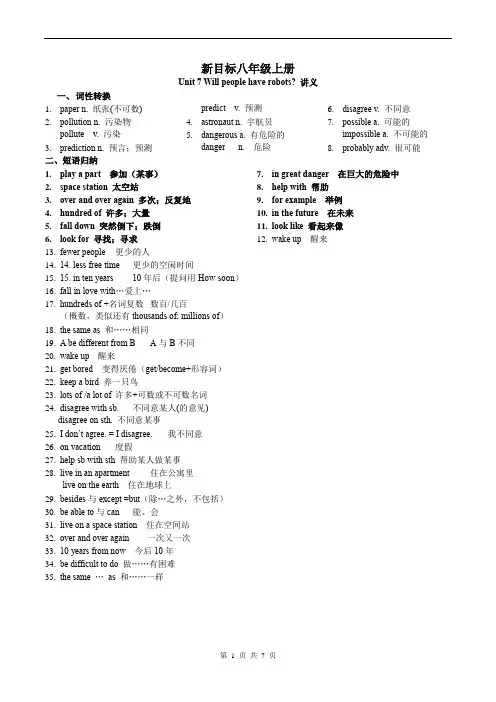
新目标八年级上册Unit 7 Will people have robots? 讲义一、词性转换1.paper n. 纸张(不可数)2.pollution n. 污染物pollute v. 污染3.prediction n. 预言;预测predict v. 预测4.astronaut n. 宇航员5.dangerous a. 有危险的danger n. 危险6.disagree v. 不同意7.possible a. 可能的impossible a. 不可能的8.probably adv. 很可能二、短语归纳1.play a part 参加(某事)2.space station 太空站3.over and over again 多次;反复地4.hundred of 许多;大量5.fall down 突然倒下;跌倒6.look for 寻找;寻求7.in great danger 在巨大的危险中8.help with 帮助9.for example 举例10.in the future 在未来11.look like 看起来像12.wake up 醒来13.fewer people更少的人14.14. less free time更少的空闲时间15.15. in ten years 10年后(提问用How soon)16.fall in love with…爱上…17.hundreds of +名词复数数百/几百(概数,类似还有thousands of; millions of)18.the same as 和……相同19.A be different from B A与B不同20.wake up醒来21.get bored变得厌倦(get/become+形容词)22.keep a bird 养一只鸟23.lots of /a lot of许多+可数或不可数名词24.disagree with sb.不同意某人(的意见)disagree on sth. 不同意某事25.I don’t agree. = I disagree.我不同意26.on vacation度假27.help sb with sth 帮助某人做某事28.live in an apartment住在公寓里live on the earth 住在地球上29.besides与except =but(除…之外,不包括)30.be able to与can 能、会31.live on a space station 住在空间站32.over and over again 一次又一次33.10 years from now 今后10年34.be difficult to do 做……有困难35.the same …as 和……一样三、重难点深度解析1. Do you think there will be robots in people's homes? 你认为将来人们的家里会有机器人吗?Do you think...? 结构通常用来征求对方的意见或看法,后面接宾语从句,从句用陈述语序。
人教新目标八年级英语上册1-4单元语法点总结
Unit 4 How do you get to school?一.短语归纳1. take the subway to …= go to … by subway搭地铁2. take the train to …= go to … by train坐火车3. take a bus to …= go to …by bus= go to … on a bus乘坐公共汽车4. take a taxi to …= go to … by taxi坐的士5. ride a bike/ bicycle to…= go to … by bike/ bicycle骑自行车6. walk to…= go to … on foot步行7. take a car to…= go to … in a car= go to … by car坐汽车8. get to school到达学校get to=arrive in/at=reach 到达 (in加大地方at加小地方)9. 10 kilometers from school离学校10公里(远)10. from…to…从…到…from his home to school 从他家到学校11. how(用于提问状态和交通工具)怎样how long用来询问时间的长度(用于提问时间段多长(时间))或物体的长度how often(用于提问频率)多久时间一次how far(用于提问距离)多远how many用于提问数量)多少how much(用于提问数量/价钱)多少/多少钱how soon“过多久”,用来询问某事要在多久以后才能发生12. have a quick breakfast快速地吃早餐13. leave for school出发去学校14. the early bus 早班车15. take sb. to school 带某人去学校Then the early bus takes him to school.然后,他乘坐早班车到学校16. bus ride搭公车的路程17. bus stop 公车亭18. bus station 公车站bus stop 是指小站,bus station指大的站,比如汽车站。
新目标人教版初中八年级上册英语语法汇总
新目标人教版初中八年级上册英语语法汇总1) leave的用法1.“leave+地点”表示“离开某地”。
例如When did you leave Shanghai?你什么时候离开上海的2.“leave for+地点”表示“动身去某地”。
例如Next Friday, Alice is leaving for London. 下周五爱丽斯要去伦敦了。
3.“leave+地点+for+地点”表示“离开某地去某地”。
例如Why are you leaving Shanghai for Beijing?你为什么要离开上海去北京2) 情态动词should“应该”学会使用should作为情态动词用常常表示意外、惊奇、不能理解等有“竟会”的意思例如How should I know? 我怎么知道Why should you be so late today?你今天为什么来得这么晚should有时表示应当做或发生的事例如We should help each other.我们应当互相帮助。
我们在使用时要注意以下几点1. 用于表示“应该”或“不应该”的概念。
此时常指长辈教导或责备晚辈。
例如You should be here with clean hands. 你应该把手洗干净了再来。
2. 用于提出意见劝导别人。
例如You should go to the doctor if you feel ill. 如果你感觉不舒服你最好去看医生。
3. 用于表示可能性。
should的这一用法是考试中常常出现的考点之一。
例如We should arrive by supper time. 我们在晚饭前就能到了。
She should be here any moment. 她随时都可能来。
3) What...? 与Which...?1. what 与which 都是疑问代词都可以指人或事物但是what仅用来询问职业。
如Whatis your father? 你父亲是干什么的该句相当于What does your father do?What is your father's job?Which 指代的是特定范围内的某一个人。
初中英语人教新目标八年级上册Unit1 单元知识点
八年级英语上册Unit1知识点【Useful expressions】1.go on vacation 去度假2.go shopping 购物3.go out 外出(娱乐)4.go to summer camp 去夏令营5.go to the beach 去海滩6.go to the mountains 去爬山7.buy sth.for sb.(= buy sb.sth.) 给某人买某物8.keep a diary 记日记9.nothing...but + V.(原形) 除了……之外什么都没有10.seem + (to be) + adj 看起来11.long time no see 好久不见12.most of the time 大多数时间13.study for tests 备考14.feed hens 喂母鸡15.quite a few 相当多;不少16.visit museums 参观博物馆17.visit my uncle 拜访我叔叔18.stay at home 待在家19.taste good 尝起来不错;taste + adj.尝起来……20.in the countryside 在乡下21.along the way 沿途22.another two hours(= two more hours) 另外两个小时23.because of 因为(后接名词代词动名词,because+从句)24.the next day 第二天25.feel like 有……的感觉;感受到,feel doing sth.想要做某事26.decide to do sth.决定做某事27.enjoy doing sth.喜欢做某事28.start doing sth.开始做某事=begin doing sth.29.stop doing sth.停止做某事区分:stop to do sth.停下来去做某事30.dislike doing sth.不喜欢做某事31.try doing sth.尝试做某事 / try to do sth.尽力做某事32.forget to do sth. 忘记去做某事 / forget doing sth 忘记做过某事33.so + adj + that + 从句如此……以至于……34.tell sb.(not) to do sth. 告诉某人(不要)做某事35.find out 查明;弄清e up 升起37.in the past 在过去38.take photos 照相39.too many people太多的人(too many+可数名词复数,too much+不可数名词,much too+形容词或副词)40.walk around 四处走走41.walk up to the top 走到顶部42.arrive in +大地点= get to= reach+地点名“到达......”arrive at +小地点(注:若后跟地点副词here/there/home, 介词需省略,如:arrive here; get home)43.rain hard 雨下得很大=rain heavily44.bring back 带回来45.jump up and down in excitement 兴奋地跳来跳去46.learn something important 学一些重要的东西47.have a fun time 过得很愉快;玩得非常开心48.in the shopping center 在购物中心49.keep doing sth.继续做某事50.go on 继续【Target sentences】1.— Where did you go on vacation?—I went to…2.—Did you…?—Yes, I did./ No, I didn’t.3.Oh, did you go anywhere interesting?4.We took quite a few photos there.5.I just stayed at home most of the time to read and relax.6.It was sunny and hot, so we decided to go to the beach near our hotel.7.I feel like I was a bird.8.What a difference a day makes!9.And because of the bad weather, we couldn’t see anything below.10.I really enjoyed walking around the town.11.We waited over an hour for the train because there were too many people.12.My legs were so tired that I wanted to stop.13.My classmates told me to keep going, so I went on.【Language points】1.Where did you go on vacation?on vacation度假;休假on vacation表示一种状态,其中vacation意为“假期”,与holiday同义。
人教新目标英语八年级上册 Unit 1 sectionA语法知识点总结
人教新目标英语八年级上册Unit 1 sectionA语法知识点总结Unit 1 Where did you go on vacation?一般过去时态的概念:1.表示过去某时间发生的动作或存在的状态。
2.表示过去经常性习惯性的动作。
一般过去时常用的标志词有:yesterday,the day before yesterday,last week/month/year, just now, …ago,in+过去时间…一.用Be动词的一般过去时(1)肯定句式:主语+ was / were + 其它.(2)否定句式:主语+ wasn’t /weren’t+ 其它.(3)一般疑问句:Was/Were + 主语+ 其它?肯定回答:Yes,主语+ was / were .否定回答:No,主语+ wasn’t /weren’t.(4)特殊疑问词+was/were+主语+其他?肯定句:The air was clean yesterday.否定句:The air wasn't clean yesterday.一般疑问句:Was the air clean yesterday?肯定回答:Yes, it was.否定回答:No, it wasn't.特殊疑问句:How was the air yesterday?二.行为动词(v.)的一般过去时态(1)肯定句式:主语+ v-ed+ 其它.【do , does---did】(2)否定句式:主语+ didn’t + v原形+ 其它. 【did not = didn’t】(3)一般疑问句:Did + 主语+ v原形+ 其它?肯定回答:Yes,主语+did.否定回答:No,主语+did’t.(4)特殊疑问词+did+主语+v.原形+其他?肯定句:I rode a horse last Sunday.否定句:I didn‘t ride a horse last Sunday.一般疑问句:Did you ride a horse last Sunday? 肯定回答:Yes, I did.否定回答:No, I didn't.特殊疑问句:(1)What did you do last Sunday?(2)When did you ride a horse?三、动词过去式的构成1. 规则动词的过去式1) 一般情况下,在动词原形后面加-ed。