
外研版(三起点)小学六年级英语上册Module8_Unit2_名师教案
1 / 1
Module8 Unit2教案
【内容来源】外研版三起点(2013年审定)六上Module8 Unit2
【主 题】I often go swimming.
【课 时】此教学设计按单元写,教师可根据实际情况划分课时。
一、教学目标(Teaching aims)
(一)全体学生理解运用often,never,sometimes,always这四个频率副词。全
体学生能听懂 I often go swimming.会运用频率副词描述自己的日常习惯。
(二)通过小组讨论,同桌互助式的学习,让学生自己总结规律,达到自学的效
果。
(三)通过本课的学习,让学生在日常和学习交流中了解同伴的日常,注意到生
活习惯的差异。从而养成良好的生活习惯。
二、教学重难点(Teaching points and difficulties)
(一)重点(Points)
复习频度副词,同时进一步巩固行为动词一班现在时的用法。
(二)难点(Difficulties)
用正确的结构谈论日常生活习惯。
三、教学准备(Teaching preparation)
多媒体PPT课件、单词卡片。
四、教学过程
Step 1: Warm-up
1. Greetings. (师生间简单地打招呼。)
2. Review.
教师呈现图片,带领学生复习上节课内容。
询问对方是否经常做……(某事):
Do you often ….? 你经常…… 吗?
---- Yes, of course = Yes,(I do)
表示肯定,经常做某事。
---- No .I don’t . = Not really.
表示否定,不全是,事实上没有。
1 / 1
----Not very often. 不经常做某事。
Step 2: Presentation
1. 教材活动1:Listen and chant.
(1)教师播放活动1课文动画,“Listen and chant”,让学生尝试跟唱。
(2)教师简单说一下歌谣大意。
(3)教师播放活动1录音,学生完成“Listen and fill in the blanks”,随后跟唱。
2. 教材活动2:Listen and read.
(1)Listen and find out the words you can’t understand.
教师播放活动2动画,请学生观看,整体感知课文内容,随后找出自己不理解的
词汇。
(2)Listen again and answer these questions.
Q1. How does Simon go to school?
Q2. Who often goes swimming?
Q3. Who doesn’t like football?
Q4. What does Heping like?
Q5. Does Linging like playing with dolls?T asks Ss to answer the questions.
S1…
S2…..
S3…
(3)Listen for the third time and students find “often sometimes always never” and
circle them.
(4)教师教授频率副词:
often.经常 never.从不 sometimes.有时候 always. 一直,总是
always > often > sometimes > never
(5)Look and say, then read.
教师在ppt第10-17页逐一呈现课文图片,引导学生观察图片,说着描述图片内
容,帮助学生理解课文语句,对重点单词短语等进行讲解。随后教师播放课文录
音,学生跟读,注意提醒学生:Pay attention to pronunciations.
ride my bike 骑我的自行车 by bus 乘公交车
1 / 1
eat with a knife and fork. 用餐刀餐叉吃饭
go swimming 去游泳 in the sea. 在大海里
read English books 的英语书 write stories 写故事
clean the blackboard 擦黑板 play football 踢足球
play with dolls. 玩玩具娃娃
(6)引导学生总结频率副词的具体用法。
often never 主语 + sometimes +动词+...... always
当主语是:I 、You、they和复数时,谓语动词用原形。
当主语是(he 、she 、it 、人名和单数),谓语动词后面要加“+s , +es”或特变
形式。
Eg:Amy and Daming sometimes ____(go 、goes) to the park .
Amy often ____(go 、goes) to the park .
(7)完成巩固操练。
教师列出几个句子,要求学生用动词的正确形式填空。
a) Maomao often______ football. (play)
b) They sometimes ___________ the blackboard. ( clean )
c). Amy never_____ with her dolls. (play)
d). Sam always______ English books. (read)
(8)出示ppt 图片,引导学生用这些频率副词描述图片。
She often does homework. She always cleans the room. They sometimes play football.
He never collects stamps.
Step 3: Practice
1. 教材活动3:Listen and complete.
(1)呈现Page48 活动3课文,学生自己尝试读一读。
(2)教师播放录音,小组合作,讨论问题答案。
(3)教师核对答案。
2. Make new sentences.
给出学过的动词短语,让学生用今天所学的句型自由造句。
I often/sometimes/always/never...
go shopping go swimming read books do homework watch films take photos eat fast
1 / 1
food help Mum play football collect tamps play with dolls
3. Introduce yourself.
请学生写几个一般现在时的句子,试着介绍自己的日常生活习惯。随后可挑选学
生展示。
4. Listen and learn to say.
(1)教师在ppt第29页呈现活动4的句子,先让学生试读,然后再标注出升降
调,播放该部分录音,让学生跟读,提醒学生注意重音。
(2)教师呈现几个句子,请学生试读。
5. Listen and say. Then chant.
请学生看图,猜测韵句大意。先播放活动5歌曲动画,学生整体感知。再次播放
请学生逐句跟读。最后请学生分组练习韵句,并挑选部分小组展示练习成果。
Step 4: Consolidation
课堂练习:打开M8U2课堂基础练,学生借助答题器或平板电脑作答,即学即
练,检测当堂学习情况。
Step 5: Summary
1.频率副词:
always 总是 often 经常
sometimes 有时候 never 从不
2.谈论日常生活习惯:
Do you often …?
I often …
Step 6: Homework
1. 登录 “优教信使”APP,在“智学助手”下完成本单元背单词、口语测试。
2. 做一个调查表,了解更多家人的习惯爱好。
3. 借助“智学助手”的听课文功能,预习Module9 Unit1。
五、板书设计
Module8 unit2
I often go swimming
often never 主语 + sometimes +动词+......
always
(三起点)外研版六年级英语上册《Module8_Unit2__第2课时导学案》
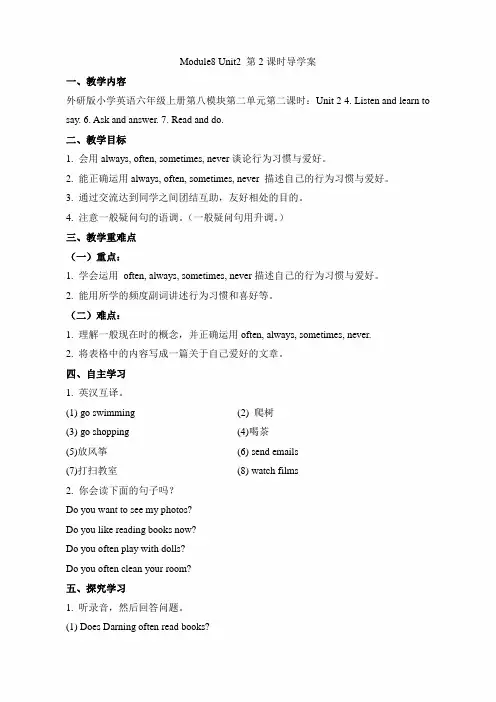
Module8 Unit2 第2课时导学案一、教学内容外研版小学英语六年级上册第八模块第二单元第二课时:Unit 2 4. Listen and learn to say. 6. Ask and answer. 7. Read and do.二、教学目标1. 会用always, often, sometimes, never谈论行为习惯与爱好。
2. 能正确运用always, often, sometimes, never 描述自己的行为习惯与爱好。
3. 通过交流达到同学之间团结互助,友好相处的目的。
4. 注意一般疑问句的语调。
(一般疑问句用升调。
)三、教学重难点(一)重点:1. 学会运用often, always, sometimes, never描述自己的行为习惯与爱好。
2. 能用所学的频度副词讲述行为习惯和喜好等。
(二)难点:1. 理解一般现在时的概念,并正确运用often, always, sometimes, never.2. 将表格中的内容写成一篇关于自己爱好的文章。
四、自主学习1. 英汉互译。
(1) go swimming (2) 爬树(3) go shopping (4)喝茶(5)放风筝(6) send emails(7)打扫教室(8) watch films2. 你会读下面的句子吗?Do you want to see my photos?Do you like reading books now?Do you often play with dolls?Do you often clean your room?五、探究学习1. 听录音,然后回答问题。
(1) Does Darning often read books?(2) Does he sometimes cook dinner?(3) Does he sometimes go swimming?(4) Does he always play basketball?录音内容: Hello, I’m Darning. I often read books, but I never cook dinner. I sometimes go swimming and I always play basketball.2. 跟读短句,回答问题。
外研版小学六年级英语上册Module 8教案
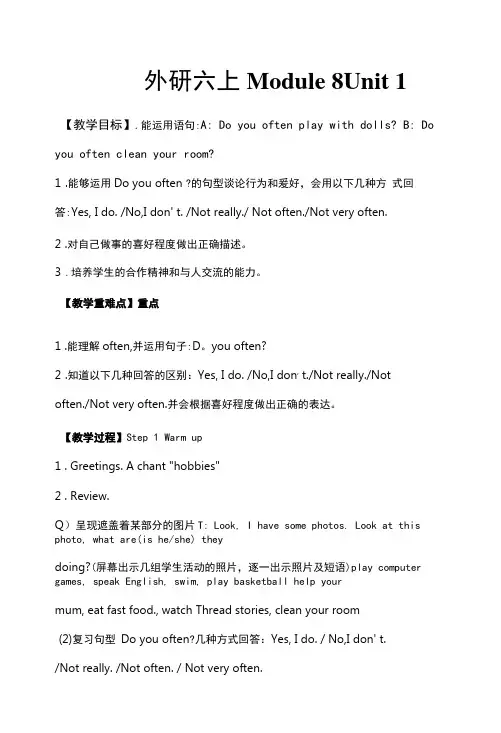
外研六上Module 8Unit 1【教学目标】.能运用语句:A: Do you often play with dolls? B: Do you often clean your room?1.能够运用Do you often ?的句型谈论行为和爰好,会用以下几种方式回答:Yes, I do. /No,I don' t. /Not really./ Not often./Not very often.2.对自己做事的喜好程度做出正确描述。
3.培养学生的合作精神和与人交流的能力。
【教学重难点】重点1.能理解often,并运用句子:D。
you often?2.知道以下几种回答的区别:Yes, I do. /No,I don, t./Not really./Not often./Not very often.并会根据喜好程度做出正确的表达。
【教学过程】Step 1 Warm up1. Greetings. A chant "hobbies"2. Review.Q)呈现遮盖着某部分的图片T: Look, I have some photos. Look at this photo, what are(is he/she) theydoing?(屏幕出示几组学生活动的照片,逐一出示照片及短语)play computer games, speak English, swim, play basketball help yourmum, eat fast food., watch Thread stories, clean your room(2)复习句型Do you often?几种方式回答:Yes, I do. / No,I don' t./Not really. /Not often. / Not very often.(设计意图:回忆已学词组,巩固旧知,为新授做好铺垫)Step 2Presentation1.出示课题:Module 8 Unitl Looking at photos.).看图回答:a. Who are they?b. What are they doing?过渡:T:Do you want to see Amy' s photo?Ss: Yes.T:You can say "Yes, I' d love to."3.带着问题听读第一遍课文a.How many photos are they talking about?b.What can you see in them?课件呈现三幅图片并让学生描述图片。
外研版(三起点)英语六年级上册-优质教案-Module 8 Unit 1 Do you often play with dolls(2)

1. Quickly scan(快速浏览文本,找出文本的场景)
2. Listen and choose.(听录音,选出答案)
3. Listen and fill in the blanks.(听录音完成填空)
4. Listen and answer. (听录音回答问题)
5. Listen and answer.
教学重点
1、能运用句型Do you often ..?询问他人的行为,并做出回答。
2、复习动词第三人称单数,切换不同人称在句中的运用。
教学难点
1、能运用句型Do you often ..?询问他人的行为,并做出回答。
2、复习动词第三人称单数,切换不同人称在句中的运用。
Step1.Greetings.
6.Follow the text.
7.Read the text.
Step 5:Extension
Do a survey.(四人为小组,用 Do you often…?句型提问,调查小组成员的日常行为)
Step 6.Homework
1.Do a survey about your parents.
S: I often …………(3人)
T:She often ...(全班回答)
T:Do you often go to school?引出Yes/ No 等回答
S:问老师Do you often ....? T:Not really .I stopped long ago.(学习Not really /long ago)
Step2. Leading in
1.T: Do you want to play a game? S:Yes.(学习I’d love to.)
外研版(三起点)小学六年级英语上册Module2_Unit2_名师教案

Module2 Unit2教案【内容来源】外研版三起点(2013年审定)六上Module2 Unit2【主题】There are lots of beautiful lakes in China.【课时】此教学设计按单元写,教师可根据实际情况划分课时。
一、教学目标(Teaching aims)1. 知识目标:(1)能听、说、读、写以下词组the Changjiang River, the Great Wall, the West Lake, the Huangshan Mountain。
(2)能准确理解并运用there be句型。
2. 能力目标:学生通过对词组、句型的学习和操练,能够比较熟练地用英语描述出祖国的大好河山或者自己家乡的景点。
3. 情感目标:培养学生热爱祖国大好河山的情感。
二、教学重难点(Teaching points and difficulties)(一)重点(Points)用There be 句型描述事物。
(二)难点(Difficulties)there is 和there are的用法。
三、教学准备(Teaching preparation)多媒体PPT课件。
任务型教学法、情景教学法、合作学习法、活动教学法。
四、教学过程一、Warm-up1. Greeting.T: Morning, boys and girls. Last text, we have learnt: There’s a Chinatown in New York. There are lots of Chinese shops and restaurants there. There’s Chinese dancing. It’s funny. What about China? Are there any famous places here? Look at the word. Follow me. Famous. Famous. Show me your finger. Spell. Group by group.【设计意图】:通过自由交流回顾所学,自然地引出祖国美好河山。
外研版(三起点)英语六年级上册-公开课PPT课件Module 8 Unit 2(period 2) I often go swimming

Let’s have a try
Copyright 2004-2015 版权所有 盗版必究
Listen and say.Then chant
Copyright 2004-2015 版权所有 盗版必究
Listen and say.Then chant
外研版三起点小学英语六年级上册
Module 8 Unit 2 (period2)
I often go swimming.
..
Simon
go always
Simon always rides bike to school. 总是
Copyright 2004-2015 版权所有 盗版必究
..
in often
一般规律,实词重读、虚词不重读。
c) 句子的语调变化直接体现说话人的感情色彩。
英语语调可归纳为四种:升调、平调、降调、升降调 。
其中,以降调和升调为两种基本语调 。
Copyright 2004-2015 版权所有 盗版必究
句子重音
句子重音,即句子的某些单词需要重读。句 子里需要重读的主要是实词,而表示语法关系的 虚词或功能词无需重读无须重读。
请根据自己的实际情况画对钩。
Copyright 2004-2015 版权所有 盗版必究
写作小提示: 1. 要求用上四个频率副词。 2. 每一个频率副词可以写一句话。 3. 用上一般现在时态,可以参考老师的例文。
Write about myself I often go swimming , Sometimes I play basketball on Sundays , I never cook dinner . But I always read books .
(三起点)外研版六年级英语上册《Module2_Unit2_名师教案》

Module2 Unit2教案【内容来源】外研版三起点(2013年审定)六上Module2 Unit2【主题】There are lots of beautiful lakes in China.【课时】此教学设计按单元写,教师可根据实际情况划分课时。
一、教学目标(Teaching aims)1. 知识目标:(1)能听、说、读、写以下词组the Changjiang River, the Great Wall, the West Lake, the Huangshan Mountain。
(2)能准确理解并运用there be句型。
2. 能力目标:学生通过对词组、句型的学习和操练,能够比较熟练地用英语描述出祖国的大好河山或者自己家乡的景点。
3. 情感目标:培养学生热爱祖国大好河山的情感。
二、教学重难点(Teaching points and difficulties)(一)重点(Points)用There be 句型描述事物。
(二)难点(Difficulties)there is 和there are的用法。
三、教学准备(Teaching preparation)多媒体PPT课件。
任务型教学法、情景教学法、合作学习法、活动教学法。
四、教学过程一、Warm-up1. Greeting.T: Morning, boys and girls. Last text, we have learnt: There’s a Chinatown in New York. There are lots of Chinese shops and restaurants there. There’s Chinese dancing. It’s funny. What about China? Are there any famous places here? Look at the word. Follow me. Famous. Famous. Show me your finger. Spell. Group by group.【设计意图】:通过自由交流回顾所学,自然地引出祖国美好河山。
外研版(三起)英语六年级上册Module8 Unit2 I often go swimming课件
Simon: He always rides his bike to school. He never goes by bus.
Presentation
often
Jack: He often eats with a knife and fork. But he likes chopsticks.
Who is sometimes here. T_h_e__b_ir_d_is sometimes here.
Listen and learn to say
Role play
Do you always go shopping?
Yes,I like shoppino you......?
外研版小学英语六年级上册(三年级起点)
Module8 Unit2 I often go swimming.
Leading in
---Do you often ...? ---Yes,I often...
read book
go swimming
clean my room
play ping-pong
Presentation
Heping: He likes writing stories. Sometimes,he writes stories in English.
sometimes
Presentation
sometimes
Lili: She sometimes cleans the blackboard for my teacher
Yes,I ........
Listen and complete What do they do on Sunday?
always often sometimes never 1.I _n_e_v_e_rplay computer games. 2.I _o_f_t_en_ play table tennis with my dad. 3.My family_s_o_m_e_t_im__e_s has a big dinner. 4.I will _a_l_w_a_y_sremember that day.
三起外研版六年级英语上册课件Module 8 Unit 2 I often go swimming
drink tea send ed go to the doctor
Look at the table about me,fill in the blanks with “never、 sometimes、often、always”
Mon. Tue. Wed. Thu. Fri. Sat. Sun.
She never plays with dolls.
He often goes swimming.
He often eats with a knife and fork. But He likes chopsticks.
He always rides his bike to school.
(6) I often help my mum.
Read and tick. About you.(Using ”√”),
Then write a short message.
often sometimes never always
I read English books. I play computer games. I sing English songs. I speak English. I draw pictures. I write emails. I ride a bike. I eat breakfast.
S4: Yes, he/she always/often/sometimes…/ No, he/she never.
collect stamp fly a kite
read a book
eat bananas go swimming visit your grandma
climb trees go shopping
外研版(三起点)小学六年级英语上册Module2_模块整体教案
外研版(三起点)小学六年级英语上册Module2_模块整体教案Module2 模块整体教案模块教材分析本模块主要学习用“There be”句型描述事物。
教学内容围绕着主人公Daming从中国来到美国,和他的表哥Simon谈论中国和美国的一些事物和一些地方的情况,以这些基本信息为主线,引出主要知识而展开的一系列对话和练习活动。
教学的重心应放在如何让学生用本模块主要句型“There’s a/a n.. in... There are...”来谈论某个地方的情况及相关的基本信息。
本模块的功能是:初步掌握运用本模块主要句型来谈论某地有某物,某地有某人,某地有某事。
第一单元主要以创设情景引出话题进人重点语言知识的学习。
主要句型是: There’s a Chinatown in New York! There’s Chinese da ncing. There are lots of Chinese shops and restaurants there.第二单元的主要句型是: There are lots of beautiful lakes in China. There are many mountains in China. There’s a famous mountai n in Anhui.模块教学目标☆知识目标1.能理解并会说唱Unit 1 Activity 1 Look, listen and say. & Unit2 Activity 1 Listen and chant. Unit 2 Activity 5 Listen and say. Then sing.2.能听、说、读、写Unit 1 Activity 3 Listen and say. & Unit 2 Activity 2 Listen and read.中的单词和句子。
3.能听说认读 Unit 1 Activity 2 Listen, read and act out & Unit 2 Activity 6 Look, remember and say. Activity 7 Look and complete the postcard.中的句子。
M8U1 Do you often play with dolls 教案六年级英语上册(外研版三起)
Module8Unit1 Do you often play with dolls?一、教学目标1.掌握单词:long ago, I’d love to , not really, stop, clean,camera,show;能运用Do you often…?询问对方是否经常做某事,并能进行肯定及否定回答: Yes, I do. / No, I don’t.(学习理解)2.通过听、读、练习熟练掌握本课句型;小组合作后能够做情境对话。
(应用实践)3.能够听懂会说本模块句型,能灵活运用功能句谈论习惯爱好,部分学生能正确运用人称与动词写几个表达自己和他人爱好的句子。
(迁移创新)4. 在业余生活的介绍活动中,激发学生了解、热爱生活的性情。
(文化品格)二、教学重难点重点:Do you often …?Yes, I do . / No, I don’t .并能在实际情景中运用。
难点:Do you often …?的正确应用,并对比Does he/she often …?句型进行比较和鉴别及tidy, messy的具体应用。
三、教学方法:采用情景教学法、直观教学法、游戏教学法和任务型教学途径四、教具准备希沃白板课件、动词卡五、教学过程Step1.Warming up1.Greeting2.Look and guessT:What does she often do?Ss:She often......(play with toys\read books\clean her room\take photos) 3.Let’s watchStep2.Presentation1.Look and predict.T:Who took this photo?Ss:Lingling’s grandpa.(教读long ago)T:Do you want to see my photos?Ss:Yes, I'd love to.(教读I'd love to)2.Listen, read and choose3.Listen, read and fill4.Read and underline跟着录音读一读,画出生词与同桌讨论它们的意思。