
九年级英语外研版上册Module5MuseumsModule5Unit1教案
Module 5 Unit1 Museums
一、教学内容:Don’t cross that rope!
二、课型:Listening and speaking
三、教学目标:
1、能正确运用词汇及短语:upstairs, exhibition,rule,against the rules,in trouble,tail,rope,entry,No entry,no good,no wonder,missing,downstairs,punish
2、语法 :学会使用祈使句(No…/ Don’t…)
3、能听懂参观博物馆的对话并获取信息;能听懂指令。
4、能说明某公开场所的规章制度;并能够发出指令。
5、能够有礼貌地提醒他人注意公开场所标语,遵守公开秩序。
四教学重难点:
1、能听懂有关参观博物馆的对话并获取信息
2、能说明某公开场所的规章制度;并能够用No…/ Don’t…发出指令。
五教学准备:
查找资料,制作多媒体课件
六预习要求:
根据音标自学本课新单词。
达标训练题
Module 3 Unit 1
I. 用方框中词的适当形式填空。
missing entry punish upstairs
1. When Mr Wang arrives, please ask him to go _________ for the meeting.
2. We can’t go along that road because the sign says “No _______”.
3. He _________ the children for their carelessness.
4. The book has two ________ pages.
II. 根据汉语提示完成下列句子。
1.吸烟是违反校规的。
It’s _______ _______ ________ of the school to smoke.
2. 雨下得太大了。
难怪你来晚了!
It rained quite heavily. ________ _______ that you were late!
3. 禁止喧哗!同学们正在安静地做作业。
________ ________! The students are doing their homework quietly.
4. 如果我回家晚了,我会有麻烦的。
If I come home late, I will be _____ _______.。
九年级英语外研版上Module_5【公开课教案】
MODULE 5 MuseumsPart 1: Teaching design第一部分教学设计Unit 1 You mustn’t touch it.■Warm up by talking about what a museum is.Hello, class. Today we shall go to a museum. But first what is a museum? What museums have you been to?A museum is a building where things are collected and then shown to people. Museums can be about different things such as Natural History, Science, or Art. Museums with live animals are called zoos.People visit museums to learn, but also to have fun.■Listen and read.On page 34 is a conversation between Betty, Daming, Guard, Tony and Lingling. They are talking about museum.Before we listen to it, let’s go on to read it first. While reading, try to: cut/ the sentence into thought groups, study the predicative, darken the connectives and underline all the useful expressions. (阅读过程中,断开/意群,观察谓语构成,圈出连词,摘录短语搭配。
外研版九年级英语上册:Module 5 Museums教案
Module 5 MuseumsUnit 1 Don’t cross that rope !第1课时【学习目标】1.(知识与技能)能理解公共场所提示标语,掌握下列重点单词的意思与用法:upstairs, exhibition, rule, tall, rope, entry, missing, downstairs, punish。
掌握下列重点短语的意思与用法:against the rules,in trouble, No entry, no good, no wonder.2.(过程与方法)通过本节课任务驱动,小组合作学习的学习方式,可以培养和提高学生的合作探究能力,增强合作意识,培养学生的探究精神,培养学生的合作精神,培养学生的创新意识,提高学生解决实际问题的能力。
3.(情感、态度与价值观)引导学生提高自觉遵守公共规则的自觉性。
【重点难点】重点句式:1)No shouting,please!2)That’s no good!3)It’s against the rules【学法指导】课前在熟读单词与对话的基础上认真完成自主学习内容并能把重点单词短语熟记于心,与小组成员团结完成合作探究内容,对未能解答的问题做上标记,完成后组长检查。
课堂上跟着老师的指导,完成听读训练,学习新的语法知识。
课后总结提炼。
导学过程方法导引【自主学习,基础过关】1.自主检测:I. 短语翻译1、期待2、也3、稍等片刻4、注意5、快点II. 句型展示台look forward to , No shouting, go off , take a photo,pay attention toA: Let's go to the science room. I'm _______ this !B:__________________. We must keep quiet .A: Where's Daming ?B; He's _____________ on his own. I want to _______________ here.A: Sorry, look at the sign----"No photography".B: I wasn't _______________ what it says.2. 我的疑惑:【合作探究,释疑解惑】1. No shouting!禁止喧哗!讲一讲:No 后跟动词-ing或跟名词,常用于标牌或告示牌上,表示“禁止…”,也可用“Don't+动词原形”来表示。
外研版英语九年级上册《Module5Museums》教学设计
外研版英语九年级上册《Module 5 Museums 》教学设计一. 教材分析外研版英语九年级上册《Module 5 Museums》主要介绍了博物馆的相关知识,包括博物馆的种类、参观博物馆的礼仪以及如何成为一名优秀的博物馆讲解员等。
通过本模块的学习,学生能够掌握相关词汇和表达方式,运用所学知识进行简单的交流和介绍。
二. 学情分析九年级的学生已经具备了一定的英语基础,能够听、说、读、写一些基本的英语句子。
但部分学生在英语学习上存在恐惧心理,不敢开口说英语,对于较复杂的语法和表达方式还不能熟练掌握。
因此,在教学过程中,教师需要关注学生的情感态度,激发他们的学习兴趣,并给予充分的语言实践机会。
三. 教学目标1.知识目标:学生能够掌握与博物馆相关的词汇和表达方式,了解博物馆的种类和参观礼仪。
2.能力目标:学生能够运用所学知识进行简单的交流和介绍,提高他们的英语听说能力。
3.情感目标:学生能够培养对博物馆的兴趣,增强他们的学习自信心。
四. 教学重难点1.重点:学生能够掌握与博物馆相关的词汇和表达方式。
2.难点:学生能够运用所学知识进行简单的交流和介绍,特别是对于一些复杂的语法和表达方式。
五. 教学方法1.任务型教学法:通过设计各种任务,激发学生的学习兴趣,提高他们的参与度。
2.情境教学法:创设各种真实的语境,让学生在实践中学习和运用英语。
3.交际法:鼓励学生进行小组合作,培养他们的团队合作能力和交际能力。
六. 教学准备1.教师准备:备好相关教学材料,如PPT、图片、实物等。
2.学生准备:预习相关词汇和表达方式,了解博物馆的基本知识。
七. 教学过程1.导入(5分钟)教师通过展示一些博物馆的图片,引导学生谈论他们对博物馆的了解和参观经历,激发学生的学习兴趣。
2.呈现(10分钟)教师通过PPT展示本节课的主要内容,包括博物馆的种类、参观礼仪以及如何成为一名优秀的博物馆讲解员等。
同时,教师引导学生跟读相关词汇和表达方式,确保他们正确掌握。
module5museums全模板教案(外研版初三上)

module5museums全模板教案(外研版初三上)Step one: Talking : the signs around youStep two: Listening and vocabulary1.Match the words in Column 1 with the word in Column 22. Listen and underline the correct word in each sentenceas well , familiar , look forward to, on one’s own, report, pay att ention to3.Listen and read4. Make notes about what people cannot do in the museumNo shouting No entry Don’t touch No photograph5. Read the passage again and choose the best answer6. Complete the sentences with the correct form of the words and phrases in the box against the rules come back downstairs real hurry up pay attention to sigh upstairs7. Pronunciation and speaking1. No shouting! It’s against the rules.2. Don’t touch! You mustn’t touch it.3. No, you can’t take a photo, eit her. Look at the sign—〞No photograph〞.8. Tell your parents about the rules for museums or librariesIn a library, you should be quiet.-- No shouting in the library.1.You aren’t allowed to go into that room.2.You can’t take food and drink into the library.3.You can’t use your camera in the museum.4.In a museum, you shouldn’t put your hands on the paintings.HomeworkWrite a passage about a museum you have ever been toSay something that you can and can’t do in the museumWrite down some differences between the museum you have even been to and other museums you have ever knownRead your passage in classTeaching Procedures:Step I: Revision There are many sorts of museumsReading and vocabulary1. Talk about the differences in the two museumsboring exhibit, not allowed to, quiet serious, busy usual fun interesting noisy do experiments2. Read the passage and answer the questionsThe science museum in London1. In what way is the Science Museum different from other museums?2. Where does Tony go when he visits the Science Museum?3. What else is there to see in the Science Museum?1.People talk about what they can see an d do there…2.…it’s a great way to learn about science…3.…but you can buy postcards of them in the museum shops.5. Answer the questionsas…as drop in fill free physics position sand truck try out wheel1.What kind of physics experiments can you do at the Launch Pat?2.What can you try out in the Human and Nature room?3.How much does it cost to go in the Science Museum?4.For how long can you drop in at the Science Museum?6. Complete the passage with it, they, that and there itThere are a lot of museum in London,and one of the most popular is the British Museum. Thousands of people visit(1) every year.(2) can see lots of interesting things from different times and places.The British Museum is very serious, so(3) is quite(4) . People mustn’t make a noise,and (5) mustn’t touch the exhibits. Photography is not allowed in the British Museum,so it’s a good idea to visit the museum shop and buy postcards. Entry to the museum is free,so you can Reading More The library of London Science MuseumThe Science Museum library was founded in 1883 as the Science Library of the South Kensington Museum (which also had Art andEducation Libraries), and had grown into an important national science library by the 1930s. More recently we have specialised in the history of science and technology, in our key role as part of the National Museum of Science & Industry. The Science Museum Library is primarily a research library for the history and public understanding of the physical sciences and all branches of engineering.We welcome academics and students, curators, collectors and dealers, enthusiasts, private researchers and the general public to use the libraryfor reference. We can provide advice and guidance for your research, and help in using our collections, and will answer enquiries requiring up to 15 minutes research.Exhibition Road, South Kensington, London SW7 2DD.Switchboard: 0870 870 4868Open 10am –6pm every day except 24 to 26 December.Entry is free, but charges apply for the IMAX 3D Cinema, simulators and some special exhibitions.7. Write a passage about your favourite museum•Say if there are many museums in your town.There ar e only two museums in my town…•Say which one is your favourite.My favourite museum is…•Say what’s special or unusual.It’s special because…•Say what you can see and do there.You can see…HomeworkFinish the workbook exercisesWrite a passage about your favourite museumPart I: Revisionnguage practiceNo shouting!Don’t touch!You mustn’t get up there.You can’t take a photo.You aren’t allowed to touch the exhibits.More SignsNo shouting! 禁止喧哗Hang on a minute! You mustn’t go up there!等一下!你们不承诺上楼去!Don’t touch! You mustn’t touch it.不碰!你们能碰它。
2022年外研版九年级上《Module 5 Unit 1 》公开课教案
Module 5 MuseumsUnit 1 Don’t cross that rope!教学目标【知识目标】1. 词汇rule entry missing2. 表示禁止的结构【能力目标】能听懂关于参观博物馆的语言材料以及表示禁止的语言, 能通过相关词汇或图片描述禁止做某事【情感目标】让青少年在亲身体验中学习知识, 培养热爱科学的意识教学重难点【教学重点】1. 领会并灵活使用以下词汇rule rope missing entry等单词2. 掌握重点句型:No smoking Don’t cross that rope No wonder……3. 理解并掌握表示禁止的结构【教学难点】能通过相关词汇或图片描述表示禁止的句子教学过程Step 1 Warming-up1. Show some pictures of the signs.2. Learn the new words.Step 2 Listening and vocabularyFinish Activi ty 1 on page 34.1. Ask the students to look at the pictures on the right in Activity 1.2. Read through the names of the signs.1) Don’t touch. 2) No smoking. 3) No shouting. 4) No photos.3. Match the signs with the rules.4. Check the answers.5. Now work in pairs. Tell your partner the rules.Step 3 Listen and answer the questions.1. Ask the students to read through the questions.1) Where did Lingling find the guide?2) How many people are going to the museum on Saturday?2. Play the recording and ask the students to listen carefully.3. Listen and answer the questions.4. Check the answers.Step 4 Listen and read1. Play the recording and ask the students to answer the questions.1) What room do the children want to visit?2) Are there lots of people in the museum?2. Check(√)the rules mentioned in the conversation.1) Ask the students to look at the pictures in Activity 3.2) Read the conversation again.3) Check (√) the rules mentioned in the conversation4) Check the answers.3. Read the conversation again and find main points.Step 5 Writing1. Write down what you cannot do in the museum.No shouting.Lingling and Betty needed some information for their projects, so they wanted to go (1) ___________ to the Animal Room, but Daming got into trouble at the monkey (2) ___________ . Daming broke the (3) ___________ by shouting and trying to cross the (4) ___________ when he planned to see a monkey with a long (5) ___________. Then they discovered that Lingling’s mobile phone was (6) ___________. The guard told them to go (7) ___________ to the lost and found office. Lingling has to find her phone, or her mother will (8) ___________ her.3) Complete the passage with the words in the box.4) Check the answers.Step 6. Learn “Everyday English〞Me too. No shouting, please!It’s against the rules. That’s no good! No wonder…Step 7 Language points1. No shouting, please! 请勿喧哗!Don’t cross that crop! 不要越过那条绳子!No photos. 请勿拍照.表示“禁止做某事〞. 主要结构:1) No + 动名词No fishing. 禁止垂钓. No parking. 禁止停车.2) No + 名词No entry. 请勿入内. No food and drinks. 请勿饮食.3) 祈使句Don’t make any noise. 不要吵闹.Keep off the grass. 请勿践踏草坪.2. It’s against the rules. 这违反了规定.against是介词, 表示“对抗, 违背, 相反〞, 句中against the rules作句子的表语. 该词可以构成很多词组. 如:Who are you playing against in the next match? 下一场比赛你们和谁对抗?3. That phone is new! I have to find it, or Mum will punish me!那部是新的. 我一定要找到它, 否那么妈妈会惩罚我的.punish v. 惩罚; 惩罚常用结构:punish sb. for sth./doing sth.e.g. He was punished for being late. 他因迟到而受到处分.5. It’s missing! 它丢了!missing adj. 找不到的; 失踪的辨析:lost/missing/gone三者都可表“失去〞. lost是广义的“丧失〞, 包含可找回和不能找回的意思; missing强调某物或某人暂时找不着了(含最终可能找到之意); gone的含义最广,包括“(东西)没了; (时间)过去了; (人)死了〞等,而且语气肯定.[运用]1) ______ time will never be found again.2) Someone reported to the police that a child was ________.3) The old times are ______ forever.Step 8 Pronunciation and speaking1. Play the recording once without stopping.2. Play the recording again and ask the whole class to repeat.1) No shouting, please! It’s against the rules.2) Because it’s closed.3) There certainly are a lot of rules in this museum.3. Ask the students to listen and underline the words the speaker stresses.4. Now listen again and repeat.Step 9 Discussion1. Read through the example with the class.— Must we keep quiet in the classroom?— Yes. No shouting in the classroom.2. Discuss the rules in your classroom.3. Work in pairs.Step 10 Exercises课堂作业1. Remember the words and phrases in Unit 1.2. Finish the exercises in the workbook.教学反思Unit 3 Language in use教学目标【知识目标】让学生能够使用在本模块所学的单词和短语.【能力目标】总结和理解if条件状语从句.【情感态度目标】在日常生活中能听懂他人的问题和给出建议, 做一个老实的人.教学重难点【教学重点】【教学难点】教学过程Step 1 Revision and lead-inLet Ss look at the pictures and answer the questions to review what they have learnt. Step 2 Language practice and grammarTo master the tense of the adverbial clause of condition.用所给单词的适当形式补全对话1. If I ______(start) the dinner, I ________ (finish) it before I go to bed.2. If you _____(do) these other things instead of your homework, you _______(not have) time to study.3. He thinks something _______(go) wrong if I play games on it.Grammar: If从句(2)一、引导条件状语从句最常用的连词是if, 常见的if条件状语从句表示在某条件下, 某事很可能发生.e.g. If you ask him, he will help you.如果你请他帮助, 他会帮你的.If he does not work hard, he will fail his exams.如果他不努力, 考试就要不及格了.二、If从句的时态1. if从句用一般现在时, 主句用一般将来时.e.g. If he runs, he’ll get there in time.如果他跑着去, 他就会及时赶到那儿.2. if从句用一般现在时, 主句用情态动词+动词原形.e.g. She may come with us if she arrives in time.如果她来得及时, 就可以和我们一道去.三、if 引导的条件状语从句位置灵活, 可直接放在主句后面, 也可以放在句首. 放在句首时, 从句后面要用逗号和主句隔开.e.g. I’ll go to see you if I have time. 如果有时间, 我就去看你.If it rains tomorrow, we’ll stay at home. 如果明天下雨, 我们就待在家里.四、同义句转换用“祈使句+and / or +一般将来时的句子〞转换.e.g. If you work hard, you’ll pass the exam easily.→ Work hard, and you’ll pass the exam easily. 努力学习, 你将很容易通过考试. If you don’t hurry up, you’ll miss the train. → Hurry up, or you’ll miss the train.快点儿, 否那么你就赶不上火车了.Exercises1.If you ____ to the party, you’ll have a great time.A. will goB. wentC. goD. going2. I ______ her the answer if she _______me.A. can tell, will askB. will tell, will askC. would tell, askD. will tell, asks3. -What are you going to do tomorrow?-We’ll go to the library tomorrow if it ______.A. isn’t rainB. rainC. won’t rainD. doesn’t rain4. I’ll give the book to him if he _____ here next Sunday.A. will comeB. comesC. is comingD. cameStep 3 Join the sentences with if●The teacher show Ss how to join the sentences with if.Listen in class, or you will not understand what to do.If you do not listen in class, you will not understand what to do.1. Eat your breakfast, or you will get hungry at school.If you do not eat your breakfast, you will get hungry at school.2. Hurry up! You will be late.If you do not hurry up, you will be late.3. Read the book carefully. Then you will not make mistakes.If you read the book carefully, you will not make mistakes.4. Don’t watch too much TV, or your eyes will hurt.If you watch too much TV, your eyes will hurt.5. Work harder! You will get higher marks.If you work harder, you will get higher marks.●Let Ss write new sentences with if.Step 4 Make a survey1.Think of three problems you have in your schoolwork.2.Make notes about them in the Problem boxes.Now work in pairs. Talk about your problems and give advice to each other. Complete the table.-I can’t speak English well.-If you practise more outside the classroom, you will make progress.Step 5 Complete the sentences so that they are true for you1. Read the sentences carefully.2. Use the correct words to fill in the blanks1 I will be really happy if________________.2 I will do well in English if______________________________.3 My parents will be angry if____________________.4 If it rains next Saturday, I_____________________.Step 6 Complete the conversation with the correct form of the words and expressions in the box1.Read the conversation carefully.2.Now complete the conversation with the words or expressions in the box.Step 7 Complete the passages with the correct form of the expressions in the box1. Read the passages carefully.2. Now complete the passages with the words or expressions in the box.Step 8 Read the problems and give your adviceStep 9 ListeningListen to the conversation and answer the questions.1. What is the girl’s problem?2. Is it a common problem among teenagers?3. What does the doctor advise the girl to do?4. What does the doctor advise the girl not to do?Step 10 Around the worldLearn about the advice columns.Read the passage and fill the blanks.1. Advice columns have been used since ___________________.2. In the past, advice columns could mainly be found in _______________________.3. Nowadays, _______________________are much more popular.Step 11 Writing1. Work in pairs. Write a letter about a problem.2. Decide on advice for the problems in groups.3. Make a problem page.Step 12 PracticeDo some exercises from the entrance exam to senior high schools.1. -Would you like to go shopping with me, Carmen?-I’d love to, ____ you don’t want to go alone.A. untilB. beforeC. if2. You will be late for school ____ you don’t get up early.A. butB. ifC. andD. or3. -Please give Alice the story book ____ you see her.-All right.A. unlessB. orC. butD. if4. If the weather ____ fine, we ___ have a sports meeting this weekend.A. will be; willB. is; willC. was; would5. He will go to the mountains with his parents if it _____ next Sunday.A. won’t rainB. doesn’t rainC. isn’t rainD. will rain6. If she _____ tomorrow, I’ll call you.A. comeB. comesC. will comeD. came课堂作业假设你是Lucy, 你的笔友Mary给你写了一封信, 告诉你她现在的问题, 请你给她写一封回信, 并给她提出你的一些建议.Dear Lucy,I am a good girl but I am not good at studying. I like watching TV so much that I can’t stop myself from watching it. My parents have tried their best to stop me watching TV too much. They argued〔争吵〕with me about it. I was so angry with them that I left home. The problem makes me very sad and I don't know what to do. Can you help me?Yours,Mary教学反思。
英语:module 5《museums》教案(1)(外研版九年级上).doc
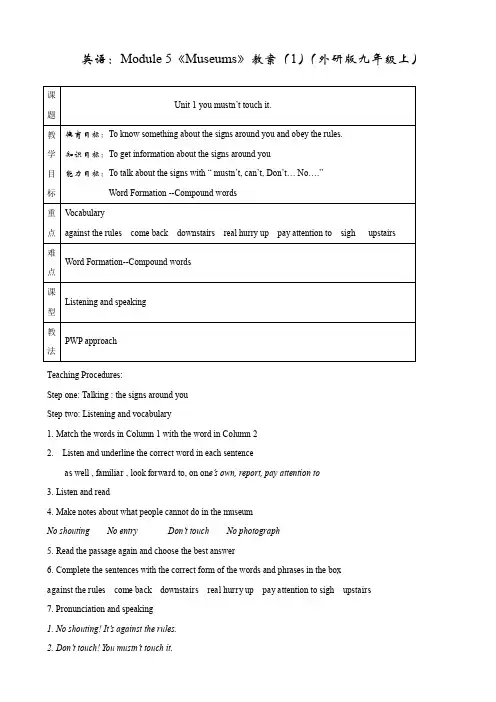
英语:Module 5《Museums》教案(1)(外研版九年级上)Teaching Procedures:Step one: Talking : the signs around youStep two: Listening and vocabulary1. Match the words in Column 1 with the word in Column 22. Listen and underline the correct word in each sentenceas well , familiar , look forward to, on on e’s own, report, pay attention to3. Listen and read4. Make notes about what people cannot do in the museumNo shouting No entry Don’t touch No photograph5. Read the passage again and choose the best answer6. Complete the sentences with the correct form of the words and phrases in the boxagainst the rules come back downstairs real hurry up pay attention to sigh upstairs7. Pronunciation and speaking1. No shouting! It’s against the rules.2. Don’t touch! You mustn’t touch it.3. No, you can’t take a photo, either. Look at the sign—”No photograph”.8. Tell your parents about the rules for museums or librariesIn a library, you should be quiet.-- No shouting in the library.1.You aren’t allowed to go into that room.2.You can’t take food and drink into the library.3.You can’t use your camera in the museum.4.In a museum, you shouldn’t put your hands on the paintings.HomeworkWrite a passage about a museum you have ever been toSay something that you can and can’t do in the museumWrite down some differences between the museum you have even been to and other museums you have ever knownRead your passage in classTeaching Procedures:Step I: Revision There are many sorts of museumsReading and vocabulary1. Talk about the differences in the two museumsboring exhibit, not allowed to, quiet serious, busy usual fun interesting noisydo experiments2. Read the passage and answer the questionsThe science museum in London1. In what way is the Science Museum different from other museums?2. Where does Tony go when he visits the Science Museum?3. What else is there to see in the Science Museum?plete the table4. Read the passage again and decide what the underlined words refer to1.People talk ab out what they can see and do there…2.…it’s a great way to learn about science…3.…but you can buy postcards of them in the museum shops.5. Answer the questionsas…as drop in fill free physics position sand truck try out wheel1.What kind of physics experiments can you do at the Launch Pat?2.What can you try out in the Human and Nature room?3.How much does it cost to go in the Science Museum?4.For how long can you drop in at the Science Museum?6. Complete the passage with it, they, that and there itThere are a lot of museum in London,and one of the most popular is the British Museum. Thousands of peoplevisit(1) every year.(2) can see lots of interesting things from different times and places.The British Museum is very serious, so(3) is quite(4) . People mustn’t make a noise,and (5) mustn’t touch the exhibits. Photography is not allowed in the British Museum,so it’s a good idea to visit the museum shop and buy postcards. Entry to the museum is free,so you canReading More The library of London Science MuseumThe Science Museum library was founded in 1883 as the Science Library of the South Kensington Museum (which also had Art andEducation Libraries), and had grown into an important national science library by the 1930s. More recently we have specialised in the history of science and technology, in our key role as part of the National Museum of Science & Industry. The Science Museum Library is primarily a research library for the history and public understanding of the physical sciences and all branches of engineering.We welcome academics and students, curators, collectors and dealers, enthusiasts, private researchers and the general public to use the libraryfor reference. We can provide advice and guidance for your research, and help in using our collections, and will answer enquiries requiring up to 15 minutes research.Exhibition Road, South Kensington, London SW7 2DD.Switchboard: 0870 870 4868Open 10am –6pm every day except 24 to 26 December.Entry is free, but charges apply for the IMAX 3D Cinema, simulators and some special exhibitions.7. Write a passage about your favourite museum•Say if there are many museums in your town.There are only two museums in my town…•Say which one is your favourite.My favourite museum is…•Say what’s special or unusual.It’s special because…•Say what you can see and do there.You can see…HomeworkFinish the workbook exercisesWrite a passage about your favourite museumPart I: Revisionnguage practiceNo shouting!Don’t touch!You mustn’t get up there.You can’t take a photo.You aren’t allowed to touch the exhibits.More SignsNo shouting! 禁止喧哗Hang on a minute! You mustn’t go up there!等一下!你们不允许上楼去!Don’t touch! You mustn’t touch it.别碰!你们能碰它。
外研版初中英语九年级上册教案:Module 5 Unit1
Book 5 Module5 Museums一、教学内容:Unit1 You mustn’t touch it.二、课型:Listening and speaking三、教学目标:1、能够正确使用下列单词和词组: entry, familiar, photography, attention, upstairs, guard,sign, as well, downstairs, sculpture, either, pay attention to2、能够掌握表示禁止行为的祈使句。
3、能够听懂指令并获取信息;能发出指令,提示某人不要做某事。
4、能够初步掌握合成词的构词法。
5、引导学生提高自觉遵守公共规则的自觉性,受到公共道德方面的教育。
四、教学重难点:能听懂指令,并能够用多种表达方式提示别人不要做某事。
五、教学准备:1.利用PowerPoint制作课件,搜集一些常见规则标致性的图片和故宫博物馆的图片。
2.布置学生预习单词。
六、教学过程:①You mustn’t /can’t do...②No doing/ You aren’allowed to do...do..., it’s against达标训练题一. 根据句意及首字母提示填单词。
1. In each building you will find many g standing outside the gate.2. Tony is running (向楼上) with a book.3. She does not like the book. Her brother doesn’t like it, e .4. There is a (雕像) of Venus on Mr. Bean’s desk.5. The music sounds very (熟悉的) to all of us.6. Our office is on the second floor. Theirs is d .7. I wanted to go into the hall, but I could not find the e . 二.选择题。
Module5museusunit1教学设计及反思
Module 5 MuseumsUnit 1 You musn’t touch it. 教学设计及反思年级:九年级姓名:张静学科:英语1. knowledge aims:Learn and master some new words and stentences. entry, familiar, attention, pay attention to, upstairs, guard, as well, downstairs, sculpture, either, experiment, unusual, work out, physics, sand, truck, wheel, position, rocket, travel, human, speed, obey, above all, drop in, as…as, communication, toilet.2. ability aims:To understand the conversation about the museums.To listen and understand the sentences giving instructions.To talk about some public rules with the sentences learned in this lesson.To learn to use imperative sentences and modal verbs to give instructions.3.attitude aimsCultivate students’ interest about museums.Gudie the students to pay attention to the public rules二.Teaching important and difficult points1.To learn to use imperative sentences and modal verbs to give instructions.No +doing, you mustn’t.. you can’t…. you aren’t allowed to….2.To talk about some public rules with the sentences learned in this lesson. 三.Teaching methods.Bottom-up, interactive methods四.Teaching toolsPictures , recorder , pptStep 1 Warming up1. free talking timeAsk two students prepare five questions to come to the front and ask other students.2. Let students see some pictures and ask students some questions.T:what can you see in the picutues?S: ChinaT: where can you see these?S: Museums.If you visit the museum,you must know what you can do or what you can’t do in the museum.So today we’ll learn “Module 5 Museum Unit 1 You mustn’t touch it!〞【设计意图】;通过学生之间的英语问答交流锻炼学生的口语能力和听力能力。
初中英语外研九年级上册(2023年新编)Module 5 MuseumsM5 U1教案
Module 5 Unit 1 Don*t cross that rope!教学内容:M5U1教学目标:L能看懂常见的标识并用英语表达。
2:能学会标识的不同表达方式。
3:在日常生活中,遵守各种标记标识。
教学重难点:标识的不同表达方式。
Step 1 : Warming-up and lead-in1:There are many signs in public places. Do you know their meanings? 可以用来表达“禁止做某事”的结构:l)No+动名词(最常用)例如:No joking!不要开玩笑!No parking!禁止停车!2)N o +名词例如:No photos.请勿拍照。
No food and drinks.请勿饮食。
3)祈使句例如:Don't make any noise. 不要吵闹。
Keep off the grass.请勿践踏草坪。
2:show some pictures and describe their meanings.Step2: Listening and vocabulary1:Match the signs with the rules.2:Check answers.3:Listen and answer the questions.4:Check answers.Step3: Listen and read.l:Listen and read.2:Check the rules mentioned in the conversations.3:Check answers.Step4:Write1:Write down what you cannot do in the museum.2:Show answers.Step5:Read and explain important and key words.Step6:Translate1:Translate important expressions in English.2:Read them aloud.Step7:Read and try to recite them.Step8:Write1:Complete the passage with the words in the box.2:Check answers.Step9:Pronunciation an speaking1:Listen and underline the words the speaker stresses.2:Read them aloud.Step: 10 Homeworkl:Work in pairs and discuss the rooms in the classroom.2:Write them on your exercise-book.。
外研版九年级上册Module 5 Museums Unit 1教案(共2个课时)
外研版九年级上册Module 5 Museums Unit1 Don’t cross that rope! (第1课时)一、教学目标1.学生能够掌握本单元的重点词汇,如:museum, against the rules, entry 等。
2.理解并能运用“Don’t...” 这一祈使句的否定形式来表达禁止和劝阻。
3.能够听懂关于博物馆规则的对话,并获取关键信息。
二、教学重难点重点:1. 重点词汇的学习和记忆。
2. 理解和运用“Don’t...” 句型。
难点:准确理解听力材料中关于博物馆规则的复杂表述。
三、教学方法情景教学法、听说训练法、任务驱动法四、教学过程Step 1 Lead-in1.Show some pictures of famous museums on the screen, such as the British Museum, the Louvre Museum, and the Palace Museum. Ask students: "What can you see in these pictures?" "Have you ever been to a museum?"2.Encourage students to share their experiences in museums.Step 2 Vocabulary Learning1.Present the key vocabulary of this unit on the screen.2.Let the students read the words after the recorder.3.Conduct spelling exercises and vocabulary games to reinforce students' memory of the words.Step 3 Sentence Pattern Learning1.Introduce the negative imperative sentence pattern "Don’t..." and explain its usage and meaning.2.Illustrate with examples like "Don’t talk loudly in the library." "Don’t play football in the street."3.Explain that "Don’t" is used to tell someone not to do something and it is often followed by a verb in its base form.4.Ask students to make sentences using the "Don’t..." pattern based on given situations or pictures. Step 4 Listening Practice1.Play a listening material about museum rules. Before playing, give students some questions to think about:"What are the rules in the museum?" "Why are these rules necessary?"2.Play the recording for the first time and ask students to answer the questions.3.Play the recording again, pausing at key points to explain difficult words and expressions. Then havestudents repeat the sentences they hear to improve their pronunciation and intonation.Step 5 Dialogue Practice1.Divide students into pairs and give them a situation in a museum. Ask them to create a dialogue using the key vocabulary and the "Don’t..." sentence pattern.2.Invite several pairs to perform their dialogues in front of the class. The rest of the students should listen carefully and give comments or suggestions.3.Provide feedback and correction on students' pronunciation, grammar, and fluency.Step 6 Class Summary1.Review the key vocabulary and the "Don’t..." sentence pattern learned in this class.2.Summarize the main points and difficulties in the listening and dialogue practices.Step 7 Homework Assignment1.Ask students to recite the key vocabulary and write them down three times each.2.Ask students to write five sentences using the "Don’t..." pattern about school rules.五、板书设计Module 5 Museums Unit1 Don’t cross that rope! (第1课时)against the rulesSentence Pattern: Don’t...Listening Questions:1.Rules mentionedDialogue Practice: Scenes and Key Points六、教学反思在本课时的教学中,通过丰富的图片和情景导入,成功吸引了学生的注意力,激发了他们的学习兴趣。