
2020七年级英语上册《Module 6》知识点及练习(无答案) 外研版
module6单词:熊_______大象____________长颈鹿__________复数__________狮子_______猴子___________熊猫__________老虎_______斑马__________动物园_______导游_________动物_________ 这样的,如此的_______像……一样,作为_____国家_________危险的__________危险n.__________不同的___________不同n.___________植物___________高的________叶子________复数_________的确,当然_______竹子__________可爱的________哪一个_________在……的上方________ 有趣的__________把……叫做;给……打电话_______非洲_________非洲的_________亚洲_______亚洲的________欧洲__________欧洲的__________千克,公斤________人,人们________草________大的,巨大的________通常_________独自地________强壮的_________抓住_________甚至________世界_________主要短语:eat meat 吃肉welcome to……欢迎到 many kinds of许多种类的 all kinds of 各种各样的……a kind of 一种……such as 比如 look at 看 over there 在那边 a little 少量 as well as 并且,还 be good at 擅长 live alone 独自居住 in fact 事实上 a trip to the zoo 一次动物园之旅 my favourite animal 我最喜爱的动物live in ……生活在…… in China 在中国 a kilo of 一千克…… all over the world 世界各地on one’s back 在某人的背部 a few +可数名词复数几个……,一些 be different from 不同于 a European country一个欧洲国家主要句型:1.Welcome to Beijing Zoo.欢迎到北京动物园。
2.They come from many different countries他们来自许多不同的国家。
3.Here are the lions.这是狮子。
Look! There she is!看!她在那儿!句子结构:There/Here +谓语 +主语(名词) There/Here+主语(代词)+谓语例:Here comes Li Ming. 李明过来了 Here he is . 他在这儿。
4.They’re my favourite animals.它们是我最喜爱的动物。
5.This elephant lives in Africa.这只大象生活在非洲。
6.It eats plants and leaves, as well as grass, but the zebra doesn’t eat bamboo.它吃植物和树叶,也吃草,但是斑马不吃竹子。
7.Shall we go and see them?我们去看它们,好吗?8.It’s a very large animal a nd usually lives alone.它是个大型动物,并且通常独自生活。
9.The zoo has many kinds of animals, such as bears, zebras, giraffes and pandas.动物园里有许多种动物,比如熊、斑马、长颈鹿和熊猫。
10.They come from many different countries and they eat different food..它们来自许多不同的国家,而且它们吃不同的食物11.Is there a panda called Tony?有叫托尼的熊猫吗?12.This black and white animal is the favourite of people all over the world.这种黑白相间的动物是世界各地人们的是最爱!13.Some people think it carries water in the humps on its back, but it’s not true.一些人认为骆驼背上的驼峰里贮存着水,但这不是真的。
14.It carries its babies and, with its strong tail and back legs, it jumps across the grassland.它携带着它的孩子,并用它强壮的尾巴和后腿跳跃草原。
选择:1 .We get up ____________ six ____________ the miming. A. at in B. in at C. in at D. in in2.Elephant like eat ____________. A. grass B. meat C. fruit D. bamboo3. ____________ are there pandas from? A. why B. what C. where D. who4.There is some on the table A. banana B. chicken C. tomato D. apple5.He ____________ America and he is American A. is come from B. come from C. comes from D. are from6. The monkey ______ in the forest. A. live B. like C. lives D. likes7. — ______ the tiger come from Asia?— Yes, it ______.A. Is; isB. Does; isC. Is; doesD. Does; does8. Welcome ______ Hong Kong Zoo. I’d like to be your guide. A. from B. in C. to D. on9. — Would you like something to drink?— Some ______, please.A. cakesB. applesC. orangesD. orange juice10. Please ________the wall. Can you __________ a picture on the wall?A. look; see.B.see; look.C. look at; see.D. see; look at11. I usually ______ at 7:00 in the evening. A. get up B. have breakfast C. have supper D. have lunch12. ______ zoos are there in your city? A. How much B. How many C. How often D. How far13. Lingling __________ go to school at 7:00 in the morning. A. doesn’t B. isn’t C. don’t D. aren’t14.There is _________elephant in the zoo. ____________elephant is from Africa.A. /; AnB.an; The.C. a; TheD. an; A15.---Can you speak Chinese, Betty? ---Yes, But ________ a little. A. only. B. also. C. even D. too16.--- Jack, are you ______________?---No, I’m not. I’m from ___________.Africa; America. B. African; American. C. African; Amrica. D. Africa; American.17. There ______ a lion, two tigers and three elephants in the photo. A. is B. are C. be D. am18.There are eight ______ and two ______ in the zoo.A.monkey;giraffes B.monkeys;giraffes C.monkeies;giraffe D.monkeys;giraffe19.The monkeys ______ are very clever.A.come from Asia B.comes from Asia C.from Asia D.are from Asia20.______ your father often ______ football matches?A.Do;watch B.Does;watch C.Do;watches D.Does;watches21.The animals in the zoo are from different ______.A.a country B.country C.countries D.countrys22.Giraffes like to eat ______ and ______.A.grass;leaf B.grasses;leaf C.grass;leaves D.grass;leafs六根据汉语意思完成句子1.这只老虎来自亚洲吗? _____ the tiger ____ ____ Asia?2.熊猫生活在中国,它吃竹子。
The panda ___ ___ China and it ____ bamboo.3.我的朋友来自英国. ______________________________4.北京动物园有很多只动物。
Beijing Zoo has ___ __ ____________animals.5.欢迎到北京来! ____ ____Beijing!6.---熊猫吃植物和树叶吗?----是的。
(外研)七上英语Module 6 知识清单
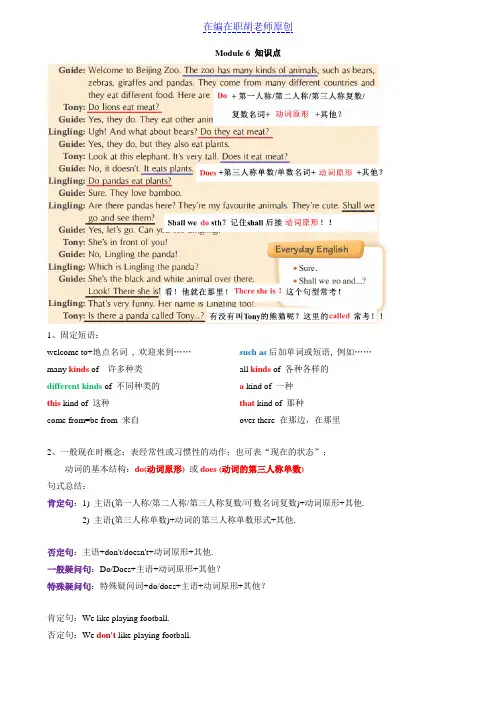
Module 6 知识点1、固定短语:welcome to+地点名词, 欢迎来到……such as后加单词或短语, 例如……many kinds of 许多种类all kinds of 各种各样的different kinds of 不同种类的a kind of 一种this kind of 这种that kind of 那种come from=be from 来自over there 在那边,在那里2、一般现在时概念:表经常性或习惯性的动作;也可表“现在的状态”;动词的基本结构:do(动词原形)或does (动词的第三人称单数)句式总结:肯定句:1) 主语(第一人称/第二人称/第三人称复数/可数名词复数)+动词原形+其他.2) 主语(第三人称单数)+动词的第三人称单数形式+其他.否定句:主语+don't/doesn't+动词原形+其他.一般疑问句:Do/Does+主语+动词原形+其他?特殊疑问句:特殊疑问词+do/does+主语+动词原形+其他?肯定句:We like playing football.否定句:We don't like playing football.一般疑问句:Do you like playing football?特殊疑问句:What kind of sport do you like?肯定句:She like s playing basketball.否定句:She doesn't like playing basketball.一般疑问句:Does she like playing basketball?特殊疑问句:What kind of sport does she like?当一般现在时的陈述句中,当句子的主语是第三人称单数时,谓语动词也要用第三人称单数形式。
即:主语(三单)+动词的第三人称单数+其他。
动词的第三人称单数变化规则与名词复数的变化方法相同。
外研版英语七年级上册Module 6 重难点知识归纳总结

Module 6【重点单词】1.bear[beə] n. 熊2.elephant ['elif(ə)nt] n. 大象3.giraffe [dʒi'rɑ:f] n. 长颈鹿4.lion ['laiən] n. 狮子5.monkey ['mʌŋki] n. 猴子6.panda ['pændə] n. 熊猫7.tiger ['taigə] n. 老虎8.zebra ['zi:brə; 'zebrə] n. 斑马9.zoo [zu:] n. 动物园10.guide [gaid] n. 导游11.animal ['æniml] n. 动物12.such [sʌtʃ] adj. 这样的;如此的13.as [æz] prep. 像……一样e [kʌm] v. 来15.different ['difrənt] adj. 不同的16.country ['kʌntri] n. 国家17.other ['ʌðə] adj. 其他的18.dangerous ['deindʒərəs] adj. 危险的19.also ['ɔ:lsəʊ] adv. 也;而且20.plant [plɑ:nt] n. 植物21.look [lʊk] v. 看,瞧22.tall [tɔ:l] adj. 高的23.sure [ʃʊə] adv. 的确;当然24.bamboo [bæm'bu:] n. 竹子25.cute [kju:t] adj. 可爱的26.shall [ʃæl; ʃel] aux. ……好吗?要不要……?27.them [ðem; ðəm] pron. (宾格)他们;她们;它们28.which [witʃ] pron. 哪一个29.over ['əʊvə] prep. 在……的上方30.there [ðeə] adv. 在那里;往那里31.funny ['fʌni] adj. 有趣的32.call [kɔ:l] v. ……叫做;称呼……为33.Africa ['æfrikə)] n. 非洲 ['eiʃə] n. 亚洲35.Europe ['jʊərəp] n. 欧洲36.little ['litl] adj. 极少量的37.only ['əʊnli] adv. 仅仅,只38.about [ə'baʊt] prep. 大约,大致39.people ['pi:pl] n. 人;人们40.African ['æfrikən] adj. 非洲的n.非洲人41.grass [grɑ:s, græs] n. 草rge [lɑ:dʒ] adj. 大的,巨大的ually ['ju:ʒuəli] adv. 通常44.alone [ə'ləʊn] adv. 独自地45.strong [strɒŋ] adj. 强壮的;强大的;强烈的46.catch [kætʃ] v. 抓住;接住47.even ['i:vən] adv. 甚至【重点短语】1.a trip to the zoo动物园之旅2.welcome to...欢迎到……3.many kinds of...许多种……4.such as比如5.different countries不同的国家6.look at看7.the black and white animal黑白相间的动物8.live in Africa生活在非洲9.a little fruit一点儿水果10.30 kilos of bamboo a day每天30公斤竹子11.all over the world全世界12.an African animal一只非洲动物13.live alone单独生活14.be good at swimming擅长游泳15.catch other animals for food抓其他动物为食16.the world of animals动物世界【重点句型】1.Welcome to Beijing Zoo.欢迎来到北京动物园。
外研版七年级上册Module 6 A trip to the zoo同步练习(无答案

Module 6 A trip to the zoo 一、根据首字母及中文提示写单词1.2.Lei is from Shanghai.3.4.5.6.many places of interest in Beijing.7.8.9.10.11.12.13.14.15.16.17.18.19.20.二、用所给单词的适当形式填空1.2.3.bus.4.5.6.7.8.9.10.11.12.13.14.15.16.17.like reading.18.19.20.they travelled.三、单项选择题1.—Look! There's _____ elephant. Where does it live? —In _____ Asia. It's a kind of cute animal.A.a; anB.a; /C.an; anD.an; /2.—Which animal comes from Africa?—The _____. It's also black and white.A.lionB.zebraC.elephantD.giraffe3.—Tony. I'm in Grade 7. What about you?—I'm in a _____ grade. I'm in Grade 8.A.beautifulB.littleC.differentD.same4.—_____ we watch Animal World on TV, Tony?—OK. It's interesting.A.DoB.AreC.DoesD.Shall5.—There _____ a cute monkey and a strong tiger in the zoo. —Really? Let's go and see _____.A.is; itB.is; themC.are; itD.are; them6.—_____ is your favourite animal, Mike?—The monkey. But I like other _____, too.A.Who; animalB.Who; animalsC.What; animalD.What; animals7.—Do you like geography?—Yes, I do. But I think it's _____ difficult for me.A.a lotB.too manyC.littleD.a little8.—_____ the monkey eat meat?—Yes, it _____. It also eats leaves and fruit.A.Does; doesB.Does; doesn'tC.Do; doesD.Do; doesn't9.—I know the kangaroo _____ from Australia. What about its food? —Well, it doesn't _____ meat, but it eats grass and leaves.e; eate; eatses; eates; eats10.—In the zoo, the giraffe is tall and large but the monkey is short and small.—_____ Let's go and have a look.A.That's bad.B.All right.C.That's very funny.D.Yes, good idea!11.—Look at _____ elephant. Is it strong?—Yes, it is.A.aB.anC.theD./12.—When is your IT lesson, Tony?—Well, we have it _____ half _____ four on Monday afternoon.A.on; pastB.at; pastC.on; toD.at; to13.—Do you like Chinese, Betty?—Yes, I do. _____ it's interesting.A.SoB.ButC.ThenD.Because14.—Mom, I want to watch TV.—Oh, no, it's ten in the evening. Please _____ now.A.have dinnerB.go to schoolC.have lunchD.go to bed15.—Let's _____ a break, Jane.—Great! I'm a little tired now.A.doB.haveC.wantD.start16.—Do you and your friend go to the zoo on Saturdays, Bill?—_____. We always have too much homework to do.A.Yes, I doB.No, I don'tC.Yes, we doD.No, we don't17.—What do you do _____ weekdays, Susan?—I usually go to school. But I may (可能) watch TV _____ the evening.A.on; atB.in; atC.on; inD.in; in18.—_____ we go to the zoo today?—Sorry, I am busy today.A.DoB.DoesC.ShallD.Would19.—Where _____ the zebra live?—In Africa. And it _____ plants and leaves.A.do; eatB.does; eatC.do; eatsD.does; eats20.—Why don't you like lions?—Because they are _____ and they eat other animals.A.cuteB.tallC.smallD.dangerous四、语法填空(一)Dear Jim,How are you? I'm very busy these two _____ (month). We havemany _____ (thing) to do at school. The basketball game and volleyball game are _____ October 3rd and 6th. I like _____ very much. We also have a music festival _____ October. The English test is on Octoberthe _____ (twelve). And next month we have a school trip on November the _____ (two) and _____ art festival on November 18th.By the way, today is October 5th. Tomorrow (明天) is _____ thirteenth birthday. Mom and Dad will give me a birthday party. Do youwant _____ (come) tomorrow?Yours,Ben(二)I'm Anna. I'm _____ (real) busy today.In the morning, I have science at 8:00. It is difficult, _____ I don't like it. Then I have _____ art class. It's fun, and I love it. At 11:00, I have P.E. I can play basketball in the P.E. class _____ my favorite teacher Mr. Green.I _____(have) lunch at 12:00, I like _____ (hamburger) and they are my favorite food. Then I have history. Ms. White is my history teacher. But Ithink history is boring. At 1:30 in the afternoon, I have math fortwo _____ (hour). My math teacher, Mr. Brown, is smart (聪明的), but I don't like _____ (he). That's because he always _____ (give) us a lot of homework. My last class in the afternoon is Chinese. It's my favorite subject.The school finishes _____ 5 o'clock. Then l go home with my friends.。
七年级英语上册外研版Module6知识点
七年级英语上册外研版Module6知识点Module 6是七年级英语上册外研版中的一个重要知识点。
本文将针对Module 6中的重点内容逐一进行详细介绍。
一、食物和饮料Module 6中的知识点包括了食物和饮料相关的单词及表达方式。
如beef, chicken, broccoli, carrot, milk, juice等。
在学习这些单词的同时,也要注意它们的用法,如“Would you like some milk?”或者“Can I have a glass of juice, please?”二、动词to be动词to be是Module 6中的重点内容之一。
在英语中,动词to be一共有三种不同的形式:am、is、are。
例如,“I am hungry”、“He is a teacher”、“They are students”。
在学习动词to be的同时,需要注意各种人称代词的用法和变化规则,如I am、you are、he/she/it is、we/you/they are。
三、时间和日期Module 6中也包括了关于时间和日期的相关知识。
如days ofthe week、months和常用的时间表达方式等。
如“What day is it today?” 或者“What’s the date today?”等。
同时,需要记住特殊节日和纪念日的名称及其日期,如Christmas、Halloween、New Year’s Day等。
四、情态动词can和must情态动词can和must也是Module 6的重点内容之一。
can表示“能够”、“会”、“可以”,must表示“必须”、“得”、“需”。
学习这两个词汇,需要注意它们的用法和变化规则。
如“I can speak English”、“You must finish your homework”等。
五、运动和爱好Module 6中也包括了描述运动和爱好的单词及表达方式。
外研版英语七年级上册 Module 6~Module 10 期末复习(无答案)

外研版英语七年级上册Module 6~Module10 期末复习(无答案)期末复习Module 6~Module 10语法练习一、重点语法梳理二、语法练习(1~10 单项选择,11~20 用所给单词的适当形式填空)(B)1.________ the tiger live in AsiaA.Do B.DoesC.Are D.Is(A)2.How do the children in America usually ________ their birthdaysA.celebrate B.celebratesC.celebrating D.to celebrate(B)3.Alice always ________ to bed at 10 o'clock.A.go B.goesC.went D.going(D)4.They are ________ TV now.A.watch B.watchesC.watched D.watching(B)5.—________ is your English teacher?—Mr Li.A.When B.WhoC.What D.Why(C)6.—________ is your history class—It's on Monday and Wednesday.A.What B.WhyC.When D.Where(D)7.—________ do you go to see a movie—Sometimes.A.How B.WhenC.Who D.How often(C)8.Look! They ________ for the boy in the supermarket. A.look B.looksC.are looking D.look(A)9.Tom often ________ TV on Saturday evenings, but now he is ________ stories.A.watches; reading B.watching; readsC.watch; looking D.watches; reads(D)10.—________ is he—He is ________ brother, Tom.A.What; I B.Who; IC.What; my D.Who; my11.Sarah reads(read) books every day.12.Cindy is very nice and she always helps(help) her friends with English. 13.Mark _knows(know) the answer to the question.14.Look! The girl is dancing(dance) in the gym.15.They are having(have) some fruits under the tree now.16.Be quiet! Your sister is sleeping(sleep).17.I never listen(listen) to English CDs.18.My father usually goes(go) to the library on weekends.19.He isn't playing(play) basketball now.He is having a rest. 20.They live(live) in a big house in the countryside(农村).知识点强化训练1.be good at (C)Lucy is good at ________.A.draw B.draws C.drawing D.to draw2.spend (C)(1) She spends a lot of money ________ this car. A.in B.ofC.on D.at (C)(2) He often spends much time ________ football. A.play B.plays C.playing D.to play3.turn on/turn off (1) Please turn on(turn on/turn off) the TV.I want to watch the football match. (2) Please turn off(turn on/turn off) the light.I want to sleep.4.get on/get off (B)(1) Lucy and Mary ________ the bus and find seats to sit. A.get off B.get on C.gets off D.gets on (2) 一些人正在下公交车。
外研版初一英语上册Module 6 知识点讲义

Module 6. A trip to the zoo一、主题:动物(Animals)二、必背单词名词:bear 熊elephant大象giraffe长颈鹿lion狮子monkey猴子panda熊猫tiger老虎zebra斑马zoo动物园guide导游animal动物country国家plant植物bamboo竹子Africa非洲Asia亚洲Europe欧洲kilo千克;公斤people人;人们leaf叶子grass草动词:come来look看,瞧shall……好吗?要不要……? Call把……叫作;称呼……为catch抓住;接住代词:them(宾格)他们,她们,它们which哪一个形容词:such这样的;如此的different不同的other其他的dangerous危险的tall高的cute可爱的funny有趣的little极少量的large大的;巨大的strong强壮的;强大的;强烈的副词:also也;而且sure的确,当然there在那里,往那里only仅仅;只about大约;大致usually通常alone独自地even甚至介词:as像……一样over在………的上方感叹词:ugh 啊,啊呀兼类词:African adj.非洲的n.非洲人三、常用短语1、welcome to 欢迎来到2、many kinds of 许多种类的……3、such as 比如4、come from 来自5、look at 看6、in front of 在………前面(外部)7、black and white 黑白相间的the black and white animal 黑白相间的动物8、over there 在那边,在那里9、live in 生活在live in Africa生活在非洲10、live on 以……为食live on bamboo 以竹子为食11、a little 少量 a little fruit 一点儿水果12、as well as 并且,还13、the favourite of…… ……的最爱the favourite of people=people’s favourite人们最喜欢的14、all over the world 全世界15、live alone 独居16、be good at 擅长be good at swimming 擅长游泳17、in the front of…..在……的最前面(内部)18、a trip to the zoo 到动物园的参观19、different countries 不同的国家20、catch other animals for food 抓其他动物为食21、the world of animals 动物世界22、an African animal一只非洲动物四、重点句型1、行为动词的一般现在时:(1)Does it eat meat?(2)It eats plants and a little fruit, but it doesn’t eat meat.2、提出建议:Shall we go and see them?3、倒装句:Here are the lions.五.模块语法行为动词的一般现在时(2)(The elephant lives in Africa and in Asia The zebra doesn’t eat bamboo. Does it come from China?)六、重要句子• 1. Welcome to Beijing Zoo. 欢迎到北京动物园。
外研社七年级英语上册module6知识点总结
外研社七年级英语上册 module 6 知识点总结Module 61、问路相关句型(1) Could you tell me how to get to...?(2) Can you show me the way to ...?(3) How can I get /go to...?/get there?(4) Where is the ...?(5) Can you tell me the way to ...?(6) Is there a ... near here?(7) How do I get to...?/get there?2、get to + sp.= reach + sp. = arrive at sp. (小地点) / in + sp. (大地点) 到达某地3、in front of 在(外面的)前面 in the front of 在(内部的)前面4、go across = cross 穿过(横穿)5、go along = go down = walk along = walk up = follow 沿着6、turn left 向左转 turn right 向右转 turn around 转身7、at the third street 在第三条街8、over there 在那边9、on the right/ left 在右边/左边10、opposite...在...的对面 There is a shop opposite the school. 11、tour 旅游—tourist、visitor 游客12、be sure 确信I’m not sure.我不知道。
13、Why not do sth,= W hy don’t you do sth,an underground station 一个地铁站 14、15、take + 冠词(a、the)交通工具 to + 地点 = go to + 地点 by 交通工具 He takes a bus to school. = He goes to school by bus. 16、Thanksa lot. = Thanks very much.17、(in) the middle /centre of (在)...的中心 Tom sits in the middleof the classroom. 18、walk along ... to 沿着...到 Walk along the street to the park. 19、above 在...之上 (位置上高于,两者不接触) The plane is flying above the clouds. above表示位置高于某人或某物。
外研社七年级上module6知识点和练习题
Module 6音标(复习)/iə/ here/εə/ bear there单词(要求听写)bear, elephant, giraffe, lion, monkey, panda, zebra, zoo, guide, animal, such, as, come, different, country, other, dangerous, ugh, also, plant, look, tall, leaf, sure, bamboo, cute, shall, them, which, over, funny, call, Africa, Asia, Europe, little, only, kilo, people, African, grass, large, usually, alone, strong, catch, even, world短语(要求听写)1.giraffe 长颈鹿(可数名词)2.Beijing Zoo 北京动物园(专有名词要大写)【zoos】3.an elephant一只大象4.many很多【much修饰不可数名词】5.kind 种类【a kind of, all kinds of…, many kinds of…】6.such as例如e from= be from来自8.different 不同的【difference不同】➢be different from …与…..不同9.Here is/are….这儿有…../这儿是…..Here are the tigers.这是狮子。
10.look at看➢辨析:look at, see, read, watch11.There she is .她就在那儿。
There/Here+主语(名词);如果是代词,则半倒装,即:There/Here +主语(代词)+谓语.如:Here comes the bus! 车来了。
外研版英语七年级上册Module6 单元必考知识点
Module6 单元必考知识点1. Welcome to Beijing Zoo.欢送来到北京动物园。
〔1〕北京动物园是中国开放最早、动物种类最多的动物园,距今已有90 多年的历史。
位于北京西城区西直门外,占地面积约90 公顷,饲养展览动物900多种,20000多只,每年接待中外游客六百多万人次。
〔2〕Welcome !/ You are welcome. 欢送你。
Welcome back! /home! 欢送归来/欢送回家。
〔You are 〕welcome to China. 欢送来中国。
Thank you .谢谢你。
You are welcome.不用谢。
〔答复对方道谢的常用语〕2.They come from many different countries…表示来自有2种说法:come from/ is from。
例如:He comes from America.他来自美国。
He is from America. 他来自美国。
3. Can you see Lingling?玲玲是一只熊猫的名字。
作为中国国宝级珍惜动物,所有生活在动物园的熊猫都有自己的名字,玲玲是1972年尼克松访华时中国送给美国的2只熊猫中的一只。
另一只叫兴兴。
增进了中美之间的友谊。
4.There are many animals from different countries in Beijing Zoo.系动词be要根据其后面的名词的数而定.如有多个名词,那么要根据就近原那么。
例如:There are 2 books and a pen on the desk.桌子上有2本书和一只笔。
There is a pen and 2 books on the desk. 桌子上有一只笔和2本书。
5.But it doesn’t eat meat.主语是第三人称单数的行为动词的一般现在时否认形式Does the camel eat fruit? 骆驼吃水果吗?主语是第三人称单数的行为动词的一般现在时疑问式是在句首加助动词does,后面的谓语动词复原为动词原形.其肯定与否认答复用Yes, X does./ No, X doesn’t.6.The panda eats about 30 kilos of bamboo a day…A kilo of eggs 一千克/公斤鸡蛋15 kilos of eggs 15千克/公斤鸡蛋II. 语法行为动词的一般现在时(3)1. 主语是第三人称单数的行为动词的一般现在时否认形式是在行为动词的前面加doesn’t〔does not〕,这时要注意把谓语动词复原为动词原形。
外研版英语七年级上册Module 6知识点讲解
M6 A trip to the zoo教学内容:一、知识点梳理1. The zoo has many kinds of animals,such as bears,zebras,giraffes and pandas.such/sʌtʃ/adj.这样的;如此的【考点】辨析such和so(1)so是副词,主要用来修饰形容词或其他的副词。
eg:He runs so fast. 他跑得这么快。
(2)当后面接的是由形容词修饰的单数可数名词时,既可用so也可用such。
such+a/an +形容词+单数可数名词=so+形容词+a/an+单数可数名词(注意不定冠词a/an的位置)。
eg:such a good boy=so good a boy 如此好的一个男孩(3)当复数名词前有many,few或不可数名词前有much,little等表示“多,少”意义的形容词时(注意这时little不当“小”讲),只能用so。
eg: There are so many girls. 有这么多女孩儿。
【重点】当后面接单数可数名词时:such+a/an+(形容词)+单数名词(当名词前有one,no,any,some,all等修饰时,such放在这些修饰词之后)。
eg:He's such a good boy. 他是这么好的一个男孩。
One such table is enough. 一张这样的桌子就够了。
【难点】当后面接的是复数名词或不可数名词时:such+除many/few之外的形容词+可数名词复数;such+除much/little之外的形容词+不可数名词。
eg:It is such hot water. 这水真热。
典例精讲:She is________nice girl.A.such a B.a such C.so a D.a sosuch as 比如典例精讲:我喜欢诸如茶和汽水之类的饮料。
I like drinks,________ ________tea and pop.2. They eat other animals.【考点】other/'ʌðə/adj .其他的other 作形容词,后跟名词,泛指其他的(人或物)。