
情态动词和助动词的用法详解及练习
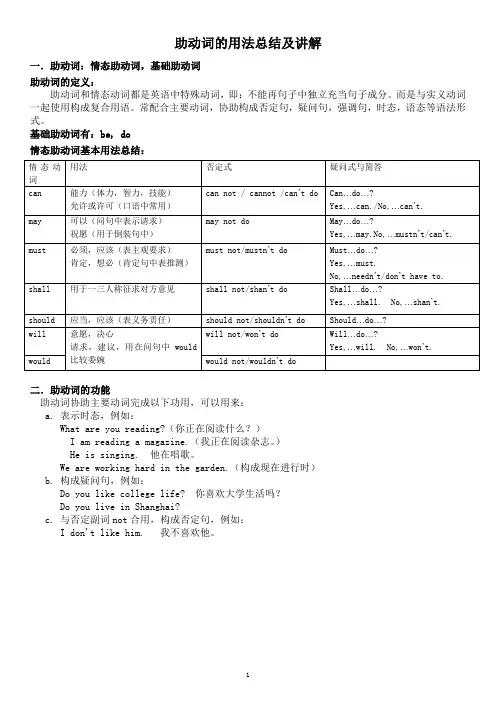
助动词的用法总结及讲解
一.助动词:情态助动词,基础助动词
助动词的定义:
助动词和情态动词都是英语中特殊动词,即:不能再句子中独立充当句子成分。
而是与实义动词一起使用构成复合用语。
常配合主要动词,协助构成否定句,疑问句,强调句,时态,语态等语法形式。
基础助动词有:be, do
情态助动词基本用法总结:
二.助动词的功能
助动词协助主要动词完成以下功用,可以用来:
a. 表示时态,例如:
What are you reading?(你正在阅读什么?)
I am reading a magazine.(我正在阅读杂志。
)
He is singing. 他在唱歌。
We are working hard in the garden.(构成现在进行时)
b. 构成疑问句,例如:
Do you like college life? 你喜欢大学生活吗?
Do you live in Shanghai?
c. 与否定副词not合用,构成否定句,例如:
I don't like him. 我不喜欢他。
助动词练习
一. +句子剩余部分。
1.
2.She is a lovely girl. ________________________________________
3.We are classmates. ______________________________________
4.I am a doctor. ________________________________________
5.There is a bird in the tree. ________________________________
6.They are good friends. ____________________________________
7.I love my parents. _______________________________________
9. We have a pleasant home. _______________________________
10.They go to church on Sunday. _____________________________
11.You are a singer. ______________________________
二. 用do does be 填空
1. _____ she know all the answers ?
Yes , she ____ . No, she _____.
2. _____ the twins often fight ?
Yes ,_____ do. No, _____ don’t.
3. _____ your dad like listening to music?
Yes ,____ does . No, _____ doesn’t.
4. _____ you have a new teacher?
Yes , I ______. No, I ______.
5. _____ she a teacher?
Yes, she _____ . No, she _____.
6. _____ your father smoking in the living room?
Yes, ____ is .No, he _____.
情态助动词练习
二.选择
1.()-Dad, may I watch TV?
-No, you can’t. You _______ finish your homework first.
A. must
B. can
C. may
2.( ) —Must I be home before eight o'clock, Mum?
— No, you_____. But you have to come back before ten o'clock.
A. needn't
B. can't
C. mustn't
3.( ) —_________ I borrow your history book?
—Sure. Here you are.
A. Must
B. May
C. Need
D. Will
4.() you like some bread ?
A . Would B. Could C . Can
5.()We throw the waste in the zoo.
A. c an’t
B. don't
C. mustn’t
6. ( ) We should more flower s, and we shouldn’t cut any flowers.
A. plant
B. planting
C. plants
7. ( ) May I have some water?
A. Yes,you have.
B. Yes,you can.
C. Yes,certainly.
8. ( ) Shall we work on the farm ?
A. Yes, we do.
B. Yes, we shall. B. All right.
9. ( ) Would you have something to announce?
A. Yes, we would.
B. Yes, I’d like .
C.Yes, of course.
10. ( ) Can I help you?
A.Yes, you can.
B.No, I can do it.
C.Yes. I’d like some oranges. 三.填空
1. Must I stand up? No, you ________.
2. ________ I speak something? Yes, you ________.
3. ________ I leave the park now? No, you _________ stay here.
4. My grandmother is ill. I _________ stay at home and look after her.
5. ________ you like some juice?
6. They ________ take more exercise.
7. ________ you tell me the way to the museum?
8. The watch ________ tell us the right time.
9. ________ you like to go boating with us?
10. ________ we play chess next weekend?
四.按要求改写句子。
1. She can walk quickly.
I ________ ________quickly . (否定句)
2. They can paint the wall well. (一般疑问句)
_______ they ______ the wall well?
3. Tom must carry the box into the room. (否定句)
Tom ________ ________ carry the box into the room.
4. She should reach the station early. (否定句)
She _______ _______ reach the station early.。
be动词、助动词、情态动词用法课件(35张)

情态动词的用法
1
表示能力
情态动词can和could用于表示能力或可能性。
2
表示意愿
情态动词may、might和would用于表达意愿、请求或建议。
3
表示推测
情态动词must、should和will用于推测、假设和推理。
例句解析
be动词
He is a doctor.
助动词
She can sing beautifully.
情态动词
You should study harder.
情态动词
情态动词用于表达说话人的态度、推测、建议 等具有情感色彩的意义。
一般助动词
一般助动词可以帮助构成英语的各种时态、语 态ቤተ መጻሕፍቲ ባይዱ情态,并提供附加的信息。
情态动词介绍
1 常见情态动词
了解常见的情态动词,如can、could、may等。
2 情态动词的用法
掌握情态动词在不同语境下的用法,如表达能力、可能性、建议等。
be动词、助动词、情态动 词用法课件(PPT35张)
本课件将详细介绍be动词、助动词和情态动词的用法。带你从基础到进阶, 掌握这些动词的使用技巧,使你的英文表达更加准确、流利。
be动词介绍
1 基础知识点
2 语言实践
掌握be动词的基本形式、变化规则及其在 句子中的作用。
通过实例运用,感受be动词在不同语境下 的使用。
be动词的用法
表示存在
使用be动词描述人、事、物的存在状态。
表示身份
使用be动词表达个体的身份、职业等信息。
表示状态
使用be动词描述人、事、物的临时或持续状态。
助动词介绍
1 助动词定义
了解助动词的特点和作用,掌握其常见的几种。
be动词、助动词、情态动词讲解(基础篇)第一讲
D. are, like
2. A:
How many days __ there in a week?
B:
There __ seven.
A. is, is
B. are, are
C. is, are
D. are, is
3. The boy __ ill today.
A. are
be
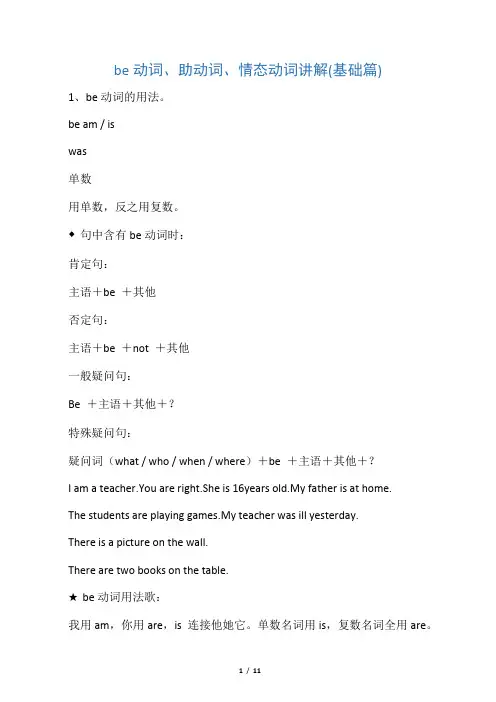
1、be动词的用法。
be am / is
was
单数
用单数,反之用复数。
◆句中含有be动词时:
肯定句:
主语+be+其他
否定句:
主语+be+not+其他
一般疑问句:
Be+主语+其他+?
特殊疑问句:
疑问词(what / who / when / where)+be+主语+其他+?
I am a teacher.You are right.She is 16years old.My father is at home.
B. is
C. be
D. am
4. What ___ your father ___?
A. do, like
B. is, like
C. are, likes
D. does, like
5. ___ you go to school by bus?
A. Are
B. Is
C. Do
D. Does
6. When ___ your birthday?
否定句:
主语+ didn’t +动词原形+其他+。
He / We didn’t get up early every morning last year.一般疑问句:
助动词和情态动词的用法总结

4) 祝愿:May you be happy!
情态动词--明晰每一个情态动词的具体功能
2
2. might 1) 可否, 含义比may委婉。
A. 用于问句:Might I use your phone?
B. 用于陈述句:You might call at the chemist on the way home.
Cars must not park in front of the entrance. We mustn’t be
late.
情态动词--明晰每一个情态动词的具体功能
4
3) 推断。
A. 现在可能: He must know the answer.
B. 过去可能: We must have read the same report.
3
4) 轻微批评、抱怨。
A. 针对现在:You might tell me if you’re going to be late.\
B. 针对过去:You might at least have phoned me if you’re not
coming.
3. must
1) 必须、一定。
A. 指现在或将来:
2) 否定式和疑问式:
You don’t have to get up early. Do you have to leave so soon?
3) 可用于各种时态: We’ll have to help him as much as we can.
4) 可用于各种语态: A lot of letters had to be answered.
You must give up smoking. I must remember to post the
情态动词和助动词的用法详解及练习
助动词的用法总结及讲解一.助动词:情态助动词,基础助动词助动词的定义:助动词和情态动词都是英语中特殊动词,即:不能再句子中独立充当句子成分。
而是与实义动词一起使用构成复合用语。
常配合主要动词,协助构成否定句,疑问句,强调句,时态,语态等语法形式。
基础助动词有:be, do情态助动词基本用法总结:二.助动词的功能助动词协助主要动词完成以下功用,可以用来:a. 表示时态,例如:What are you reading?(你正在阅读什么?)I am reading a magazine.(我正在阅读杂志。
)He is singing. 他在唱歌。
We are working hard in the garden.(构成现在进行时)b. 构成疑问句,例如:Do you like college life? 你喜欢大学生活吗?Do you live in Shanghai?c. 与否定副词not合用,构成否定句,例如:I don't like him. 我不喜欢他。
助动词练习一. +句子剩余部分。
1.2.She is a lovely girl. ________________________________________3.We are classmates. ______________________________________4.I am a doctor. ________________________________________5.There is a bird in the tree. ________________________________6.They are good friends. ____________________________________7.I love my parents. _______________________________________9. We have a pleasant home. _______________________________10.They go to church on Sunday. _____________________________11.You are a singer. ______________________________二. 用do does be 填空1. _____ she know all the answers ?Yes , she ____ . No, she _____.2. _____ the twins often fight ?Yes ,_____ do. No, _____ don’t.3. _____ your dad like listening to music?Yes ,____ does . No, _____ doesn’t.4. _____ you have a new teacher?Yes , I ______. No, I ______.5. _____ she a teacher?Yes, she _____ . No, she _____.6. _____ your father smoking in the living room?Yes, ____ is .No, he _____.情态助动词练习二.选择1.()-Dad, may I watch TV?-No, you can’t. You _______ finish your homework first.A. mustB. canC. may2.( ) —Must I be home before eight o'clock, Mum?— No, you_____. But you have to come back before ten o'clock.A. needn'tB. can'tC. mustn't3.( ) —_________ I borrow your history book?—Sure. Here you are.A. MustB. MayC. NeedD. Will4.() you like some bread ?A . Would B. Could C . Can5.()We throw the waste in the zoo.A. can’tB. don'tC. mustn’t6. ( ) We should more flowers, and we shoul dn’t cut any flowers.A. plantB. plantingC. plants7. ( ) May I have some water?A. Yes,you have.B. Yes,you can.C. Yes,certainly.8. ( ) Shall we work on the farm ?A. Yes, we do.B. Yes, we shall. B. All right.9. ( ) Would you have something to announce?A. Yes, we would.B. Yes, I’d like .C.Yes, of course.10. ( ) Can I help you?A.Yes, you can.B.No, I can do it.C.Yes. I’d like some oranges. 三.填空1. Must I stand up? No, you ________.2. ________ I speak something? Yes, you ________.3. ________ I leave the park now? No, you _________ stay here.4. My grandmother is ill. I _________ stay at home and look after her.5. ________ you like some juice?6. They ________ take more exercise.7. ________ you tell me the way to the museum?8. The watch ________ tell us the right time.9. ________ you like to go boating with us?10. ________ we play chess next weekend?四.按要求改写句子。
be动词、助动词、情态动词用法总结及练习
千里之行,始于足下。
be动词、助动词、情态动词用法总结及练习动词是英语中最重要的词类之一。
在动词中,有一些特殊的类型,包括be动词、助动词和情态动词。
它们有着特定的用法和功能。
下面是对这些特殊动词的用法总结,以及一些练习来挂念巩固学问。
1. Be动词的用法:- 表示存在或状态:I am a student.(我是一名同学。
)- 表示身份、职业或特征:She is a doctor.(她是一名医生。
)- 表示时态和语态:He was playing basketball.(他正在打篮球。
)The book is being read by her.(这本书正在被她读。
)- 表示位置:The pen is on the table.(钢笔在桌子上。
)2. 助动词的用法:- be, do, have:用于构成时态、语态和否定句等:She is studying for the exam.(她正在为考试复习。
) I don't like coffee.(我不宠爱咖啡。
)- Modal verbs(情态动词):can, could, may, might, must, shall, should, will, would等。
它们用于表示力量、可能性、义务、建议、恳求等:You should go to bed early.(你应当早睡。
) He can speak three languages.(他会说三种语言。
)3. 情态动词的用法:- can:表示力量、许可或可能性。
I can swim.(我会游泳。
) Can Iuse your pen?(我可以用你的笔吗?)- could:过去式,表示过去的力量或可能性。
When I was young, Icould run very fast.(我年轻时跑得很快。
)- may: 表示许可或可能性。
You may use my computer.(你可以用我的电脑。
助动词和情态动词

助动词和情态动词1.助动词和情态动词的定义:在英语中,助动词一般没有词义,主要帮助构成谓语,表示时态,语态,构成疑问及否定形式或加强语气。
情态动词与助动词不同,情态动词有意义,但它也和助动词一样,不能单独的作谓语,必须和其他动词一起构成谓语。
另外重要的一点是情态动词没有人称和数的变化,其后必须跟动词原形。
His brother does not like playing basketball .2.助动词和情态动词的种类1)助动词的种类①be(am ,is,are,was,were,been,being )助动词be与现在分词结合,可以构成进行时态;若它与过去分词结合,可以构成被动语态。
You are a reading . She was beaten by the boy .②have(has,had,having )助动词have 与过去分词结合,可以可以构成完成时态。
I have finished my college life. I had finished the middle school .③shall (should) ,will (would)助动词shall 和will 与动词结合,可以构成将来时。
we will be very happy to see you .④do (does,did)助动词do 与其他动词结合,可以构成否定句和疑问句。
I do not like this book . Does you buy this pen?3.情态动词的种类英语的的情态动词主要有can,could,may,might,must,have to ,will , would ,shall, should, ought to , had better ,need ,dare 等,用来表示请求,义务,劝告,推测,建议,征求对方意见或许可等。
Can ,may ,must 是三个重要的情态动词,它们的基本句型如下:肯定句:主语+can,may, must+动词原形+.....否定句:主语+can,may, must+not+动词原形+.....疑问句:Can , May , must+主语+动词原形+.....?Can 表示可能性,能力,许可等。
中学英语语法助动词与情态动词
中学英语语法助动词与情态动词(一)助动词助动词本身无词义,它仅仅是用来帮助主要动词构成各种时态、语态、语气以及否定和疑问结构。
1)由be, have, shall(should), will(would)构成除现在一般时和过去一般时外的全部时态。
如:I shall be here any minute.我将随时到达这里。
(由shall构成将来一般时)The train is now rapidly approaching the city of Beijing.火车现在正迅速地临近北京城。
(由is构成现在进行时)We shall be having rain, rain, and nothing but rain.我们会有没完没了的雨。
(由shall be构成将来进行时)The roads were full of people. We hadn't foreseen that.路上都是人。
这是我们事先未料到的。
(由had构成过去完成时) Soon they would have reached their time limit and must return to the camp.不久规定的时间就要到了,他们就得回营地了。
(由would have 构成过去将来完成时)He has been scoring plenty of goals this season.在这个(足球)赛季里,他踢进了许多球。
(由has been构成现在完成进行时)2)由be构成被动语态。
如:One is not guilty until he is proved.在没有证明有罪之前,人都是无罪的。
(现在一般时的被动式)She almost felt that she was being mocked.她几乎感觉到她在被嘲弄。
(过去进行时的被动式)I suspected that I had been followed and watched since I arrived in London.我怀疑我到达伦敦以后就已被跟踪和监视。
初中英语语法详解精练 13第十三章 助动词和情态动词
第十三章助动词和情态动词要点概览◎助动词和情态动词的定义◎can(could),may(might),must,need◎Will you? 和Shall I/we?◎would和should◎have to◎易混易错点剖析知识讲解一、助动词和情态动词用法1.助动词是协助主要动词构成谓语动词词组的词。
汉语中只有助词,而没有助动词。
这又是英汉两种语言的一大差别。
英语的助动词,就是起辅助作用的动词,本身没有独立的词义,不能单独做谓语,在句子中只起语法作用,和实意动词一起构成谓语(叫复合谓语),表达否定,疑问,时态,语态和其他语法关系。
其2.情态动词是一种本身有一定的词义,表示说话人的情绪,态度或语气的动词,但不能单独作谓语, 只能和其他动词原形构成谓语,没有人称和数的变化。
把情态动词放在句首、句尾用问号便构成疑问句;在其后加上not或never等否定词就构成否定句。
如:My mother can drive. 我妈会开车。
My mother can’t drive. 我妈不会开车。
Can your mother drive? 你妈会开车吗?Can’t your mother drive? 你妈不会开车吗?You needn’t look at me like that. 你不必那样瞧着我。
常用的情态动词有can, could; may, might; must; should; need; dare; ought to 等。
【即时体验】1. —Do we have to finish our homework this afternoon?—Yes, you ________.A. mustB. canC. mayD. need【解析】A 情态动词的用法。
情态动词have to为“不得不”,其肯定回答为“Yes, you must”,否定回答为“No, you needn’t”。
故选A。
2. –Look at that girl! Is it Susan?—No, it _______ be her. She has gone back to her hometown.A. mustn’tB. can’tC. needn’tD. wouldn’t【解析】B 情态动词的用法。
初中英语情态动词详细用法归纳含练习及答案
初中英语情态动词具体用法归纳〔含练习及答案〕情态动词有具体的词义,但也同助动词一样,须要及其他词语一起构成句子的谓语,另外情态动词没有人称和数的改变,情态动词后必需跟动词原形。
1. 的用法:〔1〕.表示实力、答应、可能性。
表示实力时一般译为“能、会〞,即有种实力,尤其是生来具备的实力.如:, I ’t . 她能游得很快,但我不能。
I . 我用眼睛看。
是的过去式。
表示过去的实力。
. 经常指经过努力,花费了时间和劳力之后才能做到某事。
.〔2〕.表示答应,常在口语中。
如: . 你可以用我的字典。
〔3〕.表示推想,可能性,意为“可能〞,常用于否认句和疑问句中,此时’t 译为“ 不行能〞。
如: ? 这个消息会是真的吗?— ?那个人有可能是我们老师吗?—, ’t . a .不行能。
咱们老师正在巡游长城呢。
【例题】—I . . —. , I . ’t ’t ’t ’t【解析】依据下文“我刚去过那儿〞可知,应为“ 不行能〞,’t 表示推想[答案] A的用法:〔1〕的过去式,意为“ 能、会〞,表示过去的实力。
如: 10. 他十岁时就会写诗。
〔2〕. 在疑问句中,表示委婉的语气,此时没有过去式的意思。
如a ? 你能帮我个忙吗?— I ? 我能用一下你的钢笔吗? —, .可以。
〔用问,不能用答。
〕2. 的用法:〔1〕.表示恳求、答应,比正式,如: I ? 我可以借你的自行车吗? . 如今你可以回家了。
【例题】— I 3? — . . A. D.【解析】在此处表示恳求,意为“ 做……可以吗〞。
答案:A(2) .表示推想,议论可能性,意为“ 可能,或许〞,一般用于确定句中。
如: . 明天可能会下雨。
. 她可能在家呢. 翻译为“可能不〞(3) 的过去式为,表示推想时。
可能性低于。
如: . .他分开学校了,可能是他生病了。
(4) . 表示盼望、祈求、祝福,常可译为“祝福〞。
通常是用 +主例如: a . 祝你过得开心。
! 祝你华蜜!!祝你胜利!3. 的用法:(1) 表示主观看法,意为“必需、确定〞。
be动词、助动词、情态动词用法总结及练习(答案)
助动词do/does
什么是助动词?
顾名思义,助动词就是帮助动词的,而本身没有 实际意义的动词,是具有雷锋精神的词汇。
助动词do的三种变化形式
do 第三人称单数时使用的does 过去式did
do的基本用法:
1 构成否定句 2 构成一般疑问句及回答 3 构成特殊疑问句
do的各种形式
肯定式:do 否定式:don't/do not do用在第一人称单复数、第二人称单复数和第三人称复 数作主语,且时态为一般现在时的句子,如:
4. shall的用法
1)shall常用于第一人称,表示简单的将来,构成将来时态。(助词)
ex: I shall think it over and let you know my idea.
When shall we meet again?
We shall have a good time in the park. 2) shall用于第一人称,还可以表示征求对方的意愿。
ex: My brother is ill, so I have to call the doctor in the middle of the night. 2) have to有人称、时态和单复数上的变化,而must只有一种形式。
have to → had to I have to/she has to
shall和will的对比
1)shall和will作为助动词可以与动词原形一起构成将来时。如: I shall study harder at English. 我将更加努力学习英语。 He will go to Shanghai. 他要去上海。
2)以前的语法中,shall用于第一人称,will只用于第二、第三人称。现在,尤其 是在口语中,will常用于第一人称,但shall只用于第一人称,如果用于第二、第三 人称,就不再有“将要”的意义,就变成命令、警告或威胁的意思了。