
高中英语 人教版必修一unit2Englisharoundtheworld同步练习,含答案
B1U2 English around the World 同步练习一、单词拼写1. The child has a very large ____________(词汇量) for his age.2. He looks honest, but ____________(实际上) he is a thief.3. The police are trying to find out the ___________ (身份) of the man killed in the accident.4. Things (逐渐地)improved.5. This film is ____________(根据)on facts.6. I come from China, and Chinese is my ____________ (本土的,本族的)language.7. We should ______ ______ ______ _____(利用好) our school library.8. __________ _______ (由于)the heavy rain, we didn’t come to school on time this morning.9. I'm afraid I can't help you ______ __ (目前) because I’m too busy.10. India has many _________(流利的) English speakers now.二、在空白处填入适当的内容 (1个单词) 或括号内单词的正确形式。
1. You’ll be able to choose a room ___________________ (base) on your own personal tastes.2. It is reported that many a new house is ________________ (build) at present in the disaster area.3. He made a lot of _______________ (spell) mistakes in his writing.4. He moved from the northwestern part of the US to an _________________ (east) city.5. The film star wears sunglasses. Therefore, he can go shopping without ______________ (recognize).6. You can only be sure of what you have ___________ present; you cannot be sure of something you might get in the future.7. We request that southern part of the block ________________________ (clean) as soon as possible.8. Native _________ the US, this kind of rabbits weighs less than 1 pound and lives in the northwestern America.9. The teacher suggest to us that every minute should be made use of _________________(improve) our spoken English.三、根据所给汉语,完成下列句子。
1. You speak English like ______________________________ (说母语的人).2. He _______________________ (走近) me and asked me the way to the station.3. John and James are brothers. The former is a teacher; _________________ (后者) is an engineer.4. Cartoon characters ____________________ (诸如) Mickey Mouse and Snoopy are still popular.5. There was a heavy rainstorm ______________________________ (雷电交加) at dusk yesterday.6. You’d sound a lot more polite if you __________________(提出请求)in the form of a question.7. I am a popular senior student ___________________(因为)my interest in English and my ability to give speeches.8. America______________________(被承认是)an independent nation by Britain in 1783.9. People should __________________________(充分利用)their time to do something meaningful.10. The country has _______________(经历)too many wars in the past few years.11. A strong wind ____________(增添)his difficulties, but he was able to swim across the channel.四、根据提示,将下列句子译成英语。
21. 自从玛丽两年前从高中毕业以后,她就再没有组织过此类活动。
22. 一旦吉姆下定决心,我们中没有人能说服他。
23. 英语在世界上扮演着重要的角色,所以你应该充分利用每次机会来练习它。
24. 由于天气不好,他开会迟到了。
25. 我想知道玛丽是不是故意打破了那个盘子。
五、根据课文原文填空,每空填一词。
THE ROAD TO MODERN ENGLISHAt the end of the 16th century, about five to seven million people spoke English. Nearly all of them lived in England. Later in the next century, people from England made voyages to __________ other parts of the world and __________ ________ that, English began to be spoken in many other countries. Today, more people speak English as their first, second or foreign language __________ __________ __________.__________ English speakers can understand each other __________ __________they don’t speak the same kind of English. Look at this example:British Betty: Would you like to see my flat?American Amy: Yes, I’d like to __________ __________ to your apartment.So why has English changed over time? _________ all languages change and develop when cultures meet and communicate with each other. At first the English spoken in En gland between about AD 450 and 1150 was very different from the English spoken today. It was ________ more ______ German than the English we speak at present. Then _________ between about AD 800 and 1150, English became ________ like German because those who ruled England spoken first Danish and later French. These new settlers _________ the English language and especially its _______. So by the 1600’s Shakespeare was able to ________ ________ ______ a wider vocabulary than ever before. In 1620 some British settlers moved to America. Later in the 18th century some British people were taken to Australia too. English began to be spoken in both countries.Finally __________ the 19th century the language was settled. At that time two big changes in English spelling happened: first Samuel Johnson wrote his dictionary and later Noah Webster wrote The American Dictionary of the English Language. The __________ gave a separate __________ to American English spelling.English now is also spoken __________ a foreign or second language in South Asia. __________ __________, India has a very large number of __________ English speakers because Britain ruled India from 1765 to 1947. __________ that time English became the language forgovernment and education. English is also spoken in Singapore and Malaysia and countries in Africa __________ __________ South Africa. Today __________ __________ of people learning English in China is increasing rapidly. In fact, China may have the __________ number of English learners. Will Chinese English __________ its own identity? Only time will tell.六、根据短文内容,从短文后的选项中选出能填入空白处的最佳选项。
人教版高中英语必修一Unit2 English around the world reading 课件
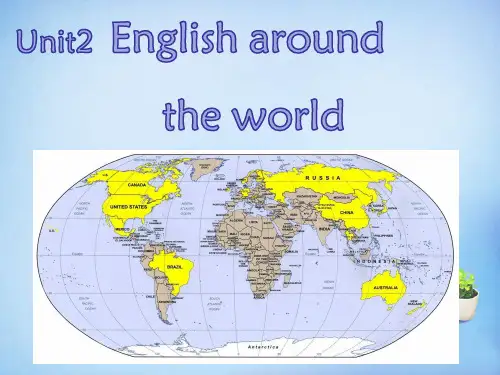
Br. E & Am.E
Enjoy the different kinds of English.
BrE
AmE
vocabulary spelling
autumn I think
colour centre traveller
fall I guess
color center traveler
pronunciation dance [da:ns] dance[dæns] not [not] not [na:t]
Native speaker can understand each other even
Para.2 If they don’t speak the same kinds of Enlish.
(different kinds of English )
Para.3 All languages change when cultures
communicate with each other.
Para.4 English is also spoken as a foreign
or second language in South Asia.
Task 2 Choose the correct answer
1. When did English begin to be spoken in many other countries? A. At the end of the 16th century. B. In the 17th century. C. In the 18th century. D. In the 19th century.
Just for Fun
A: Do you like moving pictures? B: Well, yeah! Why not! A: OK, Follow me , please! B: What? A: Let’s go downstairs to move the pictures! Oh, oh…
高中英语 Unit2 English around the world 教材导学 新人教版必修1

Unit 2 English around the world【单元导航】中国式英语欧洲人做过精细的统计,自1994年以来加入国际英语行列的词汇中,中式英语贡献了5%到20%,超过任何其他来源。
除“孔夫子(Confucious)”、“中国功夫(kung fu)”、“麻将(mahjong)”或者“豆腐(tofu)”之类绝无仅有的称谓,再挑拣几个真正有中国气质、代表华夏气派、并影响全球当代生活的“鸡蛋词”。
(一)丝绸——silk中国是养蚕大国,丝绸的故乡。
“silk”的发音,显然是汉语的音译,这个词代表了中国高超的工艺技术和贸易强势。
即便现在,丝绸仍在现代生活中充当雍容华丽、典雅高贵的象征。
(二)茶——tea这个词,又是英国人从拗口的闽南话里偷走的。
茶,和丝绸、瓷器比肩,堪称古代中国对外贸易的拳头产品。
目前,品茶代表了一种生活方式和文化品位。
18世纪的柴斯特顿勋爵在《训子家书》里写道:“尽管茶来自东方,它毕竟是绅士气味的;而可可则是个痞子、懦夫,一头粗野的猛兽。
”(三)世外桃源——Shangrila (Xanadu)这是两个近义词,都有“世外桃源”的意思。
“Shangrila”出自西藏的传说之地——香格里拉,“Xanadu”则是蒙古的元上都。
如果要表达“世外桃源”,通常采用“Xanadu”这个词。
(四)风水——Feng Shui风水,还是音译。
它凝聚了古代中国在活人住宅和死人墓地方面的集体智慧。
近年来,风水在美国红极一时,从中国人唇齿之间发出的音节,已经成为当代人急需探究的学问。
(五)走狗——running dogs中国式英语“running dogs”贴切地表达了一种见利忘义、供人驱使的“下三烂”。
最先运用这个词的是中国人,还是英国人,已无从考证;重要的是,英语世界接纳了“走狗”,并以汉语的思维抚育这个“外来词”。
接纳词汇的同时,无形中也接受了中国人的价值观。
(六)大款、巨亨——tycoon这种称呼是近些年才流行街巷的,指有钱、有势的商人或者企业家,中国传统的叫法是“大掌柜”。
高中英语 Unit 2 English around the world Reading The road to modern English教学设计 新人教版必修1

Unit 2 English around the world教材内容分析人教版>必修一第二单元阅读The road to modern English。
本篇阅读课文说明了英语语言的发展、变化和原因,以及它的发展趋势。
通过这篇文章,使学生了解一些关于英语的知识,特别是英语语言的发展变化,了解当代语言的新趋势和新特点,明确为什么除了英国英语和美国英语还会有印度英语、非洲英语等,以后可能还会有中国英语。
本课是高一学生新学年的第二单元,对于培养学生的阅读兴趣和信心以及阅读技能的训练作用重大。
教学目标1.语言技能目标:学完本课之后,学生能够通过标题预测文章内容,通过快速浏览课文、细读课文获取相关信息,并把这些信息内化为己有。
2. 语言知识目标:学完本科之后,学生将掌握以下词汇用法:because of, at present, gradually, be based on, make use of, fluent, such as, come up, voyage把握以下词汇含义:vocabulary, spelling, native, apartment, latter, identity 识得以下词汇:Singapore, Malaysia, Danish3. 学习策略目标:通过学习本课,学生将掌握以下策略交际策略:了解不同国家和地区使用不同的英语,但是以英语为母语的人基本不存在理解方面的障碍。
获取信息的策略:学生学会从因特网获取信息。
4. 情感态度目标:通过学习本课,学生将意识到学习并掌握英语的重要性,并树立学好英语的信心,意识到努力学习是祖国更加强大的必要性,同时把学好外语当成自我发展的一个重要过程。
5. 文化意识目标:通过对本课的学习,学生能认识到学习一门语言不仅仅要学语言本身,与其相关的文化背景、历史背景都是学习的内容。
教学过程Step 1 Warming-up and lead-in (8 mins)(1) 小测试: 对比阅读Robert Burns的诗A Red Red Rose和一首现代诗(4 mins)T: Hello, class. You have all been learning English for at least 3 years. But how good is your English? How much do you know about English? Today, let’s look here and have a test to see how good your English is. Here is a poem by Robert Burns, who was an English poet, or exactly, a Scottish poet. This poem, A Red Red Rose, is one of the most famous in the world. Read it and listen. Let’s see if you have any difficulty in understanding it.A Red Red RoseRobert BurnsO, my Luve's like a red, red roseThat's newly sprung in June;O, my Luve's like the melodie,That's sweetly play'd in tune.As fair art thou, my bonnie lass,So deep in luve am I;And I will luve thee still, my dear,Till a' the seas gang dry.Till a' the seas gang dry, my dear,And the rocks melt wi' the sun;I will luve thee still, my dear,While the sands o' life shall run.And fare thee well, my only Luve!And fare thee well, a while!And I will come again, my Luve,Tho' it were ten thousand mile!T: Did you find it easy or difficult? What about this one? This poem was written by a modern writer.I Am Not YoursI am not yours, not lost in you,Not lost, although I long to beLost as a candle lit at noon,Lost as a snowflake in the sea.You love me, and I find you stillA spirit beautiful and bright,Yet I am I, who long to beLost as a light is lost in light.Oh plunge me deep in love—put outMy senses, leave me deaf and blind,Swept by the tempest of your love,A taper in a rushing wind.T: Why is the first poem difficult to understand while the second one not? (Mainly because of some of the words used in the first poem, which are not often used now. Robert Burns lived in the 18th century while the writer of the second poem is a modern poet.) So we can see people in the past used different words from what is used today.(2) 听一段一位学生和来自澳大利亚的外教的对话(4 mins)T: Now, when one day Qiu Zhensong met our foreign teacher Zak, who is from Australia, what happened? Let’s welcome Zak and Qiu Zhensong.(After the dialogue, the foreign teacher explained.) Did you understand our dialogue? (Ss: No.) What’s the difficulty? (Different words were used in Australia which you do not know in American or British English.) T: So from the two poems and the dialogue we can see people from different countries speak different English and people in different times also use different English. How did the difference come about?[意图说明] 引入话题:不同时代、不同国家所使用的英语有所不同。
人教版高中英语必修一Unit2Englisharoundtheworld整个单元课件

15
Reading–III(5m)
Groupwork: Whatcanyoulearnfromthispassage? (discussingroupoffour,thenaskthestudentsto showtheirideas.)
2.Prepareforthenextclass. 3.FinishtheexercisesonWB.
19
20
Period3Learningaboutl anguage
Unit2Englisharoun dtheworld
21
Period3:幻灯片27-48页
Revision(3m)
Match:(Reivewthenewwords)
sIspoketothemjustnow? Helpthestudentsunderstandwhatisaco mmandorarequest.
27
Learningusefulstructure–II(2m)
Makeclearthedifferencebetweencommandsan drequestsandfinishthefollowingexercises:
apartment
autumn
fall
underground(地铁) subway university(大学) college
rubbish(垃圾) garbage
dustbin(垃圾箱) trashcan
holiday
vacation
fortnight(两星期)twoweeks
12
Reading–I(3m)
&
必修一unit_2_English_around_the_world_重点单词、短语和句型

Mr.Smith has a good command of spoken English.
史密斯先生对英语口语掌握得很好。
归纳总结 command v. & n.命令;指挥;掌握;博得 ___________________ 。
(1)at one's command 听某人支配
under one’s command 由……指挥
Similar National Flags
The United Kingdom of Great Britain and Northern Ireland
The Commonwealth of Australia
New Zealand
4.recognize
recognize Although many Americans move a lot,they still_______ and understand each other’s dialects.
under the command of sb. 在……指挥之下
have (a) command of 掌握;精通(尤指语言) take command of 控制 (be) in command of 掌握,控制 (2)command sb.to do sth. 命令某人做某事 command that...(should) do... 命令……
观察思考
Line up these men and see if the witness can recognize
the criminal. 让这些人站成一排,看看证人能否从中把罪犯认出来。 I recognized him though we were apart for years. 尽管我们分开多年了,我还是认出了他。
人教版高中英语必修一教案:Unit2EnglandaroundtheworldReading
必修一 Unit2 English around the worldReadingTeaching goals 教课目的1. Target language目口号言a.要点词汇和短语include, play a role, because of, international, native, come up, culture, actually, present, vocabulary, usage, identity, such as, rapidlyb.要点句子World Englishes come from those countries... P9Native English speakers can understand each other... P9It became less like German, and more like French... P102. Ability goals能力目标Enable the Ss to describe the history of English and know of the differences between American English and Britain English.3. Learning ability goals学能目标Help the students learn how to analyze the way the author describes the history of English.Teaching important points教课要点Retell the history of English according to the chart.Teaching difficult point教课难点Work together with partners and express one ’s opinion on which kind of English one should learn.Teaching methods 教课方法Discussion.Reading.Listening.Cooperative learning.Teaching aids 教具准备A recorder, a projector and some slides.Teaching procedures & ways教课过程与方式Step I Greeting and revisionT:Good morning / afternoon, boys and girls! First I will check the words and expressions you have previewed.(P11-12 Discovering useful words and phrases part 1, 2, 3, and 4)Teacher shows answers on the screen.T: Please look at the screen and check your answer. Do you have any question?S: Are“ such as” and“ for example” the same?T: OK, I’ ll give you two examples:1.He knows five languages, such as Russian, French and Spanish.2.The differences in the spoken language are greater.S: Oh, I see. Such“as” is used to list similar things, while“ for example” is used to prove the speakers w Ss ask any questions and Teacher explains to them in class.Step II Warming upArouse the Ss’interests in reading. Let the students know of world English.T:So much for the words. Can you name some countries in which English is spoken?Ss: Of course. America, Britain, Canada, Australia...Teacher writes American, British, Canadian, and Australian on the Bb. Then add English to these words.T:Are these Englishes the same?S:I think they are the same. They are all called English.S:I don’t think so. As I know BE and AE are different in spelling, pronunciation and so on.T:Well, turn to page 9. Read the warming up. Please answer the questions below.Ss: (scanning) There is more than one kind of English.T:Please go on reading and try to tell AE words from BE words below.After reading the students give their answers.T:Who will show your answer?S: I think um,“m in a team, rubber, petrol” are BE words“mom,.And on a team, eraser, gas” are AE words.T:Can you give them a name?Ss: World English.T:Very good.Step III Pre-readingActivate the Ss ’background knowledge of English.T:From Warming up we know many people speak English in the world. How many people speak English andwhy do so many people speak English? Please discuss with your partners and answer the questions.A few minutes later.S:Maybe 1000 million people speak English today. Because many countries were colonies of England so Englishis spoken as a first or second language in many countries.S:We can ’t get the exact number. More and more people begin to learn English because English is theworking language in the United Nations. Everywhere children go to school to learn English.T: Excellent! About 1500 million people speak English as their first, second or foreign language. But they’tdon speak the same kind of English.Step IV ReadingGet the students to know the history of English and help the Ss to form a good habit of reading.Point to the Bb.T: How did different kinds of English come about? Please read the text“ The Road to Modern English”and pick out the answer.Ss read quickly to find the answer.T: Any volunteer to answer the question?S: I will. English has changed over time. All languages change when cultures communicated with one another.T: Any different ideas?Well, you all have the same answer.Task1 Reading and choose correct answers.T:Turn to page 10. Please read the questions and multiple answers first to know what information we should get,and then read the passage to find the answer.S:I will. English has the most speakers now.T:Good. What ’s the answer to the second?S:Languages change when cultures change.T: Right. How do you know?S:I judge it, according to the second sentence in the third paragraph.T:Good. Can you choose the right answer to question 3 ?S:Yes. From AD 450 to1150 English sounds more like German.T:Excellent. What about question 4?S:Around 1600 ’s.T:Very good. The last one? Let ’s answer ittogether. Ss: China.T:You are quite right.Task2 Read and summarize the main idea of each paragraph. Work in groups of four.T:Read the text and tell the main idea of each paragraph. After reading, discuss your answer in groups of four.After a few minutes.T: What ’s the main idea of the first paragraph?S1: The first paragraph tells us that more and more people speak English.S2: I don’hinktt so. It describes the extension of English in the world.T: Right. The first paragraph describes the extensive of English in the world. What is the main idea of paragraph 2?S: It tells us native speakers can understand each other but not everything.Let the Ss give an example to prove this point.T: Can you tell me what the third paragraph is about?S:All languages change when cultures communicate with one another. It’s the key sentence of the last two paragraphs. This paragraph tells the development of English as native language.T:Quite right. What about the last paragraph?S:English is spoken as a foreign or second language in many countries.T:How many parts can we divide the text into ?S:Two parts. The first paragraph is the first part, and paragraph 2, 3 and 4 can be part 2.Task3 Analyze the text.T:Please read the text again to tell the main idea of each part and the function of each paragraph. Afterreading please fill in the chart below.DiscussionS1: The first part describes the history of English in chronological order: 16th century-the next century— today.S2: It describes the development of English from the angle of its extension in region. Look, England—many other countries — more people than before (China).S3: I agree with S2.S4: In part two, the author first raises the fact: English has changed over time. Then analyze how English haschanged into world English.T:Are you ready? Which group would like to fill the chart? Group 1 please writes down the main idea of each part. Group 2 please write the function of paragraph 1and2. Group3, the last two paragraphs. The other students check their answers.Sample chart (slide)Part Paragraph FunctionPart1:12Part2:34Suggested answersPart Paragraph FunctionPart1:The extension of English1Describe the development ofin the world English from the angle of itsextension in region.England— many othercountries—more people thanbefore (China).Part2:English changes when2Raise the fact: English hasits culture communicate with developed into world Englishothers3Describe the development ofEnglish in English speakingcountries.4Describe the development ofEnglish in countries where it isspoken as a foreign or secondlanguage.Step V Post-readingCheck the Ss’understanding of the text, help the Ss deal with new language points.Task Express one’s own opinion. Work in groups of four.T:There are many kinds of English. Which kind of English are we learning?Ss: Both AE and BE.Show questions on the screen and ask a student to read them.T: Please discuss these questions and tell us your answers.1.Do you think it matters what kind of English you learn? Why?2.Why do you think people all over the world want to learn English?3.Will Chinese English become one of the world English?After a few minutes.T:OK, I ’ ll ask some groups to report their opinions. Group 1, can you tell us your opinion?S:Yes. I think we should learn BE because other kinds of English came from it.T:Any different ideas?S: In my opinion, we can learn any kind of English because people can understand each other even if they don’t speak the same kind of English.T: Wonderful! What about the second question?S:With the development of economy, it is necessary for people from different countries to communicate witheach other. So we need a language to be work language, while English is the most widely used language. So people all over the world want to learn English.T:Very good! What ’s your opinion?S:I think because of the wide use of computer, people have to learn English. Computer plays an important partin the popularity of English.T:OK. Question 3.Yes or no ?S:My answer is “ yes ”A . large number of Chinese especially young people are learning English. English is communicating with Chinese culture. There will be Chinese English.T:Only time will tell. Now we know English is spoken in so many countries and it plays an important part in the world. If we learn English well, we can listen to English song, read English novels, travel in English speaking countries comfortably and communicate with foreigners easily. Also, it is of great help not only to our own development but also to the development of our country. The Olympic Games will be held in Beijing. Let’s work hard and welcome its coming.Question timeT:It ’ s time for you to ask any questions or let me explain the sentences that hinder your understanding of the text. Ss ask questions freely.T:Now let ’s deal with some language points. Turn to page 9. Let ’ s look atthe sentence: However, they may not understand everything. This sentence means that sometimes they can understand each other, but sometimes theyhave difficulty understanding each other. The English spoken between about AD 450 and 1150 was very differentfrom the English spoken today. In this sentence,“ spoken between about AD 450 and 1150” and“are used to describe the English.HomeworkRetell the text according to the chart.Finish exercises1, 2, 3 (Using words and expressions) P49-50.。
高中英语 必修1 (Unit2 English around the world the 5th period) 精品教案
高中英语必修1(Unit2Englisharoundtheworldthe5thperiod)精品教案TheFifthPeriod●从容说课Thisisthefifthperiodofthisunit.Inthispart,twoitemswillbedealtwith,thatis,thewordsleftinthevocabulary,thereadingintheworkbook.Thefirstitem,learningnewwordsleftinthevocabularyistoremovethebarrierinthefollowingstudy.Andhowtoletstudentslearnthewords withinterestisadifficultissue.Ithinkitisbettertogivestudentsthechancetolearnnewwordsbythemselves.Letstudentsloo kupwordsinthedictionaryand thencomm unicatewithothersinclass,whichcaninspirestudents.Andthenletthemmakeupsomesentences.Theseconditemisanotherpassageonthesubject “English”.ItgivesstudentsmuchmoreinformationonEnglish.Todealwiththispassage,7stepsaredesigned:(1)predictwhatwillbetalked(2)listentofindoutanswers(3)answerquestions(4)scanningtofillinatable(5)summary (6)discussion(7)homework●三维目标1.Knowledge:Learningtherestwordsinthevocabulary.2.Ability:Theunderstandingofthereadingpassage.3.Emotion:Guidestudentshowtoremembermorewordsassoonaspossible.●教学重点Theunderstandin gofthereadingpassage.●教学难点(1)Howtoletstudentsmasterwords.(2)Howtoletstudentsunderstandthepassagewell.●教具准备cassetterecorder;cardswithwordsonthe m●教学过程Step1GreetingsGreetthewholeclassasusual.Step2NewwordsandvocabularyT:Yesterday,Iaskedyoutolookupthewordsleftinthevocabularyinthedictionary.Haveyoubeenpreparedforit?Now,let’shaveagame.Let’sdividethewholeclassinto2groups.Eithergroupchoosesonestudentasarepresentative.I’llshowther epresentativeawordoraphrase,sheorheshouldexplainitinEnglish.Ifthegroup’smemberscanguessit,yourgroupwillwin10points.Eithergrouphas5chances.Let’sgo!Possibleexplanation:mand:(1)v.totellsb.todosth.(2)anorder2.standard:generallyusedoracceptedasnormal3.playapartin:playarolein4.dialect:awayofspeakingthatisusedonlyinaparticulararea5.request:(1)v.toasksb.todo(2)n.anactofaskingforsth.inapoliteorformalway6.polite:theoppositeofrude7.retell:totellastoryagainorinadifferentform8.accent:awayofsayingwordsthatshowswhatcountry,esfrom9.recognize:toknowwhothepersonis10.eastern:inorfromtheeast ofacountryorplaceT:Welldone!Nowlet’sdealwiththesomeofthewordsandphrasesindeal.mandv.命令,指挥commandsb.todo;commandsth.;博得,应得commandthat-clausee.g.Hecommandedhismantoretreat.ThetroopswerecommandedbyGerneralHaig.Thekingcommandedthatshe(should)beexecuted.(建议,命令,要求一类词后从句中用虚拟语气,此类动词有suggest,advise,order,request,require,command,demand...)Hecommanded thebuilding(should)betorndown.n.命令[C];指挥,控制[U]e.g.Areyourefusingtoobeymycommands?Youmustobeyhiscommandthatthebuilding(should)betorndown.Takecommandof;beincommand;underone’scommand;underthecommandofsb.e.g.Shetookcommandofthisclassaftertheformermanagerleft.Shefeltincommandofherlife.ThebattleshipisunderthecommandofCaptainBlake.2.requestv.requeststh.(fromsb.);requestsb.todo;requestthat-clausee.g.Youcanrequestafreecopyoftheleaflet(宣传单).Youarerequestednottosmokeintherestaurant.Sherequestedthatnoone(should)betoldofherdecision untilthenextmeeting.n.request(forsth.);request(that)e.g.Requestsforvisaswillbedealtwithwithin48hours.Herrequestthatmoresweetsbeservedwasrefused.3.recognize辨认出;意识到;承认recognizesb./sth.(by/fromsth.)通过……认出……;recognizesth.(assth.);把……认作是……recognizethat意识到;承认e.g.Irecognizedthehousefromyourdescription.Drugswerenotrecognizedasaproblemthen.Nobodyrecognizedhowurgentthesituationwas.Werecognizedthatthetaskwasnoteasy.4.standardn.规格,标准[C&U]raise/improve/lowerstandard提高/降低标准set(sb.)astandard给某人定一个标准e.g.Hesethimselfsuchahighstandardthatheoftendisappointshimself.ofhigh/lowstandard具高/低标准的standards行为标准,道德标准amanofhighstandards一个道德高尚的人Step3ReadingT:WehavelearntEnglishformanyyears.Theninyouropinion,whatisaveryimportanthelptoyourEnglishstudy?S:teachers,books,tapes...T:Anythingelse?IsthereanythingthatyoucanturntoforhelpwhenyouareconfusedwhilelearningEnglish?S:Ithinkadictionaryisagreathelp.T:Yeah.Whenwemeetacrossnewwordsweoftenlookthemupinadictionary.Whatisthemostwidely-useddictionaryinChin ese?S:XinhuaDictionary.T:ThenwhichonedoyouthinkisusedwidelyinEnglish?S:I’msorryIhavenoidea.T:It’s LongmanDictionary andthe OxfordEnglishDictionary.Today,we’llreadapassageonthe OxfordEnglishDictionary.Nowaccordingtothetitle,whatdoyouthinkwillbementionedinthepassage?S:Ithinkthewriter,thetimewhenwasitwritten,whyitwaswritten,howitwaswritten,thefeatureofthedictionarywillbementioned.T:Now,let’slistentoittoseewhetheryouranswerisrigh t.(afterlistening)T:Doyouthinkthatyouranswerisright?S:Ithinkthatitdoesn’tmentionthefeatureofthedictionary.T:Yes.Nowlet’sreaditaloudtoanswerthesequestionsthen.①Whywasitwritten?②Whendiditstarttobewritten?③Whoisthewriter?④Howitwaswritten?S:①Toencourageeverybodytospellthesame.②Theideawasraisedin1857.And22yearsl ater,itbegantobewritten.③Threemenworkedtogetheronthedictionary:SamuelJohnson,NoahWebster,andJamesMurray.④Ittookthethreemennearlyalloftheirlivestotrytocollectwords.T:Goodjob!Thenwhofirstbegantoworkonthedictionary?S:Murray.T:Yes.Nowlet’sreadthelastparagraph.AndthenfinishthetableaboutnotesonJamesMurray’slifewithyourpartners.(checktogether)Step4Consolidation/discussionT:Afterreadingit,canyousaysomethingaboutMurray?Let’sdoachainreaction.EachstudentjustsaysonesentenceaboutMurray.T:Doyouthinkitworthsothesepeople’sspendingsomuchtimeon?Why?Nowdiscusswithyourpartnerandlistsomereasons.(discussforabout3minutes)Now,it’sshowtime.S:Wethinkthatitworththeirjob.Iftherewerenodictionaries,peoplewouldhavenoruletoguidethemwhileusingthelanguage,whichwillleadtoamessinEnglishbecausedifferentpeople wouldusedifferentlawstouseit.Thentherewillbemoredifficul tyinunderstandingoneanother.Withthedictionary,peoplehaveasetruletojudgewhethertheirwayofusingthelanguageisright.Step5SummaryandhomeworkToday,wehavelearnedthewordsleftinthevocabularyandwe’vegotsomeinformationonthelargeEnglishdictionary.Afterclass,pleasereadthewordsagainandagaintorecitethemandtrytousethemtomakeupsentences.●板书设计Unit2EnglisharoundtheworldTheFifthPeriodWordsmand2.request3.recognize4.standardUnderstandingofthepassageGuessingQuestions●活动与探究ThisresearchistodoresearchontheconceptoftheOxfordDictionaryandsomeotherkindsofdictionaryinEnglishspok encountries.SostudentsshouldworkingroupstostudytheitemsoftheOxfordDictionaryandfindoutthenamesofothertypenames Themostpopularone ThereasonAbout theOxfordEnglishDictionaryThe OxfordEnglishDictionary istheacceptedauthorityontheevolutionoftheEnglishlanguageoverthelastmillenniu m.Itisanunsurpassedguidetothemeaning,history,andpronunciationofoverhalfamillionwords,bothpresentandpast.Ittracestheusageofwordsthrough2.5millionquotationsfromawiderangeofinternationalEnglishlan guagesources,fromclassicliteratureandspecialistperiodicalstofilmscriptsandcookerybooks.The OED coverswordsfromacrosstheEnglish-speakingworld,fromNorthAmericatoSouthAfrica,fromAustraliaandNewZealandtotheCaribbean.Italsooffersthebestinetymologicalanalysisandinlistingofvariantspelli ngs,anditshowspronunciationusingtheInternationalPhoneticAlphabet.Asthe OED isahistoricaldictionary,itsentrystructureisverydifferentfromthatofadictionaryofcurrentEnglish,inwhichonlypresent-daysensesarecovered,andinwhichthemostcommonmeaningsorsensesaredescribedfirst.Foreachwordinthe OED,thevariousgroupingsofsensesaredealtwithinch ronologicalorderaccordingtothequotationevidence,i.e.thesenseswiththeearliestquotationsappearfirst,andthesenseswhichhavedev elopedmorerecentlyappearfurtherdowntheentry.Inacomplexentrywithmanystrands,thedevelopmentovertimecanbeseeninastructurewithseveral“branches”.TheSecondEditionofthe OED iscurrentlyavailableasa20-volumeprint edition,onCD-ROM,andnowalsoonline.Updatedquarterlywithatleast1000newandrevisedentries,OED Onlineoffersunparalleledaccesstothegreatestcontinuingworkofscholarshipthatthiscenturyhasproduced’(Newsweek).Tofindoutmoreaboutthe OED Online,whynotfollowourfree tour?“Aboutthe OxfordEnglishDictionary”invitesyoutoexploretheintriguingbackgroundanddistinctivecharacterofthe OED.Here,youwillfindin-deptharticlesaboutthehistoryofthe OED,aninsidelookattheprogrammesusedtoenlargeandupdatethe OED entries,little-knownfactsaboutitscontent,andmuchmore.。
人教新课标高中英语必修一Unit 2 English around the world课件
BritishEnglish
10
BritishEnglish
AmericanEnglish
spelling
pronunciation
colour, favourite, theatre, centre, travelled, metre
color, favorite, theater, center, traveled, meter
2.Prepareforthenextclass. 3.FinishtheexercisesonWB.
19
20
Period3Learningaboutl anguage
Unit2Englisharoun dtheworld
21
Period3:幻灯片27-48页
Revision(3m)
Match:(Reivewthenewwords)
dtous. Themonitortoldusnottoplaygamesintheclassroom. “Willyoupleasenotsmokehere?”sheadded. Sheaskedmenottosmokehere.
29
Learningusefulstructure–IV(10m)
apartment
autumn
fall
underground(地铁) subway university(大学) college
rubbish(垃圾) garbage
dustbin(垃圾箱) trashcan
holiday
vacation
fortnight(两星期)twoweeks
12
Reading–I(3m)
Paragraph2:tellsusnativespeakerscanund erstandeachotherbutnoteverything.
人教版高中英语 必修一 Unit2 《English around the world---Reading》 课件 (共27张ppt)
Conclusion
Language can change with time.
Language can change
time
when cultures
communicate with
each other.
place
Some people say that Chinese is a much more elegant language, so it is more important for us to master it and it is not so necessary to master foreign language. Do you agree with this opinion and why?
English became the language for
_g_o_v_e_r_n_m__e_n_t_a_n__d_e_d_u_c_a_t_i_o_n_.
By the 19th century
Now
The road to modern English
The English language was settled. Two big changes in E__n_g_li_s_h_s_p_e_l_li_n_g__ happened: Samuel Johnson wrote his _d_i_c_ti_o_n_a_r_y_ and Noah Webster wrote _T_h__e_A_m__e_ri_c_a_n__D_i_ct_i_o_n_a_ry__o_f_____
Para 1--Development of English
people
the end of the 16th century
人教版高中英语 必修一 Unit2 《English around the world---Read
D. Languages change when cultures
meet
Scanning Reading Comprehension III
True or false
1 English had the most speakers in the 17th century.
2 English developed when new settlers and rulers came to Britain.
2. The text is developed mainly by ____.
A. place B. time C. people
3. At the end of the _____ century,
about five to seven million people
spoke English.
of the English language.
Discussion
Choose one of the topics below and discuss it with your partners.
1. Why do you think people all over the world want to learn English?
1. The text mainly tells us ___________. A. that old English is different from the English today B. how Middle English formed C. English and its history D. that English will keep changing
17th century today