
人教版英语七年级上册Unit6-SectionA 1a--1c课件
Fill in the blanks:
A: Do you have a v_o_l_l_ey_b__a_ll_? B: Yes, I __d_o___.
A: _D__o_you _h_a_v_e_as_o_c_c_e_r_b_a_l_l? B: No, I __d_o_n_’_t _.
A: D_o_e_s he _h_a_v_e_ a_b_a_s_k_e_t_b_a_ll_? B: Yes, __h_e_d_o_e_s__.
A: D__o__you_h_a_v_e_ a_te_n_n_i_s_b_a_l_l? B: No,_I_d_o_n__’t_____.
A: _D_o___you_h_a_v_e_ a__p__in_g_-_p_o_n_g__b_at and a_p_i_n_g_-p_o_n__g_b_a_l_l ?
2. Key sentences :
①Do you have a basketball ? Yes , I do. / No, I don’t.
② Does she/he have a ping-pong ball? Yes, she/he does. No, she/he doesn’t.
3. does 和 do 的用法 have 和 has的用法
A: D_o_e_s he _h_a_v_e_ a _te_n_n_i_s_b_a_l_l_? B: No, _h_e_d_o_e_s_n_’_t.
Pairwork
---Does he have a /an…? ---Yes, he does. ---No, he doesn’t.
Summary:
1.Key words : basketball, ping-pong,
soccer ball, volleyball, ping-pong bat , tennis.
Listening 1b Listen and circle the words you hear.
ping-pong bat volleyball
soccer ball Boy 1: Do you have a ping-pong bat? Boy 2: Yes, I do. Boy 1: Do you have a ping-pong ball? Boy 2: No, I don’t.
b
Look and say
A: Do you have a _v_o_ll_e_y_b_a_ll_? B: Yes, I do.
A: _D_o__you _h_a_v_e_a s_o_c_c_e_r_b_a_l_l? B: No, I don’t.
A: _D_o__you_h_a_v_e_ a_b_a_s_k_e_t_b_a_ll? B: Yes, ___I_d_o____.
1a Match the words with the things in the picture.
1.tennis ball __a_
2. ping-pong bat
__f_
3. soccer ball ___
4. vcolleyball ___ 5. basketball __e_ 6. baseball bat _d__
Unit5
Do you have a soccer ball?
Period 1 SectionA 1a-1c
baseball ping-pong ball tennis ball
volleyball
basketball soccer ball
Can you say ?
baseball ping-pong ball tennis ball volleyball basketball soccer ball
B: Yes,__I_d_o_____.
Does she have a tennis ball ?
√
Yes, she does .
8
Does he have a basketball?
he
basketball
√
Yes , he does .
9
Pairwork
---Does she have a/an …? ---Yes, she does. ---No, she doesn’t .
Unit6SectionA1a-1c课件人教版英语七年级上册

Ice-cream, juice, milk, water ,paper, salad等
Check
Game time!
After a while, some pictures will appear on the screen in a short amount of time. Request: Try to say their English words based on the pictures correctly and quickly.
like +a/an+可数的单数名词 例:like apples/salad/milk/ice-cream; like an orange/a pear
根据要求改写句子。
1.I like eggs.(改写成疑问句) Do you like eggs
2.She likes hamburgers and milk.(改写成否定句和疑问句) 否定句:She doesn’t like hamburgers or milk. 疑问句:Does she like hamburgers or milk 3.Li Ming and Danny like to drink a cup of juice.(改写成疑问句 并作肯定/否定回答) 疑问句:Do Li Ming and Danny like to drink a cup of juice 肯定回答:Yes, they do. 否定回答:No, they don’t.
Language points
A:Do you like salad B:No,I don’t. / Yes, I do. 1.一般疑问句,助动词提前:do提问,do回答。 2.助动词根据人称而变化:[回答的变化相同] (1)第一,二人称/复数人称——用“do” (2)第三人称/可数的单数名称/不可数名称——用“does” 例:-Does he like carrots -Yes, he does./No, he doesn’t. 3.like +可数的复数名词/不可数名词
人教版(2024)英语七年级上册 Unit 6 A Day Section B (1a-1d)课件
Language points
【拓展】finish用作及物动词时,其后可接名词或动词的-ing 形式作宾语。 Can you finish your homework? 你能做完你的家庭作业吗? Jack always finishes doing his homework before dinner. 杰克总是在晚饭前 做完他的家庭作业。
Language points
3. The afternoon lessons begin at 12:30 and finish at 2:15. 下午的课十二点 半开始,两点十五结束。 finish 作动词,意为“结束;完成”。finish与 start和 begin 意思相反, 在本句中用作不及物动词。 The meeting finishes at nine. 会议在九点结束。
finish at 2:15. Then I go to my ice hockey club. /ɔːlˈredi/ adv.已经;早已
I usually get home around 4:00. It’s already dark outside. I often have dinner
at 6:00. After that, I read with my parents for an hour. That’s an important
A. Timo’s School B. One of Timo’s School Days C. Timo’s Hobbies
The structure of the passage
Language points
1. It’s only a 10-minute walk. 仅仅步行十分钟的路程。 (1)only 作副词,意为“仅;只”。only 修饰主语以外的成分时,通常 置于实义动词之前,be动词、情态动词和助动词之后。 She only plays soccer after school. 放学后她只踢足球。 He is only a child. 他仅仅是个孩子。
新人教版英语七年级上册课件 Unit6 A Day in the Life Section A
UNIT 6 SECTION A
Listen to the second conversation. Why are Peter and Han Lin 1c
at school early? Match the names with the reasons.
1. Peter 2. Han Lin
A. do some reading before class B. on duty
UNIT 6 SECTION A
2a Listen to the conversation and fill in the blanks.
Lu Jiaqi: Hi! I’m Lu Jiaqi, a school repoter. What’s your name? Tom: Tom. Lu Jiaqi: So Tom, what time do you usually get up? Tom: At 6:45. Lu Jiaqi: And then?
Lu Jiaqi: That’s early! Tom: Well, you know the saying, “Early to bed, early to rise!”
UNIT 6 SECTION A
2b Read the conversation and answer the questions.
Time 6:45 a.m. 7:10 a.m. 7:50 a.m. around 5:00 p.m. before dinner 6:30 p.m. after dinner 9:30 p.m.
Tom’s activity get up
have breakfast go to school
go home play basketball have dinner do homework
Unit 6 Section A(1a~1e)课件-人教版(2024)英语七年级上册
3. What are they doing? They are walking into the school and greeting each other.
4. How do you think they are feeling? They are feeling happy.
Let’s have a try. Who’s the quickest? 非整点表达法:
twenty to fifteen to seven ten to seven a quarter to seven seven
five to seven
What rules can you find?
逆读法②:当分钟数>30时,用_(6__0_-分__钟__数__)_+_t_o_+_下__一__个__钟__点__数____
Tips:
Pay attention to the activities and time.
Try to answer:
Do you think Han Lin make good use of his time? What do you usually do before class?
Listen, repeat and thinkC:onversation1:
Mum: But you’re on duty today!
新人教版七上
Section A (1a---1e)
教学目标
1.在看,说的活动中,掌握正确是英语时间表达; 2.通过听说,获取和梳理有关日常行程的活动和时间信息; 3.能够使用what time和when引导的特殊疑问句与同伴相互询问晨 间作息;并使用正确的时间表达描述具体时间; 4.能够结合听力语境中人物的作息习惯来对比和反思自己的日常 作息习惯,体会文化差异,合理规划时间的重要性.
【课件】Unit6+A+Day+in+the+Life+Section+A+课件人教版英语七年级上册
Mr. Wolf
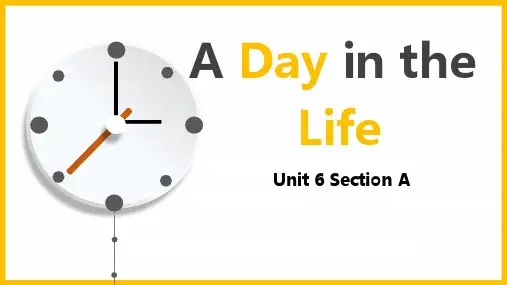
正读 It's seven thirty. It's thirty past seven.
倒读
It's half past seven.
30mins=half
What’s the time, Mr. Wolf?
Mr. Wolf
正读 It's seven forty-five. It’s fifteen to eight.
What’s the time, Mr. Wolf?
It’s a quarter past seven.
Review
What’s the time, Mr. Wolf?
It’s twenty past seven.
Review
What’s the time, Mr. Wolf?
It’s half past seven.
2c Read again and complete Tom’s school day timetable
英语人教版七年级上册Unit6section A1a-2d
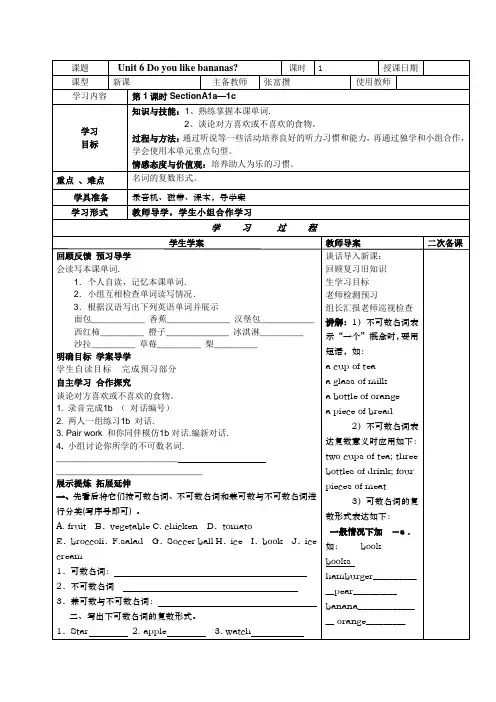
课题Unit 6 Do you like bananas? 课时 1 授课日期课型新课主备教师张富攒使用教师学习内容第1课时SectionA1a—1c学习目标知识与技能:1、熟练掌握本课单词.2、谈论对方喜欢或不喜欢的食物。
过程与方法:通过听说等一些活动培养良好的听力习惯和能力,再通过独学和小组合作,学会使用本单元重点句型。
情感态度与价值观:培养助人为乐的习惯。
重点、难点名词的复数形式。
学具准备录音机、磁带、课本,导学案学习形式教师导学,学生小组合作学习学习过程学生学案回顾反馈预习导学会读写本课单词.1.个人自读,记忆本课单词.2.小组互相检查单词读写情况.3.根据汉语写出下列英语单词并展示面包___________ 香蕉_____________ 汉堡包___________ 西红柿_________ 橙子_____________ 冰淇淋_________沙拉_________ 草莓_________ 梨_________明确目标学案导学学生自读目标完成预习部分自主学习合作探究谈论对方喜欢或不喜欢的食物。
1. 录音完成1b (对话编号)2. 两人一组练习1b 对话.3. Pair work 和你同伴模仿1b对话.编新对话.4.小组讨论你所学的不可数名词._______________________________________________________展示提炼拓展延伸一、先看后将它们按可数名词、不可数名词和兼可数与不可数名词进行分类(写序号即可) 。
A. fruit B.vegetable C. chicken D.tomato E.broccoli.F.salad G.Soccer ball H.ice I.book J.ice cream1.可数名词:2.不可数名词3.兼可数与不可数名词:二、写出下可数名词的复数形式。
1.Star 2. apple 3. watch 教师导案谈话导入新课:回顾复习旧知识生学习目标老师检测预习组长汇报老师巡视检查讲解:1)不可数名词表示“一个”概念时,要用短语,如:a cup of teaa glass of milka bottle of orangea piece of bread2)不可数名词表达复数意义时应用如下:two cups of tea; threebottles of drink; fourpieces of meat3)可数名词的复数形式表达如下:一般情况下加-s .如:bookbookshamburger____________pear__________banana_______________ orange_________二次备课4. photo 5.Backpack 6.Tomato7.key 8. bus9.strawberry 10.Dictionary达标测试效果反馈一、用所给单词的正确形式填空。
Unit6SectionA1a-1c课件人教版七年级英语上册
二、 根据图片提示完成句子。 1. — _D_o_ you like _st_r_a_w_b_e_r_r_i_e_s
— Yes, I do. I like _b_a_n_a_n_a_s_, too. 2. — _D_o_e_s_ your father like _p_e_a_r_s_
Do you like .... B: Yes, ..... \ No, ..... I like .... A、B、C: OK, let's have ....
grapes
mangoes
一、 选词填空。
Do you like ___ (strawberry/strawbe√rries) 2. Here are some ___ (tomatos/toma√toes). 3. Let’s ___ (h√ave / has) apples and bananas. 4. John likes ___ (m√ilk/milks) and bread. 5. Sam ____ (don’t /√doesn’t) like vegetable
9. milk e 10. bread a
1b Listen and number the
conversations [1-3].
2 A: Do you like salad
B: No, I don’t.
1 A: Do you like bananas
B: Yes, I do.
3 A: Do you like oranges
tomatoes oranges strawberries eggs
carrots
pears
hamburgers
eggs oranges apples bananas pears milk food ice-cream salad bread strawberries rice chicken carrots tomatoes
人教版七年级英语上册第六单元Section A (1a-2d)课件
3. oranges f 4. ice-cream h 5. salad b 6. bananas g
7. strawberries c 8. pears j
9. milk e 10. bread a
1b
Listen and number the conversations [1-3].
6. week n. 周;星期 Sunday is the first day of the week. 星期日是一周的第一天。 last week 上礼拜 this week 本周 next week 下周
7. think about 思考,思索
(一般是短时间的较仔细的考虑) What do you think about that? 你认为怎么样? I’ll have to think about it. 我得想一想。
以字母o结尾的有生命词,其 复数形式在词尾加-es。如图:
heroes
tomatoes
potatoes
[口诀] 英雄爱吃西红柿和马铃薯。
2. How about…? 相当于 What about…? 意 为 “……怎么样?”是一个用来征询别人 的 意见、向别人提建议的交际用语。about 是介词,后跟名词、代词或V-ing形式。 How about nine o’clock? 9点钟怎么样?
2d
Jack: Hey, John’s birthday dinner is next week. Let’s think about the food.
Tom: Sure. How about burgers, vegetable salad, and some fruit?
Unit 6 Section A Grammar Focus-3c 课件 人教版英语七年级上册
Grammar Focus
Do you like salad?
Do they like pears? Does she like tomatoes? I like oranges. We like rice. He likes ice-cream.
Yes, I do./No, I don't.
Yes, they do./No, they don't. Yes, she does./No, she doesn't. I don't like bananas. We don't like hamburgers. He doesn't like vegetables.
Complete the chart!
Food
Likes Doesn’t like
Ⅰ. 用所给单词的适当形式填空。
1. I like __t_o_m__a_to_e_s___(tomato) very much. 2. Nick ____l_ik_e_s_____(like) hamburgers and salad. 3. Let’s ___t_h_i_n_k_____(think) about the birthday dinner. 4. Ms. Smith has ten _s_t_r_a_w_b_e_r_r_ie_s_(strawberry)? 5. Hamburgers? That ___s_o_u_n_d_s____(sound) good. 6. My brother __d_o_e_s_n_’t_l_i_k_e_(not like) eggs. 7. His cousins ___d_o_n_’t__li_k_e__(not like) ice-cream.
2024年人教版初中英语七年级上册Unit1A(1a-1c)-课件
Good afternoon! 下午好!
Good evening! 晚上好!
How are you? 你好吗?
How do you do? 你好!(对话的双方
第一次见面时的礼貌用语)
Presentation
Words and expressions
我的
my
名字
name
是 时钟 我 好的,令人愉快的
学练优英语教学课件
七年级(上)
Unit 1
学练优七年级英语上(RJ) 教学课件
My name’s Gina.
Section A (1a-1c)
学习目标
➢ Key words & phrases:
name, nice, to, meet, too, your, Ms.
➢ Key sentences:
写出图中物品的英语单词。你能写几个?
orange teacher boy glasses cap eyes ruler hair ball
clock student girl book nose bag shoes tie hand
orange
clock
glasses
book
cap
bag
ruler tie
A: Nice/Glad to meet/see you!
B: Nice/Glad to meet/see you, too!
Homework
➢ 书面作业 (Writing work)
(1)默写所学的新单词 (2)课时训练 Unit 1 第一课时
➢ 口头作业 (Oral work)
(1)练习1b中的对话 (2)运用所学句型与同伴编新对话