
四年级下册英语知识点汇总
四年级下册英语知识点汇总 module1 a: Words nice 友好的 clever 聪明的 naughty 淘气的 shy 害羞的 bad 不好的 cool 酷的 big 年龄较大的 little 幼小的 cute 可爱的 aunt姨母,姑母 uncle 舅父,叔父 b: Phrases a bit 稍微,有点儿 answer the call 接电话 c:Sentences and Grammar 1:This is + 人物. 主语+be +a/an +adj+n. eg: This is my mother. She's a nice teacher. 2: Can you answer the call now? 你能接一下电话吗? module2 a: Words city 城市 ship 轮船 beautiful 美丽的 whose 谁的 close 接近的 old 古老的 famous 著名的 b: Phrases be close to接近 c:Sentences and Grammar 1: This is + 地点. 主语+be+adj. eg: This is Big Ben. It's very old. 2: Whose house is it? 这是谁的房子? It's the Queen's house. 这是女王的房子。 3:Is it your house? 它是你的房子吗? No,it isn't. 不,它不是。 module3 a: Words robot 机器人 will 将,将会 Monday 星期一 Tuesday 星期二 Wednesday 星期三 Thursday 星期四 Friday 星期五 Saturday 星期六 Sunday 星期天 have 有 b: Phrases one day 将来有一天 do the housework 做家务活 do the homework 做作业 help children learn 帮助孩子们学习 will not =won't 将不会 on Friday 在周五 next week 下周 on holiday 在度假 c: Sentences and Grammar 1: 主语+will + V原型. eg: Robot will do everything. 机器人将做所有的事情。 2:— What will you do on Sunday? 在星期天你准备做什么? — I will play football. 我将要踢足球。 3: Next week is a holiday. 下周将是一个假期。 module4 a: Words take 带,拿 fly 飞 great 太好了 why 为什么 because 因为 so 所以 cloudy 多云的 weather 天气 b: Phrases have a picnic 去野餐 take a ball 带一个球 c: Sentences and Grammar 1: Will + 主语+ V 原型? eg: Will you take your ball? 你将要带你的球吗? Yes, 主语 will. Yes, I will 是的,我将要带。 No, 主语 won't. 2: Why not? 为什么不呢? Because tomorrow is Friday. 因为明天是星期五。 3: We're going to have a picnic on Saturday. 在周六我们将要去野餐。 4: It will be sunny in Beijing. 北京的天气将是晴朗的 module5 a: Words then 当时,那时 was 是(am.is的过去式) were 是 (are的过去式) young年轻的 old 年老的 short 短的 long 长的 clean 干净的 dirty 脏的 hair 头发 b: Grammar and sentences 1: 主语+was/were +其他. eg: I was short then. I'm tall now. 2: 主语+ wasn't/weren't +其他. eg: I wasn't old then. 3: Who is that little girl?那个女孩是谁? It's me. 它是我。 module6 a: Words yesterday 昨天 out 不在家的 well 健康的 thanks 谢谢 sun 太阳 lesson 课程 village 村庄 b: Phrases play in the sun 在阳光下玩 at home 在家 c: Grammar and sentences 1: Were +主语 +其他? eg: Were you at home yesterday?你昨天在家吗? Yes, 主语 were. Yes, I was. No, 主语 were't. No, I wasn't. 2: Was + 主语 +其他? eg: Was it a big city then? 它之前是一个大城市吗? Yes, it was. No, it wasn't. 3:I want to play in the sun. 我想要在阳光下玩耍。 module7 a: Words had 度过(have的过去式) phone 打电话 cook 烹调 really 真的 wash 洗 did 助动词(do的过去式) computer 电脑 love 爱,喜欢 Mrs 太太,夫人 Miss 小姐 b: Phrases help Mum 帮助妈妈 row a boat 划船 cook noodles 煮面条 wash clothes洗衣服 watch TV 看电视play on the computer玩电脑phone Grandma给奶奶打电话 walk in the park 在公园散步 listen to music 听音乐 talk with some friends 和朋友们交谈 module8 a: Words sang 唱歌(sing的过去式) beautifully 优美地,动听地 saw 看见(see的过去式) game 游戏 went 去(go的过去式) there 在那儿 ate吃(eat的过去式) drank喝,饮(drink的过去式) time 一段时间 busy 忙的 tell告诉 great 非常好的 took拍摄(take的过去式) delicious 美味的 made制作(make的过去式) b: Phrases eat some food 吃一些食物 drink some drinks 喝一些饮料 play games 玩游戏 had a good time 度过美好的一天take some pictures 拍一些照片 make a poster制作海报 c: Grammar and sentences 1: 主语+ V 过去式 +其他. eg: I took some photos. 我拍了很多照片。 2: We went there by bus. 我们坐公交车去的那。 3: They sang beautifully. 他们唱的很动听 。 4:Tell me about your picnic. 告诉我关于你的野餐。 5: We ate lots of delicious food. 我们吃了很多美味的食物。 module9 a: Words welcome 欢迎 postcard 明信片 cousin 表兄弟 dear 亲爱的 travel 旅行 concert音乐会 came 来(come的过去式)earth 地球 b: Phrases welcome to…欢迎来到… last year去年 went to a pop concert去一场流行音乐会 go to a basketball game 去看一场篮球比赛 travel by plane 乘坐飞机旅行 visit New York参观纽约 have a nice holiday 度过美好的假期 on holiday 在度假 go to the earth 去地球 c: Grammar and sentences 1: Did + 主语+ V 原型+ 其他? eg: Did he live in Beijing? 他住在北京吗? Yes, 主语+ did. Yes, he did. No, 主语+didn't. No, he didn't. 2: Welcome to China. 欢迎来到中国。 3:It's a postcard from my friend Sam. 这是来自我朋友萨姆的明信片。 4: Look at these photos. 看这些照片。 module10 a:words fell掉下,落下(fall的过去式) found 发现,找到(find的过去式) town城镇 happen 发生 ride 骑车 then 然后 thirsty 口渴的 water 水 watermelon西瓜 bought 买(buy的过去式) carried拿,搬(carry的过去式) hospital医院 chocolate巧克力 stomach ache 胃疼 cold感冒 headache 头疼 fever 发烧 b: Phrases go up the hill 上山 fall off the bike从自行车上掉下来 fall down 摔倒 find a town 发现一个城镇 went for a ride bike 骑车 buy some water 买一些水 carry the watermelon 搬西瓜 bump my head 撞了我的头 have a cold 感冒 have a fever 发烧 have a headache 头疼 have a stomach ache 胃痛 have lots of chocolate吃了很多巧克力 c:Sentences 1: What happened to you? 你发生了什么? 2: Sam and I went for a ride bike yesterday. 昨天萨姆和我骑车去了。 3: We were hungry. 我们饿了。 4: I had lots of chocolate,so today I have got a stomach ache. 我吃了很多巧克力,所以今天我肚子疼。
人教版PEP四年级英语下册知识要点汇总(预习必备)

人教版PEP四年级英语下册知识要点汇总(预习必备)Unit 1 My school (我的学校)一、词汇:地点(locations):home家room房间bedroom卧室bathroom卫生间living room起居室kitchen厨房classroom教室school学校park公园library图书馆bookstore书店farm农场zoo动物园garden花园study书房playground操场teacher’s office教师办公室library图书馆gym体育馆art room绘画教室computer room计算机教室music room音乐教室TV room电视机房shop 商店指示代词:this 这,这个(通常指空间上离我们较近的单数物品) that 那,那个(通常指空间上离我们较远的单数物品)二、重点句型:A: Where is the library? 图书馆在哪里?B: It’s on the second floor. 它在二楼。
A: How many students are there in your class? 你班有多少个学生?B: Forty-five students. 四十五个学生。
It is a computer. 它是一台计算机。
This is my school. 这是我的学校。
That is the playground. 那是操场。
Is this the art room? 这是美术教室吗?Yes, it is. No, it isn’t.Is that the teacher’s office? 那是教师办公室吗?Yes, it is. No, it isn’t.Is it a computer? 它是计算机吗?Yes, it is. No, it isn’t.A: Do you have a playground? 你们(学校)有操场吗?B: Yes, we/I do. No, we/I don’t.是的,有。
人教版英语四年级下册1-6单元知识要点
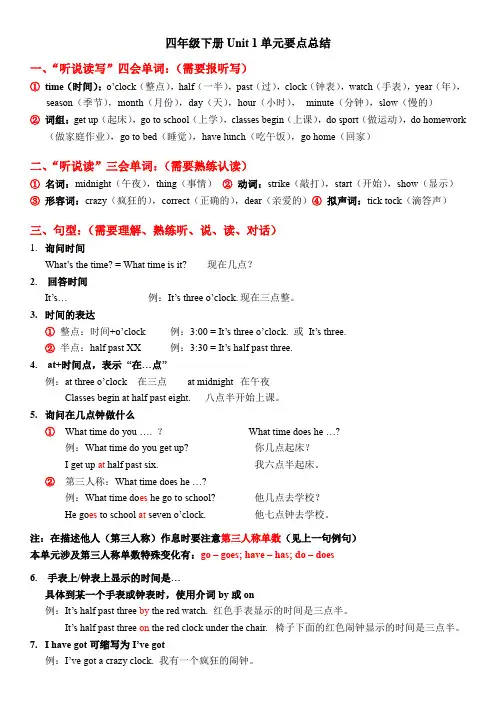
四年级下册Unit 1单元要点总结一、“听说读写”四会单词:(需要报听写)①time(时间):o’clock(整点),half(一半),past(过),clock(钟表),watch(手表),year(年),season(季节),month(月份),day(天),hour(小时),minute(分钟),slow(慢的)②词组:get up(起床),go to school(上学),classes begin(上课),do sport(做运动),do homework(做家庭作业),go to bed(睡觉),have lunch(吃午饭),go home(回家)二、“听说读”三会单词:(需要熟练认读)①名词:midnight(午夜),thing(事情)②动词:strike(敲打),start(开始),show(显示)③形容词:crazy(疯狂的),correct(正确的),dear(亲爱的)④拟声词:tick tock(滴答声)三、句型:(需要理解、熟练听、说、读、对话)1.询问时间What’s the time? = What time is it? 现在几点?2. 回答时间It’s…例:It’s three o’clock. 现在三点整。
3.时间的表达①整点:时间+o’clock 例:3:00 = It’s three o’clock. 或It’s three.②半点:half past XX 例:3:30 = It’s half past three.4. at+时间点,表示“在…点”例:at three o’clock 在三点at midnight 在午夜Classes begin at half past eight. 八点半开始上课。
5.询问在几点钟做什么①What time do you …. ?What time does he …?例:What time do you get up? 你几点起床?I get up at half past six. 我六点半起床。
人教精通版四年级英语下册期末知识点汇总
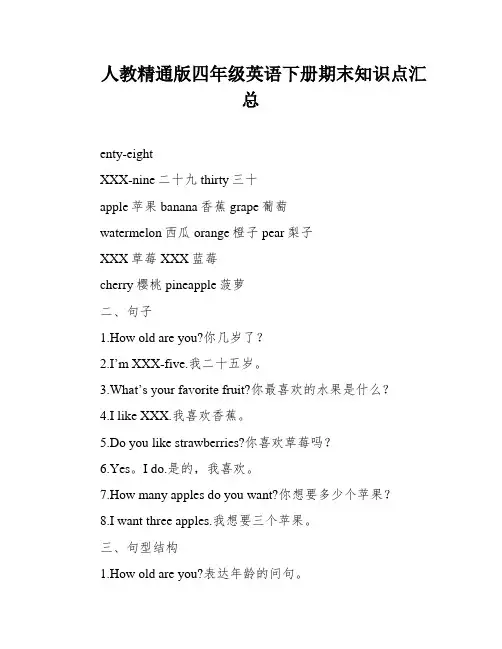
人教精通版四年级英语下册期末知识点汇总enty-eightXXX-nine二十九thirty三十apple苹果banana香蕉grape葡萄watermelon西瓜orange橙子pear梨子XXX草莓XXX蓝莓cherry樱桃pineapple菠萝二、句子1.How old are you?你几岁了?2.I’m XXX-five.我二十五岁。
3.What’s your favorite fruit?你最喜欢的水果是什么?4.I like XXX.我喜欢香蕉。
5.Do you like strawberries?你喜欢草莓吗?6.Yes。
I do.是的,我喜欢。
7.How many apples do you want?你想要多少个苹果?8.I want three apples.我想要三个苹果。
三、句型结构1.How old are you?表达年龄的问句。
2.I am + 年龄.回答年龄。
3.XXX 名词?询问最喜欢的事物。
4.I like + 名词.回答最喜欢的事物。
5.Do you like + 名词?询问是否喜欢某物。
6.Yes。
I do。
/ No。
I don’t.回答是否喜欢某物。
7.How many + 名词 + do you want?询问想要多少某物。
8.I want + 数字 + 名词.回答想要的数量。
XXX-seven。
XXX-eight。
XXX-nine。
XXX。
XXX。
thirty。
forty。
fifty。
sixty。
XXX。
eighty。
y。
one hundred。
boy。
girl。
student。
school。
bag。
book。
pen。
pencil.Good afternoon。
I would like to introduce Mr。
Gao。
our new PE teacher。
How many students are in your class。
There are twenty-nine students in our class。
四年级下册英语外研一起点知识要点汇总
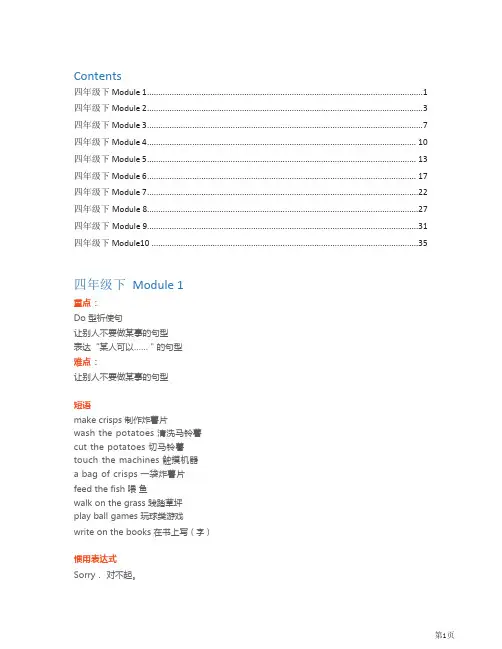
Contents四年级下Module 1 (1)四年级下Module 2 (3)四年级下Module 3 (7)四年级下Module 4 (10)四年级下Module 5 (13)四年级下Module 6 (17)四年级下Module 7 (22)四年级下Module 8 (27)四年级下Module 9 (31)四年级下Module10 (35)四年级下Module 1重点:Do 型祈使句让别人不要做某事的句型表达“某人可以……"的句型难点:让别人不要做某事的句型短语make crisps 制作炸薯片wash the potatoes 清洗马铃薯cut the potatoes 切马铃薯touch the machines 触摸机器a bag of crisps 一袋炸薯片feed the fish 喂鱼walk on the grass 践踏草坪play ball games 玩球类游戏write on the books 在书上写(字)惯用表达式Sorry.对不起。
Look! 看核心句型1.Don't touch the machines, please!请不要触摸这些机器解读这是劝告他人不要做某事的句子。
2.You can each have a bag of crisps.你们每个人都可以拥有一袋炸薯片。
解读这是表达“某人可以……"的句子。
了解句型1.The baby is sleeping.这个婴儿正在睡觉。
解读这是表达某人正在做某事的句子。
2.Sing for the baby! 为婴儿唱歌!解读这是建议他人做某事的 Do 型肯定祈使句。
Unit 1 知识点精析1.Don't touch the machines, please!请不要触摸这些机器。
这是劝告他人不要做某事的句子。
【句型结构】Don't+动词(短语)原形(+其他)【噩点解析】这是一个 Do 型祈使句的否定形式。
人教精通版四年级英语下册各单元知识点总结
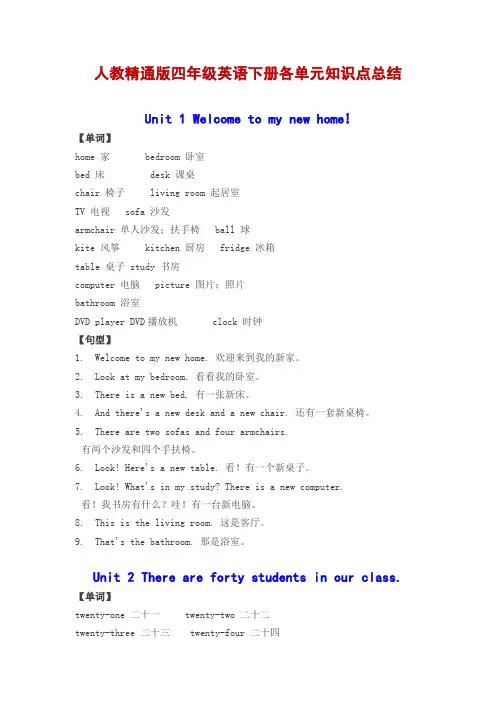
人教精通版四年级英语下册各单元知识点总结Unit 1 Welcome to my new home!【单词】home 家bedroom 卧室bed 床desk 课桌chair 椅子living room 起居室TV 电视sofa 沙发armchair 单人沙发;扶手椅ball 球kite 风筝kitchen 厨房fridge 冰箱table 桌子 study 书房computer 电脑picture 图片;照片bathroom 浴室DVD player DVD播放机clock 时钟【句型】1. Welcome to my new home. 欢迎来到我的新家。
2. Look at my bedroom. 看看我的卧室。
3. There is a new bed. 有一张新床。
4. And there's a new desk and a new chair. 还有一套新桌椅。
5. There are two sofas and four armchairs.有两个沙发和四个手扶椅。
6. Look! Here's a new table. 看!有一个新桌子。
7. Look! What's in my study? There is a new computer.看!我书房有什么?哇!有一台新电脑。
8. This is the living room. 这是客厅。
9. That's the bathroom. 那是浴室。
Unit 2 There are forty students in our class. 【单词】twenty-one 二十一twenty-two 二十二twenty-three 二十三twenty-four 二十四twenty-five 二十五twenty-six 二十六twenty-seven 二十七twenty-eight 二十八twenty-nine 二十九eleven 十一twelve 十二thirty 三十forty 四十boy 男孩girl 女孩fifty 五十sixty 六十teacher 教师school 学校seventy 七十eighty 八十bag 书包book 书ninety 九十one hundred 一百pen 钢笔pencil 铅笔【句型】1. Good afternoon, boys and girls! 下午好,男孩女孩们!2. —How many students are there in your class? —Twenty-nine.你们班有多少学生?二十九个。
人教版四年级英语下册语法知识点总结
人教版四年级英语下册语法知识点总结四年级下册的英语学习内容主要包含了一些基础的语法知识点。
在本文中,我将对这些知识点进行总结和整理,以帮助学生更好地掌握和理解英语语法。
一、时态1. 现在时态(Present Tense):表示目前正在进行或经常发生的动作。
2. 过去时态(Past Tense):表示过去发生的动作或状态。
3. 将来时态(Future Tense):表示将来要发生的动作或状态。
二、名词(Noun)1. 可数名词(Countable Noun):可单独计数的名词,前面可以加不定冠词"a"或"an"。
2. 不可数名词(Uncountable Noun):不能单独计数的名词,前面通常不加不定冠词。
3. 复数形式:名词变为复数形式的规则及特殊变化。
三、代词(Pronoun)1. 主格代词(Subject Pronoun):代替句子中的主语。
2. 宾格代词(Object Pronoun):代替句子中的宾语。
3. 物主代词(Possessive Pronoun):用来表示所属关系。
四、形容词(Adjective)1. 形容词的基本用法:用来描述名词。
2. 比较级和最高级:形容词的比较级和最高级的构成及用法。
五、副词(Adverb)1. 副词的基本用法:用来修饰动词、形容词、副词等。
2. 比较级和最高级:副词的比较级和最高级的构成及用法。
六、介词(Preposition)1. 介词的基本用法:表示位置、方向、时间、原因等。
2. 常见的介词:常用的介词及其正确用法。
七、连词(Conjunction)1. 表示并列关系的连词:and, but, or等。
2. 表示选择关系的连词:either...or, neither...nor等。
3. 表示原因关系的连词:because, so等。
八、冠词(Article)1. 不定冠词(Indefinite Article):a和an的使用。
小学四年级英语下册知识点及复习要点
人教版小学四年级英语下册知识点及复习要点第一单元our school一、对应词my ---your I ---you our---your this --- thathere----there yes----no e----go teacher----studentboy----girl his---her二、知识点1、表示在几楼上,要用介词on,如on the first floor.在一楼。
The first表示第一的,序数词在使用时前面一定要加the,表示事物的排列顺序。
2、介绍离自己近的事物时用this is ?.,介绍离自己比拟远的事物时用that is?如:This is my puter.这是我的计算机。
Thatis your puter.那是你的计算机。
3、how many??多少?用来询问物品的数量有多少,后面只能跟名词的复数形式。
如Howmany books do you have?你有多少本书?4、当表示有一个时,名词的前面可以用a或者an.元音前用an ,辅音前用a.如an apple一个苹果an orange一个橙子apear一个梨a dog一只狗5、当用Is this?? Is that??提问时,一般用肯定答复是:Yes, it is.否认是: No , it isn’t.三、句子:1、This is the teacher’s office.这是教师办公室。
2、That is my classroom.那是我的教室。
3、Go to the library. Read a story-book..去图书馆。
读故事书。
4、Is this the library? Yes, it is.这是图书馆吗?是的。
5Isthat the art room? The art room is on the second floor.那是美术室吗?不是,美术室在二楼。
6、Whereis the canteen? Its on the first floor.食堂在哪里?在一楼。
人教版四年级英语下册语法知识点总结
人教版四年级英语下册语法知识点总结一、名词单数变为复数形式:1. 一般情况加s2. 以s,x,sh,ch结尾,加es3. 不可数名词和不可数名词的复数形式:一般词意变化即可二、现在进行时:1. 构成:be+doing2. 主语为第三人称单数时,加s/es3. 常用的时间副词:now,常用的时间介词:at(在)现在时刻,in(在)将来时刻三、一般现在时:1. 构成:be动词或实意动词(do)加动词原形2. 表示经常性、习惯性动作或客观真理、客观存在、一般情况3. 主语为第三人称单数时,加s/es,实意动词变第三人称单数形式四、指示代词:1. this这一,这些,后接名词单数形式2. that那,那些,后接名词复数或代词形式3. these是this的复数形式,后接名词复数形式4. those是that的复数形式,后接名词复数形式五、一般疑问句:1. 含be动词的疑问句:把be动词提到句首即可2. 含实意动词的疑问句:第一部分改为助动词do/does,根据句意用原形;也可用缩写形式,如do(do的缩写形式可表示“经常做某事”,与含有be动词的一般疑问句相呼应)然后提出一般疑问句,句中动词根据情况变化形式。
注意含有be动词的一般疑问句也直接把be 提到主语前,回答时用yes或no并缩写相关be动词。
含实意动词的一般疑问句肯定回答用yes,用yes+动词原形,否定回答用no+主语+其他。
六、祈使句:肯定祈使句:+yes或OK!/Certainly!/OK!/With pleasure!等。
否定祈使句:Don't+动词原形!或者Let's+祈使动名词或者直接否定主语(即第一人称)。
或者let us(省略I)+动词原形(不加逗号)亦可表示否定的祈使句。
不要出现感叹词!尽量用一般现在时表达个人请求或者强烈建议等语境。
【口袋书】人教版PEP四年级下册英语 基础知识汇总
人教版PEP四年级下册基础知识汇总Unit 1 My school.重点单词:[三会]library 图书馆playground 操场[二会]homework 作业class 班;班级forty 四十way 方向重点短语:first floor 一楼second floor 二楼next to 紧邻;在…近旁art room 美术教室music room 音乐教室computer room 计算机房go to the library 去图书馆go to the teachers' office 去教师办公室go to the garden 去花园read a book 读书play football 踢足球water the flowers 浇花how many 多少this way 这边字母组合er 在单词中的发音:water 水tiger 老虎sister 姐,妹computer 电脑dinner 正餐重点句型:1.询问位置的句型: Where + be 动词+ 名词/代词?Where's the library? 图书馆在哪里?2.确认单个事物的句型: Is this/that + 名词?Is this the teachers' office? 这是教师办公室吗?3.询问可数名词数量的句型: How many + 名词复数+ are there(+ 其他)?How many students are there in your class? 你们班里有多少名学生?4.询问对方是否有某物的句型: Do you have + 名词?Do you have a library? 你们有图书馆吗?重点语法:1.序数词的用法(1)回答楼层用序数词。
-- Where's the music room? 音乐教室在哪里?-- It's on the second floor. 它在二楼。
最新版四年级英语下册知识点总结
最新版四年级英语下册知识点总结最新版四年级英语下册知识点总结小学英语是一门很有趣的课程,可以启迪孩子的心智,可以培养孩子的文学素养,应届毕业生店铺今天为您带来了四年级英语下册知识点总结,希望能对您的学习有帮助。
Unit 1 Our new house .一、词汇1、 whose 谁的,who(所有格) whose 。
2、 where 在哪儿,where(同义词)wear(穿,戴)。
3、watch 看(动词),watch(第三人称单数) watches 。
也可当名词,意为:手表(名词),watch(复数) watches 。
4、study 书房(名词),还可当动词,意为:学习(动词)。
eg:He often studies in his study。
5、big 大,big(反义词) small 。
6、too 也,太,too(同音词) two 。
7、clean 干净的(形容词),还可以当动词,意为:打扫,整理。
eg:clean the room 打扫房间二、短语1、 whose home 谁的家2、welcome to 欢迎来到……3、 small but clean 小但是干净4、hide and seek 捉迷藏5、look out 注意6、big and beautiful 既大又漂亮7、 under the bed 在床下8、living room 客厅9、dining room餐厅三、句型1、What’s in your new house ?2、 There are two bedrooms .3、 Where do you watch TV ?4、 Our livingroom is not very big,but it’s beautifu .Unit 2 I’m cooking in the kitchen .1、run (现在分词) running2、swim (现在分词) swimming3、sit (现在分词) sitting4、make (现在分词) making5、have (现在分词) having6、write (现在分词) writing7、dance (现在分词) dancing8、cook 做饭(动词),也可当名词讲,意为:厨师。