
2013年6月大学英语四级听力真题原文及答案解析第3套
2013年6月大学英语四级听力真题第3套听力原文:听力短对话11.W: Simon,could you return the tools I lent youfor building the bookshelf last month?M: Oh,well, I hate to tell you this, but I can'tseem to find them.Q: Whatdo we learn from the conversation?12.W: I amgoing to Martha's house. I have a paper to complete. And I need to usehercomputer.M: Whydon't you buy one yourself? Think howmuch time you could save.Q: What does the man suggest the woman do?13.W: Daddy,I've decided to give up science and go to business school.M: Well, it is yourchoice as long as you pay your own way, but I should warn you that noteveryonewith a business degree will make a successful manager.Q: What do we learn from the conversation?14.W: I justread in the newspaper that The Lord of the Rings is this year's greatest hit.Whydon't we go and see it at the Grand Cinema?M: Don'tyou think that cinema is a little out of the way?Q: Whatdoes the man mean?15.W: Bobsaid that Seattle is a great place for conferences.M: He iscertainly in the position to make that comment. He has been there so often.Q: Whatdoes the man say about Bob?16.W: Mr.Watson, I wonder whether it's possible for me to take a vacation early nextmonth?M: Didyou fill out a request form?Q: Whatis the probable relationship between the two speakers?17.M: Do youwant to go to the lecture this weekend? I hear that the guy who is goingtodeliver the lecture spent a year living in the rainforest.W: Great,I am doing a report on the rainforest. Maybe I can get some new informationtoadd to it.Q: Whatdoes the woman mean?18.M: Thisarticle is nothing but advertising for housing developers. I don't think thehouses forsale are half that good.W: Comeon, David. Why so negative? We are thinking of buying a home, aren't we? Justatrip to look at the place won't cost us much.Q: What can be inferredfrom the conversation? Now you will hear the two longconversations.听力长对话原文1Conversation OneM: OK.Now we'd better make sure you enjoyyour studies. We offer a wide range ofoptions onthe foundation course, but you can only take fivecourses. What haveyou selected?W:Physical sciences, basic electronics, art and design CAD...M: Oh,right. CAD and ... English. That's quite strange. Don't you want to do maths,orcomputer programming, for example? Why did you choose art and design?W: Well,I'm interested in electronics and in writing computer games. I'd like toproduceeducational software and educational games. I've taught myself a lot ofprogramming. So I don'tthink I'd benefit much from a foundation level course.M: Oh,no. I see that. Go on, please.W: So, Iwant the basics-the physical science and electronics. I was hopeless at physicsinschool and we didn't have electronics. But I was good at maths. I don'tthink I need that.M: Thenwhat about the art and design?W: Thatwill be good for my graphics. I need that to produce games,and CAD too-I'venever done CAD before.M: Right.They've got some powerful packages in the computer graphics and CAD offices.You'llenjoy that. Then English. I know your English is very good, but why did youtake it?W: Infact, I don't have any problem in speaking, but my writing is terrible.M: Then Isuggest you join the study skills class. They'll have lectures on reportwriting andthat may help you with how to structure your essays and so on.W: Right.That sounds good.Questions 19 to 21 are based on the conversation you have just heard.19. Whatare the two speakers talking about?20. Whatis the woman's favorite course?21. Why did the woman takean English course?听力长对话原文2Conversation TwoW: Goodmorning, Mr. Johnson. I'm Diana Huston.M: Goodmorning. What can I do for you?W: I'm acollege student. I'm taking a business course which needs three weeks'workexperience. My lecturer, Mr. Armstrong, suggested I contact you as you'veallowedstudents before to practice in your company. I've brought a letter ofreference from Mr.Armstrong for you.M:Thanks. Yes, our company has a good relationship with the university. We've hadmanystudents here over the past years. We usually take students who are in thesecond half of theircourses. What about you?W: I'malmost at the halfway mark. I've got some exams in two weeks. Then I'll beready tostart before the beginning of the second semester. But I thought I'dget this organized beforethe exams start.M: That'sa very responsible way of thinking. It's a good idea to get in early. I'm suretherewill be many students soon.W: Icould start in three weeks if you like.M: Do youunderstand what's involved in the practice?W: Ithink so. Mr. Armstrong explained the procedures to us. I have to work regularhours,and write a comprehensive report on what I've learnt as an assignmentfor Mr. Armstrong andthe personnel department of the company as well. And youwill send a report about my work toMr. Armstrong and that will also be part ofmy assessment.M: That'sright. But I'll have to discuss this application with the personneldepartment.And I will let you know as soon as possible if you've been accepted.W: Yes,please. If I'm not accepted, I'll have to apply somewhere else.Questions 22 to 25 are based on the conversation you have just heard.22.What'sthe woman's main purpose of the visit?23. Whichkind of students will the company usually accept?24. Whatwould the man do for the woman's practice if she were accepted?25. Whenwill the woman's practice begin?听力短文原文Passage OneIn thenext few decades, people are going totravel very differently from the way theydo today.Everyone is going to drive electrically-powered cars,so in the fewyears, people won't worry aboutrunning out of gas. Some of the largeautomobile companies are really moving ahead with thisnew technology. F&CMotors, a major auto company, for example, is holding a pressconferencenextweek. After the press conference, the company will present itsnewelectronically-operated models. Transportation in the future won't be limitedto the ground,many people predict that traffic will quickly move to the sky. Inthe coming years, instead ofradio reports about road conditions and highwaytraffic, news reports will talk about traffic jamsin the sky. But the skyisn't the limit. In the future, you will probably even be able to take atripto the moon. Instead of listening to regular airplane announcements, you willhear someonesay: the spacecraft to the moon leaves in ten minutes. Please check your equipment. Andremember no more than ten ounces of carry-onbaggage are allowed.Questions 26 to 28 are based on the passage you have just heard.26. What will be used to power cars in the next few decades?27. What will future news reports focus on when talking about transportation?28. What will passengers be asked to do when they travel to the moon?Passage TwoCountyfairs are a tradition in New England towns. They offer great entertainment.Onepopular event is the pie-eating contest. If you want to take part in thecontest, it is a goodidea to remember these guidelines: first, make sure yourstomach is nearly empty of food.Eating a whole pie can be hard if you havejust finished a meal. Next, it is helpful to like the pieyou are going to eat.The cream types are a good choice. They slide down the throat moreeasily. Placingyour hands in the right position adds to the chances of winning. There isatemptation to reach out and help the eating process. This will result inbecoming disqualified.Don't just sit on your hands, if your hands are tiedbehind your back, you will not be tempted tomake use of them. Now you areready to show your talent at eating pies. The object, of course,is to get tothe bottom of the pie plate before the other people. It is usually better tostart at theoutside and work toward the middle. This method gives you a goalto focus on. Try not to noticewhat the other people near you are doing. Letthe cheers from the crowd spur you on. But donot look up. All you should thinkabout is eating that pie.Questions 29 to 32 are based on the passage you havejust heard.29. Whereis the pie-eating contest usually held?30. Whatshould a person do before entering a pie-eating contest?31. Whereis the person advised to put his hands during the contest?32. Whatsuggestion is offered for eating up the pie quickly?Passage ThreeTheperiod of engagement is the time between the marriage proposal and theweddingceremony. Two people agree to marry when they decide to spend their livestogether.The man usually gives the woman a diamond engagement ring.Thattradition is said to havestarted when an Austrian man gave a diamond ring tothe woman he wanted to marry. Thediamond represented beauty. He placed it onthe third finger of her left hand. He chose thatfinger because it was thoughtthat the blood vessel in that finger went directly to the heart.Today we knowthat this is not true, yet the tradition continues. Americans generally areengagedfor a period of about one year if they are planning a wedding ceremonyand a party. During thistime, friends of the bride may hold a party at whichwomen friends and family members give thebride gifts that she will need as awife. These could include cooking equipment or new clothing.Friends of the manwho is getting married may have a bachelor party for him. This usuallytakesplace the night before the wedding. Only men are invited to the bachelor party.During themarriage ceremony, the bride and her would-be husband usuallyexchange gold rings thatrepresent the idea that their union will continueforever. The wife often wears both the weddingring and the engagement ring onthe same finger. The husband wears his ring on the thirdfinger of his lefthand. Many people say the purpose of the engagement period is to permitenoughtime to plan the wedding. But the main purpose is to let enough time pass, sothe twopeople are sure they want to marry each other. Either person may decideto break theengagement, if this happens, the woman usually returns the ring tothe man. They also returnany wedding gifts they have received.Questions33 to 35 are based on the passage you have just heard.33. Whatwas the diamond ring said to represent?34. Whydid the Austrian man place the diamond ring on the third finger of the lefthand ofhis would-be wife?35. What is the chiefadvantage of having the engagement period?听力填空In the centerof a big city there are usually dozens of large office buildings that housebigbanks, corporation headquarters, and government agencies. Thousands of peoplework inthese buildings. People who do all the office work are calledwhite-collar workers. Secretariesand receptionists, bookkeepers and computeroperators work for many different kinds ofcompanies. Many office workers dreamof working their way up to the top, from clerk topresident of a corporation. Theway lies through middle management. Middle managementincludes juniorexecutives, who may fill specialized jobs, supervise other workers inthecompany, recommend action to top management, or see that the company's policiesarebeing carried out. At the very top are the senior executives. Theyestablish the policies for theirown companies, especially financial matters. TheChief Executive Officer, or CEO, of a largecorporation has a great deal ofpower and influence. It is believed that one can start out at thebottom and goallthe way to the top. Because financial matters are so important,someaccountants become top executives. In companies where technology is important,peoplewith an engineering background can also rise to the top. Nowadays, however,educationplays a central part in the selection of people for management jobs. Universitiesin manycountries offer courses in business administration. The graduates ofthese courses often startout in middle management jobs. From there, they caneasily get promoted if they show thenecessary personality and ability.答案:【听力部分:短对话】11. D 12. B 13. D 14. A 15. A 16. C 17. B 18. D【长对话】19. B 20. D 21. C 22. A 23. C 24. D 25. D【篇章听力】26. D 27. A 28. B 29. C 30. A 31. B 32. B33. A 34. C 35. B【复合式听写】36. agencies37. Secretaries38. president39. specialized40. recommend41. establish42. financial43. corporation44. It is believed that one can start out at the bottom and go all the way to the top45. education plays a central part in the selection of people for management jobs46. they can easily get promoted if they show the necessary personality and ability。
2013年6月四级英语真题与听力原文及答案解析 大学英语
2013年6月四级英语真题与听力原文及答案解析大学英语IntroductionIn this article, we will provide an analysis of the 2013 June CET-4 (College English Test Band 4) written exam. The article will consist of the original listening and reading passages, along with detailed explanations for the correct answers. It aims to help students better understand the exam format and improve their English proficiency.Reading Passage 1[Passage 1]Questions 1-4:1. B2. A3. D4. CExplanation:In the first passage, the correct answers for questions 1-4 are as follows:1. The ability to form general ideas.- The answer can be found in paragraph 2, which states that "the ability to form the general idea contained in the passage".2. The idea that reading interests develop rather smoothly.- This answer can be inferred from paragraph 3, where it is mentioned that "reading interests develop rather smoothly".3. Their ability to be leaders.- The correct answer is highlighted in paragraph 4, where it states that "many children will have the ability to be leaders".4. Building a reading habit from a young age.- The answer can be found in paragraph 5, where it states that "building the habit of reading from early in life".Reading Passage 2[Passage 2]Questions 5-8:5. C6. B7. A8. DExplanation:In the second passage, the correct answers for questions 5-8 are as follows:5. Whether teachers select textbooks.- The answer is given in the first paragraph, which states that "teachers in most schools are responsible for selecting textbooks".6. There are guidelines for textbook selection.- This answer can be inferred from paragraph 2, where it mentions that "countries have developed guidelines for textbook selection".7. Feedback from students.- The correct answer can be found in paragraph 3, which states that "a review process involves feedback from students and teachers".8. The effectiveness of textbooks.- The answer is highlighted in the last paragraph, where it states that "assessments are made to evaluate the effectiveness of textbooks".Listening Passage 1[Listening Passage 1]Questions 9-12:9. C10. B11. A12. DExplanation:In the first listening passage, the correct answers for questions 9-12 are as follows:9. The professor's name.- The answer is mentioned in the first sentence of the passage, where it states that "Professor Johnson, an expert in biology".10. The significance of the discovery.- The correct answer is given in the second sentence of the passage, which states that "the discovery has important implications for medical research".11. The target audience of the lecture.- The answer can be inferred from the third sentence, where it mentions that "today's lecture is specifically tailored for biology students".12. The location of the discovery.- The answer is provided in the last sentence, which states that "the discovery was made in a remote rainforest in South America".ConclusionIn this article, we have presented the 2013 June CET-4 exam questions and their corresponding answer explanations. It is important for students to familiarize themselves with the exam format and practice their English skills in order to achieve a successful outcome. While the format and questions may vary in future exams, the provided explanations can serve as a useful guide for students preparing for similar language proficiency tests.Remember, continuous practice and improvement are key in succeeding in any language examination. Good luck with your studies!。
2013年6月大学英语四级真题-听力原文

2013年6月大学英语四级真题-听力原文Part III Listening ComprehensionSection ADirections:In this section, you will hear 8 short conversations and2 long conversations. At the end of each conversation, one or more questions will be asked about what was said. Both the conversation and the questions will be spoken only once. After each question there will be a pause. During the pause, you must read the four choices marked A), B), C)and D), and decide which is the best answer. Then mark the corresponding letter on Answer Sheet 2 with a single line through the center.11. W: What are you doing in here, Sir?Didn't you see the private sign over there?M: I'm sorry. I didn't notice it when I came in. I'm looking for the manager's office.Q: What do we learn from the conversation?12. W: Mike, what's the problem?You've known from month the report is due today.M: I know, but I'm afraid I need another few days. The data is hard to interpret than I expected.Q: What does the man mean?13. W: Excuse me, Tony. Has my parcel from New York arrived?M: Unfortunately, it's been delayed due to the bad weather.Q: What is the woman waiting for?14. W: Pam said we won't have the psychology test until the end of next week.M: Ellen, you should know better than to take Pam's words for anything.Q: What doesthe man imply about Pam?15. W: Tom, would you please watch my suitcase for a minute?I need to go make a quick phone call.M: Yeah, sure. Take your time. Our train doesn…t leave for another twenty minutes.Q: What does the man mean?16. M: Frankly, Mary is not what I'd called easy-going.W: I see. People in our neighborhood find it hard to believe she's my twin sister.Q: What does the woman imply?17. M: How soon do you think this can be cleaned?W: We have same day service, sir. You can pick up your suit after five o'clock.Q: Where does the conversation most probably take place?18. W: I really enjoy that piece you just play on the piano. I bet you get a lot of requests for it.M: You said it. People just can't get enough of it.Q: What do we learn from the conversation?Section BQuestions 19-22 are based on the conversation you have just heard.W: Good afternoon, Mr. Jones. I am Teresa Chen, and I…ll be interviewing you. How are you today?M: I am fine, thank you. And you, Miss Chen?W: Good, Thanks. Can you tell me something about your experience in this kind of work?M: Well, for several years, I managed a department for the Brownstone Company in Detroit, Michigan. Now I work part time because I also go to school at night. I…m getting a business degree.W: Oh, how interesting. Tell me, why do you want to leave your present job?M: I…ll finish school in a few months, and I‟d like a full-time position with more responsibility.W: And why would you like to work for our company?M: Because I know your company…s work and I like it.W: Could you please tell me about your special skills and interests?M: Of course, I…m good at computers and I can speak Spanish. I used to take classes in Spanish at the local college. And I like travelling a lot.W: Can you give me any references?M: Yes, certainly. You can talk to Mr. McCaw, my boss, at the Brownstone Company. I could also give you the names and numbers of several of my teachers.W: All right, Mr. Jones, and would you like to ask me any questions?M: Yes, I wonder when I…ll be informed about my application for the job.W: Well, we‟ll let you know as soon as possible. Let…s stay in touch. Thank you very much for coming this afternoon.M: Thank you. Questions 19-22 are based on the conversation you have just heard.19. What does the man say about his working experience?20. Why does the man want to leave his present job?21. What is the man interested in?22. What question did the man ask the woman?Questions 23-25 are based on the conversation you have just heard.M: Lisa, Lisa!Over here, darling!It's wonderful to see you. Oh, Lisa, you look marvelous.W: Oh, Paul, you look tired. Two months away in the capital?Paul, I think you've been working too hard.M: I'm fine. The city is very hot this time of the year. It's good to get back to some fresh air. You know, Lisa, what they say about pregnant women really is true.W: What's that Paul?M: They say they look beautiful.W: Well, I had a lot of tension while you've been studying hard on your course in D.C.M: Oh?W: Oh, don't worry, all from a man over50. Father has told all his business friends the good news about the baby. And the phone hasn't stopped ringing.M: Oh, look, darling. There's a taxi.W: Paul, tell me about the special project you mentioned on the phone. You sounded very excited about it!M: You know, I've learned a lot from the project. I'm surprised that was still in business.W: That's because we have a wonderful sales manager ——you!M: Thanks. But that's not the problem at all. Lisa, our little company, and it is little compared to the giants in the city. Our little company's in danger. We are out of date.We need to expand. If we don't, we will be swallowed up by one of the giants.Questions 23-25 are based on the conversation you have just heard.23. What do we learn about Lisa?24. What do we learn about the man from the conversation?25. What does the man say about his company?Section CPassage 1Questions 26 to 29 are based on the passage you have just heard.Farmington, Utah, is a more pleasant community since a local girls' 4-H club improved Main Street. Six 4-H girls worked to clean the 72 foot curbside that was covered with weeds, rocks and trash. Each member volunteered to clean up and to dig in plot, five flats of flowers. They also took terms in watering, weeding and maintaining the plot. Participation in this project helped the girls developed a new attitude towards their parents of their own homes;they've learned how to work with tools, and improve their work habits. One mother said that before her daughter was involved in this project, she would not even pour a weed. The experience on Main Street stimulated self-improvement, and encouraged members to take pride in their home grounds and the total community. City officials cooperated with the 4-H members in planting trees, building cooking facilities, pick-me tables, swings and public rest rooms. The 4-H girls planted trees and took care of them during the early stages of growth. The total park project needed more plantings in the following years. Members of the 4-H club agreed to follow the project through to completion, because they receive satisfaction from the results of constructive work. The project is a growing one and is spread from the park to the school and the shopping center. Trees and flowers have all been planted in the shopping center, making the atmosphere pleasant.Questions 26 to 29 are based on the passage you have just heard.26. What do we learn about Main Street in Farmington?27. What do the 4-H club members do about the curbside?28. What have the 4-H girls learned from the project?29. Why do the 4-H girls agree to follow the park project through to complete.Question 30 to 32 are based on the passage you have just heard. Passage 2 According to a survey on reading conducted in 2001 by the U.S. National Education Association (NEA), young Americans say reading is important, more important than computers and science. Over 50% of the 12 to 18 years old interviewed say they enjoy reading a lot. 79% find it stimulating and interesting. And 87% think it is relaxing. About 68% of those surveyed disagreed with the opinion that reading is boring orold-fashioned. Over half teenagers interviewed said they read more than ten books a year. The results also show that middle school students read more books than high schoolers. Over 66% of teens like to read fiction, such as novels and stories. Over 26% are interested in non-fiction, such history books.64% of students listed reading stories about people my own age. That's a favorite topic. Mysteries and detective stories came second on the list at 53%. Just under 50% said they were interested in reading about their own culture in tradition. Of the teenagers who participated inthe survey, 49% said that libraries are where they get most of their books. However, many complain that their school libraries do not have enough up-to-date interesting books and magazines. Even though many teenagers in the US enjoy reading, they still have other interests. When asked which activity would be the most difficult to give up for a week, 48% said listening to music. TV would be difficult to give up for 25% of those surveyed.Question 30 to 32 are based on the passage you have just heard.30. What does the survey on teenager reading show?31. What books are most popular among teenagers according to the survey?32. What activity do teenagers find the most difficult to give up for a week?Questions 33-35 are based on the passage you have just heard.Passage 3Thank you for coming, everyone. Today…s presentation will show how we see the development of the motor car in the short to medium term, and that is why we have invited all of you here today. Let‟s start withpower. It…s clear that petrol-driven engines have no future. Already there are many alternative fuel vehicles on the market, powered by anything from solar power to natural gas. Some independent thinkers have even produced cars that run on vegetable oil. But as we all know, of all these alternative fuel vehicles, the most practical are electric vehicles. Sure, in the past electric vehicles have their problems, namely, a limited driving range, and very few recharging points, which limited their use. Now, however, recent developments in electric vehicle technology mean they can match conventional petrol engines in terms of performance and safety. Let‟s not forget that electric vehicles are cleaner. Plus, importantly, the power source is rechargeable, so this does not involve using any valuable resources. Moving on to communications, very soon, cars will be linked to GPS satellites, so they…ll do all the driving for you. What controls remain for the users will be audio-based, so, for example, you‟ll just have to say “a bit warmer”, and the air condi tioning will adjust automatically. You…ll also be able to receive email, music and movies, all via an internet link. So just type in the destination you want, sit back, sleep, watch your movie, whatever. Questions33-35 are based on the passage you have just heard.33. What is the presentation mainly about?34. What used to restrict the use of electric vehicles?35. What does the speaker say about electric vehicles of today?2013年6月全国大学英语四级考试继续采用“多题多卷”模式,即在同一考场内采用内容不同的试题组成的多套试卷实施考试,多套试卷之间的难度差异通过试卷之间的等值计算来得到平衡,因此考生的报道成绩不会因其所答试卷的不同而受影响。
2013年6月大学英语四级听力真题原文与答案解析第3套

2013 年 6 月大学英语四级听力真题第 3 套听力原文:听力短对话11.W:Simon,could you return the tools I lent youfor building the bookshelf lastmonth?M:Oh,well, I hate to tell you this, but I can'tseem to find them.Q:Whatdo we learn from the conversation?12.W:I amgoing to Martha's house. I have a paper to complete. And I need to usehercomputer.M:Whydon't you buy one yourself? Think howmuch time you could save.Q:What does the man suggest the woman do?13.W:Daddy,I've decided to give up science and go to business school.M:Well, it is yourchoice as long as you pay your own way, but I should warnyou that noteveryonewith a business degree will make a successful manager.Q:What do we learn from the conversation?14.W:I justread in the newspaper that The Lord of the Rings is this year's greatesthit.Whydon't we go and see it at the Grand Cinema?M:Don'tyou think that cinema is a little out of the way?Q:Whatdoes the man mean?15.W:Bobsaid that Seattle is a great place for conferences.M:He iscertainly in the position to make that comment. He has been there sooften.Q:Whatdoes the man say about Bob?16.W:Mr.Watson, I wonder whether it's possible for me to take a vacation earlynextmonth?M:Didyou fill out a request form?Q:Whatis the probable relationship between the two speakers?17.M:Do youwant to go to the lecture this weekend? I hear that the guy whois goingtodeliver the lecture spent a year living in the rainforest.W:Great,I am doing a report on the rainforest. Maybe I can get some new informationtoadd to it.Q:Whatdoes the woman mean?18.M:Thisarticle is nothing but advertising for housing developers. I don't thinkthehouses forsale are half that good.W:Comeon, David. Why so negative? We are thinking of buying a home,aren't we? Justatrip to look at the place won't cost us much.Q: What can be inferredfrom the conversation?Now you will hear the two longconversations.听力长对话原文1Conversation OneM: OK.Now we'd better make sure you enjoyyour studies. We offer a wide range ofoptions onthe foundation course, but you can only take fivecourses. Whathaveyou selected?W:Physical sciences, basic electronics, art and design CAD...M: Oh,right. CAD and ... English. That's quite strange. Don't you want to do maths,orcomputer programming,for example? Why did you choose art and design?W: Well,I'm interested in electronics and in writing computer games. I'd like toproduceeducational software and educational games. I've taught myself a lot ofprogramming. So I don'tthink I'd benefit much from a foundation level course.W: So, Iwant the basics-the physical science and electronics. I was hopeless at physicsinschool and we didn't have electronics. But I was good at maths. I don'tthink I need that.M: Thenwhat about the art and design?W: Thatwill be good for my graphics. I need that to produce games,and CAD too-I'venever done CAD before.M: Right.They've got some powerful packages in the computer graphics andCAD offices.You'llenjoy that.Then English. I know your English is very good, but why did youtake it?W:Infact, I don't have any problem in speaking, but my writing is terrible.M:Then Isuggest you join the study skills class. They'll have lectures on reportwriting andthat may help you with how to structure your essays and so on.W:Right.That sounds good.Questions 19 to 21 are based on the conversation you have just heard.19. Whatare the two speakers talking about?20. Whatis the woman's favorite course?21. Why did the woman takean English course?听力长对话原文2Conversation TwoW:Goodmorning, Mr. Johnson. I'm Diana Huston.M:Goodmorning. What can I do for you?W:I'm acollege student. I'm taking a business course which needs threeweeks'workexperience.My lecturer, Mr. Armstrong, suggested I contact you asyou'veallowedstudents before to practice in your company. I've brought a letter ofreference from Mr.Armstrong for you.M:Thanks. Yes, our company has a good relationship with the university.We've hadmanystudents here over the past years. We usually take students whoare in thesecond half of theircourses. What about you?W:I'malmost at the halfway mark. I've got some exams in two weeks. ThenI'll beready tostart before the beginning of the second semester. But I thoughtI'dget this organized beforethe exams start.M:That'sa very responsible way of thinking. It's a good idea to get in early.I'm suretherewill be many students soon.W:Icould start in three weeks if you like.M:Do youunderstand what's involved in the practice?W: Ithink so. Mr. Armstrong explained the procedures to us. I have to work regularhours,and write a comprehensive report on what I've learnt as an assignmentfor Mr. Armstrong andthe personnel department of the company as well. And youwill send a report about my work toMr. Armstrong and that will alsobe part ofmy assessment.M: That'sright.But I'll have to discuss this application with the personneldepartment.And I will let you know as soon as possible if you've been accepted.W:Yes,please. If I'm not accepted, I'll have to apply somewhere else.Questions 22 to 25 are based on the conversation you have just heard.22.What'sthe woman's main purpose of the visit?23. Whichkind of students will the company usually accept?24. Whatwould the man do for the woman's practice if she were accepted?25. Whenwill the woman's practice begin?听力短文原文Passage OneIn thenext few decades, people are going totravel very differently from the waytheydo today.Everyone is going to drive electrically-powered cars,so in the fewyears,people won't worry aboutrunning out of gas. Some of the largeautomobile companies are really moving ahead with thisnew technology.F&CMotors, a major auto company,for example, is holding a pressconferencenextweek.After the press conference,the company will present itsnewelectronically-operated models. Transportation in the future won't be limitedto theground,many people predict that traffic will quickly move to the sky.Inthe coming years, instead ofradio reports about road conditions and highwaytraffic, news reports will talk about traffic jamsin the sky. But the skyisn'tthe limit. In the future, you will probably even be able to take atripto the moon.Instead of listening to regular airplane announcements, you willhear someonesay:the spacecraft to the moon leaves in ten minutes. Please check your equipment.Andremember no more than ten ounces of carry-onbaggage are allowed.Questions 26 to 28 are based on the passage you have just heard.26.What will be used to power cars in the next few decades?27.What will future news reports focus on when talking about transportation?28.What will passengers be asked to do when they travel to the moon?Passage TwoCountyfairs are a tradition in New England towns.They offer great entertainment.Onepopular event is the pie-eating contest. If you want to take partin thecontest,it is a goodidea to remember these guidelines:first,make sure yourstomach is nearly empty of food.Eating a whole pie can be hard if you havejustfinished a meal. Next,it is helpful to like the pieyou are going to eat.The cream types are a good choice. They slide down the throat moreeasily. Placingyour handsin the right position adds to the chances of winning. There isatemptation to reachout and help the eating process. This will result inbecoming disqualified.Don't justsit on your hands, if your hands are tiedbehind your back, you will not be temptedtomake use of them.Now you areready to show your talent at eating pies.The object, of course,is to get tothe bottom of the pie plate before the other people. Itis usually better tostart at theoutside and work toward the middle.This method gives you a goalto focus on. Try not to noticewhat the other people near you aredoing. Letthe cheers from the crowd spur you on. But donot look up. All you shouldthinkabout is eating that pie.Questions 29 to 32 are based on the passage you havejust heard.29.Whereis the pie-eating contest usually held?30.Whatshould a person do before entering a pie-eating contest?31.Whereis the person advised to put his hands during the contest?32.Whatsuggestion is offered for eating up the pie quickly?Passage ThreeTheperiod of engagementis the time between the marriage proposal and theweddingceremony. Two people agree to marry when they decide to spend their livestogether.The man usually gives the woman a diamond engagement ring.Thattradition is said to havestarted when an Austrian man gave a diamond ring tothe woman he wanted to marry. Thediamond represented beauty. He placed itonthe third finger of her left hand. He chose thatfinger because it was thoughtthatthe blood vessel in that finger went directly to the heart.Today we knowthat this isnot true, yet the tradition continues. Americans generally areengagedfor a periodof about one year if they are planning a wedding ceremonyand a party.During thistime, friends of the bride may hold a party at whichwomen friends and familymembers give thebride gifts that she will need as awife.These could include cooking equipment or new clothing.Friends of the manwho is getting married mayhave a bachelor party for him. This usuallytakesplace the night before the wedding.Only men are invited to the bachelor party.During themarriage ceremony, the brideand her would-be husband usuallyexchange gold rings thatrepresent the idea thattheir union will continueforever. The wife often wears both the weddingring andthe engagement ring onthe same finger.The husband wears his ring on the thirdfinger of his lefthand. Many people say the purpose of the engagement periodis to permitenoughtime to plan the wedding. But the main purpose is to let enoughtime pass, sothe twopeople are sure they want to marry each other. Either personmay decideto break theengagement, if this happens, the woman usually returns thering tothe man. They also returnany wedding gifts they have received.Questions33 to 35 are based on the passage you have just heard.33.Whatwas the diamond ring said to represent?34.Whydid the Austrian man place the diamond ring on the third finger ofthe lefthand ofhis would-be wife?35.What is the chiefadvantage of having the engagement period?听力填空In the centerof a big city there are usually dozens of large office buildings that housebigbanks,corporation headquarters,and government agencies.Thousands of peoplework inthese buildings.People who do all the office work are calledwhite-collar workers.Secretariesand receptionists,bookkeepers and computeroperators work for many different kinds ofcompanies.Many office workers dreamof working their way up to the top, from clerk topresident of a corporation.Theway lies through middle management.Middle managementincludes juniorexecutives,who may fill specialized jobs,supervise other workers inthecompany, recommend action to top management, or see thatthe company's policiesarebeing carried out.At the very top are the senior executives. Theyestablish the policies for theirown companies, especially financialmatters. TheChief Executive Officer, or CEO, of a largecorporation has a great dealofpower and influence. It is believed that one can start out at thebottom and goallthe way to the top. Because financial matters are so important,someaccountantsbecome top executives.In companies where technology is important,peoplewithan engineering background can also rise to the top.Nowadays, however,educationplays a central part in the selection of people for managementjobs. Universitiesin manycountries offer courses in business administration.The graduates ofthese courses often startout in middle management jobs. From there,they caneasily get promoted if they show thenecessary personality and ability.答案:【听力部分:短对话】11. D 12. B 13. D 14. A 15. A 16. C 17. B 18. D【长对话】19. B 20. D 21. C 22. A 23. C 24. D 25. D【篇章听力】26.D27.A28.B29.C30.A31.B32.B33.A34.C35.B【复合式听写】36.agencies37.Secretaries38.president39.specialized40.recommend41.establish42.financial43.corporation44.It is believed that one can start out at the bottom and go all the way to thetop45. education plays a central part in the selection of people for managementjobs46.they can easily get promoted if they show the necessary personality andability。
2013年6月英语四级考试真命题以及标准答案(第3套)
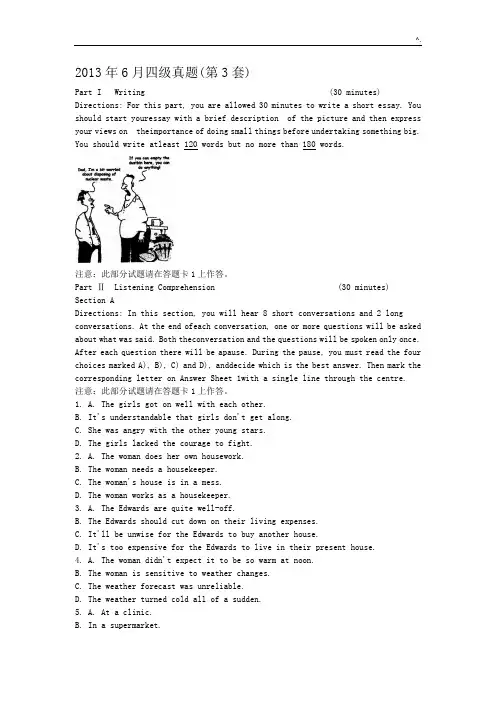
2013年6月四级真题(第3套)Part I Writing (30 minutes) Directions: For this part, you are allowed 30 minutes to write a short essay. You should start youressay with a brief description of the picture and then express your views on theimportance of doing small things before undertaking something big. You should write atleast 120 words but no more than 180 words.注意:此部分试题请在答题卡1上作答。
Part Ⅱ Listening Comprehension (30 minutes)Section ADirections: In this section, you will hear 8 short conversations and 2 long conversations. At the end ofeach conversation, one or more questions will be asked about what was said. Both theconversation and the questions will be spoken only once. After each question there will be apause. During the pause, you must read the four choices marked A), B), C) and D), anddecide which is the best answer. Then mark the corresponding letter on Answer Sheet 1with a single line through the centre.注意:此部分试题请在答题卡1上作答。
2013年6月英语四级试题解析【卷三】
2013年6月英语四级试题解析(3卷)Part I WritingScience creates the futurePart II Reading comprehension (Skimming and Scanning)1. “violent fight” is different from domestic violence in that .[B] the former is two-sided while the latter is one-sided2. From what singer Kanye West said, we know that .[D] he forgave Chris Brown’s deed3. The author suggests that in most domestic-abuse cases, women return home after the abuse because .[B] they are too scared of men’s power to leave4. What can be described as an accident or a mistake according to the author?[B] Taking the gas for the brake killing a cat.5. What do we know for sure about Chris Brown and Rihanna according to the first paragraph?[C] Rihanna has accused Chris Brown of abusing her.6. What does the author suggest we do when teaching children about domestic violence?[A] Spend some time to expose some myths.7. According to the passage, when discussing about domestic violence, we should .[D] avoid referring to it as being provoked8. What makes those abused stay with their abusive partners is the horrible cycle of emotional dependence, shame and fear .9. Women would criticize their own behavior when explaining why they are abused by their lovers.10. According to experts, in domestic violence, abusers’attacks tend to be intensifying . Part III Listening ComprehensionSection A11. [C] She would like to know about that problem.12. [B] It is very interesting.13. [A] Taking a train.14. [C] The man should practice using the vocabulary.15. [A] Choose other time.16. [D] It will probably be cold.17. [A] The woman bought too many skirts.18. [B] In a hotel.19. [C] It’s the easiest way to communicate with other users.20. [A] It may not be of a high level of security.21. [B] IE and Windows.22. [D] Try to get a free E-mail account.23. [D] Refrigerator and kitchen stuff.24. [B] Advertise them on the university notice boards.25. [A] It may not pay well.Section BPassage One26. [C] Delighted.27. [B] Tell him the truth.28. [C] Remember a couple of names first.Passage Two29. [A] Cycling around a lake.30. [D] It needs water and electricity to keep its courses green.31. [C] It uses fewer resources.32. [B] To encourage people to go in for green sports.Passage Three33. [B] 334. [D] To get to know how to ask for financial aid.35. [B] To make JohnsonReview popular.Section C36. solo37. distances38. undertaking39. continent40. stranger41. puzzled42. afford43. estimated44. rapid economic growth has fuelled an explosive expansion in car ownership45. one of his aims was to promote cycling as safe, sustainable and environmentally friendly means of getting about46. with some estimates saying the number of people cycling to work has almost doubled in the last five yearsPart IV Reading Comprehension (Reading in Depth)Section A47. What’s the main idea of the passage?[D] People in different cultures have different concepts of space.48. The Arabs and the Japanese differ in that .[A] the Japanese keep their closeness within limits while the Arabs don’t49. According to Dr. Edward Hall, .[B] space doesn’t mean emptiness in the eyes of the Japanese50. When an Arab wants to be alone, he .[B] may still stay with his companion51. It can be inferred from the passage that .[C] even impolite bodily contact is acceptable by the ArabsSection BPassage One52. What do we learn about African elephants from the passage?[A] It is difficult for people to tame them.53. Thailand was once called “Land of the White Elephant” because .[D] white elephant was a national symbol until the 1920s54. According to the passage, why is the Thai elephant “out of work”?[C] The elephants are no longer useful to their owners.55. What is said about Thailand’s elephant population at various times?[B] Today the elephant population is estimated at 5,150.56. The passage is most probably from .[C] a research reportPassage Two57. Picasso quoted the example of the English language to maintain that .[D] the intricacy of the surrealist art should not be blamed on the artists58. Which of the following artists pioneered Cubist art?[B] Picasso.59. The author most probably thinks that Picasso’s art is .[A] unprecedented60. What do people tend to think of Picasso’s paintings?[B] They are enjoyable amusements.61. Which of the following is the true description of the surrealist world?[C] It had never been explored by anyone before Picasso.Part V Cloze62. mystery63. sounds64. upon66. down67. or68. associations69. filled70. longer71. recall72. roughly73. controls74. communication.75 greatest76 aspects73 expeeted74 modeling75 assumed77. development78. defects79. diseases80. capability81. surroundings82. experiences83. Life is a journey,one that is much better traveled with a companion by our side(我们最好结伴同行).84. While crossing the mountain area, all the men carried guns lest they be attacked by wild animals(被野生动物袭击).85. He was proud of being chosen to participate in the game(为被选定参加比赛而自豪) and he assured us that he would try as hard as possible.86. My father seems to be in no mood(似乎没心情) to look at my school report.。
四级英语听力2013年06月
⽆忧考英语听⼒频道为⼤家整理的四级英语听⼒2013年06⽉,供⼤家参考:) Part III Listening Comprehension Section A Directions: In this section, you will hear 8 short conversations and2 long conversations. At the end of each conversation, one or more questions will be asked about what was said. Both the conversation and the questions will be spoken only once. After each question there will be a pause. During the pause, you must read the four choices marked A), B), C) and D), and decide which is the best answer. Then mark the corresponding letter on Answer Sheet 2 with a single line through the center.11.W: What are you doing in here, Sir? Didn't you see the private sign over there?M: I'm sorry. I didn't notice it when I came in. I'm looking for the manager's office.Q: What do we learn from the conversation?12.W: Mike, what's the problem? You've known from month the report is due today.M: I know, but I'm afraid I need another few days. The data is hard to interpret than I expected.Q: What does the man mean?13.W: Excuse me, Tony. Has my parcel from New York arrived?M: Unfortunately, it's been delayed due to the bad weather.Q: What is the woman waiting for?14.W: Pam said we won't have the psychology test until the end of next week.M: Ellen, you should know better than to take Pam's words for anything.Q: What doesthe man imply about Pam?15.W: Tom, would you please watch my suitcase for a minute? I need to go make a quick phone call.M: Yeah, sure. Take your time. Our train doesn’t leave for another twenty minutes.Q: What does the man mean?16.M: Frankly, Mary is not what I'd called easy-going.W: I see. People in our neighborhood find it hard to believe she's my twin sister.Q: What does the woman imply?17.M: How soon do you think this can be cleaned?W: We have same day service, sir. You can pick up your suit after five o'clock.Q: Where does the conversation most probably take place?18.W: I really enjoy that piece you just play on the piano. I bet you get a lot of requests for it.M: You said it. People just can't get enough of it.Q: What do we learn from the conversation?Section BQuestions 19-22 are based on the conversation you have just heard.W: Good afternoon, Mr. Jones. I am Teresa Chen, and I’ll be interviewing you. How are you today?M: I am fine, thank you. And you, Miss Chen?W: Good, Thanks. Can you tell me something about your experience in this kind of work?M: Well, for several years, I managed a department for the Brownstone Company in Detroit, Michigan. Now I work part time because I also go to school at night. I’m getting a business degree.W: Oh, how interesting. Tell me, why do you want to leave your present job?M: I’ll finish school in a few months, and I’d like a full-time position with more responsibility.W: And why would you like to work for our company?M: Because I know your company’s work and I like it.W: Could you please tell me about your special skills and interests?M: Of course, I’m good at computers and I can speak Spanish. I used to take classes in Spanish at the local college. And I like travelling a lot.W: Can you give me any references?M: Yes, certainly. You can talk to Mr. McCaw, my boss, at the Brownstone Company. I could also give you the names and numbers of several of my teachers.W: All right, Mr. Jones, and would you like to ask me any questions?M: Yes, I wonder when I’ll be informed about my application for the job.W: Well, we’ll let you know as soon as possible. Let’s stay in touch. Thank you very much for coming this afternoon.M: Thank you.Questions 19-22 are based on the conversation you have just heard.19. What does the man say about his working experience?20. Why does the man want to leave his present job?21. What is the man interested in?22. What question did the man ask the woman?Questions 23-25 are based on the conversation you have just heard.M: Lisa, Lisa! Over here, darling! It's wonderful to see you. Oh, Lisa, you look marvelous.W: Oh, Paul, you look tired. Two months away in the capital? Paul, I think you've been working too hard.M: I'm fine. The city is very hot this time of the year. It's good to get back to some fresh air. You know, Lisa, what they say about pregnant women really is true.W: What's that Paul?M: They say they look beautiful.W: Well, I had a lot of tension while you've been studying hard on your course in D.C.M: Oh?W: Oh, don't worry, all from a man over 50. Father has told all his business friends the good news about the baby. And thephone hasn't stopped ringing.M: Oh, look, darling. There's a taxi.W: Paul, tell me about the special project you mentioned on the phone. You sounded very excited about it!M: You know, I've learned a lot from the project. I'm surprised that was still in business.W: That's because we have a wonderful sales manager ——you!M: Thanks. But that's not the problem at all. Lisa, our little company, and it is little compared to the giants in the city. Our little company's in danger. We are out of date.We need to expand. If we don't, we will be swallowed up by one of the giants. Questions 23-25 are based on the conversation you have just heard.23. What do we learn about Lisa?24. What do we learn about the man from the conversation?25. What does the man say about his company?Section CPassage 1Questions 26 to 29 are based on the passage you have just heard.Farmington, Utah, is a more pleasant community since a local girls' 4-H club improved Main Street. Six 4-H girls worked to clean the 72 foot curbside that was covered with weeds, rocks and trash. Each member volunteered to clean up and to dig in plot, five flats of flowers. They also took terms in watering, weeding and maintaining the plot. Participation in this project helped the girls developed a new attitude towards their parents of their own homes; they've learned how to work with tools, and improve their work habits. One mother said that before her daughter was involved in this project, she would not even pour a weed. The experience on Main Street stimulated self-improvement, and encouraged members to take pride in their home grounds and the total community. City officials cooperated with the 4-H members in planting trees, building cooking facilities, pick-me tables, swings and public rest rooms. The 4-H girls planted trees and took care of them during the early stages of growth. The total park project needed more plantings in the following years. Members of the 4-H club agreed to follow the project through to completion, because they receive satisfaction from the results of constructive work. The project is a growing one and is spread from the park to the school and the shopping center. Trees and flowers have all been planted in the shopping center, making the atmosphere pleasant.Questions 26 to 29 are based on the passage you have just heard.26. What do we learn about Main Street in Farmington?27. What do the 4-H club members do about the curbside?28. What have the 4-H girls learned from the project?29. Why do the 4-H girls agree to follow the park project through to complete.Question 30 to 32 are based on the passage you have just heard.Passage 2According to a survey on reading conducted in 2001 by the U.S. National Education Association (N E A ) , y o u n g A m e r i c a n s s a y r e a d i n g i s i m p o r t a n t , m o r e i m p o r t a n t t h a n c o m p u t e r s a n d s c i e n c e . O v e r 5 0 % o f t h e 1 2 t o 1 8 y e a r s o l d i n t e r v i e w e d s a y t h e y e n j o y r e a d i n g a l o t . 7 9 % f i n d i t s t i m u l a t i n g a n d i n t e r e s t i n g . A n d 8 7 % t h i n k i t i s r e l a x i n g . A b o u t 6 8 % o f t h o s e s u r v e y e d d i s a g r e e d w i t h t h e o p i n i o n t h a t r e a d i n g i s b o r i n g o r o l d - f a s h i o n e d . / p > p b d s f i d = " 1 6 5 " > O v e r h a l f t e e n a g e r s i n t e r v i e w e d s a i d t h e y r e a d m o r e t h a n t e n b o o k s a y e a r . T h e r e s u l t s a l s o s h o w t h a t m i d d l e s c h o o l s t u d e n t s r e a d m o r e b o o k s t h a n h i g h s c h o o l e r s . O v e r 6 6 % o f t e e n s l i k e t o r e a d f i c t i o n , s u c h a s n o v e l s a n d s t o r i e s . O v e r 2 6 % a r e i n t e r e s t e d i n n o n - f i c t i o n , s u c h h i s t o r y b o o k s . 6 4 % o f s t u d e n t s l i s t e d r e a d i n g s t o r i e s a b o u t p e o p l e m y o w n a g e . T h a t ' s a f a v o r i t e t o p i c . M y s t e r i e s a n d d e t e c t i v e s t o r i e s c a m e s e c o n d o n t h e l i s t a t 5 3 % . J u s t u n d e r 5 0 % s a i d t h e y w e r e i n t e r e s t e d i n r e a d i n g a b o u t t h e i r o w n c u l t u r e i n t r a d i t i o n . O f t h e t e e n a g e r s w h o p a r t i c i p a t e d i n t h e s u r v e y , 4 9 % s a i d t h a t l i b r a r i e s a r e w h e r e t h e y g e t m o s t o f t h e i r b o o k s . H o w e v e r , m a n y c o m p l a i n t h a t t h e i r s c h o o l l i b r a r i e s d o n o t h a v e e n o u g h u p - t o - d a t e i n t e r e s t i n g b o o k s a n d m a ga z i n e s . E v e n t h o u g h m a n y t e e n a g e r s i n t h e U S e n j o y r e a d i n g , t h e y s t i l l h a v e o t h e r i n t e r e s t s . W h e n a s k e d w h i c h a c t i v i t y w o u l db e t h e m o s t d i f f ic u l t t o g i v e u p f o r a w e e k , 4 8 % s a id l i s te n i n g t o m u s i c . T V w o u l d b e d if f i c u l t t og i v e u p f o r 2 5 % o f th o s e s u r v e y e d . / p > p b d s fi d = " 1 6 6 " > Q u e s t i o n 3 0 t o 3 2 a r e b a s e d o n t h e p a s s a g e y o u h a v ej u s t h e a r d . / p > p b d s f i d = " 1 6 7 " > 3 0 . W h a t d o e s t h e s u r v e y o n t e e n a g e r r e a d i n g s h o w ? / p > p b d s f i d = " 1 6 8 " > 3 1 . W h a t b o ok s a r e m o s t p o p ul a r am on g t e e n a g e r s a c co r d i n g t o t h e s u r v e y ? /p > p b d s f i d = " 1 6 9 " > 3 2 . W h a t a c t i v i t y d o t e e n a g e r s f i n d t h e m o s t d i f f i c u l t t o g i v e u p f o r a w e e k ? / p > p b d s f i d = " 1 7 0 " > Q u e s t i o n s 33 - 3 5 a r e b a s e d o n t h e p a s s a g e y o u h a v e j u s t h e a r d . / p > p b d s f i d = " 1 7 1 " > P a s s a g e 3 / p > p b d sf i d = " 1 7 2 " > T h a n k y o u f o r c o m i ng , e v e r y o n e . T o d a y s p r e s e n t a t i o n w i l l sh o w h o w w e s e e t h e d e v e l o p m e n t o f t h e m o t o r c a ri n t h e s h o r t t o m e d i u m t e r m , a n d t h a t i s w h y w e h a v e i n v i t e d a l l o f y o u h e r e t o d a y . L e t s s t a r t w i t h p o w e r . I t s c l e a r t h a t p e t r o l - d r i v e n e n g i n e s h a v e n o f u t u r e . A l r e a d y t h e r e a r e m a n y a l t e r n a t i v e f u e l v e h i c l e s o n t h e m a r k e t , p o w e r e d b y a n y t h i n g f r o m s o l a r p o w e r t o n a t u r a l g a s . S o m e i n d e p e n d e n t t h i n k e r s h a v e e v e n p r o d u c e d c a r s t h a t r u n o n v e g e t a b l e o i l . B u t a s w e a l l k n o w , o f a l l t h e s e a l t e r n a t i v e f u e l v e h i c l e s , t h e m o s t p r a c t i c a l a r e e l e c t r i c v e h i c l e s . S u r e , i n t h e p a s t e l e c t r i c v e h i c l e s h a v e t h e i r p r o b l e m s , n a m e l y , a l i m i t e d d r i v i n g r a n g e , a n d v e r y f e w r e c h a r g i n g p o i n t s , w h i c h l i m i t e d t h e i r u s e . N o w , h o w e v e r , r e c e n t d e v e l o p m e n t s i n e l e c t r i c v e h i c l e t e c h n o l o g y m e a n t h e y c a n m a t c h c o n v e n t i o n a l p e t r o l e n g i n e s i n t e r m s o f p e r f o r m a n c e a n d s a f e t y . L e t s n o t f o r g e t t h a t e l e c t r i c v e h i c l e s a r e c l e a n e r . P l u s , i m p o r t a n t l y , t h e p o w e r s o u r c e i s r e c h a r g e a b l e , s o t h i s d o e s n o t i n v o l v e u s i n g a n y v a l u a b l e r e s o u r c e s . M o v i n g o n t o c o m m u n i c a t i o n s , v e r y s o o n , c a r s w i l l b e l i n k e d t o G P S s a t e l l i t e s , s o t h e y l l d o a l l t h e d r i v i n g f o r y o u . W h a t c o n t r o l s r e m a i n f o r t h e u s e r s w i l l b e a u d i o - b a s e d , s o , f o r e x a m p l e , y o u l lj u s t h a v e t o s a y a b i t w a r m e r , a n d t h e a i r c o n d i t i o n i n g w i l l a d j u s t a u t o m a t i c a l l y . Y o u l l a l s o b e a b l e t o r e c e i v e e m a i l , m u s i c a n d m o v i e s , a l l v i a a n i n t e r n e t l i nk . S o j u s t t y p e i n t h e d e s t i n a t i o n y o u w a n t , s i t b a c k , sl e e p , w a t c h y o u rm o v i e , w h a t e v e r . / p > p b d s f i d = " 1 7 3 " > Q u e s t i on s 3 3 - 3 5 a r e b a s e do n t h ep a s s a g e y o u h a v e j u s t h e a r d . / p > p b d s f i d = " 1 7 4 " > 3 3 . W h a t i s t h e p r e s e n t a t i o n m a i n l y a b o u t ? / p > p b d s f i d = " 1 7 5 " > 3 4 . W h a t u s e d t o r e s t r i c t t h e u s e o f e l e c t r i c v e h i c l e s ? / p > p b d s f i d = " 1 7 6 " > 3 5 . W h a t d o e s t h e s p e a k e r s a y a b o u t e l e c t r i c v e h i c l e s o f t o d a y ? / p > p b d s f i d = " 1 7 7 " > / p > p b d s f i d = " 1 7 8 " > / p > p b d s f i d = " 1 7 9 " > 1 9 . B . H e w o r k e d a t t h e B r o w n s t o n e C o m p a n y f o r s e v e r a l y e a r s . / p >。
2013年6月四级听力答案及原文
2013年6月四级听力答案及原文2013年06月4级听力真题Section A11 What do we learn from the conversation? A: The woman is the manager's secretary.B: The man found himself in a wrong place.C: The man is the manager's business associate. D: The woman was putting up a sign on the wall. 答案: B12 What does the man mean?A: He needs more time for the report.B: He needs help to interpret the data.C: He is sorry not to have helped the woman. D: He does not have sufficient data to go on.答案: A13 What is the woman waiting for?A: A friend from New York.B: A message from Tony.C: A postal delivery.D: A change in the weather.答案: C14 What does the man imply about Pam?A: She is not available until the end of next week. B: She is not a reliable source of information. C: She does not like taking exams.D: She does not like psychology.答案: B15 What does the man mean?A: He will help the woman carry the suitcase.B: The woman's watch is twenty minutes fast.C: The woman shouldn't make such a big fuss.D: There is no need for the woman to be in a hurry.答案: D16 What does the woman imply?A: Mary is not so easygoing as her.B: Mary and she have a lot in common.C: She finds it hard to get along with Mary.D: She does not believe what her neighbors said.答案: A17 Where does the conversation most probably take place? A: At an information service.B: At a car wash point.C: At a repair shop.D: At a dry cleaner's.答案: D18 What do we learn from the conversation?A: The woman came to the concert at the man's request.B: The man is already fed up with playing the piano.C: The piece of music the man played is very popular.D: The man's unique talents are the envy of many people.答案: C19 What does the man say about his working experience? A: He has taught Spanish for a couple of years at a local school. B: He worked at the Brownstone Company for several years. C: He owned a small retail business in Michigan years ago. D: He has been working part-time in a school near Detroit.答案: B20 Why does the man want to leave his present job?A: He prefers a full-time job with more responsibility.B: He is eager to find a job with an increased salary.C: He likes to work in a company close to home.D: He would rather get a less demanding job.答案: A21 What is the man interested in?A: Sports.B: Travel.C: Foreign languages.D: Computer games.答案: B22 What question did the man ask the woman?A: When he is supposed to start work.B: What responsibilities he would have.C: When he will be informed about his application.D: What career opportunities her company can offer.答案: C23 What do we learn about Lisa?A: She is pregnant.B: She is over 50.C: She has just finished her project.D: She is a good saleswoman.答案: A24 What do we learn about the man from the conversation? A: He takes good care of Lisa.B: He is the CEO of a giant company.C: He is good at business management.D: He works as a sales manager.答案: D25 What does the man say about his company?A: It is in urgent need of further development.B: It produces goods popular among local people.C: It has been losing market share in recent years.D: It is well positioned to compete with the giants.答案: ASection B26 What do we learn about Main Street in Farmington?A: It is lined with tall trees.B: It was widened recently.C: It has high buildings on both sides.D: It used to be dirty and disorderly.答案: D27 What do the 4-H club members do about the curbside?A: They repaved it with rocks.B: They built public restrooms on it.C: They beautified it with plants.D: They set up cooking facilities near it.答案: C28 What have the 4-H girls learned from the project?A: What makes life enjoyable.B: How to work with tools.C: What a community means.D: How to improve health.答案: A29 Why do the 4-H girls agree to follow the park project through to complete? A: They were obliged to fulfill the signed contract.B: They were encouraged by the city officials' praise.C: They wanted to prove they were as capable as boys.D: They derived happiness from the constructive work.答案: D30 What does the survey on teenager reading show?A: The majority of them think it less important than computers.B: Many of them consider it boring and old-fashioned.C: The majority of them find it interesting.D: Few of them read more than ten books a year.答案: C31 What books are most popular among teenagers according to the survey? A: Novels and stories.B: Mysteries and detective stories.C: History and science books.D: Books on culture and tradition.答案: A32 What activity do teenagers find the most difficult to give up for a week?A: Watching TV.B: Listening to music.C: Reading magazines.D: Playing computer games.答案: B33 What is the presentation mainly about?A: Advice on the purchase of cars.B: Information about the new green-fuel vehicles.C: Trends for the development of the motor car.D: Solutions to global fuel shortage.答案: C34 What used to restrict the use of electric vehicles?A: Limited driving range.B: The short life of batteries.C: Huge recharging expenses.D: The unaffordable high price.答案: A35 What does the speaker say about electric vehicles of today?A: They need to be further improved.B: They can easily switch to natural gas.C: They are more cost-effective than vehicles powered by solar energy. D: They can match conventional motor cars in performance and safety. 答案: D。
2013年6月英语四级听力及答案
听录音,回答11-47题:Part Ⅲ Listening Comprehension:11-3511、A.Children should be taught to be more careful. B.Children shouldn't drink so much orange juice. C.There is no need for the man to make such a fuss. D.Timmy should learn to do things in the right way.12、A.Fitness training.B.The new job offer.C.Computer programming.D.Directorship of the club.13、A.He needs to buy a new sweater.B.He has got to save on fuel bills.C.The fuel price has skyrocketed.D.The heating system doesn't work.14、A.Committing theft.B.Taking pictures.C.Window shopping,D.Posing for the camera.15、A.She is taking some medicine.B.She has not seen a doctor yet.C.She does not trust the man's advice.D.She has almost recovered from the cough.16、A.Pamela's report is not finished as scheduled.B.Pamela has a habit of doing things in a hurry. C.Pamela is not good at writing research papers.D.Pamela's mistakes could have been avoided.17、A.In the left-luggage office.B.At the hotel reception.C.In a hotel room.D.At an airport.18、A.She was an excellent student at college.B.She works in the entertainment business.C.She is fond of telling stories in her speech.D.She is good at conveying her message.19、Questions 19 to 21 are based on the conversation you have just heard. A.Arranging the woman's appointment with Mr. Romero.B.Fixing the time for the designer's latest fashion show.C.Talking about an important gathering on Tuesday.D.Preparing for the filming on Monday morning.20、A.Her travel to Japan.B.The awards ceremony.C.The proper hairstyle for her new role.D.When to start the makeup session.21、A.He is Mr. Romero's agent.B.He is an entertainment journalist.C.He is the woman's assistant.D.He is a famous movie star.22、Questions 22 to 25 are based on the conversation you have just heard.A.Make an appointment for an interview.B.Send in an application letter.C.Fill in an application form.D.Make a brief self-introduction on the phone.23、A.Someone having a college degree in advertising.B.Someone experienced in business management.C.Someone ready to take on more responsibilities.D.Someone willing to work beyond regular hours.24、A.Travel opportunities.B.Handsome pay.C.Prospects for promotion.D.Flexible working hours.25、A.It depends on the working hours.B.It's about 500 pound a week.C.It will be set by the Human Resources.D.It is to be negotiated.26、Questions 26 to 29 are based on the passage you have just heard. A.To give customers a wider range of choices.B.To make shoppers see as many items as possible.C.To supply as many varieties of goods as it can.D.To give space for more profitable products.27、A.On the top shelves,B.On the bottom shelves.C.On easily accessible shelves.D.On clearly marked shelves.28、A.Many of them buy things on impulse.B.A few of them are fathers with babies.C.A majority of them are young couples,D.Over 60% of them make shopping lists.29、A.Sales assistants promoting high margin goods.B.Sales assistants following customers around.C.Customers competing for good bargains,D.Customers losing all sense of time,30、Questions 30 to 32 are based on the passage you have just heard. A.Teaching mathematics at a school.B.Doing research in an institute.C.Studying for a college degree.D.Working in a high-tech company.31、A.He studied the designs of various choices.B.He did experiments to different materials.C.He bought an alarm clock with a pig face.D.He asked different people for their opinions.32、A.Its automatic mechanism.B.Its manufacturing pattern.C.Its way of waking people up.D.Its funny-looking pig face.33、Questions 33 to 35 are based on the passage you have just heard.A.It's often caused by a change of circumstances.B.It usually doesn't require any special attention.C.It usually appears all of a sudden.D.It usually lasts for several years.34、A.They can't mix well with others,B.They emotionally receive their friends.C.They depend severely on family members.D.They share similar interests with friends.35、A.They lack consistent support from peers.B.They doubt their own popularity.C.They were born psychologically weak.D.They focus too much attention on themselves.Part Ⅲ Listening Comprehension:36-4636、根据以下内容,回答问题。
2013年6月四级英语真题与听力原文及答案解析完整版
11. A) Children should be taught to be more careful.B) Children shouldn’t drink so much orange juice.C) There is no need for the man to make such a fuss.D) Timmy should learn to do things in the right way.12. A) Fitness training. B) The new job offer.C) Computer programming. D) Directorship of the club.13. A) He needs to buy a new sweater. B) He has got to save on fuel bills.C) The fuel price has skyrocketed. D) The heating system doesn’t work.14. A) Committing theft. B) Taking pictures.C) Window shopping. D) Posing for the camera.15. A) She is taking some medicine. B) She has not seen a doctor yet.C) She does not trust the man’s advice. D) She has alm ost recovered from the cough.16. A) Pamela’s report is not finished as scheduled.B) Pamela has a habit of doing things in a hurry.C) Pamela is not good at writing research papers.D) Pamela’s mistakes could have been avoided.17. A) In the left-luggage office. B) At the hotel reception.C) In a hotel room. D) At an airport.18. A) She was an excellent student at college. B) She works in the entertainment business.C) She is fond of telling stories in her speech. D) She is good at conveying her message.Passage OneQuestions 26 to 29 are based on the passage you have just heard.26. A) To give customers a wider range of choices.B) To make shoppers see as many items as possible.C) To supply as many varieties of goods as it can.D) To give space for more profitable products.27. A) On the top shelves.B) On the bottom shelves.C) On easily accessible shelves.D) On clearly marked shelves.28. A) Many of them buy things on impulse.B) A few of them are fathers with babies.C) A majority of them are young couples.D) Over 60% of them make shopping lists.29. A) Sales assistants promoting high margin goods.B) Sales assistants following customers around.C) Customers competing for good bargains.D) Customers losing all sense of time.Passage TwoQuestions 30 to 32 are based on the passage you have just heard.30. A) Teaching mathematics at a school.B) Doing research in an institute.C) Studying for a college degree.D) Working in a high-tech company.31. A) He studied the designs of various choices.B) He did experiments to different materials.C) He bought an alarm clock with a pig face.D) He asked different people for their opinions.32. A) Its automatic mechanism.B) Its manufacturing pattern.C) Its way of waking people up.D) Its funny-looking pig face.Questions 33 to 35 are based on the passage you have just heard.33. A) It’s often caused by a change of circumstances.B) It usually doesn’t require any special at tention.C) It usually appears all of a sudden.D) It usually lasts for several years.34. A) They can’t mix well with others.B) They emotionally receive their friends.C) They depend severely on family members.D) They share similar interests with friends.35. A) They lack consistent support from peers.B) They doubt their own popularity.C) They were born psychologically weak.D) They focus too much attention on themselves.Section CThere was a time when any personal information that was gathered about us was typed on a piece of paper and (36) ________ away in a file cabinet. It could remain there for years and, often (37) ________, never reach the outside world.Things have done a complete about-face since then. (38) ________ for the change has been the astonishingly (39) ________ development in recent years of the computer. Today, any data that is(40) ________ about us in one place or another — and for one reason or another — can be stored in a computer bank. It can then be easily passed to other computer banks. They are owned by (41) ________ and by private businesses and corporations, lending (42) ________, direct mailing and telemarketing firms, credit bureaus, credit card companies, and government (43) ________ at the local, state, and federal level.A growing number of Americans are seeing the accumulation and distribution of computerized date as a frightening invasion of their privacy. (44) ____________________________________________________________________ as the computer becomes increasingly efficient, easier to operate, and less costly to purchase and maintain. In 1970, a national survey showed that (45) ___________________________________________________ _________________. Seven years later, 47 percent expressed the same worry. (46) ____________________________________________________________________.Part III Listening Comprehension11.W: What are you doing in here, Sir? Didn't you see the private sign over there?M: I'm sorry. I didn't notice it when I came in. I'm looking for the manager's office.Q: What do we learn from the conversation?12.W: Mike, what's the problem? You've known from month the report is due today.M: I know, but I'm afraid I need another few days. The data is hard to interpret than I expected.Q: What does the man mean?13.W: Excuse me, Tony. Has my parcel from New York arrived?M: Unfortunately, it's been delayed due to the bad weather.Q: What is the woman waiting for?14.W: Pam said we won't have the psychology test until the end of next week.M: Ellen, you should know better than to take Pam's words for anything.Q: What doesthe man imply about Pam?15W: Tom, would you please watch my suitcase for a minute? I need to go make a quick phone call.M: Yeah, sure. Take your time. Our train doesn’t leave for another twenty minutes.Q: What does the man mean?16M: Frankly, Mary is not what I'd called easy-going.W: I see. People in our neighborhood find it hard to believe she's my twin sister.Q: What does the woman imply?17M: How soon do you think this can be cleaned?W: We have same day service, sir. You can pick up your suit after five o'clock.Q: Where does the conversation most probably take place?18W: I really enjoy that piece you just play on the piano. I bet you get a lot of requests for it.M: You said it. People just can't get enough of it.Q: What do we learn from the conversation?Passage 1Questions 26 to 29 are based on the passage you have just heard.Farmington, Utah, is a more pleasant community since a local girls' 4-H club improved Main Street. Six 4-H girls worked to clean the 72 foot curbside that was covered with weeds, rocks and trash. Each member volunteered to clean up and to dig in plot, five flats of flowers. They also took terms in watering, weeding and maintaining the plot. Participation in this project helped the girls developed a new attitude towards their parents of their own homes; they've learned how to work with tools, and improve their work habits. One mother said that before her daughter was involved in this project, she would not even pour a weed. The experience on Main Street stimulated self-improvement, and encouraged members to take pride in their home grounds and the total community. City officials cooperated with the 4-H members in planting trees, building cooking facilities, pick-me tables, swings and public rest rooms. The 4-H girls planted trees and took care of them during the early stages of growth. The total park project needed more plantings inthe following years. Members of the 4-H club agreed to follow the project through to completion, because they receive satisfaction from the results of constructive work. The project is a growing one and is spread from the park to the school and the shopping center. Trees and flowers have all been planted in the shopping center, making the atmosphere pleasant.Questions 26 to 29 are based on the passage you have just heard.26. What do we learn about Main Street in Farmington?27. What do the 4-H club members do about the curbside?28. What have the 4-H girls learned from the project?29. Why do the 4-H girls agree to follow the park project through to complete.Question 30 to 32 are based on the passage you have just heard.Passage 2According to a survey on reading conducted in 2001 by the U.S. National Education Association (NEA), young Americans say reading is important, more important than computers and science. Over 50% of the 12 to 18 years old interviewed say they enjoy reading a lot. 79% find it stimulating and interesting. And 87% think it is relaxing. About 68% of those surveyed disagreed with the opinion that reading is boring or old-fashioned.Over half teenagers interviewed said they read more than ten books a year. The results also show that middle school students read more books than high schoolers. Over 66% of teens like to read fiction, such as novels and stories. Over 26% are interested innon-fiction, such history books.64% of students listed reading stories about people my own age. That's a favorite topic. Mysteries and detective stories came second on the list at 53%. Just under 50% said they were interested in reading about their own culture in tradition. Of the teenagers who participated in the survey, 49% said that libraries are where they get most of their books. However, many complain that their school libraries do not have enough up-to-date interesting books and magazines. Even though many teenagers in the US enjoy reading, they still have other interests. When asked which activity would be the most difficult to give up for a week, 48% said listening to music. TV would be difficult to give up for 25% of those surveyed.Question 30 to 32 are based on the passage you have just heard.30. What does the survey on teenager reading show?31. What books are most popular among teenagers according to the survey?32. What activity do teenagers find the most difficult to give up for a week?Passage 2【总评】本篇文章以阅读调查报告为话题,贴近生活,容易理解。
2013年全国英语四级考试听力真题、答案及原文(6月)
2013年全国英语四级考试听力真题、答案及原文(6月)听力试题11. A) The woman is the manager's secretary. B) The man found himself in a wrong place. C) The man is the manager's business associate. D) The woman was putting up a sign on the wall. 12. A) He needs more time for the report. B) He needs help to interpret the data. C) He is sorry not to have helped the woman. D) He does not have sufficient data to go on. 13. A) A friend from New York. B) A message from Tony. C) A postal delivery. D) A change in the weather. 14. A) She is not available until the end of next week. B) She is not a reliable source of information. C) She does not like taking exams. D) She does not like psychology. 15. A) He will help the woman carry the suitcase. B) The woman's watch is twenty minutes fast. C) The woman shouldn't make such a big fuss. D) There is no need for the woman to be in a hurry. 16. A) Mary is not so easygoing as her. B) Mary and she have a lot in common. C) She finds it hard to get along with Mary. D) She does not believe what her neighbors said. 17. A) At an information service. B) At a car wash point. C) At a repair shop. D) At a dry cleaner's. 18. A) The woman came to the concert at the man's request. B) The man is already fed up with playing the piano. C) The piece of music the man played is very popular. D) The man's unique talents are the envy of many people. Questions 19 to 22 are based on the conversation you have just heard. 19. A) He has taught Spanish for a couple of years at a local school. B) He worked at the Brownstone Company for several years. C) He owned a small retail business in Michigan years ago. D) He has been working part-time in a school near Detroit. 20. A) He prefers a full-time job with more responsibility. B) He is eager to find a job with an increased salary. C) He likes to work in a company close to home. D) He would rather get a less demanding job. 21. A) Sports. B) Travel. C) Foreign languages. D) Computer games 22. A) When he is supposed to start work. B) What responsibilities he would have. C) When he will be informed about his application. D) What career opportunities her company can offer. Questions 23 to 25 are based on the conversation you have just heard. 23. A) She is pregnant. B) She is over 50. C) She has just finished her project. D) She is a good saleswoman. 24. A) He takes good care of Lisa. B) He is the CEO of a giant company. C) He is good at business management. D) He works as a sales manager. 25. A) It is in urgent need of further development. B) It produces goods popular among local people. C) It has been losing market share in recent years. D) It is well positioned to compete with the giants. Section B Directions: In this section, you will hear 3 short passages. At the end of each passage, you willhear some questions. Both the passage and the questions will be spoken only once. After youhear a question, you must choose the best answer from the four choices marked A), B), C) andD). Then mark the corresponding letter on Answer Sheet 2 with a single line through thecentre. 注意:此部分试题请在答题卡2上作答。