
Unit-1-Where-did-you-go-on-vacation八年级教案
Unit 1 Where did you go on vacation? Period 1 Section A 1 (1a-2d) I.Teaching Aims: 1) 能掌握以下单词:anyone, anywhere, wonderful, quite a few, most, something, nothing, everyone, of course, myself, yourself 句型: ① —Where did you go on vacation? —I went to the mountains. ② —Where did Tina to on vacation? —She went to the beach. ③ —Did you go with anyone? —Yes, I did./No, I didn’t. 2) 能了解以下语法: —复合不定代词someone, anyone, something, anything等 的用法。 —yourself, myself等反身代词的用法。 3) 一般过去时态的特殊疑问句,一般疑问句及其肯定、否定回答。 Ⅱ.Teaching Main Points: 1) 用所学的功能语言交流假期去了什么地方旅行。 2) 掌握本课时出现的新词汇。 III.Teaching Difficult Points: 1) 复合不定代词someone, anyone, something, anything等 的用法。 2) yourself, myself等反身代词的用法。 IV. Teaching Methods: Listening,speaking,practicing V. Teaching Procedures: 1.Lead-in Welcome back to our school! I’m your English teacher this term.Can you tell me what you did in summer holiday?Where did you go? Who did you go with? What was the weather?Then ask sevsral students to answer the questions. 2. Presentation 1). Show some pictures on the big screen. Let Ss read the expressions. 2). Focus attention on the picture. Ask: What can you see? Say: Each picture shows something a person did in the past. Name each activity and ask students to repeat: Stayed at home, Went to mountains, went to New York City , Went to the beach, visited my uncle, visited museums, went to summer camp 3). Now, please match each phrase with one of the pictures next to the name of the activity,point to the sample answer. 4). Check the answers. Answers: 1. f 2. b 3. g 4. e 5. c 6. a 7. d 3. Listening 1. Point to the picture on the screen. Say: Look at the picture A. Where did Tina go on vacation? She went to mountains. Ask: What did the person do in each picture? 2. Play the recording the first time. 3. Play the recording a second time. Say: There are three conversations. The people talk about what did on vacation. Listen to the recording and write numbers of the names in the right boxes of the picture. 4. Check the answers. 4.Pair work 1. Point out the sample conversation. Ask two Ss to read the conversation to the class. 2. Now work with a partner. Make your own conversation about the people in the picture. 3. Ss work in pairs. As they talk, move around the classroom and give any help they need. 4. Let some pairs act out their conversations. 5. Listening 1). Tell Ss they will hear a conversation about three students’ conversations. Listen for the first time and fill in the chart. Then listen again and check Yes, or No. 2). Let Ss read the phrases in the chart of 2b. 3). Play the recording the first time. Ss listen and fill in the chart. 4). Play the recording a second time for the Ss to check ―Yes, I did.‖ or ―No, I didn’t. ‖ 5). Check the answers with the Ss. 6. Pair work 1. Let two Ss read the conversation between Grace, Kevin and Julie. 2. Let Ss work in pairs and try to role-play the conversation. 3. Ask some pairs to act out their conversations. 7. Role-play 1. First let Ss read the conversation and match the people and places they went. 2. Let Ss act out the conversations in pairs. 3. Some explanations in 2d. 重点知识点: 1. 不定代词 anyone是不定代词,意为―任何人‖,相当于anybody,主要用于疑问句或否定句中。作主语时,谓语动词用单数。 Eg:Hello!Is anyone at home? 喂!有人在家吗? I didn’t see anyone in the room。 我没看见有人在房间里。 Do you know anyone else who wants a ticket? 你知道还有谁想要一张票吗? 类似的不定代词有:someone(某人),somebody(某人),something(某事,某物),anyone(任何人),anybody(任何人),anything(任何事情),no one(没有人),nobody(没有人), nothing(没有什么,没有一件东西), everyone(每人;人人;所有人), everybody(每个人), everything(每件事,一切事物) 不定代词被其他词修饰时的位置: 形容词、动词不定式、介词短语、分词或从句修饰不定代词时,要放在不定代词之后。 Eg:Don’t worry about me. There is nothing difficult for me . 不要替我担心,什么都难不倒我。 I have something interesting to tell you. 我有一些有趣的事情告诉你。 2. We took quite a few photos there.我们在那里照了好多照片。 quite的用法:quite为程度副词,可以修饰形容词、副词或动词,意为―很;非常‖。 Eg:Her English is quite perfect.她的英语好极了。 She plays quite well.她表演得挺不错的。 辨析:quite a few & quite a little Quite a few 意为―相当多,不少‖,用于修饰可数名词。 Eg: Quite a few students come to visit Peking University every year. 每年有很多学生参观北京大学。 Quite a little 意为―相当多;不少‖,用于修饰不可数名词。 Eg:There is quite a little meat in the fridge. 冰箱里有不少的肉。 Exercises: 1. last summer vacation, we _____many photos when we had a trip to Dalian. A.take B. takes C. took D.will take 2. –Mum,I’m hungry.Is there _____to eat? A. something B. nothing C. anything D.everything 3.After a long walk in the sun, they wanted to drink_______. A. cold something B. something cold C. nothing cold D. cold anything 4.Did Lisa tell you______in the letter? A. funny anything B. anything funny C.funny something D. something funny Homework: 用英语询问你的一位好朋友,她(他)假期去了哪里?看到了什么?并将此对话写在作业上。 A: Where did you go…? B: I went to… A: Did you see… B: Yes, I did. / No, I didn’t. Ⅵ.The Blackboard Design: Section A 1 (1a-2d) anyone, someone, everyone, something, anything, everything yourself, myself Where did you go on vacation? Did you do anything special? I went to New York City. Did you go anywhere interesting? Where did she go on vacation? most of the time She went to the mountains.
Unit1Wheredidyougoonvacation(4课时教案)
1.理论介绍:首先,我们要了解一般过去时和旅行词汇的基本概念。一般过去时是用来描述过去发生的事情的时态,而旅行词汇则是我们在描述旅行经历时会用到的关键词汇。
2.案例分析:接下来,我们来看一个具体的案例。这个案例展示了如何用一般过去时和旅行词汇来描述一段假期旅行。
3.重点难点解析:在讲授过程中,我会特别强调一般过去时的动词变化和旅行词汇的运用这两个重点。对于难点部分,我会通过举例和比较来帮助大家理解。
然而,我也注意到在讲解一般过去时和旅行词汇的过程中,部分学生对动词过去式的变化规则掌握不够熟练,这在课堂练习中表现得尤为明显。为此,我计划在下一节课开始前,用更多实例和互动游戏帮助学生巩固这部分知识。
此外,在实践活动和小组讨论中,学生们表现出了很高的积极性。他们能够运用所学知识进行实际情境的对话练习,展示了对一般过去时的运用和理解。但在引导讨论过程中,我意识到需要进一步关注学生的个体差异,对基础较弱的学生给予更多关注和指导,以提高他们的自信心和参与度。
Unit 1 Where did you go on vacation(4课时教案)
一、教学内容
《Unit 1 Where did you go on vacation》共分为四个课时,教学内容主要包括:
1.第一课时:引入本单元主题,学习询问和回答假期旅行的地点。重点词汇包括:beach, mountain, camp, city, visit等。学习一般过去时的用法,如:“I went to the beach.”
(三)实践活动(用时10分钟)
1.分组讨论:学生们将分成若干小组,每组讨论一个与假期旅行相关的实际问题。
2.实验操作:为了加深理解,我们将进行一个简单的角色扮演活动。这个活动将演示如何在实际对话中使用一般过去时和ห้องสมุดไป่ตู้行词汇。
初中初中八年级英语上册《Unit 1 Where did you go on vacation》教案

《Unit 1 Where did you go on vacation》一.教学目标(teaching aims)1)知识目标(knowledge aims)1.掌握本单元的重点单词:anyone, anywhere, wonderful, few, most, decide, try,difference…2.掌握本单元的重点短语:go to summer camp, go out, qu ite a few, most of time…3.掌握本单元的重点句型:a.Where did you go on vacation?b.Did you do anything special last month?c.Long time no see.d.I just stayed at home most of time to read and relax.2)能力目标(abilities aims)1.听能目标: 关于“旅游(holiday)和度假(vacation)的听力训练。
2.说能目标:能够流利的谈论“度假”3.写能目标:能够写一篇关于旅行的文章。
3)过程与方法目标(process and method aims)借助图片与对话反复操练“Where did you go on vacation?”这个句型。
4)情感态度与价值观通过谈论假期生活,使学生加强交流.沟通,并学会劳逸结合,更好的投入到学习当中。
二.教学工具多媒体,录音机三.教学重难点教学重点:1)熟练掌握本单元的重点单词、句型2)不定代词及一般过去时的用法教学难点:熟练运用一般过去时和不定代词四.教学过程(teaching proceduces)Section AStep1. 课前预习(1)教师通过师生自由交流,导入本节课的话题。
T: What did you do on vacation?S: I went hiking…T:Where did you go on vacation?S: I went to the mountains…(2) Match the picture 1aStep2 课堂呈现1)Where did you go on vacation?on vacation 意为“在度假,在假期中”eg She is on vacation now.vacation(n、)意为“假期,休假”go on vacation 去度假take a vacation at/in 在……度假2)…go with anyone?……和别人去的吗?anyone 不定代词,相当于anybody.用于肯定句当中,意为“任何人”,用于否定句和疑问句中时,意为“有人”,作主语时,谓语动词用单数形式。
八年级英语上册 Unit 1 Where did you go on vacation教案1

Unit 1 Where did you go on vacation教案Language goalIn this unit students learn to talk about past events.New languageWhere did you go on vacation? I went to the mountains.Where did they go on vacation? They went to New York.Where did he go on vacation? He stayed at home.Where did she go on vacation? She visited her uncle.Did you go to the beach? Yes, I did. /No, I didn't.Section AAsk questions about what students did last Saturday. Write some past tense statements on the board. Ask, Who went to the movies l ast Saturday? Point toa student who raises his or her hand. Sara went to the movies last Saturday.Repeat. Write this sentence on the board. Underline the word went. Ask, Who visited a friend lastSaturday? Point to a student who r aises his or her hand. Carlos visited a friend last Saturday. Repeat. Write this" sentence on the board. Underline the word visited.Point to the words went and visited in the sentences on the board. Say, We use these words to do on the board: go-went, visit-visited. Ask a student to point out the words that talk about the past.1 a This activity introduces the key vocabulary.Focus attention on the picture. Ask students to tell what they see. Say, Each picture shows s omething a person did in the past. Name each activity and ask students to repeat: went to the mountains, went to New York City, went to summer camp, visited my uncle, stayed at home, went to the beach, and visited museums.Point out the numbered list of activities. Say each one again and ask students to repeat.Then ask students to match each phrase with one of the pictures. Say, Write the letter of each picture next to the name of the activity. Point out the sample answer.Check the answers.1 b This activity gives students practice in understanding the target language in spoken conversation.Point to the picture. Ask students to tell what the person did in each scene.For example, Tina went to the mountains or She went to the mountains.Play the recording the first time. Students only listen.Play the recording a second time. This time say, There are three conversations.The people talk about what they did on vacation. Listen to the recording and write numbers of the names in the white boxes in the picture. Please write only five numbers. Point out the sample answer next to the picture showing went to the mountains.Correct the answers.1 C This activity provides guided oral practice using the target language.Point out the example conversation. Ask two students to read the dialogue to the clas s.Say, Now work with a partner. Make your own conversations about the pictures.Say the dialogue in the picture with a student. Do a second example, if you wish.Then have students work in pairs. As they talk, move around the room monitoring their work.Offer language or pronunciation support as needed.2a This activity gives students practice in understanding the key vocabulary in spoken conversation.Point to the thre e people's names and read the names t o the class. Point to the three vacation activities and ask a student to read the activities to the class.Say, This is a recording about three people's vacations. Please match the people with the places they went to o n vacation.Play the recording the first time. Students only listen.Play the recording a second time. This time, ask students to write the letters of where people went on vacation next to their names. Point out the sample answer next to item 1.Correct the answers.2b This activity provides more listening practice using the target language.Call attention to the chart. Ask a student to read throu gh the names and activities listed.Say, Now listen to the recording again. This time, please listen to theconversations and put a checkmark in the "Yes, I did." or "No, I didn't." blank after each activity. |Play the recording the first time. Students only listen.Point out the sample answer under Yes, I did in the first blank after the words "Nancy... go to Central Park?" Say, Did Nancy go to Central Park? Yes, she did.Play the recording again. Ask students to put check martial in the correct blanks. 2c This activity provides guided oral practice using the target language.S ay, Get into groups of three. One of you will be Nancy, one will be Kevin, and one will be Julie. Ask each other about the vacations. You can talk about the activities from the chart in 2b or about any other activities you like.As students talk, move around the room, monitoring the conversations and offering support as needed.You may want to have a group of students present their conversation to the class. 3a This activity provides reading and writing practice using the target language.Point out the pictures in the photo album. Ask students to describe what they see. (In picture 1 there is a man with a bowl of soup. There is also a waiter.He looks angry. In picture 2 there is a beautiful beach. There is a man. He looks unhappy.)After that, read the first two lines of the dialogue to the class. Poin t out the answer was in the first line.Then point out the blanks in the rest of the lines of the dialogue. Read the conversation to the class saying the word blank for each blank line: How blank the beaches?Then say, Write the word was or were in each blank. Ask students to complete the activity on their own.Correct the answers.3b This activity provides guided oral practice using the target language.Point to each of the pictures and ask students to say what they see. Then read the words under each picture. Pronounce any new words and explain what they mean, if necessary. For example, In this picture a girl is on a bus. The girl is taking a bus trip. Ask, What does relaxing mean? Does it mean you are excited or quiet? How do you look when you relax? If students don't know the meaning of relaxing, demonstrate by leaning back in your seat and half-closing your eyes.Say, Now work with a partner. Make your own conversations about the pictures.Say a dialogue with a student. Point to the food picture. Ask, How was the food?The student replies, It was awful. Do a second example, if you wish.Then have students work in pairs. As they talk, move around the room monitoring their work. Offer language or pronunciation support as needed.4. This activity provides speaking practice using the targetlanguage.Explain to the students that they are going to make a vacation photo album and talk about it with their classmates. You may want to provide students with magazines which they can cut up for their photo albums, or ask them to draw the photos or have them make their photo albums at home for homework.Once students have completed their photo albums, draw students' attention to the vacation pictures in the student book. Tell them that they are pictures from your last vacation. Using the simple past tense, point to each picture and describe a few things about your time in each place. Write wh- questions on the board (where, what, who, why, when, how). Remind students that the photos in the book in activity 4 are photos from your vacation. Encourage the class to ask you wh- questions about your vacation.Have students interview their classmates about their vacation photo albums.When students have interviewed several classmates, have them discuss in pairs where in China they think would be the best place for a vacation. It could be somewhere one of them has been to, or just somewhere they have heard of and would like to visit.Have several pairs explain their choices of vacation destination to the rest of the class。
初中八年级英语上册 Unit 1 Where did you go on vacation Period 2教案

Unit 1 Where did you go on vacation一、教学目标:1. 语言知识目标:1) 复习所学的重难点句型及句式结构。
2)总结学习anyone, someone, everyone, something, anything, nothing等不定代词的用法。
3)练习运用所学的句型及句式结构。
2. 情感态度价值观目标:学会用一般过去时进行信息交流,培养学生的环保意识,热爱大自然。
二、教学重难点1. 教学重点:1) 用所学的功能语言交流假期去了什么旅行。
2) 复习运用本课时出现的新词汇。
2. 教学难点:1) 复合不定代词someone, anyone, something, anything等的用法。
2) 阅读填空能力的提高。
三、教学过程Ⅰ. Warming- up and revision1. Free talk: Ask Ss the questions: Where did you go on vacation?Ss try to answer the questions.2. Review the usage of “复合不定代词”Ⅱ. Grammar focus.1. 学生阅读Grammar Focus中的句子,然后做填空练习。
1. 你去了什么地方去度假?______ ______ you go on ___________?2. 我去了纽约市。
I _______ _______ New York City.3. 你和什么人别一起去的吗?______ ______ go out with _______?4. 不,没有别人在这儿。
每个人都在度假。
No. ____ ______ was here.________ was on _________.… (其余试题见课件部分)3. 学生们完成填空试题后,可以打开课本检查答案,对错误的句子,单独进行强化记忆。
Ⅲ. Try to Find一、复合不定代词总结:1. some, any, no, every与-one, -thing可以组成八个不定代词,他们分别是:someone, ________ _______ ________ __________ __________ ______________。
unit 1 Where did you go on vacation_教案
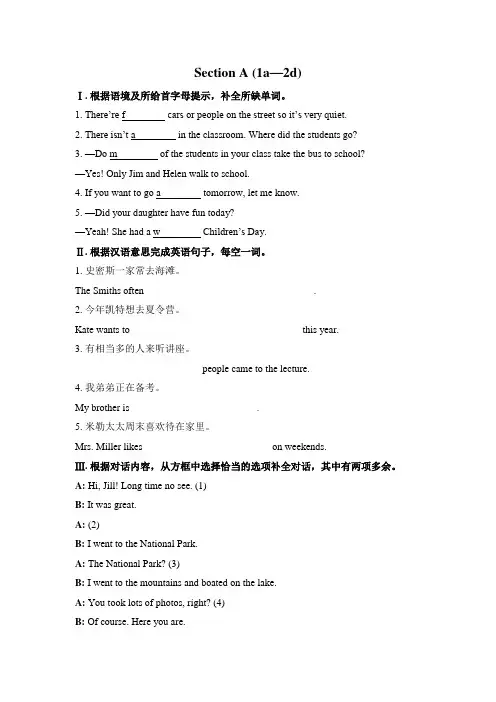
Section A (1a—2d)Ⅰ. 根据语境及所给首字母提示,补全所缺单词。
1. There’re f cars or people on the street so it’s very quiet.2. There isn’t a in the classroom. Where did the students go?3. —Do m of the students in your class take the bus to school?—Yes! Only Jim and Helen walk to school.4. If you want to go a tomorrow, let me know.5. —Did your daughter have fun today?—Yeah! She had a w Children’s Day.Ⅱ. 根据汉语意思完成英语句子,每空一词。
1. 史密斯一家常去海滩。
The Smiths often ________ ________ ________ ________.2. 今年凯特想去夏令营。
Kate wants to ________ ________ ________ ________ this year.3. 有相当多的人来听讲座。
________ ________ ________ people came to the lecture.4. 我弟弟正在备考。
My brother is ________ ________ ________.5. 米勒太太周末喜欢待在家里。
Mrs. Miller likes ________ ________ ________ on weekends.Ⅲ. 根据对话内容,从方框中选择恰当的选项补全对话,其中有两项多余。
A: Hi, Jill! Long time no see. (1)________B: It was great.A: (2)________B: I went to the National Park.A: The National Park? (3)________B: I went to the mountains and boated on the lake.A: You took lots of photos, right? (4)________B: Of course. Here you are.A:Wow, they’re beautiful.B: Thanks. (5)________A:Yes! I helped in the old people’s home as a volunteer (志愿者). B:Wow, you’re great.答案Section A (1a—2d)Ⅰ. 1. few 2. anyone 3. most 4. anywhere 5. wonderfulⅡ. 1. go to the beach 2. go to summer camp3. Quite a few4. studying for tests5. staying at homeⅢ. 1-5 DGAFB。
人教版八年级英语上册Unit1:where-did-you-go-on-vacation教案

Where did you go on vacationSection A(二)Aims1.Match the vocabulary : were rainyMaster and use: How was your vacation ? how were the beaches?where did you go?Difficult1.The vocabulary : were rainy fishnguage: Where did you go on vacation? I went to the mountains/ New York City /beach /summer camp How was your vacation ? how were the beaches?ImportantUse the language to talk about past events.教学步骤教学步骤、时间Step 1Free talk教师活动学生活动媒体应用Ask the question : Where did you go last Students talk about Sunday?events in the past.Step 2 Presentation (16’)(3a)(用班里的学生为例做练习)Point out the pictures in the photo album. Ask studentsto describe what they see.( In Picture 1 there is aman with a bowl of soup .There is also a waiter. Helooks angry .)Describe what theysee in picture 1 andpicture 2Fill in the blanks inthe conversation(In picture 2 there is a beautiful beach .There isa man. He looks unhappy .)(学生看3a 部分)Read the first two lines of the dialogue to the practice and act.class.Point out the answer was in the first line.Listen .Then point out the blanks in the rest of the lines(学生看图互问)Step 3the Work with the teacher.of the dialogue. Read the conversation toPractice(36)Work with a partner class saying the word blank for each blank line:(6')and act out.How blank the beaches?Then say , Write the word was or were in each Read and learn.blank. Ask students to complete the activity on Make their owntheir own .conversationPoint to picture 3 and ask students to say what 多媒体放映图一图二they see.Then read the words under thepicture .Pronounce any new words and explainwhat they mean ,if necessary Say:In this picturea girl is on a bus. The girl is taking a bustrip . Ask , What does relaxing mean ?Does it mean you are excited or quiet?How do you look when you relax?H students don ’ t know the meaningrelaxing,ofdemonstrate by leaning back in your seat andhalf 一 closing your eyes.Say a dialogue with a student . point tothe food picture. Ask , How was the food? Do asend example, if you wish .Move around the room monitoring theirwork . Offer language or pronunciation support Practice in pairs.as needed.The student replies ,itHave two students perform the example was awful .conversation ,or perform it yourself with one work in pairs多媒体student(you ask the questions).Look at picture6 ,放映Point out that the conversations starts off with Practice thethe sentences in the speech bubbles.conversation below .For example ,Ask and answerA :where did you go?questions.B: I went toA: What was the weather like?B: It was hot and humid .Say: First fill in the chart with the information Something in theabout your last vacation , Say where you went , pictures.Step 4the weather was like,what you ate, and Act it out多媒体whatPracticeFill in the chart with放映what else you did . As students fill in the chart(10')move around the classroom, monitoring progress Their own informationand offering help as necessary。
Unit 1 Where did you go on vacation初中八年级上册英语教案教学设计
Unit 1. Where did you go on vacation ? 协作教学设计喀拉塔勒镇中学 王雅婷一.教材分析本教材是人民教育出版制定的义务教育教科书,教学内容为八年级上册第一单元Where did you go on vacation? 单元核心话题是用一般过去式谈论度假等发生在过去的事情,本节写作课需要立足教材内容,通过反复使用动词的过去式进行写作,掌握英语旅行日记的写法。
二.学情分析我校农村学生虽然受外界语言环境的限制,但通过日常课堂学习,大部分学生已经能够掌握本单元的话题词汇,程度较好的学生有能力在教师的引导下对话题相关词汇进行拓展与迁移使用。
三.教学目标According to the new standard curriculum and the syllabus, after studying the teaching material, the teaching aims are the followings:1.Knowledge objects:(1) The students can master the usage of the important words and expressions.(2) The students can use the simple past tense in theproper situation.(3) The students can understand the content of the lesson, talk about holidays and vacations and get their own ideas about how to keep an English diary about travelling.2.Ability objects:(1) To develop the students’ abilities of listening, speaking, reading and writing.(2) To guide students to set up effective studying strategies.(3) To improve the students’ writing ability.3.Emotion or moral objects:By completing the task, Students increase their interest in travelling and set up self-confidence in Chinese Culture.四.教学重难点Based on the requirement of syllabus.The important points is the usage of the simple past tense, such as the correct forms of the regular and irregular verbs.The difficult points are the English writing structures and skills, such as the logical order and the conjunctions.五.教学方法As is known to us all, a good teaching method requires that the teacher should help students develop good sense of the English language. For achieving these teaching aims,I will use the following methods according to the modern social communication teaching theories.(1) Communicative approach(2) Total Situational Action六.教学过程Step1. Lead inDiscuss the Pictures on RMB including the scenery spots and the exact places.100-The great hall of the people 50-the Po-tala Palace 20-Guilin Scenery10-Three Gorges 5-Mount Tai 1-Three Pools Mirroring the Moon设计意图:从学生所熟悉的实物入手,激发学生开口说英语的兴趣,引导学生说出旅游见到的基本元素及地理位置,再看中华山水与实际生活的完美结合,激发学生对祖国文化的自信,逐步进入主题。
Unit 1 Where did you go on vacation全单元教案 (5课时)
Unit 1 Where did you go on vacation?Ⅰ.Analysis of teaching materials:This unit is around "Holidays and vacation” to carry out teaching activities.Students should learn to use past tense to talk about holiday activities. The content is close to students’lives,it’s also a topic that students are willing to discuss and share with others .So in teaching process ,we can consolidate the key sentences “Where did you go on vacation? Did you …How …”through different methods such as pair work ,acting , reporting and interviews. Students can consolidate and study further about the past tense on the basis of original.Students can also use the past tense to write a diary about their vacations. Ⅱ.Teaching Aims:1.Knowledge aims:①Ss talk about travel activities correctly using “where” and “how”.②Ss master questions with auxiliary “did”and the answers to the questions.③Ss learn to express their feelings correctly.2.Ability aims::①Ss can ask and answer questions about the things in the past using the past tense.②Ss can use description words to express their feelings.③Ss can record a vacation in a form of a diary and express their feelings about the vacations.3Emotional aims:Ss get to know more about each other through the exchange of what they have seen, heard and felt.Ss learn to express their feelings in a better way.Ⅲ.Teaching important and difficult points1、Ss master and use the vocabulary and expressions.2、Ss master general questions and special questions and the answers to the questions.3、Ss master the past tense of regular and irregular verbs .Ⅳ.Teaching arrangements1.Section A 1a~2c 2. Section A 2d~3c 3. Section B 1a~1e4.Section B 2a~2e 5. Review of Unit 1. 3a~Self check 2Unit 1 Where did you go on vacation?Period 1 Section A 1a~2cI. Teaching Aims:1.Knowledge aims:Key words and phrases: New York City. Central Park anyone. anywhere interesting wonderful. Key sentences: Where did you go on vacation?I went to New York City.Did you buy anything special?Yes. I bought something special for my dad.2.Ability aims: Students learn to discuss their vacations in the past using key sentences.Students improve their listening and speaking skills.3. Emotional aims: Ss exchange their feelings about their vacations and know more about each other. II. Teaching important and difficult pointsSs master key words and sentences, then use them correctly.Ss learn to talk about what they did in the past.Ss improve their listening and speaking skills.Ⅲ. Teaching Aids:mufti-media, tapeUnit 1 Where did you go on vacation?Period 2 Section A 2d~3cI. Teaching Aims:1.Knowledge aims:Key words and phrases: most of the time, quite a few ,something, anything / nothing fun, everyone, of course , myself , yourself, hen, pig, seem to be bored, someone, diary, Huangguoshu Waterfall.Key sentences:Did you do anything fun on your vacation? Yes, I did. I went to ….How was your vacation? How did you like it? It was wonderful.Did you do anything interesting\buy anything special?The only problem was that there was nothing much to do in the evening but read.Still no one seemed to be bored.2.Ability aims: Ss learn to talk about their vacations using key sentences.Ss improve their speaking skills.3. Emotional aims: Ss express their feelings about vacations.II. Teaching important and difficult pointsSs get to know how to talk about their vacations using past tense.Ss understand differences between different pronouns and know how to use pronouns correctlyⅢ. Teaching Aids: mufti-media, tapeⅣ. Teaching ProcedureUnit 1 Where did you go on vacation?Period 3 Section B 1a~1eI. Teaching Aims:1.Knowledge aims:Key words and phrases: Malaysia, Malaysian, Georgetown, Word Quay, Penang Hill,Key sentences: Where did she go on vacation?Did she do anything special?What did she do there?How was the food? How were the people?2. Ability aims: Ss learn to discuss their vacations including the places, the food, the people, the weather and so on. Ss improve their listening and speaking skills.3. Emotional aims: Ss share the vacations and know more about different places.II. Teaching important and difficult pointsSs master and use key words and sentences correctly.Ss improve their listening and speaking skills.Ss learn to talk more about their vacations and exchange their feelings.Ⅲ. Teaching Aids: mufti-media, tapeUnit 1 Where did you go on vacation?Period 4 Section B 2a~2eI. Teaching Aims:1.Knowledge aims:Key words and phrases: activity, decide to do, try, feel like, Paragliding, bicycle ,building, trader, wonder, difference ,top, wait for,umbrella, wet, because of , below, enough, hungry , as, hill,Key sentences: I felt like I was a bird.We saw the houses of the Chinese traders from 100 years ago.I wonder what life was like here in the past.What a difference a day makes!Because of the bad weather. We couldn’t see anything below.2. Ability aims: Ss learn to write a diary about their vacations.Ss improve their reading and writing skills.3. Emotional aims: Ss get to understand different travel experience makes people have different feelings. II. Teaching important and difficult points1. Ss master and use key words, phrases and sentences correctly.2. Ss improve their reading skills and writing skills.3. Ss learn to write a plete diary about their vacation.Ⅲ. Teaching Aids: mufti-media, tapeUnit 1 Where did you go on vacation?Period 5 3a~Self check 2I. Teaching Aims:1.Knowledge aims:key words and phrases: Tian’anmen Square, the Palace Museum ,a Beijing hutong. learn something important , Beijing duckKey sentences: Did you dislike anything?What did you like best?How did you feel about the trip?2. Ability aims: Ss talk about their vacations in the past using key sentences in this Unit.Ss improve their listening, speaking and writing skills.3. Emotional aims: Ss exchange their feelings by talking about vacations and get to know more aboutothers.II. Teaching important and difficult pointsSs revise and master the key sentences and phrases in this unit.Ss improve their speaking, listening and writing skills.Ⅲ. Teaching Aids: mufti-media, tape。
英语教案人教版八年级英语上册Unit 1 where did you go on vacation
Unit 1 Where did you go on vacation?Level: 8th gradeObjectives:To enable students to talk about past vacation experiences using past tense verbs.To encourage students to ask and answer questions using past tense.To develop students' listening and speaking skills through pair and group work.To enhance students' vocabulary related to travel and vacation.Materials:Textbook: New Target 8th grade English textbook, Unit 1.Handouts: Irregular verbs list and questions for pair work.Pictures of different travel destinations and modes of transportation.Procedure:Warm-upa. Greet the students and ask them how they are doing.b. Ask students to recall a memorable vacation they had and share their experience with their partner.c. Review the use of past tense verbs by asking students to identify the verbs in their vacation experiences.Presentationa. Introduce the topic of the lesson "Where did you go on vacation?" and show some pictures of different travel destinations and modes of transportation.b. Teach the past tense irregular verbs through the handouts provided.c. Model the use of past tense verbs in sentences by using the verb "go" and the students' vacation experiences. Example: I went to Hawaii with my family last summer.Practicea. Divide the class into pairs and give them the questions handout. The questions should focus on their vacation experiences. Example: Where did you go on your last vacation? Who did you go with? What did you do?b. Instruct the students to take turns asking and answering the questions using past tense.c. Monitor the pairs and provide feedback where necessary.Productiona. Divide the class into groups of 4-5 students.b. Instruct the students to plan a vacation to a specific destination and present it to the class using past tense.c. Encourage the students to use as many past tense verbs as possible in their presentation.d. Allow the students to present their vacation plan to the class and give feedback.Conclusiona. Summarize the lesson by asking the students to recall the use of past tense verbs.b. Ask the students to share what they have learned in the lesson.c. Assign homework, which could be to write a paragraph about their dream vacation using past tense.Assessment:The teacher can assess the students' understanding of the lesson through their participation in the pair and group work. The students' use of past tense verbs and their ability to ask and answer questions will be evaluated. The homework assigned will also be assessed for the students' use of past tense.。
人教版英语八年级上册unit1:where-did-you-go-on-vacation教案
Unit 1 Where did you go on vacation?Period 1 Section A(1a-2c)Teaching aims1.learn the important words、expressions and target language.main words and expressions:visited museum,New York City,someone,anyone,stay at home,went to the mountains.target language:---where did you go on vacation? ----i went to new york city.2.talk about things that happened in the past freely.3.learn to catch the main imformation while listening.Importance and difficultiese the simple past term to talk about activitieshe.e the past form correctly.Preparation before class1.know students’ summer vacations in advance.2.prepare tapes、PPTTeaching method:task-based teaching method、situational teaching method、cooperative method.Teaching steps:Step1:Lead inTeacher share her summer vacation and show some pictures to them to arouse their interests .and then ask some of students about where did they go on vacation.T: ....i went to tuolong gorge in pingjiang on vacation,it was exciting and dangerous.how about you? where did you go on vacation?S1:I went to yueyangS2:Iwent to Beijing.S3:I stayed at home .Step2:Presentationfocus their attention on the form of verbs,using the flash cards on the computer.went to the beach went to new york city visited museumsstayed at home and watched TV went to summer camp visited my unclewent to the mountains.practice the sentences:---Where did you go on vacation?---I went to the beach .---I went to New York City...............Step3:Games1,divide the whole class into two groups and play the game named “quick memory”.revise the activities and past form of verbs above.2,play a chain game to practice the main sentences:where did you go on vacation? I........ask some rows to act out.Step4:Work on 1afinish 1a by themselves and check the answers.Step5:Listening (work on 1b)1.ask students to read the five names in the box.2.look at the pictures to get some information.3.ask students to listen and number the people in the picture.tell them to pay attention to thenames,and get the main information.Step6:Reporteveryone asks three or more classmates about where did they go on vacation,and write it down,then report to the whole class. when one student is reporting ,others should listen carefully and answer and repeat where they went on vacation.Step7:Work on 2a&2b1.Teacher share her experience in beijing and lead the main expressions that will appeared in the following listening material.T:I went to xiangshan park in beijing a couple of years ago,and i went with someone .i went with my friend.so,did i went with anyone?S:Yes,you did .T:I also do something interesting ,i tied a red ribbon to the wishing tree,so did i do anything interesting?S:Yes, you did. ..................................Let them realise the meaning of someone 、anyone、something interesting、anything interesting and something special 、anything special.2.Listen for more information and finish 2a&2bStep8:Pair-work(work on 2c)1.make conversation between grace,kevin and julie according to the listening material or maketheir own coversations .2.act out the conversations.3.Step9:ExercisesDo some exercises on the ppt.Step10:Homework.。