
人教PEP版-英语-三年级下册-Unit 3 At the zoo part B 教案
Unit 3-Part B一、教学目标:1. 能力目标:让学生围绕“at the zoo”这个主题进行“谈论动物”的活动,让学生了解到更多动物的名称并能对动物的主要特征(高矮、大小、习性等)进行简单的描述。
培养学生听、说、认读和对话交际的能力,及培养学生小组合作学习的能力。
2. 知识目标:(1)能听懂、会说一些含有简单形容词的句子,并能在实际情景中用相关形容词来描述动物的特征。
E.g. The giraffe is tall. The deer is short.It is (so).... It has (a long tail).(2)学习了解常用表达法:Yeah. You are right .You see.3. 德育目标:培养学生爱护动物、保护动物的意识。
并了解Don't feed the animals in the zoo.二、教学重点,难点:抓住动物特征,用含有简单形容词的句子来进行描述。
三、教学用具:自制的各种小动物图片及4个盘子、一颗大树的图片、四张装饰成动物园的吹塑纸板、(动物园名称:Happy zoo, Lucky zoo, Funny zoo, Sunny zoo. )图钉、动物园门、录音机、Amy and her dad's picture四、学情分析:本节课是在学生学完B Let's learn的基础上学习的一节对话课,教学对象是小学三年级学生。
学生已经学过一些简单、常见的动物单词,如dog、cat、monkey等。
另外学生已学习了一些形容词,如:big, small, long, funny 等。
五、教学过程:Step 1.Warm-up课件1:封面的背景及音乐《Little and big.》1. Let’s sing a song. <They Are in the Zoo>T: Boys and gir ls. Before class let’s sing a song. Please watch the screen. Clap your hands.2. Free talkT: (教师手指屏幕画面)Boys and girls. Do you like animals?Ss: Yes.T: What animals do you like best? Can you tell me?S1: I like _____.T: What about you?S2: I like ___.T: What animal do you like?S3: I like …T: I have many pictures of animals’ here.(教师将盛动物的四个盘子分给各小组)In this class, if you can answer my question. You can get one of them from the plate. Let’s see which group can get the most animals. OK?(设计思路:以歌曲《They Are in the Zoo.》开始,把学生带入本节课的主题: At the zoo. 然后沿着歌曲的思路,在free talk中与学生谈论自己喜欢的动物,调动学生思维,引入对动物名称的复习,学生通过brainstorm活动,绕有兴趣的在不知不觉中进入所涉及到的话题。
并借助话题把学生分成四个小组,引入本节课的评价机制。
)3. Brainstorm 复习形容词。
T: We all like an imals. Now, let’s go to the zoo and see the animals. Please watch carefully.T: Look. The____ is _____. Look at the ____. It's ____.课件3:动物园的门打开,六种动物图片: giraffe, deer, elephant, mouse, snake, monkey依次出示在屏幕上。
T: Now, let’s chant. 课件4:Let’s chant. 句子+动物图片。
Let’s chant.Tall, tall, tall! The giraffe is tall.Short, short, short! The deer is short.Big, big, big! The pig is big.Small, small, small! The mouse is small.Long, long, long! The snake is long.Funny, funny, funny, the monkey is funny.(设计思路:这些动物所选择的都是特征明显的动物,目的是为形容词复习做好铺垫。
通过形体语言,帮助学生复习、理解、巩固形容词,)Step 2 Presentation(一)导入呈现1.rabbit and monkey的对比教学引出long, short的复习。
a. 兔子(教具兔子贴在黑板上面)T: The animals are lovely. I have another animal. Look, what's this?Ss: rabbit.T: Look at the rabbit. It’s pink. What’s it like? It has a ---. (师用手摸兔子尾巴)S: It has a short tail.(板书: short)T: Yeah. You’re right. It has a short tail. You can get a picture of animal from the plate. (教师用You're right来表扬,并且告诉学生拿奖品:小动物)b. 猴子(教具猴子贴在黑板上面)T: Look, what's this?Ss: monkey.T: Look at the monkey. What color is it? What’s it like? (师用手摸猴子尾巴)S: It’s orange? It has a long tail.(板书: long )T: Yeah. You’re right. It has a long tail. You can get a picture of animal from the plate.c. 对比(教师手指板书对比)T: Boys and girls. Look at the blackboard. You see. The rabbit has a short tail .The monkey has a long tail.d. Ask the students to repeat the sentences. (1-2学生重复读句子)T: Who can say?S: You see. The rabbit has a short tail .The monkey has a long tail.(设计思路:通过rabbit 和monkey的对比,引出long,short 的复习,并引出You see .同时渗透You're right.)2.pig and squirrel的对比教学引出big, small的复习.a. 小猪(师将教具小猪贴在黑板上,用手指外形)T: Look at the pig.Ss &S: It’s big. (板书: It's big. )T: Yes. It’s so big. You can get a picture of animal.b. 松鼠(教具松鼠贴在黑板上)T: Look, what's this?Ss: Squirrel.T: Look at the squirrel. What’s it like? (师用手指小猪和松鼠,对比)S: It’s so small.(板书: small )T: You’re right. The squirrel is small. You can get a picture of animal.c.(教师手指板书对比)T: You see. The pig is big. The squirrel is small. (也可以此处板书: big ,small)d. Ask the students to repeat the sentences. (1-2学生重复读句子)T: Who can say?S: You see. The pig is big. The squirrel is small.(设计思路:通过pig 与squirrel 的对比教学,引出big和small的复习。
同时进一步渗透:You see . You're right.)(设计思路:这一部分的设计,看起来是在复习long 、short 、big 、small这四个形容词,但是它有一个新旧知识点的衔接,那就是人称代词it转换成了具体的名词。
本节课中有一个教学重点:The giraffe is tall. The deer is short.其实,这一环节就是重点部分教学的一个铺垫。
通过新课导入这一环节,板书句型:It's (so)---.)(二)、创设情景,呈现并教、学课文。
1. 听录音,回答问题,初步了解课文内容。
T: Today, Amy and her dad(拿两张图片贴在黑板上)are in the zoo(贴动物园门,画上栅栏。
)They are watching the animals. Open your books and turn to P 63. Let’s watch the video and think about the question. What animal are they talking about?课件5:问题,视频,回答。
Answer the question.What animals are they talking about? (他们在谈论什么动物)后出示答案: giraffe 和deer图。
S: Giraffe / Deer.(设计思路:创设情景,画上栅栏,贴上动物园的门和人物Amy and her dad的图片。
通过老师的一句话就把地点、人物、事情交待清楚了,并且借助图片,孩子一目了然,紧接着提出问题:Which animals are they talking about?让孩子带着问题听录音,为课文的理解做好铺垫。
【同步教案】人教PEP 三年级下册 Unit 3 At the zoo PA Let's learn
【同步教案】人教PEP 三年级下册 Unit 3 At the zoo PALet's learn 教案一、教学内容:Unit 3 At the zoo PA Let's learn二、教学目标:1. 认识并掌握本单元的四个动物:panda, giraffe, hippo, camel。
2. 能听懂、说出并正确发音这四个动物的单词。
3. 能理解并运用句型“Where is the …?”和“I seethe ….”进行问答和描述。
三、教学重难点:1. 教学重点:本单元的四个动物单词及其发音。
2. 教学难点:熟悉并理解句型“Where is…?”和“I see the….”的用法。
四、教学准备:多媒体课件,四个动物的图片及配套卡片。
五、教学过程:1. Warm-up(1) GreetingHello, boys and girls! Good morning/afternoon!(2) Daily reportTeacher asks some students about their daily routines using the present tense, such as: “What time do you get up?”, “What do you have for breakfast?”, “What time do you go to school?”.2. Presentation(1) Introduce new vocabularyTeacher shows the pictures of the four animals (panda, giraffe, hippo, camel) and says the words. Students repeat after the teacher to practice pronunciation.(2) PracticeTeacher gives each student a card with a picture of one of the four animals on it. Then, teacher says the name of one of the animals, and students with the matching cards stand up and show their cards.3. Production(1) Learn a new sentence patternTeacher introduces the sentence pattern “Where isthe …?” to ask about the location of the animals. Teacher gives examples by asking: “Where is the panda?” and “Where is the hippo?” and asking students to respond with “It’s in the zoo.”(2) Use the sentence patternTeacher asks some students to ask “Where is the …?”questions and other students to respond.(3) Learn another sentence patternTeacher introduces the sentence pattern “I see the ….”to describe the animals. Teacher gives examples by saying“I see the giraffe.” and “I see the camel.” and asking students to repeat.(4) Use the sentence patternTeacher turns around and says “I see the giraffe.”Students must say “Where is the giraffe?” and teacher answers “It’s in the zoo.”4. Summary and Homework(1) SummaryTeacher lets students summarize what they have learned today, such as the names of the four animals, what the sentence pattern “Where is the …?” means and how to use it, and what the sentence pattern “I see the ….” means and how to use it.(2) HomeworkTeacher assigns a homework to students to draw the pictures of the four animals and write sentences using “Where is the …?” and “I see the ….” sentence patterns.六、教学反思:本节课首先介绍了新单元的四个动物单词,并通过卡片配对的方式进行了拓展学生们的词汇量。
三年级下册英语优质教案-Unit 3 At the zoo Part A 人教PEP

Unit 3 At the zoo第一课时教学内容:A. Let’s talk教学目标:1、能够听、说、读句型It’s so……2、并在情景中熟练应用教学重点:1、能听、说、认读几个形容词tall fat thin short2、句型It’s so…教学难点:句型It’s so…教学过程:1、S: The elephant has a long nose. It has big ears. It hasa short tail. It is (so)big. 教师引导学生将这些句子用and连接在一起,并带读:Look at the elephant, It’s so big. It hasa long nose and a short tail. It has small eyes and big ears.2、再次播放Let’s talk 部分的教学录音,让学生跟读对话中的句子,模仿发音,要求自然生动。
板书:Unit 3 At the zooA Let’s talkIt’s so thin/short/ tall/ fat……教学反思:Unit 3 At the zoo第二课时教学内容:A. Let’s learn Let’s do教学目标:1.能听、说、认读几个形容词tall fat thin short。
2.听懂含有形容词的几个指令,并按指令做动作。
教学重点:1.能听、说、认读几个形容词tall fat thin short。
2.听懂含有形容词的几个指令,并按指令做动作。
教学难点:听懂含有形容词的几个指令,并按指令做动作。
教学过程:1、出示图片,教师说:You will see a beautiful picture. Look at it carefully and tell us: What’s in it?/What are they?2、教师快速展示系列动物图片:giraffe, monkey,3、学生根据看到的图片说说动物单词。
Unit3Atthezoo(单元解读)三年级英语下册(人教PEP版)
三年级下册Unit 3 At the zoo单元解读一、单元内容体现的新课标理念本单元在英语核心素养的育人价值下进行,围绕单元主题—描述动物外形特征展开教学。
本单元学习的主题是运用形容词描述动物的外貌特征,通过本单元的学习,学生能够理解形容词的意义,能够在情境中描述动物的外形特征并能听懂别人的描述,通过学习本单元知识,学生能够具有热爱动物、保护动物的意识。
二、单元信息本单元是义务教育人教版(PEP)小学英语三年级下册第三单元。
单元主题为At the zoo(在动物园)。
本单元通过孩子们和老师一起去动物园观察动物引出本单元的主题:描述动物的特征。
A部分共三页,分三课时。
第一课时为情景对话和练习部分。
Let’s talk部分通过Mike、Amy和Miss White的对话引出了三会单词:tall, short, fat, 两会单词giraffe, so。
同时呈现了本单元描述动物整体特征的句式:Look at that giraffe. It’s so tall. 在画一画,说一说的练习中,Chen Jie和John分别画了自己的动物,并使用重点句式来描述其特征。
学生通过这样的活动来操练在对话中学习到的重点句式。
第二课时为重点词汇和重点句型呈现,孩子们继续在动物园里游玩,发现了monkey和giraffe,从而呈现出三会词汇:tall, short, fat, thin,以及在Let’s talk中出现的描述动物的特征的句式:Look at that monkey. It’s fat. Let’s do是指令活动,学生需要根据指示做到变胖、变瘦、变高、变矮的动作,从而操练重点单词。
第三课时为语音学习,通过听一听、读一读、唱一唱、写一写活动,让学生理解并掌握字母i在单词里发的短音/ ɪ /。
B部分共四页,分三课时。
第一课时呈现情景对话和练习。
Miss White 带着孩子们观察大象,孩子们开始描述它具有的具体特征。
Unit3AtthezooPartA第2课时(课件)人教PEP版英语三年级下册

A. at
B. in
( B ) 2. It's short ___ fat.
A. on
B. and
( A) 3. It ___ so tall.
A. is
B. am
( B ) 4. It’s___ big.
A. and
B. so
B. on C. to C. are C. be
Summary
1. 学习了描述动物特征的形容词tall, short, fat。
Look at my giraffe!
Look at my cat!
It's tall.
It's fat.
Practice1:Look and say 描述以下动物的外貌特征。
Look at the pig.
Look at the monkey.
It's fat and cute.
可爱的
It's short and thin.
4. ha 哈
【解析】感叹词,表示惊讶,怀疑,愉快,胜利等。 如:Ha! You are here. 哈!你在这里。
5. so 如此,那么
【解析】副词,常用于形容词或副词前,表示程度。可和very互换使用。 如:She is so/very beautiful! 她好漂亮!
Practice1:Draw and say 准备好动物图片,向同学描述自己画的动物。
Exercise
一、根据图片选出正确的单词。 ( A ) 1. A. panda B. bear
( A ) 2. A. duck B. ant
( B ) 3. A. elephant
B. giraffe
( B ) 4. A. pig
Unit3AtthezooPartALet’slearnLet’sdo(课件)人教PEP版英语三年级
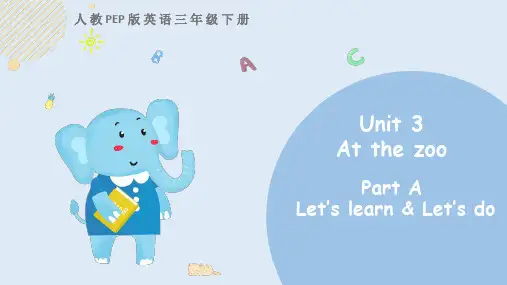
He is tall He is ... and fat. and ...
short tall thin fat
Summary
What we have learnt today
1. 学习了下列词汇: tall, short, fat, thin. 2.学习了下列句型: Look at ... It's...
Be tall. Be tall. Be tall, tall, tall! Be short. Be short. Be short, short, short!
Watch and do
Pair work Please talk with your partner.
I’mI’msh.o..rt anadndth..i.n.
/ʃɔ:t/ 矮的
so so so
short short short so short!
(我的朋友是只猫)
Look at that _c_a_t_. It’s _____.
/fæ t/ 胖的,肥的
so so so fat fat fat so fat!
why is Gafield so fat ?
bear
cat
panda
bird
tiger
dog
duck
elephant monkey
Look and say
Look at that giraffe.
It’s _____. /tɔ:l/ 高的
so so so tall tall tall so
tall
Look at that panda. It’s _____.
what animal do you want adopt? (你想领养什么动物?)
人教版pep三年级下册英语新Unit3 At the zoo Par课件

Good to know
人走路的速度:每小时4~7千米 平时车速:每小时60~80千米
Good to know
人走路的速度:每小时4~7千米 It can run very fast. 平时车速:每小时60~80千米 他可以跑得非常快。 鸵鸟速度:每小时80~90千米
It has two long legs.
It is___.
It has ___ eyes and ___ ears. It has a ____ nose.
It has a __ body.
It is___. It has ___ eyes and ___ ears. It has a ____ nose. It has a __ tail.
人教版小学英语三年级下册
Unit 3 At the zoo
Part B Let’s learn
非洲 bird
animal
neck
Africa
1 (动物)
2
ostrich
It is big.
It is big. Look at the body. It has a big body. big It is ___.
long neck. It has a ____
It is ____. tall
It ___ has a long neck.
It has a ____ long tail .
Look at the tail. _____ It has a short tail. It is short ____.
It has ___ eyes and ___ ears.
Love
the animals
Homework
人教PEP版英语三年级下册Unit 3 At the zoo PA Let's learn 课件
Presentation
What other animals can you see ?
Presentation
高的
Look at that__g_ir_a_f_fe. It’s so __t_a_ll__.
Presentation
矮的 Look at that__t_ig_e_r_. It’s so __sh_o_r_t_.
Practice
Be tall. Be fat. Be short. Be thin.
Practice
I say, you do!
Be fat. Be fat. Be fat, fat, fat!
Be thin. Be thin. Be thin, thin, thin!
Be tall. Be tall. Be tall, tall, tall!
Be short. Be short. Be short, short, short!
Task 4 I can choose
Look and choose
Look at that tree. A. It’s tall!
√ B. It’s short!
Look at that panda.
A. It’s fat!
Practice
Be fat. Be fat. Be fat, fat, fat!
Practice
Be thin. Be thin. Be thin, thin, thin!
Practice
Be tall. Be tall. Be tall, tall, tall!
Practice
Be short. Be short. Be short, short, short!
人教版PEP英语三年级下册Unit3 At the zooPart A课件等
…
形容词的比较级
1.含义:表示两者(人或事物)的 比较。
2.用于:比较级+than的句子中 3.翻译:“更…….”
形容词比较级的变化规则
1.一般在词尾+er:
strong—stronger old --- older
tall---taller small ---- smaller
选择适当的一对反义词填空。
long short small big
1.The monkey has a __l_o_n_g___ tail. The rabbit has a __s_h__o_r_t_ tail.
long short small big
2. The elephant has ___b_ig____ ears. The panda has __s_m__a_l_l_ ears.
long short small big
3. I have __b_i_g____ eyes. My brother has __s_m__a_ll__ eyes.
记住几个形容词 small, big, long, short。
Unit1 How tall are you ? B. Read and write
Unit three 3up
绿色圃中小学教育网
monkey
绿色圃中小学教育网
绿色圃中小学教育网
tiger
绿色圃中小学教育网
绿色圃中小学教育网
绿色圃中小学教育网
绿色圃中小学教育网
绿色圃中小学教育网
绿色圃中小学教育网
in the morning
at noon
三年级下册英语unit 3 At the zoo Part B人教PEP版
Let`s chant
It has big ears. It has small eyes. It has long legs. It has a short tail.
Can you guess? (猜一猜)
It has a long nose. It has a short tail. It has small eyes It has big ears.
(cat)
It has a big head. It has a long tail.
It has big eyes.
Tadpole`s Mum
Mum, mum!
No, no ,no. I`m not your
mum. It has big eyes.
Mum, mum!
No, no ,no. It has a
New words
big
small
big
small
long
tail
short
It has a long nose .
It has a short tail .
It has small eyes.
It has big ears.
It has small eyes and big ears. It has big ears. It has small eyes.
Look at the … It has a… It has …
Introduce your animal toys in English.
green body.
Mum, mum!
No, no ,no. It has long
legs.
Come here, children!
英语人教版三年级下册Unit 3 At the zoo Part A 教案
人教PEP版小学英语三年级下册Unit 3 At the zooPeriod 2(Part A .Let’s learn & Let’s do)Teaching design合肥市庐江县海事沙岗希望小学李冬Subject(课题): Unit 3 At the zooLesson period(课时):The Second PeriodLesson type(课型): New lessonTeaching material analysis(教材分析)本套教材以小学三年级为起点,注重学生语言应用能力的培养。
本课时在A 部分Let's talk的基础上再次熟练巩固运用所学形容词来描述动物的特征,教学单词“tall”、“short”、“fat”和“thin”和“Let’s do”部分歌谣。
Learning situation analysis(学情分析)1、学生经过三年级上册的英语学习,具备了一定的语言基础,能用英语进行一些简单的日常对话,对形象的物体较感兴趣,容易被调动起来。
2、由于学生上学期已经学习了表示动物的一些单词,所以教学的一开始,复习已学的一些内容,唤起学生的记忆,激发学生的学习兴趣。
3、这个年龄段的学生比较好动,喜欢游戏,对直观的图片和动画情景比较感兴趣,因此,只要投其所好,就能激发学生的学习兴趣。
Teaching contents(教学内容)(Unit 3 At the zoo Part A .Let’s learn & Let’s do)Teaching aims(教学目标)(一)Knowledge & skills (知识与技能)1.通过学习,学生能熟练掌握两对意思相反的形容词:“tall”和“short”,“fat”和“thin”。
2.通过学习,学生能运用句型“It’s、、、” 简单地对动物进行描述。
3.通过学习,学生能听懂指令,并根据指令做出相应的动作。