
人教版英语八年级上册7-8单元复习导学案
初中英语学习材料madeofjingetieji本周习惯养成: Practice makes perfect. 一、示标自学短语大声背:1.两片火鸡肉__________2.尝起来不错_________3. 在山顶_________4. 一段音乐_____________5.制作水果沙拉__________6.两勺蜂蜜___________7.一杯酸奶_________8…的食谱__________9.在一片面包上放一些作料____________10.打开搅拌机___________11.去水族馆_________12.买一些纪念品___________13.和朋友们闲逛____________14.在一天的结束___________15.休息日___________16.在我的下一个休息日______________17.去开车兜风____________18.睡得晚____________19.忙碌的休息日____________20.淋湿__________21.野营很开心___________22.举行一次旧货出售_____________23.观看海豚表演___________24.在学校旅行中____________25.带来了我们的雨伞和雨衣_______________ 牢记重点句:1. How many bananas do we need?2. How much yogurt do we need?3. I helped Sally buy a new watch.4. We watched a movie about living in the future.5. Were there any sharks?Step one :点击重点词A win ,beat1) We played very well, and we ______ them. 2 )They ______ the match this time. 3 ) He ______ first prize in the surfing competition4 ) We ________ the strongest team in the football match this time .5 ) He ______ me at chess the day before yesterday.6 ) We_____ the basketball match last week.7 )We are sure to _______B sound, noise, voice1) Soon they heard the _______ of planes. 2)She has a beautiful and sweet ________3) Light travels faster than _______. 4)We could hear the children’s _______5) Don’t make so much ________ 6)Very loud ________ can make people ill.C at the end of, by the end of, in the end课题: 课型: 新授编号:09804 主备人: Liu Haixia审核: Luan Guiling 小主人: 学习目标:通过讨论,做针对性练习让学生掌握本单元重点单词,词组及语法;同时渗透答题技巧,穿插阅读训练或写作训练。
【复习重点】重点单词:win, sound ,at the end of, watch ;重点短语:turn …on pour … into mix …up cut …up hang out sleep late语法:1)名词复数 2)一般过去时 3) 不规则动词的过去式【复习难点】 1)名词复数 2)不规则动词的过去式1) He had learned thousands of English words ____the end of last year.2) ______ the end he passed the final exam.3) The students all went home ______ the end of term.4) The bookstore is _____ the end of the streetD watch, see, look, look at1) I_____ but I can't ____ 2) who isn't here? Let me _____.3) What do you on Sundays? I _____ TV. 4) Let me take a _______ this Swiss watch5) They are going to watch a football game this afternoon 6) ___________me carefully.7) I'm _________a football game now. 8) She wants to ________her friend.Step Two: 短语集中练1.The pizza__________(尝起来不错).2. Did you _________(野营过得愉快)?3.____________(在我的下一个工作日), I don’t want to go for a drive.4. The students ______________(有一个糟糕的校旅行).5. ____________(在那天的结束), the science teacher was very happy because the students cleaned the bus after the trip.6. _________(在……的尽头) the road you’ll see the hospital.7. We_____________(玩得高兴) at the English party.8. They ________________(乘地铁返回到) school last Friday9. He often _________(开车兜风) on the weekends10. I’m sorry you didn’t have fun ________________ (你休假的时候)11. He _____________(拍了许多照片) when he was on holiday last year12. Last Sunday I __________(闲逛) with my friends in the mall.13.He needs____(两片火鸡肉)and ____(一些佐料).14. You’d better _____________(不要切碎) the meat15. If you want to make dumplings, we should __________(混合) flour and waterStep Three:语法练兵场There be句型的基本用法:某地/某存在有某人/某物形式为“There be+代词或名词(短语)+地点/时间状语”。
eg:1. There is a desk and two chairs in the room.2. There aren't two chairs and a desk in the room. (否定句)3. Is there anything wrong with your ears? (Yes,there is/No,there isn't.)4. There wasn't a meeting yesterday, was there?(反意疑问句)语法大练兵:1 There_____ not any sharks in the aquarium last year.2 When _____your brother born?3 Everyone _____ at school yesterday afternoon.4 There ____ not much tea in the box now5 There _____ many books and some pens in the desk now6 There ____ a kite and some strings over there just now7 There ____ some oranges and some juice in the box a moment ago8. The twin brother were at the supermarket half an hour ago.(对划线部分提问)_______ _______the twin brothers half an hour ago?9.the boys in Grade Seven had a great time at the zoo.(同义句)The boys in Great Seven ______ ______at the zoo.10. We bought some apples in the shop.(改为否定句)We _______ _______ _______apples in the shop.写出下列动词的过去式并写出你发现的规律1)answer________ live________; ask________ dance_________; (________________)2)stay _________;carry_________ study_________ (_____________________________)3)stop_______ shop________ nod________ (_____________________________________)4) 1. are____________ 2.do____________ 3.have____________4.cost____________5.take____________6.sweep___________7.say____________8.read____________9. make __________10. eat____________11. buy____________12.see__________e___________14.swim____________15.know__________Step Four :中考题型练一,根据句意及所给提示,补全单词或用单词、固定短语、固定搭配的正确形式填空。
人教版-英语-八上-8单元导学案

Section A学习目标知识目标:1. words: shake, blender, yogurt, turn on, peel, pour, honey, watermelon ,spoon, add, finally, salt,machine.2. sentences: How do you make a banana milk shake?How many bananas do we need ?How much yogurt do we need ?能力目标: 学会使用how many 和how much 分别对可数名词和不可数名词的量提问.情感目标: 培养学生热爱劳动的习惯.教学重点:可数名词和不可数名词的运用以及对他们量的提问。
教学难点.:如何描述过程。
学习过程一.情境导入(Warm up)1、T:What food do you like? What drink do you like?2、让学生讨论他们喜欢的食物和饮料。
二.引入新课(Presentation)从方框中选择适当的单词完成下列句子1. Finally ____ the pancake.2. ____ looks like sugar.3. How many teaspoons of ____ do you need?4. Did you ____your answers?5. Put some ____ slices on the sandwich.三、教授新课(New lesson)1.学习1a .Look at the picture .What can you see ?Point out the blank likes in the picture .Ss twrite the names of the actions .Choose the correct words .Ss fill in the blanks on their own .Check the answers .2.学习1b .Point out the actions in the picture and the list of actions in activity 1b . Play the recording and check the answers .3.学习1c,对话练习。
八年级英语上册第八单元导学案(XX新人教版)

八年级英语上册第八单元导学案(XX新人教版)本资料为woRD文档,请点击下载地址下载全文下载地址八年级上册英语导学案Unit8Howdoyoumakeabananamilkshake?Period1sectionA1a--2c课时目标:知识目标:.熟练掌握词汇:watermelon,shake,pour,pour..into,turnon,cutup,yogurt,honey,need2.熟练掌握以下句型:(1)cutupthebananas(2)pourthemilkintotheblender(3)Howdoyoumake…?Howmuch…doyouneed?技能目标:1,会用本节新词和短语,能听说读写;2能听懂,读懂描述程序的简短听力材料,能就某个操作程序对话,初步书面编写这样的对话;情感目标:培养学生热爱劳动和独立自主的生活态度。
课前预习Ⅰ.回顾你所学过的有关食物的单词,并将其分类,比一比谁写的多。
Drink:_______________________________Fruit:_______________________________Vegetables:__________________________Food:________________________________Ⅱ.和同伴合作,把这些食物安可数和不可数名词分类。
可数名词:___________________________不可数名词:_________________________课堂学习Beforelistening.结合课前准备Ⅰ的内容,完成1a。
2.运用生活常识,依据图画提示,通过和伙伴的探讨,了解制作水果奶昔的步骤。
whilelistening.听录音,对话中出现了____步制作奶昔的步骤。
将其排序,完成1b。
2.再听一遍,你听到那些描述过程所用的连接词和句式?和同伴探讨一下吧!3.听录音,模仿对话中的精彩片段。
八年级上英语7-8单元练习导学案
三、作业Homework
1.整理笔记词汇写在作业本上
2、作业完成后拍照发钉钉。
科目
英语
课题
八上7-8单元练习
授课老师
班级
上课时间
签审领导
节次
学习目标及重难点
1.完成67页的练习并讲解改错(难、重)
2.熟悉中考题型,逐步提高学生做题的正确率和速度。(难)
一、解读学习目标强调作业完成的质量
二、新授Presentation(练习)
P67词汇练习
(1)语篇提升
1.师讲解方框中所给单词。
2.生完成练习时间:12分钟。
要求:独立完成,完成后回复字母o。
3.连麦核对答案。
4.师讲解题,对错题进行重点讲解。高职学生选什么?为什么?
(2)项选择题
1.生完成练习.时间:3分钟。
要求:1独自完成,认真审题,画出重点。2.完成后及时回复老师。
2核对答案。
3.先连麦学生,分析出错原因,后师讲解补充。
八年级上册英语全册导学案(人教版)
八年级上册英语全册导学案(人教版)八年级上册英语全册导学案(人教版)八年级上册英语全册导学案(人教版)学习目标:知识目标:1熟练掌握词汇:atereln,shae,pur,purint turn n, ut up, gurt, hne, need 2熟练掌握以下句型:(1)ut up the bananas (2)pur the il int the blender (3)H d u ae…? (4) H uh …d u need?技能目标:1,会用本节新词和短语,能听说读写;2能听懂,读懂描述程序的听力材料,能就某个操作程序对话,初步书面编写这样的对话;情感目标:培养学生热爱劳动和独立自主的生活态度。
学习过程:一、自主学习(做学习的主人!)(一)Previe steps and ethds(预习步骤及方法):(新知识,早知道)前预习Ⅰ回顾你所学过的有关食物的单词,并将其分类,比一比谁写的多。
Drin:_______________________________ Fruit:_______________________________Vegetables:__________________________Fd:________________________________ Ⅱ和同伴合作,把这些食物按可数和不可数名词分类。
可数名词:___________________________ 不可数名词:__________堂学习Befre listening 1结合前准备Ⅰ的内容,完成1a。
2运用生活常识,依据图画提示,通过和伙伴的探讨,了解制作水果奶昔的步骤。
(二)听力练习1b,2a,2b,并完成相应任务二、合作交流:-peratin( 三个臭皮匠,顶个诸葛亮,T heads are better than ne) 小组练习对话1,2。
三、展示点拨:Displa (弘扬个性,展示讲解,让我们共同分享成功的喜悦!)Rle pla the nversatins in 1 and 2 Sh t the lasses四、巩固提升:Exerise in lass (别低估了自己的潜力!)根据首字母提示补全单词,使句子完整通顺。
人教版八上英语unit7教案和导学案

人教版八上英语unit7教案和导学案全文共3篇示例,供读者参考篇1Unit 7 Teaching Plan and Study GuideUnit 7: The World of WorkI. Teaching Objectives:1. Understand the words and phrases related to jobs and professions.2. Learn how to talk about different jobs and career aspirations.3. Understand and use the past simple tense to talk about past work experiences.4. Develop listening and speaking skills in English.II. Key Vocabulary:1. Job related words: engineer, doctor, teacher, journalist, chef, etc.2. Work related words: work experience, promotion, interview, salary, etc.3. Words related to career aspirations: dream job, career goals, etc.III. Teaching Activities:1. Warm-up (5 minutes):Start the lesson by asking students about their dream jobs and why they want to pursue those careers. This will introduce the topic of the unit and get students involved in the discussion.2. Vocabulary Introduction (10 minutes):Introduce the key vocabulary related to jobs, work, and career aspirations. Use pictures, flashcards, and real-life examples to help students understand and remember the words.3. Listening Task (15 minutes):Play a recording of a dialogue between two people talking about their work experiences. Ask students to listen carefully and answer questions about the dialogue. This will improve their listening skills and help them understand how to talk about past work experiences.4. Speaking Activity (20 minutes):Divide the class into pairs or small groups and ask them to discuss their own work experiences or talk about a job theyadmire. Encourage students to use the vocabulary they learned in the lesson and practice speaking in English.5. Grammar Practice (15 minutes):Introduce the past simple tense and explain how to use it to talk about past work experiences. Provide examples and additional exercises for students to practice forming sentences using the past simple tense.6. Role-Playing Activity (20 minutes):Assign roles to students and have them act out job interviews or conversations between a boss and an employee. This will encourage creative thinking and help students practice speaking and using the vocabulary and grammar they learned in the lesson.7. Wrap-up (5 minutes):Review the key points of the lesson and ask students to summarize what they learned. Encourage them to ask any questions they may have and provide feedback on their performance in the activities.IV. Study Guide:1. Review the vocabulary related to jobs, work, and career aspirations.2. Practice listening to dialogues and conversations in English to improve your listening skills.3. Practice using the past simple tense to talk about past work experiences.4. Engage in speaking activities to practice using the vocabulary and grammar you learned in the lesson.5. Participate in role-playing activities to improve your communication skills and fluency in English.By following this teaching plan and study guide, students will be able to enhance their English language skills and develop a better understanding of the world of work. With practice and perseverance, they can achieve their career goals and excel in their chosen professions.篇2Unit 7: How much are these socks?Teaching Goals:1. Understand and use the key vocabulary for different items of clothing.2. Be able to ask and answer questions about the price of items using "How much is/are...?"3. Practice using the quantifiers "a pair of", "a pack of", "a piece of" and "a bottle of".Teaching Procedures:Step 1: Warm-up (5 minutes)- Start the lesson by showing pictures of different items of clothing and asking students to identify them in English.- Review the names of the items of clothing and make sure all students understand the vocabulary.Step 2: Presentation (15 minutes)- Introduce the key vocabulary for this unit by showing flashcards of different items of clothing. Have students repeat after you and practice saying the words.- Teach the structure "How much is/are...?" and model some examples with the items of clothing. Encourage students to ask and answer questions about the price of different items in pairs.Step 3: Practice (20 minutes)- Divide students into pairs and give each pair a set of flashcards with pictures of items of clothing and their prices written on the back.- Students take turns flipping a card, asking their partner "How much is/are...?" and practicing responding with the correct price.- Monitor students as they practice and provide feedback on pronunciation and grammar.Step 4: Application (15 minutes)- Give each student a list of items they need to buy and a set budget.- Students must visit different "shops" (stations set up around the classroom) to inquire about the price of each item and decide what they can afford to buy within their budget.- Encourage students to negotiate with the "shopkeepers" and practice using the target language in a real-life scenario.Step 5: Extension Activities (10 minutes)- To further practice the target language, have students work in pairs to create a dialogue where they discuss prices and shopping for clothing.- Challenge students to come up with their own sentences using the quantifiers introduced in this unit ("a pair of", "a pack of", "a piece of", "a bottle of").Homework:- For homework, ask students to write a short paragraph describing their favorite item of clothing and its price. They should also include why they like it and where they bought it.Overall, this unit is designed to help students practice asking and answering questions about prices while expanding their vocabulary related to clothing items. By engaging in various activities and scenarios, students will develop their communication skills and gain confidence in using English in real-life situations.篇3Unit 7 Teaching Plan and Study GuideUnit 7: Where are you going?Teaching Aims:1. Enable students to understand and use vocabulary related to places in the city.2. Enable students to understand and use expressions related to giving directions.3. Improve students' listening, speaking, reading, and writing skills through various activities.Teaching Key Points:1. Vocabulary related to places in the city.2. Expressions related to giving directions.3. Listening and speaking skills.Teaching Difficult Points:1. Differentiation between prepositions of place.2. Using the target vocabulary and expressions in context.Teaching Methods:1. Task-based learning.2. Group work.3. Pair work.4. Role-play.5. Games.Teaching Aids:1. Multimedia resources.2. Flashcards.3. Worksheets.Teaching Procedures:Step 1: Warm-up (10 minutes)- Greet the students and review the vocabulary related to places in the city.- Show pictures of different places in the city and ask students to identify them.Step 2: Presentation (15 minutes)- Introduce the expressions related to giving directions using flashcards.- Practice pronunciation and usage of the expressions.Step 3: Listening (20 minutes)- Play a recording of a conversation between two people asking for and giving directions.- Ask students to listen and answer questions about the directions given.Step 4: Speaking (25 minutes)- Divide students into pairs and ask them to practice asking for and giving directions using the target expressions.- Monitor their conversations and provide feedback on pronunciation and usage.Step 5: Reading (15 minutes)- Distribute a reading passage about a tourist in the city asking for directions.- Ask students to read the passage and identify the places mentioned.Step 6: Writing (20 minutes)- Have students write a dialogue between two people asking for and giving directions in the city.- Provide examples and guidance on how to structure the dialogue.Step 7: Review and Homework (5 minutes)- Review the key vocabulary and expressions learned in the lesson.- Assign homework to practice using the target language in context.Study Guide:1. Review the vocabulary related to places in the city.2. Practice using the expressions related to giving directions in conversations with your classmates.3. Listen to recordings of conversations asking for and giving directions to improve your listening skills.4. Read passages about asking for directions in the city to improve your reading skills.5. Write dialogues between two people asking for and giving directions to practice using the target language.By following the teaching plan and study guide for Unit 7, students will have the opportunity to improve their English skills and become more confident in using vocabulary and expressions related to places in the city and giving directions. The variety of activities and methods used in the lesson will engage students and ensure they have a fun and effective learning experience.。
人教版八年级英语上册导学案(全册)
【课题】 Unit1 How often do you exercise? Section A 1a-1c (1)(1课时)【学习目标】1.识记周末活动的词汇和6个频度副词(always, usually, often , sometimes , hardly ever ,never )。
2.运用周末活动的词汇、频度副词及一般现在时简单谈论周末活动情况。
【重点,难点】1.对6个频度副词细微差异的理解及使用。
2.弄清一般现在时在不同人称下动词形式及提问的变化。
【导学指导】知识链接:问:什么情况下使用一般现在时?答:简单讲,当动作经常、反复发生,表达习惯、爱好、客观规律和现在的状态 时需使用一般现在时。
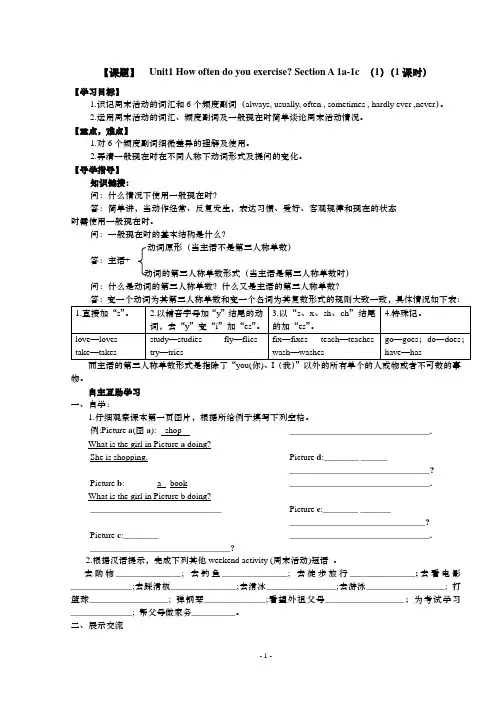
问:一般现在时的基本结构是什么?动词原形(当主语不是第三人称单数) 答:主语+ 动词的第三人称单数形式(当主语是第三人称单数时) 问:什么是动词的第三人称单数?什么又是主语的第三人称单数?物。
自主互助学习 一、自学:1.仔细观察课本第一页图片,根据所给例子填写下列空格。
例:Picture a (图a ): shop What is the girl in Picture a doing? She is shopping. Picture b :_______ a book What is the girl in Picture b doing? ______________________________ Picture c :________ ________________________________?________________________________. Picture d :________ ______ ________________________________? ________________________________. Picture e :________ _______ _______________________________? ________________________________. 2.根据汉语提示,完成下列其他weekend activity (周末活动)短语 。
最新人教版八年级英语上册全册复习导学案金牌教学资源名师优秀教案
人教版八年级英语上册全册复习导学案(金牌教学资源) 人教版八年级英语上册全册复习导学案(金牌教学资源)新目标八年级英语上册全单元复习导学案(金牌教学资源)新目标八年级上册复习导案Unit One一、请您回顾这里为您再现了Unit One应掌握的基本知识目标,请您认真思考,完成专题。
?、基础词汇名词(n .)锻炼/运动_________次/次数___________网络/互联网_______节目/表演/程序_____结果/成果_________废弃旧物/破烂物____采访者____________动词(v.)牛奶生活方式_____________ _________ 咖啡分数/成绩/年级_____________ _____ 薄片差异/区别_____________ _________ 可乐爷爷/外公______________________ 巧克力结果/成果___________ _________ 健康_____________ 习惯/习性________新目标八年级英语上册全单元复习导学案(金牌教学资源)锻炼/运动_________踩滑板___________副词(adv.)几乎不___________两次/两倍_________形容词(adj.)大多数的_________没有的___________活跃的/积极的_____介词(prep.)对于;关于________连词(conj.)虽然;即使________?、重点词组1.看电购物试图/设法________ _____________ 保持____________ 喝/饮必须________________________ 冲浪____________ 曾/曾经__________ 约摸/几乎________ 或许/大概________ 同样的/相同的差异的/不同的_____ _____ good/well比较级不健康的____________ little的比较级______ 与…(表示比较)_____ 影________________________新目标八年级英语上册全单元复习导学案(金牌教学资源)2.照顾 13.不同___________________________ ________________________ 3.上网14.一周两次_________________________ ____________________ 4.健康的生活方式_______________ 5.去划板_______________________ 6.身体健康_____________________ 7.保持健康_____________________ 8.至于_________________________ 9.锻炼/做运动__________________ 10. 饮食习惯____________________ 11. 与……相同__________________ 12. 一月一次____________________ 15.对什么有影________________ 16.多久一___________________ 17.虽________________________ 18.大多数学__________________ 19.活动调____________________ 20.购________________________ 21.做家庭____________________ 22.帮助某人做某______________ 23.做家务____________________响次然生查物作事事新目标八年级英语上册全单元复习导学案(金牌教学资源)24.垃圾食物____________________ 25.有益(害)_________________________ 26.在周末__________________________ 27.在某方面帮助某人________________ 28. 许多/大量的______________________ 29.至于/关于_______________________ 30.多少(针对可数名词)____________ 31.多少(针对不可数名词)__________ 32.当然/确信_______________________ 33.每一天___________________________ 34.每晚_____________________________ 35.几乎不___________________________ 36.有益健康________________________ 37. 尝试做某事_______________________ 38. 有点_____________________________ 39.想要某人做某事___________________ 40.尽量做某事_______________________ 41. 试着做某_________________________ 42.尽力做某事_______________________ 43.放学回家_________________________ 44.当然新目标八年级英语上册全单元复习导学案(金牌教学资源)_____________________________?、主要句型 45.取得好成绩_______________________1. 你多久锻炼一次,________ _________ _______ you ________?2. 每周三到六次Three______ six times _______ ________.3.你每天睡几个小时,_______ _________ _________do you sleep every night?4.多于5小时I sleep ______ ________ 5 hours every night5.你周末通常做什么,What do you usually do _______ _________,6. 你最喜欢的节目是什么,What______ __________________program,?、难点语法频率副词按频率由低到高的顺序写出频率副词:_____ ______ _____ _______ ________ _________.就频率副词或词组(如every day/three times a week等)提问的疑问词组是_____________.?、易误点拨1.how often提出的问题表示询问动作发生的______,意为___________,可用___________等词来回答。
人教版八年级英语上册Unit 7复习课导学案
Unit7 导学案教学目标:1.能根据汉语提示,填写英语句子,完成句子翻译。
2.能理解段落中各句子之间的逻辑关系,完成简短笔记。
3.能从机器人有关文章中找出有关信息,理解大意,完成大意总结。
4.能运用一般过去时,一般现在时和将来时态描写自己的生活学习,完成书面表达。
一、句子翻译1. 我十年后会成为一名记者。
I will be a reporter _________ __________ __________.2. 将来会有更多的污染吗?_______ ________ ________ more pollution in the future?3.每个人应当尽一份力来拯救地球。
Everyone should _______ _______ ________ in _________ the earth.4. 已经有机器人在工厂里干活了。
There are already robots _________ _________ _________.5. 我将乘坐火箭去月球。
I ______ ________ rockets ________ the moon.6.你认为在人们家中将会有机器人吗?Do you think robots in people's homes?7.人们将会活到两百岁。
People will200 years old.8.将会有更少的树而且环境将处于极大的危险中。
There trees and the environment will be. 9.我们将不得不搬到其他星球上去吗?Will we have to.10. 在将来,将会有更少的人和更少的污染。
In the future,there people and .二、语法填空Do You Think You Will Have Your Own Robot?When we watch movies ____1_____ the future, we sometimes___2___ (see) robots. They are usually like ___3____ (human)servants. They help ___3___the housework and___4____(do) jobs like___5___ (work) in dirty or ___6____(danger)places.Today there are already robots___7___ (work) in factories. Some can help___8___(build) cars, and they dosimple jobs over and over again. ____9___ people___10__(do) such jobs in the future because they are ___11__, but robots will never get ___12____.Scientists are now trying___13___(make) robots look like humans and___14__(do) the same things as we do. Some robots in Japan____15___(walk) and dance. They are fun __16__(watch). However, some scientists believe that although we can make robots___17___(move) like people, it will be difficult__18___(make)them really__19___(think) like a human. For example, scientist James White__20___(think) that robots will never be able to wake up and know where they are. But many scientists disagree with Mr. White. They think that robots will even be able to talk like humans in 25 to 50 years.Some scientists believe that there___21___ (be) more robots in the future. However, they agree it __22__(take) hundreds of years. These new robots___23___(have) many different shapes. Some will look like humans, and others__24___(look) like animals. In India, ___25____ example, scientists___26___ (make) robots that look like snakes. If buildings fall down with people inside, these snake robots ___27___ (help) look for people under the buildings. This ___28___(be) not possible 20 years ago, but computers and rockets also___29___ (seem) impossible 100 years ago. We never know what___30___(happen) in the future!三、读语法填空,做笔记(共10分)1.The general idea of the article is________________________________________________________2. In the movies, robots are usually like___________________________________________________3. James White’s opinion of robots is that ________________________________________________4.The advantage(优势)of the robots in today’s factories is that______________________________5.The shapes of robots in the future will be__________________________________________________四、大意总结(10分)读第六题文章,请根据问题提示,尽可能用自己的话写出大意总结,词数60~80,并在短文最后注明词数。
人教版英语八年级上册Unit 7导学案及答案
Unit 7:Will people have robots ?Section A一、词汇默写1、纸、纸张2、污染、污染物3、预言、预测4、将来、未来5、污染6、环境7、行星8、地球、世界9、种植、植物10、部分11、参与、发挥作用12、和平13、海、海洋14、建造、建筑、体形15、天空16、在人们的家里17、上学18、在家里学习19、在电脑上20、活到200岁21、在100年后22、更少的人23、更少的空闲时间24、更多的污染25、少使用地铁26、我不认为是这样。
27、一本关于未来的书28、听起来很酷29、更拥挤30、处于极大的危险中31、那听起来很糟糕32、不得不33、搬到其它星球34、在地球上35、少用水36、多种树37、拯救地球38、打扫厨房39在将来40、在海里41、做与人相同的工作42、在周末43、蓝天45、新鲜的水二、句型默写(一)展望未来的句子1、未来怎么样?(开头句)(1)在人们的家里将有机器人。
(2)我认为每个家庭将有机器人。
(3)孩子们不要去上学。
他们通过电脑在家里学习。
(4)人们将活到200岁。
(5)我认为将有更多的人。
(6)我认为将有更少的空闲时间。
(7)我认为将有更少的车辆。
(8)将有更少的污染。
(9)我认为将有更少的树木。
(10)城市将更更大,更拥挤,因为有更多的人。
(11)那将对地球有好处。
(12)人们将更多使用地铁。
(13)城市更拥挤和污染。
(14)环境处于极大的危险中。
(15)一切都是免费的。
(16)我们将不得不搬到其它星球。
2、那么我们可以怎么做?(1)我们可以少用水,多种树。
(2)每个人都应该参与拯救地球。
3、其它句型(1)我希望如此。
(2)我希望不。
(3)我不赞成。
(4)我认为是这样。
(5)我不认为是这样。
1三、单元语法讲练:一般将来时1、结构:(1)be going to +动词原形(2)will+动词原形2、标志性时间状语:tomorrow、tonight、next+时间、in+时间段(in two months两个月后、in five minutes 五分钟之后)、in the future (在将来)、soon(不久、很快)、the day after tomorrow等表示将来的时间。
人教版八年级英语上册复习导学案 Unit7---Unit8(无答案)
八年级英语上册复习导学案Unit7---Unit8(人教版)话题: Life in the future & Cooking功能: Make predictions & Describe a process ;Follow instructions语法结构: 能正确使用一般将来时谈论对未来的预测;能掌握并使用祈使句,能正确使用表示序列的副词。
单元知识点梳理Task1. 重点词汇英汉互译1.纸2.将来3.行星4.植物5.地球6.环境7.参与(某事)8.世界和平9.处于极大的危险之中10.在未来11.live to be…years old _________ 12.多次,反复地___________13.奶昔14.切碎_______________ 15. add…to…____________16.pour…into…17.fill…with…__________ 18.一片(块、张)19.cover…with ____________ 20.传统食品_____________21.during_________ 22.工厂_________________ 23.假期;假日___________ 24.temperature___________ 25.庆祝__________ 26.秋天;秋季____________27.机器__________ 28.混合;融合____________29.许多;大量_________ 30.看起来像______________Task2: 重点句型英汉互译①将来会是什么样子?What ______the ____ be _____?②城市污染将会更多。
且树木将会更少。
Cities ____ ___ _____ polluted. And there ____ _____ _______.③一百年后,人们会使用钱币吗?____ people ____ money ___ 100 years?④不会的。