
高中英语新人教版必修一Unit1 知识点讲解
(推荐下载)人教版高一英语必修一Unit1知识点详解383
高一英语必修1 Unit 1 FriendshipPart 1. Warming up1.介词不同,含义有别:be good to sb./sth. 对… 好be good for sb./sth. 对… 有好处be good at (doing) sth. 擅长,精通be good with sb./sth. 善于应付… 的eg. She was very good to me when I was ill.Doing morning exercises is good for health.Tim is good at speaking English.He is very good with children. 他对孩子很有一套。
2.add up 合计,把…加起来add up to 合计达到…add to 增加,增添add A to B 把…加进…里面,把…和…相加eg. Please add these figures up.These figures add up to 900.The bad weather added to our difficulities.Please add some salt to the water.Add three to four and you get seven.▲ add vt. 补充说(后接that从句或者直接引语)eg. He added that they would return in a week.“And don’t be late,”she added.3. point n.点,要点,观点,意义,得分v.指着be on the point of doing sth. when......=be about to do sht. when....正要做某事,这时......There is no point (in) doing sth. 没有必要(意义)做某事4. until与not … untiluntil表示动作、状态的持续,强调“一直到……为止”,或强调某个动作或状态一直持续到另一个动作或状态出现之前。
人教版 高中英语必修一unit1 知识点总结
人教版高中英语必修一unit1 知识点总结一、词汇1. acquaintance:a person one knows slightly or with whom one has a casual or superficial relationship2. adolescent:a young person who is developing into an adult3. ambition:a strong desire to do or achieve something, typically requiring determination and hard work4. atmosphere:the pervading tone or mood of a place, situation, or creative work5. attentive:paying close attention to something6. awkward:causing or feeling embarrassment or inconvenience7. complex:consisting of many different and connected parts8. confide:tell someone about a secret orprivate matter while trusting them not to repeat it to others9. conform:comply with rules, standards, or laws10. desperate:feeling or showing a hopeless sense that a situation is so bad as to be impossible to deal with11. dread:great fear or apprehension12. embarrass:cause (someone) to feel awkward, self-conscious, or ashamed13. encounter:meet (someone) unexpectedly or by chance14. forbid:refuse to allow (something)15. gesture:a movement of part of the body, especially a hand or the head, to express an idea or meaning16. hesitant:uncertain or unwilling to take action17. identical:similar in every detail; exactly alike18. indifferent:having no particular interest or sympathy; unconcerned19. obliging:willing to do a service or kindness; helpful20. passionate:showing or caused by strong feelings or a strong belief二、句型1. It's quite an experience to have someone who knows you better than you know yourself.2. Who […] dares to live life to the full?3. Of course, being well off helps, but money alone can't bring happiness.4. I'm not going to pretend that I find it easyto talk to people I don't know.5. I can't stand people who pretend to besomething they're not.6. I was so embarrassed that I wanted to crawl into a hole and disappear.7. He was so good-looking that he made everyone else in the room seem plain and ordinary.8. He's the sort of person who will do anything for a laugh.9. I had a feeling that she wasn't telling me the whole truth.10. It's funny how you can live somewhere for years and still not know your neighbours.三、语法1. 主语 + be + adj.:作主语补语,表示主语的状态或特征。
高一英语必修一unit1知识点人教版
高一英语必修一unit1知识点人教版Unit 1: FriendshipIn the first unit of the Grade 10 English textbook, we delve into the theme of friendship. Here, we will explore various knowledge points related to this topic.1. Definition and Importance of FriendshipFriendship is a mutual relationship between two or more individuals who genuinely care about and support each other. It plays a crucial role in our lives, providing emotional support, companionship, and a sense of belonging.2. Types of FriendshipThere are different types of friendships, including childhood friendships, school friendships, work friendships, and online friendships. Each type has its unique characteristics and dynamics.3. Qualities of a Good FriendGood friends possess certain qualities that make their relationship stronger. These qualities include loyalty, trustworthiness, empathy, and the ability to listen without judgment.4. Building and Maintaining FriendshipsFriendships require effort and time to develop and maintain. To build and strengthen friendships, one should be open, honest, and supportive. Regular communication, sharing experiences, and resolving conflicts are also vital for maintaining long-lasting friendships.5. Friendships and Social MediaIn the digital age, social media has influenced the way we form and maintain friendships. While it allows us to connect with people worldwide, it is essential to use it mindfully and be aware of the potential drawbacks, such as the risk of online deception and the impact on face-to-face interactions.6. The Impact of True FriendshipTrue friendship brings numerous benefits to one's life. It promotes mental well-being, boosts self-confidence, provides a support system during difficult times, and encourages personal growth.7. Expressing Gratitude for FriendshipGratitude is essential in maintaining and nurturing friendships. Simple acts such as expressing appreciation, remembering special occasions, and being there for each other can go a long way in strengthening the bond between friends.In conclusion, friendship is a vital aspect of our lives. It enriches our experiences, provides emotional support, and contributes to our overall well-being. Understanding the different aspects of friendship and cultivating these relationships can bring immense joy and fulfillment to our lives. Let us cherish and value the friendships we have and strive to be a good friend to others.。
高一英语必修一unit1知识点
高一英语必修一unit1知识点高一英语必修一Unit 1 知识点随着时间的推移,英语作为一门全球通用语言的地位越来越重要。
而高中英语教材的第一个单元,无疑会给我们带来初步认识英语的机会。
本文将详细介绍高一英语必修一Unit 1的知识点,帮助大家更好地理解和掌握这些内容。
第一部分:词汇1.1 生词在学习新的知识时,我们需要积累大量的词汇。
Unit 1的生词包括"But", "necessary", "reluctant", "minority", "traditional", 等等。
词汇的学习可以通过词汇记忆卡片、词汇书等方式来强化记忆。
1.2 词性转换我们还需要学习词性转换,以用不同的词性来表达不同的含义。
比如,"reluctantly"是"reluctant"的副词形式,"necessity"是"necessary"的名词形式。
第二部分:语法2.1 形容词和副词的比较级和最高级在Unit 1中,我们学习了形容词和副词的比较级和最高级的用法。
比如,在比较两个人或物的不同时,我们可以使用比较级,如"Mary is taller than Tom." 在比较三个或多个人或物时,我们可以使用最高级,如"This is the most interesting book I've ever read."2.2 一般现在时和一般过去时在Unit 1中,我们也学习了一般现在时和一般过去时的用法。
一般现在时用来表达我们常常发生的动作或习惯,如"I usually goto school by bus." 一般过去时则用来表达过去的动作或状态,如"He studied hard last night."第三部分:阅读理解3.1 阅读技巧在英语学习中,我们需要培养良好的阅读理解能力。
Unit 1 Teenage life 单词讲解课课件-高中英语人教版(2019)必修第一册
schedule
13. schedule n.工作计划; 日程安排 v. 安排时间;预定 a very tight schedule 日程安排得很紧 _o_n__ schedule按时; 如期 _a_h_e_a_d_ of schedule 提前 _b_e_h_in__d schedule 落后于预定计划 be scheduled _fo_r_ June/Monday 被安排在六月/周一
在讨论中/毋庸置辩
We debated whether to launch live-stream lessons in the summer vacation.
prefer
4. prefer vt. 宁愿,偏爱,更喜欢
doing/to do sth. sb. to do sth.
A to B doing sth. to doing sth. to do sth.rather than do sth.
Some people prefer _to__d_o__e_v_e_r_y_t_h_i_n_g_(做所有的事) over the Internet. I'd prefer__y_o_u_t_o_s_t_a_r_t_e_a_r_ly__(你早点开始).
I prefer original novels __to___ adapted movies. I prefer _r_e_a_d_i_n_g_b_o_o_k__s___to__w_a_t_c_h_in_g__T_V___(看书而不是看电视). I prefer to go there by bike _r_a_t_h_e_r_t_h_a_n___(而不是) by car.
人教版高中英语必修1知识点汇总(一册全)
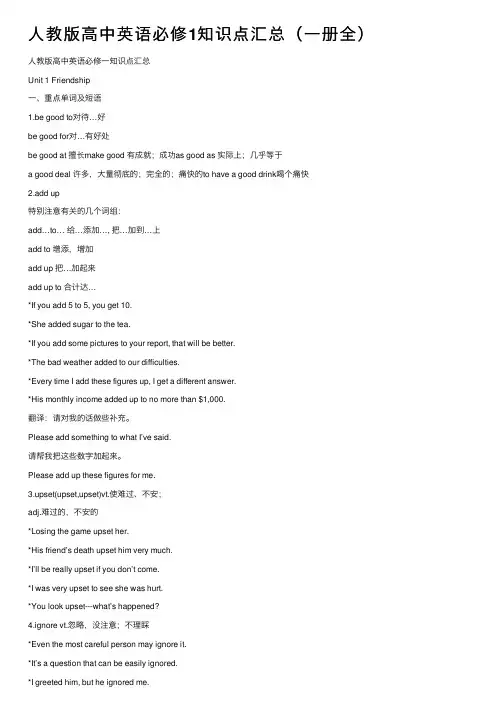
⼈教版⾼中英语必修1知识点汇总(⼀册全)⼈教版⾼中英语必修⼀知识点汇总Unit 1 Friendship⼀、重点单词及短语1.be good to对待…好be good for对…有好处be good at 擅长make good 有成就;成功as good as 实际上;⼏乎等于a good deal 许多,⼤量彻底的;完全的;痛快的to have a good drink喝个痛快2.add up特别注意有关的⼏个词组:add…to… 给…添加…, 把…加到…上add to 增添,增加add up 把…加起来add up to 合计达…*If you add 5 to 5, you get 10.*She added sugar to the tea.*If you add some pictures to your report, that will be better.*The bad weather added to our difficulties.*Every time I add these figures up, I get a different answer.*His monthly income added up to no more than $1,000.翻译:请对我的话做些补充。
Please add something to what I’ve said.请帮我把这些数字加起来。
Please add up these figures for me.3.upset(upset,upset)vt.使难过、不安;adj.难过的,不安的*Losing the game upset her.*His friend’s death upset him very much.*I’ll be really upset if you don’t come.*I was very upset to see she was hurt.*You look upset---what’s happened?4.ignore vt.忽略,没注意;不理睬*Even the most careful person may ignore it.*It’s a question that can be easily ignored.*I greeted him, but he ignored me.5.calm adj.平静的,镇静的;风平浪静的vt.使平静*After the storm, the sea was calm again.*Keep calm in time of danger.*Don’t be nervous; calm yourself, please.calm down平静下来*I told him to calm down.6.concern vt.关系到,和…有关;使关⼼*This matter concerns all of us.*I’m not concerned with this matter again.be concerned about关⼼…;为…担⼼*Please don’t be concerned about me.7.go through 经历,经受;审阅,检查*Most families went through a lot during the war. *I can’t go through these letters in an hour.8. “make her diary her best friend”“call my friend Kitty”make和call都能以名词作宾语补⾜语,即make+sb./sth.+n. 使某⼈/某物成为…call+sb./sth.+n. 称某⼈/某物为…*We must try to make our country a strong one.*All work and no play makes Jack a dull boy.*We called messenger msn in short.*What do you call it?9.everything to do with naturesomething/anything/everything/nothing to do with 与…有关/⽆关*What he is doing has nothing to do with his work.10.far too much实在太多too much(+n.)太多(…), 超过某⼈的能⼒far/much too+adj./adv.实在太…too much homeworkThe work is too much for a boy like him.It’s (much/far) too hot todaymuch/ far too much实在太多11.suffer vi.受苦,受痛苦,受损失vt.受到,遭受*He suffered terribly when his mother died.*He looked pale, and seemed to have suffered a lot/a great deal. *We suffered a set-back/no pain. suffer from遭受,患(病)*I suffered much from lack of rest.suffer from cold/cancer12.recover vt.恢复vi.痊愈*She recovered her health.*Amy is recovering from a severe illness.*He is unlikely to recover.13.get tired of对…开始感到厌烦(表动作)be tired of对…感到厌烦(表状态)14.get along with和…相处;进展*They get along quite well with each other.*How are you getting along with your classmates?*How are you getting along with your English?*I’m getting along well with my study.15.exactly adv.确切地;正是;说的对*You must tell me exactly what you’re doing?*That’s exactly what I want.*It looks exactly like an elephant’s leg.*Exactly!(=That’s right.)16.grateful adj.感激的*I’m very grateful to you for your advice.=Thank you very much for your advice.17.joinA.参加,加⼊(成为其中的成员)*He joined the army/the Party 3 years ago.*He is too young to join the club.B.join sb.和某⼈⼀起(从事某活动)*Will you join us for dinner?*I’ll join you later.*May I join you in the game?C.join in参加某活动(=take part in)*A lot of newcomers joined in the discussion.*May I join in the game?⼆、重点句型1. Do you want a friend whom you could tell everything to, like your deepest feelings and thoughts?2. I wonder if it’s because I haven’t been able to be outdoors for so long that I’ve grown so crazy about everything to do with nature.3. I can well remember that there was a time when a deep blue sky, the song of the birds, moonlight and flowers could never have kept me spellbound.4. It’s no pleasure looking through these any longer because nature is one thing that really must be experienced.5. It/This/That is the first /second…time that+现在完成时“某⼈第⼀/⼆次做……”eg. It is the first time that I have been to the airport.It/This/That was the first / second…timethat+过去完成时eg. It was the second time that I had seen him.三、语法语法----直接引语和间接引语概念:直接引语:直接引述别⼈的原话。
2019新人教版高中英语必修一unit1词汇表重点知识点拓展总结(复习必背)
必修一Unit1Teenage Life词汇知识点归纳总结①黄色部分为本单元重点词;
②红色部分为短语、同根词,注意汉译英;
③蓝色部分为词块,注意英译汉
向某人推荐
从地震中幸存下来
vt&vi(使)聚焦;(使)集中;调节(...的)焦距
focus on/upon...集中/聚焦于;特别关注
focus one’s mind/attention on...集中注意力于……
【拓展】表示“集中注意力/精力于…”的短语还有
concentrate one’s attention on...
fix one’s attention on...
put one’s heart into...
【同根词】focus(s)ed adj注意力集中的
40.addict v使入迷,使上瘾
addict oneself to(doing)sth沉溺于(做)...
n[C]吸毒上瘾的人;对.......着迷的人
【同根词】●addicted adj上瘾的;入迷的
be/get/become addicted to(doing)sth沉溺于(做)...;专心(做)...
●addiction n.上瘾;沉溺
have an addiction to doing sth做某事上瘾
41.adult n[C]成年人。
高中人教版英语必修一Unit 单词讲解
3. because of后边加名词或动名词短语 because是连词, 所以后边跟句子 He came to work late because he got up late. He came to work late because of getting up late.
4. native adj. 本土的,本国的,土生的 (+to) The giant panda is native to China. The giant panda is a native of China. 大熊猫是中国特有的动物。 n. 本地人,本国人 Are you a native here, or just a visitor? 你是本地人, 或者只是游客?
5. base vt.以……为根据 n.基部;基地;基础 6. gradual adj.逐渐的;逐步的→ adv.逐渐地;逐步地 gradually 7. vocabulary n.词汇;词汇量; 词表 8. latter adj.较后的;后半的;(两 者中)后者的→ former (反义词)
重点短语
He is an officer in the army.
2.voyage/journey/travel/trip/tour
voyage: 去国外或较远地方的海上旅行 journey: 指较远的从一地到另一地旅行 travel: 一系列的旅程,尤指旅行的概念 trip: (短途)旅行 tour: 为了公务、娱乐或教育参观多处名胜 的旅行
【答案】 A
8.make use of 利用 同义词 take advantage of 好好利用 make good use of __________ 充分利用 make full use _______ 被动 be made use of eg:You must make good use of any chance to practise English.
新教材)人教版 2019 高中英语选择性必修一 第一单元(知识点总结全)
新教材)人教版 2019 高中英语选择性必修一第一单元(知识点总结全)Unit 1 People of Achievement常见短语下面是一些常用的短语,包括conclude和acknowledge:conclude from。
从…中推断出acknowledge。
to be/as…:承认…是/为…draw/reach/come to a n:得出结论acknowledge doing/having done sth:承认做了某事in n:最后总之be acknowledged as/to be…:被认为是…be crucial to…:对…至关重要with the objective of…:目的是…play a crucial role/part in sth:在…(方面)起关键作用achieve/meet an objective:达到目标set an objective:制定目标be of crucial importance:非常重要main/primary objective:主要/首要目标a crucial d:关键时期be objective about…:对…是客观的take的常用短语下面是一些常用的take短语:take up a n:担任任职take up:拿起、接受、开始从事、继续、占用(时间、物品等)、占据(空间)take down:写下、拆除take in:收留、吸收、欺骗、领会、理解take off:脱掉、起飞、成功take on:呈现、承担、雇用take over:接任、接管take after:(在外貌、性格等方面)与(父母)相像take apart:拆开易混词(组)辨析下面是一些易混淆的词组及其区别:1.try to do和manage to dotry to do:强调动作,不表示结果如何例句:I’ll try to get downtown this afternoon but I don’t know if I can make it.(今天下午我想去市中心,但不知是否能去成。
高一英语必修一unit1知识点总结
高一英语必修一unit1知识点总结Unit 1 of the first year English textbook focuses on introducing and reviewing essential language points and grammar structures. In this unit, we learn about greetings, self-introductions, nationality and languages, and classroom expressions. The following is a summary of the key knowledge points covered in Unit 1.1. Greetings and IntroductionIn this section, we learn how to greet people and introduce ourselves in English. This includes phrases like "Hello", "Hi", "How are you?" and appropriate responses. We also learn how to introduce ourselves by stating our names, ages, nationalities, and occupations.2. Nationality and LanguagesThis section deals with discussing nationalities and languages. We learn how to ask someone about their nationality using questions like "Where are you from?" and "What's your nationality?" We also learn how to talk about languages and ask someone about their language skills using phrases such as "What languages do you speak?" and "Do you speak English?"3. Classroom ExpressionsIn this part, we focus on expressions commonly used in the classroom. We learn phrases for asking and answering questions, seeking clarification, and expressing understanding. Some examples include "May I ask a question?", "Could you please repeat that?", and "I don't understand."4. Verb "to be"The verb "to be" is a fundamental verb in English and is extensively used to express identity, nationality, professions, and characteristics. It is also used to describe locations and relationships between people. We learn the forms and conjugations of "to be" in different tenses, including present simple, past simple, and future.5. Adjectives and AdverbsAdjectives and adverbs are used to provide additional details and descriptions in English. We learn how to form and use adjectives and adverbs correctly to modify nouns or verbs. Additionally, we study the comparatives and superlatives used to compare degrees of adjectives and adverbs, such as "bigger", "better", and "the most beautiful".6. Simple Present TenseThe simple present tense is used to talk about general truths, habits, and routines. We learn the structure and usage of the simple present tense, including positive, negative, and interrogative forms. Examples of sentences using the simple present tense are "She works in a hospital" and "We don't like coffee."7. Prepositions of PlacePrepositions of place are used to indicate the position or location of something. We learn how to use prepositions such as "in", "on", and "at" correctly in relation to specific places or objects. For instance, "The book is on the table" and "He is in the park."8. Question WordsQuestion words help us ask specific questions to gather information. We learn essential question words such as "What", "Where", "When", "Who", "Why", and "How". These words enable us to form meaningful questions and obtain the necessary details in conversations.This summary covers the key knowledge points in Unit 1 of the first year English textbook. By understanding and mastering these concepts, students will be better equipped to communicate effectively in English, both in written and spoken forms.。