
2007年考研英语真题及答案完整解析
第 1 页 共 17 页 2007年全国硕士研究生入学统一考试英语试题 Section I Use of English Directions: Read the following text. Choose the best word(s) for each numbered blank and mark [A], [B], [C] or [D] on ANSWER SHEET 1. (10 points) By 1830 the former Spanish and Portuguese colonies had become independent nations. The roughly 20 million 1 of these nations looked 2 to the future. Born in the crisis
of the old regime and Iberian Colonialism, many of the leaders of independence 3 the ideals of representative government, careers 4 to talent, freedom of commerce and trade, the 5 to private property, and a belief in the individual as the basis of society. 6 there was a belief that the new nations should be sovereign and independent states, large enough to be economically viable and integrated by a 7 set of laws. On the issue of 8 of religion and the position of the church, 9, there was less agreement 10 the leadership. Roman Catholicism had been the state religion and the only one 11 by the Spanish crown. 12 most leaders sought to maintain Catholicism 13 the official religion of the new states, some sought to end the 14 of other faiths. The defense of the Church became a rallying 15 for the conservative forces. The ideals of the early leaders of independence were often egalitarian, valuing equality of everything. Bolivar had received aid from Haiti and had 16 in return to abolish slavery in the areas he liberated. By 1854 slavery had been abolished everywhere except Spain’s 17 colonies. Early promises to end Indian tribute and taxes on people of mixed origin
came much 18 because the new nations still needed the revenue such policies 19. Egalitarian sentiments were often tempered by fears that the mass of the population was 20 self-rule and democracy.
1. [A] natives [B] inhabitants [C] peoples [D] individuals 2. [A] confusedly [B] cheerfully [C] worriedly [D] hopefully 3. [A] shared [B] forgot [C] attained [D] rejected 4. [A] related [B] close [C] open [D] devoted 5. [A] access [B] succession [C] right [D] return 6. [A] Presumably [B] Incidentally [C] Obviously [D] Generally 7. [A] unique [B] common [C] particular [D] typical 第 2 页 共 17 页
8. [A] freedom [B] origin [C] impact [D] reform 9. [A] therefore [B] however [C] indeed [D] moreover 10. [A] with [B] about [C] among [D] by 11. [A] allowed [B] preached [C] granted [D] funded 12. [A] Since [B] If [C] Unless [D] While 13. [A] as [B] for [C] under [D] against 14. [A] spread [B] interference [C] exclusion [D] influence 15. [A] support [B] cry [C] plea [D] wish 16. [A] urged [B] intended [C] expected [D] promised 17. [A] controlling [B] former [C] remaining [D] original 18. [A] slower [B] faster [C] easier [D] tougher 19. [A] created [B] produced [C] contributed [D] preferred 20. [A] puzzled by[B] hostile to [C] pessimistic about [D] unprepared for Section II Reading Comprehension
Part A Directions: Read the following four texts. Answer the questions below each text by choosing [A], [B], [C], or [D]. Mark your answers on ANSWER SHEET 1. (40 points)
Text 1 If you were to examine the birth certificates of every soccer player in 2006’s World Cup tournament, you would most likely find a noteworthy quirk: elite soccer players are more likely to have been born in the earlier months of the year than in the later months. If you then examined the European national youth teams that feed the World Cup and professional ranks, you would find this strange phenomenon to be even more pronounced. What might account for this strange phenomenon? Here are a few guesses: a) certain astrological signs confer superior soccer skills; b) winter-born babies tend to have higher oxygen capacity, which increases soccer stamina; c) soccer-mad parents are more likely to conceive children in springtime, at the annual peak of soccer mania; d) none of the above.
Anders Ericsson, a 58-year-old psychology professor at Florida State University, says he believes strongly in “none of the above.” Ericsson grew up in Sweden, and studied nuclear engineering until he realized he would have more opportunity to conduct his own research if he switched to psychology. His first experiment, nearly 30 years ago, involved memory: training a person to hear and then repeat a random series of numbers. “With the first subject, after about 20 hours of training, his digit span had risen from 7 to 20,” Ericsson recalls. “He kept improving, and after about 200 hours of training he had risen to over 80 numbers.”
2007年考研英语一试题(附答案)【3】
2007年考研英语一试题(附答案)【3】Text 2For the past several years, the Sunday newspaper supplement Parade has featured a column called “Ask Marilyn.” People are invited to query Marilyn vos Savant, who at age 10 had tested at a mental level of someone about 23 years old; that gave her an IQ of 228 - the highest score ever recorded. IQ tests ask you to complete verbal and visual analogies, to envision paper after it has been folded and cut, and to deduce numerical sequences, among other similar tasks. So it is a bit confusing when vos Savant fields such queries from the average Joe (whose IQ is 100) as, What’s the difference between love and fondness? Or what is the nature of luck and coinciden ce? It’s not obvious how the capacity to visualize objects and to figure out numerical patterns suits one to answer questions that have eluded some of the best poets and philosophers.Clearly, intelligence encompasses more than a score on a test. Just what does it mean to be smart? How much of intelligence can be specified, and how much can we learn about it from neurology, genetics, computer science and other fields?The defining term of intelligence in humans still seems to be the IQ score, even though IQ tests are not given as often as they used to be. The test comes primarily in two forms: the Stanford-Binet Intelligence Scale and the Wechsler Intelligence Scales (both come in adult and children’s version). Generally costing several hundred dollars, they are usually given only by psychologists, although variations of them populate bookstores and the World Wide Web. Superhigh scores like vos Savant’s are no longer possible, because scoring is now based on a statisticalpopulation distribution among age peers, rather than simply dividing the mental age by the chronological age and multiplying by 100. Other standardized tests, such as the Scholastic Assessment Test (SAT) and the Graduate Record Exam (GRE), capture the main aspects of IQ tests.Such standardized tests may not assess all the important elements necessary to succeed in school and in life, argues Robert J. Sternberg. In his article “How Intelligent Is Intelligence Testing?”, Sternberg notes that traditional test best assess analytical and verbal skills but fail to measure creativity and practical knowledge, components also critical to problem solving and life success. Moreover, IQ tests do not necessarily predict so well once populations or situations change. Research has found that IQ predicted leadership skills when the tests were given under low-stress conditions, but under high-stress conditions, IQ was negatively correlated with leadership - that is, it predicted the opposite. Anyone who has toiled through SAT will testify that test-taking skill also matters, whether it’s knowing when to guess or what questions to skip.26.Which of the following may be required in an intelligence test?[A] Answering philosophical questions.[B] Folding or cutting paper into different shapes.[C] Telling the differences between certain concepts.(D)[D] Choosing words or graphs similar to the given ones.27.What can be inferred about intelligence testing from Paragraph 3?[A] People no longer use IQ scores as an indicator of intelligence.[B] More versions of IQ tests are now available on theInternet.[C] The test contents and formats for adults and children may be different.(C)[D] Scientists have defined the important elements of human intelligence.28.People nowadays can no longer achieve IQ scores as high as vos Savant’s because[A] the scores are obtained through different computational procedures.[B] creativity rather than analytical skills is emphasized now.[C] vos Savant’s case is an extreme one that will not repeat.(A)[D] the defining characteristic of IQ tests has changed.29.We can conclude from the last paragraph that[A] test scores may not be reliable indicators of one’s ability.[B] IQ scores and SAT results are highly correlated.[C] testing involves a lot of guesswork.(A)[D] traditional test are out of date.30.What is the author’s attitude towards IQ tests?[A] Supportive.[B] Skeptical.[C] Impartial.(B)[D] Biased.。
2007考研英语真题及彻底解析_适合菜鸟级别的人
2007年硕士研究生入学统一考试英语试题Section I Use of EnglishDirections:Read the following text. Choose the best word(s)for each numbered blank and mark A,B,C,and D on ANSWER SHEET 1 (10 points)By 1830 the former Spanish and Portuguese colonies had become independent nations. The roughly 20 million 1 of these nations looked 2 to the future. Born in the crisis of the old regime政权and Iberian Colonialism,many of the leaders of independence 3 the ideas of representative government,careers 4 to talent,freedom of commerce and trade,the 5 to private property,and a belief in the individual as the basis of society,6 there was a belief that the new nations should be sovereign and independent states,large enough to be economically viable and integrated by a 7 set of laws.On the issue of 8 of religion and the position of the church,9 ,there was less agreement 10 the leadership. Roman Catholicism had been the state religion and the only one 11 by the Spanish crown王冠,12 most leaders sought to maintain Catholicism 13 the official religion of the new states,some sought to end the 14 of other faiths. The defense of the Church became a rallying 集体15 for the conservative 保守派forces.The ideals of the early leaders of independence were often egalitarian平等主义,valuing equality of everything. Bolivar had received aid from Haiti and had 16 in return to abolish slavery in the areas he liberated. By 1854 slavery had been abolished everywhere except Spain's 17 colonies. Early promises to end Indian tribute贡物and taxes on people of mixed origin came much 18 because the new nations still needed the revenue 税收such policies 19 Egalitarian sentiments 感情were often tempered 调和by fears that the mass of the population was 20 self-rule自治and democracy.民主1. [A] natives[B] inhabitants居民[C] peoples [D] individuals2. [A] confusedly[B] cheerfully[C] worriedly [D] hopefully3. [A] shared[B] forgot [C] attained 取得,完成,达到[D] rejected拒绝4. [A] related[B] close [C] open [D] devoted5. [A] access[B] succession[C] right[D] return6. [A] Presumably 大概[B] Incidentally [C] Obviously[D] Generally7. [A] unique[B] common [C] particular[D] typical8. [A] freedom [B] origin[C] impact[D] reform9. [A] therefore[B] however [C] indeed[D] moreover10. [A] with[B] about[C] among[D] by11. [A] allowed[B] preached[C] granted [D] funded12. [A] Since[B] If[C] Unless[D] While13. [A] as[B] for[C] under[D] against14. [A] spread[B] interference[C] exclusion [D] influence15. [A] support[B] cry [C] plea[D] wish16. [A] urged[B] intended[C] expected[D] promised17. [A] controlling[B] former[C] remaining[D] original18. [A] slower [B] faster [C] easier [D] tougher19. [A] created[B] produced[C] contributed [D] preferred20. [A] puzzled by [B] hostile to [C] pessimistic about [D] unprepared for Section II Reading ComprehensionPart ADirections:Read the following four texts. Answer the questions below each text by choosing A,B,C or D. Mark your answers on ANSWER SHEET 1. (40 points)Text 1If you were to examine the birth certificates证书of every soccer player in 2006's World Cup tournament you would most likely find a noteworthy quirk怪癖elite soccer later months. If you then examined the European national youth teams that feed the World Cup and professional ranks,you would find this strange phenomenon to be even more pronounced.What might account for this strange phenomenon?Here are a few guesses:a)certain astrological signs confer superior soccer skills. b)winter-born bathes tend to have higher oxygen capacity which increases soccer stamina. c)soccer mad parents are more likely to conceive children in springtime at the annual peak of soccer mania. d)none of the above.Anders Ericsson,a 58-year-old psychology professor at Florida State University,says he believes strongly in “none of the above.” Ericsson grew up in Sweden,and studied nuclear engineering until he realized he realized he would have more opportunity to conduct his own research if he switched to psychology. His first experiment nearly years ago,involved memory:training a person to hear and then repeat a random series of numbers. “With the first subject. after about 20 hours of training his digit span had risen from 7 to 20,” Ericsson recalls. “He kept improving,and after about 200 hours of training he had risen to over 80 numbers.”This success coupled with later research showing that memory itself as not genetically determined,led Ericsson to conclude that the act of memorizing is more of a cognitive exercise than an intuitive one. In other words,whatever inborn differences two people may exhibit in their abilities to memorize those differences are swamped by how well each person “encodes” the information. And the best way to learn how to encode informationmeaningfully,Ericsson determined,was a process known as deliberate practice. Deliberate practice entails more than simply repeating a task. Rather,it involves setting specific goals,obtaining immediate feedback and concentrating as much on technique as on outcome.Ericsson and his colleagues have thus taken to studying expert performers in a wide range of pursuits,including soccer. They gather all the data they can,not just predominance statistics and biographical details but also the results of their own lavatory experiments with high achievers. Their work makes a rather startling assertion:the trait we commonly call talent is highly overrated. Or,put another way,expert performers whether in memory or surgery,ballet or computer programming are nearly always made,not born.[410 words]21. The birthday phenomenon found among soccer players is mentioned to[A] stress the importance of professional training.[B] spotlight the soccer superstars in the World Cup.[C] introduce the topic of what males expert performance.[D] explain why some soccer teams play better than others.22. The word “mania” (Line 4,Paragraph 2)most probably means[A] fun.[B] craze.[C] hysteria.[D] excitement.23. According to Ericsson good memory[A] depends on meaningful processing of information.[B] results from intuitive rather than cognitive exercises.[C] is determined by genetic rather than psychological factors.[D] requires immediate feedback and a high degree of concentration.24. Ericsson and his colleagues believe that[A] talent is a dominating factor for professional success.[B] biographical data provide the key to excellent performance.[C] the role of talent tends to be overlooked.[D] high achievers owe their success mostly to nurture.25. Which of the following proverbs is closest to the message the text tries to convey?[A] “Faith will move mountains.”[B] “One reaps what one sows.”[C] “Practice makes perfect.”[D] “Like father,like son”Text 2For the past several years,the Sunday newspaper supplement Parade has featured a column 专栏called “Ask Marilyn.” People are invited to query询问Marilyn vos Savant,who at age 10 had tested at a mental level of someone about 23 years old;that gave her an IQ of 228-the highest score ever recorded. IQ tests ask you to complete verbal 口头的and visual 可视化的analogies类比,比喻,to envision 想象paper after it has been folded and cut,and to deduce 推想,演绎numerical sequences,数字顺序among other similar tasks. So it is a bitconfusing when vos Savant fields such queries from the average Joe (whose IQ is 100)as,What's the difference between love and fondness喜欢?Or what is the nature of luck and coincidence?It's not obvious how the capacity to visualize构想objects and to figure out numerical patterns suits one to answer questions that have eluded逃避some of the best poets and philosophers.Clearly,intelligence encompasses 包含more than a score on a test. Just what does it means to be smart?How much of intelligence can be specified,and how much can we learn about it from neurology神经学,genetics,computer science and other fields?The defining term of intelligence in humans still seems to be the IQ score,even though IQ tests are not given as often as they used to be. The test comes primarily in two forms:the Stanford-Binet Intelligence Scale and the Wechsler Intelligence Scales (both come in adult and children's version版本)。
2007年GCT工程硕士(英语)真题试卷(题后含答案及解析)
2007年GCT工程硕士(英语)真题试卷(题后含答案及解析)题型有:1. V ocabulary and Structure 2. Reading Comprehension 3. Cloze 4. Dialogue CompletionPart I V ocabulary and StructureDirections: There are ten incomplete sentences in this part. For each sentence there are four choices marked A, B, C and D. Choose the one that best completes the sentence. Mark your answer on the ANSWER SHEET with a single line through the center.1.Living things can sense and ______ changes in their surroundings.A.decide onB.make upC.lead toD.respond to正确答案:D解析:decide on意思为”决定”;make up意思为”弥补”;lead to意思为”导致”;respond to意思为”应对”。
请注意本句话中第一个动词sense与第二个动词的并列对应关系。
只有D选项符合本句话的语境,全句意思为”生物能够感应并应对周围环境的变化”。
2.Some persons ______ fishing simply for fun.A.makeB.enjoyC.seekD.feel正确答案:B解析:本句话的关键考点为非谓语动词的正确搭配,只有B选项的enjoy能与后面的动名词fishing搭配。
3.In space, ______ and equipment need many forms of protection.A.pilotsB.engineersC.astronautsD.scientists正确答案:C解析:本句话的关键是正确理解语境信息In space(在太空),只有C选项的astronauts(宇航员)与前面的语境(在太空)有直接联系。
2007年考研英语真题Text2解析
analysis
analytic
envision
envisage
fold
deduce
deduct
numerical
number
sequence
similar
完成,结束,完全的
补充,补足
口头的,动词的,言辞的
视觉的,看得见的
类似,类比
类似物,相似体
分析
分析,解析
分析的,分解的
supply
feature
featured
column
补充,增补,增刊
供给,供应
特征,特色
特定的,特色的
专栏,圆柱
People are invited to query Marilyn Vos Savant,
who at age 10 had tested at a mental level of someone about 23 years old;
elude
poet
poem
poetry
philosopher
philosophy
明显的,显著的
能力,容量,资格
形象,想象
视觉的,视力的
物体,目标,反对
反对,不喜欢
目标,客观的,真实的
解决,算出
计算,数字
数值的,数字的
模式,图案,仿制
适合,相称
合适的,适宜的
套间,系列
逃避,躲避
诗人
诗
诗歌,诗集
哲学家,哲人
formula
formulate
scale
version
首先,主要的,根本上
最初的,主要的,基本的
首要的,最好的,
2007年考研英语完形填空真题答案解析
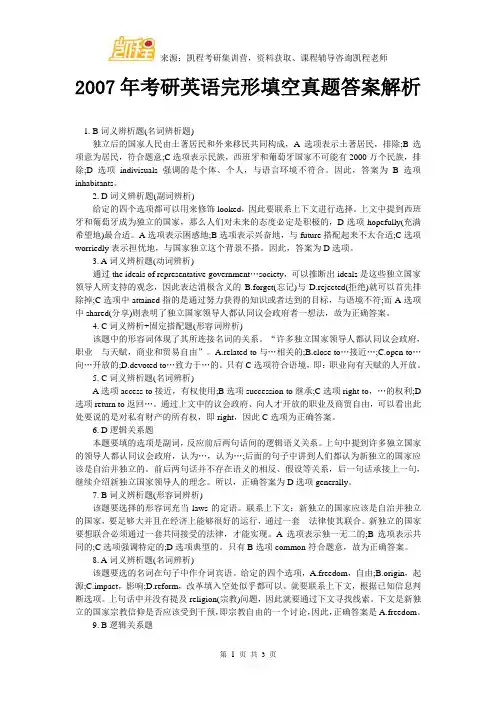
2007年考研英语完形填空真题答案解析1. B词义辨析题(名词辨析题)独立后的国家人民由土著居民和外来移民共同构成,A选项表示土著居民,排除;B选项意为居民,符合题意;C选项表示民族,西班牙和葡萄牙国家不可能有2000万个民族,排除;D选项indivisuals强调的是个体、个人,与语言环境不符合。
因此,答案为B选项inhabitants。
2. D词义辨析题(副词辨析)给定的四个选项都可以用来修饰looked,因此要联系上下文进行选择。
上文中提到西班牙和葡萄牙成为独立的国家,那么人们对未来的态度必定是积极的,D选项hopefully(充满希望地)最合适。
A选项表示困惑地;B选项表示兴奋地,与future搭配起来不太合适;C选项worriedly表示担忧地,与国家独立这个背景不搭。
因此,答案为D选项。
3. A词义辨析题(动词辨析)通过the ideals of representative government…society,可以推断出ideals是这些独立国家领导人所支持的观念,因此表达消极含义的B.forget(忘记)与D.rejected(拒绝)就可以首先排除掉;C选项中attained指的是通过努力获得的知识或者达到的目标,与语境不符;而A选项中shared(分享)则表明了独立国家领导人都认同议会政府者一想法,故为正确答案。
4. C词义辨析+固定搭配题(形容词辨析)该题中的形容词体现了其所连接名词的关系。
“许多独立国家领导人都认同议会政府,职业__与天赋,商业和贸易自由”。
A.related to与…相关的;B.close to…接近…;C.open to…向…开放的;D.devoted to…致力于…的。
只有C选项符合语境,即:职业向有天赋的人开放。
5. C词义辨析题(名词辨析)A选项access to接近,有权使用;B选项succession to继承;C选项right to,…的权利;D 选项return to返回…。
考研英语2007真题答案

考研英语2007真题答案考研英语2007真题答案考研英语作为研究生入学考试的一部分,一直备受考生们的关注和重视。
2007年的考研英语真题是很多考生备考的重要参考资料之一。
本文将对2007年考研英语真题进行分析,并给出相应的答案。
第一部分:阅读理解阅读理解是考研英语中的重点部分,也是考生们备考过程中最需要花费时间和精力的部分。
2007年考研英语真题中的阅读理解部分包括了三篇文章,分别是《The Role of Women in the 19th Century》、《The Origin of the Species》和《The Industrial Revolution》。
首先,我们来看第一篇文章《The Role of Women in the 19th Century》。
这篇文章主要讲述了19世纪女性在社会中的地位和角色。
根据文章内容,我们可以得出以下答案:1. The author's attitude towards women in the 19th century is most likely to be _______.答案:positive2. Which of the following is NOT mentioned as a reason for women's limited access to education in the 19th century?答案:lack of interest in education3. According to the passage, which of the following statements is true?答案:Women were expected to focus on domestic duties and child-rearing.接下来,我们来看第二篇文章《The Origin of the Species》。
考研英语历年阅读理解真题精析--2007年part1
Unit 14Text 1 If you were to examine the birth certificates of every soccer player in 2006’s World Cup tournament, you would most likely find a noteworthy quirk: elite soccer players are more likely to have been born in the earlier months of the year than in the late months. If you then examined the European national youth teams that feed the World Cup and professional ranks, you would find this strange phenomenon to be ever more pronounced. What might account for this strange phenomenon? Here are a few guesses: a)certain astrological signs confer superior soccer skills; b)winter born babies tend to have higher oxygen capacity, which increases soccer stamina; c)soccer-mad parents are more likely to conceive children in springtime, at the annual peak of soccer mania; d)none of the above. Anders Ericsson, a 58-year-old psychology professor at Florida State University, says he believes strongly in “none of the above.” Ericsson grew up in Sweden, and studied nuclear engineering until he realized he would have more opportunity to conduct his own research if he switched to psychology. His first experiment, nearly 30 years ago, involved memory: training a person to hear and then repeat a random series of numbers. “With the first subject, after about 20 hours of training, his digit span had risen from 7 to 20,” Ericsson recalls. “He kept improving, and after about 200 hours of training he had risen to over 80 numbers.” This success, coupled with later research showing that memory itself is not genetically determined, led Ericsson to conclude that the act of memorizing is more of a cognitive exercise than an intuitive one. In other words, whatever inborn differences two people may exhibit in their abilities to memorize, those differences are swamped by how well each person “encodes” the information. And the best way to learn how to encode information meaningfully, Ericsson determined, was a process known as deliberate practice. Deliberate practice entails more than simply repeating a task. Rather, it involves setting specific goals, obtaining immediate feedback and concentrating as much on technique as on outcome. Ericsson and his colleagues have thus taken to studying expert performers in a wide range of pursuits, including soccer. They gather all the data they can, not just performance statistics and biographical details but also the results of their own laboratory experiments with high achievers. Their work makes a rather startling assertion: the trait we commonly call talent is highly overrated. Or, put another way, expert performers – whether in memory or surgery, ballet or computer programming –are nearly always made, not born.1. The birthday phenomenon found among soccer players is mentioned to [A] stress the importance of professional training. [B] spotlight the soccer superstars at the World Cup. [C] introduce the topic of what makes expert performance. [D] explain why some soccer teams play better than others.2. The word “mania” (Line 4, Paragraph 2)most probably means [A] fun. [B] craze. [C] hysteria. [D] excitement.3. According to Ericsson, good memory [A] depends on meaningful processing of information. [B] results from intuitive rather than cognitive exercises. [C] is determined by genetic rather than psychological factors. [D] requires immediate feedback and a high degree of concentration.4. Ericsson and his colleagues believe that [A] talent is a dominating factor for professional success. [B] biographical data provide the key to excellent performance. [C] the role of talent tends to be overlooked. [D] high achievers owe their success mostly to nurture.5. Which of the following proverbs is closest to the message the text tries to convey? [A] “Faith will move mountains.” [B] “One reaps what one sows.” [C] “Practice makes perfect.” [D] “Like father, like son.”Unit 14(2007) Part 1试题解析:1.【正确答案】【C】【解析】结构题,题⼲中的“is mentioned to”表明本题是结构题。
2007年考研英语真题Text4解析
董事会有责任为了股东的利益对市场价值负责。
responsible
respond
response
responsibility
behalf
shareholder
有责任的,负责的
回答,响应,做出反应
回答,响应,反应
责任,责任心
利益,代表
股东
Indeed,just as there is the concept of Generally Accepted Accounting Principles(GAAP),
在美国,而不是欧洲,缺乏对数据泄漏的法律制裁虽然并不能说明目前事态是合理的,
但却可能助长了其形成。
current
currency
state
statement
statesman
affair
encourage
encouraged
just
justice
justify
legal
legend
legislation
data insecurity.
当老板和董事会终于解决了最糟糕的财务和规章问题,
并加强了企业管理力度之后,
一个新的问题正威胁着他们,——数据安全问题,
使他们出现在令人讨厌的(尤其美国的)头版头条新闻中,
企业管理层进而不可避免的受到惩罚。
boss
board
sort
sort out
account
divert
diversion
manage
manager
management
hurry
hurried
hurriedly
hurricane
2007年考研英语完形填空真题及其答案
2007考研英语真题完形真题及其答案Section I Use of EnglishDirections: Read the following text. Choose the best word(s) for each numbered blank and mark A, B, C, and D on ANSWER SHEET 1. (10 points) By 1830 the former Spanish and Portuguese colonies had become independent nations. The roughly 20 million __1__ of these nations loved __2__ to the future. Born in the crisis of the old regime and Iberian Colonialism, many of the leaders of independence __3__ the ideals of representative government, careers __4__ to talent, freedom of commerce and trade, the __5__ to private property, and a belief in the individual as the basis of society. __6__ there was a belief that the new nations should be sovereign and independent states, large enough to be economically viable and integrated by a __7__ set of laws. On the issue of __8__ of religion and the position of the church, __9__, there was less agreement __10__ the leadership Roman Catholicism had been the state religion and the only one __11__ by the Spanish crown, __12__ most leaders sought to maintain Catholicism __13__ the official religion of the new states, some sought to end the __14__ of other faiths. The defense of the Church became a rallying __15__ for the conservative forces. The ideals of the early leaders of independence were often egalitarian, valuing equality of everything. Bolivar had received aid from Haiti and had __16__ in return to abolish slavery in the areas he liberated. By 1854 slavery had been abolished everywhere except Spain’s __17__ colonies. Early premise to end Indian tribute and taxes on people of mixed origin came much __18__ because the new nations still needed the revenue such policies __19__ Egalitarian sentiments were often tempered by fears that the mass of the population was __20__ self-rule and democracy. Section I Use of English1.B2. D3. C4. A5. C6. D7. C8. C9. B 10. C11. C 12. D 13.A 14. D 15. C 16. D 17.B 18. D 19. C 20.D。
2007年考研英语完形填空真题解析
2007年考研英语完形填空真题解析By 1830 the former Spanish and Portuguese colonies had become independent nations. The roughly 20 million 1 of these nations looked 2 to the future. Born in the cri sis of the old regime and Iberian Colonialism, many of the leaders of independence 3 the ideals of representative government, careers 4 to talent, freedom of commerce and trade, the 5 to private property, and a belief in the individual as the basi s of society. 6 there was a belief that the new nations should be sovereign and independent states, large enough to be economically viable and integrated by a 7 set of laws.On the issue of 8 of religion and the position of the church, 9 , there was less agreement 10 the leadership. Roman Catholicism had been the state religion and the only one 11 by the Spani sh crown. 12 most leaders sought to maintain Catholicism 13 the official religion of the new states, some sought to end the 14 of other faiths. The defense of the Church became a rallying 15 for the conservative forces.The ideals of the early leaders of independence were often egalitarian, valuing equality of everything. Bolivar had received aid from Haiti and had 16 in return to abolish slavery in the areas he liberated. By 1854 slavery had been abolished everywhere except Spai n's 17 colonies. Early promises to end Indian tribute and taxes on people of mixed origin came much 18 because the new nations still needed the revenue such policies 19 . Egalitarian sentiments were often tempered by fears that the mass of the population was 20 self-rule and democracy.1. [A] natives[B] inhabitants[C] peoples[D] individual s2. [A] confusedl y[B] cheerfully[C] worriedly[D] hopefully3. [A] shared[B] forgot[C] attained[D] rejected4. [A] related[B] close[C] open[D] devoted5. [A] access[B] succession [C] right[D] return6. [A] Presumable [B] Incidentally[C] Obviously[D] Generally7. [A] unique[B] common[C] particular[D] typical8. [A] freedom[B] origin[C] impact[D] reform9. [A] therefore[B] however[C] indeed[D] moreover10. [A] with[B] about[C] among[D] by11. [A] allowed[B] preached[C] granted[D] funded12. [A] Since[B] If[C] Unless[D] While13. [A] as[B] for[C] under[D] against14. [A] spread[B] interference[C] exclusion[D] influence15. [A] support[B] cry[C] plea[D] wish16. [A] urged[B] intended[C] expected[D] promised17. [A] controlling[B] former[C] remaining[D] original18. [A] slower[B] faster[C] easier[D] tougher19. [A] created[B] produced[C] contributed[D] preferred20. [A] puzzled by[B] hostile to[C] pessimistic about[D] unprepared for文章背景本文主要介绍了西班牙和葡萄牙的殖民地在获得独立后在政治宗教以及信念各个方面对未来的展望。