
七年级英语下册 Unit 2 Neighbours知识点精讲(上)(新版)牛津版
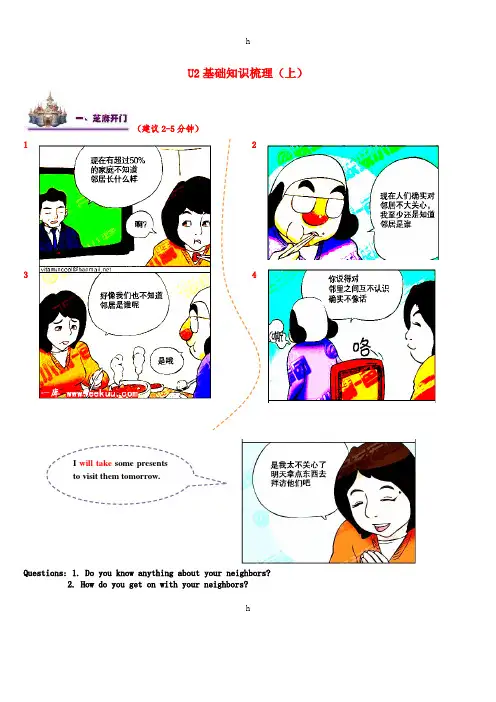
U2基础知识梳理(上)(建议2-5分钟)1 23 4I will take some presentsto visit them tomorrow.Questions: 1. Do you know anything about your neighbors?2. How do you get on with your neighbors?一、词汇Words1.___________ 邻居(英式英语)neighbor为美式英语neighbor用作名词,意为“邻居”,指居住在同一座楼、同一小区、同一街区的人数其复数形式是___________.2.like 像,相似,类似(1)like用作介词,指某人或某物“像,相似,类似”。
常用的固定搭配有像…样子______________________;看起来像______________________;例1:我不欢迎像你这样的人。
____________________________________________例2:这个女孩看起来像她的父亲。
____________________________________________(2) like 也可以用作动词,表示“喜欢”之意,常用的固定搭配:like sb/sth 喜欢某人/某物_______________ 喜欢做某事(习惯)_______________ 喜欢做某事(具体的事)练习:1. He_______ his father because he wants to speak English______ his father.A. like; likeB. likes; likesC. likes; likeD. like; likes2. I need a bike_________.A. like youB. like yourC. like yoursD. likes you3. John, ______ his father, _______ playing basketball.A. likes; likeB. like; likesC. likes; likesD. like; like4. Do you like any sports like_______, _______ or________?A. swimming; playing basketball; runB. swimming;playing basketball; runningC. swim;play basketball; runD. to swim; to play basketball; to run3.waiter (参观等)服务员名词,意为“(餐馆等)服务员”,是由动词wait 加后缀-er构成的,其对应词为___________,意为“女侍者,女服务员”。
visitor,意为“参观者,拜访者”,由动词visit加后缀-or构成的。
以-er结尾的名词:以-or结尾的名词:4.broken 弄坏了的,伤残的broken是由动词break 演变来的,类似的还有excite→excited , surprise→ surprised .broken形容词,“弄坏了的;伤残的”,可位于名词前作定语或系动词前作表语。
Eg: 这台电视机坏了。
____________________________________________________你能看见那个破的窗子吗?____________________________________________________【拓展】broken还有“骨折的;零碎的;不连贯的”意思1. I _______ my leg in the football game.A. am breakingB. brokenC. breakD. am broken2. I’m sorry your leg________.A. brokenB. is breakingC. breakD. is broken3. The _______ car is mine.A. breakingB. breakC. brokenD. broke4. My computer is_________(break) so I will find someone__________(fix) it.munity n. 社区,社团community用作名词,其复数形式是___________,表示社区、社团之意,作主语时,谓语可以是复数形式,也可以是单数形式。
常用the community“公众、群众”,______________________“社区中心”等固定搭配。
6.something 代词某事,某物someone 代词某人anyone 代词任何人(1)不具体指明代替任何特定的名词或形容词的代词成为不定代词。
不定代词分为代替人或代替物两类,代替人的不定代词有:_______________________________________________________;代替物的复合不定代词:_______________________________________________________。
由___________构成的复合词通常用在肯定句中,由___________构成的复合词通常用在疑问句和否定句中。
例 ---Would you like to have anything more?--- No, thanks. I’ve had enough.7. lucky adj. 幸运的Lucky是由名词luck+y 构成的形容词,意为“幸运的”;可以用来作定语、表语和宾语补足语等句子成分。
lucky的一些词性转换:名词_____________;形容词_____________;副词_____________;(反义)形容词_____________;副词_____________幸运儿句型: sb be lucky to do sth= It’s lucky for sb to do sth延伸: You are a lucky dog. 你真是个人幸运的家伙。
(谚语) 例1 Jack is a lucky boy. (作定语)例2 All of us are very lucky. (作表语)例3 We are feeling you luckier than them. (作宾语补足语) 练习:1. ---Good luck _______ your basketball game.--Thank you.A. toB. withC. forD. in2. I’m sorry you lose(输) the game. You’re a _______ boy .A. luckyB. luckilyC. unluckyD. luck3. ________, I am the first one in this examA. LuckB. LuckyC. UnluckyD. Luckily4. You are a _____ dog.A. luckB. luckyC. unluckyD. luckily5. I’m so_________(luck). I missed(错过) the train today.6. She __________ (luck) gets on the last bus.7. She is lucky to get on the last bus.(同义句)_______ _______ _______ _______ _______ get on the last bus.8.elder 形容词:更年长的(辈分:家庭成员里)old older oldest 1. 老的 He is ninety. He is old.2. 旧的 I have an old bike.3. 比较级 older than---I am older than you.elder eldest 1. 兄弟姐妹间年长的 my elder brother 我哥哥 my elder son 我的大儿子2. 不能和than 连用3. 不能用在be后面练习:1. My ______ brother is twenty years______.A. older; oldB. old; oldC. elder; oldD. eld; old2. I’m two years_______ than you.A. elderB. oldC. olderD. oldest3. My grandfather is _______. He can’t carry the box.A. oldB. olderC. elderD. eld4. My_______ sister has an_______ bike.A. old; oldB. older; oldC. elder; oldD. elder; elder9.worry 动词:着急worried 形容词:着急的worry about为……着急=be worr ied aboutDon’t worry. 别着急(安慰的话)练习:1)---My brother is badly ill.---___________. He will be ok.A. NOB. All rightC. Don’t worryD. Sure2) ----Are you________ about the English exam?A. worryB. worriedC. worryingD. to worry3) My parents always ________ about my health. And I’m also worried________ about theirs.A. worry; worryB. worried; worryC. worry; worriedD. worried; worried4) I wait ______ her for an hour so I’m worried______ her.A. for; forB. about; forC. for; aboutD. about; about10.check 动词:检查名词:检查check sth have a checkcheck in 入住 -----check out 退房二、重要句型Important Sentences structures1.I’m afraid they won’t welcome visitors like you.解析: I’m afraid 用于礼貌或正式的道歉、对不起、恐怕等,一般做插入语。
牛津译林英语七年级英语下册Unit 2 Neighbours 知识点归纳.doc

7B Unit2 知识点解析一、知识要点1.Where are you going?你打算去哪里?be going此处为“现在进行时表将来”。
现在进行时表将来主要用于表示按计划或安排将要发生的动作,常有“意图”“安排”或“打算”的含义。
这种现在进行时比较生动,给人一种期待感。
go, come, leave等表示位移的动词,都可以用于现在进行时表将来。
例如:He is going. 他要走了。
I’m coming. 我要来了。
Tom is leaving. 汤姆要走了。
2. I’m going to visit our new neighbours.我打算拜访我们的新邻居。
be going to意为“计划,打算”,后接动词原形,用于表将来。
例如:I’m going to wash the car if I have time. 若有时间我想洗洗车。
Where are we going to stay tonight? 我们今晚住哪里?3. I’m afraid they won’t welcome visitors like you.恐怕他们不会欢迎像你一样的拜访者。
(1)welcome作及物动词,意为“欢迎’’,可与介‘词to连用;也可作形容词,意为“受欢迎的"。
如:Welcome you to our school! 欢迎到我们学校来!You’re welcome.不用谢。
(2)句中like是介词,意为“像,相似’’,其反义词是unlike;作动词时,意为“喜欢’’,后可接动名词或不定式作宾语。
如:What is Jim like? 吉姆这个人怎么样?They like playing football on Sunday.他们喜欢在星期天踢足球。
(3)won’t是will与not的缩略形式。
“will+动词原形"也是一般将来时的构成之一。
如:We will take a bus to work.我们将乘公共汽车上班。
牛津英语七年级下册 Unit 2 Neighbours知识汇总

牛津英语七年级下册Unit 2 Neighbours 一、单元重点词组二、重点句型1.I'm afraid they won't welcome visitors like you. 恐怕他们不会欢迎像你这样的客人。
(1)I'm afraid 译为“恐怕”,是一种口语表达习惯,通常不用he's afraid, she's afraid.例:I'm afraid it is going to rain tomorrow. 恐怕明天要下雨了。
翻译:恐怕他下个星期不能去上学了因为他得了感冒。
补充:be afraid of sth 害怕某物我害怕蛇I'm afraid so. 我恐怕是这样的。
I‘m afraid not. 我恐怕不是这样的。
I think so. 我如此认为。
I don't think so. 我不这样认为。
★ be afraid of doing sth★ be afraid to do sth 表示“怕….. ”之意---Can I have dinner with you?我能与你共进晚餐吗?--- Sorry, I'm afraid not.这里的意思是:对不起,不能(2)visitor 派生词有visit演变(3)like 介词像与…一样/ 动词喜欢做某事2.Most of them have 14 floors.大多数楼有14层。
most的用法表示“数量上最多,最大”,为many或much 的最高级。
例:She had the most money of all of them.在这些人中,她最有钱。
most of + the/this/these/that/those/物主代词+名词,指某一范围内的多数。
(名词前面一定要有修饰词)例:Most of the students come from China. most of my booksmost of +可数名词复数+ V复most of +不可数名词+V单★most 与most of 的区别1 most+名词表泛指,无范围如:most young peopleII most of + 名词指某一范围的多数III most of +人称代词,of 不能少如:most of them两者有时可互换:Most teachers in this school are women.= Most of the teachers in this school are women.3. It’s good to live in a neighbourhood like that. 住在那样的居民区里真好。
江苏省盐城市亭湖区七年级英语下册Unit2Neighbours知识点归纳新版牛津版
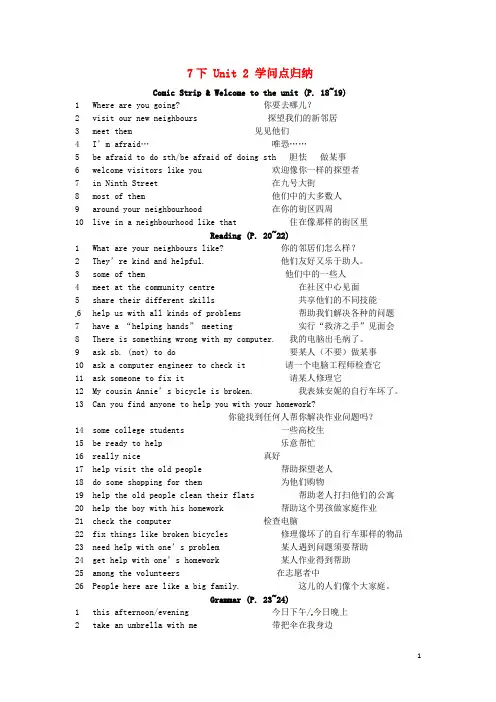
7下 Unit 2 学问点归纳Comic Strip & Welcome to the unit (P. 18~19)1 Where are you going? 你要去哪儿?2 visit our new neighbours 探望我们的新邻居3 meet them 见见他们4 I’m afraid…唯恐……5 be afraid to do sth/be afraid of doing sth 胆怯做某事6 welcome visitors like you 欢迎像你一样的探望者7 in Ninth Street 在九号大街8 most of them 他们中的大多数人9 around your neighbourhood 在你的街区四周10 live in a neighbourhood like that 住在像那样的街区里Reading (P. 20~22)1 What are your neighbours like? 你的邻居们怎么样?2 They’re kind and helpful.他们友好又乐于助人。
3 some of them 他们中的一些人4 meet at the community centre 在社区中心见面5 share their different skills 共享他们的不同技能6 help us with all kinds of problems 帮助我们解决各种的问题7 have a “helping hands” meeting实行“救济之手”见面会8 There is something wrong with my computer. 我的电脑出毛病了。
9 ask sb. (not) to do 要某人(不要)做某事10 ask a computer engineer to check it 请一个电脑工程师检查它11 ask someone to fix it 请某人修理它12 My cousin Annie’s bicycle is broken. 我表妹安妮的自行车坏了。
七年级英语下册 Unit 2 Neighbours知识点精讲(上)(新版)牛津版
U2基础知识梳理(上)(建议2-5分钟)1 23 4I will take some presentsto visit them tomorrow.Questions: 1. Do you know anything about your neighbors?2. How do you get on with your neighbors?h一、词汇Words1.___________ 邻居(英式英语)neighbor为美式英语neighbor用作名词,意为“邻居”,指居住在同一座楼、同一小区、同一街区的人数其复数形式是___________.2.like 像,相似,类似(1)like用作介词,指某人或某物“像,相似,类似”。
常用的固定搭配有像…样子______________________;看起来像______________________;例1:我不欢迎像你这样的人。
____________________________________________例2:这个女孩看起来像她的父亲。
____________________________________________(2) like 也可以用作动词,表示“喜欢”之意,常用的固定搭配:like sb/sth 喜欢某人/某物_______________ 喜欢做某事(习惯)_______________ 喜欢做某事(具体的事)练习:1. He_______ his father because he wants to speak English______ his father.A. like; likeB. likes; likesC. likes; likeD. like; likes2. I need a bike_________.A. like youB. like yourC. like yoursD. likes you3. John, ______ his father, _______ playing basketball.A. likes; likeB. like; likesC. likes; likesD. like; like4. Do you like any sports like_______, _______ or________?A. swimming; playing basketball; runB. swimming;playing basketball; runningC. swim;play basketball; runD. to swim; to play basketball; to run3.waiter (参观等)服务员名词,意为“(餐馆等)服务员”,是由动词wait 加后缀-er构成的,其对应词为___________,意为“女侍者,女服务员”。
Unit2Neighbours知识讲义牛津译林版英语七年级下册
牛津版译林英语7B知识点总结Unit2 Neighbours1.Where are you going?【知识点一】:be doing(1)现在进行时表将来(2) go、e、leave、move表示移动的词,都可以用“现在进行时表将来”(3)进行时开始表示:近期一直在做某事2. I'm afraid they won't wele visitors like you. 恐怕他们不会欢迎像你这样的客人。
(P18)【知识点一】afraid adj. 害怕的(1) I'm afraid (that) + 宾语从句, 恐怕Eg. I’m afraid (that) you are wrong.(2) be afraid of doing sth 害怕做某事= be afraid to do sth(3) I'm afraid not. 恐怕不是这样的。
Eg.—Can you get there before 6 o’clock? —I’m afraid not.(4) I'm afraid so. 恐怕是这样的。
Eg.—Is it going to rain tomorrow? —I’m afraid so.【随堂练习】1. —Will your father e to see your piano show tomorrow?— . He is having an important meeting in Beijing now.A. They'd like toB. You're rightC. I'm afraid soD. I'm afraid not2. —Would you like to help me with my lessons?—Sorry. .I have no time now .A. I'm sure.B. I'm afraid.C. I'd like.D. I hope.【知识点二】visitor (n.)拜访者①visit v. 参观;拜访n. 参观visit sp. = be on a visit to sp.②构词法:动词+or→表示人的职业或身份act→ actor invent→ inventor collect→ collector【随堂练习】1. Do you know the (visit) telephone numbers? I want to call them.【知识点三】like(1) v. 喜欢like doing sth./ like to do sth. 反义词:dislike = hate(2) prep. 像反义词:unlikebe like/look like①问性格,品质What be sb. like?Eg.—What is he like? —He is kind and helpful.②问外貌:What does sb. look like? = How does sb. look?Eg.—What does he look like? = How does he look?—He looks tall and strong.区别:What does sb like (doing)? 问爱好(3)不能单独作谓语: be like 像…look like 看起来像… sound like听起来像【随堂练习】1.The boy, his father, playing football.A. like;likesB. likes;likeC. liked;likeD. like; will like2.— __________ your hometown like? —It’s a good place ___________.A. How is; to liveB. How does; to liveC. What is; livingD. What is; to live3. What is your father like?A. He likes history best.B. He likes eating meat.B. He is kind and friendly. D. He is forty years old.补: 问职业①What be sb? ②What be sb’s job? ③What do/does sb do?3. How many buildings are there in your neighbours? 在你居民区有多少幢楼?【知识点一】how often, how many times, how soon, how long 与how far的区别【随堂练习】1. — ______ do you help your parents do housework? — Every evening.A. How oftenB. How longC. How soonD. How far2. — ______ music do you listen to every day? —One hour.A. How manyB. How longC. How soonD. How much3. — ______ hours of music do you listen to every day? —One.A. How manyB. How longC. How soonD. How much4. — ______ will you e back? —In two days.A. How oftenB. How longC. How soonD. What time4. Most of them have 14 floors. 它们大多数有14层。
牛津译林英语七年级英语下册unit2neighbours知识点归纳
一、知识要点1.Where are you going?你打算去哪里?be going此处为“现在进行时表将来”。
现在进行时表将来主要用于表示按计划或安排将要发生的动作,常有“意图”“安排”或“打算”的含义。
这种现在进行时比较生动,给人一种期待感。
go, come, leave等表示位移的动词,都可以用于现在进行时表将来。
例如:He is going. 他要走了。
I’m coming. 我要来了。
Tom is leaving. 汤姆要走了。
2. I’m going to vi sit our new neighbours.我打算拜访我们的新邻居。
be going to意为“计划,打算”,后接动词原形,用于表将来。
例如:I’m going to wash the car if I have time. 若有时间我想洗洗车。
Where are we going to stay tonight? 我们今晚住哪里?3. I’m afraid they won’t welcome visitors like you.恐怕他们不会欢迎像你一样的拜访者。
(1)welcome作及物动词,意为“欢迎’’,可与介‘词to连用;也可作形容词,意为“受欢迎的"。
如:Welcome you to our school! 欢迎到我们学校来!You’re welcome.不用谢。
(2)句中like是介词,意为“像,相似’’,其反义词是unlike;作动词时,意为“喜欢’’,后可接动名词或不定式作宾语。
如:What is Jim like? 吉姆这个人怎么样?They like playing football on Sunday.他们喜欢在星期天踢足球。
(3)won’t是will与not的缩略形式。
“will+动词原形"也是一般将来时的构成之一。
如:We will take a bus to work.我们将乘公共汽车上班。
牛津译林版英语七年级下册Unit 2 Neighbours 第一课时 课件
I’m afraid my mother has no time to play with me.
Role play the conversation with your partner.
What’s your neighbour?
A: What does your neighbour do? B: He/She is a/an...... A: Where does he/she work then? B: He/She works ...... A: What about you? B: I want to be .......and work......
teacher student
school
Do you know what they are and where they work?
farmer
on a farm
Do you know what they are and where they work?
office worker
in an office
Listen and answer
Eddie and Hobohat are they going to do? They are going to visit their new neighbours. Will Eddie go and visit the new neighbours? Yes ,he will.
Help Simon to complete his article with the words in the box.
[K12学习]七年级英语下册 Unit 2 Neighbours知识点清单+练习(无答案)(新版)牛
帮助某人解决某种困难help sb with sth后天the day after tomorrow
在将来in the future为...担心worry about=be worried about
生火make a fire计r away from...在社区中心at the community centre
( ) 10. If it ________ tomorrow, weroller-skating.
A. isn’t rain;will go B. won’t rain;go
C. doesn’t rain;will go D. isn’t raining;will go
7BUnit 2 Neighbours
重点单词:
邻居neighbour参观者,访问者visitor愿意帮忙的;有用的helpful
问题,难题problem损坏了的;破碎的broken听起来sound
运气n.luck(不)幸运的adj.(un)lucky(不)幸运的是adv.(un)luckily
信息information
()8. It's very dark and cold. It _______rain.
A. will B. shall C. is going to D. are going to
()9. There ________ two films this evening.
A. are going to be B. is going to be C. is going to have D. will have
...坏了There’s something wrong with...让某人做某事make sb do sth
【英语】七年级英语下册Unit2Neighbours词汇语法素材新版牛津版
【关键字】英语7 B Unit 2 Neighbours词汇语法重点短语visit our new neighbours 拜访我们的新邻居welcome visitors like you 欢迎像你一样的客人live in a neighbourhood like that 居住在像那样的社区meet at the community centre 在社区中心集中share their different skills 分享各自的一技之长help us with all kinds of problems 帮助我们各种困难help sb with sth 帮助某人解决某种困难help sb do sth 帮助某人做某事have a “helping hands” meeting 召开“助人为乐”会议have a meeting 开会There’s something wrong with sth=Something is wrong with sth 某物坏(失灵)了a computer engineer 一位电脑工程师be broken 坏了something is broken 某物坏了ask someone to fix sth 叫某人修理某物help you with your homework 帮助你做功课some college students 一些大学生be ready to do sth 准备做某事beready to help 准备提供帮助do +some/the +V-ing 泛指做某类事do some cleaning/reading 打扫卫生/读些书be lucky to do sth 做某事是幸运的help people in the neighbourhood with different problems 帮助社区的人们解决不同的困难ask someone to fix his bicycle 请人修他的自行车need help with their problems 需要帮助他们的困难have problems (in) doing sth 做某事遇到困难have problems with sth 某事遇到困难check their computers 检修他们的电脑find someone to fix things like broken bicycles 找人修理像坏自行车之类的东西be like a big family 像个大家庭take an umbrella with sb 随身携带一把雨伞wait for us to call back 等我们回电wait for your call 等你的电话be free 自由的、空闲的be going to be late 将要迟到了be (so) cloudy 多云plan a day out 计划外出一天the day after tomorrow 后天bring some water 带些水make a fire生火cook some food煮食物an office worker 办公室人员in a police station 在警察所in a post office 在邮局in the town centre 在镇中心Wendy’s elder brother/sister文迪的哥哥/姐姐be busy with sth 忙于某事be busy doing sth 忙于做某事work for a company 效力于一家公司far away from her home 远离她的家in the future 将来be a computer engineer 做一名电脑工程师sound like a good idea 听起来像是好主意help sick people 帮助病人be an artist 做一位艺术家in an hour 一小时后turn on / off 开/关(电器按钮等)go in 进去;进入go in for 参加,从事next team 下学期keep busy 保持忙碌cold drink 冷饮料on the afternoon of 5 March 在下午look at the information below 看下列信息feel well 感觉身体好make you feel better 使你感觉更好worry about sth / (not)doing sth 担心某物/担心(不)做某事all our group members 我们所有的团体成员give you some ideas 给你一些建议what to wear to a party 穿什么去参加晚会how to design their home 怎样设计他们的家园重点句型1. What are your neighbours like?= How are you neighbours?你的邻居们(性格品质)如何?What be sb/sth like?你认为…怎么样(性格品质)?(用形容词回答)What do/does sb. like?某人喜欢什么?What do/does sb. look like?某人长什么样子(外貌)?2. Are you not feeling well these days? 你最近觉得不舒服吗?I’m not feeling well.= I don’t feel well. “well”此处是形容词,表示身体好的。
牛津译林版七年级下册 Unit2 Neighbours 知识点总结
牛津译林版七年级下册unit2 Neighbours 1.I’m afraid they won’t welcome visitors like you.恐怕他们不会欢迎你这样的客人。
句中的like为介词,意为“像,类似,像......一样”Eg: Don’t look at me like that. 别像那样看着我。
2.I live in a flat in City Garden in Ninth Street.我住在第九大道城市花园的一个公寓里。
live in 居住在......Eg: We live in the same alley.我们住在同一条小巷里。
3.How many buildings are there in your neighbourhood?你的邻近有多少建筑物?how many (+可数名词)多少= how much (+不可数名词)Eg: How many parents do that?有多少父母能做到这样吗?How much is this worth?这值多少钱?4.There are about 20 buildings.有大约20栋建筑物。
there be 句型表示“有(某处存在某物)”have 也可表示“有(某人拥有某物)”Eg: There are some apples on the table.有一些苹果在桌上。
We have all kinds of books.我们有各种各样的书。
there be 句型的就近原则:be 动词的使用取决于be动词后最近的词为单数还是复数。
Eg: There is a book on the desk.有一本书在书桌上。
There are three books on the desk.有三本书在书桌上。
若be动词后的词为不可数名词,则be动词用单数。
Eg: There is some milk in the fridge.有一些牛奶在冰箱里。