
外研版八年级英语下册Module 1 Feelings and impressions 模块知识点归纳
Module 1 Feelings and impressions
It smells delicious.
必背单词
1. smell (v.) 有……的气味; 闻; 闻出→smelled/smelt (过去
式)→smelled/smelt(过去分词)
2. soft (adj.) 软的; 柔软的→softly (adv.) 软地, 柔软地
3. lovely (adj.) 令人愉快的; 可爱的→love (n.) 爱→(v.) 喜爱
4. done (adj.) 做完的→do (v.) 做
5. try (n.) 尝试; 努力→(v.) 尝试→tried(过去式)→tried(过去分词)
6. sound (v.) 听起来; 令人觉得→(n.)声音
7. salt (n.) 盐; 食盐→salty (adj.)咸的
8. favourite (n.) 最喜欢的人或事→(adj.) 最喜欢的
9. sour (adj.) 酸的; 馊的
10. cookie (n.) 小甜饼; 曲奇饼
11. pizza (n.) 比萨饼
12. pie (n.) 馅饼; 派
13. jam (n.) 果酱
必背短语
14. on top 在顶端, 在上边
15. a bit 有点
16. have a try 尝一尝; 试试看
17. in the middle 在中间
18. lots of 许多
19. make an apple pie 做个苹果派
20. be sure 确信
必背句子
21. What a delicious smell!多好闻的香味!
22. Would you like to try some?你想尝一些吗?
23. I'm afraid I don't like cheese. 恐怕我不喜欢奶酪。
24. It's my lucky day!今天是我的幸运日!
I feel nervous when I speak Chinese.
必背单词
1. nervous (adj.) 情绪不安的; 紧张的→more nervous (比较级)更紧
张的→most nervous 最紧张的
2. pretty (adj.) 秀丽的; 标致的→prettier(比较级)更秀丽的; 更标致
的→prettiest(最高级)最秀丽的; 最标致的
3. proud (adj.) 感到自豪的, 感到骄傲的→pride ( n. ) 自豪; 骄傲
4. stranger (n.) 陌生人→strange (adj.) 陌生的, 奇怪的
5. hobby (n.) 业余爱好→hobbies (pl.)
6. glasses (n.) [用复数]眼镜
7. jeans (n.) [用复数]牛仔裤
8. fair (adj.) (头发)金色的, 浅褐色的
9. message (n.) 电子邮件; 口信; 信息
必背短语
10. hear from… 收到……的来信
11. can't wait 等不及了
12. arrive at 到达
13. each other 互相
14. as well 也
15. be proud of 为……而感到自豪
16. be afraid of… 害怕……
必背句子
17. Thank you for your last message.
谢谢你的上一封电子邮件。
18. I'm quite tall, with short fair hair, and I wear glasses.
我相当高, 梳着金色短发, 而且我戴眼镜。
19. How do you feel about coming to China?
你觉得来中国怎么样?
20. But I can't tell you how excited I am about going to China!但是我无法向你表达我要去中国的兴奋之情!
Language in use
必背短语
1. shake hands 握手
2. look like 看起来像
3. would like 要; 想要
必背句子
4. How are you today?今天你感觉如何?
5. What is he like?他是什么性格?
6. They may be a bit noisy sometimes, but they are quite friendly.有时他们可能有点吵, 但是他们是相当友好的。
外研版八下英语 Module 1 Feelings and impressions Unit 3
much修饰形容词/副词的比较级 意为"……得多",much用来修饰比较级。However, the technology will become much better in the future. 然而,在未来,技术会变得好得多。
And another good thing is, my friend Ben is coming to stay. 另一件好事是我的朋友本要来住一段时间。(教材P7)
现在进行时表将来 本句中"is coming"是现在进行时,表示将要发生的动作,意为"将要来"。在英语中,表示位置移动的动词,如go、come、arrive、leave等,常用其现在进行时表示将来。The bus is coming soon. 公共汽车很快就会来。I'm leaving soon. 我即将离开。
—What does May look like? 梅长什么样?—She is a pretty girl with big bright eyes and long straight hair. 她是一个长着明亮的大眼睛,留着长长的直发的漂亮女孩。(南通中考)—What do they look like? 她们长什么样?—They have long hair. 她们留着长发。
—What's he like?他是个什么样的人?—He is friendly and kind.他友好善良。—What does he like? 他喜欢什么?—He likes swimming. 他喜欢游泳。
典例1 (北京八中期中)—What does your friend look like?—___
外研版八年级英语下册教案 Module 1 教案 2
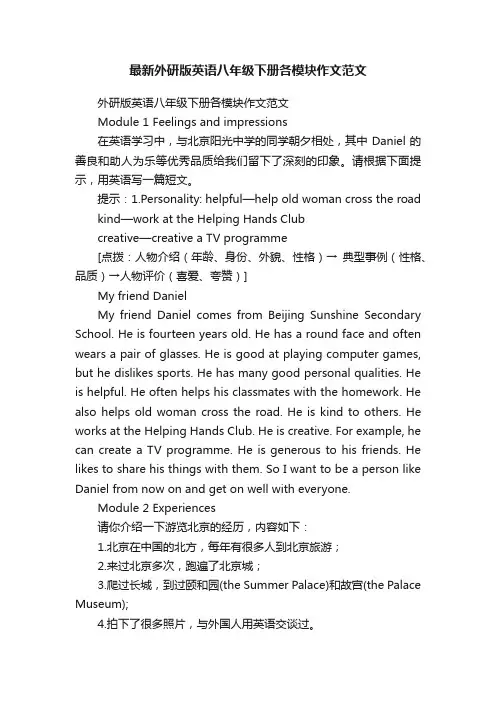
Module 1 Feelings and impressions I. Teaching objectives教学目标II. Teaching materials analyzing 教材分析本模块的主题是“Feelings and i mpressions”, 教材的设置将功能与结构融于话题与任务中,通过话题的循环与任务的完成学习感官动词的用法及系表结构。
Unit 1主要目标是学习感官动词,通过听读呈现了感官动词的功能,运用说写任务循环训练,强化语言知识。
活动1要求听句子,给图片标号,训练学生捕捉主要信息及所需信息的能力。
活动2要求将所给句子与图片配对,为学习对话做准备。
活动3听读谈论“感觉和印象”的对话,培养学生领会主旨大意的听力技巧,呈现新的语言内容。
活动4要求回答问题,进一步熟悉对话内容,掌握感官动词的用法。
活动5要求完成句子,巩固感官动词及描述性形容词的用法。
活动6 的完成可帮助进一步辨认不同感官动词与相应感觉器官的对应。
活动7和8 是对本单元语音语调规则的训练及实践运用。
Unit 2 主要目标是学习运用系表结构描述人的外表,初步认识并使用when 引导的时间状语从句。
活动1是热身活动,为阅读部分做了句式结构及词汇上的准备。
要求学生运用所给词汇谈论图片中人物形象。
活动2 是Sally写给其笔友Lingling的一封信,要求学生读后根据信中描述找出正确的图片。
活动3要求将所给问句与相应段落配对,考查学生把握段落大意的能力。
活动4要求学生仿照信件中Sally对自己外表的描述,描述照片中人物的形象。
活动5和6 要求以回答问题和两人对话的形式,运用when 引导的时间状语从句谈论别人及自己的感受。
活动7要求按照提示给Sally写一封回信介绍自己的情况:外貌、喜好等。
Unit 3 主要是语言应用。
活动1 要求小组活动说出自己的好恶及理由,巩固感官动词的用法。
活动2和3 要求用感官动词填空,完成句子。
最新外研版英语八年级下册各模块作文范文
最新外研版英语八年级下册各模块作文范文外研版英语八年级下册各模块作文范文Module 1 Feelings and impressions在英语学习中,与北京阳光中学的同学朝夕相处,其中Daniel的善良和助人为乐等优秀品质给我们留下了深刻的印象。
请根据下面提示,用英语写一篇短文。
提示:1.Personality: helpful—help old woman cross the road kind—work at the Helping Hands Clubcreative—creative a TV programme[点拨:人物介绍(年龄、身份、外貌、性格)→ 典型事例(性格、品质)→人物评价(喜爱、夸赞)]My friend DanielMy friend Daniel comes from Beijing Sunshine Secondary School. He is fourteen years old. He has a round face and often wears a pair of glasses. He is good at playing computer games, but he dislikes sports. He has many good personal qualities. He is helpful. He often helps his classmates with the homework. He also helps old woman cross the road. He is kind to others. He works at the Helping Hands Club. He is creative. For example, he can create a TV programme. He is generous to his friends. He likes to share his things with them. So I want to be a person like Daniel from now on and get on well with everyone.Module 2 Experiences请你介绍一下游览北京的经历,内容如下:1.北京在中国的北方,每年有很多人到北京旅游;2.来过北京多次,跑遍了北京城;3.爬过长城,到过颐和园(the Summer Palace)和故宫(the Palace Museum);4.拍下了很多照片,与外国人用英语交谈过。
最新外研版英语八年级下册课文翻译

Module 1 Feelings and impressions Unit 1?It?smells?delicious.?1 Listen and number the pictures.1Lingling: Guess what it is!玲玲:猜猜它是什么!Betty: It tastes sweet. Is it a cookie?贝蒂:它尝起来很甜。
是小甜饼吗?2Daming: Ugh! This milk smells sour.大明:呃!这牛奶闻起来酸了。
Tony: Don’t drink it.托尼:别喝了。
3Betty: This bed feels a bit soft.贝蒂:这张床摸起来有点儿软。
Lingling: Try a harder bed.玲玲:试一张硬点儿的。
4Lingling: Tom looks very strong!玲玲:汤姆看起来很强壮!Daming: Yes. He does a lot of exercise.大明:是的。
他做很多运动。
2 Listen again and complete the sentences. 1Lingling: Guess what it is!玲玲:猜猜它是什么!Betty: It tastes sweet. Is it a cookie?贝蒂:它尝起来很甜。
是小甜饼吗?2Daming: Ugh! This milk smells sour.大明:呃!这牛奶闻起来酸了。
Tony: Don’t drink it.托尼:别喝了。
3Betty: This bed feels a bit soft.贝蒂:这张床摸起来有点儿软。
Lingling: Try a harder bed.玲玲:试一张硬点儿的。
4Lingling: Tom looks very strong!玲玲:汤姆看起来很强壮!Daming: Yes. He does a lot of exercise.大明:是的。
Module-1--Feelings-and-impressions知识点1
Module 1 Feelings and impressions知识归纳解说1.feel 的用法feel :动词,意为感觉,感到,其为感官动词,后接形容词。
构成的词组有:feel about +doing\n.(揣摩,摸索)feel like +doing sth. (想要,有…的感觉)2. What a delicious smell. 考察感叹句。
感叹句有两种结构:第一种为what+(a\an )+形容词+可数名词单数形式+(主语+谓语)第二种:how +形容词或副词+主语+谓语3.would you like 的用法Would you like + to do = want to do 想要做某事,其确定回答为:Yes, I’d love to4. afraid 的用法Afraid 为形容词,其用法主要有A: be afraid to do sth. 胆怯做某事B:be afraid of doing sth\sth. 担忧某事5.too 的用法作为副词,后面可以修饰形容词或者副词的原级,表示“太”,也可以表示“也”,常放在确定句句尾,表示某状况也适合某人。
6. strong 的用法Strong 常有强壮,强大的意思,但在本模块中,指的是(味道)很重,很浓7.a bit 的用法A bit 指“一点,略微”,用作副词,其后可以修饰动词以及形容词和副词的原级。
但也可以后面接副词或形容词的比较级。
相当于“a little “8.there be 句型此句型表示某地方有某物,强调地方有。
用于就近原则,常及some 及any 一起考察。
确定要留意some 常用于确定句,而any 常用于疑问句及否定句。
9. make 的用法Make :制作,使Make an apple pie 中指制作Make 后面接动词原形或者是形容词。
如:My boss makes me work for ten hours.We should make the classroom clean.10.have a + 其他的结构,表示有,常构成的短语有:have a try (试一试);have a sweet tooth(有虫牙,有吃甜食的爱好);have a good time (玩得开心) have a hard time (过得困难)11.luck 的用法Luck 为名词,意为运气。
八年级英语下册Module1Feelingsandimpressions文化背景资料(新版)外研版
Business etiquette商务礼仪是商务活动中的礼仪规范。
商务礼仪具有协调和沟通的功能,具有凝聚情感的作用。
Business etiquette is the business etiquette norms. Business etiquette is coordination and communication functions with cohesion emotional role. With the development of society, the business relations are getting wider and wider, in a variety of business contacts gradually formed a code of conduct and guidelines, guidance on business conduct themselves in society, and as a code of society, coordinating human relations and human and social relations, so that people are friendly to each other, respect the other's premise, compliance with the protocol norms, in accordance with the protocol norms restrain itself, it is easy for people to feelings of interpersonal communication. so emotional pool play to the role, and establish mutual respect, mutual trust, friendship and cooperation relations, in turn help the development of various undertakings. Business etiquette is a behavioral science, and should seriously the systemic training. Due to geographical and historical background, the system between various kinds of differences True but reflects the aspirations of the same, and to abide by the norms and codes of conduct is consistent.Some Common Manners in the West你都知道些西方人的什么礼节呢?It is a great help for the person who is learning a foreign language to know some customs and manners for the people who speaks it, because the language is very closely associated with them. I will tell you some common western manners.1) Greeting The simplest thing to say is "Good morning," "Good afternoon'" or "good evening." This greeting is given to one whom you know only slightly, or to any one you are passing quickly. "How are you" is usually used when you are notin such a hurry. No answer is expected other than " Fine, thank you." "hello' is the commonest form of greeting between good friends.2) When to Shake Hands It is customary to shake hands when you first meet someone. And usually friends shake hands when they meet after not having seen each other for some time. However it is not necessary to shake hands.3) How to Introduce People In introducing two people, the general rule is: Introduce other people to the person you wish to honor. The old are honored in the West as in China. Women have been honoured in the West since the days of knighthood(骑士时代).4) Introducing Yourself If you want to meet someone, it is better to ask a friend who know him to introduce you. But sometimes at a meeting or gathering it is all right to introduce yourself to a fellow-student, or to one of the same sex and position.5) What to Say on Leaving When leaving any kind of a party, a guest always expresses his appreciation to the hostess. Some such words as these are appropriate. "Thank you so much. I've had a delight evening."Table Manners1) As soon as the hostess picks up her napkin(餐巾), pick yours up and lay it on your lap. Sometimes a roll of bread is wrapped in it; if so, toke it our and put it on your side plate.2) The Soup Course Dinner usually begins with soup. The largest spoon at your place is the soup spoon. It will be beside your plate at the right-hand side.3) The Fish Course If there is a fish course, it will probably follow the soup. There may be a special fork for the fish, or it may be similar to the meat fork. Often it is smaller.4) The Meat Course The main Course is usually served by the host himself, especially if it is a fowl(鸡禽) or a roast which need to be carved. He will often ask each guest what piece he prefers, and it is quite proper to state your preference as to lean or fat, dark(红肉) or light(白肉).5) Using Knife and Fork If you have English and American friends you will notice a few differences in their customs of eating. For the main or meat curse, the English keep the fork in the left hand, point curved downward, and bring the food to the mouth either by sticking the points onto it or in the case of soft vegetables, by placing it firmly on the fork in this position with the knife. Americans carve the meat in the same position, then lay down the knife and taking the fork in the right hand with the point turned up, push it under a small piece of food without the help of the knife and bring it to the moth right-side-up.6) Helping Yourself and Refusing If a servant passes food around, he will pass the dish in at your left hand so that you can conveniently serve yourself with your right hand. Never serve yourself while the dish is on your right; it is then the turn of your neighbor on the right. It is polite to take some of everything that is passed to you. But if there is something you may not like, you may quietly say: "No thank you."。
外研版英语八年级下册 Module 1 Feelings and impressions 单元检测题
外研版英语八年级下册 Module 1 Feelings and impressions 单元检测题外研版英语八年级下册 Module 1 Feelings and impressions 单元检测题一、单项选择题Susan usually eats _______ egg and _______ pie in the morning.A. a; aB. an; aC. a; anD. an; anMike is the best basketball player _______ the school team.A. toB. forC. inD. atJenny couldn’t find _______ bike. _______ had to walk to school.A. she; SheB. her; SheC. she; HerD. her; HerLinda is very _______ because she’s going to China on holiday.A. excitedB. excitingC. interestedD. interestingThe pandas are _______, so all people love them.A. quietB. dangerousC. lovelyD. terribleYou did a good job, Jane. We are _______ you.A. strict withB. sorry forC. proud ofD. angry with—I hope to visit the moon one day.—That _______ possible.A. soundsB. tastesC. smellsD. looks—_______ do you feel when you watch a movie?—I feel relaxed.A. HowB. WhatC. WhyD. WhenMr Wang is good at _______ baseball.A. playB. to playC. playingD. playedTom was afraid of _______ Chinese when he came to China for the first time.A. talkB. speakC. talkingD. speakingSandy, thanks for _______ me with my maths.A. helpB. helpingC. helpedD. to helpYou’d better have a good rest after your work is _______.A. doB. doingC. didD. doneA. ranB. runC. runningD. to run_______ sunny day! Let’s go to the park for fun.A. WhatB. What aC. HowD. How a—Your new dress is so beautiful.—_______A. Thanks!B. Good luck!C. I don’t know.D. You’re wele.二、完型填空Dogs have feelings just like you and me. They cry when they are______ , and they smile when they are happy. It’s true. Dogs have a lot of ways of_______ their feelings without using words. You just needto_______ their body language. For exle, what does it ______ when your dog wags his tail (摇尾巴)? He is telling you that he is happy, or that heis________something. When your dog puts his tail______ his legs, he is probably afraid, or not feeling ______. Also, it isn’t hot outside, but does your dog look like he is panting (喘气)? Don’t worry! He is fine. It may be strange,_______ that’s how d ogs smile when they relax. Here is a(n) _____ . You can try it at home. Ask your ______, “Do you want to go for a walk?” Watch his body language closely, and you’ll probably see him answer, “Yes!”1.A. healthyB. sadC. strongD. wele2.A. losingB. gettingC. tellingD. hurting3.A. cleanB. watchC. smellD. listen4.A. produceB. hideC. warnD. mean5.A. interested inB. famous forC. different fromD. afraid of6.A. ofB. betweenC. onD. from7.A. proudB. luckyC. nervousD. good8.A. andB. butC. soD. or9.A. advantageB. marketC. exerciseD. job10.A. rabbitB. dogC. catD. pig三、补全对话7选5根据对话内容从方框中选择能填入空白处的.最正确选项补全对话,其中有两项多余。
新外研版八年级英语下册导学案Module 1(Unit 1~Unit 3)
外研版 八年级英语下册导学案Module 1 Feelings and impressionsUnit 1 It smells delicious.【学习目标】1. 知识目标:能够正确运用表示感觉和知觉的系动词,并且识记本单元的单词、重点短语: Smell, soft, sour, lovely, try, have a try, sound, salt,favourite 等等。
2. 能力目标:能够听懂本单元中表示感觉和知觉的系动词(sound, smell, look,taste, feel)表述的内容并能与图片匹配。
3. 情感目标:通过学习表达对事物的感觉能够更好地理解别人,从而更懂得关爱别人。
【重点及难点】1. 重点:掌握句子的系表结构:linking verb+adj. (系动词+形容词)。
2. 难点:运用表示感觉和知觉的系动词表达对事物的感觉。
【学习步骤】 :一、 课前预习【自主学习】I 、完成下列关于五官及其感觉的图示:We use our eyes / noses / hand s / mouths / ears to …Five senses ,, , , eye, lookII.结合课本2页的对话,试着翻译下列词组、重点句子。
1.①②想要做某事2. 在顶部3. 恐怕4. ①②一点儿5. 做完了6. 试试看7. 在中间8. 对甜食的爱好9. 确信10. 草莓酱11. 今天是我的幸运日二、课堂学习过程【合作探究】Step 1. Read the conversation on page 2, and complete the table.food How ... ?looks so nice ,smellstastessmells ,tastestastefeel in the middlesoundcaketastestastesStep 2. Practise speaking like this:E.g. The pizza looks/smells/tastes...【归纳总结】上述句子中的look、smell、taste、feel、sound 叫做,他们与be动词一样也被叫做系动词。
Module 1 Unit 1 知识点详解-外研版八年级下册英语
外研版英语八(下)Module 1 Feelings and impressions 知识点详解Unit 1It smells delicious.Unit 1 It smells delicious.★(A3).【知识点再现】What a delicious smell! 多香的味道啊!【知识点1】本句是一个感叹句。
感叹句通常由what或how引导,表示惊讶、赞美、喜悦、愤怒等感情。
what通常修饰名词,how通常修饰形容词或副词。
感叹句的结构如下:①“What + a/an+形容词+可数名词单数形式(+主语+谓语)!”What a useful book! 多么有用的一本书啊!What a clever boy! 多么聪明的男孩!What an old tree it is! 多么古老的一棵树啊!What a beautiful flower! 多么漂亮的一朵花啊!②“What+形容词+可数名词复数/不可数名词(+主语+谓语)!”What good children they are!他们是多么好的孩子啊!What beautiful flowers they are! 他们是多么漂亮的花啊!What delicious food it is! 它是多么美味的食物啊!What heavy snow it is! 它是多么大的雪啊!③“How+形容词或副词(+主语+谓语)!”How lovely the baby is! 婴儿多么可爱啊!How fast he is running! 他跑得多么快啊!【拓展】感叹句在表示激动、强烈的感情时,口语中常常采用省略的形式,即后面的主语和谓语往往省略。
如:What a fine day! 多么晴朗的天气啊!How wonderful! 精彩极了!★(A3).【知识点再现】Y our pizza looks so nice. 你的比萨饼看起来如此的好。
【知识点2】本句是主系表结构,句中look是感官系动词,意为“看上去;看起来”,后面常接形容词或介词短语作表语。
外研版英语八年级下册Module1模块知识点归纳
Module 1 Feelings and impression知识点归纳一、短语归纳1. a bit一点点课本原句:P2 It smells too strong and it tastes a bit sour.a bit 相当于a little,都可以修饰adj或者adv的原级和比较级、以及不可数名词,但是a bit修饰不可数名词后面要加of。
例1:There is a bit of milk in the bottle.=There is a little milk in the bottle.2. be done 做好了,完成了课本原句:P2 Well,my chocolate cookies are done now.Have a try.例2:The work _______ _________ ________until tomorrow. 这工作要到明天才能完成。
例3:—Is the kite ______now? —Yes, we can fly it this afternoon.A.doB. doingC. done3.have a try 试试看,尝一尝例4:I have just made a cake. ______ ______ ______.例5:I will have a try even though I may fail.4.have a sweet tooth 爱吃甜食课本原句:P2 I have a sweet tooth,you know.Shall I get the sugar?Tooth牙齿其复数为teeth例6:大多数孩子喜欢吃甜食Most children have a sweet tooth.4.in the middle课本原句:They taste really sweet and they feel soft in the middle.例7:那张小桌子在中间。