
形容词和副词的比较级和最高级
2. 比较级 ,… or …? “哪个更……?”
表示两者之间的选择.
Which is longer, this one or that one?
Who draws better ,Tom or Jim?
3.形容词的比较级前面一般不加冠词, 但表示“两者中较……”的时候,要用 “the+比较级+of the two ”。
She doesn’t study as hard as Mary =Mary studies hader than she.
形容词副词的最高级可转换为以下比较级句式: 1、比较级+than +any other+名词单数 2、比较级+than+the +other+ 名词复数
He is the tallest student in his class.
…less +原级 + than… “……不如/没有……” He is l_e_s_s__t_a_ltlhan Jim. She studies l_e_s_s__h_a_r_dthan Mary
… not as(so) + 原级 + as …隐含前者不如后者, 可转化为 “比较级+than”
He isn’t as tall as Jim. = Jim is taller than he .
形容词和副词比较级和最高级构成
4.easy easier easiest lucky luckier luckiest
以辅音字母加“y”结尾的双音节词,先改“y”为“i”
再加er,est
more beautiful
more serious
5.beautiful
serious
most beautiful
4…the +序数词(second,third…)+最高级+ 表示范围的短语 “…是第(二,三……)最…”
The Yellow River is the second longest river in China.
1.Of all the subjects, which do you think is _th_e__m_o_s_t_d__if_fi_c_u_lt__ (difficult) to learn?
most serious
部分双音节词和多音节词在前面加more或most
early earlier earliest slowly more slowly most slowly
quickly more quickly most quickly
注意:以“ly”结尾的副词,除early外,其 后
不规则变化 good/well bad/badly/ill many/much little
2.Every knows China is getting _B____
A .rich and rich
B.richer and richer
C.比the较ri级che+r,athnedr+ic比her较级D .ric表he示st a“nd越ric来he越st …” 3.I think our school is becoming _C____
large
以字母e 结尾的词,加 r,st
later latest
larger largest
3.thin thinner thinnest big bigger biggest 重读闭音节词只有一个辅音字母时,双写辅音字母,加 er,est
大 热天,胖子湿了,瘦子红眼了 big, hot, fat, wet, thin, red
2.This is one of the __w__o_r_s_t____(bad) games I’ve
ever watched.
3. My mother is __t_h_e_b_u_s_i_e_s_t____(busy) in my family. 4.This question is __th_e__e_a_s_ie_s_t____(easy ) of the five. 5.Which goesfa_s_t_e_s_t (fast),the bus,the cat or the train? 6.Huanghe is the second _lo_n__g_e_s_t (long)river in China. 7.I think Jim works_h_a_r_d_e_s_t___(hard) in our class.
AB“..mmmooorrreeebaneaadnumtdifourmleaconlderaemneo+rr原e b级eau”tif表ul 示“越来越……”
C. more and more beautiful D. clean and clean
C 4.Of the two rooms, this one is ________
形容词和副词比较级和最高级构成
1.long longer longest
fast faster fastest
young younger youngest tall taller tallest 一般在词尾加 er, est
2.fine finer finest
late
nice nicer nicest
注意:当比较双方属同一范围时,应用other排除自身。 当比较双方不属同一范围时,不存在自己与自己比较的问题,
所以不用other。
写出下列句子的同义句
1.Shanghai is the biggest city in China . Shanghai is bigger than a_n_y__ ___ot_hecr ity in China. Shanghai is bigger than t_h_e__ __o_th_er cities in China.
He is taller than a_n__y__ o__th_e_r___ _s_t_u_d_e_n_tin his class.
He is taller than _t_h_e___ _o_t_h_e_r_ __st_u_d__e_n_tsin his class.
Changjiang River is longer than any other river in China. Changjiang River is longer than any r_am_fa_ulir_tct_hle_ _b_ig_g__e_r than that one.
1.The more exercise you take , the _B______ you will be.
At.wheeak+比B. h较eal级thie.r..Cth.lueck+ie比r D较.wo级rse表示“越……越……”
This bridge is longer than that one.
2. 最高级用于三者或三者以上,形容词的最 高级前面一定要有定冠词 the,副词的最 高级前可加不加。后面可带of,in短语来说
明比较的范围
Shanghai is the biggest city in China. Lucy sings (the) best of all.
Summer is very hot.
Summer is ___h_o_tt_e_r_ than spring. Summer is_t_h_e_h_o__tt_e_ssteason of the four. Winter is very cold.
Winter is ___c_o_l_d_e_r than autumn. Winter is __th_e__c_o_l_d_e_ssteason of the four.
far
better best worse worst more most less least farther farthest
further furthest
old
older oldest
elder eldest
注:older 一般指年龄大小; My father is older than my mother. elder指长幼关系(一般修饰名词作定语);
2. Shanghai is bigger than any city in Africa. Shanghai is _t_h_e b_ig_g_e_st_ city in Africa.
6. 注意:比较级前面可以用even(更加), much/far a lot(……得多),a littlie/bit (一点), 等词语表示不定程度或数量。
This room is much bigger than that one.
I am a little taller than he .
He studies even harder than before.
Our school is getting —m—or—e —an—d —m—or—e b—e—au—tif—ul(越来越漂亮)
5.The+比较级…,the+比较级…
“越……,越……”
The more,the better.
The more you eat,the fatter you will be.
My elder brother is a driver. farther指距离更远. jump farther further指抽像的. I want to study English further.
further reading
1. 比较级用于两者之间的比较通常用连词
than 引导,表示“较······”或“更······一些” 的意O思u.r school is bigger than theirs.
英语形容词和副词的比较级和最高级
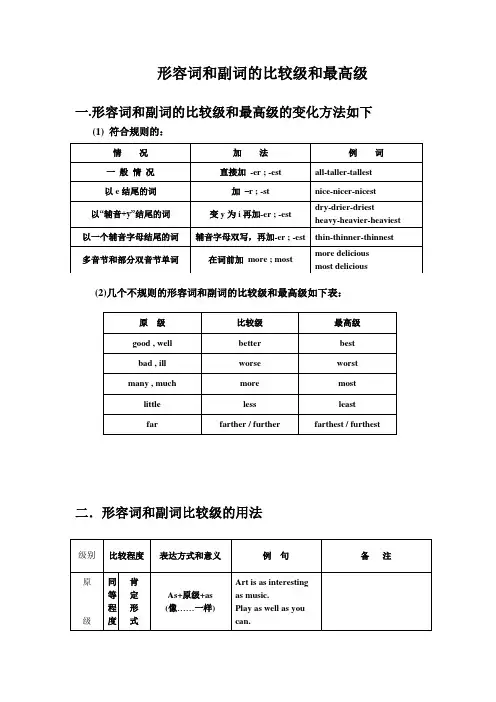
形容词和副词的比较级和最高级一.形容词和副词的比较级和最高级的变化方法如下(1) 符合规则的:(2)几个不规则的形容词和副词的比较级和最高级如下表:二.形容词和副词比较级的用法注意:有些形容词,如 dead, empty, round, sure, woolen 等受本身含义的限制,没有比较级。
例题解析1. He is ________ friends than I.A. much moreB. many moreC. very moreD. too more解析:后面有可数名词复数时,many的比较级形式为many more 修饰。
应选B.2. Which is the _________ country, Japan or Australia?A. more developedB. more developingC. most developedD. most developing解析:两者比较用比较级,表示"发达"用developed, 而developing 是"发展中的" 意思3. There were _______ shops in the city in 1982 than in 1990.A. littleB. fewC. fewerD. less解析:little 不能修饰可数名词,两者比较需用比较级,所以应选C.4. If you are not free today, come another day __________.A. tooB. soC. insteadD. yet解析:instead 作副词用时意为"代替,顶替",表示前面的事情没做,而是做了后面的事。
Instead一般位于句首。
应选C.5.He can't tell us ________, I think.A. important anythingB. anything importantC. important somethingD. something important.解析:不定代词与形容词联用需后置,否定句中应该用anything而不是something. 因此应选B6. The Huang River is the second __________ river in our country.A. longB. longerC. longestD. the longest解析:"定冠词the+ 序数词+ 形容词最高级" 表示"第几大……" 应选C.7. The light in the office wasn't ________for him to read.A. enough brightB. bright enoughC. brightlyD. enough brightly解析:enough修饰名词时可前可后,修饰形容词或副词时,要后置。
形容词和副词的比较级和最高级变化规则

形容词和副词的比较级和最高级变化规则形容词和副词的比较级和最高级是用来表示程度或大小上的比较,其变化规则如下:1.单音节词和部分双音节词: a. 比较级:在形容词或副词前加"er",如"fast"(快)的比较级是"faster"(更快)。
b. 最高级:在形容词或副词前加"est",如"fast"的最高级是"fastest"(最快)。
2.以"e"结尾的词: a. 比较级:在形容词或副词前加"r",如"large"(大)的比较级是"larger"(更大)。
b. 最高级:在形容词或副词前加"st",如"large"的最高级是"largest"(最大)。
3.以一个辅音字母加"y"结尾的词:a. 将结尾的"y"变为"i",再加上"er"或"est",如"heavy"(重)的比较级是"heavier"(更重),最高级是"heaviest"(最重)。
4.以重读闭音节结尾,且最后一个音节只有一个辅音字母:a.双写最后一个辅音字母,再加上"er"或"est",如"big"(大)的比较级是"bigger"(更大),最高级是"biggest"(最大)。
5.不规则变化形式: a. 有一些形容词和副词的比较级和最高级形式是不规则的,需要记忆。
例如,"good"(好)的比较级是"better"(更好),最高级是"best"(最好)。
形容词副词的比较级和最高级变化规则

形容词副词的比较级和最高级变化规则形容词和副词的比较级和最高级的变化规则如下:
1.一般规则:
比较级:在词尾加上-er,例如:big(大)→ bigger(更大)
最高级:在词尾加上-est,例如:big(大)→ biggest(最大)
注意:有些形容词和副词不符合一般规则,需要使用不规则比较级和
最高级形式,例如:good(好)→ better(更好)→ best(最好)
2.以“e”结尾的形容词和副词:
比较级:在词尾加上-r,例如:nice(好)→ nicer(更好)
最高级:在词尾加上-st,例如:nice(好)→ nicest(最好)
3.以“y”结尾的形容词和副词:
比较级:将“y”变为“i”,并在词尾加上-er,例如:happy(高兴)→ happier(更高兴)
最高级:将“y”变为“i”,并在词尾加上-est,例如:happy(高兴)→ happiest(最高兴)
4.以辅音字母加“y”结尾的形容词和副词:
比较级:在词尾加上-ier,例如:busy(忙)→ busier(更忙)
最高级:在词尾加上-iest,例如:busy(忙)→ busiest(最忙)
5.部分双音节及多音节形容词和副词:
比较级:在前面加上more
最高级:在前面加上most,例如:beautiful(美丽)→ most beautiful(最美丽)
6.不规则形容词和副词:
比较级和最高级的形式不按照规律变化,需要记忆特定形式,例如:good(好)→ better(更好)→ best(最好)
总之,形容词和副词的比较级和最高级变化规则是有规律可循的,但也存在一些不规则形式需要特别记忆。
英语中形容词副词的比较级和最高级
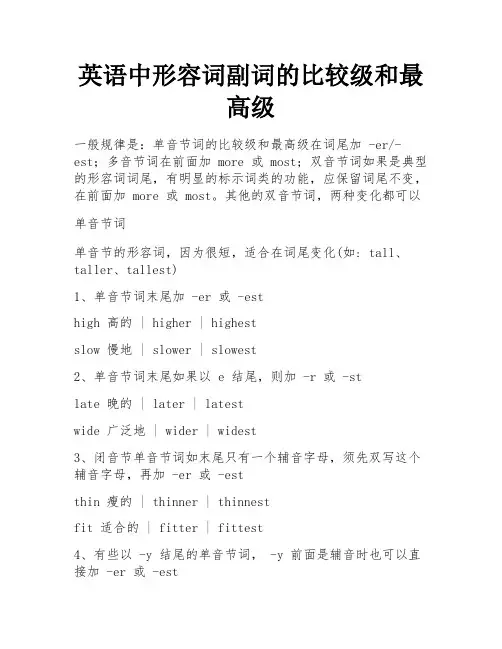
英语中形容词副词的比较级和最高级一般规律是:单音节词的比较级和最高级在词尾加 -er/-est;多音节词在前面加 more 或 most;双音节词如果是典型的形容词词尾,有明显的标示词类的功能,应保留词尾不变,在前面加 more 或 most。
其他的双音节词,两种变化都可以单音节词单音节的形容词,因为很短,适合在词尾变化(如: tall、taller、tallest)1、单音节词末尾加 -er 或 -esthigh 高的 | higher | highestslow 慢地 | slower | slowest2、单音节词末尾如果以 e 结尾,则加 -r 或 -stlate 晚的 | later | latestwide 广泛地 | wider | widest3、闭音节单音节词如末尾只有一个辅音字母,须先双写这个辅音字母,再加 -er 或 -estthin 瘦的 | thinner | thinnestfit 适合的 | fitter | fittest4、有些以 -y 结尾的单音节词, -y 前面是辅音时也可以直接加 -er 或 -estshy 害羞的 | shyer | shyestsly 狡猾的 | slyer | slyestwry 讽刺的 | wryer | wryest多音节词三个音节以上的多音节词已经很长,不适合再加词尾变化,因而在前面加 more 或 most,表示更(最)...,或者加 less 或least ,表示更(最)不...interesting 有趣的 | more interesting | most interestingimportant 重要的 | less important | least importantcarefully 认真地 | more carefully | most carefully双音节词双音节形容词很尴尬:不长不短,怎么判断?1、词尾是典型的形容词词尾,有明显的标示词类的功能,应保留词尾不变,在前面加 more 或 mostcrowded more crowded most crowdedloving more loving most lovinghelpful more helpful most helpfulfamous more famous most famousactive more active most active2、其他的双音节形容词,如果不是典型的形容词字尾,变化则无限制,两种变化都可以often oftener(more often) oftenest(most often)shallow shallower(more shallow) shallowest(most shallow)3、如果是 -y 结尾,这个长母音因为发音上的要求,要先变成短母音的 i,再加字尾变化,如:happy happier happiestlucky luckier luckiest二、不规则形式good/well | better | bestbad/ill/badly | worse | worstmany/much | more | mostlittle | less | leastfar | farther/further | farthest/furthestold | older/elder | oldest/eldest三、比较等级英语中形容词副词有三个比较等级,即原级、比较级和最高级1、原级(1) 表示程度相同,即“和...一样...”时用原级,常用"as... as" 结构It is as beautiful as paradise in Heaven. 这里如天堂般美丽This room is as broad as it is long. 那个房间长宽相等He is as handsome as John (is). 他和约翰一样英俊He studies as hard as John (does). 他和约翰一样努力(2) as...as... 引导的结构可采用倒装句型He studies as hard as John (does). = He studies as hard as does John.He is as handsome as John is. = He is as handsome as is John.(3) 否定的原级用 not as...as 或not so...as,二者区别不大You are not as tall as he. 你没有他高Guangzhou is not as clean as Shanghai. 广州没有上海那么干净I didn't do so well as I should. 我做得不如我应做得那么好(4) as/so... as... 结构前可以用 just、quite、almost、nearly、half 等词在程度上加以修饰This story was quite as interesting as we had thought. 这个故事和我们想的一样精彩The bike is not half so new as mine. 这辆自行车还没我的一半新She can read twice as fast as he does. 她的阅读速度比他快一倍John is not quite as good a student as his sister.连接词 as 表示这是组 as..as 的比较级。
形容词和副词比较级和最高级变化规则

形容词和副词比较级和最高级变化规则1.规则变化1 一般情况下;单音节或双音节的形容词或副词比较级+er ;最高级+est 如: clever-cleverer-cleverestfew-fewer-fewestsmall-smaller-smallest等..2 以e结尾的词;比较级+r;最高级+st 即可.. 如:nice-nicer-nicest cute-cuter-cutest large-larger-largest3 以辅音字母+y结尾的变y为i+er或est..如:easy-easier-easiest happy-happier-happiest再如:early; busy; heavy; dirty; lazy也如此..少数单音节词也是这样;如:pleased-more pleased-the most pleasedtired-more tired-the most tired4中读闭音节词双写后面的辅音比较级+er ;最高级+est如:big-bigger-biggest thin-thinner-thinnest2. 不规则变化:good —better — best well —better — bestbad-worse - worstmany / much — more — mostfar — farther —farthest 距离远far — further — furthest 程度深old — elder — eldest 长幼old — older —oldest 年龄Step 2 中考链接1. 比较级考点①比较级修饰问题a little; a bit; even; still; much; a lot; far 等可修饰比较级..e.g. Tom is a little taller than Jim.This book is much more interesting than that one.②同级比较e.g. The weather in Beijing is colder than that in Xi’an.Our school is bigger than yours.③ the + 比较级e.g. Lucy is the fatter of the two girls.④“a/an + 比较级” 表示“又一;再一”e.g. Lily has a doll; but she wants a bigger one.⑤隐性比较没有than的情况e.g. Who runs faster; Lucy or LilyYou’d better come earlier next time.He worked hard last term; but he works even harder this term.⑥越来越......a. 比较级 + and + 比较级b. the + 比较级 + 句子;the + 比较级 + 句子a. e.g. It’s getting colder and colder.The more you exercise; the better you are.2. 最高级考点说明:形容词的最高级前必须加the; 副词的最高级前省略the..①范围问题e.g. Tom is the tallest student in the class.Spring is the best season of the year.②“......之一”问题e.g. Beijing is one of the biggest cities in the world.③“the + 序数词 + 最高级”e.g. I think he is the second tallest boy in his class.3. 比较级和最高级的转换e.g. Tom is the tallest student in the class.= Tom is taller than any other student in the class.= Tom is taller than all the other students in the class.= No other students are taller than Tom.2. 同级比较① as + adj./adv. + ase.g. She is as thin as Lily.He writes as carefully as Linda.② not + as/so + adj./adv. + ase.g. Tony didn't run so fast as Carter中考真题1. Our family has bought a car so we can travel _____ than before.A. most easilyB. less easilyC. easilyD. more easily2. My father told me a story last night. It is ____ one I’ve ever heard.A. the funniestB. funniestC. funnierD. the funnier3. The _____ friends you have; the ____ you will be.A. more; happyB. many; happyC. more; happierD. many; happier4. When he heard a cry for help; he ran out as _______ as he could.A. hardlyB. quicklyC. finallyD. slowly5. This place is not big enoug h for Lucy’s birthday party. We should find a _____ one.A. bigB. smallC. biggerD. smaller。
形容词和副词的比较级和最高级(完美版)
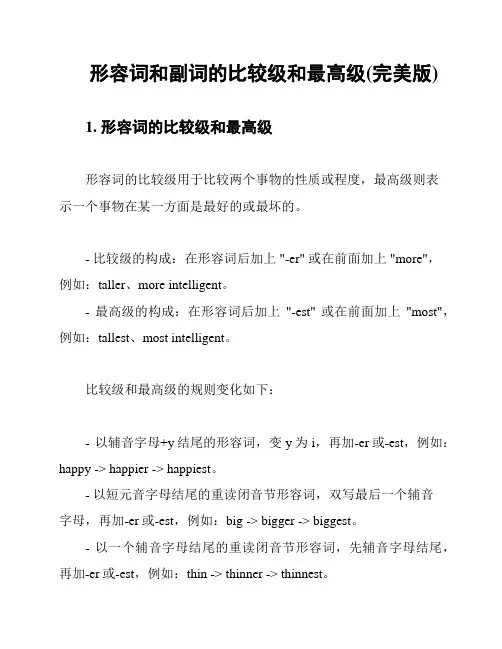
形容词和副词的比较级和最高级(完美版)1. 形容词的比较级和最高级形容词的比较级用于比较两个事物的性质或程度,最高级则表示一个事物在某一方面是最好的或最坏的。
- 比较级的构成:在形容词后加上 "-er" 或在前面加上 "more",例如:taller、more intelligent。
- 最高级的构成:在形容词后加上"-est" 或在前面加上"most",例如:tallest、most intelligent。
比较级和最高级的规则变化如下:- 以辅音字母+y结尾的形容词,变y为i,再加-er或-est,例如:happy -> happier -> happiest。
- 以短元音字母结尾的重读闭音节形容词,双写最后一个辅音字母,再加-er或-est,例如:big -> bigger -> biggest。
- 以一个辅音字母结尾的重读闭音节形容词,先辅音字母结尾,再加-er或-est,例如:thin -> thinner -> thinnest。
- 多音节和部分双音节形容词前加more或most,例如:beautiful -> more beautiful -> most beautiful。
2. 副词的比较级和最高级副词的比较级和最高级的构成方式与形容词类似,只是在形容词的基础上加上 "-ly" 构成副词。
- 比较级的构成:在副词后加上 "-er" 或在前面加上 "more",例如:faster、more quickly。
- 最高级的构成:在副词后加上 "-est" 或在前面加上 "most",例如:fastest、most quickly。
与形容词类似,副词的规则变化也遵循相同的规律。
形容词副词的比较级和最高级变化规则
形容词副词的比较级和最高级变化规则形容词和副词的比较级和最高级变化规则如下:
1. 一般情况下,在形容词和副词的原级后加-er构成比较级,加-est构成最高级。
例如:
原级:fast(快速的)
比较级:faster(更快的)
最高级:fastest(最快的)
原级:happy(快乐的)
比较级:happier(更快乐的)
最高级:happiest(最快乐的)
2. 如果形容词或副词的原级以字母e结尾,直接在原级后加-r构成比较级,加-st构成最高级。
例如:
原级:nice(好的)
比较级:nicer(更好的)
最高级:nicest(最好的)
3. 如果形容词或副词的原级以辅音字母+y结尾,先将y变为i,再加-er构成比较级,加-est构成最高级。
例如:
原级:funny(有趣的)
比较级:funnier(更有趣的)
最高级:funniest(最有趣的)
4.一些形容词及副词的比较级和最高级形式不规则,需要进行记忆。
例如:
原级:good(好的)
比较级:better(更好的)
最高级:best(最好的)
原级:bad(坏的)
比较级:worse(更差的)
最高级:worst(最差的)
原级:far(远的)
比较级:farther(更远的)
最高级:farthest(最远的)
总的来说,形容词和副词的比较级和最高级的变化规则大致为在原级后添加-er和-est,但也有一些特殊情况需要记住。
形容词副词原级比较级最高级用法
形容词副词原级比较级最高级用法形容词、副词都可以用比较级和最高级来表达程度上的差异。
1. 原级:形容词、副词本身的最高程度。
例如:big(大)、slow(慢)。
2. 比较级:表示两个事物之间的程度差别,通常用“比...更...”来表达,也可以使用不同的比较级形式,如“-er”或“more+形容词/副词”。
例如:bigger(更大的)、slower(更慢的)、moreinteresting(更有趣的)。
3. 最高级:表示三个或三个以上事物之间的程度差别,通常用“...最...”来表达,也可以使用不同的最高级形式,如“-est”或“most+形容词/副词”。
例如:biggest(最大的)、slowest(最慢的)、mostinteresting(最有趣的)。
要想正确使用形容词、副词的比较级和最高级,需要注意以下几点:1. 比较级只能用于两个事物之间比较,而最高级用于三个或以上的事物之间比较。
例如:She is taller than her sister.(她比她妹妹更高。
)/ He is the tallest in the class.(他班上最高的。
)2. 形容词、副词比较级和最高级在用法上有一些例外,如good (好)、well(好地)。
例如:good(好)--better(更好的)--best(最好的)/ well (好地)--better(更好地)--best(最好地)3. 一些形容词、副词的比较级和最高级形式是不规则的,需要记忆。
例如:good(好)--better(更好的)--best(最好的)/ bad (坏)--worse(更坏的)--worst(最坏的)/ little(小)--less (更小的)--least(最小的)。
4. 某些形容词、副词虽然有比较级和最高级形式,但在句子中不能与其它物品进行比较。
例如:unique(独一无二的)/ complete(完整的)/ excellent (卓越的)。
形容词和副词的比较级和最高级
一、形容词和副词的比较级和最高级1) 单音节形容词的比较级和最高级形式是在词尾加 -er 和 -est 构成。
great (原级) greater(比较级) greatest(最高级)2) 以 -e 结尾的单音节形容词的比较级和最高级是在词尾加 -r 和 -st 构成。
wide (原级) wider (比较级) widest (最高级)3)少数以-y, -er, -ow, -ble结尾的双音节形容词的比较级和最高级是在词尾加 -er 和 -est 构成。
clever(原级) cleverer(比较级) cleverest(最高级)4) 以 -y 结尾,但 -y 前是辅音字母的形容词的比较级和最高级是把 -y 去掉,加上-ier 和-est 构成.happy (原形) happier (比较级) happiest (最高级)5) 以一个辅音字母结尾其前面的元音字母发短元音的形容词的比较级和最高级是双写该辅音字母然后再加 -er和-est。
big (原级) bigger (比较级) biggest (最高级)6) 双音节和多音节形容词的比较级和最高级需用more 和 most 加在形容词前面来构成。
beautiful (原级)? difficult (原级)more beautiful (比较级) more difficult (比较级)most beautiful (最高级) most difficult (最高级)不规则变化原级比较级最高级good better bestmany more mostmuch more mostbad worse worstlittle less leastill worse worstfar farther(further) farthest(furthest)deep deeper deepesttall taller tallest形容词比较级的用法:形容词的比较级用于两个人或事物的比较,其结构形式如下:主语+谓语(系动词)+ 形容词比较级+than+ 对比成分。
形容词和副词的比较级和最高级
形容词的比较级和最高级,词形规则变化时分别在词尾加-er,-est。
1.一般单音节词和部分双音节词在词尾加-er(比较级)或-est(最高级)。
例如:great-greater-the greatest tall-taller-the tallest slow-slower-the slowest2.以不发音的e结尾的单音节词和少数以le结尾的双音节词只在词尾加-r或-st。
例如:nice-nicer-the nicest large-larger-the largest late-later-the latest3.以辅音字母+y结尾的双音节词,将词尾的y改为i,再加-er或-est。
例如:easy-easier-the easiest busy-busier-the busiest happy-happier-the happiest4.重读闭音节词,只有一个辅音字母结尾时,要双写该辅音字母,再加再加-er或-est。
例如:big-bigger-the biggest hot-hotter-the hottest thin-thinner-the thinnest5.部分双音节词和多音节词,在该词前面加more和the most构成比较级和最高级。
例如:interesting-more interesting-the most interestingbeautiful-more beautiful-the most beautiful补充:elder和eldest主要用于表示家庭成员之间的长幼关系,如:elder sister 姐姐elder brother 哥哥Mary is my elder sister. 玛丽是我的姐姐。
Alice is the eldest of the three children. 爱丽丝是三个孩子里最年长的。
older和oldest则用于表示年龄大小,如:Mark looks older than Jack. 马克看起来比杰克年龄大。