
六年级上册Unit One How can I get There
Where is the cineme?
Mike: Where is the Italian restaurant? Turn right here? Robin: No, turn left. Italian restaurant
[ɪ'tælɪən] [ˈrestərənt]
Crossing 十字路口
A to B of C 不填写
Goodbye
post office 邮局
[pəust ˈɔfis]
post 邮件 office 办公室
postcard
postman postmark postbox
明信片
投递员 邮戳 邮箱
bookstore 书店
['bʊkstɔ:(r)] book 书 + store 商店 shoe store 鞋店
food store 食品店
2、what+形容词+可数名词复数+主语+谓语!
3、what+形容词+不可数名词+主语+谓语!
Excuse me.和Sorry.的区别
Excuse me通常在说或做可能令人不悦的事情之前使用; Excuse me通常在要打扰别人或要打断别人谈话或要吸引别 人注意时使用. Sorry在说或做这种事情之后使用,表示歉意.
2. My school is _____ the post office. A next B near C in front
3. I want to see a film. I’m going to the ______ . A cinema B school C museum
4. Let’s go _____ home.
Excuse me. 和Sorry. 是日常会话中使用频率较高的客套话,它们都可译为“对不起”。 Excuse me.可用来引起别人注意,也可表示礼貌,意为“对不起、请问、打扰了、劳驾”等,它是在给别人添麻烦之前说 的话。通常用于下列场合: (1) 当你向陌生人问路时,先对人说:“Excuse me.”译为“劳驾、请问”。例如: Excuse me. Where is No. 1 Middle School? 请问,一中在哪里? (2) 当你向对方询问、了解有关情况时,先对人说Excuse me. 例如: Excuse me. Are you Miss Wang? 对不起,你是王小姐吗? (3) 当你向对方请求给予帮助时,Excuse me. 用于句首以示礼貌。例如: Excuse me. May I come in? 对不起,我可以进来吗? Excuse me. Can I sit here, please? 对不起,请问我可以坐在这里吗? Sorry. (=I'm sorry.)是最普通的道歉用语。通常用于表示由于某种过失或办不成某事的一种歉意。例如: -Are you Miss Zhao? 你是赵小姐吗? -No, I'm not. 不,我不是。 -Sorry. 对不起。 回答sorry时常用That's OK. / That's all right. / Not at all. / It doesn't matter. 等。例如: -I'm sorry, I'm late. 对不起,我迟到了。 -That's OK. 没关系。
How can I get to Zhongshan park?
You can go by the No. 15 bus.
询问“某地怎么去”基本句型是:
How can +主语 +to the cinema ? It’s over there.
转换为同义句:
apple store 苹果商店
hospital 医院
[ˈhɒspɪtl]
in hospital 住院
in the hospital 在医院
cinema 电影院
[ˈsɪnəmə] film movie
电影
go to the cinema see a film
看电影
Where is the cinema, please?
首字母填空。选择正确的句子补全对话。
1. It's n_________ to the library.
2. I’m going to the b_________ to buy some books this weekend
3. I usually go to the h___________ to see a doctor.
Sure.
Is the Thames far from here? Let’s go. No, it isn’t.
Excuse me, is there a cinema near here? 请问这附近有电影院吗?
Yes, there is. /No,there isn’t. 有./没有。
How can I get to the hospital? 我该怎样到达医院呢? How can I / we get there? 我/ 我们怎样到那? 回答 Turn right/ left at the ⋯ 在⋯ 地方向右/ 左转. 或 Go straight. 向前直走. 或 You can take the No.31 bus. 你可乘坐31 路公交车去。
turn left 向左转
go straight 直行
turn right 向右转
话题:日常活动(交通) 时态:一般现在时
How 引导的特殊疑问句,外出问路:
How can I get to + 目的地?--- You can go + 交通方式。 例: A: How can I get to Zhongshan park? B: You can go by the No. 15 bus.
4. ---Excuse me, w_________ is the cinema?
---Walk straight for three minutes.
5. Go s___________ for 5 minutes. You can see it.
1. -- _____ is the park? -- It’s near the bank. A Where B What C When
选择正确的答句
( )1.Is there a cinema near here? ( )2.Where is the hospital? ( )3.Let’s go. ( )4.How can I get to the hospital? A. Yes, there is. B. It's in front of the museum. C. Go straight, then turn right. D. OK.
It’s next to the bookstore.
此问句是由特殊疑问词 where 引导的一个特殊疑问句, where 此句中near是表示位置的介词, 意为“旁边,附近” ,意为“在哪里, 其同义句是: 到 哪里”, 用来询问地点, 放在句子的开头。询问“某人或某物在哪里”的基本句 It ’s next to the door.它在门的旁边。表示位置的短语: 型是:“ Where +is/are+ 主语? ”, where is 后接名词或代词的单数形式, next to the bookstore挨着书店 where are 后接名词或代词的复数形式。 near the hospital 在医院附近 表示地点的词: museum博物馆, post office 邮局, bookstore书店, cinema电影院, near the post office在邮局附近 hospital 医院 restaurant 餐馆bank银行bus stop公交车站lake 湖library 图书馆zoo 动 over there 在那边 物园school 学校 park 公园garden花园hotel 旅馆
on Dongfang Street在东方大街上 in front of the school 在学校前面
Where is the post office?
It’s next to the school.
询问“某人或某物在哪里”基本句型是:
Where +is/are+ 主语? It ’s next to ……
I want to buy a postcard. Is it far from here? Yes, it is. / No, it isn ’ t. I’m hungry. I see.
I don’t know.I’ll ask. A talking robot! What a great museum! Excuse me. Can you help me?
Unit One
How can I get There?
science museum
post office
bookstore
cinema
hospital
science museum 科学博物馆
[ˈsaiəns mju:ˈziəm]
art museum 艺术博物馆 history museum 历史博物馆
以what引导的感叹句,一般有三种形式: 1、what+a/an+形容词+可数名词单数+主语+谓语! What a great museum! 多么宏伟的一座博物馆啊! What good students they are! 他们是多么好的学生啊! What cool water(this is)! 多清凉的水啊! What an interesting film! 多么有趣的一部电影啊! What beautiful flowers! 多么漂亮的花啊! What bad weather it is! 多么糟糕的天气啊!
PEP 英语六年级上册 unit1 How can I get there重点知识
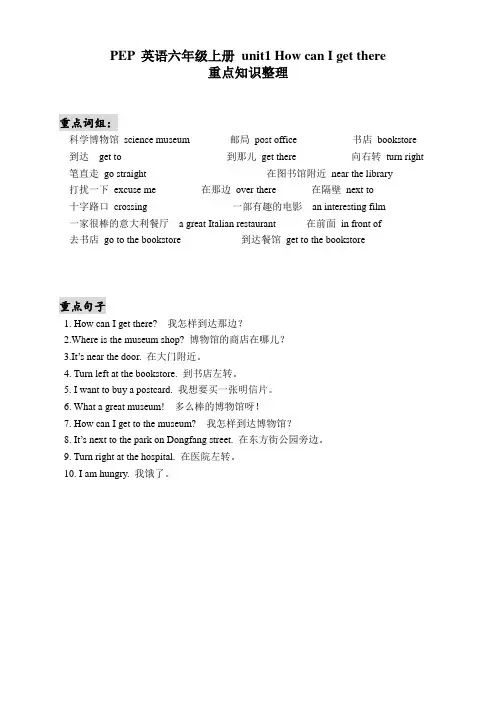
PEP 英语六年级上册unit1 How can I get there
重点知识整理
重点词组:
科学博物馆science museum 邮局post office 书店bookstore 到达get to 到那儿get there 向右转turn right 笔直走go straight 在图书馆附近near the library
打扰一下excuse me 在那边over there 在隔壁next to
十字路口crossing 一部有趣的电影an interesting film
一家很棒的意大利餐厅 a great Italian restaurant 在前面in front of
去书店go to the bookstore 到达餐馆get to the bookstore
重点句子
1. How can I get there? 我怎样到达那边?
2.Where is the museum shop? 博物馆的商店在哪儿?
3.It’s near the door. 在大门附近。
4. Turn left at the bookstore. 到书店左转。
5. I want to buy a postcard. 我想要买一张明信片。
6. What a great museum! 多么棒的博物馆呀!
7. How can I get to the museum? 我怎样到达博物馆?
8. It’s next to the park on Dongfang street. 在东方街公园旁边。
9. Turn right at the hospital. 在医院左转。
10. I am hungry. 我饿了。
Unit 1 How can I get there?Part A人教PEP版(三起)英语六年级上册

I don’t know. I’ll ask. Excuse me, sir. Man: Wow! A talking robot! What a great museum!
Robin: Where is the post office? Man:
Robin: It’s next to the museum.
Unit 1 How can I get there?
Part A Let's try & Let's talk
人教版.小学六年级.英语
Revision
behind
in
near
in front of
under
next to
Let's match.
Let's watch and say
Let's guess
A talking bird! A swimming pig!
A flying duck! A running baby!
What a great museum! 多棒的一个博物馆呀!
What a tall man!
What a clever boy! What a beautiful girl! What a big classroom !
Ask for directions(问路指路)
park 后
zoo 前
museum
school
library
post office
课
—It’s in front of the post office. A. What B. Where C. When
擦车比赛:方位介词选一选。
B
人教版六年级上册英语第一单元Unit1《How can I get there?》重要知识点总结
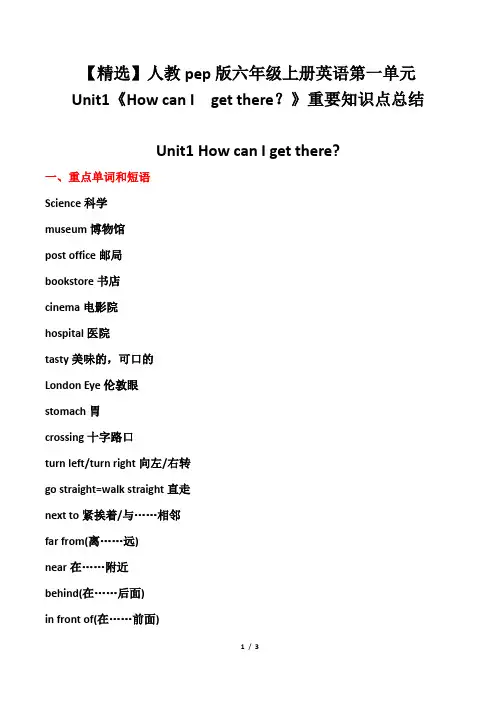
【精选】人教pep版六年级上册英语第一单元Unit1《How can I get there?》重要知识点总结Unit1 How can I get there?一、重点单词和短语Science科学museum博物馆post office邮局bookstore书店cinema电影院hospital医院tasty美味的,可口的London Eye伦敦眼stomach胃crossing十字路口turn left/turn right向左/右转go straight=walk straight直走next to紧挨着/与……相邻far from(离……远)near在……附近behind(在……后面)in front of(在……前面)between…and…(在…和…之间)二、重点句子1.How do you go to school? 你是怎样去上学的?2.where is the restaurant? 餐馆在哪里?3. Usually I go to school on foot. 我通常走路去上学。
4. Sometimes I go by bike. 有时候我骑自行车去。
5.问路之前,出于礼貌,我们要说“Excuse me”与后面的句子要用标点符号隔开。
6.Look at the traffic lights, remember the traffic rules. 看着交通灯,记住交通规则。
7.Stop at a red light.Wait at a yellow light. Go at a green light.红灯停。
黄灯等一等。
绿灯行。
8.Red means stop, yellow means wait, green means go. 红色的意思是停止,黄色的意思是等待,绿色的意思是通行。
9.How can I get to the park? 我该怎样到达公园呢?10.You can go by the No.15 bus. 你可以坐15路公交车去。
人教版六年级上册 Unit 1 How can I get there
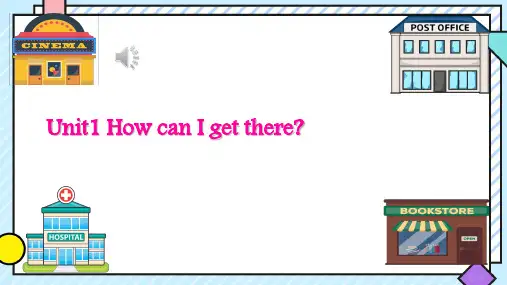
I want to see a robot. Where should I go?
Let's guess
I'm hungry. Where should I go?
Part A Let's learn
science museum
post office
bookstore
cinema
hospital
Turn left and you can see the Beihai Park.左转你可以看见北海公园
Let's answer
You are in a car. Which of these can help you find a place ?
map
compass
BDS
中国北斗卫星导航系统(BeiDou Navigation Satellite System,BDS)是中国自行研制的全球卫星导航系统。是继
How 和what引导的感叹句,一般情况下可以相互转换,转换后意义不变。 What an interesting story it is !=How interesting the story is !多么有趣的则故事
知识点五:如何表达给某人某物
固定句型:give sb. sth.“给某人某物”,= give sth.to sb.
_____.
AA. there is
B. there isn’t C. it is
Review
turn left
go straight
turn right
crossing
How can I get to the cinema?
我怎样到达电影院?
A:How can I get to the cinema?
Unit1HowcanIgetthere?(讲义)人教PEP版英语六年级上册(1)
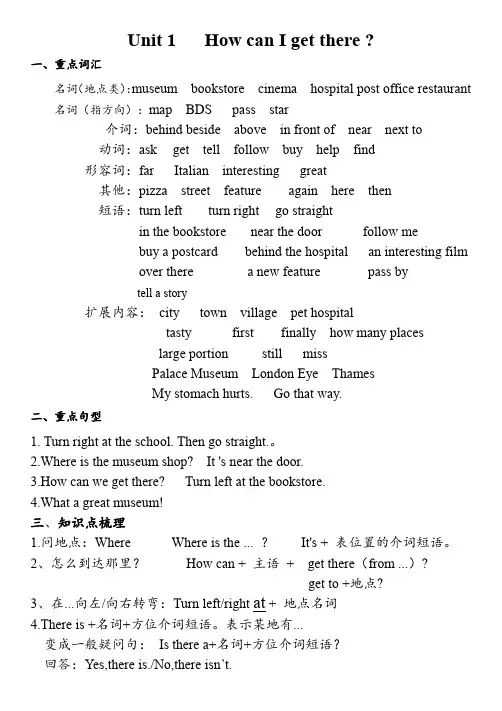
Unit 1 How can I get there ?一、重点词汇名词(地点类):museum bookstore cinema hospital post office restaurant 名词(指方向):map BDS pass star介词:behind beside above in front of near next to动词:ask get tell follow buy help find形容词:far Italian interesting great其他:pizza street feature again here then短语:turn left turn right go straightin the bookstore near the door follow mebuy a postcard behind the hospital an interesting filmover there a new feature pass bytell a story扩展内容:city town village pet hospitaltasty first finally how many placeslarge portion still missPalace Museum London Eye ThamesMy stomach hurts. Go that way.二、重点句型1. Turn right at the school. Then go straight.。
2.Where is the museum shop? It 's near the door.3.How can we get there? Turn left at the bookstore.4.What a great museum!三、知识点梳理1.问地点:Where Where is the ... ?It's + 表位置的介词短语。
人教PEP版六年级英语上册Unit-1《How-can-I-get-there》说课稿
人教PEP版六年级英语上册Unit 1《How can I get there》说课稿Unit 1 How can I get there? A Let’s learn说课稿Good morning, dear judges. I’m the second examinee. It’s my great honor to have this opportunity to interpret my teaching design here. My topic is Unit 1 How can I get there? According to the New Curriculum Standard, I will interpret my teaching design from the following parts, such as teaching aims, teaching procedures and so on.I. The analysis of teaching materialThe first part in my presentation is the analysis of teaching material. (Firstly, please allow me to talk about the analysis of teaching material) This lesson is chosen from part A Let’s learn of Unit 1 of PEP Primary English, book 7, and the main topic of this lesson is to ask and answer the way. After learning this lesson, students will be able to know how to help others find the way. Therefore, this lesson plays an important role in their studying.II. The analysis of studentsAfter analysis of teaching material, let’s move to the next step: analysis of students. Students are the subject of our class. Students of this period are active and curious. They are interested in new things after learning English for 3 years. They have some basic English background knowledge, so the teacher should attach more importance to the communication with them.III. The analysis of teaching aimsAccording to the New Curriculum Standard in English, I set the teaching aims as follows: Firstly, knowledge aim: students can understand the basic meaning of some new words, such as crossing, turn left, turn right, go along and so on.Secondly, ability aim: students can use some simple expressions and target language to communicate in daily life.Lastly, emotional aim: students are willing to help others after class.IV. The analysis of teaching key point and difficult pointThen, I want to put forward the key point and the difficult point of this lesson. Students can apply these new words and sentences naturally and appropriately.V. The analysis of teaching methodsNow I want to talk about the teaching methods. Communicative Approach, Tasked-based Teaching Method and TPR Teaching Method will be adopted in this lesson to active my students. VI. The analysis of teaching aidsTo help students learn better. I will mainly use pictures and tape recorder as teaching aids. VII. The analysis of teaching procedureNext, let’s focus on the most important part of this lesson, the analysis of teaching procedures. It consists of the following steps: warming-up, pre-listening, while-listening, post-listening, summary and homework.Now, let’s go to the first step,warming-up. In this step, I will divide students into groups Monkey 1 and Monkey 2, the one who gets banana first is the winner. Then I will sing a song named penguin’s Game. After listening, students should tell me what they have heard in this song. Then I will tell students this song is about directions. This song is closed related to the topic of this lesson. Besides, It’s very interesting for students. They would be very glad to pay attention to this lesson.Then, let’s come to the second step, pre-listening. I will draw a map and some buildings on the blackboard. Imagine I’m a foreigner and get lost. Let students help me find my way. Then I will show them some new words such as, turn left, turn right, crossing and go straight through many actions. And a word game will be arranged. It’s a bomb game. If I say a word, students should read after me quickly. But when I read the boom word, students should be quiet. Through this activity, students will be attracted and know how to read and use the new words.Now let’s talk about next period, while-listening. There are 3 activities in this step. The first activity is extensive listening. I’ll ask students to listen to the tape, then find out the main idea of this conversation. The second activity is intensive listening. I will ask students to listen to the tape once again. And try to find the answer, “Where is the Italian restaurant?” The third activity is to read. Students should read after the tape and pay attention to their pronunciation. Through this section, students could develop the ability of grasp detailed information and cooperation spirit. They will join more class activities actively.Next step is post-listening. Some students will be asked to come the front of the class, and do some actions. The other students will guess the meaning of these new words. Then I will pick one place in the map like bookstore. Ask students “Where’ the bookstore?” Students will tell me theway in their own words according to the map. Role play is very attractive for students. Students would like to take part in it very actively. By this, students can improve their speaking skills and understand how to use these sentences to communicate with others.Now, let’s move on to the summary and homework. At the end of the class, I’ll make a summary together with students. The purpose of this step is to help students recall what we have learned today. And deepen their impression of the key words and sentences. The homework is to be a guide. Tell their friends the way to the house with the target language. Next class, I’ll invite some students to share it. It can develop their independent learning ability and provide more opportunities to practice after class. At last, I will attract students attention and tell students the winner of this class.VIII. The analysis of blackboard designThe last part is my blackboard design. These are the new words and phrases. These are key sentences. It’s very clear and simple for students. And the pictures can attract students attention. That’s all for my presentation. Thank you for your listening.。
人教PEP版英语六年级上册Unit 1《How can i get there》说课稿
人教PEP版英语六年级上册Unit 1《How can I get there》说课稿一. 教材分析《人教PEP版英语六年级上册Unit 1 How can I get there》是一篇关于日常交际用语的课文。
本节课主要介绍了如何询问和描述路线和方向。
通过本节课的学习,学生能够掌握日常生活中常用的交通方式,如“walk”, “bus”, “bike”等,并能够运用所学知识询问和描述到达某地的路线。
教材内容贴近学生生活实际,有利于激发学生学习兴趣,提高学生英语应用能力。
二. 学情分析六年级的学生已经具备了一定的英语基础,对日常交际用语有一定的了解。
但是,学生在实际运用英语进行交际时,还存在一定的困难。
因此,在教学过程中,教师需要关注学生的个体差异,充分调动学生的积极性,引导他们积极参与课堂活动,提高他们的英语交际能力。
三. 说教学目标1.知识目标:学生能够掌握日常生活中常用的交通方式,如“walk”,“bus”, “bike”等,并能够运用所学知识询问和描述到达某地的路线。
2.能力目标:学生能够听懂、说出生日的日常交际用语,提高英语交际能力。
3.情感目标:通过本节课的学习,学生能够增强自信心,更加热爱英语学习。
四. 说教学重难点1.重点:学生能够掌握日常生活中常用的交通方式,并能够运用所学知识询问和描述到达某地的路线。
2.难点:学生能够在实际情景中灵活运用所学知识进行交际。
五. 说教学方法与手段1.情景教学法:通过设置真实的生活场景,让学生在实际情景中学习、运用英语。
2.交际法:引导学生积极参与课堂交际活动,提高他们的英语交际能力。
3.任务型教学法:通过完成具体任务,让学生在实践中掌握英语知识。
4.多媒体教学手段:运用多媒体课件、视频等资源,丰富教学内容,提高学生的学习兴趣。
六. 说教学过程1.热身(5分钟):教师与学生进行简单的英语对话,营造轻松愉快的课堂氛围。
2.引入(10分钟):教师通过展示一幅地图,引导学生谈论自己熟悉的路线和方向,为新课的学习做好铺垫。
人教版小学英语六年级上册《Unit1HowcanIgetthere》单元说课稿(6课时)说课稿
人教版小学英语六年级上册《Unit 1 How can I get there 》单元说课稿(6课时)说课稿一. 教材分析《Unit 1 How can I get there》是人教版小学英语六年级上册的第一个单元,本单元主要围绕“如何到达某个地方”的主题展开。
通过本单元的学习,学生能够掌握有关交通工具和方向的词汇,如bus, trn, car, left, right, strght等,并能够运用这些词汇描述自己的路线和询问他人的路线。
同时,学生还能够学会使用can引导的一般疑问句,询问他人能否做某事。
本单元的内容与学生的生活实际紧密相连,有利于激发学生的学习兴趣和积极性。
二. 学情分析六年级的学生已经具备了一定的英语基础,能够听懂并运用简单的英语进行交流。
然而,部分学生在英语学习上存在一定的困难,如词汇量不足、语法知识不扎实等。
此外,学生在学习过程中容易受到母语的干扰,导致英语表达不准确。
针对这些情况,教师在教学过程中应注重激发学生的学习兴趣,调动他们的积极性,同时加强对学生英语基础知识的巩固和指导。
三. 说教学目标1.知识目标:学生能够掌握有关交通工具和方向的词汇,如bus, trn,car, left, right, strght等;能够运用这些词汇描述自己的路线和询问他人的路线;学会使用can引导的一般疑问句,询问他人能否做某事。
2.能力目标:学生能够在图片或情景的帮助下,正确使用本单元所学词汇和句型进行简单的交流,达到“能交流”的目标。
3.情感目标:培养学生热爱生活、积极乐观的人生态度,使他们更加关注身边的事物,学会用英语描述生活中的场景。
四. 说教学重难点1.重点:学生能够掌握有关交通工具和方向的词汇,如bus, trn, car,left, right, strght等;能够运用这些词汇描述自己的路线和询问他人的路线;学会使用can引导的一般疑问句,询问他人能否做某事。
2.难点:学生能够在实际情景中灵活运用本单元所学词汇和句型进行交流,同时注意语音、语调的准确表达。
Unit1HowcanIgetthere?BReadandwrite(课件)人教PEP版英语六年级上
Draw on a map and tell how you go to the cinema from your home.
Tips for pronunciation
Listen, look and say.
Robin has
Follow
Is it
Where is the
Practice
Read these sentences in correct tones.
How to go
go straight and turn left turn right and turn right
While-reading
Task3; fill in the blanks.
Wu Binbin and his friends want to eat some pizza in an Italian restaurant. They _g_o_s_tr_a_ig_h_t_ and _t_u_rn_l_e_ft_a_t_t_h_e_b_oo_k_s_to_r.e They _t_u_rn_r_ig_h_t__ and then turn right again.
While-reading
Task4; Read picture4,and then answer the questions.
Which word means “奏效,起作用“?
__w_o_r_k___________
Post-reading
Listen and imitation
Robin: We’re in front of the cinema. Let’s go straight and turn left at the
It’s Robin’s new feature.
人教版(PEP)六年级上册《Unit1 How can I get there Part A》教案
人教版(PEP)六年级上册《Unit1 How can I get there Part A》教案一. 教材分析《Unit1 How can I get there Part A》是人教版(PEP)六年级上册的第一单元,主要介绍如何去某个地方。
本节课主要通过学习不同的交通工具和询问路线的方式,让学生能够用英语进行简单的日常交流。
教材内容丰富,插图生动,符合学生的兴趣。
二. 学情分析六年级的学生已经具备了一定的英语基础,能够听懂并运用简单的英语进行交流。
但是,对于如何描述路线和交通工具的用法,学生可能还比较陌生。
因此,在教学过程中,需要注重引导学生理解和运用新知识。
三. 教学目标1.知识目标:学生能够掌握表示交通工具的单词和询问路线的句型;2.能力目标:学生能够用英语描述如何去某个地方;3.情感目标:培养学生热爱生活,乐于探索的情感。
四. 教学重难点1.重点:学生能够正确拼读和书写单词“bus, trn, subway, on, off, go,stop”等;2.难点:学生能够运用句型“How can I get there?”和“Go strght, thenturn left/right.”等进行实际交流。
五. 教学方法1.情境教学法:通过设置生活中的场景,让学生在实际情境中学习和运用英语;2.游戏教学法:通过趣味游戏,激发学生的学习兴趣,巩固所学知识;3.任务型教学法:通过完成具体任务,培养学生实际运用英语的能力。
六. 教学准备1.准备相关的图片和地图,用于展示交通工具和路线;2.准备录音机和磁带,用于播放教材中的听力材料;3.准备单词卡片,用于引导学生进行词汇学习。
七. 教学过程1.导入(5分钟)教师通过提问学生“How do you come to school?”等方式,引导学生谈论交通工具,为新课的学习做好铺垫。
2.呈现(10分钟)教师展示相关的图片和地图,引导学生说出表示交通工具的单词,并板书在黑板上。