
电子商务英文参考文献
附件1:外文原文(复印件)The Development of E-commerceA perfect marketMay 13th 2004From The Economist print edition E-commerce is coming of age, says Paul Markillie, but not in the way predicted in the bubble yearsWhen the technology bubble burst in 2000, the crazy valuations for online companies vanished with it, and many businesses folded. The survivors plugged on as best they could, encouraged by the growing number of internet users. Now valuations are rising again and some of the dotcoms are making real profits, but the business world has become much more cautious about the internet’s potential. The funny thing is that the wild predictions made at the height of the boom—namely, that vast chunks of the world economy would move into cyberspace—are, in one way or another, coming true.The raw numbers tell only part of the story. According to America’s Department of Commerce, online retail sales in the world’s biggest market last year rose by 26%, to $55 billion. That sounds a lot of money, but it amounts to only 1.6% of total retail sales. The vast majority of people still buy most things in the good old “bricks-and-mortar” world.But the commerce department’s figures deal with only part of the retail industry. For instance, they exclude online travel services, one of the most successful and fastest-growing sectors of e-commerce. InterActiveCorp (IAC), the owner of expedia. and hotels., alone sold $10 billion-worth of travel last year—and it has plenty of competition, not least from airlines, hotels and car-rental companies, all of which increasingly sell online.Nor do the figures take in things like financial services, ticket-sales agencies,pornography (a $2 billion business in America last year, according to Adult Video News, a trade magazine), online dating and a host of other activities, from tracing ancestors to gambling (worth perhaps $6 billion worldwide). They also leave out purchases in grey markets, such as the online pharmacies that are thought to be responsible for a good proportion of the $700m that Americans spent last year on buying cut-price prescription drugs from across the border in Canada.And there is more. The commerce department’s figures include the fees earned by internet auction sites, but not the value of goods that are sold: an astonishing $24 billion-worth of trade was done last year on eBay, the biggest online auctioneer. Nor, by definition, do they include the billions of dollars-worth of goods bought and sold by businesses connecting to each other over the internet. Some of these B2B services are proprietary; for example, Wal-Mart tells its suppliers that they must use its own system if they want to be part of its annual turnover of $250 billion.So e-commerce is already very big, and it is going to get much bigger. But the actual value of transactions currently concluded online is dwarfed by the extraordinary influence the internet is exerting over purchases carried out in the offline world. That influence is becoming an integral part of e-commerce.To start with, the internet is profoundly changing consumer behaviour. One in five customers walking into a Sears department store in America to buy an electrical appliance will have researched their purchase online—and most will know down to a dime what they intend to pay. More surprisingly, three out of four Americans start shopping for new cars online, even though most end up buying them from traditional dealers. The difference is that these customers come to the showroom armed with information about the car and the best available deals. Sometimes they even have computer print-outs identifying the particular vehicle from the dealer’s stock that they want to buy.Half of the 60m consumers in Europe who have an internet connection bought products offline after having investigated prices and details online, accordingto a study by Forrester, a research consultancy (see chart 1). Different countries have different habits. In Italy and Spain, for instance, people are twice as likely to buy offline as online after researching on the internet. But in Britain and Germany, the two most developed internet markets, the numbers are evenly split. Forrester says that people begin to shop online for simple, predictable products, such as DVDs, and then graduate to more complex items. Used-car sales are now one of the biggest online growth areas in America.People seem to enjoy shopping on the internet, if high customer-satisfaction scores are any guide. Websites are doing ever more and cleverer things to serve and entertain their customers, and seem set to ta ke a much bigger share of people’s overall spending in the future.This has enormous implications for business. A company that neglects its website may be committing commercial suicide. A website is increasingly becoming the gateway to a company’s brand, products and services—even if the firm does not sell online. A useless website suggests a useless company, and a rival is only a mouse-click away. But even the coolest website will be lost in cyberspace if people cannot find it, so companies have to ensure that they appear high up in internet search results.For many users, a search site is now their point of entry to the internet. The best-known search engine has already entered the lexicon: people say they have “Googled” a compan y, a product or their plumber. The search business has also developed one of the most effective forms of advertising on the internet. And it is already the best way to reach some consumers: teenagers and young men spend more time online than watching television. All this means that search is turning into the internet’s next big battleground as Google defends itself against challenges from Yahoo! and Microsoft.The other way to get noticed online is to offer goods and services through one of the big sites that already get a lot of traffic. Ebay, Yahoo! and Amazon arebecoming huge trading platforms for other companies. But to take part, a company’s products have to stand up to intense price competition. People check online prices, compare them with those in their local high street and may well take a peek at what customers in other countries are paying. Even if websites are prevented from shipping their goods abroad, there are plenty of web-based entrepreneurs ready to oblige.What is going on here is arbitrage between different sales channels, says Mohanbir Sawhney, professor of technology at the Kellogg School of Management in Chicago. For instance, someone might use the internet to research digital cameras, but visit a photographic shop for a hands-on demo nstration. “I’ll think about it,” they will tell the sales assistant. Back home, they will use a search engine to find the lowest price and buy online. In this way, consumers are “deconstructing the purchasing process”, / says Professor Sawhney. They are unbundling product information from the transaction itself.It is not only price transparency that makes internet consumers so powerful; it is also the way the net makes it easy for them to be fickle. If they do not like a website, the y swiftly move on. “The we b is the most selfish environment in the world,” says Daniel Rosensweig, chief operating officer of Yahoo! “People want to use the internet whenever they want, how they want and for whatever they want.”Yahoo! is not alone in defining its strategy as working out what its customers (260m unique users every month) are looking for, and then trying to give it to them. The first thing they want is to become better informed about products and prices. “We operate our business on that belief,” says Jeff Bezos, Amazon’s chief executive. Amazon became famous for books, but long ago branched out into selling lots of other things too; among its latest ventures are health products, jewellery and gourmet food. Apart from cheap and bulky items such as garden rakes, Mr Bezos thinks he can sell most things. And so do the millions of people who use eBay.And yet nobody thinks real shops are finished, especially those operating inniche markets. Many bricks-and-mortar bookshops still make a good living, as do flea markets. But many record shops and travel agents could be in for a tougher time. Erik Blachford, the head of IAC’s travel side and boss of Expedia, the biggest internet travel agent, thinks online travel bookings in America could quickly move from 20% of the market to more than half. Mr Bezos reckons online retailers might capture 10-15% of retail sales over the next decade. That would represent a massive shift in spending.How will traditional shops respond? Michael Dell, the founder of Dell, which leads the personal-computer market by selling direct to the customer, has long thought many shops will turn into showrooms. There are already signs of change on the high street. The latest Apple and Sony stores are designed to display products, in the full expectation that many people will buy online. To some extent, the online and offline worlds may merge. Multi-channel selling could involve a combination of traditional shops, a printed catalogue, a home-shopping channel on TV, a phone-in order service and an e-commerce-enabled website. But often it is likely to be the website where customers will be encouraged to place their orders.One of the biggest commercial advantages of the internet is a lowering of transaction costs, which usually translates directly into lower prices for the consumer. So, if the lowest prices can be found on the internet and people like the service they get, why would they buy anywhere else?One reason may be convenience; another, concern about fraud, which poses the biggest threat to online trade. But as long as the internet continues to deliver price and product information quickly, cheaply and securely, e-commerce will continue to grow. Increasingly, companies will have to assume that customers will know exactly where to look for the best buy. This market has the potential to become as perfect as it gets.附件2:外文资料翻译译文日趋完善的电子商务当2000年科技泡沫爆发时,备受炒作的网上公司好象随之蒸发了,众多的网上贸易也被迫流产。
电子商务领域英文论文原文
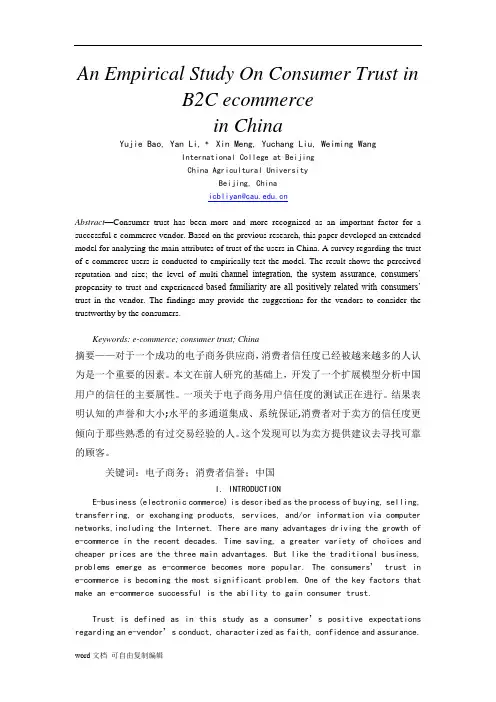
An Empirical Study On Consumer Trust inB2C ecommercein ChinaYujie Bao, Yan Li,﹡Xin Meng, Yuchang Liu, Weiming WangInternational College at BeijingChina Agricultural UniversityBeijing, Chinaicbliyan@Abstract—Consumer trust has been more and more recognized as an important factor for a successful e-commerce vendor. Based on the previous research, this paper developed an extended model for analyzing the main attributes of trust of the users in China. A survey regarding the trust of e-commerce users is conducted to empirically test the model. The result shows the perceived reputation and size; the level of multi-channel integration, the system assurance, consumers’ propensity to trust and experienced-based familiarity are all positively related with consumers’ trust in the vendor. The findings may provide the suggestions for the vendors to consider the trustworthy by the consumers.Keywords: e-commerce; consumer trust; China摘要——对于一个成功的电子商务供应商,消费者信任度已经被越来越多的人认为是一个重要的因素。
电子商务参考文献
电子商务参考文献电子商务是指通过互联网等电子手段进行商业活动的一种商业模式。
它已经成为了现代企业发展的重要方式,为企业带来了巨大的商机和发展空间。
在电子商务的发展过程中,有许多重要的文献被引用和参考,本文将介绍一些经典的电子商务参考文献。
1. Porter, M. E. (2001). Strategy and the Internet. Harvard Business Review.迈克尔·波特是战略管理领域的著名学者,他在这篇经典的文章中强调,互联网并非一个威胁,而是一个改变商业规则的机会。
文章提出了互联网给各行业带来的竞争优势机会,并以5个力量模型来分析企业在互联网时代的竞争策略。
2. Hoffman, D. L., & Novak, T. P. (1996). Marketing in hypermedia computer-mediated environments: Conceptual foundations. Journal of Marketing, 60(3), 50-68.霍夫曼和诺瓦克是互联网营销领域的重要学者,他们的文章对电子商务中的市场营销进行了深入研究。
文章概括了电子商务环境中的市场特点,提出了网络媒体环境中的互动和个性化定制的特点,为企业在网络营销中提供了指导。
3. Rayport, J. F., & Sviokla, J. J. (1994). Managing in the Marketspace. Harvard Business Review.雷波特和斯维奥克拉是电子商务战略领域的重要学者,他们的文章讨论了电子商务对市场的影响和企业管理的变革。
文章强调企业需要从传统的市场到互联网时代的市场空间进行管理转变,并提出了一些实践指导和策略建议。
4. Li, T., & Li, X. (2011). Information technology and firm profitability: Mechanisms and empirical evidence. MIS Quarterly, 35(4), 1167-1188.李彤和李旭是电子商务领域的重要学者,他们的文章通过实证研究揭示了信息技术对企业盈利能力的影响机制。
电子商务毕业论文参考文献
电子商务毕业论文参考文献电子商务毕业论文参考文献随着互联网的快速发展,电子商务成为了当今社会中不可或缺的一部分。
电子商务的兴起给传统商业模式带来了巨大的冲击,也为企业提供了更广阔的发展空间。
在撰写电子商务毕业论文时,参考文献的选择是非常重要的。
本文将从不同的角度介绍一些值得参考的文献,以帮助毕业生更好地进行研究。
一、电子商务的发展历程1. Rappa, M. (2000). Business models on the web: Managing the digital enterprise. Journal of Electronic Commerce Research, 1(1), 75-85.这篇文章详细介绍了电子商务的发展历程,从传统商业模式到互联网时代的商业模式转变。
作者通过分析不同的商业模式,探讨了电子商务对企业的影响和挑战。
2. Turban, E., King, D., & Lee, J. (2015). Electronic commerce: A managerial and social networks perspective. Springer.这本书是电子商务领域的经典教材,全面介绍了电子商务的概念、技术和管理。
作者通过实际案例和研究成果,解析了电子商务的发展趋势和未来挑战。
二、电子商务平台的建设与管理1. Osterwalder, A., & Pigneur, Y. (2010). Business model generation: A handbook for visionaries, game changers, and challengers. John Wiley & Sons.这本书提供了一个实用的框架,帮助企业构建和管理电子商务平台。
作者通过分析不同的商业模式,介绍了如何创新和优化电子商务平台,以实现企业的商业目标。
2. Chaffey, D., & Smith, P. R. (2017). Digital marketing excellence: Planning, optimizing and integrating online marketing. Taylor & Francis.这本书详细介绍了数字营销的策略和技术,帮助企业在电子商务平台上实现市场营销的最佳实践。
电子商务英文参考文献
The Development of E-commerceA perfect marketMay 13th 2004From The Economist print edition E-commerce is coming of age, says Paul Markillie, but not in the way predicted in the bubble yearsWhen the technology bubble burst in 2000, the crazy valuations for online companies vanished with it, and many businesses folded、The survivors plugged on as best they could, encouraged by the growing number of internet users、Now valuations are rising again and some of the dotcoms are making real profits, but the business world has become much more cautious about the internet’s potential、The funny thing is that the wild predictions made at the height of the boom—namely, that vast chunks of the world economy would move into cyberspace—are, in one way or another, coming true、The raw numbers tell only part of the story、According to America’s Department of Commerce, online retail sales in the world’s biggest market last year rose by 26%, to $55 billion、That sounds a lot of money, but it amounts to only 1、6% of total retail sales、The vast majority of people still buy most things in the good old “bricks-and-mortar” world、But the commerce department’s figures deal with only part of the retail industry、For instance, they exclude online travel services, one of the most successful and fastest-growing sectors of e-commerce、InterActiveCorp (IAC), the owner of expedia、com and hotels、com, alone sold $10 billion-worth of travel last year—and it has plenty of competition, not least from airlines, hotels and car-rental companies, all of which increasingly sell online、Nor do the figures take in things like financial services, ticket-sales agencies, pornography (a $2 billion business in America last year, according to Adult Video News, a trade magazine), online dating and a host of other activities, from tracing ancestors to gambling (worth perhaps $6 billion worldwide)、They also leave out purchases in grey markets, such as the online pharmacies that are thought to be responsible for a good proportion of the $700m that Americans spent last year on buying cut-price prescription drugs from across the border in Canada、And there is more、The commerce department’s figures include the fees earned by internetauction sites, but not the value of goods that are sold: an astonishing $24 billion-worth of trade was done last year on eBay, the biggest online auctioneer、Nor, by definition, do they include the billions of dollars-worth of goods bought and sold by businesses connecting to each other over the internet、Some of these B2B services are proprietary; for example, Wal-Mart tells its suppliers that they must use its own system if they want to be part of its annual turnover of $250 billion、So e-commerce is already very big, and it is going to get much bigger、But the actual value of transactions currently concluded online is dwarfed by the extraordinary influence the internet is exerting over purchases carried out in the offline world、That influence is becoming an integral part of e-commerce、To start with, the internet is profoundly changing consumer behaviour、One in five customers walking into a Sears department store in America to buy an electrical appliance will have researched their purchase online—and most will know down to a dime what they intend to pay、More surprisingly, three out of four Americans start shopping for new cars online, even though most end up buying them from traditional dealers、The difference is that these customers come to the showroom armed with information about the car and the best available deals、Sometimes they even have computer print-outs identifying the particular vehicle from the dealer’s stock that they want to buy、Half of the 60m consumers in Europe who have an internet connection bought products offline after having investigated prices and details online, according to a study by Forrester, a research consultancy (see chart 1)、Different countries have different habits、In Italy and Spain, for instance, people are twice as likely to buy offline as online after researching on the internet、But in Britain and Germany, the two most developed internet markets, the numbers are evenly split、Forrester says that people begin to shop online for simple, predictable products, such as DVDs, and then graduate to more complex items、Used-car sales are now one of the biggest online growth areas in America、People seem to enjoy shopping on the internet, if high customer-satisfaction scores are any guide、Websites are doing ever more and cleverer things to serve and entertain their customers, and seem set to take a muc h bigger share of people’s overall spending in the future、This has enormous implications for business、 A company that neglects its website may becommitting commercial suicide、A website is increasingly becoming the gateway to a company’s brand, products and services—even if the firm does not sell online、A useless website suggests a useless company, and a rival is only a mouse-click away、But even the coolest website will be lost in cyberspace if people cannot find it, so companies have to ensure that they appear high up in internet search results、For many users, a search site is now their point of entry to the internet、The best-known search engine has already entered the lexicon: people say they have “Googled” a company, a product or their plumber、The search business has also developed one of the most effective forms of advertising on the internet、And it is already the best way to reach some consumers: teenagers and young men spend more time online than watching television、All this means that search is turning into the internet’s next big battleground as Google defends itself against challenges from Yahoo! and Microsoft、The other way to get noticed online is to offer goods and services through one of the big sites that already get a lot of traffic、Ebay, Yahoo! and Amazon are becoming huge trading platforms for other companies、But to take part, a company’s products have to stand up to intense price competition、People check online prices, compare them with those in their local high street and may well take a peek at what customers in other countries are paying、Even if websites are prevented from shipping their goods abroad, there are plenty of web-based entrepreneurs ready to oblige、What is going on here is arbitrage between different sales channels, says Mohanbir Sawhney, professor of technology at the Kellogg School of Management in Chicago、For instance, someone might use the internet to research digital cameras, but visit a photographic shop for a hands-on demonstration、“I’ll think about it,” they will tell the sales assistant、Back home, they will use a search engine to find the lowest price and buy online、In this way, consumers are “deconstructing the purchasing process”, says Professor Sawhney、They are unbundling product information from the transaction itself、It is not only price transparency that makes internet consumers so powerful; it is also the way the net makes it easy for them to be fickle、If they do not like a website, they swiftly move on、“The web is the most selfish environment in the world,” says Daniel Rosensweig, chief operatingofficer of Yahoo! “People want to use the internet whenever they want, how they want and for whatever they want、”Yahoo! is not alone in defining its strategy as working out what its customers (260m unique users every month) are looking for, and then trying to give it to them、The first thing they want is to become better informed about products and prices、“We operate our business on that belief,” says Jeff Bezos, Amazon’s chief executive、Amazon became famous for books, but long ago branched out into selling lots of other things too; among its latest ventures are health products, jewellery and gourmet food、Apart from cheap and bulky items such as garden rakes, Mr Bezos thinks he can sell most things、And so do the millions of people who use eBay、And yet nobody thinks real shops are finished, especially those operating in niche markets、Many bricks-and-mortar bookshops still make a good living, as do flea markets、But many record shops and travel agents could be in for a tougher time、Erik Blachford, the head of IAC’s travel side and boss of Expedia, the biggest internet travel agent, thinks online travel bookings in America could quickly move from 20% of the market to more than half、Mr Bezos reckons online retailers might capture 10-15% of retail sales over the next decade、That would represent a massive shift in spending、How will traditional shops respond? Michael Dell, the founder of Dell, which leads the personal-computer market by selling direct to the customer, has long thought many shops will turn into showrooms、There are already signs of change on the high street、The latest Apple and Sony stores are designed to display products, in the full expectation that many people will buy online、To some extent, the online and offline worlds may merge、Multi-channel selling could involve a combination of traditional shops, a printed catalogue, a home-shopping channel on TV, a phone-in order service and an e-commerce-enabled website、But often it is likely to be the website where customers will be encouraged to place their orders、One of the biggest commercial advantages of the internet is a lowering of transaction costs, which usually translates directly into lower prices for the consumer、So, if the lowest prices can be found on the internet and people like the service they get, why would they buy anywhere else?One reason may be convenience; another, concern about fraud, which poses the biggest threat to online trade、But as long as the internet continues to deliver price and productinformation quickly, cheaply and securely, e-commerce will continue to grow、Increasingly, companies will have to assume that customers will know exactly where to look for the best buy、This market has the potential to become as perfect as it gets、。
电子商务专业外文文献
本科毕业论文外文文献及译文文献、资料题目:CUSTOMER RELATIONSHIPMANAGEMENT文献、资料来源:加勒斯特经济学院文献、资料发表(出版)日期:2000.3.25院(部):专业:班级:姓名:学号:指导教师:翻译日期:外文文献:CUSTOMER RELATIONSHIP MANAGEMENT1. IntroductionIn the last decade, the majority of the companies were preoccupied with production, recession, mergers, new technologies and business regulation. Romania’s accession in the European Union will bring many advantages for further development, together with membership in a Common Market with common policies on product regulation, and freedom of movement for all the four factors of production (goods, services, capital and labor). This means that Romanian companies will compete with other companies from the EU directly in their home market. European companies are more flexible and mobile and will put a high pressure on the local companies in order to produce better products, launch better offers and services and orientate more towards their customers. High revenue equals important customer is a classic rule when the company organises its customer policy. “An important customer brings a gross amount of money for our enterprise” has become a reflex for many companies a broad and perhaps in Romania, too. But is this always true, or do we need more information than a simple figure reported at the end of the year?2. Marketing information systemA winning company is more productive in acquiring and retaining customers, to expand its clientele (Kotler, 2003). This company improves the value of the customers by reducing the rate of defection, increasing the longevity of customer Management & marketing relationship, making low-profit customers more profitable or terminating them etc. Gathering information on the actual or potential marketplace not only allows the organisation to monitor trends and issues concerning its current customers, but also helps it identify and profile potential customers and new markets, to keep track of its competition, their strategies, tactics and future plans (Brassington and Pettitt,2003). In order to collect and organize a high quantity of diverse information, the enterprises started to build marketing information systems. There are, mainly, a set of procedures and methods by which pertinent, timely and accurate information is continually gathered, sorted, analysed, evaluated, stored and distributed for the use of marketing decisionmakers (Zikmund and D´Amico,1993). The marketing information system includes data from external and internal sources (sales records, customer records, marketing communications, and sales force information). The focus on the customer and the integration of the marketing function helps the company to create customer databases with comprehensive information about individual customers or prospects.3. Customer relationship managementCustomer Relationship Management has been around for the last 30 years, but it became very important when companies changed their attitude towards marketing function. Nowadays, the cross-functional approach to marketing requires an organizational culture and climate that encourages collaboration and cooperation between departments. People within the business must understand their role in serving customers, internal or external one. CRM builds on the principles of relationship marketing and recognizes that customers are a business asset and not simply a commercial audience, implies the structuring of the company from functions to processes, information are used proactively rather than reactively and develops the ne-to-one marketing approaches (Payne, 2006).When defining CRM, we must first explain the difference between customer acquisition and customer retention. The two concepts have different drivers. Attracting customers has become very difficult these days, when people are harder to please. They are smarter, price conscious and sensitive, more demanding, less forgiving, and they are approached by many more competitors with equally good or better offers (Kotler,2003). Companies focus more on sales analysis, customer segmentation, advertising, merchandising and campaign management. The more difficult part is keeping the customers. According to Bruhn, a customer is satisfied when the comparison between offer and consumption fulfils his/her expectations, after he/she accepts the company, trusts it and exhibits a positive attitude towards it, becomes loyal to that company. In this situation, the customer talks favourably about the company and about its products, pays less attention to competing brands and is less sensitive to price, which turns transactions into routine (Bruhn, 1999). With customer retention, the company must pay attention to service satisfaction and trust in Customer relationship management the organization and its staff. Some companies believe that if a customer complaints the problem will be solved, but 96% ofunsatisfied customers don’t complain and go to another company. Therefore, Customer Relationship Management is the mechanism for retaining customers (Russell-Jones, 2003). Mainly CRM allows the company to understand who their customer is, isolate the best customer (those with whom you desire to have long-standing relationships), create relationships stretching over time and involving multi-interactions, manage the relationship to mutual advantage, seek to acquire more of those “best” customers. Inputs like marketing strategy, customer base, products, and regulation, competitors and staff skills are synthesized in a CRM programme which creates outputs as customer service, customer retention, higher share of wallet, customer referral, more predictable revenues streams, improved profitability, lower costs and better compliance (Russell-Jones, 2003).4. Developing a strategy in customer relationship managementBecause CRM is a cross-functional activity and large companies have thousands and millions of customers, the need for a strategic framework is very high. The dimensions of a CRM strategy are mainly focused on defining the following topics:- object of the customer relationship management – the company has three options: focusing on the company itself, on a brand or on the distributor;- target segment – the company usually sets priorities between different customer segments, it defines strategic customers based on the portfolio analyses, factors as revenue, length of the relationship, income, collaboration with the customer. These are its analysis criteria;- ways of retaining the customers –customers’ satisfaction is in the centre of all the decisions, but customers retention can also become a central issue through contractual clauses, such as service, leasing and warranty;- choosing the instruments of CRM – the company combines the instruments of the 4P´s with focus on the customer;- intensity and timing of the CRM decisions –show when and how should the company introduce different instruments; programmes can last from one day to one week, or from three month to two years;- cooperation within the CRM programme – sometimes the company must cooperate with other partners from the distribution channel, mainly between producer and wholesaler and retail.5. Instruments of customer relationship managementThe communication policy plays an important role in the instruments mix. It follows two objectives: first, to build a permanent dialogue with the customer in order to stabilize or change its expectations, and second, to counteract influences after consumption. The main CRM instruments within the communication policy are: Direct-Mail is material distributed through the postal service to the recipients’ home or business address to promote a product or service. In CRM the mailed issue can vary from a simple letter to a catalogue, and its sending will always occur at a particular moment in customer’s life (birthday, invitation for an event). It must incorporate sticky gadgets to increase their chances of being opened and read; Newsletters are distributed to customers for free and contain information about new products, offers for special events and others; Fidelity cards (store cards) are an important tool in gathering information about customer behaviour. By accumulating points of fidelity, the customer can benefit from different special offers; Clients club designates a concept which has grown in parallel with the fidelity cards. Its main forms are VIP-Club, Fan-Club, Product-Interest-Club, and Lifestyle-Club. The club represents an opportunity for the company to make offers in accordance with the social status, acceptance, prestige and expectations of its customers;Telemarketing allows companies to undertake marketing research and is highly measurable and accountable; the number of positive and negative responses are easily recorded and monitored. It provides for interaction, is flexible and permits immediate feed-back. Online-marketing includes many forms such as on-line advertising, on-line sales promotions, on-line direct marketing, on-line public relations, one-line personal selling. The medium used is the internet and the main instrument is the email. Virtual promotions are cheaper than hard copy versions, but the challenge is to drive traffic to your company’s Web site. Event-marketing takes place in three main areas: the product (here, it focuses on increasing sales), the corporation (for developing a corporate body) and the community (to make a difference in the life of the local community) (Bruhn, 1999& Fill, 2002).The price policy can be thought about in various ways when building a CRM programme: discounts for special customers, underselling or matching competitors, loyalty refunds, bundling items together and offering overall prices. Although price is not a measure of inherent value received, it is often used by customers as a benchmark, ignoring any other features or differences.Key factors in the product policy are the product itself, with quality, design, technical features, packaging and service management which includes lifelong warranty, price warranty or a customer telephone line. An active management in the distribution policy can focus on the customer or on the distribution channel. The producer evaluates the activity of the distribution partner and Customer relationship management intervenes when needed. The focus on the customers is realised through a Key Account Management which develops programmes for special customers.6. Customer relationship management in financial servicesFinancial services differ from many other industries. This can be seen particularly in Romania, where 40 commercial banks fight for a population of 21 million citizens. They cover the whole spectrum of customers from individuals to partnerships, institutions, corporations and governments. As a result, it can be very difficult to focus on single markets. Customers are often in two positions: they may have a deposit and savings accounts, but also loans and overdrafts. They are very service focused, they sell only intangibles. Financial services require processing billions of transactions worldwide and they are one of the heaviest regulated industries in the world (Rusell-Jones, 2003).The customers in the financial services are better informed, are switching channels, and seem to be more demanding of service, and used to change. The market is also highly competitive and new entrants are coming with diverse products and approaches.The industry of financial services in Romania has a very high potential and registers every year high growth rates. Till now, the location in a major city of the country with a population around 300.000 people was an advantage of the business and a success factor. Now the battlefield has moved in the small towns. The competition became tougher; banks began to develop and to introduce new products. Some experts say that a weakness of the banking sector is market segmentation. There is lots of information about customers, but it seems that banks prefer to focus on clients with large savings accounts. The main banks in Romania, as BRD, BCR, ING, and HVB-Tiriac announced for the year 2005 an increase in the number of the private banking clients. These are mainly customers with accounts between 50.000 and 100.000 Euros, they benefit of private consultancy, special interest rates, commissions, and special insurances. Customers have also a word to say about their bank. A market study made by DeadalusConsulting revealed that the customer profile for banking services is: person aged between 45-55 years, with higher or middle education. The most utilized service is the bank card for salaries payment (32,6%). Next, savings accounts (10,2%), credits for personal needs (11,1%), credits for buying electronics (9,2%) and auto leasing. The best grades were received by Raiffeisen Bank (8,83), BCR (8,58) and BRD Societe Generale (8,57). A customer’s criteria when choosing a bank are the trust in the bank, the environment in the branch, the quality of the staff, the advice they receive, the best interest rate they can receive, the information about the credit costs, and the conditions for obtaining a credit. A successful service provided by the majority of the banks is internet banking. It allows clients to save time and money, without going to the bank, 24 of 24 from inside or abroad. The access is free of charge or very cheap, and includes all kinds of activities from money transfer, payment orders, currency exchange, payment of current bills, external payments etc. The rate of penetration is still low, ranking between 10% and 30% of the customers in one middle bank.7. ConclusionsRomanian companies must focus in the future on the Customer Relationship Management and try to turn a “susceptible” client into a “partner”, to transform people who once needed their product/service, or occasional business partners into supporters and advocates and, eventually, into loyal partners that “sell” on the behalf of the company. Companies must create a permanent dialogue with their customers, and fight for them, because the clientele is not given for free. Customers that were price sensitive show now a higher interest in quality, service and behaviour of staff, and a company which concentrated on a price strategy should check how prepared its rivals are for a competition in the aforementioned fields. Customer Relationship Management increases its flexibility and adaptability to the market, in a world of capricious clients.中文译文:客户关系管理1.介绍在过去的十年中,大多数企业正在忙于生产,经济衰退,合并,新技术和商业管理。
电子商务参考文献
电子商务参考文献随着互联网的蓬勃发展和技术的迅速进步,电子商务在世界范围内正在成为一种日益重要的商业模式。
电子商务的兴起不仅深刻地改变了我们的生活方式,也对传统商业模式带来了革命性的冲击。
为了更好地理解和掌握电子商务的发展趋势、挑战和机遇,许多学者和专家们进行了大量的研究,并出版了一系列的参考文献。
本文将介绍一些有关电子商务的经典参考文献,以供学者和从业者参考。
1. Internet Marketing: Strategy, Implementation, and Practice(互联网营销:战略、实施与实践)作者:Dave Chaffey出版年份:2019年这本书是互联网营销领域的经典之作,全面介绍了互联网营销的策略、实施和实践。
书中涵盖了众多互联网营销的关键概念和技术,如搜索引擎优化(SEO)、社交媒体营销和内容营销等。
对于电子商务从业者来说,这本书是一本不可或缺的指南,可帮助他们构建有效的互联网营销策略。
2. E-commerce 2019: Business, Technology, and Society(2019年电子商务:商业、技术与社会)作者:Kenneth C. Laudon, Carol Traver出版年份:2019年这本书定位于大学本科和研究生的教材,全面介绍了电子商务的商业、技术和社会方面。
作者通过案例研究和实地调研,深入探讨了电子商务的发展趋势、商业模式、电子支付、安全性和隐私等重要话题。
对于对电子商务进行研究或者希望了解电子商务的学者和从业者来说,这本书是一本权威的参考资料。
3. Electronic Commerce: A Managerial and Social Networks Perspective (电子商务:管理和社交网络视角)作者:Efraim Turban, David King, Jae Kyu Lee, Ting-Peng Liang, Deborrah C. Turban出版年份:2015年这本书从管理和社交网络的视角,探讨了电子商务的关键问题和新兴趋势。
电子商务毕业外文文献(本科)
本科毕业论文外文文献及译文文献、资料题目:Distribution to users from alogistics base shipping method 文献、资料来源:网络文献、资料发表(出版)日期:2012。
7院(部):商学院专业: 电子商务班级:姓名:学号:指导教师:翻译日期:外文文献:Distribution to users from a logistics base shipping methodAbstract: Logistics is the company's 'third profit source',while at the end of the logistics of distribution, logistics and economic efficiency has to improve, optimize,improve the logistics system,improve service, reduce costs and other functions in the logistics system to occupy an important position。
Keywords:Efficient Logistics And Distribution Trends Of The Importance Of Features Distribution of transport and other logistics activities,or constitute a combination of integrated logistics services activities。
Distribution of the 'distribution’ includes the requirements of the order by the user,sorting,picking, loading, storage, handling and other activities, one of the 'free' in the transport process is in the 'secondary transport’, ’Feeder' or 'transport terminal', starting and ending point of the logistics base to the user。
电子商务参考文献
电子商务参考文献参考文献 1. Son, J.-Y., and Benbasat, I. Organizational buyers' adoption and use of B2B electronic marketplaces: Efficiency- and legitimacy-oriented perspectives. Journal of Management Information Systems, 24, 1 (2007), 55-99. 2. 3. 4. 5. Grewal, R., Comer, J.M., and Mehta, R. An investigation into the antecedents of organizational 蔡斌. 基本B2B 与深度B2B 电子商务采纳意图影响因素比较研究. 复旦大学, 2006. 翟春娟. B2B 电子市场采纳的影响因素研究. 南开大学, 2009. Zhu, K., and Kraemer, K.L. Post-adoption variations in usage and value of E-Business by participation in business-to-business electronic markets. The Journal of Marketing, 65, 3 (2001), 17-33. organizations: Cross-country evidence from the retail industry. Information Systems Research, 16, 1 (2005), 61-84. 6. 7. 8. 9. Iacovou, C.L., Benbasat, I., and Dexter, A.S. Electronic data interchange and small organizations: Malhotra, A., Gosain, S., and El Sawy, O.A. Leveraging standard electronic business interfaces to Bala, H., and Venkatesh, V. Assimilation of interorganizational business process standards. Chwelos, P., Izak Benbasat, and Dexter., A.S. Research report: Empirical test of an EDI adoption Adoption and impact of technology. MIS Quarterly, 19, 4 (1995), 465-485. enable adaptive supply chain partnerships. Information Systems Research, 18, 3 (2007), 260-279. Information Systems Research, 18, 3 (2007), 340-362. model. Information Systems Research, 12, 3 (2001), 304-321.10. Teo, H.H., Wei, K.K., and Benbasat, I. Predicting intention to adopt interorganizational linkages: An institutional perspective. MIS Quarterly, 27, 1 (2003), 19-49. 11. Son, J.-Y., Narasimhan, S., and Riggins, F.J. Effects of relational factors and channel climate on EDI usage in the customer-supplier relationship. Journal ofManagement Information Systems, 22, 1 (2005), 321-353. 12. Chen, P.Y., and Hitt, L.M. Measuring switching costs and the determinants of customer retention in Internet-enabled businesses: A study of the online brokerage industry. Information Systems Research, 13, 3 (2003), 255-274. 13. Cyr, D. Modeling Web site design across cultures: Relationships to trust, satisfaction, and e-loyalty. Journal of Management Information Systems, 24, 4 (2008), 47-72. 14. Riggins, F.J., Kriebel, C.H., and Mukhopadhyay, T. The growth of interorganizational systems in the presence of network externalities. Management Science, 40, 8 (1994), 984-998. 15. Wang, E.T.G., and Seidmann, A. Electronic data interchange: Competitive externalities and strategic implementation policies. Management Science, 41, 3 (1995), 401-419. 16. Yao, Y., Dresner, M., and Palmer, J. Private network EDI vs. Internet electronic markets: A direct comparison of fulfillment performance. Management Science, 55, 5 (2009), 843-852. 17. Malone, T.W., Yates, J., and Benjamin, R.I. Electronic market and electronic hierarchies Communications of the ACM, 30, 6 (1987), 484-497. 18. Davis, F.D. Perceived Usefulness, Perceived Ease of Use, and User Acceptance of Information Technology. MIS Quarterly, 13, 3 (1989), 318. 19. Moon, J.W., and Kim, Y.G. Extending the TAM for a World-Wide-Web context. Information & Management, 38, 4 (2001), 217-230. 20. Venkatesh, V. A Theoretical Extension of the Technology Acceptance Model. Management Science, 46, 2 (2000), 186,119. 21. V enkatesh, V., Morris, M.G., Davis, G.B., and Davis, F.D. User Acceptance Of Information 16 *本研究受阿里巴巴青年学者支持计划资助(Ali-2010-A-9) Technology: Toward A Unified View. MIS Quarterly, 27, 3 (2003), 425. 22. Rogers, E.M. Diffusion of innovations (4th Edition). New York: Free Press, 1995. 23. O'Callaghan, R., Kaufmann, P.J.,and Konsynski, B.R. Adoption correlates and share effects of electronic data interchange systems in marketing channels. Journal of Marketing, 56, 2 (1992), 45. 24. Premkumar, G., and Ramamurthy, K. Implementation of electronic data interchange: An innovation diffusion perspective. Journal of Management Information Systems, 11, 2 (1994), 157-186 25. Katz, M.L. Technology Adoption in the presence of network externalities. Journal ofPolitical Economy, 94, 4 (1986), 822-841. 26. Zhu, K., Kraemer, K.L., Gurbaxani, V., and Xin Xu, S. Migration to Open-Standard Interorganizational Systems: Network Effects, Switching Costs, and Path Dependency. MIS Quarterly, 30, Special Issue (2006), 515-539. 27. DiMaggio, P.J., and Powell, W.W. The iron cage revisited: Institutional isomorphism and collective rationality in organizational fields. American Sociological Review, 48, 2 (1983), 147-160. 28. Dyer, J.H., and Singh, H. The relational view: Cooperative strategy and sources of interorganizational competitive advantage. Academy of Management Review, 23, 4 (1998), 660-679. 29. Chau, P.Y.K., and Tam, K.Y. Factors affecting the adoption of open systems: An exploratory study. MIS Quarterly, 21, 1 (1997), 1-24. 30. Tornatzky, L., and Fleischer, M. The process of technological Innovation. Lexington, MA: Lexington Books, 1990. 31. Alba, J., Lynch, J., Weitz, B., Janiszewski, C., Lutz, R., Sawyer, A., and Wood, S. Interactive home shopping: consumer, retailer, and manufacturer incentives to participate in electronic marketplaces. The Journal of Marketing, 61, 3 (1997), 38-53.32. Peterson, R.A., Balasubramanian, S., and Bronnenberg, B.J. Exploring the implications of the Internet for consumer marketing. Journal of the Academy of Marketing Science, 25, 4(1997), 329-346. 33. Gefen, D., and Straub, D. The relative importance of perceived ease of use in IS adoption: a study of e-commerce adoption. Journal of the Association for Information Systems, 1, 8 (2000), 1-28. 34. Pavlou, P.A., and Fygenson, M. Understanding and predicting electronic commerce adoption: An extension of the theory of planned behavior. Management Information Systems Quarterly, 30, 1 (2006), 115. 35. Ives, B., and Learmonth, G.P. The information system as a competitive weapon. Communications of the ACM, 27, 12 (1984), 1201. 36. Choudhury, V., and Karahanna, E. The relative advantage of electronic channels: a multidimensional view. MIS Quarterly, 32, 1 (2008), 179-200. 37. Steinfield, C., Bouwman, H., and Adelaar, T. The dynamics of click-and-mortar electronic commerce: opportunities and management strategies. International Journal of Electronic Commerce, 7, 1 (2002), 93-119. 38. Williamson, O.E. The Economics of Organization: Journal of Sociology (1981). 39. Liang, T.P., and Huang, J.S. An empirical study on consumer acceptance of products in electronic markets: a transaction cost model. Decision Support Systems, 24, 1 (1998), 29-43. 40. Levi, M., Kleindorfer, P.R., and Wu, D.J. Codifiability, relationship-specific information technology investment, and optimal contracting. Journal of Management Information Systems, 20, 2 (2003), 77-98. 41. T an, J., KatherineTyler, and Manica, A. Business-to-business adoption of eCommerce in China. 17 The Transaction Cost Approach. American *本研究受阿里巴巴青年学者支持计划资助(Ali-2010-A-9) Information&Management (2007), 332–351. 42. Molla, A., and Licker, P.S. eCommerce adoption in developing countries: a modeland instrument. Information & Management (2005), 877–899. 43. Teo, T.S.H., and Ranganathanb, C. Adopters and non-adopters of business-to-business electronic commercein Singapore. Information & Management (2004), 89–102. 44. Ray, G., Wu, D., and Konana, P. Competitive environment and the relationship between IT and vertical integration. Information Systems Research, 20, 4 (2009), 585. 45. Venkatesh, V., and Ramesh, V. Web and wireless site usability: Understanding differences and modeling use. MIS Quarterly, 30, 1 (2006), 181-205. 46. Agarwal, R., and Venkatesh, V. Assessing a firm's web presence: A heuristic evaluation procedure for the measurement of usability. Information Systems Research, 13, 2 (2002), 168-186.47. Palmer, J.W. Web site usability, design, and performance metrics. Information Systems Research, 13, 2 (2002), 151-167. 48. McKinney, V., Kanghyun, Y., and Zahedi, F.M. The measurement of web-customer satisfaction: An expectation and disconfirmation approach. Information Systems Research, 13, 3 (2002), 296-315.49. Devaraj, S., Fan, M., andKohli, R. Antecedents of B2C channel satisfaction and preference: Validating e-commerce metrics. Information Systems Research, 13, 3 (2003), 316-333. 50. Premkumar, G. A meta-analysis of research on information technology implementation in small business. Journal of Organizational Computing and Electronic Commerce, 13, 2 (2003), 91-121. 51. Thong, J.Y.L. An integrated model of information systems adoption in small businesses. Journal of Management Information Systems, 15, 4 (1999), 214. 52. Chau, P.Y.K., and Hui, K.L. Determinants of small business EDI adoption: An empirical investigation. Journal of organizational computing and electronic commerce, 11, 4 (2001), 229 - 252. 53. Ramamurthy, K., Premkumar, G., and Crum, M.R. Organizational and interorganizational determinants of EDI diffusion and organizational performance: A causal model. Journal of Organizational Computing & Electronic Commerce, 9,3 (1999), 253-285. 54. Hart, P.J., and Saunders, C.S. Emerging electronic partnerships: Antecedents and dimensions of EDI use from the supplier's perspective. Journal of Management Information Systems, 14,4 (1998), 87-111. 55. Pavlou, P.A. Institution-based trust in interorganizational exchange relationships: the role of online B2B marketplaces on trust formation. The Journal of Strategic Information Systems, 11, 3-4 (2002), 215-243.中小企业电子商务使用模式及影响因素分析: 中小企业电子商务使用模式及影响因素分析: 文献综述及未来研究展望徐赟丁婕曾红华陈冬宇经济信息工程学院, 西南财经大学【摘要】中小企业对电子商务的采纳与使用一直以来都吸引着众多研究者的兴趣, 但以往大量文献都仅仅局限于研究采纳或采纳的意图, 很少有文章具体分析了这些企业是如何使用电子商务的不同服务,以及什么因素造成了这样的不同.为了探索这方面潜在的研究前景,本论文通过对以往电子商务采纳与使用文献的分析,总结了以往研究的对象,背景,理论及相关发现.在上述分析基础上,我们提出了下一步研究的展望和建议.理论上,本文指明了中小企业电子商务使用模式研究的潜在方向, 从而为进一步的具体的使用模式及影响因素分析做好铺垫.实践上,本研究将有助于电子商务服务商针对不同行为的企业提供更为精准,有效, 便捷的服务,从而争取吸纳更多潜在中小企业客户,推动电子商务应用的广度和深度. 【关键词】中小企业,B2B 电子商务,组织行为1 *本研究受阿里巴巴青年学者支持计划资助(Ali-2010-A-9) Analysis of small and medium enterprises' e-commerce usage patterns and antecedents: Literature review and future research. Xu Yun, Ding Jie, Zheng Honghua, Cheng Dongyu Southwestern University of Finance and Economics Abstract E-commerce adoption and use of small and medium enterprises (SME) has been attracting the interest of many researchers, but previous studies are limited to the adoption or the intention to adopt. There is little research analyzes how theseenterprises use e-commerce services in different ways, and what factors contribute to the differences. In order to explore the potential research opportunity, the paper reviews related literature, summarizes the background, theory and related findings. Based on the results, we propose our future research. Theoretically, this paper indicates the potential direction of SME e-commerce use research. Practically, this study will help e-commerce service providers to provide more precise, effective and convenient services to different companies, and attract more SME to use e-commerce. Keywords: SME, B2B e-business, organization behavior 2 *本研究受阿里巴巴青年学者支持计划资助(Ali-2010-A-9) 一) 引言近年来,伴随着国内互联网建设的迅速发展,电子商务政策法律环境的日益完善,中小企业及个人利用电子商务的意识逐步提升, 国内电子商务进入了一个高速发展的阶段. 根据艾瑞咨询报告显示,2010 第一季度中国电子商务市场整体交易额规模达到了10152.7 亿元, 单季交易额突破万亿规模.以投融资规模来看,第一季度互联网行业14.3 亿元的投融资额当中,电子商务的占比高达74.3%,电子商务成为网络经济各行业当中最受关注的行业.从电子商务市场结构来看,企业间电子商务仍然是电子商务市场的主体.其中,中小企业B2B 电子商务交易规模占比最高,达到了52.6%,成为电子商务市场发展最大的推动力.中小企业B2B 电子商务的发展对中国经济起到越来越重要的作用.例如,根据阿里巴巴提供的中国中小企业电子商务发展报告(2009)介绍:2009 年,中小企业通过电子商务创造的新增价值占我国GDP 的 1.5%,拉动我国GDP 增长0.13%.中小企业电子商务交易规模将达1.99 万亿,同比增速达到20.3%.其中内,外贸交易规模分别为1.13 万亿和0.86 万亿, 分别相当于2008 年全国国内商品销售总额和出口总值的6%和8.9%.中小企业通过开展电子商务直接创造的新增就业超过130 万,相当于我国2008 年全国城镇新增就业的11.7%.每增加1%的中小企业使用电子商务,将带来 4 万个新增就业机会.此外,电子商务还带动了大量创业机会和间接就业, 为缓解社会就业压力, 促进社会稳定发挥着重要的作用. 对于这么一个巨大,重要,而且发展迅速的市场,中小企业如何使用电子商务,以及什么因素影响了他们对电子商务的使用成为服务商和相关研究人员关注的焦点. 以往相关的大量文献都仅仅局限于研究中小企业对B2B 电子商务的采纳或采纳的意图[1-4],很少有文章探索了企业是如何使用电子商务的不同服务,以及什么因素造成了这样的不同. 有些研究已经指出企业对技术的使用或采纳不能仅仅停留在简单的"使用"vs."不使用" 或"采纳"vs."不采纳"的二元关系[5, p. 61],而是应该进一步分析企业对这些技术的使用行为模式.因为最终的收益,对企业的冲击等等都取决于企业如何使用这些技术,而不仅仅是采纳或使用的决定. 实践上, 各种企业在使用电子商务时, 很多不同的行为模式已经被识别. 例如,把电子商务作为一个简单的广告或信息收集渠道vs. 将电子商务作为线下业务的有益补充vs.做纯粹的网商而完全依赖于电子商务.当服务商提供更多的电子商务服务时,企业对电子商务的使用模式更加多样化.例如,通过阿里巴巴,买家可以找到卖家,可以使用相关的辅助服务(查看信用,比较报价等) ,可以使用在线交易,物流服务,和其他服务(金3 *本研究受阿里巴巴青年学者支持计划资助(Ali-2010-A-9) 融,培训,外贸等) .那么众多电子商务的使用者在面对如此多的服务时,他们到底有没有使用这些服务;如果使用,是如何使用的?这是我们需要关注的第一个研究问题,这个问题在以往的文献中很少被回答. 上述的这些行为模式受到很多因素的影响,如企业战略(高附加值产品vs. 简单来料加工) ;产品特性(制造业vs.服务业) ;市场(农村vs. 城市,国内vs.国外) ;企业背景(中型vs.小型vs.微型)等等.例如一个服装行业的买家,可能利用阿里巴巴找到卖家,查看该卖家信用,比较价格后决定交易,然后直接利用阿里巴巴提供的在线交易平台完成交易;与之相反,一个重型机械的买家,可能仅仅利用阿里巴巴找到卖家,然后直接与该卖家线下联系交易.这种使用行为模式上的区别可能是因为重型机械产品需要大量定制,客户化服务, 而且交易金额巨大等原因,阿里巴巴因而无法满足其特定需求而造成了该用户使用上的差异.因此,第二个值得关注研究问题就是分析这些典型行为模式背后的核心影响因素;有哪些因素影响了用户(特别是买家)对电子商务网站所提供的服务的使用.为了更好的帮助我们回答上述两个问题, 本文将呈现一个全面的文献综述. 其主要目的将集中在: 1) 对以往研究做多维度的分析(研究对象,目标,理论等) ,从而指出将来的研究会有哪些理论上的贡献度. 2) 分析企业进行电子商务时所经历的主要阶段,对网站提供的服务做有效分类.从而为进一步的使用模式分类做好铺垫. 3) 全面整理出影响电子商务使用模式的因素,并对各种因素分类.为下一步结合实际找出针对特定群体的影响因素做好准备. 二) 文献搜索为了了解国内外研究现状,我们深入搜索了相关文献.尽管我们关注的研究重点是B2B 电子商务下的电子市场(E-marketplace)模式,我们也把文献搜索的范围扩大到B2C, C2C, 以及B2B 电子商务下的跨组织系统(Inter-organizational systems –IOS)模式(例如,供应链管理系统) .我们相信这些相关研究的发现和结论对本研究也大有裨益. 我们首先指定了一些关键词,如电子商务(E-commerce) ,电子业务(E-business) ,B2B, B2C,C2C,采纳(Adoption) ,采纳后(Post-adoption) ,使用(Use)等.然后利用这些关键词在英文电子期刊数据库(EBSCOhost, ABI 和ScienceDirect Online 等)搜索, 并专注于某4 *本研究受阿里巴巴青年学者支持计划资助(Ali-2010-A-9) 些顶尖的信息系统,管理,及市场营销期刊(例如Information Systems Research,MIS Quarterly, Journal of Management Information Systems, Decision Support Systems, Information & Management,International Journal of Electronic Commerce,Academy of Management Journal,Academy of Management Review,Strategic Management Journal,Administrative Science Quarterly,Management Science,Organization Science,Journal of Marketing,Journal of Marketing Research,Journal of Consumer Research,Marketing Science 等).国内的文献搜索集中于核心期刊(例如管理世界,管理科学学报,中国管理科学,南开管理评论等) ,和博士,硕士学位论文.找到相当数量的文章后,我们利用这些文章中参考文献部分的列表进行反向搜索更多文章. 我们认真阅读了文章的摘要和主要理论章节以判断文章的相关性, 最后总共85 篇文章被确认和本研究相关. 三) 文献分析在开始文献分析之前,第一作者首先提出了一套分析的框架,在同其他作者讨论,修正后达成一致.利用这套框架分析相关文献后,我们有了如下发现: 1)研究背景) 以往中小企业电子商务使用的研究背景除了阿里巴巴和淘宝这种第三方电子市场平台, 另外非常多的研究集中在跨组织系统, 例如沃尔玛和它的供应商之间的供应链管理系统. 基于增值网(V AN)的传统电子数据交换(Electronic data interchange – EDI)技术被应用于最早的跨组织系统.早期的EDI 系统可以增加企业的业务处理速度和降低成本,因为交易(如订单)的数据可以自动转移到合作伙伴组织的内部系统中,而无需手动重新进入,因而减少了错误[6].随着互联网技术的发展,更多的跨组织系统开始基于XML (Extensible Markup Language)语言,这些系统可以针对某特定行业/领域的电子数据交换的需求,如产品/服务细节定义,数据定义,商业文件的格式,和企业间的业务流程;从而允许参与业务流程的不同贸易合作伙伴利用互联网自动化流程,因而提高速度,效率和可靠性,允许在贸易合作伙伴间进行更大规模的协作和交流[7, 8].这些跨组织系统相对于一般性的电子市场平台在某些方面具有一定优势, 如能提供更多的产品细节与针对性服务, 吸引相关产业的供应商和客户等.另外一个重要的优点在于这些跨组织系统可以提供与本企业内部系统(如ERP)的集成.这将大大减少企业的手工干预,从而提高企业的业务处理速度和降低成本. 5 *本研究受阿里巴巴青年学者支持计划资助(Ali-2010-A-9) 2)研究的因变量(Dependent variable) ) 2.1 意图(Intention) vs. 真实行为(Behavior) 意图( 真实行为( ) ) 以往大量文献都集中研究了用户对电子商务采纳或使用的意图[例如,3, 4, 6, 9, 10]. 这些文章关注的目标是"用户是否打算或计划在未来使用电子商务". 尽管行为意图很大程度上决定行为的产生, 但很多学者也指出了真正的采纳或使用行为还受到更多因素的影响. 例如, 即便使用意图本身很强烈, 知识壁垒或资源的缺乏都会阻碍或影响着用户对技术的使用过程[8]. 也有少量论文研究了用户对电子商务真正的使用[例如, 11]. Zhu et al. [5] 强5, 如调了电子商务采纳后的企业真实使用行为,因此他们的研究度量了使用的电子商务服务种类,在线服务的比例等实际使用指标. 2.2 最初采纳(Initial Adoption)vs. 持续使用(Retention/Loyalty/Continuance)最初采纳( 持续使用( ) ) 对于电子市场的用户来说,电子商务的使用不是一次性的.因此,相关的研究不仅仅应该强调最初的采纳决定, 而且更应该关注这些用户是否持续地使用电子商务, 以及对相关网站的忠诚度如何.以往的大部分文献都只是研究了电子商务最初采纳的行为或决定[例如, 1, 2], 相对比较少的文章关注了后续的使用, 对网站的忠诚, 用户的留存度等[例如, 13]. 12, 如Chen et al. [12] 研究了一个房屋中介的电子服务网站,研究发现网站,用户,以及在线中介的特点都影响了用户是否继续使用该网站服务,或是否选择另外一个中介. 3)使用的理论) 以往文献使用了很多不同的理论支持相关研究,主要的一些理论如下: 3.1 经济学理论在经济学的视角中, 技术的采纳基于效率的考虑. 一些研究人员已经利用微观经济学和交易成本(Transaction cost)等理论建立电子商务技术采纳和扩散的模型[14-16].例如,基于交易成本理论,Malone et al. [17]指出,一个企业将依据经济效率选择合适的电子商务方式(第三方的电子市场vs. 直接联系的EDI 系统) . 3.2 技术接受模型(Technology acceptance model TAM) 技术接受模型( ) 根据技术接受模型[18],感知有用性(Perceived usefulness)和感知易用性(Perceived ease of use)是使用态度(Attitude toward Using)的决定因素,进而影响到使用者的行为意愿(Behavior intention)和使用行为(Behavior).这个理论大量地被用于B2C 和C2C 电子商务研 6 *本研究受阿里巴巴青年学者支持计划资助(Ali-2010-A-9) 究领域, 相关研究分析了电子商务网站服务的有用性和易用性如何影响了用户的采纳和使用决定.后续的研究在该理论的基础上也做了很多补充和完善,例如,Moon et al. [19] 在该模型中添加了一个感知趣味性(Perceived playfulness)的新变量,建议网站不仅仅要有用,易用,还要有趣.Venkatesh 和Davis 等学者也将技术接受模型进行延伸扩展,修改并重复测试后重新提出了新的技术接受模型(TAM2)和整合技术接受模型(UTAUT) [20, 21].另外两个与技术接受模型相关的是理性行为理论TRA,和计划行为理论TPB.它们也被广泛应用于电子商务研究领域. 3.3 创新扩散理论(Innovation diffusion theory - IDT) 另外一个被广泛使用的是创新扩散理论, 该理论指出创新技术的采纳和扩散取决于该技术本身的特点[22],这些特点包括了技术的相对优势,兼容性,复杂性等.因此,电子商务的相对优势影响该技术的采纳和使用[23].另外,这些技术的使用关系到多个合作伙伴和多种交易类型,这涉及不同的硬件,软件,网络协议和业务过程.因此,电子商务系统的兼容性和复杂性也影响其采纳和使用[24]. 3.4 网络效应理论网络效应理论指出某技术使用者的收益与由所有该技术的使用者组成的网络的大小正相关[25].这些收益包括基于这个技术的更多应用,更广泛的服务,和更丰富的知识共享等.因此,当有很多企业开始使用某电子商务网站时,其他企业将有更强的动机使用同一个网站[26].为了创造正向的网络外部性,电子商务的发起者应该资助其他的使用者加入该用户网络,以形成更大的用户网络和更强的外部效应[14, 15]. 3.4 制度理论(Institutional theory) ) 制度理论的核心支柱是组织趋同现象(Isomorphism),即组织之间具有相似的行为. DiMaggio 和Powell [27]认为有三个机制会导致组织趋同:强制机制(Coercive),模仿机制(Mimetic)和规范机制(Normative).同时,组织趋同性是竞争性过程和制度化过程的共同结果.例如Teo et al. [10] 发现上述三种机制造成的强制压力,模仿压力和规范压力很显著地影响了企业对EDI 系统的采纳. 7 *本研究受阿里巴巴青年学者支持计划资助(Ali-2010-A-9) 3.5 组织间关系理论组织间关系理论(Relational View) 企业存在于价值链或价值网络中的,很多时候影响技术采纳的因素不仅局限于企业内部,而是分布于价值网络中.Dyer and Singh [28] 提出一个组织间关系理论去分析企业如何利用在价值网络中的资源和形成的能力去创造竞争优势. 这个视角包括了四个要素: 关系专属性资产(Relation-specific asset),知识共享渠道(Knowledge-sharing routine),互补的资源和能力(Complementary resources and capabilities),和有效的管理(Effective governance).例如,有效的管理中一个经常被研究的因素就是信任(Trust) ,很多学者研究了信任如何影响用户开始使用电子商务,愿意购买,以及持续的使用.其他诸如组织间学习,社会网络等因素也广泛被研究. 3.6 综合框架上述介绍表明,许多因素可能影响电子商务的采纳.为了取得一个全面的视角,很多综合框架已经被构建出来.技术-组织-环境框架(Technology–Organization–Environment, TOE) 框架是其中最常见的一个,而且已经被许多研究人员所采用[例如5, 6, 29].TOE 的框架是由Tornatzky 和Fleischer [30] 所构建.这个框架确定了三方面影响技术采纳的因素:技术方面,组织方面和环境方面.重要的技术因素包括技术的感知收益,复杂性,兼容性等特点[6, 29].组织因素反映了一个组织本身促进或遏制技术采纳的某些特点,如企业规模和技术能力等[3]. 环境因素包括了各种来自业界, 竞争对手, 贸易伙伴, 和政府的外部影响等[10]. 4)电子市场服务阶段划分) 互联网技术可以极大地影响销售中的信息流,资金流,和物流的服务[31, 32],但是像阿里巴巴等电子市场还是主要提供针对信息流和资金流方面的服务. 因此, 很多相关研究就直接将电子市场提供的服务与用户行为划分成两个阶段:获取信息与产品购买[33, 34].当然也有更多的研究将相关服务和行为分为三个阶段:购买前(Pre-purchase),购买中(During purchase),和购买后(Post-purchase) [35-37].购买前阶段主要涉及到买家获取产品和卖家信息,明确自己需求,产品和卖家评估, 比较, 以及讨价还价等活动.购买中就主要是下订单, 在线支付,收货等活动.购买后就主要涉及一些售后活动,例如通过用户评价,论坛等形式提供客户对产品和反馈信息等. 8 *本研究受阿里巴巴青年学者支持计划资助(Ali-2010-A-9) 5) 影响因素影响因素接下来, 本文将基于以往的文献综合整理出影响电子商务采纳和使用的关键因素, 并把它们区分为六个主要维度.一些主要的因素归纳于下表(并不代表全部因素) . 产品产品描述复杂度,产品的标准化程度, 产品的可编码程度产品价格与采购频率,数字化产品,产品差异化程度环境地方环境:政府的电子就绪度,法律,信用,安全等外部压力:强制压力,模仿压力,规范压力产业环境:需求不确定性,市场波动性,产业集中度,市场力量电子就绪度,支持性行业电子就绪度电子商务网站系统质量:可用性,可靠性,反应速度,易使用性信息质量:相关性,准确性,可靠性,充分性,易懂性服务质量: :可靠性,响应性,保证性,移情性交易伙伴组织本身组织本身(态度) 依赖程度,合作经历,诚信,地域,规模高层的支持,组织规模,IT能力,经营战略感知收益,感知可用性,感知易用性信任,感知风险,感知控制度表一:关键因素分类5.1 产品一个企业的产品特点对该企业接受电子商务技术有重要的影响. 以往文献中已经总结了不同的产品特点: 产品描述复杂度- 根据市场交易理论[17, 38], 影响企业利用电子市场机制交易的一个重要影响因素是产品描述复杂度[1].产品描述复杂性被定义为描述特定的产品所需一切细节信息的总和. 描述复杂性是电子商务的障碍, 这类产品很难通过网络为网上购物提供足够的产品描述信息.例如,比起书籍和CD,纺织品受颜色,印花图案,工艺和原材料质量诸多因素影响, 描述的复杂程度很高, 买卖双方交易这类产品时就需要详细的产品描述信息[17, 39].很多相关的研究也介绍了相近的概念:如1)产品的标准化程度,产品标准化对复杂产品的交易起着很大推动作用, 通过简洁明确的属性信息描述的标准化产品便于在网络交易中降低描述的复杂程度[7];2) 产品的可编码程度,这个概念度量产品信息是否能够被9 *本研究受阿里巴巴青年学者支持计划资助(Ali-2010-A-9) 很精确地转换为电子信息,从而有利于用户在进行电子商务时可以准确找到想要的产品[40]. 价格与采购频率- Peterson et al.[32] 提出一个会影响网上交易的产品特性是价格和采购频率,他们把产品区别为低价易耗品(例如牛奶)和高价耐用品(例如电脑) .很多研究都指出因为物流成本和相对的低价,低价易耗品可能不太适合电子商务. 其他特性还包括: 1)数字化产品(如各种充值卡) vs. 实物产品; 2)产品差异化程度(如是否品牌产品) .这些特性都会对买家是否希望进行网上购物产生影响. 5.2 环境企业所处的环境对于其采纳和具体使用电子商务也有重要影响.主要因素归纳如下: 地方环境- 国内江浙一带电子商务非常流行,这不能不说与当地软环境(法律,信用, 安全等因素)有着紧密关系.政府可以通过提供支持性的基础建设,法律规范和电子商务使用指导等来促进企业使用这种新的业务方式,很多文章总结这个因素为政府的电子就绪度[41].在发展中国家的研究背景中,这一因素甚至会影响到已经采用电子商务企业的后续使用行为[41, 42].规范的法律和商务环境,会大大的降低网络交易的违约率,从法律层面增强对于电子交易保障,从而影响用户对于电子商务的风险感知程度,提高使用率[43]. 外部压力- 很多研究已经基于制度理论指出强制压力(Coercive pressures),模仿压力(Mimetic pressures)和规范压力(Normative pressures)会影响电子商务的采纳和使用.在中小企业参与类似阿里巴巴的B2B 电子市场时,可能。
电子商务毕业论文参考文献
电子商务毕业论文参考文献2021电子商务毕业论文参考文献电子商务(Electronic Commerce),是以信息网络技术为手段,以商品交换为中心的商务活动(Business Activity);也可理解为在互联网(Internet)、企业内部网(Intranet)和增值网(VAN,Value Added Network)上以电子交易方式进行交易活动和相关服务的活动,是传统商业活动各环节的电子化、网络化、信息化;以互联网为媒介的商业行为均属于电子商务的范畴。
以下是小编整理的电子商务毕业论文参考文献,供你参考借鉴。
[1]王萍.我国跨境电子商务关税征收问题研究[D].郑州大学,2019.[2]徐莉.青龙满族自治县农村电子商务发展研究[D].河北科技师范学院,2019.[3]刘茜.京郊农户电子商务意愿及影响因素研究[D].北京农学院,2019.[4]李倩.C2B电子商务企业盈利模式研究[D].河北经贸大学,2019.[5]刘万立.京津冀区域物流与电子商务协同发展研究[D].河北经贸大学,2019.[6]李雪.电子商务合同法律问题研究[D].河北经贸大学,2019.[7]苏旭.美妆产品B2C进口跨境电子商务同质化竞争研究[D].河北经贸大学,2019.[8]孙艳秋.电子商务环境下服务补救悖论形成机制研究[D].天津理工大学,2019.[9]王银萍.民族地区农产品电子商务发展研究[D].内蒙古师范大学,2019.[10]高雨平.网络交易价格监管问题研究[D].中共吉林省委党校,2019.[11]牛明阳.网络交易平台消费者保护法律责任[D].哈尔滨师范大学,2019.[12]周璇.电子商务企业审计风险防范研究[D].湖北经济学院,2019.[13]操相亮.国美零售盈利模式转型的财务绩效评价[D].湖北经济学院,2019.[14]张文.电子商务企业盈利模式研究[D].湖北经济学院,2019.[15]隋亮.山东省供销合作社农村现代流通服务体系优化研究[D].山东财经大学,2019.[16]宋祎玮.乡村振兴战略实施进程中地方政府在农村电商产业发展中的作用[D].浙江大学,2019.[17]王颖.中高职衔接课程体系建设研究[D].河北师范大学,2019.[18]项铭晓.C2C模式下电子商务税收征管博弈分析及对策研究[D].上海海关学院,2019.[19]朱辉辉.高并发电商评论系统的设计与实现[D].南京大学,2019.[20]傅哲宁.“淘宝村”分类与发展模式研究[D].南京大学,2019.[21]艾金金.电商平台客户流失预警分析及应用研究[D].南京大学,2019.[22]臧新宇.技术发展与新型电商群体的社会学研究[D].内蒙古师范大学,2019.[23]王晓琼.微商交易中消费者权益保护法律问题研究[D].北方工业大学,2019.[24]朱菲.泰兴市工业生产性服务业发展的政策文本研究[D].南京大学,2019.[25]乔艺波.多维邻近性视角下淘宝村创新知识的扩散与升级研究[D].南京大学,2019.[26]许甜华.用户画像技术在电子商务系统中的研究与应用[D].北方工业大学,2019.[27]许凤翔.用户行为分析技术对个性化服务的研究与应用[D].北方工业大学,2019.[28]许率(HEOSOL).O2O模式下中韩广告营销比较研究[D].哈尔滨师范大学,2019.[29]曹常影.基于TAM模型的家用医疗器械O2O电商模式用户接受意愿研究[D].北京中医药大学,2019.[30]翟曼蔓.自营型跨境电商平台服务质量评价研究[D].南京大学,2019.[31]薛航.跨境电子商务论坛马云演讲汉英模拟交传实践报告[D].吉林外国语大学,2019.[32]陈文静.数字经济背景下国际税收管辖权面临的问题与对策[D].安徽大学,2019.[33]赵壮壮.刷单炒信行为的刑法规制研究[D].安徽大学,2019.[34]程璐.美国公众点评类网站名誉侵权研究[D].安徽大学,2019.[35]沈馨.电子商务C2C模式的税收征管问题研究[D].山东财经大学,2019.[36]牛姗姗.涡阳县农业信息化建设存在问题及对策研究[D].安徽大学,2019.[37]任璐璐.我国跨境电商食品诉讼案件实证研究[D].安徽大学,2019.[38]徐诺.第三方支付中消费者权益的法律保护[D].山东财经大学,2019.[39]刘常兰.网约车行业消费者信任影响因素研究[D].山东财经大学,2019.[40]丁颢钰.睢县制鞋产业集聚区竞争力提升研究[D].郑州大学,2019.[41]许涛.社会资本对生鲜电商企业运营绩效的影响研究[D].山东财经大学,2019.[42]于兆青.公平关切下电商供应链的决策与协调研究[D].山东财经大学,2019.[43]张春霞.基于系统动力学仿真的电子商务平台双边网络效应研究[D].郑州大学,2019.[44]郝涵星.基于系统动力学M生鲜电商企业发展影响因素研究[D].郑州大学,2019.[45]刘天雨.时间窗口约束下社区团购生鲜第三方平台仓配模式优化问题研究[D].郑州大学,2019.[46]段永晓.跨境电商背景下粮油设备出口企业营销策略研究[D].郑州大学,2019.[47]黄鹭.电子商务对农村居民主观幸福感的影响研究[D].浙江大学,2019.[48]胡安琪.互联网服务格式条款法律规制问题研究[D].安徽大学,2019.[49]李东方.改进的聚类算法在电子商务中的应用[D].南昌大学,2019.[50]朱涛.先天禀赋、网络关系与农村电商产业集群[D].南京大学,2019.[51]任晓晓.淘宝村时空演变特征、区域效应及不同发展路径对比分析[D].河北师范大学,2019.[52]靳字含.石家庄信息辐射能力与网络交易距离的耦合关系[D].河北师范大学,2019.[53]苗青.新零售供应链的数字化研究[D].安徽大学,2019.[54]袁琳静.关联分析在电子商务中的应用研究[D].郑州大学,2019.[55]冯萌.中日跨境电商的发展现状及对策研究[D].安徽大学,2019.[56]郑灿灿.基于网络购物直播情境的消费者冲动性购买行为影响因素研究[D].安徽大学,2019.[57]王福斌.百事食品电子商务市场营销策略研究[D].沈阳大学,2019.[58]周宗超.M电子商务公司自营物流优化研究[D].沈阳大学,2019.[59]陈力.基于Java的会员制商品交易系统的设计与实现[D].浙江工业大学,2019.[60]俞春.基于Android的“掌上团购”App设计与实现[D].浙江工业大学,2019.[61]徐天睿.乡村振兴战略背景下农村电商服务站发展现状的田野调查[D].浙江工业大学,2019.[62]王晓.“农银E管家”电商平台浙江地区营销策略研究[D].浙江工业大学,2019.[63]倪红耀.高职电子商务专业毕业论文(设计)探讨[J].文教资料,2006(01):45-46.[64]张旭力.信息系统项目的风险管理研究[D].浙江工业大学,2019.[65]朱彩.中国与东南亚国家的贸易便利化及其对中国出口的影响[D].浙江工业大学,2019.[66]赵丹阳.大数据时代电子商务企业财务风险管理研究[D].北京印刷学院,2019.[67]袁飞.淮安市众创空间发展中的问题与对策研究[D].扬州大学,2018.[68]杨永佳.M电子商务公司成本控制问题研究[D].沈阳大学,2018.[69]聂灵磊.大连市电子商务税收征管问题与对策研究[D].大连理工大学,2018.[70]方安诺.电商专业大学生农村电商从业意愿及影响因素分析[D].浙江农林大学,2019.[71]金水丰.临安区农产品电子商务运行实践研究[D].浙江农林大学,2019.[72]楼杰.安吉农产品电子商务发展影响因素研究[D].浙江农林大学,2019.[73]杨锐.乡镇区域电子商务发展的战略研究[D].山东师范大学,2018.[74]徐楚翘.大连市甘井子区跨境电商营商环境评估研究[D].大连理工大学,2018.[75]孙月玲.电子商务运营训练系统的设计与实现[D].南京理工大学,2018.[76]汤成.J电商公司差异化战略研究[D].大连理工大学,2018.[77]吴融.Y公司电子产品B2C平台业务发展战略的研究[D].大连理工大学,2018.[78]郑大哲(JEONGDAECHEOL).中韩电子商务企业比较[D].浙江大学,2018.[79]闫晗.具有推荐功能的电子商务系统的设计与实现[D].大连理工大学,2018.[80]余婷.电子商务合同的效力和证据问题研究[D].华南理工大学,2018.[81]潘俊文.微商法律规制研究[D].华南理工大学,2018.[82]胡邓飞.我国中小型进口跨境电商物流渠道的影响因素研究[D].华东师范大学,2018.[83]刘伯丹.海湾公司电子商务平台运营管理优化研究[D].燕山大学,2018.[84]张小良.电子商务领域专利行政执法保护问题研究[D].西北大学,2018.[85]尹丽娟.京东商城物流策略优化研究[D].河北科技大学,2019.[86]宋雪丽.郓城县农村电子商务扶贫问题研究[D].山东大学,2018.[87]张志红.深圳市锦隆城公司竞争战略研究[D].兰州大学,2018.[88]王宇光.甘肃淘一郎电子商务有限公司营销策略研究[D].兰州大学,2018.[89]刘超.奢侈品频道综合电子商务平台营销策略研究[D].北京服装学院,2019.[90]姚斯晨.海林市农产品电子商务发展问题研究[D].吉林大学,2018.[91]邢磊.牡丹江地区农产品电子商务物流发展问题研究[D].吉林大学,2018.[92]常雨昌.电子商务背景下J市邮政公司实物传递网络流程优化研究[D].吉林大学,2018.[93]金洋.绥芬河跨境电子商务发展问题研究[D].吉林大学,2018.[94]段紫兰.A电子商务企业成本控制研究[D].南昌大学,2019.[95]林元昱.基于改进模糊综合评价法的农产品电商信用评价体系构建研究[D].南昌航空大学,2018.[96]王义峰.仪征市马集镇农村电子商务发展问题及对策研究[D].扬州大学,2018.[97]邱钰博.泗洪县农村电子商务发展研究[D].扬州大学,2018.[98]朱静荷.电子商务模式下苏宁易购主要业务环节内部控制的`案例研究[D].华中科技大学,2018.[99]程国凯.京东白条消费金融产品资产证券化的案例研究[D].华中科技大学,2018.[100]徐慧.恒源祥集团电子商务业务发展优化研究[D].江西财经大学,2018.[101]于忠齐.基于个性化推荐的电子商务网站系统设计与实现[D].江西财经大学,2018.[102]桑林.长治市农村电商助力精准扶贫模式的研究[D].山西农业大学,2018.[103]薛皓巍.吕梁市特色农产品电子商务发展研究[D].山西农业大学,2018.[104]刘长兴.基于供需融合的农产品电子商务模式研究[D].山西农业大学,2018.[105]王书艺.电子商务平台供应链博弈分析及多元治理模式研究[D].浙江工商大学,2019.[106]温海林.协同治理视角下我国C2C电子商务税收征管问题与对策研究[D].广西大学,2018.[107]胡琪.C2M电子商务模式下基于学习效应的人因可靠性分析[D].东北财经大学,2018.[108]彭剑雄.社会化电子商务平台特性对消费者购买意愿的影响机制研究[D].浙江工商大学,2019.[109]王红军.跨境电子商务人才创业胜任力培养机制研究[D].浙江大学,2018.[110]OlaMohamedElsayedIbrahimMadi.电子商务对发展中国家对外贸易的影响研究[D].辽宁大学,2018.[111]郁云宝.移动电子商务服务质量对顾客契合的影响研究[D].辽宁大学,2018.[112]王岩.内蒙古多伦县发展旅游电子商务对策研究[D].内蒙古师范大学,2018.[113]杨彩霞.保山市电子商务扶贫模式研究[D].云南财经大学,2018.[114]王筱.基于4C理论的浙江妮素公司电子商务精准营销策略研究[D].兰州理工大学,2018.[115]AnastasiiaKameneva.DevelopmentofE-commerceinChinaandinRussia[D].华东师范大学,2018.[116]朴美玲.传统诚信观在我国电子商务中的运用研究[D].延边大学,2018.[117]金石.基于运营商管道大数据的智能电商推荐系统[D].南京邮电大学,2018.[118]王力.电子商务领域中大数据的质量及预测分析研究[D].南京邮电大学,2018.[119]葛飞.社会化电子商务背景下微博用户购买意愿与信任机制研究[D].南京邮电大学,2018.[120]范习佳.电子商务企业盈利能力分析[D].南京邮电大学,2018.[121]裴一蕾,薛万欣,李丹丹.应用型本科电子商务专业毕业论文“双导师制”指导模式研究[J].价值工程,2018,37(13):256-258.[122]柴兴文,廖薇.高校电子商务专业毕业论文模式存在问题的研究——以贵阳学院为例[J].经贸实践,2018(03):330.[123]吴卫群.独立学院本科生毕业论文(设计)质量提升研究——以电子科技大学中山学院电子商务专业为例[J].电子商务,2014(12):95-96.[124]倪莉莉.高职院校电子商务专业毕业设计(论文)探讨[J].淮南师范学院学报,2013,15(02):127-131.[125]钟武俊,叶依如,叶晰.电子商务专业毕业论文管理系统的建设[J].商场现代化,2013(05):86.。
电子商务外文文献
电子商务外文文献Title: E-commerce: A Review of the Literature and Perspectives for Future ResearchE-commerce, or electronic commerce, has become a fundamental aspect of business and economic activity in the globalized digital age. The交易研究领域的一个重要组成部分。
在这个日益数字化的时代,电子商务已经成为全球商业和经济活动的一个重要组成部分。
本文旨在回顾和分析电子商务领域的研究现状,探讨未来可能的研究方向和挑战。
The literature on e-commerce has been extensive, covering a range of topics from online retailing to global supply chain management. The Journal of Electronic Commerce in Organizations (JECO) and Journal of Electronic Commerce Research (JECR) are two of the leading journals in the field, publishing high-quality research on various aspects ofe-commerce. Additionally, several books and conference proceedings provide valuable insights into the development and evolution of e-commerce.E-commerce research has examined the impact of technology on business processes, explored innovative business models, andanalyzed the role of e-commerce in global trade and development. The literature has addressed a range of important issues, including security and privacy, electronic payment systems, and the impact of social media on e-commerce.Despite the significant progress made in e-commerce research, several areas for future exploration remn. These include the development of new e-commerce technologies, such as blockchn and artificial intelligence, and their potential impact on global trade and supply chns. Additionally, research on the role of e-commerce in sustnable development, particularly in terms of environmental sustnability and social inclusivity, represents an important area for future investigation.In conclusion, e-commerce has become a fundamental aspect of business and economic activity in the digital age. The literature on e-commerce has provided valuable insights into its development and evolution, but there remn several areas for future exploration. Future research should address these unexplored areas and contribute to the development ofe-commerce as a transformative force in global trade and development.商学院电子商务外文文献Title: E-commerce in Business Schools: A Critical Analysis of Curriculum, Teaching Methods, and Future TrendsThe rise of e-commerce in recent years has revolutionized business education, with business schools across the globe scrambling to keep up with the latest trends and prepare students for the digital economy. This article delves into the world of e-commerce education in business schools, exploring curriculum, teaching methods, and predicting future trends. E-commerce has become an integral part of modern business, and business schools are responding to this trend by incorporating e-commerce courses into their curriculum. The primary objective of these courses is to provide students with a comprehensive understanding of the e-commerce industry, including the latest trends, tools, and techniques. In addition to fundamental topics such as online marketing and web design, today's e-commerce courses also cover more specialized topics such as cloud computing, big data analysis, and social media marketing.Business schools are adopting a variety of teaching methods to impart knowledge on e-commerce, ranging from traditional classroom lectures to more innovative hands-onbs and simulations. These experiential learning opportunities allow students to gain practical experience in real-world settings, providing them with a deeper understanding of the dynamics and challenges of the e-commerce industry.With the continuous evolution of the internet and e-commerce landscape, it is essential to track and predict future trends in this field. Business schools are playing a crucial role in this regard by staying abreast of industry developments and incorporating relevant content into their courses. The trend towards more personalized and interactive learning experiences is likely to continue, with business schools tloring their teaching methods to suit the needs of individual students. Additionally, the integration of technology into every aspect of business will continue to drive changes in e-commerce education, with an increasing focus on areas such as cybersecurity and artificial intelligence.In conclusion, business schools have responded to the rise of e-commerce with a comprehensive approach that includes updating curriculum, adopting innovative teaching methods, and predicting future trends. However, there are still challengesahead, such as keeping up with the rapidly changing landscape and providing all students with equal opportunities to access e-commerce education. By continuing to adapt and innovate, business schools can help shape a brighter future fore-commerce and prepare students to thrive in the digital economy.电子商务外文翻译文献电子商务的发展及其影响:外文翻译文献随着全球互联网的迅速普及,电子商务在全球范围内得到了前所未有的发展。