
Join in小学英语六年级上册教案Unit5_Animals_in_danger
Unit5 Animals in danger教学设计一、教学目标1. 能运用It is ... It has got... It lives/eats ... Its fur is ...等句型描述动物的信息。
2. 能运用句型Has it got…?Does it live/ eat? Is it…?进行猜测动物的游戏。
3. 能听懂、读懂有关动物信息的短文,完成猜测动物名称、选择正确答案、判断句子正误等活动。
4. 能听懂、读懂有关panda和the South China Tiger的海报,了解它们的生活习性和生存状态,体验爱护动物的情感。
5. 能借助图片读懂故事The kingfishers,能够正确朗读并表演。
二、教学建议1. Listen, read and guess what animals they are. 听一听,读一读,猜动物。
Groupwork小组活动Step l 老师利用图片或课件创设情境,如参观动物园,并出示动物身体一部分的图片,引发学生的猜测What animal is it?Step 2 学生听第一段录音,初步感知描述动物特征的语句,猜测What animal is it? 老师用课件展示elephant的图片,并出示文本,学生认读。
Step 3 学生听第二、三、四段录音,猜测录音内容描述的是什么动物。
老师利用课件展示cow, polar bear, horse的图片。
Step 4 学生使用句子It has got ... It eats/lives …等来描述elephant, cow, polar bear, horse 的特征。
Step 5老师设计看图填写单词、补充句子等活动,进一步巩固短文内容。
如It has got _________ legs. It eats other ________. Its fur is _________.It lives in the _________.Step 6 播放第五段录音,学生猜测动物并认读文本。
老师利用课件进行图片对比,帮助学生理解:It’s smaller than a tiger.Step 7 播放第六段录音,学生再次体会比较级句型:It’s smaller than a sheep. Step 8 学生打开课本到38页,听录音,模仿跟读全文。
Step 9老师将6个动物图片任意摆放在黑板上,请一位学生抽取一张。
教师背对学生,运用句型Has it got…? Does it live/eat…? Is it…?进行猜测。
Step 10 老师板书核心句型:Has it got …? Does it live/eat …? Is it …?Step 11 学生两人小组,运用板书句型开展游戏活动。
Step 12 根据学生的活动情况,请2-3组学生进行展示。
录音稿:It has got four legs. It has got a long nose. It's a very big animal. It lives in Africa and Asia.It has got four legs. It eats grass. It lives on a farm. It gives us milk.It has got four legs. It eats other animals. Its fur is white. It lives in the Arctic.It has got four legs. It eats grass. It lives on a farm. People ride it.It has got four legs. It eats other animals. It’s smaller than a tiger. It lives in Africa and Asia.It has got four legs. It eats grass. It’s smaller than a sheep. Foxes like to eat it.2. Listen and read. Then choose the best answer.听一听,读一读,选择答案。
Step l 老师出示图片内容并提问:What is it? 并学习单词kingfisher。
Step 2 老师再次播放录音,采取分段听的方式,借助图片或课件,让学生充分理解文本第一部分(前两行)的内容:Kingfishers are beautiful birds. They live in many countries of the world. They eat small fish.Step 3 老师提问:Why are kingfishers in danger? 学生打开课本自读文本第二部分(第二行及以后),画出答案,并学习新单词:dirty, problem, build, nest, riverbank, change, quiet。
Step 4 学生打开课相第39页,完整阅读短文,独立完成选择练习。
师生共同核对答案。
Step 5老师再次播放录音,学生模仿跟读。
录音稿:Kingfishers are beautiful birds. They live in many countries of the world. They eat small fish. Kingfishers are in danger. The water in many rivers is dirty. There are no fish in them, so there is no food for the kingfishers. There is also another problem. Kingfishers build their nests in holes in riverbanks. When people change the rivers and build new riverbanks, there is no quiet place for birds to make holes for their nests.3. Look at the animals in danger below. Try to find out why they are in danger.看一看,想一想。
Step l老师播放搜集到的濒危动物的视频或图片,让学生了解濒危动物的生存状况,激发学生保护动物的情感。
Step 2 学生模仿kingfishers的短文,尝试运用所学的句型介绍濒危动物的信息,老师给予积极的评价。
4. A story—The kingfishers. 故事—翠鸟。
Step 1 老师将人物头像呈现在黑板上,并进行介绍:Emma and Mike are good friends. They like animals. In this story, they try to help an animal. What is it?Step 2 老师播放录音,让学生初步感知故事,通过学生的回答引出故事主题:The kingfishers。
Step 3 老师播放第一部分的录音(Pictures 1-3),学生边听边思考,回答老师的问题,如:Are there any kingfishers this year? Why? Why not? 可以给学生几个选择:A. The water is dirty. B. There are lots of fish in the river. C. They need holes in riverbanks to make nests.学生做出选择,并操练句型:They need holes in riverbanks to make nests.Step 4 老师再次播放第一部分的录音,学生逐句跟读,模仿录音中的语音、语调。
Step 5 老师引导学生,对后面的故事情节进行预测:What do they do?Step 6 老师播放第二部分的录音(Pictures 4-9),学生初步感知这-部分的情节和内容。
Step 7老师再次播放第二部分录音,学生边听边思考,将打乱的图片重新排序,如:()()()()()()Step 8 学生操练这一部分的重点句型,如:We want to help the kingfishers. Why don’t you come and help us? Let’s make the hol e for the nest here. Do you think the kingfishers will come here, Emma? It’s a quiet place.Step 9 学生分角色朗读第二部分。
Step 10 老师播放第三部分的录音(Pictures 10-12),让学生闭上眼想象听到的场景,注意人物的语音、语调。
Step 11学生跟读第三部分故事,体会Aren’t they sweet?的语气。
Step 12老师完整播放录音,学生跟读,注意模仿语音、语调。
Step 13小组活动,分角色朗读或表演。
请1-2组学生表演。
录音稿:Fisherman: There are no kingfishers this year.Girls: Why not?Fisherman: I don’t know. The water is OK. There are lots of fish.Emma: Let’s find out about kingfishers on the web.Mike: Good idea!Emma: Ah, here it says how we can help the kingfishers.Mike: Right. They need holes in riverbanks to make nests.Boy: Where are you going?Emma: To the river. We want to help the kingfishers.Emma: Why don’t you come and help us?Boy: No, that’s boring.Girl: See you.Emma: Let’s s tart digging here.Mike: OK.Emma: Let’s make the hole for the nest here.Mike: All right.(Five hours later)Mike: That was a lot of work.Emma: Yeah.Mike: Do you think the kingfishers will come here, Emma?Emma: I think so. It’s a quiet place.Mike: Let’s not tell anyone.Emma: OK.(Three months later)Boy: Who is that behind the bush?Girl: I think it’s Emma and Mike.Boy: What are you doing here?Emma: Be quiet and have a look.Boy: Wow, baby birds.Emma: Aren’t they sweet?5. Listen and read the posters.听一听,读读。
新牛津上海版深圳六年级上册unit 5《animals in danger》优秀教案(重点资料).doc
Module 2 Unit 5 Animals in danger教案一、教学目标1. 认知目标:学习掌握新词汇:thousand,hundred,wild,way,die,learn,send,掌握句型:In the past, there were …, but now there are ….,以及过去式与现在时的区别。
2. 能力目标:能运用所学句型与同学谈论濒临灭绝的野生动物。
3. 情感目标:让学生通过对课文内容的学习掌握,增强学习的信心,调动学生的学习兴趣。
二、教学重难点1. 重点能运用所学句型与同学谈论濒临灭绝的野生动物。
2. 难点句型:In the past, there were …, but now there are ….,以及过去式与现在时的区别的理解掌握三、教学用具多媒体教学设备、单词卡片、图片。
四、教学设计Step 1 warming1. 师生互相问好,教师询问大家喜欢去动物园吗?最喜欢的动物是什么呢?是否了解这些动物呢?2. 教师向学生们说说自己最喜欢的动物以及此种动物的一些特点与现状。
Step 2 Revision and Presentation1. 教师告诉学生我们这节课就要学学如何用英语表达一些动物的生存现状,了解一些濒临灭绝动物的现状。
2. 教师请学生谈谈自己最喜欢的动物。
3. 教师出示单词卡片进行新单词教学,带读并配合肢体动作让同学们印象深刻。
4. 教师播放课文内容录音,请同学们认真听一遍,争取做到理解内容。
Step 3 Practice1. 分小组讨论练习,两人一组,相互介绍一些动物的生存现状。
A: My favourite animal is panda, in the past, there were many pandas, but now there are only about one thousand six hundred pandas in the wild.B: My favourite animal is blue whale, in the past, there were many blue whales, but now there are only about ten thousand in the wild.2. Let’s learn and sing a song: All animals bright and beautiful.Step 4 Summary教师根据本课时所学内容进行回忆总结,并请同学们谈谈本节课印象最深刻的环节。
沪教版英语六年级上册《Unit5Animalsindanger》教案
沪教版英语六年级上册《Unit5Animalsindanger》教案一、教学目标1.掌握词汇:leopard, polar bear, kangaroo,monkey, elephant, panda, koala, dolphin2.能听懂、会说、会读、会写句型:What animalsare in danger? They are ____. What can we do? We can ____.3.了解几种濒危动物的情况及其保护。
4.培养学生的环保意识。
二、教学重难点1.词汇的掌握及运用。
2.句型的理解及运用。
3.学生对濒危动物的保护意识的培养。
三、教学准备1.PPT。
2.海报。
3.相关课件材料。
4.牛津英语教材。
四、教学流程1. 导入(5分钟)通过展示一幅画面或视频,激起学生对动物的兴趣,引发学生对保护动物的思考,举出保护动物的缘由。
2. 学习新知(25分钟)2.1. 新词汇的学习1.出示图片,让学生辨认,大声跟读,理解词义。
2.再次出示图片,让学生用单词描述图片。
3.回答问题:What animals are in danger?(用图片答题)4.手抄单词,翻译。
2.2 句型的学习1.通过PPT呈现英语句子,再一遍遍地读出来,让学生理解句子组成结构。
2.提问:What animals are in danger?(学生回答)What can we do?(学生回答)3. 操练(15分钟)1.听录音,模仿、理解语音语调和语速。
2.进行小组讨论,让学生用学过的单词,进行组句并合理表述。
(练习时,老师可以参与其中,引导学生)4. 巩固(10分钟)1.以小组为单位,让学生在四幅海报上(分别是熊猫、考拉、海豚、豹),描述关于保护这四种动物的方式,并贴在黑板上。
2.列举保护濒危动物的方法,学生一起回答并发表自己的个人见解。
5. 作业布置(5分钟)一篇小短文:We should protect animals. My favourite animal is ____. It is in danger now. I can ____.五、板书设计1.What animals are in danger? They are ____.2.What can we do? We can ____.六、教学反思通过本节课的学习,学生能较好地掌握了有关濒危动物的知识和保护濒危动物的方法,学习氛围愉悦且积极。
沪教版小学六年级英语上Unit 5 Animals in danger 教案
many
many
many
Now
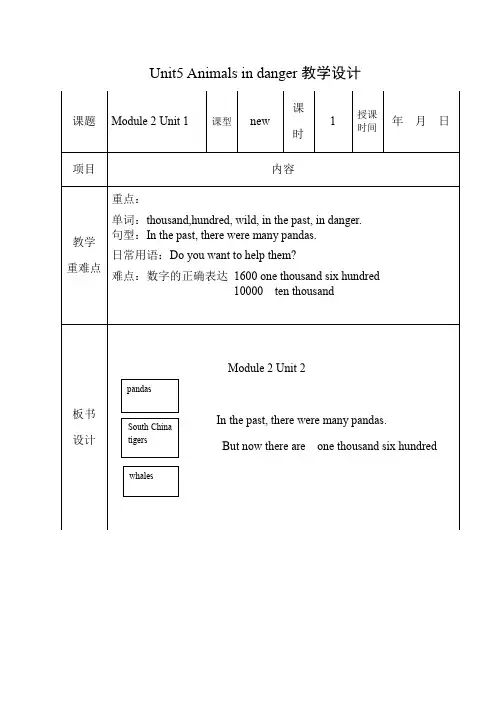
1,600
30
10,000
In the past,there were…,but now there are only about…
Listen to the tape,and fill in the blanks.
Play the tape again,let them repeat.
S2: I can hear“tiger”.
…
Yes.Do youknowmany animals are in danger in the world.Some animals are less and less.(T draw a graph on the Bb) They are in danger. We should protect them.
Let Ss talk about the difference.Eg:
There were three students in the classroom. Now there are five students in the classroom. There was a table in front of the blackboard. Now there is no table in the class.….
Thousand neans ten hundred.
Read this two words.And say the rs.
100 tigers, 1000 South China tigers, 10000 whales
Pandas
South China tigers
Blue whales
六年级英语Unit5Animalsindanger第四课时(Part5)Joinin外研剑桥英语
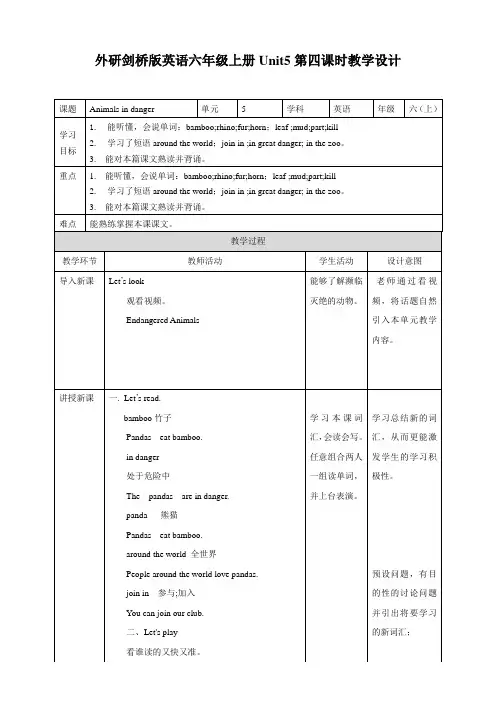
外研剑桥版英语六年级上册Unit5第四课时教学设计It is black and white.Yes,they are.It eats bamboo.It has beautiful fur.六、Let’s read.1 Listen and read the posters.③Save China's tigers!We all know Toby the Tiger and love him.But do you know the South China Tiger?save v.拯救---Do you know the South China Tiger?---Yes,I do./No,I don’t.④The South China Tiger lived in many parts of China.But people can only see them in the zoo today.Let's help to save China's tigers!in many parts of 在... 的许多地方only 只,仅in the zoo 在动物园七、Group work.对比一下华南虎之前和现在分布的地区对比情况Let's describe(描述)the characteristics(特征)of the South China Tiger. 学习有关华南虎海报内容的文章,掌握本篇文章的重点单词,词汇和知识点。
几个人一个小组,小组讨论对比华南虎之前和现在分布的地区对比情况通过小组讨论对比,培养学生珍惜濒危动物的意识。
〖2021年整理〗《Unit5 Animals in danger 教学设计》优秀教案
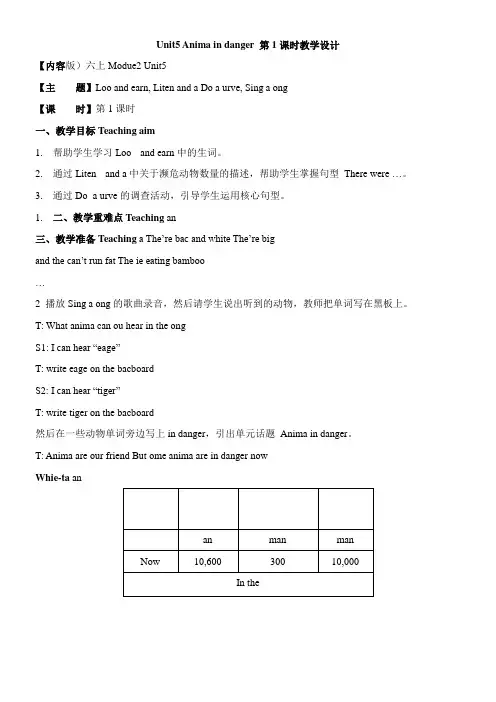
Unit5 Anima in danger 第1课时教学设计【内容版)六上Modue2 Unit5【主题】Loo and earn, Liten and a Do a urve, Sing a ong【课时】第1课时一、教学目标Teaching aim1.帮助学生学习Loo and earn中的生词。
2.通过Liten and a中关于濒危动物数量的描述,帮助学生掌握句型There were …。
3.通过Do a urve的调查活动,引导学生运用核心句型。
1.二、教学重难点Teaching an三、教学准备Teaching a The’re bac and white The’re bigand the can’t run fat The ie eating bamboo…2 播放Sing a ong的歌曲录音,然后请学生说出听到的动物,教师把单词写在黑板上。
T: What anima can ou hear in the ongS1: I can hear “eage”T: write eage on the bacboardS2: I can hear “tiger”T: write tiger on the bacboard然后在一些动物单词旁边写上in danger,引出单元话题Anima in danger。
T: Anima are our friend But ome anima are in danger nowWhie-ta anan an South China tiger, but now there are on about thirt South China tiger In the an bue whae, but now there are on about ten thouand Thee anima are in danger now We mut hea and。
外研剑桥版英语六年级上册Unit 5 Animals in danger 教案
Unit 5 Animals in danger 教案一、教材分析本模块以“Animals in danger〞为话题,以学习There be 句型的用法为主线,介绍了当前濒临灭绝,需要人类保护的动物的情况, 并重点介绍了大熊猫的保护情况。
在此根底上,学生可以根据自己的建议制定更合理的动物保护措施。
二、教学目标Knowledge objectiveTo master the useful words and sentences.Words: anyone, black rhino, bamboo, panda, danger, grass, fur, wild, protect, dig, kill, dirty, peace, work, and yesterday.Expressions: in danger, at last, be interested in, think of, take away, in peace, on earth, in order to, look after●Ability objective1. To help students to improve their ability of listening and speaking.2. Enable students to understand conversations about animals in danger.●Moral objective1. To help students know the importance of protecting animals and our environment.2. Improve their sense of duty to love and protect animals.三、教学重点New words and expressions.To learn the grammar knowledge of infinitive.四、教学难点Cultivating the ability of expressing opinions.五、教学方法PWP method, task-based method and interactive approach【教学手段】A tape recorder, multimedia and some pictures六、教学过程Teaching Procedures:Step 1 Lead-inSs look the pictures and guess what the animal is.Step 2 Consolidate new wordsLook and say. The teachers shows the pictures of new words and let the students to say the new words as quickly as possible.Step 3 Say the meaning of the phrases.Work in pairs. Let Ss say the meaning of the phrases as quickly as possible.Step 4 ListeningListen and answer the questions.1. What’s this week’s Animal World about?2. Which animals are in danger?Step 5 Listen to Activity 3 and answer the following questions.1. Is Betty more interested in South China Tiger Reserve?2. Do many animals have a safe place to live?Step 6 Find out the sentence of infinitive.Work in pairs. Let Ss find out the sentences of infinitive as many as possible. Give the prize to the first group.Step 7 Now complete the table.Step 9 Complete the passage with the correct form of the words and expressions in the box.Let Ss read the passage first and choose the words and expressions from the box. Step 10 Homework编写一个关于保护濒危动物华南虎的对话。
Unit 5 Animals in danger 系列课件 外研版Join in 六年级上册第五单元课件
What animals can you see?
Animals
people Map around of thethe world world
North America Europe
Antarctica
Asia South America
Save China’s tigers
We all know Toby the Tiger and love him.
But do you know the South China Tiger?
The South China Tiger lived in many parts of China.
But people can only see them in the zoo today.
South China Tiger
Task 1
Talk about the South China Tiger in groups(小组运用所给信
息谈论一下华南虎的简介)
Name
South China Tiger
Place
China
Colour
white,yellow, black,orange
Food
Can
deers (鹿) swim wild pigs (野猪)
Name
South China Tiger
Place
China
Colour
white,yellow, black,orange
Food
Can
deers (鹿) swim wild pigs (野猪)
Tips
小Байду номын сангаас士
You can use:
Joinin外研社六年级上Unit5:Animalsindanger(2)
六年级上册Unit 5 : Ani mals in dan ger (2)【课前测验】、听写、根据图片和中文提示补充句子1. -The-It eats-It lives on a-It gives us(奶牛)h as got four(农场)•(牛奶)•2.-It-The-It has got a long-It 'a very(大象)has got(大的)animal.(居住)in Africa andAsia.legs.3.狗有四条腿。
如左图,根据提示请描述一下狗的特征:它是一个小动物。
【课堂讲解】*重点句子1.The panda lives in Chi na . 熊猫生活在中国。
2.lt eats bamboo. 它吃竹子。
It has beautiful fur . ___ 它的毛色很漂亮。
It is black and white . ___ 它是黑白相间的。
3.lt has got four legs. It has got a long no se. It ' s a very big animal.他有四条腿和长长的鼻子,它是一种大型动物。
4.lt eats grass .I t lives on the farm.lt gives us milk. 他吃草,生活在农场里,给我们牛奶。
5.It ' s smaller than a sheep.他个子比绵羊小。
6. People around the world love pan das. 世界各地的人们都很喜欢熊猫。
7. But they are in great dan ger. 但是他们现在处于危险之中。
Let ' s join in to help them让我们加入去帮助他们。
8. There are no kingfishers this year.Let ' s find out about kingfishers on the web.今年没什么翠鸟了,让我们上网查查关于翠鸟的资料。
Unit 5 Animals in danger第1课时公开课教案【小学英语外研六年级上册】
学生进行一个单词游戏的操练,看到哪个单词消失就念出来。
学习词汇时注意模仿发音,力争发音准确到位。
初步学习比较级的用法。
学习总结新的词汇,从而更能激发学生的学习积极性。
巩固词汇;针对性的完成学习目标;学习形式生动多样化,使学生集中注意力,同时保持学习的积极性。
Practice
1.Let’swrite
教师播放课件,让学生填入单词的比较级形式。
2.Let’s match
教师播放课件,让学生连线。
学生朗读题目,根据题目写出对应时间,作答完毕,师生共同校对答案。
在练习中巩固本节课的核心内容。
Summary
Words:
animals, danger, grass, nose, leg等。
Sentence:
在看完图片时老师将ntation
1.Let’s read
学习本课单词。
2.Let’s play
单词游戏,看到哪个单词消失就念出来。
3.Listen and read
初步通读课文,学习课文内容,出示课文图片。
4.Let’s learn
教师播放课件,带领学生深度解读课文。
It has…
学生回顾本节课的核心内容。
总结回顾本节课所学内容。
Homework
1.熟读该课课文;
2.预习P39,尝试背背本篇课文。
学生登记任务,按时完成作业。
巩固本课内容,训练学生运用目标语言的能力。
课堂小结
这节课的教学任务目标是学习单词和短语animals, danger, grass, nose, leg。本课为新授课,词汇的学习主要通过听,跟读为主要形式。通过灵活多样,丰富多彩的课堂形式的进行,激发学生学习英语的兴趣,增强他们的自信心,通过教学评价的开展,让学生体验到成就感,促进学生学习和发展。
牛津沪教版六上英语Unit 5 Animals in danger 教案
Module 2 RelationshipsUnit 5 Animals in danger 教案一、教学目标1. 认知目标:学习掌握新词汇:thousand,hundred,wild,way,die,learn,send,掌握句型:In the past, there were …, but now there are ….,以及过去式与现在时的区别。
2. 能力目标:能运用所学句型与同学谈论濒临灭绝的野生动物。
3. 情感目标:让学生通过对课文内容的学习掌握,增强学习的信心,调动学生的学习兴趣。
二、教学重难点1. 重点能运用所学句型与同学谈论濒临灭绝的野生动物。
2. 难点句型:In the past, there were …, but now there are ….,以及过去式与现在时的区别的理解掌握。
三、教学用具多媒体教学设备、单词卡片、图片。
四、教学设计Step 1 warming1. 师生互相问好,教师询问大家喜欢去动物园吗?最喜欢的动物是什么呢?是否了解这些动物呢?2. 教师向学生们说说自己最喜欢的动物以及此种动物的一些特点与现状。
Step 2 Revision and Presentation1. 教师告诉学生我们这节课就要学学如何用英语表达一些动物的生存现状,了解一些濒临灭绝动物的现状。
2. 教师请学生谈谈自己最喜欢的动物。
3. 教师出示单词卡片进行新单词教学,带读并配合肢体动作让同学们印象深刻。
4. 教师播放课文内容录音,请同学们认真听一遍,争取做到理解内容。
Step 3 Practice1. 分小组讨论练习,两人一组,相互介绍一些动物的生存现状。
A: My favourite animal is panda, in the past, there were many pandas, but now there are onlyabout one thousand six hundred pandas in the wild.B: My favourite animal is blue whale, in the past, there were many blue whales, but now there areonly about ten thousand in the wild.2. Let’s learn and sing a song: All animals bright and beautiful.Step 4 Summary教师根据本课时所学内容进行回忆总结,并请同学们谈谈本节课印象最深刻的环节。