
新托福听力学术讲座
1 地理 GEOGRAPHY geography 地理 geographer地理学家 hemisphere 半球 meridian子午线,经线 parallel平行圈,纬线 latitude 经度 Ion gitude 度 elevatio n 海拔 altitude 高度 horiz on地平线 equator 赤道 tropics热带地区 Arctic北极 An tarctic(A ntarctica)南极 expediti on 探险 time zone 时区 topography 地形,地形学 plai n平原 plateau (highland)高地 lowla nd 低地 bas in
盆地 caver n (cave)洞穴 terrain 地域 subterranean ( underground)地底下
coastla nd沿海地区 island岛屿 continental island 大陆岛 volca nic isla nd 火山岛 coral isla nd珊瑚岛 当你消沉时,不要寻找任何人,自己去解决。 peninsular 半岛 con ti nent 大陆 continental shelf 大陆架 ran ges山脉 valley峡谷 canyon峡谷 channel (strait)海峡 terrestrial地球的,陆地的 terrestrial heat (geothermal) 地热 continental drift大陆漂移学说 ocea n bottom 海床 sedime nt沉淀物,沉积物
上Z Dream Sky I ft 室 tropical热带的 temperate温带的 frigid
寒带的 formation 形成 fieldst one 卵石
2地质类 geology地质学 geologist地质学家 crust地壳 man tle地幔 core地核 continental crust 大陆地壳 ocea nic crust海洋地壳 layer (stratum,复数 strata)地层 plate板块 fault断层 fault plane 断层面 fault zone断层带 rift (crack; split) 断裂 dis in tegratio n (decompositi on) 分解 erosi on 腐蚀 fossil化石 ign eous rock 火成岩 sedimentary rock 沉积岩 metamorphic rock 变质岩 quartz石英 limest one石灰岩 marble大理石 gran ite花岗岩 mi neral 矿物 ore矿石 deposit 矿床 platinum 白金,铂 silver 银 copper黄铜 aluminum 乍吕 tin锡 lead 铅 zinc 锌 ni
ckel 镍 mercury汞,水银 sodium 钠 上3 Dream Sky I ft 室
gem宝石 diam ond 钻石 glacier 冰川 glacial冰川的 glacial epoch ( age, period) 冰川期 iceberg 冰山 volca no 火山 active volca no 活火山 exti net volca no 死火山 dormant volcano 休眠火山 eruptio n火山喷发 crater 火山口 lava火山岩浆 volca nic火山的 volca nic dust 火山尘 earthquake
( quake; tremor; seism)地震 seismic地震的 seismology 地震学 magn itude 震级 seismic wave 地震波
Dream Sky [ (1 宰 天文类 astr onomy天文学 astr ono mical 天文的 astronomical observatory 天文台 astr ono mer天文学家 astrophysics天文物理学 astrology占星学 pseudoscie nee 伪科学 cosmos( uni verse)宇宙 cosmology宇宙学 infinite无限的 cosmic宇宙的 cosmic radiati on 宇宙辐射 cosmic rays 宇宙射线 celestial 天的 celestial body (heave nly body)天体 celestial map (sky
atlas)天体图 celestial sphere 天球 con stellati on 星座 cluster 星团
solar system 太阳系 solar radiati on 太阳辐身寸
Z? Dream Sky I ft 室 pla net行星 planetoid (asteroid)小行星 revolve旋转,绕转 twinkle 闪烁 Mercury 水星 Venus金星 Earth地球 Mars火星 Jupiter 木星 Satur n 土星 Ura nus天王星 Nept une海王星 Pluto冥王星 orbit轨道 spi n旋转 satellite 卫星 lunar月球的 meteor流星 meteor shower 流星雨 meteoroid流星体 meteorite 陨石 comet彗星 space (outer space)太空,外层空间 spacecraft (spaceship) 宇宙飞船 space shuttle航天飞机 space telescope空 间望远镜 astr on aut宇航员 star恒星 stellar恒星的 interstellar
恒星间的 interplanetary 行星间的 asteroid小行星 n ebula星云 corona
日冕 vacuum真空 infrared ray 红外线 radiati on 辐射 emissi on发射,散发
4.考古,人类 anthropologist 人类学家 paleoanthropologist 古人类学家 ecological anthropologist 生态人类学家 psychological anthropologist 心理人类学家 orig in ate起源于 an cestor 祖先 homoge neous同一种族(种类)的 tribe部落 cla n氏族 archeologist考古学家 excavati on 挖掘 excavate (un earth)挖掘 ruins遗迹,废墟 remai ns遗迹,遗骸 relic遗物,文物 an tique古物,古董 antiquity古代,古老 Sto ne Age石器时代 Bronze Age (青)铜器时代
Iron Age铁器时代 Paleolithic旧石器时代的 Mesolithic中石器时代的 Neolithic新石器时代的 archaeology 考古学 anthropology 人类学 morphology 形态学
5.生态类 ECOLOGY生态学 ecologist生态学家 ecosystem 生态系统 balanee (of nature)自然界生态平衡 fauna动物群 flora植物群 rain forest
雨林 food chain食物链 acid rain 酸雨 gree
nhouse effect 温室效应 in frared radiation 红外线辐射 ozone layer (oz ono sphere)臭氧层 ultraviolet radiati on 紫外辐射 pollution 污染 pollution control 污染控制 air pollution 空气污染 water pollution 水污染 noise pollution 噪音污染 soil pollution
土壤污染 Dream Sky I ft 电
pollution-free 无污染 pollutant污染物 no xious (toxic)有毒的 fumes (有毒)废气 waste废物 solid waste固体垃圾 sewage
(wastewater)污水 sewage purification 污水净化 sewage disposal 污水处理 decibel (噪音)分贝
6气象类 Meteorology 气象 meteorology 气象 meteorologist 气象学家 forecast (predict)预报 climate 气候 atmosphere 大气层 troposphere 对流层 curre nt (气)流 vapor蒸汽 evaporate 蒸发 damp (wet; moist; humid)
潮湿的 humidity 湿度 moisture潮湿;水分
saturate 饱和 dew露 frost 霜 fog (mist)雾 smog烟雾 droplet小水珠 condense 浓缩 crystal水晶体 dow npour (torre ntial rain)
origi n起源 Dream Sky I (1 宰
新托福考试听力测试考点分析:听力介绍+方法指导
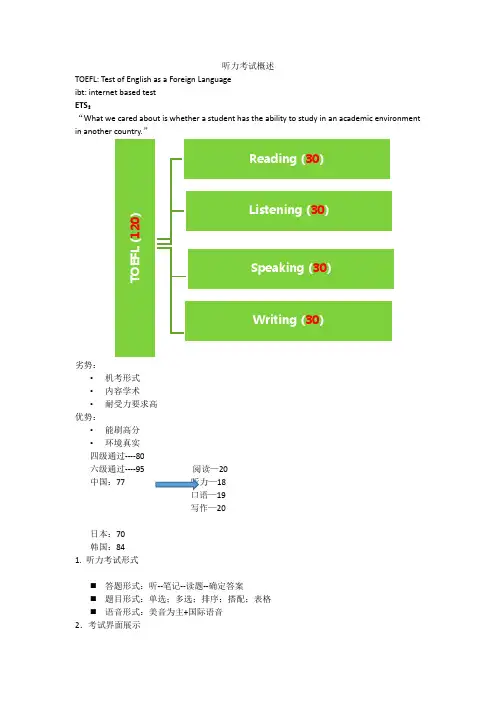
听力考试概述TOEFL: Test of English as a Foreign Language ibt: internet based test ETS :“What we cared about is whether a student has the ability to study in an academic environment劣势:• 机考形式 • 内容学术 • 耐受力要求高 优势:• 能刷高分 • 环境真实 四级通过----80六级通过----95 阅读—20 中国:77 18 口语—19 写作—20日本:70 韩国:84 1. 听力考试形式⏹ 答题形式:听--笔记--读题--确定答案⏹ 题目形式:单选;多选;排序;搭配;表格 ⏹ 语音形式:美音为主+国际语音 2.考试界面展示3.听力考试内容听力材料题目数量时间Conversation: 2-3个长对话5 2-3 min/conversationLecture:4-6个学术讲座6 4-6 min/lectureTotal:6-9(加试)34+ 60—90 minConversation考察场景⏹Office hour(可能涉及学术内容或与课程相关)⏹Service encounter(通常为非学术性内容)⏹讲座四大类话题:⏹Arts (艺术)⏹Life Science (生命科学)⏹Physical Science (自然科学)⏹Social Science (社会科学)听力能力提升之笔记一、Why to Take Notes?•无预览•对话/讲座持续时间长•防止听力过程中走神•训练听力思维能力二、How to Take Notes?•速记•听懂后总结•只记录核心观点•有一定结构性三、What Notes to Take?•主旨•分论点=: equal to, the same as≠: difference↑: increase, promote, enhance, improve, go up↓: decrease, fall, worsen, reduce+: plus, add, besides, moreover-: minus, deduct, except→: result in, lead to←: originate from, date back to√: correct, good, positive, affirmative×: wrong, bad, mistaken, negative☆: outstanding, elite∵: because, owing to, thanks to, since, as∴: therefore, consequently, as a result, so, hence ∑: total, amount~:about/around,or so,approximately∈:belong to, be part of, fall into, remain with,++:最高级best, most高:superior to,surpass低:inferior to2.列顺序{⒈⒉⒊Ⅰ;Ⅱ;ⅢA; B ; C3.做比较= Equals=/= Does not equal& And> Is more than< Is less than4.表因果→Leading to∴Therefore∵Because5.表年代1929→Since 1929←1929 1929 and earlierC. Century6.表增减↑To increase↓To decrease/ Per% Percent7.表举例e. g. -----For example8.其它常用符号♂Man; Men♀Woman; Women$ dollar£ pound€eurob.速记方法二:缩写1.拿掉所有元音msg messagestd standardmkt marketrspct respect2.保留前几个字母wk--------weekbd---------boardpl----------peoplebk---------bank,book3.后缀缩写able/ ible/ ble bling: Gtion: Nment: T/ mtize: Ztive: TVless: LSful: FLed: dent/ant: T4.后缀缩写impossible-----------impoblshopping-------------SHPGoccupation-----------OCPNamendment----------amdmtorganization----------ognzeffective----------------efctvregardless-------------rgdlsurgent------------------URGT五、文章结构及笔记方法论⏹完整的结构---从牌面分类到规则梳理⏹清晰的逻辑---由浅入深⏹个性的符号---拼音图片联用⏹主次分明---不含次要信息六、Conversation 结构七、conversation 笔记要点• 提出问题• 原因诊断1、原因诊断2、原因诊断3 • 解决方案1----拒绝+理由 • 解决方案2----拒绝+理由 • 最终解决方案 • 建议/保证问答 矛盾 八、1.Consultation-an engineering courseQ :上 Eng 课----take again Why ? Do better ?Half + rest = better next time Fill a form有form-----need sig必须滴!听力材料(student) Professor, I have a question about taking the engineering course that you’ll be teaching. I already took this course once, but I didn’t do very well on it, and I’d like to take it over again.(professor) Why do you want to try it again? Do you think you can do it better this time?(student) Well, I understood about half material last time, and if I concentrate on the rest of the material, I think I can do much better next time.(professor) It’s …uh…possible to repeat a course to try for a higher grade, as long as the appropriate form is filled out.(student) I’ve got the form right here, and I’ve already filled out most of it. All I need is your signature at the bottom.(professor) That’s fine. You really do seem prepared. Give me the form, and I’ll sign it. 2.Consultation-the grade reportQ:×收到grade report两周前出了move了?×Take all exam了?√等我在电脑上查查听力材料(student) I have a problem, and I hope you can help.(worker) What’s you problem?(student) I haven’t received my grade report from last quarter, and my friends have already received their grade reports.(worker) Grade reports from last quarter were mailed out two weeks ago. You haven’treceived yours yet?(student) No, I haven’t.(worker) Did you move in last quarter? Has your address changed? Um,…maybe the grade report went to the wrong address.(student) No I’m still in the same place. I haven’t moved. The address should be accurate.(worker) And did you take all of your final exams? If you missed an exam, then you grade report would be held up.(student) No I took all my exams…(worker) Then, uh, you should’ve received your grade report by now. Give me a moment, please, and I’ll look your grade report up in the computer system and see if I can figure out what the problem is.(student) Thanks very much for your help.九、Lecture笔记注意事项⏹听懂主旨、态度、结构即可作对大多数题目⏹顺序性原则---笔记结构清晰⏹出题点集中于主题,分论点,问答,观点和解释(原因)⏹经典段落结构不要听写要总结常见lecture结构:并列式1.Discussion-lakes地理课各种lake---怎么form的Lake Superior(LS)& Caspian Sea(CS)& Lake Baikal(LB)CS:ocean----cut offLS:glaciersLB:earth’s crust broke apart各种lake---怎么form的听力材料(woman 1) OK. Let’s see where we are on this project for geography class. Ourpresentation’s in two days, and I hope we’re almost ready.(man) I hope so, too. We are each going to look up information about a different lake-with an emphasis on how each lake formed-and we’ll each present information on the lake to the , to the class. My job was to look up information on Lake Superior, and I’ve done that.(woman 2) I’ve done my research on the Caspian Sea.(woman 1) And I’m already with information about Lake Baikal.(woman 2) Great. I’ll go first. I’ll be discussing the Caspian Sea, which is the largest inland body of water in the world. The Caspian Sea is a saltwater lake between Europe and Asia. It is believed that this lake was originally connected to the world’s ocean, which would account for its saltwater content. As the Earth’s plates moved, this arm of the ocean was cut off.(man) Well, here’s what I found on Lake Superior. Lake Superior is, of course, one ofthe Great Lakes in North America, and it’s the largest freshwater lake in the world. Along with the other Great Lakes, it was formed by glaciers. Glaciers, covered the northern part of North America until 10000years ago and were responsible for carving the Great Lakes,including Lake Superior.(woman 1) OK, now for Lake Baikal, which is the lake I’ll be discussing. Lake Baikal’s in Russia, and it was formed when the earth’s crust broke apart at a fault. Because Lake Baikal formed over a split in the Earth’s crust, it’s a very deep lake, the deepest lake in theworld. Lake Baikal’s so deep that, even though its surface area is much smaller than the surface area of Lake Superior, it could hold the water of all the Great Lakes combined.(man) Well, it looks like we’ve all found information about each of these lakes, and, in particular, how they were formed. Now we need to talk about how we can present theinformation to the rest of the class.常见lecture结构:递进式2.Consultation- an anthropology paper人类学discuss选topic什么topic?eyesight test that the Roman military used看见A星,做archer;看不见A星,做foot solider跟人类学的relationship?“survival of the fittest”为什么?原因?Archer生存几率高,因为在后方就这么写吧!听力材料(student) 1. Thanks for seeing me, Dr. Barton.(professor) No problem. It’s my office hour… What did you want to talk about?(student) I wanted to discuss the topic I’ve chosen for the paper I’m supposed to be writing for you anthropology course. The topic I’m thinking about is a bit unusual.(professor) Oh you know, it has to be related to some aspect of anthropology that we’re studying… What topic did you have in mind?(student) I wanted to write about a test used by the Roman military to test soldiers’ eyesight. (pro fessor) Hmmm… an eyesight test used by the Roman military? Are you sure this is related to our anthropology class?... Well, tell me about it… What is the eyesight test that the Roman military used?(student) Well, it was a test that the Romans used to determine if their soldiers would fight as foot soldiers on the front lines or as archers behind the front lines. Roman soldiers were required to undergo certain tests to determine their ability to perform as soldiers. One of these tests was simply to count the stars in the constellation, the Big Dipper. This test determined the acuity of their vision. See. Look at this picture of the Big Dipper. You can see the seven stars in the BigDipper. The star at the bend of the handle of the Big Dipper is called Mizar, and Mizar is a binary star. If you look closely, there’s a second star called Alcor next to Mizar. If a Roman soldier’s eyesight was good enough to see Alcor, he could fight as an archer. If he couldn’t see Alcor, he had to fight on the front lines as a foot soldier.(professor) So this eye test was based on the ability of the soldier to see Alcor next to Mizar. (student) Yes, exactly.(professor) Well, that’s a very interesting test, but I’m sure it’s related to the material in our anthropology class. Well, let’s put it away… how would you related this to the material in the anthropology course?(student) I’d related it to the idea of “survival of the fittest.”(professor) Um… interesting… and how would you related it to this concept? Survival of the fittest has to do with the idea that those who’s strongest or have some other physical or material advantage will be more likely to survival.(student) Well, this test for eyesight was used not only by Romans but also other groups of people for hundreds of years. The interesting point is that over time more people have been able to pass the test, and the fact that more people have been able to pass the test over time has been attributed to survival of the fittest. It was certainly true for Roman soldiers that those who passed the test had a better chance of surviving longer.(professor) And why was that? Why did Roman soldiers who passed the test stand a better chance of surviving longer?(student) Well, soldiers with better eyesight weren’t on the front line s. Those with bad eyesight were sent to the front lines and, more often than not, were killed on the front lines. Archers stood a better chance of survival and were around to father children, who would also tend to have better eyesight than those who failed the test. This is what supports the concept of survival of the fittest.(professor) 3. Umm. That’s an interesting idea. As long as you concentrate on the idea of survival of the fittest in your paper and use this example of an eye test to support the concept, I think you would have a solid paper.(student) That’s what I’ll do then. Thanks, Dr. Barton.•笔记:•笔记的目的:记录信息,防止遗忘•笔记的作用:帮助回忆文章,结合题目定位出题点•笔记的要素:主旨,结构(分论点),情感•笔记(听力)的提升:听懂句子---听懂文章---学会“读题”---掌握文章结构---针对文章要点进行笔记一级要点:分论点,段意二级要点:解释性,补充性内容。
托福tpo听力最难的几篇
托福tpo听力最难的几篇托福 TPO 听力最难的几篇托福考试是许多考生梦寐以求的机会,其中听力部分对于许多考生来说极具挑战性。
而在 TPO(TOEFL Practice Online)的模拟考试中,有几篇听力材料被认为是最难的。
本文将为大家分析这几篇最难的TPO 听力材料,并提供一些建议来应对这些挑战。
第一篇:历史类这篇听力材料围绕着历史事件和人物展开,语言组织复杂,充满了学术术语和历史背景。
考生需要通过听力理解和分析来回答问题,同时还要运用背景知识进行推测。
为了应对这个挑战,建议考生在备考过程中注重历史背景的学习,了解各种历史事件和人物,并进行相关的听力训练。
第二篇:科学类这篇听力材料讨论了一项复杂的科学研究,包括科学概念、实验设备和数据分析。
考生除了需要对科学词汇和概念有一定的掌握外,还需要具备分析和推理能力。
为了攻克这篇听力,建议考生在备考过程中加强科学知识的学习和实践,同时进行科学类听力材料的大量训练。
第三篇:学术讲座类学术讲座类听力材料通常涉及复杂的学科知识,要求考生快速理解和分析讲座内容,并能准确回答问题。
这种听力材料在难度上较高,需要考生具备较高水平的听力技巧和学科知识储备。
为了突破这个难关,建议考生多阅读相关学术文章,扩充词汇量和学科背景。
同时,进行听力练习时,注重练习不同学科领域的讲座材料,增强自己的应对能力。
第四篇:口音类在托福听力中,口音种类繁多,如美国口音、英国口音、澳大利亚口音等。
其中,对于非母语使用者来说,英语国家的口音常常成为一个挑战。
建议考生在备考过程中多听不同口音的英语材料,如英美剧、英语新闻等,提高自己对于各种口音的听解能力。
总结托福 TPO 听力的难点主要在于语言的难度、背景知识的应用以及口音的理解。
考生可以通过加强词汇和学科知识的学习,注重历史和科学领域的背景知识培养,多听不同口音的英语材料,并进行大量的听力练习来克服这些难点。
同时,要保持耐心和自信,在备考过程中积极总结经验和技巧,为取得更好的成绩做好准备。
新托福口语模板4
新托福口语模板4〔托福〕口语task4的内容是学术讲座,所以很多中国考生觉得难度很大,不知道怎么答,得分点在哪里,分数自然也不会太高。
下面是我为您整理的关于新托福口语模板4,希望对你有所帮助。
新托福口语模板41. TOPIC SENTENCE: The professor talks about the theory that。
SUPPORTING DETAILS: He/she gives one/two examples to illustrate/explain such a point.(接下来陈述实验对象,实验过程,实验结果)。
2、(1)类型:The reading passage: definitionListening passage: examples, study, research 模版:The reading passagegives the definition of(关键的抽象词)。
XXX is(定义的内容)In the listening passage,the professor goes on todemonstrate it by introducing some researches / examples. This first is(最后一句注意挂钩)The second is(同样挂钩)(2)类型:The reading passage: the phenomenon / the problem/the process /somefunctions/some featuresListening passage: research, analysis.。
.模版:the reading passage describes the phenomenon / the problem/the process /somefunctions/some features(关键的抽象词)。
托福听力tpo68 lecture1、2、3 原文+题目+答案+译文

托福听力tpo68 lecture1、2、3 原文+题目+答案+译文Lecture1 (2)原文 (2)题目 (4)答案 (6)译文 (6)Lecture2 (7)原文 (8)题目 (10)答案 (12)译文 (12)Lecture3 (14)原文 (14)题目 (17)答案 (19)译文 (19)Lecture1原文Professor: OK, let’s look at two specific ancient cultures of the arctic, both of which lived on the far northern edge of the continent, the Dorset and the Thule. The Dorset culture began around eight hundred BC and ranged to cross most of arctic Canada. The Thule, well, they lived in the same area, but about twelve hundred years later. Both groups left some beautiful art behind, really are best evidence that these folks even existed. And although these two cultures lived in the same region, each group approached their art in very different ways.Alright, so the Dorset culture. Archaeologists have unearthed hundreds of Dorset sculptures mostly carve from ivory or bone and sometimes stone. They were mostly small sculptures of animal or human figures. And our best guess is that they were probably used mainly for religious purposes. The main subject of Dorset animal sculptures is the polar bear. Some of these polar bears are represented in naturalistic or realistic ways, but usually, their abstracted or stylized that is to say less realistic. Here is a typical polar bear sculpture. It's carved from ivory, we call these artifacts flying or floating polar bears, because, because they look like the polar bears doing just that flying or floating. Notice the distinctive markings, they seem to mark out the skeleton or joints of the bear.While polar bears were favorite subject, the Dorset created sculptures of other animals too, like seals and caribou which were represented in a more realistic fashion. We speculate that if the Dorset feared or respected a particular animal, they were more likely to present it in a stylized way, like with the polar bear, which, of course, is a large dangerous predator, maybe, it was a way of dealing with their fear. We also have Dorset’s sculptures whose meaning is more allusive. I'm talking about horns with many human faces carved into them. What's remarkable about these sculptures is the variety of facial types in expressions that appear on the single horn. If only the people represented on these artifacts could answer our questions, it tells us whetherthey are ancestors or residents of villager or what.Okay, let's switch to Thule art, which differs from Dorset art in, in some important ways. Interestingly, Thule artwork wasn't generally influenced by the earlier Dorset culture. It seems it would’ve grown out of a separate tradition that originated in Alaska. Thule artwork was most likely used to decorate common objects such as tools with attractive designs, we can't be entirely sure about this. However, we've tried to interpret the symbolic designs into the art. But of course, it's impossible to confirm the accuracy of such interpretations. What we do know is that the Thule people made extensive use of engravings, they drove the small holes and carve lines into various materials. These engravings, engraved patterns, rather, are found on the diverse group of artifacts, things ranging from weapons to jewelry to cones and boxes. Here's some examples. It's hard to see, but most of these objects do have engravings on them. Thule art was more of a graphic art. Uh, more like drawing. Many of their designs are geometric and abstract. Others containing engravings of human and animal figures.For instance, the long skinny object, among left, has a face at the top. We’ve also found the tool handle with hunting and camp scenes carved into it. As far as Thule’s sculpture goes, there is only a few small objects in wooden dowels like the one in the bottom right-hand corner. These have either no facial features or very rudimentary ones, less detailed, less individualized than the faces of Dorset’s sculpture.One scholar has argued that this difference resulted from the nature of Thule’s society which was built around group hunting expeditions on the ocean. This hunting approach required a great deal of cooperation which may have led to a kind of an overall uniformity in their art. And emphasis on commonality rather than individuality, which probably explains why there’re human figures like the faces or had standardized faces that all look similar. The most famous of the few Thule sculptures are the ones of birds in creatures that are part bird and part woman. While the sculpture is probably had some symbolic purpose, patterns of holes were drilled into them too. So, in general compared with artwork of the Dorset, Thule artprobably had a more decorative or utilitarian function.题目1.What is the main purpose of the lecture?A. To examine the extent to which Thule and Dorset art influenced the artwork of other arctic culturesB. To examine how Thule and Dorset designs changed over timeC. To compare and contrast artwork from two ancient arctic culturesD. To discuss how the natural world is shown in the artwork of two ancient arctic cultures2.What does the professor imply about “flying”or “floating”polar-bear sculptures?[Click on 2 answers.]A. They may have helped the Dorset people cope with their fear of a dangerous animal.B. Art historians consider them to be of little religious importance to the Dorset people.C. The Dorset people created them to demonstrate respect for polar bears.D. They were designed to take advantage of the natural shape of the ivory.3.According to the professor, what can be inferred about Dorset society based on its artwork?A. It placed more emphasis on religious beliefs than Thule society did.B. It relied on hunting large animals to a greater extent than Thule society did.C. It placed an emphasis on the production of jewelry.D. It was structured to support long ocean expeditions.4.According to the professor, what appears to be the main reason that the Thule engraved holes and lines into their artifacts?A. To honor their Alaskan ancestorsB. To illustrate the layout of their campgroundsC. To add realism to their sculpturesD. To add decoration to their sculptures5.Why does the professor mention Thule group-hunting expeditions?A. To explain why the Thule had plenty of time to produce detailed artworkB. To draw a connection between cooperation in finding food and uniformity in artC. To compare Thule hunting practices with Dorset hunting practicesD. To suggest that the majority of Thule sculptures were probably lost at sea6.Why does the professor saythis:If only the people represented on these artifacts could answer our questionsA. To suggest that the students interview descendants of Dorset peopleB. To propose a topic that the students could write aboutC. To ask students who they think the faces representD. To indicate that there is still a lot of missing information答案C AC AD B D译文教授:好的,让我们来看一下北极的两种特定的古代文化,它们都生活在大陆的最北端,Dorset文化和Thule文化。
2014年 新托福听力conversationTPO21-30总结分类

易错题目
22 2,4,(5) 19,(22) 4,5 (19), (20), 21,22 19,20,21,22 19,22(偏难) 19,20,21,22
学生和biology professor的对话,关于whale Why does the man go to see the professor? 学生和biology professor的对话,关于jellyfish why does the student go to see the professor? 学生和history of technology professor的对话,有关农业 Why has the student come to see the professor?
内容说明
学生和music history professor的对话 学生和art history professor的对话 学生和public relation professor的对话 学生和music history professor的对话 学生和geography professor的对话
主旨方式
易-中-难 易-中-难
主旨方式 易错题目
(1),(3) (4),5 (3),(5) (2),(3) 4 3 19,20 2,3,(4),5 (2),5 (1),3 1,2 1,2,4,5
内容说明
易 中 难
难度系数
学生无法找到orientation session,之后和教授之间的对话 Why does the man need the professor's help? 学生和图书馆老师的对话 What does the woman go to the information desk? 学生和注册老师关于选课的对话 What is the conversation mainly about? 学生和活动中心老师的对话 Why does the student go to speak with the woman? 学生和校报的faculty advisor之间的对话 Why does the student go to the man's office? 学生和学校活动老师的对话,学校网站编辑没有把他们的 What is the cause of the student's problem? 活动发布到网站上 学生和English professor的对话 学生和书店店员之间的对话 学生和academic advisor的对话,有关于毕业要求 学生和老师关于论文的对话 学生和老师关于论文的对话 学生和print shop店员的对话 Why does the man go to see the professor? Why can the man NOT find is the conversation mainly about? What is the conversation mainly about? Why does the man go to see the professor? Why does the student go to speak to the man?
新托福突破口TPO(1-30 纸质版)听力分类总结(用于横听及总结)

Art TPO1TPO3TPO3TPO7TPO8TPO9艺术Lecture1Lecture2Lecture3 Lecture1Lecture2Lecture1TPO16TPO17TPO18TPO19TPO22TPO24Lecture4Lecture1Lecture2Lecture4Lecture4Lecture2Anthropology TPO1TPO7TPO22人类学Lecture3Lecture3Lecture1Psychology TPO2TPO10TPO14TPO15TPO30心理学Lecture1Lecture4Lecture1Lecture1Lecture1Philosophy TPO2TPO28哲学Lecture3Lecture1Biology TPO1TPO2TPO4TPO6TPO7TPO8生物学Lecture4Lecture2Lecture1Lecture2Lecture2Lecture1TPO15TPO16TPO17TPO18TPO19TPO20Lecture4Lecture3Lecture4Lecture4Lecture3Lecture4TPO25TPO25TPO26纸质TPO4TPO27TPO27Lecture1Lecture4Lecture2Lecture2Lecture1Lecture3Astronomy TPO2TPO3TPO5TPO13TPO14TPO18天文学Lecture4Lecture4Lecture2Lecture4Lecture3Lecture1纸质TPO5TPO30Lecture3Lecture3Geology TPO1TPO4TPO6TPO7TPO9TPO15地质学Lecture2Lecture3Lecture4Lecture4Lecture3Lecture2Environmental TPO3TPO9TPO10TPO11TPO12TPO13环境科学Lecture1Lecture2Lecture3 Lecture3Lecture4Lecture2Business TPO6TPO11TPO12TPO26纸质TPO4商业Lecture1Lecture4Lecture2Lecture1Lecture1Chemistry TPO5TPO8化学Lecture3Lecture4Architecture TPO11TPO13TPO29建筑Lecture2Lecture1Lecture2History TPO8TPO10TPO17TPO18TPO21TPO25历史Lecture3Lecture2Lecture3 Lecture3 Lecture4Lecture2Archaeology TPO14TPO23TPO14TPO28TPO29考古学Lecture4Lecture1Lecture3 Lecture4Lecture3Linguistics TPO9TPO19TPO20语言学Lecture4Lecture1Lecture1Literature TPO4TPO5TPO6TPO20文学Lecture2Lecture4Lecture3 Lecture3杂类U.S. Governme TPO4Sociology TPO5Choreography T PO23美国政府Lecture4社会学Lecture1舞蹈Lecture4Structural Engine TPO29结构工程学Lecture4无老师题:很多筒子们在准备新托福考试的时候,都感觉一方面自己的能力确实是有问题,但是同太高,使得很多考生都应付不来,无老师这次幸得一份图片版新托福突破口TPO听力部分的分类总结,特地放出横听。