
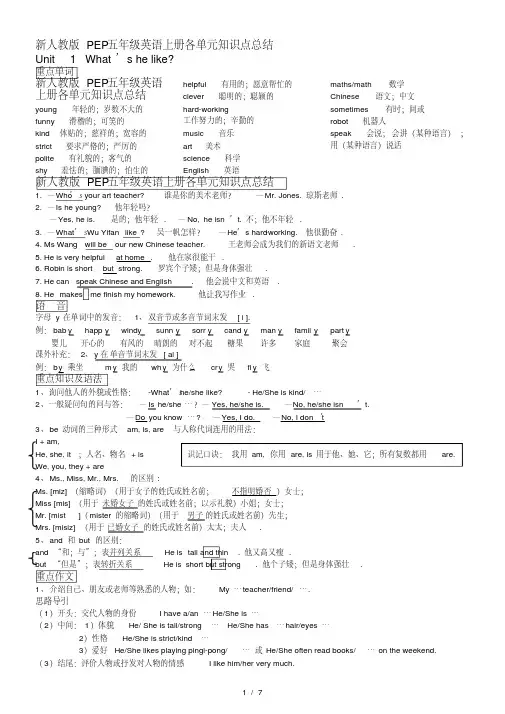
新人教版PEP五年级英语上册复习资料(全)
1新版PEP 五年级上册知识点总结Unit 1 What ’s he like?old 老的,年纪大的young 年轻的funny 滑稽的可笑的kind 体贴的strict 严格的polite 有礼貌的 shy 羞怯的,怕生的 helpful 有用的 clever 聪明的,聪颖的 hard-working 工作努力的,辛勤的 music 音乐 art 美术 science 科学 English 英语 maths/math 数学 Chinese 语文,中文 sometimes 有时,间或 robot 机器人 speak 说讲(某种语言)1. —Who’s your art teacher? 谁是你的美术老师? —Mr. Jones.琼斯老师。
2. —Is he young? 他年轻吗?—Yes, he is. 是的,他年轻。
—No, he isn’t.3. —What’s Wu Yifan like ? 吴一帆怎样? —He’s hard -working. 他很勤奋。
4. Ms Wang will be our new Chinese teacher. 王老师会成为我们的新语文老师。
5. He is very helpful at home . 他在家很能干。
6. Robin is short but strong. 罗宾个子矮,但是身体强壮。
7. He can speak Chinese and English . 他会说中文和英语。
8. He他让我完成我的作业。
字母y 在单词中的发音:1、双音节或多音节词末发[ i ]。
例:bab y happ y windy sunn y sorr y cand y man y famil y part y婴儿 开心的 有风的 晴朗的 对不起 糖果 许多 家庭 聚会课外补充:2、y 在单音节词末发[ ai ] 例:b y 乘坐 m y 我的 wh y 为什么 cr y 哭 fl y 飞1、询问他人的外貌或性格:-What’s he/she like? - He/She is kind/…2、一般疑问句的问与答:—Is he/she…?—Yes, he/she is. —No, he/she isn’t.—Do you know …? —Yes, I do. —No, I don ’t3、be 动词的三种形式am, is, are 与人称代词连用的用法:I + am, He, she, it ,人名、物名+ is We, you, they + are 4、and 和but 的区别:and “和,与”,表并列关系 He is . 他又高又瘦。
but “但是”,表转折关系 He is . 他个子矮,但是身体强壮。
Unit 2My weekSunday (Sun.) 周日Monday (Mon.) 周一Tuesday(Tue./Tues.)周二Wednesday(Wed./Weds.) 周三Thursday (Thur./Thurs.) 周四Friday (Fri.) 周五Saturday (Sat.) 周六weekend 周末wash my clothes 洗衣服watch TV 看电视do homework 做作业read books 看书play football 踢足球on the weekend 在周末play sports/do sports 做体育运动listen to music 听音乐play ping-pong 打乒乓球1.on Thursday星期四你们上什么课?—I have math, English and music. 我们上数学、英语和音乐课。
2. 爷爷,星期四你要做什么?—I have a cooking class with your grandma. 我和你奶奶去上烹饪课。
3. —Do you often read books in this park? 你经常在这个公园看书吗?—Yes, I do.是的—No, I do n’t.不是4. Look at my picture. 看我的图片。
5. You look tired. 你看起来很累。
6. You shouldplay sports every day. 你应该每天做运动。
字母组合ee, ea在单词中的的发音:[ i: ]例:f ee t b ee f m ee t s ee f ee d t ea r ea d ea t rep ea t脚牛肉遇见看见喂养茶阅读吃重复注:1、ee组合绝大部分发长音[ i: ],只有少部分发短音[ i ],如:coffee 咖啡2、ea字母组合除了发[ i: ],还有可能发[ e ]等发音,如:bread 面包,或者发[ ei ],如:great 好极了1、询问做什么事/活动:—What do you do …? —I often play ping-pong…询问星期几上什么课:—What do you have on…? —We have English class…2、一般疑问句的问与答:—Do you often read books? —Yes, I do. —No, I don’t.3、,如:on Monday/Tuesday…课外’clock 在十二点整补充:,如:in 2014 在2014年in the morning/afternoon/evening 4、play + 球类、棋类、娱乐活动,如:play football/ping-pong补充:play + the + 乐器(第四单元知识),如:play the pipa/piano/violin…Unit 3What would you like? 重点单词ice cream 冰淇淋hamburger 汉堡包tea 茶sandwich 三文治salad 沙拉fresh 新鲜的healthy 健康的delicious 美味的;hot 辣的;辛辣的sweet 含糖的;甜的hungry 饿的thirsty 渴的;口渴的favourite 特别喜爱的food 食物drink 喝;饮carrot 胡萝卜chicken 鸡肉onion 洋葱milk 牛奶bread 面包beef noodles 牛肉面fish sandwich 鱼肉三明治tomato soup 西红柿汤重点句子1.—What would you like to eat? 你想吃什么?—A sandwich, please. 请给我一个三明治。
—What would you like to drink? 你想喝什么?—I’d like some water. 我想喝点水。
2. —What’s your favourite food?你最喜欢吃什么食物?—Noodles. They are delicious.面条。
面条很好吃。
3. My/His /Her favourite food is fish. 我/他/她最喜欢的食物是鱼。
4. I’m hungry/thirsty. 我饿/渴了。
5. I don’t like beef but chicken is OK. 我不喜欢牛肉但是鸡肉也可以。
6. Onions are my favourite vegetable. 洋葱是我最喜欢的蔬菜。
7. I like vegetables but not carrots. 我喜欢吃蔬菜但不喜欢胡萝卜。
语音字母组合ow在单词中的发音:[ au ]例:[ au ] c ow奶牛fl ow er 花w ow哇d ow n 向下h ow如何,怎样n ow现在sl ow慢的sn ow雪yell ow黄色wind ow窗户sn ow y 下雪的tomorr ow明天重点知识及语法1、询问想要吃/喝什么:—What would you like to eat/drink? —I’d like…2、询问最喜欢的事物:—What’s your favourite food/vegetable/…? —My favourite food/…is…/I like…3、名词复数的规则变化:(1)直接加s;(2)以s, x, sh, ch结尾的,加es,如,bus es box es sandwich es(3)以o结尾,有生命的加es,如,potato es tomato es;无生命的加s,如,photo s piano s zoo s (4)以辅音加y结尾,改y为i再加es,如,famil ies bab ies;以元音加y结尾,直接加s,如,boy s day s (5)以f或fe结尾,改f为v再加es,如knife-kni ves小刀leaf-lea ves树叶4、some+可数/不可数名词例:some apple s(可数)some water/rice/juice/bread/…(不可数)课外补充:不可数名词(词后不可以加-s/es,所接动词用单数is /V-s/es)液体water milk tea orange(桔汁)coke juice 气体air(空气)食物food rice bread fruit 肉类meat(肉)fish beef chi cken五年级上册期末复习资料paper(纸)time music weather(天气)rain snow moneyUnit 4 What can you do?dance 跳舞sing English songs唱英文歌play the pipa 弹琵琶do kung fu 打功夫draw cartoons 画漫画swim 游泳speak English 说英语cook 烹饪,烹调play basketball 打篮球play ping-pong 打兵乓球draw pictures 画画clean the classroom打扫教室1. We’ll have an English party next Tuesday! 我们下周二将举行英语派对。
2. —What can you do for the party? 你能为派对做些什么呢?—I can sing English songs. 我能唱英文歌。
3. How/What about you? 你呢?4. Can you do any kung fu? 你会打功夫吗—Yes, I can. 是的,我会。
—No, I can’t.5. No problem. I can help you. 没问题。
我会帮你。
6. I can play ping-pong, but I can’t swim. 我会打乒乓球,但我不会游泳。
新人教版PEP五年级英语上册各单元知识点总结(完美版)
新人教版PEP五年级英语上册各单元知识点总结Unit 1 What’s he like?重点单词新人教版PEP五年级英语上册各单元知识点总结young 年轻的;岁数不大的funny 滑稽的;可笑的kind 体贴的;慈祥的;宽容的strict 要求严格的;严厉的polite 有礼貌的;客气的shy 羞怯的;腼腆的;怕生的helpful 有用的;愿意帮忙的clever 聪明的;聪颖的hard-working工作努力的;辛勤的music 音乐art 美术science 科学English 英语maths/math 数学Chinese 语文;中文sometimes 有时;间或robot 机器人speak 会说;会讲(某种语言);用(某种语言)说话新人教版PEP五年级英语上册各单元知识点总结1. —Who’s your art teacher? 谁是你的美术老师?—Mr. Jones.琼斯老师.2. —Is he young? 他年轻吗?—Yes, he is. 是的;他年轻. —No, he isn’t.不;他不年轻.3. —What’s Wu Yifan like? 吴一帆怎样?—He’s hard-working. 他很勤奋.4. Ms Wang will be our new Chinese teacher. 王老师会成为我们的新语文老师.5. He is very helpful at home. 他在家很能干.6. Robin is short but strong. 罗宾个子矮;但是身体强壮.7. He can speak Chinese and English. 他会说中文和英语.8. He makes me finish my homework. 他让我写作业.语音字母y在单词中的发音:1、双音节或多音节词末发[ i ].例:bab y happ y windy sunn y sorr y cand y man y famil y part y婴儿开心的有风的晴朗的对不起糖果许多家庭聚会课外补充:2、y在单音节词末发[ ai ]例:by 乘坐m y 我的wh y 为什么cry 哭fl y 飞重点知识及语法1、询问他人的外貌或性格:-What’s he/she like? - He/She is kind/…2、一般疑问句的问与答:—Is he/she…?—Yes, he/she is.—No, he/she isn’t.—Do you know…? —Yes, I do.—No, I don’t3、be动词的三种形式am, is, are与人称代词连用的用法:I + am,He, she, it;人名、物名+ isWe, you, they + are4、Ms., Miss, Mr., Mrs.的区别:Ms. [miz](缩略词)(用于女子的姓氏或姓名前;不指明婚否)女士;Miss [mis](用于未婚女子的姓氏或姓名前;以示礼貌)小姐;女士;Mr. [mist](mister的缩略词)(用于男子的姓氏或姓名前)先生;Mrs. [misiz](用于已婚女子的姓氏或姓名前)太太;夫人.5、and和but的区别:and “和;与”;表并列关系He is tall and thin. 他又高又瘦.but “但是”;表转折关系He is short but strong. 他个子矮;但是身体强壮.重点作文1、介绍自己、朋友或老师等熟悉的人物;如:My …teacher/friend/….思路导引(1)开头:交代人物的身份I have a/an…He/She is…(2)中间:1)体貌He/ She is tall/strong…He/She has …hair/eyes…2)性格He/She is strict/kind…3)爱好He/She likes playing pingi-pong/…或He/She often read books/… on the weekend. (3)结尾:评价人物或抒发对人物的情感I like him/her very much.识记口诀:我用am, 你用are, is用于他、她、它;所有复数都用are.2、范文:(1)课本P9 Read and write(2)My Chinese teacherI have a new Chinese teacher. She is Ms. Chen. She is tall and thin. She has big eyes and long black hair. She is kind and funny. Sometimes she is strict, too. She is hard-working. She likes reading. Her class is so much fun. We all like her.Unit 2My week重点单词新人教版PEP五年级英语上册各单元知识点总结Monday (Mon.) 周一Tuesday (Tue./Tues.) 周二Wednesday (Wed./Weds.) 周三Thursday (Thur./Thurs.) 周四Friday (Fri.) 周五Saturday (Sat.) 周六weekend 周末(周六、日)wash my clothes 洗衣服watch TV 看电视do homework 做作业read books 看书play football 踢足球on the weekend 在周末play sports/do sports 做体育运动listen to music 听音乐play ping-pong 打乒乓球新人教版PEP五年级英语上册各单元知识点总结1. —What do you have on Thursday s? 星期四你们上什么课?—I have math, English and music. 我们上数学、英语和音乐课.2. —What do you do on Thursdays, Grandpa? 爷爷;星期四你要做什么?—I have a cooking class with your grandma. 我和你奶奶去上烹饪课.3. —Do you often read books in this park? 你经常在这个公园看书吗?—Yes, I do.是的—No, I don’t.不是4. Look at my picture. 看我的图片.5. You look tired. 你看起来很累.6. You should play sports every day. 你应该每天做运动.语音字母组合ee, ea在单词中的的发音:[ i: ]例:fee t bee f m eet see fee d tea rea d ea t rep ea t脚牛肉遇见看见喂养茶阅读吃重复注:1、ee组合绝大部分发长音[ i: ];只有少部分发短音[ i ];如:coffee 咖啡2、ea字母组合除了发[ i: ];还有可能发[ e ]等发音;如:bread 面包;或者发[ ei ];如:great 好极了重点知识及语法1、询问做什么事/活动:—What do you do …? —I often play ping-pong…询问星期几上什么课:—What do you have on…? —We have English class…2、一般疑问句的问与答:—Do you often read books? —Yes, I do. —No, I don’t.3、on+具体某一天(年月日;星期);如:on Monday/Tuesday…课外at+具体时刻(…点钟);如:at 12 o’clock 在十二点整补充:in+大致时间(年月;早中晚);如:in 2014 在2014年in the morning/afternoon/evening4、play + 球类、棋类、娱乐活动;如:play football/ping-pong补充:play + the + 乐器(第四单元知识);如:play the pipa/piano/violin…重点作文1、描写一周的生活;如:My week思路导引(1)开头:简单的自我介绍:My name’s…/ I’m…(2)中间:1)介绍周一至周五的情况;可以着重介绍自己最喜欢的那一天:I go to school from Monday to Friday. I like…because I have…2)介绍自己周六、日的活动:I often watch TV/…on the weekend.(3)结尾:This is my week. What about yours?2、范文:My weekMy name is Li Ming. I go to school from Monday to Friday. I like Tuesdays and Thursdays, because I havemusic and PE. I often do my homework and read books on Saturdays. I often play ping-pong on Sundays.Unit 3What would you like? 重点单词新人教版PEP五年级英语上册各单元知识点总结hamburger 汉堡包tea 茶sandwich 三文治salad 沙拉fresh 新鲜的;刚摘的healthy 健康的delicious 美味的;可口的hot 辣的;辛辣的sweet 含糖的;甜的hungry 饿的thirsty 渴的;口渴的favourite 特别喜爱的food 食物drink 喝;饮carrot 胡萝卜chicken 鸡肉onion 洋葱milk 牛奶bread 面包beef noodles 牛肉面fish sandwich 鱼肉三明治tomato soup 西红柿汤新人教版PEP五年级英语上册各单元知识点总结1.—What would you like to eat? 你想吃什么?—A sandwich, please. 请给我一个三明治.—What would you like to drink? 你想喝什么?—I’d like some water. 我想喝点水.2. —What’s your favourite food?你最喜欢吃什么食物?—Noodles. They are delicious. 面条.面条很好吃.3. My/His /Her favourite food is fish. 我/他/她最喜欢的食物是鱼.4. I’m hungry/thirsty. 我饿/渴了.5. I don’t like beef but chicken is OK. 我不喜欢牛肉但是鸡肉也可以.6. Onions are my favourite vegetable. 洋葱是我最喜欢的蔬菜.7. I like vegetables but not carrots. 我喜欢吃蔬菜但不喜欢胡萝卜.语音字母组合ow在单词中的发音:[ au ] ;[例:[ au ] cow奶牛flow er 花wow哇dow n 向下how如何;怎样now现在[slow慢的snow雪yellow黄色window窗户snow y 下雪的tomorrow明天重点知识及语法1、询问想要吃/喝什么:—What would you like to eat/drink? —I’d like…2、询问最喜欢的事物:—What’s your favourite food/vegetable/…? —My favourite food/…is…/I like…3、名词复数的规则变化:(1)直接加s;(2)以s, x, sh, ch结尾的;加es;如;bus es box es sandwich es(3)以o结尾;有生命的加es;如;potato es tomato es无生命的加s;如;photo s piano s zoo s补充:(4)以辅音加y结尾;改y为i再加es;如;famil ies bab ies以元音加y结尾;直接加s;如;boy s day s(5)以f或fe结尾;改f为v再加es;如knife-kni ves小刀leaf-lea ves树叶4、some+可数/不可数名词例:some apple s(可数)some water/rice/juice/bread/…(不可数)课外补充:不可数名词(词后不可以加-s/es;所接动词用单数is /V-s/es)液体water milk tea orange(桔汁)coke juice气体air(空气)食物food rice bread fruit肉类meat(肉)fish beef chicken物质work(工作)paper(纸)time music weather(天气)snow money重点作文1、描述自己和家人最喜爱的食物思路导引(1)开头:简单介绍自己的家庭成员:There are…people in my family. They are…(2)中间:分别介绍每个家庭成员最喜爱的食物时什么:…favourite food is…/…is…favourite./…like(s)…best.(3)结尾:穿插说明喜欢的原因:It’s/They’re…2、范文:(1)课本P29 Read and write(2)There are four people in my family. They are my parents, my brother and me. My mother likes saladbest. It’s fresh. Beef is my father’s favourite. He thinks(认为)it’s delicious. My brother likes ice cream. It’ssweet. My favourite food is fish. It’s very healthy.Unit 4 What can you do?重点单词新人教版PEP五年级英语上册各单元知识点总结sing English songs 唱英文歌曲play the pipa 弹琵琶do kung fu 打功夫draw cartoons 画漫画swim 游泳speak English 说英语cook 烹饪;烹调play basketball 打篮球play ping-pong 打兵乓球draw pictures 画画clean the classroom 打扫课室新人教版PEP五年级英语上册各单元知识点总结1. We’ll have an English party next Tuesday! 我们下周二将举行英语派对.2. —What can you do for the party? 你能为派对做些什么呢?—I can sing English songs. 我能唱英文歌.3. How/What about you? 你呢?4. Can you do any kung fu? 你会打功夫吗?—Yes, I can. 是的;我会. —No, I can’t. 不;我不会.5. No problem. I can help you. 没问题.我会帮你.6. I can play ping-pong, but I can’t swim. 我会打乒乓球;但我不会游泳.7. Please send me an email at robin@. 请给我发邮件;邮箱robin@.语音字母组合oo在单词中的发音:[ u ];[ u: ]例:[ u ] loo k 看goo d 好的boo k 书coo k 烹饪woo d 木头foo t 脚助记口诀: 1. 看look好good书book;砍柴wood做饭cook洗脚foot.2. 押韵记忆:Look good book, cook wood foot.[ u: ] ball oo n 气球foo d 食物zoo动物园noo dles 面条注:字母组合oo发音少数发短音[ u ];多数发长音[ u: ] .重点知识及语法1、询问对方会做什么事情:—What can you do? —I can play the pipa.2、can句型的否定句:I can’t play the pipa.3、can句型的一般疑问句的问与答:—Can you do any kung fu? —Yes, I can./No, I can’t.4、play + the + 乐器;例play the erhu /pipa /piano…play + 球类、棋类、娱乐活动;例play basketball/football/ping-pong…5、some与any的异同:相同之处:都有“一些”的含义;不同之处:some+可数名词复数/不可数名词(用于肯定句中)例:I can do some kung fu. 我会打功夫.any+可数名词复数/不可数名词(用于否定句或疑问句中)例:I can’t do any kung fu. 我不会打功夫. Can you do any kung fu? 你会打功夫吗?课外补充:1)any还可以用于肯定句;作“任何的”解.例:Any student can answer this question. 任何学生都能回答这个问题.2)在表示建议;请求的疑问句中;或期望得到肯定回答时;用some而不用any.例:Would you like some coffee? 你想来点咖啡吗?重点作文1、描写自己或家庭成员会做的事情;如:I’m helpful / Super family;思路导引(1)开头:介绍自己或家庭成员的基本情况:I’m… I’m…years old.I have a super family. There are three people in my family. They are…(2)中间:介绍自己在家和在学校里会做的事情/介绍家人的外貌性格以及会做的事情:I can…at school. I can…at home.My father is strong. He can do some kung fu. My mother is…She can…(3)结尾:总结This is me. What can you do?This is my family. I love my family. Can you tell me your family?/What about your family?2、范文:(1)课本P43 Read and write(2)Hello, I’m Zhao Ming. I’m eleven years old. I’m helpful. I can clean the windows and sweep the floorat school. I can cook and wash my clothes at home.I often play the pipa on the weekend. I can play basketball. I like English very much. I can speak English well. What can you do?Unit 5重点单词新人教版PEP五年级英语上册各单元知识点总结photo 照片;相片plant 植物water bottle 水瓶bike 自行车;脚踏车in front of 在……前面beside 在旁边(附近)between 在……中间behind 在(或向)……后面above 在(或向)……上面so many 许多their 他们的lots of 许多dirty 肮脏的near 在附近house 房屋;房子;住宅新人教版PEP五年级英语上册各单元知识点总结1. Your room is really nice! 你的房间真漂亮!2. There is a big bed. 有一张床.3. 我的电脑在书桌这里.4. This is my room. 这是我的房间.5. There are so many picture s here. 这有许多照片.6. My father can draw very well. 我父亲画的很好.7 .—Where is the ball? 球在哪里?—It’s in front of the dog. 在狗的前面.8. There is a tree in front of the house. 在房子前有棵树.9. I live near the nature park. 我住在自然公园附近.语音字母组合ai, ay在单词中的发音:[ ei ]例:rai ny 下雨的rai nbow 彩虹pai nt 涂色wait 等待say说way路;方法birthd ay生日Mond ay周一day天;日子tod ay今天may可以课外补充:元音字母a在开音节中也发[ ei ] 例:cake 蛋糕face 脸name 名字重点知识及语法1、there be(is, are)句型的单复数形式:There is a clock. There are lots of flower s.课外补充:(1)There be句型的动词就近原则:例:There is a bed, a desk, two photos in my room.There are two photos, a bed and a desk in my room.(2)there be与have/has的异同:相同之处:都有“有”的含义不同之处:there be表示“某地有……”(无生命的);主语放在句末;例:There is a book on the desk. 书桌上有一本书.have/has表示“某人有……”(有生命的);放在主语(人)的后面.例:I have a book. 我有一本书.2、询问方位或地点:—Where is the ball? —It’sin front of the dog.3、lots of + 可数/不可数名词= a lot of + 可数/不可数名词“许多……”比较:many + 可数名词复数“许多……”例:There are many tree s in the forest.much + 不可数名词“许多…....”例:I drink much water every day. 我每天喝很多水. 4、动词+very well例:My father can draw very well我爸爸画的很好比较:be (am/is/are)+very good例:The book is very good. 这本书非常好.重点作文1、描写房间、卧室;如:My room / bedroom;思路导引(1)开头:总体概括自己卧室的特征I have a nice/big/clean/…room.(2)中间:描述卧室里的物品、摆设There is/are….on/beside/…… is on the desk/….(3)结尾:抒发对卧室的情感I like/love my bedroom (very much)! Can you tell me yours?2、范文:(1)课本P53 Read and write(2)My bedroomI have a nice bedroom. It’s not big but clean.I like my bedroom. Can you tell me yours?Unit 6 重点单词新人教版PEP五年级英语上册各单元知识点总结hill 山丘;小山river 河;江mountain 高山;山岳lake 湖;湖泊village 村庄;村镇house 房屋;房子;住宅tree 树;树木;乔木bridge 桥go boating 去划船nature park 自然公园people 人;人们rabbit 兔子duck 鸭子animal 动物high 高的children 孩子们(child的复数形式)新人教版PEP五年级英语上册各单元知识点总结1. Children, let’s go to the forest. 孩子们;让我们去森林吧.2. —Is there a river in the forest? 森林里有河流吗?—Yes, there is.是;有的. —No, there isn’t.不;没有.3. The nature park is so quiet! 自然公园这么安静!4. There aren’t many people. (这里)人不多.5. —Are there any tall building s in the nature park? 自然公园例有高楼吗?—Yes, there are.是;有的. —No, there aren’t.不;没有.6. —How many? 多少? —Two. 两个.7. Robin is at Mr. Jones’ house. 罗宾在琼斯先生的房子里.语音字母组合ou在单词中的发音:[ au ]例:hou se 房屋;房子mou se 老鼠sou nd 声音;听起来cou nt 数数提示:字母组合ow也有些发[ au ];例:cow奶牛how如何;怎样dow n 向下课外补充:字母组合ou在单词中还可读[ u: ];如sou p 汤grou p 群;团体;和[ ;如you ng 年轻的.重点知识及语法1、there be句型的一般疑问句的问与答:—Is there a lake? —Yes, there is. —No, there isn’t.—Are there any animal s? —Yes, there are. —No, there aren’t. 2、there be(is, are)句型的单复数形式(具体见Unit 5的重点知识及语法):例:There is a nature park near the house. There are many duck s on the lake.3、some与any在肯定句、否定句及问句中的用法:some+可数名词复数/不可数名词(用于肯定句中)例:There are some books on the desk.any+可数名词复数/不可数名词(用于否定句或疑问句中)例:There aren’t any people in the forest.Are there any tall buildings in the natures park?4、people人;人们(集体名词;明为单数;实为复数;词末不能加-s)例:There are many people in the park.重点作文1、描写景物;如:看图作文(风景图)思路导引(1)开头:Look at the picture.(2)中间:用There is/are…beside/in front of…句型描述图中所有的景物及其位置;注意要有明确的观察主线;即观察的顺序性与条理性.2、范文:(1)课本P63 Read and write(2)看图作文Look at the picture. This is a beautiful village. There are three houses in thepicture. There are many trees near them. In front of the houses, there is a river.The bridge is over the river. Behind the houses, there is a forest and a mountain.。
期末复习(课件)人教PEP版英语五年级上册

语法
可数名词变复数 有规律的变法 1、一般在词尾加s 2、以s、x、sh、ch结尾的,加es 3、以辅音字母加y结尾的,把y变成i再加es
以元音字母加y结尾的,直接加s 4、以o结尾的,有生命的加es: tomato、potato、hero(英雄爱吃土豆和西红柿)
没有生命的加s 5、以f/fe结尾的,把f/fe变成v,再加es
4、Practice makes perfect. 熟能生巧。
5、East,west,home is best. 金窝银窝,不如自己的狗窝。
6、Seeing is believing. 眼见为实。
形容词
tired 疲倦的 thirsty 口渴的 favourite 特别喜爱的 dirty 脏的 high 高的 wonderful 极好的 next 下一个 Dear 亲爱的
动词
know 知道,了解 finish 完成 learn 学习 send 邮寄 move 搬家 live 居住 speak 说 want 想要 drink 喝
4、询问对方会做什么事并回答 What can you do? I can... 询问对方能否做某事并回答 Can you...? Yes,I can./No,I can’t.
5、描述某处有某物 There is a/an+可数名词的单数+其他. There is+不可数名词+其他. There are+可数名词的复数+其他.
6、询问某处是否有某物并回答 Is there a/an...? Yes,there is./No,there isn’t. Are there...? Yes,there are./No,there aren’t.
2021年人教版(PEP)五年级英语上册总复习要点.doc
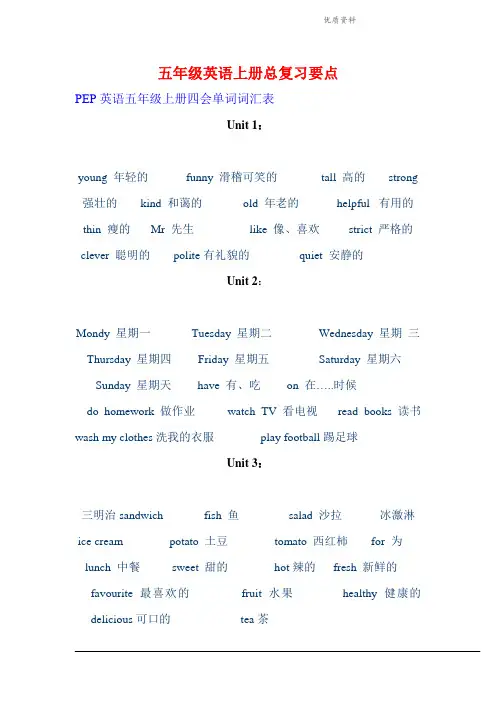
五年级英语上册总复习要点PEP英语五年级上册四会单词词汇表Unit 1:young 年轻的 funny 滑稽可笑的tall 高的 strong 强壮的kind 和蔼的old 年老的helpful 有用的thin 瘦的Mr 先生like 像、喜欢strict 严格的clever 聪明的 polite有礼貌的quiet 安静的Unit 2:Mondy 星期一Tuesday 星期二Wednesday 星期三Thursday 星期四Friday 星期五Saturday 星期六Sunday 星期天have 有、吃 on 在…..时候do homework 做作业watch TV 看电视read books 读书wash my clothes洗我的衣服play football踢足球Unit 3:三明治 sandwich fish 鱼salad 沙拉冰激淋 ice cream potato 土豆tomato 西红柿for 为lunch 中餐sweet 甜的hot辣的fresh 新鲜的favourite 最喜欢的fruit 水果healthy健康的delicious可口的tea茶五年级上册四会句子:1.谁是你的英语老师?王老师。
Who’s your English teacher?Mr Wang .2.他长得什么样?他(是)高而强壮。
What’s he like ?He’s tall and strong . 3.她很安静吗?不是的。
她很活跃的。
Is she quiet ?No, she isn’t. She’s very active.4.她很严格么?是的,但她很和蔼的。
Is she strict ?Yes, she is , but she’s very kind .5 今天星期几?星期二。
What day is it today ?It’s Tuesday.6 星期二你们上什么课?What do you have on Tuesdays ?7 我们上数学和科学课。
人教PEP小学英语五年级上册期末复习知识要点+期末测试卷(共2套 含答案 含听力材料)
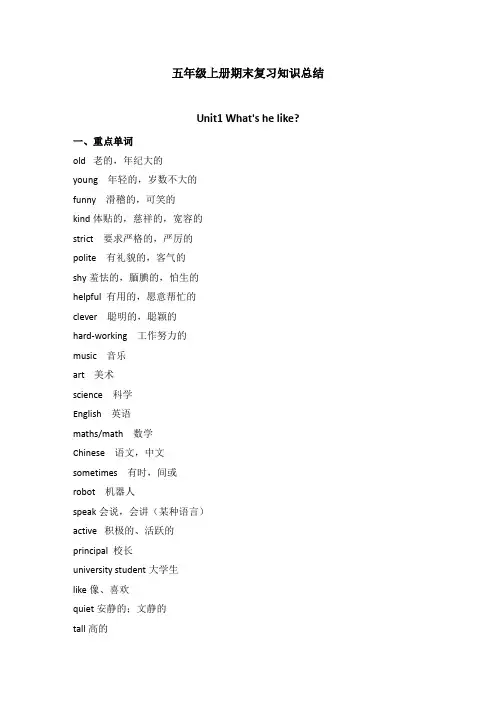
五年级上册期末复习知识总结Unit1 What's he like?一、重点单词old 老的,年纪大的young 年轻的,岁数不大的funny 滑稽的,可笑的kind体贴的,慈祥的,宽容的strict 要求严格的,严厉的polite 有礼貌的,客气的shy羞怯的,腼腆的,怕生的helpful 有用的,愿意帮忙的clever 聪明的,聪颖的hard-working 工作努力的music 音乐art 美术science 科学English 英语maths/math 数学Chinese 语文,中文sometimes 有时,间或robot 机器人speak会说,会讲(某种语言)active 积极的、活跃的principal 校长university student大学生like像、喜欢quiet安静的;文静的tall高的short矮的very 很、非常What's = what iswho's = who isshe's = she ishe's = he is二、重点句子(Who,What引导的特殊疑问句,用来对不熟悉的老师进行问答:Who's +某人?What's he / she like? He / She is + 与身体特征和性格特征有关的形容词。
)1.询问人—Who's your art teacher?谁是你的美术老师?—Mr. Jones.琼斯老师。
( Is引导的一般疑问句,谈论某位人是否具有某方面的特征:Is he / she + 与身体特征和性格特征有关的形容词,回答用:Yes, he / she is. No, he / she isn't. ) 2.—Is he young?他年轻吗?—Yes, he is. 是的,他年轻。
或—No, he isn't. 不,他不年轻。
—Is she strict?她很严格么?—Yes, she is , but she's very kind.是的,但她很和蔼的。
新人教版PEP五年级英语上册复习资料(全)
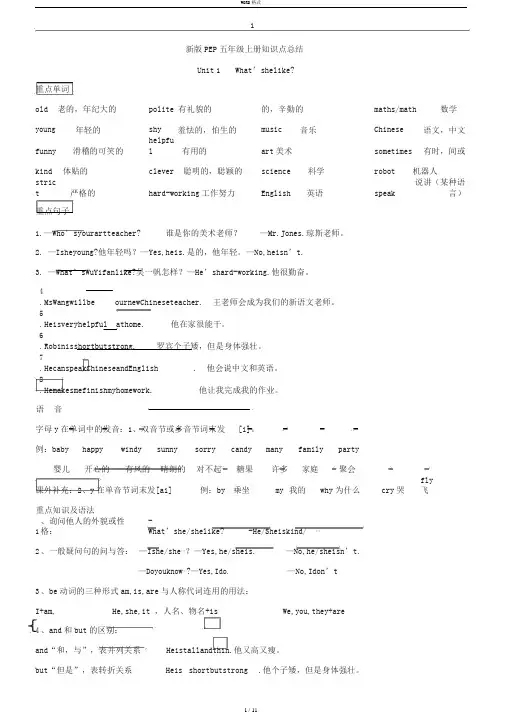
1新版PEP五年级上册知识点总结Unit 1 What’shelike?重点单词old 老的,年纪大的polite 有礼貌的的,辛勤的maths/math 数学young年轻的shy 羞怯的,怕生的music 音乐Chinese 语文,中文funny 滑稽的可笑的helpful 有用的art美术sometimes 有时,间或kind 体贴的clever 聪明的,聪颖的science 科学robot 机器人strict 严格的hard-working工作努力English 英语speak 说讲(某种语言)重点句子1.—Who’s yourartteacher? 谁是你的美术老师?—Mr.Jones.琼斯老师。
2.—Isheyoung?他年轻吗?—Yes,heis.是的,他年轻。
—No,heisn’t.3.—What’s WuYifanlike?吴一帆怎样?—He’shard-working.他很勤奋。
4.MsWangwillbe ournewChineseteacher. 王老师会成为我们的新语文老师。
5.Heisveryhelpful athome. 他在家很能干。
6.Robinisshortbutstrong. 罗宾个子矮,但是身体强壮。
7.HecanspeakChineseandEnglish . 他会说中文和英语。
8.Hemakesmefinishmyhomework. 他让我完成我的作业。
语音字母y在单词中的发音:1、双音节或多音节词末发[i]。
例:baby happy windy sunny sorry candy many family party 婴儿开心的有风的晴朗的对不起糖果许多家庭聚会课外补充:2、y在单音节词末发[ai] 例:by 乘坐my我的why为什么cry哭fly 飞重点知识及语法1、询问他人的外貌或性格:-What’s he/shelike? -He/Sheiskind/⋯2、一般疑问句的问与答:—Ishe/she⋯?—Yes,he/sheis. —No,he/sheisn’t.—Doyouknow⋯?—Yes,Ido.—No,Idon’t3、be动词的三种形式am,is,are与人称代词连用的用法:I+am, He,she,it ,人名、物名+is We,you,they+are4、and和but的区别:and“和,与”,表并列关系Heistallandthin.他又高又瘦。
新pep人教版五年级英语上册期中复习资料

五年级上册期中复习Unit1重点单词old年老的young年轻的funny 滑稽的kind和蔼的strict严格的polite 礼貌的helpful乐于助人shy害羞的hard-working勤奋的clever聪明的重点句型1、———Who's your art teacher? 谁是你的美术老师--—Mr Jones.琼斯老师。
2、—-—Is he young?他年轻吗?——- Yes,he is。
是的,他年轻。
--- No,he isn’t.不,他不年轻.3、—-—Is she funny?她有趣吗?---Yes,she is.是的,她有趣。
—--No,she isn’t.不,她不有趣.4、--—What’s Wu Yifan like? 吴一帆长什么样?—--He's hard—working. 他很勤奋。
5、——-Do you know Mr Young?你认识杨老师? ---Yes,I do. 是的,我认识。
No, I don’t。
不,我不认识。
6、Ms Wang will be our new Chinese teacher.王老师会成为我们的新语文老师。
7、He is very helpful at home. 他在家很能干。
8、He can speak Chinese and English.他会说中文和英语。
9、He makes me finish my homework。
他让我写作业。
发音/i/baby宝宝happy开心的windy刮风的sunny晴朗的sorry 对不起作文My friend She is Amy. She is 11. She is tall。
She is shy。
She is kind.语法:be动词的三种形式am,is, are,与人称代词连用的用法:I+am, he、she、it、人名、物名+is, we、you、they+are,识记口诀:我用am,你用are,is用于他、她、它,所有复数都用are,单数用isI polite. You helpful. She kind。
各单元作文期末复习(课件)人教PEP版英语五年级上册
写作步骤:
1.介绍朋友的身份 2.描述朋友的情况(外貌,性格等) 3.表达情感
My friend Hi.I’m Amy.Mike is my good friend.He is tall .He is
thin.He has big eyes.He is kind.He is polite.I like him.
Unit 4 What can you do?
写作步骤:
I’m Chen Jie.I am 11.I can sing.I can swim.I can draw pictures.But I can’t play football.I often swim on the weekend.What can you do?
PEP人教版五年级英语上册
Unit 1 What’s he like? Unit 2 My week
Unit 3 What would you like? Unit 4 What can you do? Unit 5 There is a big bed Unit 6 In a nature park
Unit 2 My week
写作步骤:
1.表达最喜欢的一天 2.具体描述喜欢的原因 3.总结
I’m Sarah.I like Friday best.I have English,PE and music class on Fridays.I like music class.I often sing songs in music class.
Unit 1 What’s he like?
写作步骤:
1.介绍老师的身份 2.描述老师的情况(外貌,性格等) 3.表达情感
My PE teacher Mr Zhang is my PE teacher.He is tall and strong.He is
PEP人教版小学五年级英语上册复习提纲
PEP人教版小学五年级英语上册复习提纲PEP英语五年级上册四会单词词汇表Unit 1:Young 年轻的funny 滑稽可笑的tall 高的strong 强壮的kind 和蔼的、亲切的old 年老的short矮的thin 瘦的Mr 先生like 像、喜欢strict 严格的smart 聪明的、巧妙的active 积极的、活跃的quiet 安静的、文静的very 很、非常but 但是Unit 2:Mondy 星期一Tuesday 星期二Wednesday 星期三Thursday 星期四Friday 星期五Saturday 星期六Sunday 星期天day 天have 有、吃on 在…..时候do homework 做作业watch TV 看电视read books 读书Unit 3:eggplant 茄子fish 鱼green beans 青豆tofu 豆腐potato 土豆tomato 西红柿for 为lunch 中餐we 我们tasty 好吃的sweet 甜的sour 酸的fresh 新鲜的salty 咸的favourite 最喜欢的they are 他们是fruit 水果grape 葡萄Unit 4:Cook the meals water the flowers 浇花sweep the floor 扫地clean the bedroom 打扫卧室make the bed 铺床set the table 摆饭桌wash the clothes 洗碗碟do the dishes 收拾衣服use a computer 使用计算机)Unit 5:curtain 空调trash bin 垃圾箱closet 壁橱mirror 镜子end table 床头柜bedroom 卧室kitchen 厨房bathroom 卫生间living room 客厅in 在…里面on 在…上面under 在…下面near 在..旁边behind 在…后边clothes 衣服Unit 6:river 河流flower 花grass 草lake 湖泊forest 森林path 路park 公园picture 照片hourse 房子bridge 桥tree 树road 公路building 建筑物clean 干净的五年级上册四会句子1.谁是你的英语老师?Carter先生。
新人教版PEP五年级英语上册各单元知识点复习总结
新人教版PEP五年级英语上册各单元知识点复习总结新版PEP五年级上册知识点总结Unit 1 What’s he like?重点单词old 老的,年纪大的young 年轻的,岁数不大的funny 滑稽的,可笑的kind 体贴的,慈祥的,宽容的strict 要求严格的,严厉的polite 有礼貌的,客气的shy 羞怯的,腼腆的,怕生的helpful 有用的,愿意帮忙的clever 聪明的,聪颖的hard-working工作努力的,辛勤的music 音乐art 美术science 科学English 英语maths/math 数学Chinese 语文,中文sometimes 有时,间或robot 机器人speak 会说,会讲(某种语言);用(某种语言)说话重点句子1. —Who’s your art teacher? 谁是你的美术老师?—Mr. Jones.琼斯老师。
2. —Is he young? 他年轻吗?—Yes, he is. 是的,他年轻。
—No, he isn’t.不,他不年轻。
3. —What’s Wu Yifan like? 吴一帆怎样?—He’s hard-working. 他很勤奋。
4. Ms Wang will be our new Chinese teacher. 王老师会成为我们的新语文老师。
5. He is very helpful at home. 他在家很能干。
6. Robin is short but strong. 罗宾个子矮,但是身体强壮。
7. He can speak Chinese and English. 他会说中文和英语。
8. He makes me finish my homework. 他让我写作业。
语音字母y在单词中的发音:1、双音节或多音节词末发[ i ]。
例:bab y happ y windy sunn y sorr y cand y man y famil y part y婴儿开心的有风的晴朗的对不起糖果许多家庭聚会课外补充:2、y在单音节词末发[ ai ]例:b y 乘坐m y 我的wh y 为什么cr y 哭fl y 飞重点知识及语法1、询问他人的外貌或性格:-What’s he/she like? - He/She is kind/…2、一般疑问句的问与答:—Is he/she…?—Yes, he/she is.—No, he/she isn’t.—Do you know…? —Yes, I do.—No, I don’t3、be动词的三种形式am, is, are与人称代词连用的用法:I + am,He, she, it,人名、物名+ isWe, you, they + are4、Ms., Miss, Mr., Mrs.的区别:Ms. [miz](缩略词)(用于女子的姓氏或姓名前,不指明婚否)女士;Miss [mis](用于未婚女子的姓氏或姓名前,以示礼貌)小姐,女士;Mr. [mist](mister的缩略词)(用于男子的姓氏或姓名前)先生;Mrs. [misiz](用于已婚女子的姓氏或姓名前)太太;夫人。
2017新人教版PEP五年级英语上册复习资料
2017新人教版PEP五年级英语上册复习资料Unit 1 My School LifeThis unit focuses on introducing school life vocabulary and phrases to students. Through various activities, students learn about different subjects, school facilities, and daily routines. Let's take a look at the key points covered in this unit.1. School SubjectsIn this section, students are introduced to different subjects they study at school, such as Chinese, English, math, science, and PE. They learn how to ask and answer questions about their favorite subjects, as well as express their opinions.2. Classroom ObjectsStudents learn the names of various objects they can find in the classroom, such as desks, chairs, blackboards, and books. Through interactive games and exercises, they practice describing the location of these objects and learn prepositions of place.3. Daily RoutinesThis section focuses on teaching students how to talk about their daily routines. They learn how to use simple present tense verbs to describe actions they do every day, such as 'get up,' 'brush teeth,' 'have breakfast,' 'go to school,' and 'come back home.' Through discussions and role-plays, they practice using these phrases in meaningful context.4. School FacilitiesStudents are introduced to different facilities they can find at school, such as the library, playground, computer room, and art room. They learn new vocabulary related to these places and practice asking and answering questions about them. This section also provides opportunities for students to give directions using simple prepositions, such as 'next to,' 'behind,' and 'opposite.'5. School LifeThis section focuses on encouraging students to talk about their school life experiences. They learn new words and phrases related to school activities, such as 'science fair,' 'sports day,' 'morning assembly,' and 'English corner.' Through group discussions and presentations, students share their own experiences and talk about their favorite school events.Unit 2 My FamilyThis unit introduces vocabulary and phrases related to family members, their roles, and activities. Students learn how to talk about their own families and ask questions about others. Let's explore the key points covered in this unit.1. Family MembersStudents are introduced to different family members, such as parents, grandparents, siblings, and relatives. They learn how to use possessive pronouns to describe family relationships and practice asking and answering questions about their own families.2. Family Roles and ActivitiesIn this section, students learn about different roles family members play at home, such as father, mother, brother, sister, and grandparents. They also learn about daily activities they do together, such as cooking, cleaning, playing games, and watching movies. Through discussions and role-plays, students share their own experiences and talk about their favorite family activities.3. My Family TreeStudents learn how to create a simple family tree to represent their own family members. They practice using possessive pronouns and present tense verbs to describe the relationships and activities of each family member. This section encourages students to share their family tree with their classmates and talk about their family members.4. Family Traditions and CelebrationsIn this section, students learn about different family traditions and celebrations, such as birthdays, New Year's Eve, and Spring Festival. They learn new vocabulary related to these festivities and practice asking and answering questions about how they celebrate these occasions with their families. Students also have the opportunity to share their own family traditions and celebrations.Unit 3 My FriendsThis unit focuses on introducing vocabulary and phrases related to friends, friendship, and activities with friends. Students learn how to describe their friends and talk about their favorite activities together. Let's explore the key points covered in this unit.1. Describing FriendsStudents learn how to describe their friends using adjectives, such as tall, short, thin, and kind. They practice using sentence patterns to talk about their friends' physical appearance, personality traits, and hobbies. Through interactive activities, students learn to appreciate diversity and respect their friends' differences.2. Likes and DislikesIn this section, students learn how to express their likes and dislikes. They learn new vocabulary related to hobbies and activities, such as playing basketball, painting, dancing, and reading. Through discussions and role-plays, students practice asking and answering questions about their friends' preferences.3. Activities with FriendsStudents learn how to talk about their favorite activities with friends. They learn new verbs related to different activities, such as playing games, going swimming, watching movies, and having picnics. Through group discussions and presentations, students share their favorite activities and talk about why they enjoy doing them with their friends.4. Being a Good FriendThis section focuses on teaching students the qualities of a good friend. They learn about kindness, honesty, cooperation, and respect. Students practice using sentence patterns to give advice and support their friends. Through role-plays and real-life scenarios, they learn how to be good friends to others.Unit 4 My HobbiesThis unit introduces vocabulary and phrases related to hobbies and interests. Students learn how to talk about their own hobbies and ask questions about others. Let's explore the key points covered in this unit.1. Hobbies and InterestsStudents learn how to talk about different hobbies and interests, such as playing soccer, drawing, singing, and collecting stamps. They practice asking and answering questions about their favorite hobbies and learn new vocabulary related to these activities.2. Everyday HobbiesIn this section, students learn about hobbies they can do every day, such as reading, watching TV, and playing games. They learn new verbs and phrases related to these hobbies and practice talking about their daily routines and free time activities.3. Exploring New HobbiesStudents are encouraged to explore new hobbies and interests. They learn new vocabulary related to various activities, such as cooking, gardening, photography, and playing musical instruments. Through discussions and presentations, students share their experiences of trying new hobbies and talk about their interests.4. My Hobby PresentationThis section provides students with the opportunity to create a presentation about their favorite hobby. They learn how to structure apresentation, use visual aids, and deliver their speech confidently. Through peer feedback and evaluation, students improve their presentation skills and learn to appreciate different hobbies and interests.Unit 5 My DayThis unit focuses on introducing vocabulary and phrases related to daily activities and time expressions. Students learn how to talk about their daily routines and schedule. Let's explore the key points covered in this unit.1. Daily ActivitiesStudents learn how to talk about their daily activities, such as waking up, eating breakfast, going to school, doing homework, and going to bed. They practice using simple present tense verbs and time expressions to describe their routines.2. Time ExpressionsIn this section, students learn how to use different time expressions to talk about specific times of the day, such as 'in the morning,' 'in the afternoon,' 'in the evening,' 'at night,' and 'at noon.' They practice using these expressions to create sentences and describe their activities at different times.3. My ScheduleStudents learn how to create a daily schedule to plan their activities. They practice using time expressions and verbs to describe their planned activities and learn how to talk about their schedule with others. This section encourages students to be organized and manage their time effectively.4. Time for FunIn this section, students learn how to talk about their favorite leisure activities and free time. They learn new vocabulary related to hobbies, sports, and entertainment. Through discussions and role-plays, students share their favorite leisure activities and talk about how they spend their free time.These are the key points covered in the 2017 New Edition PEP Grade 5 English textbook. By revising and practicing these topics, students will develop their language skills and enhance their understanding of the English language. Remember to review the vocabulary, practice speaking and writing, and engage in interactive activities to reinforce your learning.。