
形容词和副词的比较级和最高级完美版
形容词、副词的比较级和最高级一.形容词和副词的比较级和最高级的变化方法如下(1) 符合规则的:( 1)和冠词连用the +形容词原级+v(复),指一类人或物the +形容词比较级,指两者中“较…的”的那一个,eg. the younger of thea/ an +形容词比较级eg. The pen is expensive. I want a cheaper one.( a) +most+形容词最高级“非常…”eg. a most beautiful city( 2 ) 相关结构a. 原级比较:肯定句as….as…., 否定句not so / as….as…..b.比较句:比较级+than….或more (less) ….than…..The furniture in this shop is less beautiful than that in that shop.c.比较级+and+比较级或more and more+比较级“越来越… ”richer and richer, more and more interestingd. The more….., the more…..“越…,越…”The more you look at the picture, the better you will like it.e. 比较级+than any other +n. (单)(适用于范围一致时)(all) other +n.(复)any +n.(单) (适用于范围不一致时)He is taller than any other student / all other students in his class.any student in my class.f. 倍数表达法。
A is three(four, etc.)times the size(height, length etc.)of B.A is three(four, etc.)times as big(high, long, etc.)as B.A is three (four, etc.)times bigger(higher, longer, etc.)than B.用times 表倍数通常用于三倍以上,两倍可以用twice或double.The new building is four times the size (the height)of the old one.Asia is four times as large as Europe.Your school is three times bigger than ours.g. 最高级+of/ in/ among….He is the tallest of the three/ among them/ in is class.形容词、副词的比较级和最高级专项练习(一)写出下列形容词与副词的比较级与最高级形式:long __ wide __ ___ fat _ ___ heavy _____ ____ slow _____ ____ few _____ ____ brightly ___ _____ important ___ _____ far ____ ______ quickly ____ ____ happy ___ ____ many ___ ____ interesting __ __good ___ ___(二)用所给词的正确形式填空:1. He ran ______ than all the others. He ran _______ of all. ( fast )2. James played as ______ as you. Mary played _______of all. ( well )3. She waited ________ than she usually did. ( long )4. I walked _______ than the rest. I walked _______ of all. ( far )5. My friend came ________ than Pual and Mike. ( late )6. Among the three boys he works ________. ( hard )7. Bob left school ______ in his class yesterday. ( late )8. He swims as ______ as I do. ( badly )9. Who did _______ in the 100-metre race, Jim or Tim? ( badly )10. Both Li Ming and Li Hong sang __________, but I sang _______ of all. ( badly )11. Peter is as _______ as Tom. Benny is _____ than Tom. David is ______ of all. ( fat )12. Li Li found _________ mushrooms than I did. ( many )13. The elephant is ________ than any other animals. ( big )14. Man is ________ than animals. ( much clever )15. Lesson Two is a bit ________ than Lesson One. ( easy )16. I’m _______ boy under the sun. ( happy )17. Today is ________ than yesterday. ( hot )18. An elephant is _______ than a tiger. It is _______ animal on land. ( big )19. Mr. Li is _______ than your uncle. ( thin )20. Which book is _________, yours or mine? ( thick )21. This park is much _______ than that one. ( beautiful )22. The first book is more useful than the second one.The second book is ______ than the first one. ( useful )23. Allan is _______ of the three boys. ( strong )24. His marks are _______ than his friend’s ( bad )25. It is _______ to do this maths problem than to do that one. ( easy )26. My house is ________ to the farm than yours. ( far )27. My work is more important than yours. Your work is ________ than mine. ( important )28. Climbing this hill is _________. Climbing that hill is ________. Climbing Mt. Everest is _______ of all. ( dangerous )29. Mt. Everest is _________ than the Mont-Blanc. ( high )30. My mother drives very carefully. She is a _________ driver than my father. ( careful ).31. Of the two girls, I find Lucy the _______ (clever).32. Gold(黄金) is ______ (little) useful than iron(铁).33. My sister is two years _______ (old ) than I.34. John’s parents have four da ughters, and she is the _____ (young) child.35. The _____ (cheap) bags are the not usually the best ones.36. The short one is by far _______ expensive of the five.37. The boy is not so ______ (interesting) as his brother.38. Dick sings _____ (well), she sings ______(well) than John, but Mary sings______(well) in her class.39. She will be much ______ (happy) in her mew house.40. This dress is ______ that.(twice, as…as…, expensive)(三)选择填空:1. He feels _____ today than yesterday. A. tired B. more tired C. more tireder D. much tired2. Which do you like _____, coffee, tea or milk? A. the worst B. worse C. the worse D. worst3. Of the two toys, the child chose_____.A. the expensive oneB. one most expensiveC. a least expensiveD. the most expensive of them4. The line is ____ than that one. A. more longer B. not longer C. much more longer D. many more longer5. The earth is _____ the moon.A. as 49 times big asB. 49 times as bigger asC. 49 times as big asD.as big as 49 times6. The book is ____ of the two. A. thinner B. the thinner C. more thinner D. the thinnest7. She looks _____ than she does. A. the more older B. very older C. much older D. more older8. The garden is becoming ______.A. more beautiful and moreB. more beautiful and beautifulC. more and more beautifulD. more beautiful and beautifuler9. They competed(比赛)to see who could work _____.A. the fastest and bestB. the faster and the betterC. fastest and betterD. faster and better10.______ hurry, _______speed. A. More, less B. Much, little C. The more, the less D. The much, the little11. This kind of coffee is different ______.A. and it is also betterB. and better than the otherC. but also than othersD. from the other, and better(四)翻译句子:1.本书跟那本书一样有趣。
英语形容词和副词的比较级和最高级
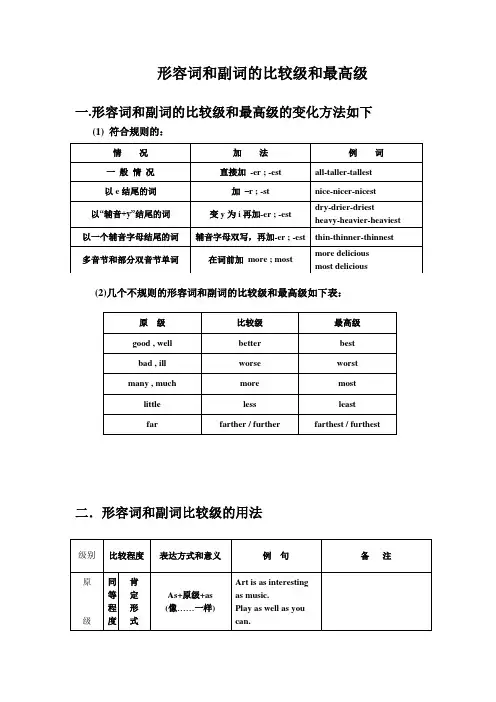
形容词和副词的比较级和最高级一.形容词和副词的比较级和最高级的变化方法如下(1) 符合规则的:(2)几个不规则的形容词和副词的比较级和最高级如下表:二.形容词和副词比较级的用法注意:有些形容词,如 dead, empty, round, sure, woolen 等受本身含义的限制,没有比较级。
例题解析1. He is ________ friends than I.A. much moreB. many moreC. very moreD. too more解析:后面有可数名词复数时,many的比较级形式为many more 修饰。
应选B.2. Which is the _________ country, Japan or Australia?A. more developedB. more developingC. most developedD. most developing解析:两者比较用比较级,表示"发达"用developed, 而developing 是"发展中的" 意思3. There were _______ shops in the city in 1982 than in 1990.A. littleB. fewC. fewerD. less解析:little 不能修饰可数名词,两者比较需用比较级,所以应选C.4. If you are not free today, come another day __________.A. tooB. soC. insteadD. yet解析:instead 作副词用时意为"代替,顶替",表示前面的事情没做,而是做了后面的事。
Instead一般位于句首。
应选C.5.He can't tell us ________, I think.A. important anythingB. anything importantC. important somethingD. something important.解析:不定代词与形容词联用需后置,否定句中应该用anything而不是something. 因此应选B6. The Huang River is the second __________ river in our country.A. longB. longerC. longestD. the longest解析:"定冠词the+ 序数词+ 形容词最高级" 表示"第几大……" 应选C.7. The light in the office wasn't ________for him to read.A. enough brightB. bright enoughC. brightlyD. enough brightly解析:enough修饰名词时可前可后,修饰形容词或副词时,要后置。
形容词,副词的比较级和最高级总结

形容词,副词的比较级和最高级一:比较级,最高级的构成1 在单音节形容词和部分以-er , -ow , -ble , -ple 结尾的双音节词后面直接+er;+est 例:warm → warmer → warmest high → higher →highest slow → slower → slowest able → abler → ablestsimple → simpler → simplest2 形容词,副词以e结尾时→+r;+st例:nice → nicer → nicestlarge → larger → largest3 形容词,副词以辅音+y结尾时→变y为i+er;+est例:busy → busier → busiest happy → happier → happiest**** shy → shier → shiest / shyer → shyestsly → slier → sliest / slyer → sl yest4 以一个辅音字母结尾的重读闭音节的形容词或副词→双写词尾字母再+er;+est例:hot → hotter → hottest big → bigger → biggest5 多音节词(3个或3个以上音节)和部分双音节的词在前面加→ more~;most~例:beautiful → more beautiful → most beautifuluseful → more useful → most usefulfamous →more famous → most famous6 不规则变化:7 特殊情况:⑴下列各词无比较级和最高级:wrong right correct true empty perfect excellent unique extreme extremely ready possible possibly chief main mainly final sufficient fatal primary absolute absolutely entire entirely infinite naked favorite⑵下列单音节词变比较级和最高级时在前面加more~;most~累的:tired → more tired → most tired高兴的:glad → more glad → most glad无聊的:bored → more bored → most bored喜欢的:fond → more fond → most fond高兴的,愉快的:pleased → more pleased → most pleased用旧的,用坏的:worn → more worn → most worn真的,真实的:real → more real → most real热衷的,喜爱的,着迷的:keen → more keen → most keen⑶下列词即可以直接+er;+est,又可以more~;most~聪明的 clever → cleverer → cleverest / more clever → most clever经常 often → oftener → oftenest / more often → most often残酷的 cruel → crueler → cruelest / more cruel → most cruel严厉的 strict → stricter → strictest / more strict → most strict狭窄的,狭隘的narrow → narrower → narrowest / more narrow → most narrow淘气的naughty → naughtier → naughtiest / more naughty → most naughty困的,想睡觉的sleepy → sleepier → sleepiest / more sleepy → most sleepy友好的friendly → friendlier → friendliest/ more friendly → most friendly充满活力的,活泼的lively → livelier → liveliest/ more lively → most lively安全的,可靠的secure → securer → securest / more secure → most secure浅的,肤浅的,无关紧要的shallow → shallower → shallowest / more shallow → most shallow有名的,众所周知的 well-known → better-known → best-known / more well-known → most well-known二:公式;1.A+V.+as+a.∕ad.(原级)+as+B.(as…as… 像…一样)→同级比较例句:This tree is as big as that one. 这棵树和那棵一样大。
形容词和副词的比较级和最高级

形容词和副词的比较级和最高级一、形容词和副词的比较级和最高级在我们的日常生活中,我们经常会使用形容词和副词来描述事物的特点。
有时候,我们需要对这些词进行比较,以便更好地了解它们之间的差异。
比较级和最高级就是用来表示这种比较的两种方式。
本文将详细讨论形容词和副词的比较级和最高级,以及它们在实际应用中的一些注意事项。
我们来看形容词的比较级和最高级。
形容词的比较级是在形容词原级的基础上加上-er或-est。
例如,tall(高的)变为taller(更高的),而big(大的)变为bigger(更大的)。
需要注意的是,有些形容词在构成比较级时需要进行特殊处理,例如good(好的)变为better(更好的),bad(坏的)变为worse(更坏的)。
有些形容词在构成最高级时需要加上the,例如beautiful(美丽的)变为the most beautiful(最美的)。
接下来,我们来看副词的比较级和最高级。
副词的比较级是在副词原级的基础上加上-er或-est。
例如,quick(快的)变为quicker(更快的),而slow(慢的)变为slower(更慢的)。
与形容词不同的是,大多数副词在构成比较级时不需要进行特殊处理。
也有一些例外,例如well(好的)变为better(更好的),而badly(糟糕地)变为worse(更糟糕地)。
同样,有些副词在构成最高级时需要加上the,例如fast(快地)变为the fastest(最快地)。
二、比较级和最高级的实际应用1. 形容词和副词在修饰名词时的运用在英语中,我们经常会使用形容词和副词来修饰名词,以便更准确地描述事物的特点。
当我们需要对两个或多个事物进行比较时,可以使用比较级和最高级。
例如:This book is more interesting than that one.(这本书比那本书更有趣。
)She sings the best in the choir.(她在合唱团里唱得最好。
常见形容词副词比较级和最高级

常见形容词副词比较级和最高级
常见的形容词和副词比较级和最高级对照表如下:
快 - 更快 - 最快
近 - 更近 - 最近
高 - 更高 - 最高
难 - 更难 - 最难
老 - 更老 - 最老
年轻 - 更年轻 - 最年轻
短 - 更短 - 最短
长 - 更长 - 最长
干净 - 更干净 - 最干净
大 - 更大 - 最大
晚 - 更晚 - 最晚
好看 - 更好看 - 最好看
接近 - 更接近 - 最接近
可爱 - 更可爱 - 最可爱
好 - 更好 - 最好
白 - 更白 - 最白
大 - 更大 - 最大
热 - 更热 - 最热
瘦 - 更瘦 - 最瘦
忙 - 更忙 - 最忙
早 - 更早 - 最早
容易 - 更容易 - 最容易快乐 - 更快乐 - 最快乐丑 - 更丑 - 最丑
友善 - 更友善 - 最友善美丽 - 更美丽 - 最美丽美味 - 更美味 - 最美味有趣 - 更有趣 - 最有趣耐心 - 更耐心 - 最耐心无聊 - 更无聊 - 最无聊缓慢 - 更缓慢 - 最缓慢可怕 - 更可怕 - 最可怕兴奋 - 更兴奋 - 最兴奋重要 - 更重要 - 最重要危险 - 更危险 - 最危险好 - 更好 - 最好
多 - 更多 - 最多。
形容词和副词的比较级和最高级笔记

形容词和副词的比较级和最高级笔记在英语学习中,形容词和副词的比较级和最高级是非常重要的语法点。
它们能够帮助我们更准确、生动地表达程度和数量的差异。
接下来,让我们一起来详细了解一下。
一、比较级的构成大多数单音节形容词和部分双音节形容词,在词尾加 er 构成比较级。
比如:tall taller,short shorter,young younger。
以不发音的 e 结尾的单音节形容词,直接加 r 构成比较级。
例如:nice nicer,large larger。
重读闭音节词,且词尾只有一个辅音字母时,要先双写这个辅音字母,再加 er 。
比如:big bigger,hot hotter,thin thinner 。
多音节形容词和部分双音节形容词,在前面加 more 构成比较级。
例如:beautiful more beautiful,important more important 。
二、比较级的用法1、两者之间的比较A + be +形容词比较级+ than +B ,表示“A 比 B 更……”。
例如:He is taller than me(他比我高。
)A +实义动词+副词比较级+ than +B ,表示“A 做某事比 B 更……”。
例如:She runs faster than him(她跑得比他快。
)2、比较级+ and +比较级,表示“越来越……”。
例如:It's getting colder and colder(天气变得越来越冷。
)3、The +比较级,the +比较级,表示“越……,越……”。
例如:The more you read, the more knowledge you will get(你读得越多,你获得的知识就越多。
)4、可以用 much、a little、a lot、even、far 等修饰比较级,加强比较的程度。
例如:He is much taller than me(他比我高得多。
形容词副词的比较级和最高级的变化规则及用法(完美版)
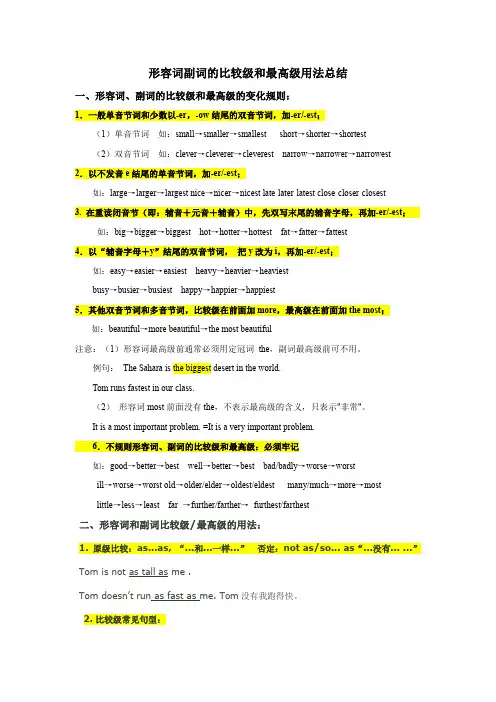
形容词副词的比较级和最高级用法总结一、形容词、副词的比较级和最高级的变化规则:1.一般单音节词和少数以-er,-ow结尾的双音节词,加-er/-est;(1)单音节词如:small→smaller→smallest short→shorter→shortest(2)双音节词如:clever→cleverer→cleverest narrow→narrower→narrowest2.以不发音e结尾的单音节词,加-er/-est;如:large→larger→largest nice→nicer→nicest late-later-latest close-closer-closest3. 在重读闭音节(即:辅音+元音+辅音)中,先双写末尾的辅音字母,再加-er/-est;如:big→bigger→biggest hot→hotter→hottest fat→fatter→fattest4.以“辅音字母+y”结尾的双音节词,把y改为i,再加-er/-est;如:easy→easier→easiest heavy→heavier→heaviestbusy→busier→busiest happy→happier→happiest5.其他双音节词和多音节词,比较级在前面加more,最高级在前面加the most;如:beautiful→more beautiful→the most beautiful注意:(1)形容词最高级前通常必须用定冠词the,副词最高级前可不用。
例句:The Sahara is the biggest desert in the world.Tom runs fastest in our class.(2)形容词most前面没有the,不表示最高级的含义,只表示"非常"。
It is a most important problem. =It is a very important problem.6.不规则形容词、副词的比较级和最高级:必须牢记如:good→better→best well→better→best bad/badly→worse→worstill→worse→worst old→older/elder→oldest/eldest many/much→more→mostlittle→less→least far →further/farther→furthest/farthest二、形容词和副词比较级/最高级的用法:1. 原级比较:as...as, “...和...一样...”否定:not as/so... as“...没有... ...”Tom is not as tall as me .Tom doesn’t run as fast as me. Tom没有我跑得快。
形容词和副词的比较级和最高级(完美版)
形容词和副词的比较级和最高级(完美版)1. 形容词的比较级和最高级形容词的比较级用于比较两个事物的性质或程度,最高级则表示一个事物在某一方面是最好的或最坏的。
- 比较级的构成:在形容词后加上 "-er" 或在前面加上 "more",例如:taller、more intelligent。
- 最高级的构成:在形容词后加上"-est" 或在前面加上"most",例如:tallest、most intelligent。
比较级和最高级的规则变化如下:- 以辅音字母+y结尾的形容词,变y为i,再加-er或-est,例如:happy -> happier -> happiest。
- 以短元音字母结尾的重读闭音节形容词,双写最后一个辅音字母,再加-er或-est,例如:big -> bigger -> biggest。
- 以一个辅音字母结尾的重读闭音节形容词,先辅音字母结尾,再加-er或-est,例如:thin -> thinner -> thinnest。
- 多音节和部分双音节形容词前加more或most,例如:beautiful -> more beautiful -> most beautiful。
2. 副词的比较级和最高级副词的比较级和最高级的构成方式与形容词类似,只是在形容词的基础上加上 "-ly" 构成副词。
- 比较级的构成:在副词后加上 "-er" 或在前面加上 "more",例如:faster、more quickly。
- 最高级的构成:在副词后加上 "-est" 或在前面加上 "most",例如:fastest、most quickly。
与形容词类似,副词的规则变化也遵循相同的规律。
(完整)形容词和副词的比较级和最高级(完美版).docx
形容、副的比和最高一.形容和副的比和最高的化方法如下(1) 符合的:情况加法例一般情况直接加 -er ; -est all-taller-tallest以 e 尾的加–r ; -st nice-nicer-nicest以“ 音 +y” 尾的y i 再加 -er ; -est dry-drier-driestheavy-heavier-heaviest以一个音字母尾的音字母双写,再加 -er ;thin-thinner-thinnest -est多音和部分双音在前加 more ; most more delicious most delicious(2)几个不的形容和副的比和最高如下表:原比最高good , well better bestbad , ill worse worst many , much more most little less leastfar farther / further farthest / furthest 二.形容和副比的用法比程度肯定原同等程否度定不同程度(用于两者比)比程度加深表达方式和意例句 (注 )As+原 +asArt is as interesting as music.Play as well as you can.(像⋯⋯一 )not + so (as) +原English is not so difficult as science.+as She does not study so well as I do.(不如⋯⋯那 )Jim is older比 +thanthan Luky.比前面可以加I like pork much, far, even, still,(比⋯⋯)better than a lot, a little, a bit 等beef.比 +and+比He is growing taller and taller.(越来越⋯⋯ )He studies better and better.The + 比, the +The more books she reads, the better 比she understand.(越⋯⋯ , 越⋯⋯)最高程度副最Spring is the best season of 高前最高(用于三The +最高 +of (in)the year.面的者或三者(最⋯⋯)Lin Tao jumped (the)the 往往以上)farthest of all.省略三.形容副比最高的其他用法( 1)和冠用the +形容原+ v(复),指一人或物the +形容比,指两者中“ ⋯的”的那一个, eg. the younger of the a/ an +形容比 eg. The pen is expensive. I want a cheaper one.( a) +most+形容最高“非常⋯” eg. a most beautiful city ( 2 ) 相关构a. 原比:肯定句as⋯ .as ⋯ .,否定句 not so / as⋯ .as ⋯..b.比句:比+than⋯或. more (less)⋯.than⋯ ..The furniture in this shop is less beautiful than that in that shop.c.比+ and+比或 more and more+比“越来越⋯ ” richer andricher, more and more interesting d. The more ⋯ .., the more 越⋯⋯..,“ 越⋯”The more you look at the picture, the better you will like it.e. 比+ than any other +n. ()(适用于范一致)(all) other + n.(复)any +n.( )(适用于范不一致)He is taller than any other student / all other students in his class.any student in my class.f. 倍数表达法。
形容词和副词地比较级和最高级(完美版)
形容词、副词的比较级和最高级一.形容词和副词的比较级和最高级的变化方法如下(1) 符合规则的:情况加法例词一般情况直接加-er ; -est all-taller-tallest以e 结尾的词加–r ; -st nice-nicer-nicest以“辅音+y”结尾的词变y为i再加-er ; -est dry-drier-driestheavy-heavier-heaviest以一个辅音字母结尾的词辅音字母双写,再加-er ;-estthin-thinner-thinnest多音节和部分双音节单词在词前加more ; most more delicious most delicious(2)几个不规则的形容词和副词的比较级和最高级如下表:原级比较级最高级good , well better bestbad , ill worse worst many , much more most little less leastfar farther / further farthest / furthest 二.形容词和副词比较级的用法级别比较程度表达方式和意义例句(备注)原同肯定As+原级+as(像⋯⋯一样)Art is as interesting as music.Play as well as you can.等级程度否定not + so (as) +原级+asE nglish is not so difficult as science.She does not study so well as I do.(不如⋯⋯那样)Jim is older比较不同程度(用于两者比较)比较级+than(比⋯⋯)t han Luky.I like porkbetter thanbeef.比较级前面可以加much, far, even, still,a lot, a little, a bit 等比较级+and+比较级He is growing taller and taller. 级(越来越⋯⋯)He studies better and better.程度加深The + 比较级,the + The more books she reads, the better比较级she understand.(越⋯⋯, 越⋯⋯)1最高级最高程度(用于三者或三者以上)The +最高级+of (in)(最⋯⋯)Spring is the best season ofthe year.Lin Tao jumped (the)farthest of all.副词最高级前面的the 往往省略三.形容词副词比较级最高级的其他用法( 1)和冠词连用the +形容词原级+v(复),指一类人或物the +形容词比较级,指两者中“较⋯的”的那一个,eg. the younger of thea/ an +形容词比较级eg. The pen is expensive. I want a cheaper one.( a) +most+形容词最高级“非常⋯”eg. a most beautiful city( 2 ) 相关结构a. 原级比较:肯定句as⋯.as ⋯.,否定句not so / as⋯.as ⋯..b.比较句:比较级+than ⋯或.more (less) ⋯.than ⋯..The furniture in this shop is less beautiful than that in that shop.c.比较级+and+比较级或more and more+比较级“越来越⋯”richer and richer, more and more interestingd. The more ⋯.., the more 越⋯⋯.. ,“越⋯”The more you look at the picture, the better you will like it.e. 比较级+than any other +n. (单)(适用于范围一致时)(all) other +n.(复)any +n.(单) (适用于范围不一致时)He is taller than any other student / all other students in his class.any student in my class.f. 倍数表达法。
完整word版形容词和副词的比较级和最高级
一、形容词和副词的概念形容词:是修饰名词(人或事物),表示名词的性质,特征或属性一种词类。
它在句中作定语、表语和宾语补足语。
词叫副词。
副词在句中多作副词:用来修饰动词.形容词及其他副词的状语.二、形容词和副词的用法的名词之前。
①形容词作定语一般放在被修饰big treesa new book, two。
如:等②形容词放在系动词be , get, turn, become, keep, stay, look, smell, feel, taste, sound, 等之后。
如:1. I am short・2・She looks fine・3・ They turn green.③如果形容词修饰不定代词something,anything, everything, nothing等时,要放在不定代词后面。
如:something interesting nothing new④副词放在所修饰的动词之后、形容词和副词之前。
如果前面是行为动词,则后面用副词。
如:1. She works hard・(修饰动词)2.I am very busy.(修饰形容词)3.He runs too quickly ・(修饰副词)4.We play happily.(修饰动词)⑤通常在形容词后加-ly变成副词。
slow —►____ real t ___________usual —> _____ careful—> _______easy —______ happy—> ________heavy —> ____ angi^y—* _______形容词副词比较级最高级变化形式归纳大多数形容词和副词有比较级和最高级的变化,即原级、比较级和最高级,用来表示事物的等级差别。
原级即形容词的原形,比较级和最高级有规则变化和不规则变化两种。
规则变化1 •单音节以及少数双音节的词后面直接加-er或-est最高级比较级原级tallest taller tallsmartest smarter smartshortestshorter shortesto结尾的双音节形容词末尾加特别提醒:以-y, -er, -ow, leer和healthy, funny, busy, hungry, easy, happy, early, pretty, lazy,如:heavy, dirty, clever, narrow o -stp或2.以不发音的e结尾只加最高级原级比较级nicest nice nicerfinest fine finerlargestlarge larger-est或i,再加-er3•“以辅音字母+y”结尾的词改y为最高比较原easiesteasiereasyprettiestprettierprettyhappiesthappierhappyfunniestfunnierfunnybusiestbusierbusy再加以一个元音加一个辅音字母结尾的重读闭音节词,双写后面的辅音字母,4 •一est最高级原级比较级thinnest thin thinner hottest hotter hotbiggestbigger big等词含有字母组合,且发的是长元音,不用new, few, slow, clean特别提醒: 双un构成的三音节形容词不适合上述情况,特别提醒:以形容前缀unhappy-一unhappier一一unhappiest, untidy一一untidier一一untidiest 如26.以形容词+ly构成的副词要在前面加more, most原级比较级最高级most slowly more slowly slowlymost quickly more quickly quicklymost angrily more angrily angrilymost softly more softly softlymost noisilymore noisilynoisily特另II提醒:early -- e arlier --- earliest7. ill ING分词和ED分词演变过来的形容词(包括不规则动词如know—known)只能加more或most来表示它们的比较级和最高级。