
最新仁爱版八年级上册 Unit 4 Our world Topic 1 Section C导学案
最新教学资料·仁爱版英语Unit 4 Our world Topic 1 Section C导学案thick , ground, wet, cover, forest, earth, surface, control, die, wood, protect2. 能正确拼读并运用黑体单词:thick , ground, wet, cover, forest, rainforest, earth, surface, control, die, wood, protect3. 能正确使用“比较级and比较级”的形式。
Skill aims:1. 能基本听懂本课文本材料及简单的环保倡议书。
2. 能正确地口头介绍森林带给我们的好处,并建议大家保护环境。
3. 能正确朗读课本的文本材料,并能读懂相关的文本材料。
4. 能写一份简单的有关环保的倡议书。
Emotional aims:通过对热带雨林的学习,加深对森林的认识,学会从小事做起,从自己做起,保护环境。
二、学习重点(Key points):1. 复习形容词比较级、副词的用法。
2. 学习热带雨林的相关知识。
3. 学习有顺序、连贯的书写倡议书。
三、学习难点(Difficult points):熟练应用形容词的比较级和最高级。
四、学习策略(Learning strategies)1. 在写文章的时候,用上适当的连词如:and, but, however, while等,可以让文章更加连贯。
2. 阅读时上一段的最后一句很有可能会提示你下一段的主要内容。
一、自习自疑(一)词汇过关I.看第136页P.85的新单词,试拼读,并小组内相互拼读。
II.熟记并默写。
1.(热带)雨林2.茂密的;厚的;浓的3.森林4.地,地面5.湿的,潮湿的6.覆盖;掩盖;盖子7.地球;土,泥;大地 8.表面 9.成千上万,几千10. 无处,哪里都不 11.控制 12.气候 13.死,死亡14.灭绝;消失 15. 木头,木材;树木,森林 16.保护(二)阅读教材一. 写出下面形容词或副词的比较级和最高级1. small-- --2. fresh -- --3. clean-- --4. beautiful -- --eful -- --6. hot -- -- (三)在文中划出下列短语并翻译1. in the hot parts of the world2.a lot3.the earth’s surface4.thousands of5. on earth6. thousands and thousands of7.live in8. help to do sth.9.die out 10. smaller and smaller(四)在文中找到下列句子并翻译总结1.Rainforests cover 6% of the earth’s surface.译:(1)cover 动词:覆盖。
cover… with…用……覆盖……如:水覆盖着地球大部分地区。
Water most parts of the earth.他们给她盖上了毛毯。
They her a blanket.cover 名词:封皮,封面,封底;from cover to cover.从头到尾。
(2)百分数的读法:先读基数词,再读百分号“%”—percent。
如:6%读作six percent。
(3)surface 名词:表面,表层。
on the surface 表面上,从外表看。
2. Thousands and thousands of animals live in rainforests.译:thousands and thousands of 成千上万的。
当hundred ,thousand ,million ,billion 等表示不确定的树木时,常用复数形式,后面跟介词of,意为“数以百计的,成千上万的,数百万计的,几十亿”。
注:当这些词与具体数词连用时,则不用复数形式。
如:天上有数百万颗星星。
There are of stars in the sky.五百 five 六百万 six 七千 seven3. They play an important part in controlling the climate.译:。
(1)play a part ( in sth. )意为“(在某事中)起作用;参与(某事)”。
(2)control 动词:控制。
Control oneself 控制自己。
4. Without rainforests , many beautiful plants and animals would die out.译:。
die 动词:死,死亡。
die out 灭绝,消失。
dead 形容词:死的。
那是一条死的狗吗?译:?它是半小时前死的。
译:。
5. But now , rainforests are becoming smaller and smaller , so we should prote ctthem . 译:。
smaller and smaller 越来越小。
“形容词比较级+and+形容词比较级”结构表示“越来越……”的意思。
“the +形容词比较级,the+形容词比较级”表示“越……,就越……”。
protect 动词:保护。
protect sth./sb. from sth.保护某物/某人免于……天气变得越来越暖和了。
译:。
你吃巧克力越多,你就会越胖。
译:。
6.They provide places to live for thousands of plants and animals found nowhereelse on Earth.译:。
表示我们生活的地球,用earth,Earth,the earth都可以。
即无论大写还是小写,前面不加the,都表示“地球”。
on earth 还可以表示“到底,究竟”,但on the earth则无此意。
如:你究竟是谁?Who on earth are you ?二、自疑:将预习中不能理解的短语和句子写下来,等待课堂上与老师和同学探究解决。
家长签字________________预习等级_____________组长签字_______________三、自主探究活动一:听磁带,朗读课文1a部分1.模仿纯正的语音语调,纠正错误的发音2.独自、小组朗读课文活动二:剖析课文,解决疑惑。
结合自身知识疑惑,小组讨论,师生共同解惑。
1.掌握“cover, earth, surface, dark, forest, thousands of”等单词和短语2.完成1b3.完成1c,并作报告,说出雨林的重要性。
活动三:综合运用能力提升。
1.小组活动,讨论保护雨林的办法。
2.根据讨论写一篇短文。
四、自测(一)单项选择( )1. The TV is for people to watch clearly.A. small enoughB. enough smallC. large enoughD. enough large( ) 2. We live .A. on earthB. on the earth C . in earth D. in the earth( ) 3. He his schoolbag a lot of booksA. fill; inB. fills; ofC. filled; withD. filled; of( )4. The number of wild animals is becoming .A. much more s mallB. much more smalle rC. smaller and smallerD. small and small( )5. Eighty students our class.A.makes upB. make upC. make ofD. make from(二)根据首字母提示完成句子1. We should p the wild animals.2. In f , he can’t speak English at all.3. We should save every d of water on earth4. Water c most of the earth.5. There are t of people in the city.(三)完形填空Many animals use some kind of “language”. They use signals(信号)and the signalshave meanings. For example, when a bee(蜜蜂) has found some food, it goes 1 home.It is 2for a bee to tell 3 bees where the food is by speaking to 4 , but it can doa little dancing. This tells the bees where the food is and 5 it is.Some animals show how they feel by making sounds. It is not difficult to 6 .If a dog is angry, it barks(吠). Birds make several different sounds and 7 hasits own meaning. Sometimes we humans make sounds 8 . We make sounds like“Oh!”or“Ouch!”to show how we feel about something or when we 9 something on our feet.We humans have languages. We have words. These words have the meaning of things,actions(行动), feelings or ideas. We 10 give each other information. Writingdown words, we can remember what has happened or send messages to people far away.( )1. A. out of B. on with C. away from D. back( )2.A .important B. difficult C. necessary D. impossible( )3.A. each other B. another C. other D. others( )4.A. it B. him C. them D. themselves( )5.A.how long B.how far C.how many D.how old( )6.A.watch B.see C.look D.tell( )7.A.each B.every C.all D.some( )8.A.in the same sound B.by different soundsC.in the same wayD.by different ways( )9.A.put B.drop C.fall D.set( )10.A.could B.are able to C.couldn’t D.be able to五、自结我想说:学了section C, 我的收获有(从短语结构、重点句型、语法等方面总结)—— 1.本课主要学习了有关热带雨林的话题内容,使我们认识到热带雨林对重要性。
英语仁爱版八年级上册《Unit 4 Our World Topic 1 What's the 》课件公开课 (3)
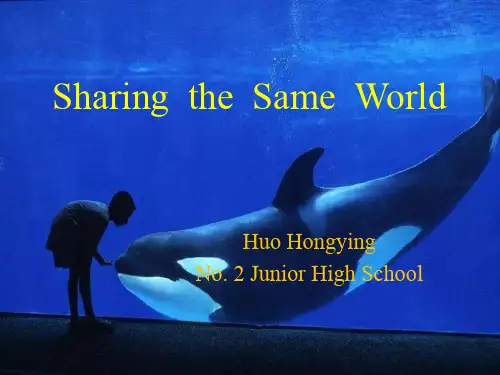
The _tra_g_ic_life of Tilikum
being c_a_pt_ur_ed___ at the age of 2
killed
_____three people during his life
d_i_e_d___on January 6th, 2017
Is killing 3 people Tilikum's fault?
林深时见鹿,海蓝时见鲸。
The oldest orca died at the age of 105.
But my friend, Tilikum-the killer whale died only when he was 36 in 2017.
Are the two passages telling the same thing? Why do you say so?
• There is enough evidence that we humans can live in harmony with animals.
Summary:
• How to read English articles when it is difficult for you to understand?
Homework
• Write a passage the ideal home for animals according to your reports.(You can have your own solutions)
Thank you!
You should write down your group members' opinions on your paper.
Every coin has two sides.
【课件】Unit4Topic2SectionC课件++2022-2023学年仁爱版八年级英语上册

Topic 2 How can we protect ourselves from the earthquake?
Section C
Learning Objects
What will we do today?
1. Learn some new words and useful expressions. 2. Know about some ways to keep safe in the earthquake. 3. Talk about how to keep safe when natural disasters happen.
help others in danger
after-earthquake
stay calm
1c Read again and answer the following questions.
1. When can earthquakes be very serious ? When the earthquakes happen near a city, they can be very serious.
Retell
Retell Paragraph 2 with the help of the mind map.
stay under a strong table or desk
sit on the floor in protect your head and a doorway or close neck with arms to the wall
stand near a tall tree
protect your head with your arms
八年级英语上册:Unit-4--Our-world-Topic-2-Section-C省公开课一等奖
1. We learn : some phrases. keep sb. / sth. + adj. close to stay away from = get away from be over
2. We know some ways to protect ourselves in an earthquake.
3. Stay away from windows … stay away from = get away from 远离…… Eg: 我们应该远离一切危险东西。 We __s_h_o_u_l_d__s_t_a_y__a_w_a_y__f_r_o_m___ everything dangerous.
If you … the safest place … Sitting on … Remember to protect your head … Stay away from windows … Do not try to …
第12页
Paragraph 3 :
If you are out of doors … Get away from … Be very …
第17页
b
a
e
c
d
第18页
Find more useful expressions to use in the 2b table with should and shouldn’t do. Then write
down sentences based on 2a and exchange ideas with your partner.
3. What does the word “aftershocks” mean ?
It means “余震”.
八年级英语上册:Unit4OurworldTopic1SectionA
The geese are the biggest of all.
small big
thin
The ducks are a little thinner than the geese.
<
The ducks are much thinner than the pigs.
small big
The mice are smaller than the hens.
The hens are smaller than the geese.
The mice are the smallest of all.
<
<
>
>
The hens are bigger than the mice.
Unit 4 Topic 1 Which do you like better, plants or animals Section A
Animals on the farm
a pig
a cow
a horse
a rabbit
a hen
a cat
a dog
a duck
a sheep
a goose
a mouse
four sheep
two geese
five mice
Attention
Learn Together
The dogs are small.The cats are smaller.The mice are the smallest.
cow
countryside n. 农村,乡下
fresher
Unit4+Topic2+Section+D+教案 仁爱版英语八年级上册+
初中英语仁爱版八年级上册Unit 4 Our WorldTopic 2 How can we protect ourselves from the earthquake?Section D【Teaching aims】知识与能力:1. 引导学生复习本话题的重点词汇。
2. 引导学生复习形容词的比较级和最高级的变化规则及其在句子中的具体使用。
3. 引导学生熟练谈论有关地震的话题,能用英语自由地交流如何从自然灾害中逃生。
核心素养:1. 能听懂有关灾难的话题,以及介绍如何在灾难中逃生的短文。
2. 能用英语谈论生活中发生的有关灾难的话题,如地震、火灾、暴风雪等以及用比较级和最高级谈论在灾难中如何保护自己。
3. 能够读懂跟课文水平相当的文章,如介绍火灾、洪涝、旱灾的文章等。
4. 根据所学内容用新闻的方式写出介绍某种自然灾害的文章,并能够写出如何在灾难发生的时候好好保护自己。
【Teaching key points and difficult points】Key points:1. 复习形容词比较级和最高级的用法以及本单元的功能句,如:I am sorry to hear that等。
2. 学习新闻的写作方法。
Difficult points:根据新闻的要素进行新闻写作。
【Teaching methods】Situational language learning, task-based language teaching, group discussionteaching.【Teaching procedures】Lead in:1. Get students ready for learning.2. Invite students to report his/her homework.3. Show the pictures, make a short conversation.A: The __________ is ________.B: I think the ________ is _________ than the ________.C: Yes, but the _________ is __________ of the three.Presentation:1. Give students 3 minutes to read through Sections A-C. Ask them to underline or write down the key points they think.2. Provide 1 minute for students to classify their notes.3. Make a competition. Divide students into three parts. One part writes down the new words, and another part writes down the new sentences. The last part aims to write down the phrases. There are three groups in each part.4. Ask students to look at the blackboard and check whether they can remember all of these on the blackboard.5. Show “Grammar and Functions” to students. And check the answers.6. Organize students to read “Grammar and Functions”.7. Give explanations if necessary.Presentation:1. Ask students to read the passage in 1 carefully.2. Show the first table on Page 96 to students. Make sure every student knows the meaning of the table. Complete the table.3. Invite students to share their answers.4. Listen and find out important phrases. Learn the key points.1) five million2) with the help of …3) the whole nation4) rebuild their homes5) return to normal life6) be able toConsolidation:1. Show the table in 2 to students.2. Ask students to write a piece of news similar to 1 about Tangshan earthquake. Remind students to pay attention to the elements in news.3. Invite students to share their news in class.4. Organize students to choose the best announcer and the best team.5. Praise the best announcers.6. Finish Project. Ask your friends how they feel about children from disaster areas.7. Make a short report to your class about your survey.8. Write a letter to the children in disaster areas. Give your comfort, concern and best wishes to them.9. Do some exercises.Summary:We learn:1. 复习形容词比较级和最高级的用法以及本单元的功能句。
八年级英语上册 Unit 4 Our World综合能力演练1(含解析)(新版)仁爱版

Unit 4 Our World综合能力演练I. 单项选择1. —Kangkang, can I borrow your bike?—_______A. I’d love to.B. Thank you.C. Sure.D. You’re welcome.2. —Excuse me, Maria. These are new words. Can you help me _______ in the dictionary?—Certainly.A. look it upB. look up itC. look up themD. look them up3. —We can use QQ to chat online.—Really? Could you please show me _______ it?A. what to doB. how to doC. when to doD. why to do4. What a good boy! He_______ every Sunday volunteering at an old person’s hom e.A. spendsB. givesC. usesD. takes5. —Now the air in our hometown is even _______ than it was before.—So we must do something to stop it.A. dirtyB. betterC. worseD. cleaner6. Pens are helpful to humans. Students use pens for _______.A. writeB. writesC. wroteD. writing7. There _______ some forests here ten years ago. But now we can see nothing.A. used to haveB. used to beC. is used to beD. was used to have8. The students think English is very important, so they try _______ it well.A. learnB.to learnC. learningD.to learning[真题链接]1. —How can we protect ourselves ________ the earthquake?—We should stay calm first.A. withB. aboutC. forD. from2. —The picture is, I have to say, not a bit beautiful.—Why? It’s ________ than the pictures I have ever seen.A. far more beautifulB. much less beautifulC. no more beautifulD. any less beautiful3. —Bob, where is Linda?—She be in the library, but I am not sure.A. mustB. mayC. needD. has toII. 阅读理解AMany people are interested in UFOs and there are a lot of reports about them. One report of UFOs came from a British plane on its way from New York to London in 1954.The British plane was flying over an island at 19,000 feet when the captain(机长) noticed that something was on their left and a little lower(更低) than their plane. It was about five miles away.“It was not one object but several ones.” the captain said, “We saw one large and six smaller objects. I sent out a radio report about them and I got some information that the other planes were coming out to meet us. Before the planes arrived, the smaller objects went into the big object. The big object then became smaller and moved away fast.”1. A British plane flew to _______ in 1954.A. Now YorkB. LondonC. BeijingD. Sydney2. There was something on the _______ of the plane.A. aboveB. middleC. leftD. right3. The captain saw _______ in the sky.A. there was something higher than their planeB. there was one large object and six smaller objectsC. the big object disappeared at onceD. all of above4._______ would come to meet them.A. The other planesB. The other captainsC. A UFOD. The radio5. This passage is mainly about _______.A. the radioB. a British planeC. seven objectsD. one report about UFOsBNew Technology Revolutionizes(变革) LearningMore and more people believe that technologies are great for learning. Today, such teaching tools as iPads are used in a lot of courses, including language, history and science.Many teachers are supporters of using iPads in language learning. They say that students now have much more time for discussion in the classroom. Instead of spending valuable class time listening to texts or watching teaching videos, students can do this on their own and come to class prepared for discussion.The teachers also say that iPads allow students to learn at their own pace. Some students might listen to a dialogue only once and understand it, so they can save time for doing other things. Other students, however, might need to listen to the same dialogue again and again to understand it. Using iPads is especially helpful to students who are learning a language at different paces.The students who are using the new tool in some courses are also happy. They believe that using iPads is a more enjoyable way to learn (such as listening to stories and watching movies). The class has become much more interesting and creative.There are other advantages for students. By using iPads, they can pay more attention to the material and learn more. Teaching notes are stored in their iPads and are easy to find .Some students spend more time studying now. “I can listento my language material or watch teaching videos on the bus, instead of having to wait until I get home,” a student explained.Many adults complain that technologies such as iPads are doing harm to students. They worry that students might use iPads to download teaching notes and use them to cheat during exams. Some believe that iPads may separate students from each other. If a student spends more time watching videos on an iPad, he will have fewer opportunities to have face-to-face communication with others.However, technologies are already a part of most students’ day-to-day lives. As for cheating, teachers can ask students to hand in their iPads when they take exams. Education needs to make changes with the times as technology is playing an important part. We should look forward to a wonderful future when iPads and other technologies can add a lot to the classroom.6. What does the expression “at their own pace” in Paragraph 3 probably mean?A. According to their own timetable.B. Without their teachers’ help.C. Because of their wonderful goals.D. Against their parents’ hope.7. From the passage we can learn that____.A. students with iPads have less discussion in classB. students get more fun from learning with iPadsC. iPads help students save time waiting for busesD. iPads prevent students from cheating in exams8. The writer probably agrees that____.A. teacher s can take control of students’ learningB. exam results depend a lot on now technologyC. technology in education has a bright futureD. note-taking is as helpful as video-watchingIII.书面表达现在学生在网吧上网(get on-line)成风,你们班在下周班会上将谈论有关问题。
八年级英语上册 Unit 4《Our World》Topic 3 Section C 教案 仁爱版
Topic 3 The workers used live models, didn’t they?Section CThe main activityis 1a. 本课重点活动是1a。
Ⅰ. Teaching aims and demands 教学目标1. Learn some new words and phrases:king, ancient, be made up of, true, according to2. Learn some useful sentences:(1) The building is made up of two million stones.(2) Each stone weighs more than two tons.3.Go on learning about measurement:(1) The Great Pyramid has four sides and each side is 230.4 meters long.(2) It’s 146.5 meters high.4.Talk about the Great Pyramid:(1) The pyramids in Egypt are world-famous.(2) It is one of the“Seven Wonders”of the ancient world.(3) Until the 19th century, it was the tallest building on earth.(4) It took about 100 000 people over 20 years to build it.(5) Khufu ordered his men to build the Great Pyramid as his tomb in about 2 560 B.C.(6) Many people believe the Great Pyramid is the oldest and greatest building in the world. Ⅱ. Teaching aids 教具录音机/幻灯片/图片/小黑板Ⅲ. Five-finger Teaching Plan 五指教学方案Step 1 Review 第一步复习(时间:8分钟)师生对话,复习旧知识,导入新课。
仁爱版八年级英语上册导学案(完整修改版)
仁爱版八年级英语上册导学案(完整修改版)Unit 1 Playing SportsTopic 1: Are You Going to Play Basketball?n AXXX:1.Master the words。
key phrases。
and sentence structures on Pages 1-2.2.Proficiently grasp the structure of "be going to + verb" to express the simple future tense.Key Points:1.Simple XXXConcept: XXX future。
ns。
plans。
or ns。
Basic structure: be going to + do (verb)。
XXX。
next day (week。
month。
year。
)。
soon。
the day after tomorrow。
etc.Negative form: add "not" after the auxiliary verb "be" (am。
is。
are).General n: move the auxiliary verb "be" to the beginning ofthe sentence。
change "some" to "any," "and" to "or," and swap the first and second person.For example: I'm going to have a XXX.I'm not going to have a XXX.We are going to go on an outing this weekend.Are you going to go on an outing this weekend?2."see sb do sth" means "XXX" and refers to the entire process of the event or n that has already ended.XXX" emphasizes that the event is XXX.3."have a。
仁爱英语八上导学案全
111仁爱版八年级英语教案 Unit1 Playing sportsTopic1 Are you going to play basketball? Section A学习目标:掌握Page1-2的单词,重点短语及句型.熟练掌握“be going to +动词原形”的结构表示的一般将来时。
积极、主动的参与课堂。
学习重难点:1.一般将来时来时概念:表示将要发生的动作或存在的状态及打算、计划或准备做某事.基本结构:be going to + do(动词原形); .句中一般有以下时间状语:tomorrow, next day(week, month, year…),soon, the day after tomorrow(后天)等。
否定句:在be动词(am, is, are)后加not;一般疑问句: be提到句首,some改为any, and改为or,第一二人称互换。
例如:I'm going to have a picnic this afternoon.→ I’m not going to have a picnic this afternoon。
We are going to go on an outing this weekend。
→ Are you going to go on an outing this weekend?2. see sb do sth “看见某人做某事”表示看见事件、行动的全过程,动作已经结束。
see sb doing sth “看见某人正在做某事”强调事件正在进行.3.have a … game against …“同…进行一场…比赛”4。
cheer…on “为某人加油(喝彩)”5.-— Would you like to do sth?—— Sure, I’d love to.6. Me,too。
自学引导:1、自学Page1-2的单词。
(根据音标拼读、拼写单词并牢记)。
Unit 4 Topic 1 精讲-2021-2022学年八年级英语上册单元重难单词短语句(仁爱版)
同步课堂仁爱版八年级英语上Unit 4 Our WorldTopic1 we share the world with plants and animals一、重点词语sky天,天空river河,江clear清澈的;明白清楚地,明显的;晴朗的。
移走,清除nature自然;性质horse马sheep(绵)羊;驯服者hen母鸡cow母牛,奶牛thin瘦的;薄的;稀的rose玫瑰花thick茂密的;厚的;浓的forest森林ground地,地面wet湿的,潮湿的cover覆盖,遮盖;掩盖。
盖子;罩earth地球;土,泥;大地surface表面control控制climate 气候die死,死亡wood木头,木材;树木,森林protect保护feed喂(养),饲养bamboo竹less(与不可数名词连用)较少的,更少的land陆地;土地。
登岸(陆);降落sea海,海洋south南部;南方;南风;南。
南(方)的;向南的;从南来的。
在南方;向南方;自南方二、词组1.share…with 与……共享2.play with 玩弄,玩耍3.in danger 在危险之中4.feed on 以……为食5.think about 考虑,思考6.enjoy nature 享受自然7.at night 晚上8.in the daytime 白天9.summer vacation 暑假10.thousands of 成千上万11.in fact 事实上12.find out 查明,发现13.in nature 在自然界三、重点句型1.Plants are more beautiful than animals.植物比动物更漂亮。
2.The plants stay green longer there.那儿的植物能更长时间保持绿色。
3.The rainforests are very important to us.(热带)雨林对我们很重要。