
牛津译林版七年级下册Unit5Amazingthingswelcometotheunit
牛津译林版 7BUnit 5 课文默写(含答案)
“What happened?” Andy asked.
“公园里有鬼!”米莉说。
“There is a ghost in the park!” Millie said.
然后她把一切都告诉了安迪。
Then she told Andy everything.
“这是什么?”安迪很好奇。
他不想停下来吃饭,所以他把肉夹在两片面包中间。
He did not want to stop for meals, so he put meat between two pieces of bread.
很快,其他人也想吃同样的食物,所以他们要了一个“三明治”。
Soon others wanted to eat the same food, so they asked for a “sandwich”.
那很酷!你知道什么了不起的事吗,米莉?
That's cool! What amazing things do you know, Millie?
前几天我读到一个人的故事。
I read about a man the other day.
他可以一只手写字,同时另一只手画画。
He can write with one hand and draw with the other at the me time.
那真的很神奇!
That's really amazing!
你呢,彼得?你知道什么神奇的事情吗?
What about you, Peter? Do you know any amazing things?
我了解了一位艺术家。
I learned about an artist.
【最新】牛津译林版七年级英语下册Unit 5 Amazing things精品课件(共35张PPT)

e.g.1.你每天早上几点起床? What time do you get up every morning? 2.我每天有大量的时间做作业。 I have plenty of time to do homework.
Practice:
(1)To visit the science museum helps us to learn more about amazing ________(amaze) things in the world. amazed (2)The teacher was _________ (amaze) at the boy’s action. (3)You won the boy’s relay race. That’s _________ (amaze) amazing
Try to learn the new words.
表示天体时, 首字母大写, the Earth 表示一般意义 的太阳和地球 elephants 时则小写。 the Sun big ear at the back of long nose “在…的背部” back
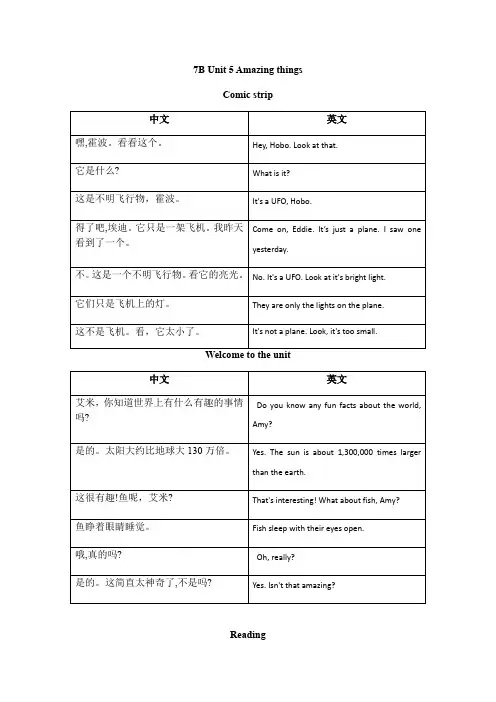
Match the picture with the sentences.
No. It’s a UFO. Look at its bright lights.
It’s not a plane. Look, it’s too small.
Retell the dialogue.
One day Eddie and Hobo looked at
Unit 5 Amazing things 表格式教案

(3)The Sun is about 1,300,000larger than the.(times Earth)
(4)There are noin the back of elephants’ feet----only fat.(bones)
3.To introduce students to unusual phenomena and events.
重点难点
1.To understandthe concept of things that areunusual.
2.识记有关Amazing things的词汇和用形容词表达自己感觉。
教学过程
3.Answer:They’re talking about Picture1and4.They think they’re interesting and amazing.
4.Read after the tape.
5.Read in roles.Read together.Try not to look at the book if you can.
Which one is larger,the Sun or the Earth?Yes,of course the Sun.
5.Show the other three pictures.
There are three moresenescesabout amazing things.Please read them inpairs and find the new words.
2.Let’s read the sentences again.And try to remember them.
2020—2021学年牛津译林英语七年级下册 unit 5 Welcome to the 教案
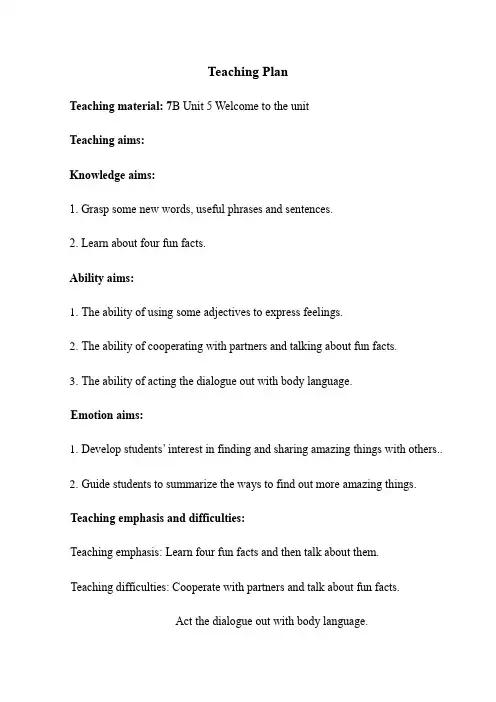
Teaching PlanTeaching material: 7B Unit 5 Welcome to the unitTeaching aims:Knowledge aims:1. Grasp some new words, useful phrases and sentences.2. Learn about four fun facts.Ability aims:1.The ability of using some adjectives to express feelings.2.The ability of cooperating with partners and talking about fun facts.3.The ability of acting the dialogue out with body language.Emotion aims:1.Develop students’ interest in finding and sharing amazing things with others..2.Guide students to summarize the ways to find out more amazing things. Teaching emphasis and difficulties:Teaching emphasis: Learn four fun facts and then talk about them.Teaching difficulties: Cooperate with partners and talk about fun facts.Act the dialogue out with body language.Teaching aids: MultimediaTeaching Procedures:Step 1 Lead inWatch a short video about the amazing things that Doraemon can do to lead in this lesson.(Purpose: Doraemon should be very familiar to students. Asking several questions about him can make students recall their knowledge. The amazing things that Doraemon does can greatly arouse students’ interest. Therefore, students will be more involved in this lesson. )Step 2 PresentationPresentation of four fun facts in Part A on P57.1. Fill in the blanks according to pictures.2. Learn new words and phrases.(Purpose: Some funny pictures can make students more interested in this lesson. Asking them to fill in the blanks about fun facts make make students more concentrated and think carefully. Besides, students can grasp the fun facts and new words better.)Step 3 Practice1. Exercise: Match and fill in blanks.2. Retell the four sentences.(Purpose: Timely consolidation is necessary. Enough time should be given to students to understand and memorize the fun facts. Moreover, strict checking is also important.)Step 4 Presentation1.Listen and answer the question:--Which pictures are they talking about?--They are talking about Picture 1 and Picture 4.2.Read in groups to find out the words about feelings and important sentences.words about feelings:interesting, amazingimportant sentences: Do you know any fun facts about the world, Amy?Isn’t that amazing?(Purpose: Questions can make students think carefully.)Step 5 PracticePair work: make a dialogue to talk about fun facts.A : Do you know any fun facts about the world?B : Yes, … .A : That’s … ! Anything else?B : … .A : Oh, really?B : Yes. Isn’t that...?(Purpose: Making a dialogue can help students understand the four fun facts better. )Step 6 PresentationEddie found an amazing thing, too. What’s it? Let’s go and see.1.Enjoy the video of the comic strips and answer questions.---What did Eddie see? ---A UFO---What did Hobo see? ---A plane---Did you see a plane before? Was the plane big?e pictures to explain “UFO”UFO is short for Unidentified Flying Object.(Purpose: The pictures about the UFO can arouse students’ interest.)Step 7 Practice1.Fill in the blanks about the dialogue.2.Work in pairs: Act it out with the body language.(Purpose: Filling the blanks can help students further understand the dialogue. And students’ ability of acting can also be developed.)Step 8 Activity1.Present two videos about amazing things and ask them questions:T: What can the elephant do in the video?Ss: It can draw pictures and play football.T: Can you do this like the man?Ss: No.2.Ask students to share their amazing things with others.(Purpose: Develop students’ interest in finding and sharing amazing things with others)Step 9 DiscussionAsk students to discuss how to find amazing things.Work in groups of 4 and talk about the ways to find more amazing things.(Purpose: Develop the ability of cooperating with partners and guide students tosummarize the ways to find out more amazing things)Step 10 ExercisesFinish the exercises on the exercise book.(Purpose: do some exercises to strengthen the knowledge.)Step 11 Homework1. Look for more amazing things and share them with friends.2. Review and finish the exercise3. Preview the next lesson。
牛津译林版英语七年级下册第五单元短语
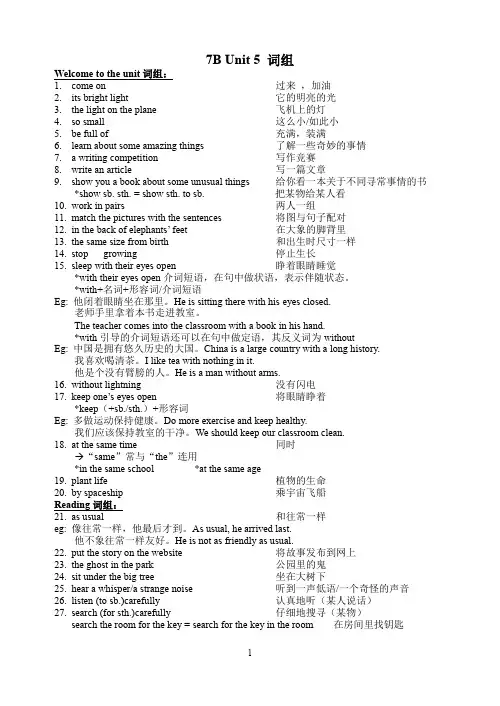
7B Unit 5 词组Welcome to the unit词组:e on 过来,加油2.its bright light 它的明亮的光3.the light on the plane 飞机上的灯4.so small 这么小/如此小5.be full of 充满,装满6.learn about some amazing things 了解一些奇妙的事情7. a writing competition 写作竞赛8.write an article 写一篇文章9.show you a book about some unusual things 给你看一本关于不同寻常事情的书*show sb. sth. = show sth. to sb. 把某物给某人看10.work in pairs 两人一组11.match the pictures with the sentences 将图与句子配对12.in the back of elephants’ feet 在大象的脚背里13.the same size from birth 和出生时尺寸一样14.stop growing 停止生长15.sleep with their eyes open 睁着眼睛睡觉*with their eyes open介词短语,在句中做状语,表示伴随状态。
*with+名词+形容词/介词短语Eg: 他闭着眼睛坐在那里。
He is sitting there with his eyes closed.老师手里拿着本书走进教室。
The teacher comes into the classroom with a book in his hand.*with引导的介词短语还可以在句中做定语,其反义词为withoutEg: 中国是拥有悠久历史的大国。
China is a large country with a long history.我喜欢喝清茶。
U5 课时1 Welcome to the Unit七年级英语下册课后培优分级练(牛津译林版)
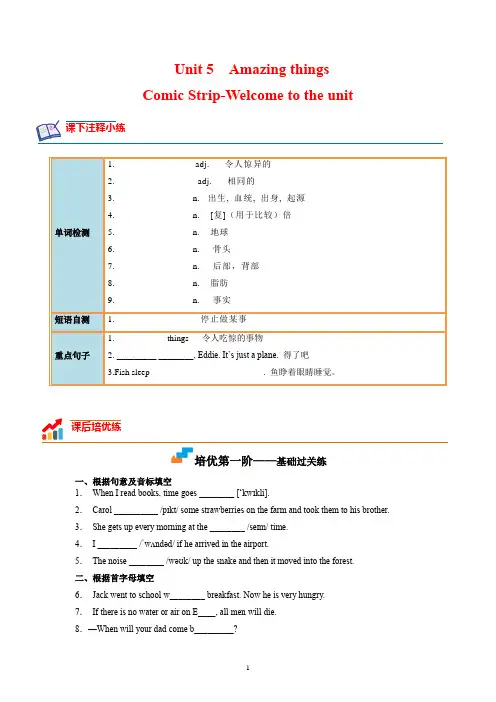
Unit 5 Amazing thingsComic Strip-Welcome to the unit单词检测 1.________________ adj. 令人惊异的2.________________ adj. 相同的3.________________ n. 出生, 血统, 出身, 起源4.________________ n. [复](用于比较)倍5.________________ n. 地球6.________________ n. 骨头7.________________ n. 后部,背部8.________________ n. 脂肪9.________________ n. 事实短语自测 1.________________ 停止做某事重点句子 1. ___________ things 令人吃惊的事物2. _________ ________, Eddie. It’s just a plane. 得了吧3.Fish sleep _____ ______ _______ ______. 鱼睁着眼睛睡觉。
培优第一阶——基础过关练一、根据句意及音标填空1. When I read books, time goes ________ [‘kwɪkli].2. Carol __________ /pɪkt/ some strawberries on the farm and took them to his brother.3. She gets up every morning at the ________ /seɪm/ time.4. I _________ /ˈwʌndəd/ if he arrived in the airport.5. The noise ________ /wəʊk/ up the snake and then it moved into the forest.二、根据首字母填空6. Jack went to school w________ breakfast. Now he is very hungry.7. If there is no water or air on E____, all men will die.8.—When will your dad come b_________?课后培优练 课下注释小练—At 7:30.9.—May I speak to Zhang Min?—Sorry, she isn’t in. I’ll ask her to call you back l_________.10.The story happened two years a________, so I can’t remember it well.三、完成句子11.他提出的那些办法很奏效。
2021年牛津译林版七年级英语下册《Unit5 Amazing things》知识点整理
《Unit5 Amazing things》知识点整理Welcome & comic1. 它的明亮的光 its bright light2.飞机上的光the light on the plane3. 充满 be full of4. 一些令人吃惊的事some amazing / unusual things 形容词+名词某件不寻常的东西something unusual 不定代词+形容词6. 给某人展示某物 show sb th = show sth to sb带领某人参观某地 show sb around sp举办服装(车、花)展览 have a fashion / car / flower show7.你的睁着眼睛keep your eyes open / closed8.睁着眼睛睡觉. sleep with their eyes open / closed do sth with +n(名词)+adj (形容词)sleep with lights on / off do sth with +n(名词)+adv (副词)come in / go out with books in his hand do sth with +n(名词)+prep(介词)9.相同点大小(颜色、款式、年龄)be the same size / colour / style / age同时 at the same time 与----相同 be the same as10.自出生起 from birth11.停止做某事 stop doing sth停下来去做某事 s top to do sth 停止A去做B stop doing A to do B12.A is 差值 adj比较级 than B (tall, young, big, long, wide---)13. 大象脚背没有骨头,只有脂肪。
There are no bones in the back of elephants’ feet---only fat.=Elphants have no bones in the back of theirfeet---only fat.Reading1. 上个星期天 last Sunday2. 一个星期天的早晨 one Sunday morning3.向往常一样做某事 do sth as usual4.坐在大树下sit under the big tree5.听到来自灌木丛中的耳语 hear a whisper from the bushes 来自灌木丛 come from the bushes6.转过身 turn around (round)7.什么都没看见see nothing=can’t see anything8.回答某人reply to sb / sth = answer sb / sth give me a reply = give me an answer9.某人发生了某事Something happen to sb .某人发生什么事? What happened to sb ?=What is happening to sb?碰巧在街上遇到他 happen to meet him in the street10.仔细地听----- listen( to sb / sth) carefully听见奇怪的声响 hear the strange noise 听上去像低语声sound like a whisper听上去很奇怪sound strange / amazing / interesting / wonderful---11.立刻跑走 leave / run away quickly12.在某人回家的路上on one’s way home (副词,回家)在某人去我家的路上on one’s way to my home(名词,家)13.告诉某人一切tell sb everything 14.站在树边 stood beside the tree15.仔细地搜索灌木丛 search the bushes carefully为----搜索某地search A fo r B eg. The police searc hed the house for the lost boy.在森林里搜索那个男孩(2种) search for the boy in the forest=search the forest for the boy16.自言自语 say to oneself (myself , yourself , himself ,herself , itself ,ourselves , yourselves ,themselves)17.在灌木丛中发现一只小猫 find a little cat in the bushes18.虚弱 be weak 19.拿起某物 pick up sth=pick sth (it / them ) up20.对某事感到吃惊 sb be surprised at sth 吃惊地做某事be surprised to do sth某事令人惊奇 sth is surprising 令人惊奇的是-----It’s surprising / amazing / interesting that21.那天傍晚later that day 22.把小猫带到了动物中心 take the little cat to the animal centre好好照看23.开心地诉说某事say sth happil y 24.告诉某人关于那奇怪的声音 tell sb about the strange25.帮助Andy找到鬼 help Andy find the ghost26.把小猫给Andy give the little cat to Andy give sth to sb=give sb sth (show ,send,)Grammar1.一个月(很久)以前 a month / a long time ago2.上个星期天的早晨 last Sunday morning3.昨天早晨 yesterday morning 前天 the day before yesterday4.去奇妙世界博物馆go to the Fun World Museum5.到达博物馆 get to the museum6.在博物馆度过3小时spend three hours in the museum7.拍大量的照片take a lot of photos8.我们中的一些人some of us9.买了一些动物卡片buy cards of the animals 10.返回学校come back to school 11.玩的开心Havea great time12.告诉我关于这事的全部Tell me all about it13.只有11厘米高 a long time ago 14.其他还有什么?what else?15.学一些类似渡渡鸟的奇怪鸟类 learn about some strange birds like dodos16.住在地球上live on the earth / ground // live in trees / water / in very dry placeIntegrated skills1.向某人展示一些动物的图片Show sb some pictures of animals2.害怕动物Be afraid of animals3.一些有关动物的有趣的事情Some interesting things about animals对----感兴趣Be interested in sth4.长长脖子Have a long neck5.在寒冷的冬天吃的很少或几乎不吃Eat little or nothing for in cold winter6.没有---也能活很长一段时间Live without for a long time7.嗅觉灵敏 Smell things well闻起来很香Smell good / delicious8.给某人写封感谢信 write a thank-you letter to sb9.谢谢你的帮助thank you for your help10.对动物了解更多know more about animals11.需要保持房屋干净need to keep our house clean keep sth adj12.不再-----not---any more13.更多的了解他们learn / know more about them15.听说某人hear of sb / sth16.骑车环游80多个国家travel around over 80 countries by bike17.第二天the other day18.用一只手写字write with one hand19.用另一只手画画draw with the other hand20.同时做某事do A and do B at the same time21.用粉笔画3-D图画draw 3-D pictures with chalksStudy skills1. 在博物馆外遇见某人Meet sb outside a museum2.博物馆一分钟前关门了。
牛津译林版英语七下Unit 5《Amazing things》(Integrated skills)
牛津译林版英语七下Unit 5《Amazing things》(Integrated skills)教学设计一. 教材分析牛津译林版英语七下Unit 5《Amazing things》主要讲述了关于奇妙事物的话题。
通过本单元的学习,学生将掌握有关奇妙事物的词汇和表达方式,提高听说读写的能力。
本单元包括两个语篇,分别为一个故事和一个新闻报道,涉及到的主要词汇有:amazing, incredible, wonder, creature等。
二. 学情分析七年级的学生已经具备了一定的英语基础,能够进行简单的听、说、读、写操作。
但部分学生在口语表达和听力方面还存在一定的困难,需要教师在教学中给予关注和指导。
同时,学生对奇妙事物充满好奇,兴趣浓厚,有利于激发学习积极性。
三. 教学目标1.知识目标:学生能够掌握本单元的相关词汇和表达方式,理解语篇大意。
2.能力目标:学生能够运用所学知识进行简单的交流,提高听说读写的能力。
3.情感目标:培养学生对奇妙事物的好奇心,激发学习兴趣。
四. 教学重难点1.重点:学生能够掌握本单元的相关词汇和表达方式,理解语篇大意。
2.难点:学生能够运用所学知识进行口语交流,提高听说读写的能力。
五. 教学方法1.任务型教学法:通过设定各种任务,让学生在实践中运用所学知识。
2.情境教学法:创设生动有趣的情境,激发学生的学习兴趣。
3.互动式教学法:鼓励学生积极参与课堂活动,提高口语表达能力。
六. 教学准备1.教材:牛津译林版英语七下Unit 5《Amazing things》2.多媒体设备:电脑、投影仪、音响等3.教学素材:相关奇妙事物的图片、视频等4.课件:根据教学内容设计的课件七. 教学过程1.导入(5分钟)利用多媒体展示一些奇妙事物的图片,如奇异动物、神秘地貌等,引导学生谈论自己对奇妙事物的看法。
2.呈现(10分钟)通过课件展示本节课的主要内容,让学生初步了解本节课的学习目标。
引导学生关注语篇中的关键词汇,如amazing, incredible, wonder等。
牛津译林版七年级下册Unit5 Amazing things Integrated skills课件
牛津译林版七年级下册Unit5 Amazing things Integrated skills课件(共28张PPT,内嵌音频)(共28张PPT)Unit 5 Amazing thingsIntegrated skillsLet's play a game!They are brown.They can jump 9 meters and jump very fast—30km/h.They can stand on their tails and fight with their back legs.They carry their babies in a pocket of skin.They live in Australia.kangaroosI live in rivers but oftenpeople keep me at home.I can swim.I have a tail.I can only remember things for three seconds.I am colourful.I sleep with my eyes open.goldfishThey are white and black.They are very lovely.They are birds but they can’ t fly.They live in very cold place, South Pole. penguins企鹅They are grey.They walk on tiptoe.They have long noses and big ears. elephantsIt likes eating grass and leaves from the trees. Usually ,it walks slowly.It is very tall and has a long neck.giraffeantIt is very hard-working.It looks weak and very small.If it works with its friends, they are strong.It can carry things much heavier .It smells well.It walks very slowly.It can live up to 150 years old.It is very friendly.tortoisecamelIt is big.It can live without water for a long time.It lives in desert.snakeIt is a long animal that lives in grass or other dark places.It has no legs or feet, but can move very fast on its stomach.They are cold-blooded animals. They take many things as food, such as mice, sparrows, frogs, birds'eggs, pests and so on.Listen and put them in the correct order.1342giraffesnakecamelanta giraffe—has a very long neckonly (1) _____ bones in its long necka snake—lives on the ground, in trees or in watereats little or nothing for (2) ______in cold wintercamels—live in very dry placescan live without (3) _____ for a long timeants— can (4) ______ things wellListen and fill in the blanks.sevenmonthswatersmellTips:Have a guess before listeningI know more about animals now. Some animals are really interesting. The giraffe has a very long neck, but I was surprised to know that there are (1) ________________ in it. It is also amazing that a snake (2) _______________________ in cold winter. Camels live in very dry places, and it is interesting that they (3) __________________________ for a long time. I also know that we need to keep our house clean—ants (4) ____________________.Now I am not afraid of animals any more. I would like to learn more about them.Suzyeats little or nothingonly 7 bonescan smell things wellcan live without waterI am surprised to know that…It’s amazing that…It’s interesting that…I also know that…What amazing things are they talking about1. A young man travelled aroundover 80 countries by bicycle.2. A man can write with one hand anddraw with the other at the same time.3. An artist can draw 3-D pictureswith chalk.The students are talking about amazing things in the world. Listen and answer:A Legendary(传奇的) WomanPair workA: Do you know any amazing thingsB: Yes. I heard….I was surprised….A: That’s amazing. I read about…B: Tell me more about it.A: Ok. It was interesting/amazing that….B: Cool!Her name _______ (be) Wu Shengming. She _______ (be) 85 years old this year. She _______ (be) born in a rich family in Zhejiang Province. Her father ________ (be) a merchant (商人). Her parents ________ (want) her to marry (与...结婚;嫁;娶) a man she _________ (not like) when she ______ (be) 16 years old. She ________ (refuse) and _________ (leave) home.Then she ________ (work) as a nanny(保姆) and ______ (have) a boyfriend. But they ________ (break) up and she _______ (feel) very sad. After that, she ______ (go) to Shanghai and ________ (start) from scratch (白手起家). In 1980s, she ________ (become) a multi-millionaire(千万富翁). She ______ (live) a luxury (奢侈的) life.At that time, if she _________ (want) to buy a bottle of perfume (香水) she ________ (like), she _______ (can) fly to Paris and buy one. Unluckily, when she ________ (buy) some cars from foreign countries, she _______ (be) put into prison (监狱) because of smuggling(走私). Her daughter _______ (be) only 10 years old then. Her husband (丈夫) married their nanny and _______ (send) their own daughter to arelative's home. Six years later, her daughter ______ (kill) herself at the age of 16. Wu Shengming ________ (spend) another 12 years in prison. She also ________ (think) about killing herself and she ________ (prepare) a blade(刀片). But a policewoman ______ (talk) her through(说服) and she _______ (give) upcommitting suicide(实施自杀). When she _____ (get) out of prison, she ______ (be) 70 years old. She _______ (lose) all her family members. She was alone. But she ___________ (remember) or we could say that she never ________ (forget) what her daughter ________ (want) her to do. She _______(take) part in (参加) plenty of charity (慈善) activities. She _______ (build) a lot of old people's homes and orphanages (孤儿院) because her daughter once _______(write) to her and ______ (tell) her to help people without children like her mother and help children without parents like her before she _______ (die).Now, Wu Shengming _______ (become) a successful business woman. She is wealthy and happy.climb mountains without ropesclimb mountains with hands and feet.draw 3-D pictures with____3____( ) 1.A. by bike B. on foot C. by underground ( ) 2. A. foot B. ear C. hand( ) 3. A. pens B. pencils C. chalktravel around over 80 countries ____1____write with one ___2___draw withthe other at the same timeACCAre there any amazing people in our classWhat amazing things can you doFurther thinkingPractice makes perfect.(孰能生巧)Can they do these amazing things from birthGroup workWelcome to our talent show. There are a lot of amazing people and animals in the show.Animals are amazing!……People here are also amazing!……Do you want to be an amazing people like them, maybe you need to …Please come and enjoy the show!Practice makes amazing!Homework1.Search for more amazing things on the Internet and share with me.2.Tell the amazing things you learnt to your parents.3.Finish the exercises left.Thank you。
牛津英语7BUnit5Amazingthings单元知识点总结解析
Unit5Amazing things单元知识点解析Comic strip1.C ome on,Eddie.Ifs just a plane.I saw one yesterday.得了吧,埃迪。
它只是一架飞机。
我昨天看到过一架。
⑴come on语气词,此处意为“得了吧气表示责备或不耐烦。
Come on,don*t sit there dreaming.得了吧,别坐在那儿空想了。
[拓展]come on的其他含义:①用于体育比赛等场合鼓励队员,意为“加油"Come on,Lily!You can catch up with Amy!加油,莉莉!你可以赶上埃米的!②用于催促他人,意为"赶快,快点儿"。
Come on!Ifs dark.快点儿!天黑了。
③用于招呼他人,意为"来,过来”。
Come on!This way,please.来!请走这边。
中考.链接—Dad,I'm afraid it's too hard.-----------!You can do it.—A.Well donee onC.ThanksD.You're welcome解析:我们可用“语境分析法”解答此题。
well done"干得好,干得漂亮”;come on"加油”; thanks"谢谢,;youTe welcome"不用谢”。
句意:“爸爸,恐怕它太难了。
”“你能做到的。
”结合语境可知,此处应用come on加油"来鼓励对方。
答案:B2)yesterday此处用作副词,意为“昨天”,是一般过时的时间状语。
所以句中谓语动词see 用了过去式sawoI planted many trees yesterday.昨天我种了许多树。
2.The world is full of amazing things.世界上充满了令人惊奇的事情。