
MSDS TDI
1. IDENTIFICATION OF THE MATERIAL AND SUPPLIERProduct Name:TOLUENE DIISOCYANATE (TDI)Other name(s):Methylphenylene diisocyanate * Tolylene diisocyanate * Toluene diisocyanate 80/20, TDI80/20 * Toluene diisocyanate 100, TDI 100 * Toluene diisocyanate 65, TDI 65Component for the manufacture of urethane polymers.Recommended Use of the Chemicaland Restrictions on UseSupplier:Ixom Operations Pty LtdABN:51 600 546 512Street Address:Level 8, 1 Nicholson StreetMelbourne 3000AustraliaTelephone Number:+61 3 9665 7111Facsimile:+61 3 9665 7937Emergency Telephone: 1 800 033 111 (ALL HOURS)Please ensure you refer to the limitations of this Safety Data Sheet as set out in the "Other Information" section at the end of this Data Sheet. 2. HAZARDS IDENTIFICATIONClassified as Dangerous Goods by the criteria of the Australian Dangerous Goods Code (ADG Code) for Transport by Road and Rail; DANGEROUS GOODS.This material is hazardous according to Safe Work Australia; HAZARDOUS SUBSTANCE.Classification of the substance or mixture:Skin Irritation - Category 2Skin Sensitisation - Category 1Eye Irritation - Category 2AAcute Inhalation Toxicity - Category 1Respiratory Sensitisation - Category 1Specific target organ toxicity (single exposure) - Category 3Carcinogenicity - Category 2Acute Aquatic Toxicity - Category 3Chronic Aquatic Toxicity - Category 3SIGNAL WORD: DANGERHazard Statement(s):H315 Causes skin irritation.H317 May cause an allergic skin reaction.H319 Causes serious eye irritation.H330 Fatal if inhaled.H334 May cause allergy or asthma symptoms or breathing difficulties if inhaled.H335 May cause respiratory irritation.H351 Suspected of causing cancer.H412 Harmful to aquatic life with long lasting effects.Precautionary Statement(s):Prevention:P201 Obtain special instructions before use.P202 Do not handle until all safety precautions have been read and understood.P260 Do not breathe mist / vapours / spray.P264 Wash hands thoroughly after handling.P271 Use only outdoors or in a well-ventilated area.P272 Contaminated work clothing should not be allowed out of the workplace.P273 Avoid release to the environment.P280 Wear protective gloves / protective clothing / eye protection / face protection.P281 Use personal protective equipment as required.P284 Wear respiratory protection.P285 In case of inadequate ventilation wear respiratory protection.Response:P304+P340 IF INHALED: Remove person to fresh air and keep comfortable for breathing.P310 Immediately call a POISON CENTER or doctor/physician.P320 Specific treatment is urgent (see First Aid Measures on this Safety Data Sheet).P302+P352 IF ON SKIN: Wash with plenty of soap and water.P333+P313 If skin irritation or rash occurs: Get medical advice/attention.P362 Take off contaminated clothing and wash before reuse.P363 Wash contaminated clothing before re-use.P321 Specific treatment (see First Aid Measures on Safety Data Sheet).P305+P351+P338 IF IN EYES: Rinse cautiously with water for several minutes. Remove contact lenses, if present and easy to do. Continue rinsing.P337+P313 If eye irritation persists: Get medical advice/attention.P312 Call a POISON CENTER or doctor/physician if you feel unwell.P304+P341 IF INHALED: If breathing is difficult, remove to fresh air and keep at rest in a position comfortable for breathing.P342+P311 If experiencing respiratory symptoms: Call a POISON CENTER or doctor/physician.P308+P313 IF exposed or concerned: Get medical advice/attention.Storage:P403+P233 Store in a well-ventilated place. Keep container tightly closed.P405 Store locked up.Disposal:P501 Dispose of contents/container in accordance with local/regional/national/international regulations.Poisons Schedule (SUSMP):S6 Poison.3. COMPOSITION AND INFORMATION ON INGREDIENTSComponents CAS Number Proportion Hazard Codes Toluene diisocyanate26471-62-5>99.5%H351 H330 H319 H335H315 H334 H317 H412 4. FIRST AID MEASURESFor advice, contact a Poisons Information Centre (e.g. phone Australia 131 126; New Zealand 0800 764 766) or a doctor. Urgent hospital treatment is likely to be needed.Inhalation:Remove victim from area of exposure - avoid becoming a casualty. Remove contaminated clothing and loosen remaining clothing. Allow patient to assume most comfortable position and keep warm. Keep at rest until fully recovered. If patient finds breathing difficult and develops a bluish discolouration of the skin (which suggests a lack of oxygen in the blood - cyanosis), ensure airways are clear of any obstruction and have a qualified person give oxygen through a face mask. Apply artificial respiration if patient is not breathing. Seek immediate medical advice.Skin Contact:If skin or hair contact occurs, immediately remove any contaminated clothing and wash skin and hair thoroughly with running water and soap. If swelling, redness, blistering or irritation occurs seek medical assistance.Eye Contact:If in eyes, hold eyelids apart and flush the eye continuously with running water. Continue flushing until advised to stop by a Poisons Information Centre or a doctor, or for at least 15 minutes.Ingestion:Rinse mouth with water. If swallowed, do NOT induce vomiting. Do not give anything to drink. Seek medical advice. Indication of immediate medical attention and special treatment needed:Treat symptomatically. Effects may be delayed. Following severe exposure, the patient should be kept under medical supervision for at least 48 hours.5. FIRE FIGHTING MEASURESSuitable Extinguishing Media:Water fog (or if unavailable fine water spray). Alcohol-resistant foam. Dry agent (carbon dioxide, dry chemical powder).Unsuitable Extinguishing Media:Solid water jet/stream may scatter and spread the fire. Most foams will react with the material and releasecorrosive/toxic gases.Hazchem or Emergency Action Code: 2ZSpecific hazards arising from the substance or mixture:Combustible liquid. Toxic substance.Special protective equipment and precautions for fire-fighters:Keep people away from and upwind of fire. On burning will emit toxic fumes, including those of oxides of carbon . If safe to do so, remove containers from path of fire. Fire fighters to wear self-contained breathing apparatus and suitable protective clothing if risk of exposure to vapour or products of combustion. Keep containers cool with water spray. Ensure that there is no direct contact between the water and the product.6. ACCIDENTAL RELEASE MEASURESEmergency procedures/Environmental precautions:Clear area of all unprotected personnel. Evacuate personnel from downwind areas. Do not allow container or product to get into drains, sewers, streams or ponds. If contamination of sewers or waterways has occurred advise local emergency services.Personal precautions/Protective equipment/Methods and materials for containment and cleaning up:Wear protective equipment to prevent skin and eye contact and breathing in vapours. Air-supplied masks are recommended to avoid inhalation of toxic material. Contain - prevent run off into drains and waterways. Use absorbent (soil, sand or other inert material). Collect in properly labelled containers, with loose fitting lids, for disposal. Contact with water results in chemical reaction, which may result in rupture of the container.7. HANDLING AND STORAGEClassified as a C1 (COMBUSTIBLE LIQUID) for the purpose of storage and handling, in accordance with the requirements of AS 1940. Refer to State Regulations for storage and transport requirements.This material is a Scheduled Poison S6 and must be stored, maintained and used in accordance with the relevant regulations.Precautions for safe handling:Avoid skin and eye contact and breathing in vapour, mists and aerosols. Keep out of reach of children. Never add water to this product.Conditions for safe storage, including any incompatibilities:Store in a cool, dry, well ventilated place. Store away from foodstuffs. Store away from sources of heat or ignition. Store below 40°C. Store away from incompatible materials described in Section 10. Do not store in galvanised containers. Do not store in aluminium containers. Suitable containers: stainless steel. Keep containers closed when not in use - check regularly for leaks.8. EXPOSURE CONTROLS/PERSONAL PROTECTIONControl Parameters: No value assigned for this specific material by Safe Work Australia. However, Workplace Exposure Standard(s) for constituent(s):Isocyanates, all (as -NCO): 8hr TWA = 0.02 mg/m3, 15 min STEL = 0.07 mg/m3, SenAs published by Safe Work Australia Workplace Exposure Standards for Airborne Contaminants.TWA - The time-weighted average airborne concentration of a particular substance when calculated over aneight-hour working day, for a five-day working week.STEL (Short Term Exposure Limit) - the airborne concentration of a particular substance calculated as atime-weighted average over 15 minutes, which should not be exceeded at any time during a normal eight hour work day. According to current knowledge this concentration should neither impair the health of, nor cause undue discomfort to, nearly all workers.`Sen' Notice - sensitiser. The substance can cause a specific immune response in some people. An affected individual may subsequently react to exposure to minute levels of that substance and should not be further exposed to the substance.These Workplace Exposure Standards are guides to be used in the control of occupational health hazards. All atmospheric contamination should be kept to as low a level as is workable. These workplace exposure standards should not be used as fine dividing lines between safe and dangerous concentrations of chemicals. They are not a measure of relative toxicity.Appropriate engineering controls:Ensure ventilation is adequate and that air concentrations of components are controlled below quoted Workplace Exposure Standards. Keep containers closed when not in use.If in the handling and application of this material, safe exposure levels could be exceeded, the use of engineering controls such as local exhaust ventilation must be considered and the results documented. If achieving safe exposure levels does not require engineering controls, then a detailed and documented risk assessment using the relevant Personal Protective Equipment (PPE) (refer to PPE section below) as a basis must be carried out to determine the minimum PPE requirements.Individual protection measures, such as Personal Protective Equipment (PPE):The selection of PPE is dependent on a detailed risk assessment. The risk assessment should consider the work situation, the physical form of the chemical, the handling methods, and environmental factors.OVERALLS, CHEMICAL GOGGLES, SAFETY SHOES, FACE SHIELD OR AIR MASK, GLOVES (Long).* Not required if wearing air supplied mask.Wear overalls, chemical goggles and impervious gloves. Use with adequate ventilation. If determined by a risk assessment an inhalation risk exists, wear an air supplied respirator meeting the requirements of AS/NZS 1715 and AS/NZS 1716.Always wash hands before smoking, eating, drinking or using the toilet. Wash contaminated clothing and other protective equipment before storage or re-use.9. PHYSICAL AND CHEMICAL PROPERTIESPhysical state:LiquidColour:Colourless to Pale YellowOdour:PungentSolubility:Reacts with water.Specific Gravity: 1.21 @25°CRelative Vapour Density (air=1): 6.0Vapour Pressure (20 °C):0.014-0.021 hPaFlash Point (°C):131Flammability Limits (%):0.9-9.5Autoignition Temperature (°C):>595Boiling Point/Range (°C):253pH:Not applicableViscosity: 3 mPa.s @25°CFreezing Point/Range (°C):2110. STABILITY AND REACTIVITYReactivity:Reacts with water.Chemical stability:Isocyanates react, often violently, with solvents containing active hydrogenincluding water and alcohols. Also reacts with many materials such as bases,ammonia, primary and secondary amines, acids and metal compounds. Maypolymerise if heated above 177 °C or above 45 °C for prolonged periods. Carbondioxide and heat are generated during the polymerisation process resulting inpressure build-up which could rupture closed containers.Possibility of hazardous reactions:Hazardous polymerisation may occur. Heating can cause expansion or decomposition of the material, which can lead to the containers exploding. Sinks in water and reacts slowly at the interface. A solid water-insoluble layer of polyurea is formed by liberating carbon dioxide gas.Conditions to avoid:Avoid contact with water. Avoid exposure to moisture. Avoid exposure to humidity.Avoid temperatures above 40 °C. Avoid temperatures below 16°C. Avoid exposureto heat, sources of ignition, and open flame.Incompatible materials:Acids, amines, ammonia , alcohols , water , aqueous solutions , galvanised metals, copper , copper alloys , tin , zinc , bases, , polymerisation initiators , strongoxidising agents , protic solvents .Oxides of carbon. Oxides of nitrogen. Hydrogen cyanide.Hazardous decompositionproducts:11. TOXICOLOGICAL INFORMATIONNo adverse health effects expected if the product is handled in accordance with this Safety Data Sheet and the product label. Symptoms or effects that may arise if the product is mishandled and overexposure occurs are: Ingestion:Swallowing may result in nausea, vomiting, and abdominal pain.Eye contact:An eye irritant.Skin contact:Contact with skin will result in irritation. A skin sensitiser. Repeated or prolongedskin contact may lead to allergic contact dermatitis.Inhalation:Material is irritant to the mucous membranes of the respiratory tract (airways). Arespiratory sensitiser. Can cause possible allergic reactions, producingasthma-like symptoms. Symptoms include nasal and throat irritation withincreased secretion, headache, nausea and vomiting. Higher levels may lead tobronchitis, constriction of the chest, bronchospasm and pulmonary oedema. Acute toxicity:Oral LD50 (rat): 4130-5110 mg/kg (female, male)Dermal LD50 (rabbit): >9400 mg/kgInhalation LC50 (rat): 0.48 mg/L/1hSkin corrosion/irritation:Severe irritant (rabbit).Serious eye damage/irritation:Severe irritant (rabbit).A respiratory sensitiser. A skin sensitiser.Respiratory or skinsensitisation:Chronic effects: Available evidence from animal studies indicate that repeated or prolonged exposure to this material could result in effects on the lungs.Carcinogenicity:Suspected of causing cancer.Toluene diisocyanate has been reported to have gastrointestinal effects and effects on the liver and kidney when given to animals orally. Rats, guinea pigs and rabbits exposed via the respiratory tract to 0.1 ppm of TDI, 6 hours/day 5 days/week for 58 exposures or 6 hours/day for 38 consecutive days, developed lung inflammation. Lung damage generally increased in severity for several days after exposure ended. Concentration dependent respiratory sensitisation has been produced in guinea pigs. Skin and respiratory sensitisation has occured following skin application in test animals.For industrial grade TDI, long-term inhalation studies in rat and mice reveal no indications of carcinogenic potential. Intragastric intubation of high doses of TDI led to increased incidence of tumours. Industrial experience in humans has not shown any link between TDI exposure and cancer development.This material has been classified by the International Agency for Research on Cancer (IARC) as a Group 2B. Group 2B - The agent is possibly carcinogenic to humans.12. ECOLOGICAL INFORMATIONEcotoxicity Avoid contaminating waterways.Persistence/degradability:The material is not readily biodegradable.Aquatic toxicity:Harmful to aquatic organisms. May cause long term adverse effects in the aquaticenvironment.48hr EC50 (Daphnia magna):12.5 mg/L (static)96hr LC50 (fish):133 mg/L (Oncorhynchus mykiss)13. DISPOSAL CONSIDERATIONSDisposal methods:Refer to Waste Management Authority. Dispose of material through a licensed waste contractor. Normally suitable for incineration by an approved agent.14. TRANSPORT INFORMATIONRoad and Rail TransportClassified as Dangerous Goods by the criteria of the Australian Dangerous Goods Code (ADG Code) for Transport by Road and Rail; DANGEROUS GOODS.UN No:2078Transport Hazard Class: 6.1 ToxicPacking Group:IIProper Shipping Name orTechnical Name:TOLUENE DIISOCYANATEHazchem or Emergency ActionCode:2ZMarine TransportClassified as Dangerous Goods by the criteria of the International Maritime Dangerous Goods Code (IMDG Code) for transport by sea; DANGEROUS GOODS.UN No:2078Transport Hazard Class: 6.1 ToxicPacking Group:IITOLUENE DIISOCYANATEProper Shipping Name orTechnical Name:IMDG EMS Fire:F-AIMDG EMS Spill:S-AAir TransportClassified as Dangerous Goods by the criteria of the International Air Transport Association (IATA) Dangerous Goods Regulations for transport by air; DANGEROUS GOODS.UN No:2078Transport Hazard Class: 6.1 ToxicPacking Group:IITOLUENE DIISOCYANATEProper Shipping Name orTechnical Name:15. REGULATORY INFORMATIONClassification:This material is hazardous according to Safe Work Australia; HAZARDOUS SUBSTANCE.Classification of the substance or mixture:Skin Irritation - Category 2Skin Sensitisation - Category 1Eye Irritation - Category 2AAcute Inhalation Toxicity - Category 1Respiratory Sensitisation - Category 1Specific target organ toxicity (single exposure) - Category 3Carcinogenicity - Category 2Acute Aquatic Toxicity - Category 3Chronic Aquatic Toxicity - Category 3Hazard Statement(s):H315 Causes skin irritation.H317 May cause an allergic skin reaction.H319 Causes serious eye irritation.H330 Fatal if inhaled.H334 May cause allergy or asthma symptoms or breathing difficulties if inhaled.H335 May cause respiratory irritation.H351 Suspected of causing cancer.H412 Harmful to aquatic life with long lasting effects.Poisons Schedule (SUSMP):S6 Poison.This material is listed on the Australian Inventory of Chemical Substances (AICS).In Australia this substance is on a list for which health surveillance is required: Isocyanates.16. OTHER INFORMATIONSupplier Safety Data Sheet; 02/ 2011.`Registry of Toxic Effects of Chemical Substances'. Ed. D. Sweet, US Dept. of Health & Human Services: Cincinatti, 2012.International Agency for Research on Cancer. In: `IARC Monographs on the Evaluation of Carcinogenic Risk to Humans'. World Health Organisation, 1999.Reason(s) for Issue:Revised Primary SDSChange in company detailsThis SDS summarises to our best knowledge at the date of issue, the chemical health and safety hazards of the material and general guidance on how to safely handle the material in the workplace. Since Ixom Operations Pty Ltd cannot anticipate or control the conditions under which the product may be used, each user must, prior to usage, assess and control the risks arising from its use of the material.If clarification or further information is needed, the user should contact their Ixom representative or Ixom Operations Pty Ltd at the contact details on page 1.Ixom Operations Pty Ltd's responsibility for the material as sold is subject to the terms and conditions of sale, a copy of which is available upon request.。
甲苯二异氰酸酯MSDS

外观与性状:无色透明至淡黄色液体,有刺激性气味。
主要用途:用于制造聚氨酯树脂及其泡沫塑料。
健康危害
侵入途径:吸入、食入、经皮吸收。
健康危害:本品急性吸入毒性较高,经口毒性较低。主要有明显刺激和致敏作用。对眼、呼吸道粘膜和皮肤有刺激作用,并引起支气管哮喘。
急救措施
皮肤接触:脱去被污染的衣着,用肥皂水和清水彻底冲洗皮肤。
辛醇/水分配系数的对数值:
燃烧热(kJ/mol)
临界温度(℃)
临界压力( MPa):
溶解性:不溶于水,溶于丙酮、乙酸乙酯和甲苯等
稳定性和反应活性
稳定性:
聚合危害:
避免接触的条件:受热、潮湿空气。
禁忌物:强氧化剂
燃烧(分解)产物:氰化物、氮氧化物
毒理学资料
急性毒性:LD50:4130mg/kg(大鼠经口)
眼睛接触:提起眼睑,用流动清水或生理盐水冲洗。就医。
吸入:迅速脱离现场至空气新鲜处。保持呼吸道通畅。如呼吸困难,给输氧。如呼吸停止,立即进行人工呼吸。就医。
食入:饮足量温水,催吐。就医。
燃爆特性与消防
燃烧性:易燃
闪点(℃):132
爆炸下限(%):
爆炸上限(%):
引燃温度(℃):
最小点火能(mJ):
最大爆炸压力(MPa):
防
护
措
施
车间卫生标准:中国MAC(mg/m3):未制定标准
PC-TWA(mg/m3):
PC-STEL(mg/m3):
前苏联MAC(mg/m3)
美国TVL-TWA
美国TLV-STEL:未制定标准
检测方法:
工程控制:生产过程密闭,加强通风。提供安全淋浴和洗眼设备。
甲苯二异氰酸酯安全技术说明书MSDS
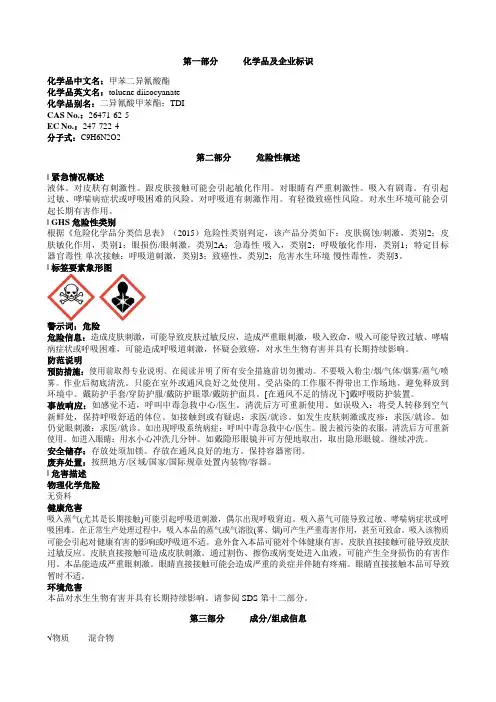
第一部分化学品及企业标识化学品中文名:甲苯二异氰酸酯化学品英文名:toluene diisocyanate化学品别名:二异氰酸甲苯酯;TDICAS No.:26471-62-5EC No.:247-722-4分子式:C9H6N2O2第二部分危险性概述| 紧急情况概述液体。
对皮肤有刺激性。
跟皮肤接触可能会引起敏化作用。
对眼睛有严重刺激性。
吸入有剧毒。
有引起过敏、哮喘病症状或呼吸困难的风险。
对呼吸道有刺激作用。
有轻微致癌性风险。
对水生环境可能会引起长期有害作用。
| GHS 危险性类别根据《危险化学品分类信息表》(2015)危险性类别判定,该产品分类如下:皮肤腐蚀/刺激,类别2;皮肤敏化作用,类别1;眼损伤/眼刺激,类别2A;急毒性-吸入,类别2;呼吸敏化作用,类别1;特定目标器官毒性-单次接触:呼吸道刺激,类别3;致癌性,类别2;危害水生环境-慢性毒性,类别3。
| 标签要素象形图警示词:危险危险信息:造成皮肤刺激,可能导致皮肤过敏反应,造成严重眼刺激,吸入致命,吸入可能导致过敏、哮喘病症状或呼吸困难,可能造成呼吸道刺激,怀疑会致癌,对水生生物有害并具有长期持续影响。
防范说明预防措施:使用前取得专业说明。
在阅读并明了所有安全措施前切勿搬动。
不要吸入粉尘/烟/气体/烟雾/蒸气/喷雾。
作业后彻底清洗。
只能在室外或通风良好之处使用。
受沾染的工作服不得带出工作场地。
避免释放到环境中。
戴防护手套/穿防护服/戴防护眼罩/戴防护面具。
[在通风不足的情况下]戴呼吸防护装置。
事故响应:如感觉不适,呼叫中毒急救中心/医生。
清洗后方可重新使用。
如误吸入:将受人转移到空气新鲜处,保持呼吸舒适的体位。
如接触到或有疑虑:求医/就诊。
如发生皮肤刺激或皮疹:求医/就诊。
如仍觉眼刺激:求医/就诊。
如出现呼吸系统病症:呼叫中毒急救中心/医生。
脱去被污染的衣服,清洗后方可重新使用。
如进入眼睛:用水小心冲洗几分钟。
如戴隐形眼镜并可方便地取出,取出隐形眼镜。
TDI(2-4-甲苯二异氰酸酯)理化性质及危险特性表
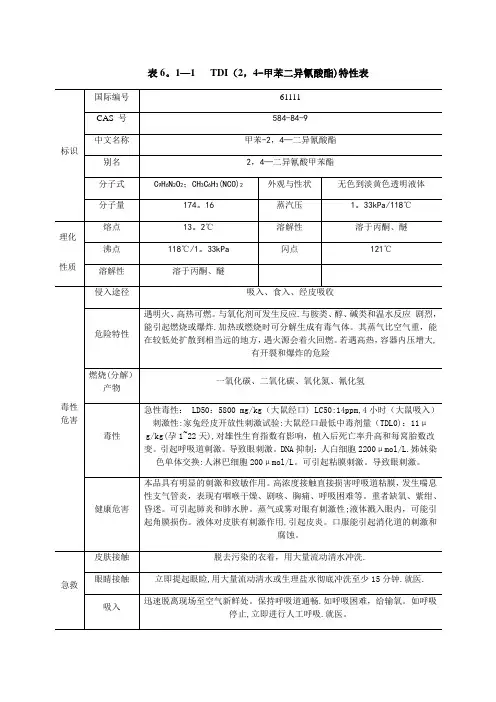
立即提起眼睑,用大量流动清水或生理盐水彻底气新鲜处。保持呼吸道通畅.如呼吸困难,给输氧。如呼吸停止,立即进行人工呼吸.就医。
食入
用水漱口,给饮牛奶或蛋清。就医。
灭火方法
消防人员须佩戴防毒面具、穿全身消防服,在上风向灭火。尽可能将容器从火场移至空旷处。喷水保持火场容器冷却,直至灭火结束。处在火场中的容器若已变色或从安全泄压装置中产生声音,必须马上撤离。
溶解性
溶于丙酮、醚
沸点
118℃/1。33kPa
闪点
121℃
溶解性
溶于丙酮、醚
毒性危害
侵入途径
吸入、食入、经皮吸收
危险特性
遇明火、高热可燃。与氧化剂可发生反应.与胺类、醇、碱类和温水反应 剧烈,能引起燃烧或爆炸.加热或燃烧时可分解生成有毒气体。其蒸气比空气重,能在较低处扩散到相当远的地方,遇火源会着火回燃。若遇高热,容器内压增大,有开裂和爆炸的危险
燃烧(分解)产物
一氧化碳、二氧化碳、氧化氮、氰化氢
毒性
急性毒性: LD50:5800 mg/kg(大鼠经口) LC50:14ppm,4小时(大鼠吸入) 刺激性:家兔经皮开放性刺激试验:大鼠经口最低中毒剂量(TDL0):11μg/kg(孕1~22天),对雄性生育指数有影响,植入后死亡率升高和每窝胎数改变。引起呼吸道刺激。导致眼刺激。DNA抑制:人白细胞2200μmol/L.姊妹染色单体交换:人淋巴细胞200μmol/L。可引起粘膜刺激。导致眼刺激。
防护措施
呼吸系统防护
空气中浓度超标时,必须佩戴自吸过滤式防毒面具(半面罩).紧急事态抢救或撤离时,应该佩戴空气呼吸器。
眼睛防护
戴化学安全防护眼镜。
身体防护
穿防毒物渗透工作服。
异氰酸酯msds

异氰酸酯msds异氰酸酯 MSDS基本信息中文别名:異氰酸英文别名:Polyisocyanates;Hydrogen isocyanate中文别名:異氰酸英文别名:Polyisocyanates;Hydrogen isocyanate物理化学性质异氰酸酯是异氰酸的各种酯的总称。
包含一异氰酸酯R—N=C=O和二异氰酸酯O=C=N—R—N=C=O。
一般是不愉快气味的液体。
一异氰酸酯易与氨或胺作用而成脲类,易与醇作用而成氨基甲酸酯(如氨基甲酸乙酯)沸点(℃):83~84 分子式:C4H7NO 分子量: 85.11饱和蒸气压(kPa): 6.65/19℃闪点(℃): 26 燃烧性:易燃溶解性:不溶于水相对密度(水=1): 0.91相对蒸气密度(空气=1):2.93 外观与性状:无色液体,带有葱的气味。
禁配物:水、醇类、强碱、酸类、强氧化剂。
化学反应:容易与包含有活泼氢原子的化合物: 胺、水、醇、酸、碱发生反应。
与水反应生成甲胺、二氧化碳; 在过量水存在时, 甲胺再与MIC反应生成1,3-二甲基脲, 在过量MIC时则形成1,3,5-三甲基缩二脲。
这二个反应均为放热反应。
纯物在有触媒存在条件下, 发生自聚反应并放出热能。
遇热、明火、氧化剂易燃。
燃烧时释出MIC蒸气、氮氧化物、一氧化碳和氰化氢。
高温 (350~540℃)下裂解可形成氰化氢。
遇热分解放出氮氧化物烟气。
异氰酸酯产品用途单异氰酸酯是有机合成的重要中间体,可制成一系列氨基甲酸酯类杀虫剂、杀菌剂、除草剂,也用于改进塑料、织物、皮革等的防水性。
二官能团及以上的异氰酸酯可用于合成一系列性能优良的聚氨酯泡沫塑料、橡胶、弹力纤维、涂料、胶粘剂、合成革、人造木材等。
目前应用最广、产量最大的是有:甲苯二异氰酸酯(Toluene Diisocyanate,简称TDI);二苯基甲烷二异氰酸酯(Methylenediphenyl Diisocyanate,简称MDI)。
甲苯-2,4-二异氰酸酯(TDI)MSDS

化学品安全技术说明书第一部分化学品及企业标识化学品中文名:甲苯-2,4-二异氰酸酯;2,4-二异氰酸甲苯酯化学品英文名:toluene-2,4-diisocyanate;2,4-tolylene diisocyanate生产企业名称:地址: 邮编:电子邮件地址:技术说明书编码: 登记号:生效日期: 传真号码:企业应急电话:第二部分成分/组成信息纯品混合物有害物成分浓度CAS No.甲苯-2,4-二异氰酸酯584-84-9第三部分危险性概述危险性类别:第类毒害品侵入途径:吸入、食入、经皮吸收健康危害:本品具有明显的刺激和致敏作用。
高浓度接触直接损害呼吸道粘膜,发生喘息性支气管炎,表现有咽喉干燥、剧咳、胸痛、呼吸困难等。
重者缺氧、紫绀、昏迷。
可引起肺炎和肺水肿。
蒸气或雾对眼有刺激性;液体溅入眼内,可能引起角膜损伤。
液体对皮肤有刺激作用,引起皮炎。
口服能引起消化道的刺激和腐蚀。
慢性影响:反复接触本品,能引起过敏性哮喘。
长期低浓度接触,呼吸功能可受到影响。
环境危害:燃爆危险:本品可燃,有毒,具刺激性,具致敏性。
第四部分急救措施皮肤接触:脱去污染的衣着,用大量流动清水冲洗。
眼睛接触:立即提起眼睑,用大量流动清水或生理盐水彻底冲洗至少15分钟。
就医。
吸入:迅速脱离现场至空气新鲜处。
保持呼吸道通畅。
如呼吸困难,给输氧。
如呼吸停止,立即进行人工呼吸。
就医。
食入:用水漱口,给饮牛奶或蛋清。
就医。
第五部分消防措施危险特性:遇明火、高热可燃。
与氧化剂可发生反应。
与胺类、醇、碱类和温水反应剧烈,能引起燃烧或爆炸。
加热或燃烧时可分解生成有毒气体。
其蒸气比空气重,能在较低处扩散到相当远的地方,遇火源会着火回燃。
若遇高热,容器内压增大,有开裂和爆炸的危险。
有害燃烧产物:一氧化碳、二氧化碳、氧化氮、氰化氢。
灭火方法:消防人员须佩戴防毒面具、穿全身消防服,在上风向灭火。
尽可能将容器从火场移至空旷处。
喷水保持火场容器冷却,直至灭火结束。
甲苯-2,4-二异氰酸酯-高毒物品信息卡

名称:甲苯-2,4-二异氰酸酯(TDI)高毒物品信息卡:017
中文名称:甲苯-2,4-二异氰酸酯(TDI)
CAS号:584-84-9
英文名称:Tolylene-2,4-diisocyanate(TDI)
分子式:C9H6N2O2
理化性质:为白色液体,静置后可变为淡黄色。相对分子质量174.15,熔点20.5℃,沸点251℃。不溶于水,可与水发生反应,溶于丙酮、乙酸乙酯、甲苯。相对密度1.22,相对蒸气密度6.0,饱和蒸气压0.133kPa(80℃)。
工作场所警示标识
体检项目:
上岗前:常规项目。
在岗期间:内科常规检查,皮
体检周期:1年;在作业工人中,有多人同时出现异常表现应及时检查。
职业禁忌:慢性呼吸系统疾病,严重的皮肤病;过敏体质。
可能引起的职业病:职业性哮喘。
急救和治疗
抢救人员穿戴防护用具;立即将患者移离现场至空气新鲜处。去除污染衣物;注意保暖、安静;皮肤污染或溅入眼内用流动清水冲洗至少20min;呼吸困难给氧,必要时用合适的呼吸器进行人工呼吸;立即与医疗急救单位联系抢救。
皮肤直接接触可引起皮炎,出现瘙痒、红斑、水肿、丘疹,水疱。
职业接触限值:PC-TWA0.1mg/m3,PC-STEL0.2mg/m3
工作场所监测:每月至少监测一次,每半年至少进行一次控制效果评价。
防护设施和个人防护:严加密闭,提供局部排风和全面通风设施。穿防毒物渗透工作服﹐戴橡胶手套和防护眼镜。提供淋浴和洗眼设施。IDLH浓度为72mg/m3,嗅阙高于卫生标准,属有机蒸气,易成雾。工作场所禁止饮食,吸烟。及时换洗工作服。浓度超标时,佩戴过滤式防毒口罩或面具。应急救援时,佩戴空气呼吸器。
甲苯二异氰酸酯msds
甲苯二异氰酸酯msds国标编号: CAS: 26471-62-5中文名称: 甲苯二异氰酸酯英文名称: Toluene diisocyanate别名: 二异氰酸甲苯酯;Diisocyanatotoluene;TDI;分子式: CHNO 分子量: 174.16 9622熔点: 3.5~5.5 ?(TDI-65);密度: 1.22?0.01(25?)蒸汽压: 132?(闭杯)溶解性: 不溶于水; 溶于丙酮、乙酸乙酯和甲苯等稳定性: 能与强氧化剂发生反应。
遇热、明火、火花会着火外观与性无色透明至淡黄色液体,有刺激性气味状:危险标记:用途: 用于制造聚氨酯树脂及其泡沫塑料理化性质甲苯二异氰酸酯为无色透明至淡黄色液体,有刺激性气味; 遇光颜色变深。
分子式C9-H6-N2-O2。
分子量174.16。
相对密度1.22?0.01(25?)。
凝固点3.5~5.5 ?(TDI-65); 11.5~13.5?(TDI-80); 19.5~21.5?。
沸点251?。
闪点132?(闭杯)。
蒸气密度6.0。
蒸气压0.13kPa(0.01mmHg20?)。
蒸气与空气混合物可燃限0.9~9.5% 。
不溶于水; 溶于丙酮、乙酸乙酯和甲苯等。
容易与包含有活泼氢原子的化合物:胺、水、醇、酸、碱发生反应,特别是与氢氧化钠和叔胺发生难以控制反应,并放出大量热。
与水反应生成二氧化碳是聚氨酯泡沫塑料制造过程中的关键反应之一; 应避免受潮。
在常温下聚合反应速度很慢,但加热至45?以上或催化剂存在下能自聚生成二聚物。
能与强氧化剂发生反应。
遇热、明火、火花会着火。
加热分解放出氰化物和氮氧化物。
消防措施用干粉、二氧化碳灭火,大火用水施救。
消防人员须穿戴防毒面具与防护服。
储运须知包装标志:毒害品。
包装方法:(II)类。
铁桶装内充氮气。
储运条件:储存于阴凉、干燥、通风良好的不燃材料结构的库房中,防止容器受损和受潮。
储存温度控制在20-35?。
远离热源和火源、与胺类、醇、碱类和含水物品隔离储运。
TDI(2-4-甲苯二异氰酸酯)理化性质及危险特性表
TDI(2-4-甲苯二异氰酸酯)理化性质及危险特性表
简介
TDI,化学名称为2-4-甲苯二异氰酸酯,是一种化学物质,通常用于生产泡沫塑料。
该物质具有危险特性,因此必须在正确的环境下储存和处理。
下面是TDI 的一些理化性质和危险特性表。
理化性质
•外观:透明至微黄色液体
•味道:刺激性气味
•熔点:20 ℃
•沸点:253 ℃
•相对密度:1.22 g/mL
•折射率:1.5510
•溶解性:溶于苯和乙腈等有机溶剂,微溶于水。
危险特性
急性毒性
TDI具有刺激性致死毒性,暴露于TDI可以导致以下危险: - 吸入TDI会引起喉咙疼痛、胸闷、咳嗽、气喘、恶心和呕吐等症状; - 接触皮肤会引起严重的皮肤炎症和灼伤; - 摄入TDI可能导致恶心、呕吐、腹泻、眼疼和眼病; - TDI有可能引起致癌的长期健康问题。
慢性毒性
TDI的慢性毒性非常严重。
长期暴露于TDI可能导致以下危险: - 呼吸系统问题,如肺损伤和支气管痉挛; - 泌尿系统问题,如尿路感染和肾病; - 皮肤过敏和接触性皮炎等皮肤问题; - 多种癌症,如膀胱癌、气管癌、肾盂癌等。
防护措施
为了避免TDI的危害,必须采取以下措施: - 戴好防护手套和眼镜; - 在芳香族溶剂中使用TDI时,应戴好呼吸面具; - 穿上防护服; - 严格控制工作地点内的TDI含量; - 遵循适当的装卸、储存和运输程序; - 避免和食物、饮料接触。
TDI是一种具有危险特性的化学品。
为了避免TDI的危害,必须严格控制各种工作场所内的TDI含量,并采取适当的防护措施。
如果您需要进行TDI相关的实验或其他工作,请务必注意安全。
油漆MSDS、涂料SDS,油漆的危害、涂料的有害物质
油漆有什么危害,出口时为何要提供SDS油漆在进口清关或者出口订舱的时候,都会被要求提供符合GHS标准的SDS(化学品安全技术说明书),而很多人认为油漆危害性不大,为何要提供SDS。
其实,不同种类的油漆危害程度不大,其中油性油漆的危害性最大。
下面来了解下油漆的分类和常见的危害。
涂料:涂于物体表面能形成具有保护、装饰或特殊性能(如绝缘、防腐、标志等)的固态涂膜的一类液体或固体材料的总称。
包括油(性)漆、水性漆、木器漆、粉末涂料、木蜡油。
油漆:以有机溶剂为介质或高固体、无溶剂的油性漆。
油漆英文名:paint or coating。
油漆是一种能牢固覆盖在物体表面,起保护、装饰、标志和其他特殊用途的化学混合物涂料。
涂料是一种材料,这种材料可以用不同的施工工艺涂覆在物件表面,形成粘附牢固、具有一定强度、连续的固态薄膜。
这样形成的膜通称涂膜,又称漆膜或涂层。
国家标准(GB 5206.1)在色漆和清漆词汇标准的基{HotTag}本术语中,涂料是被这样定义的:涂于物体表面能形成具有保护、装饰或特殊性能(如绝缘、防腐、标志等)的固态涂膜的一类液体或固体材料之总称。
早期大多以植物油为主要原料,故有油漆之称。
现合成树脂已大部或全部取代了植物油,故称为涂料。
涂料一般由成膜物质、填料(颜填料)、溶剂、助剂等四部分组成。
根据性能要求有时成份会略有变化,如清漆没有颜填料、粉末涂料中可以没有溶剂。
属于有机化工高分子材料,所形成的涂膜属于高分子化合物类型。
按照现代通行的化工产品的分类,涂料属于精细化工产品。
现代的涂料正在逐步成为一类多功能性的工程材料,是化学工业中的一个重要行业。
油漆的危害是由油漆中一些有毒物质造成的,油漆的有毒物质可以分为溶剂类(甲醛,甲苯,苯,二甲苯,醛类,酮类,酯类,醚类,芳香烃等)和重金属类(铅,铬,汞,镉等)。
一般来说,品牌油漆里这些物质的含量都比较低,环保性能比较好。
那么油漆主要的有害成分有哪些,危害有哪些?1.VOC(挥发性有机化合物)VOC是挥发性有机化合物的英文缩写,挥发性有机化合物是指油漆中不形成漆膜而最终挥发到大气中的有机物质。
甲苯二异氰酸酯
皮肤接触: 脱去被污染的衣着,用肥
吸入: 迅速脱离现场至空气新鲜处。保持呼吸道通畅。
急救 皂水和清水彻底冲洗皮肤。
如呼吸困难, 给输氧。 如呼吸停止, 立即进行人工呼吸。
措施 眼睛接触: 提起眼睑,用流动清水或
就医。
生理盐水冲洗。就医。
食入: 饮足量温水,催吐。就医。
燃烧性: 易燃 闪点(℃) :132
甲苯二异氰酸酯 (TDI)
英文名: Toluene
标
中文名: 甲苯二异氰酸 酯;二异氰酸甲苯酯
diisocyanate ;
Diisocyanatotoluene;TDI
分子式: C9H6N2O2
相对分子质量: 174.16
识 CAS号: 26471-62-5 结构式 :
危险性类别: 第 6.1 类 毒性物质
致突变性 :
该物质对环境有害,对水体可造成污染。
处置前应参阅国家和地方有关法规。
序号: 1017
UN编号: 2078
包装分类: Ⅱ
包装标志:
包装方法: 螺纹口玻璃瓶、铁盖压口玻璃瓶、塑料瓶或金属桶(罐)外普通木箱。
《危险化学品安全管理条例》 (国务院令第 591 号),《工作场所安全使用化学品规定》 ( [1996]
爆炸下限( %): 爆炸上限( %):
最大爆炸压力( MPa):
特性 与消
防
危险特性: 容易与包含有活泼氢原子的化合物、胺、水、醇、酸、碱发生反应,特别是与氢氧 化钠和叔胺发生难以控制反应,并放出大量热。与水反应生成二氧化碳是聚氨酯泡沫塑料制造 过程中的关键反应之一, 应避免受潮。 在常温下聚合反应速度很慢, 但加热至 45℃以上或催化
护 眼睛防护: 戴化学安全防护眼镜。