
小学英语四种基本句型-肯定句、否定句、一般疑问句与特殊疑问句
2、 姓名和人
表示人名:My name is Gina. What’s your name
表示人:The woman is Gina.
Who is the woman
3、 长度和距离
表示距离:It’s five hundred metres away from here. How far is it from here
(
否定回答:No, it isn’t.
2. 就划线部分提问(变特殊疑问句) This is a book. 第一步:变一般疑问句 Is this a book 第二步:找合适的特殊疑问词 Is this what 第三步:特殊疑问词提前放到句首,并大写,其余按顺序照抄,省略划线部分。What is this
表示长度:It’s five hundred metres. How long is it
4、 ~ 5、 颜色,东西
表示颜色:The shoes are white. What color are the shoes
表示物:They are white sheep. What are they
表示颜色:They are white sheep. What color are these sheep
%
选择 反意
用于提出问题 用于提出问题 '
Is your friend a boy or a girl It's a fine day, isn't it
祈使句 感叹句
特殊:
表示命令或请求、建议
表示惊讶\赞美\愤怒 等强烈情感
.或! !
Put it here! Look at the noticeboard.
现在几点了 Whatห้องสมุดไป่ตู้s the time
哪一支笔是你的 Which is your pen
二、肯定句、否定句、一般疑问句和特殊疑问句的相互转换 有 am, is, are 的句子
肯定句变否定句:在 am, is, are 后面加上 not,其余按顺序照抄。 肯定句变一般疑问句:把 am, is, are 提前放到句首并大写 Am, Is, Are,其余照抄。
变为 yet I have been there already.→I haven't been there yet.
熟记变特殊疑问句时,容易判断错的情况。
1、 数词
表示年龄:He is fifty-five. How old is he
!
表示时间:It’s fifty-five.
What’s the time
变为 or I have a knife and a ruler.→I don't have a knife or a ruler.
。
lot of (=lots of)变为 many 或 much They have a lot of friends.(可数名词)→They don't have many friends. There is lots of orange in the bottle.(不可数名词) →There isn't much orange in the bottle.
否定句:He does not like English.
2.就划线部分提问(变特殊疑问句) I like English. 第一步:先变一般疑问句 Do you like English 第二步:找合适的特殊疑问词代替划线部分 Do you like what 第三步:特殊疑问词提前放到句首,并大写,其余按顺序照抄,省略划线部分。
他不去上学
He does not go to school.
3. 一般疑问句:回答为“是 yes”或者“否 no”的问句。
~
你是一个学生吗 Are you a student
你喜欢英语吗 Do you like English
4. 特殊疑问句:回答不是“是 yes”或者“否 no”的问句,根据提问内容具体回答。
is this It’s a rubber. _______ rubbers are there in the pencilbox _______ is your brother He’s nine. are they They are cows. 5. _______ are you I’m fine. 6. _______ do you feel We are happy. is your father He is a dentist.
B: _______
A: I want to make a kite.
12、A:_______ one is fatter, the blue one or the red one B: The blue one.
13、A:_______ is your cousin B: He’s 15 years old.
14、A:_______ do you have dinner B: At 6 o’clock
练一练 2:
1、 It’s a book. (改一般疑问句)
2、 My father is in the study. (对划线部分提问)
3、 Do you watch TV every Sunday (做肯定回答)
三.句子的种类
How soon 多快,多久 问时间 How often 多久 问频率
类别
~
陈述句
疑问句
用法
标点
肯定 叙述一件事情或
说明说话人的看法
.
否定
一般 用于提出问题
特殊 用于提出问题 ^
例句 This is a bag. That's my book. I can see a bag over there. I don't know. Are you a student Do you like puppets Can you speak English What's your name Where's my bag How many trees are there
表示加法:Six and two is eight. What’s six and two
表示价格:The shirt is thirty yuan . How much is the shirt
表示多少:I have three brothers.
How many brothers do you have
9、A: _______ this red one
B:It’s beautiful.
10、A: _______ is it from here B:It’s about two kilometres away.
11、A: Can I have some paper and some crayons
【
(
肯定句变特殊疑问句(就划线部分提问):分 3 步骤 第一步:先变一般疑问句 第二步:找合适的特殊疑问词代替划线部分(划线部分不能在特殊疑问句中出现) 第三步:特殊疑问词提前放到句首,并大写,其余按顺序照抄,省略划线部分。
1. 肯定句、否定句和一般疑问句的互换 肯定句:This is a book. 否定句:This is not a book. 一般疑问句:Is this a book 肯定回答:Yes, it is.
@
does he goto school He goes to school by bus. are the ducks They are on the river. 10. ______ is his name He is Martin. 11. _______ ________ new books have you got Five. ________ is the tree It’s green. 13. _______coats are these Mary’s. 14. _______ is on the desk There is a glass. 15. _______ _______ is this book It’s very interesting. 练一练 4(对画线部分提问): 1. They bought a new bike yesterday.
1.肯定句、否定句和一般疑问句的互换
非单三时用 do, 单三时用 does
非单三 肯定句:I like English.
一般疑问句:Do you like English
>
否定句:I do not like English.
单三
肯定句:He likes English.
一般疑问句:Does he like English
How smart! Glad to see you! What a nice pencil case!
变为 any There are some birds in the tree.→There aren't any birds in the tree. 但是,若在表示请邀请、请求的句子中,some 可以不变。 Would you like some orange juice 与此相关的一些不定代词如 something, somebody 等也要进行相应变化。
6、 名词所有格和人
表示名词所有格:She’s Lucy’s sister. Whose sister is she
表示人:She’s Lucy’s sister.
Who is she
练一练 1 (用特殊疑问词填空):
1、A: _______ is the boy in blue B:He’s Mike.
—
What do you like 常用特殊疑问词及词组:
when 什么时间(问时间) who 谁(问人) whose 谁的 问主人 where 在哪里 问地点
(完整版)小学英语人教版-肯定句、否定句、疑问句总结+练习
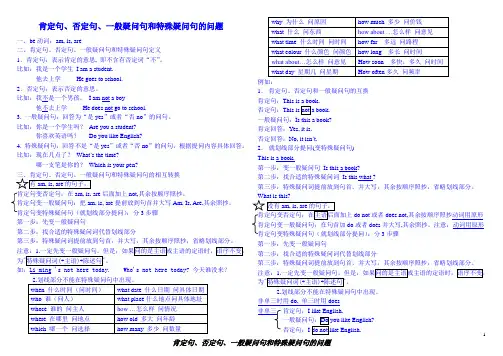
肯定句、否定句、一般疑问句和特殊疑问句的问题一、be 动词:am, is, are二、肯定句、否定句、一般疑问句和特殊疑问句定义 1.肯定句:表示肯定的意思, 即不含有否定词“不”。
比如:我是一个学生 I am a student. 他去上学 He goes to school. 2.否定句:表示否定的意思。
比如:我不是一个男孩。
I am not a boy 他不去上学 He does not go to school.3. 一般疑问句:回答为“是yes ”或者“否no ”的问句。
比如:你是一个学生吗? Are you a student? 你喜欢英语吗? Do you like English?4. 特殊疑问句:回答不是“是yes ”或者“否no ”的问句,根据提问内容具体回答。
比如:现在几点了? What ’s the time? 哪一支笔是你的? Which is your pen?肯定句变否定句:在am, is, are 后面加上not,其余按顺序照抄。
肯定句变一般疑问句:把am, is, are 提前放到句首并大写Am, Is, Are,其余照抄。
肯定句变特殊疑问句(就划线部分提问):分3步骤 第一步:先变一般疑问句第二步:找合适的特殊疑问词代替划线部分第三步:特殊疑问词提前放到句首,并大写,其余按顺序照抄,省略划线部分。
注意:1.如:Li ming 's not here today. Who's not here today? 今天谁没来? 例如:1. 肯定句、否定句和一般疑问句的互换 肯定句:This is a book. 否定句:一般疑问句:Is this a book? 肯定回答:Yes, it is. 否定回答:No, it isn ’t.2. 就划线部分提问(变特殊疑问句) This is a book.第一步:变一般疑问句 Is this a book? 第二步:找合适的特殊疑问词 Is this what ?第三步:特殊疑问词提前放到句首,并大写,其余按顺序照抄,省略划线部分。
肯定句、否定句、一般疑问句和特殊疑问句的详解讲课讲稿
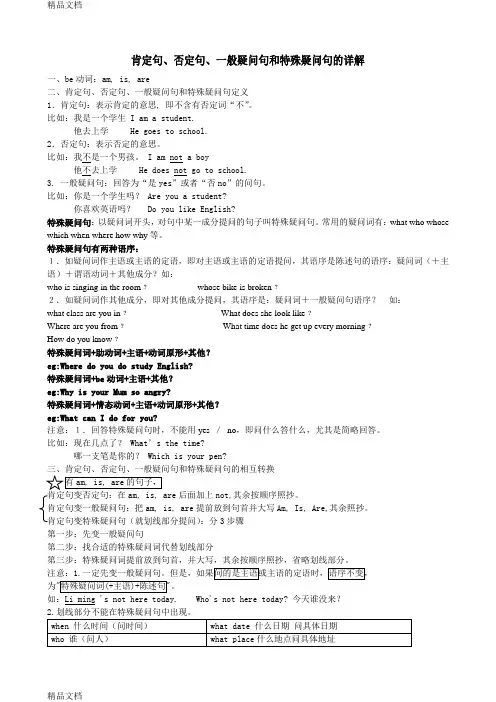
肯定句、否定句、一般疑问句和特殊疑问句的详解一、be动词:am, is, are二、肯定句、否定句、一般疑问句和特殊疑问句定义1.肯定句:表示肯定的意思, 即不含有否定词“不”。
比如:我是一个学生 I am a student.他去上学 He goes to school.2.否定句:表示否定的意思。
比如:我不是一个男孩。
I am not a boy他不去上学 He does not go to school.3. 一般疑问句:回答为“是yes”或者“否no”的问句。
比如:你是一个学生吗? Are you a student?你喜欢英语吗? Do you like English?特殊疑问句:以疑问词开头,对句中某一成分提问的句子叫特殊疑问句。
常用的疑问词有:what who whose which when where how why等。
特殊疑问句有两种语序:1.如疑问词作主语或主语的定语,即对主语或主语的定语提问,其语序是陈述句的语序:疑问词(+主语)+谓语动词+其他成分?如:who is singing in the room﹖whose bike is broken﹖2.如疑问词作其他成分,即对其他成分提问,其语序是:疑问词+一般疑问句语序?如:what class are you in﹖What does she look like﹖Where are you from﹖What time does he get up every morning﹖How do you know﹖特殊疑问词+助动词+主语+动词原形+其他?eg:Where do you do study English?特殊疑问词+be动词+主语+其他?eg:Why is your Mum so angry?特殊疑问词+情态动词+主语+动词原形+其他?eg:What can I do for you?注意:1.回答特殊疑问句时,不能用yes /no,即问什么答什么,尤其是简略回答。
(完整版)英语肯定句、否定句、一般疑问句和特殊疑问句地讲解与练习

肯定句、否定句、一般疑问句和特殊疑问句的讲解与练习二.句子的种类类别用法标点例句陈述句肯定叙述一件事情或说明说话人的看法.This is a bag.这是一个包。
That's my book.那是我的书。
否定I can’t see a bag over there.I don't know.我不知道。
疑问句一般用于提出问题?Are you a student?你是学生吗?Do you like puppets?Can you speak English?你会说英语吗?特殊用于提出问题?What's your name?你的名字是什么?Where's my bag?我的包在哪里How many trees are there?那儿有多少树?选择用于提出问题?Is your friend a boy or a girl?你的朋友是男孩还是女孩?反意用于提出问题?It's a fine day, isn't it?祈使句表示命令或请求、建议.或!Put it here!把那个放这儿。
Look at the noticeboard.看公告栏。
感叹句表示惊讶赞美愤怒等强烈情感!How smart!多么聪明啊!Glad to see you!见到你真是高兴!What a nice pencil case!一、be动词:am, is, are二、肯定句、否定句、一般疑问句和特殊疑问句定义1.肯定句:表示肯定的意思, 即不含有否定词“不”。
比如:我是一个学生 I am a student.他去上学 He goes to school.2.否定句:表示否定的意思。
比如:我不是一个男孩。
I am not a boy.他不去上学 He does not go to school.3. 一般疑问句:回答为“是yes”或者“否no”的问句。
比如:你是一个学生吗? Are you a student?你喜欢英语吗? Do you like English?4. 特殊疑问句:回答不是“是yes”或者“否no”的问句,根据提问内容具体回答。
小学英语肯定句、否定句、一般疑问句和特殊疑问句的详解之欧阳理创编

小学英语肯定句、否定句、一般疑问句和特殊疑问句的详解一、be动词:am, is, are二、肯定句、否定句、一般疑问句和特殊疑问句定义1.肯定句:表示肯定的意思, 即不含有否定词“不”。
比如:我是一个学生 I am a student.他去上学 He goes to school.2.否定句:表示否定的意思。
比如:我不是一个男孩。
I am not a boy他不去上学 He does not go to school.3. 一般疑问句:回答为“是yes”或者“否no”的问句。
比如:你是一个学生吗? Are you a student?你喜欢英语吗? Do you like English?4. 特殊疑问句:回答不是“是yes”或者“否no”的问句,根据提问内容具体回答。
比如:现在几点了?What’s the time?哪一支笔是你的? Which is your pen?三、肯定句、否定句、一般疑问句和特殊疑问句的相互转换有am, is, are的句子,肯定句变否定句:在am, is, are后面加上not,其余按顺序照抄。
肯定句变一般疑问句:把am, is, are提前放到句首并大写Am, Is, Are,其余照抄。
肯定句变特殊疑问句(就划线部分提问):分3步骤第一步:先变一般疑问句第二步:找合适的特殊疑问词代替划线部分第三步:特殊疑问词提前放到句首,并大写,其余按顺序照抄,省略划线部分。
注意:1.一定先变一般疑问句。
但是,如果问的是主语或主语的定语时,语序不变,为"特殊疑问词(+主语)+陈述句"。
如:Li ming's not here today.Who's not here today? 今天谁没来?2.划线部分不能在特殊疑问句中出现。
例如:1.肯定句、否定句和一般疑问句的互换肯定句:This is a book.否定句:This is not a book.一般疑问句:Isthis a book?肯定回答:Yes, it is.否定回答:No, it isn’t.2.就划线部分提问(变特殊疑问句)This is a book.第一步:变一般疑问句 Isthis a book?第二步:找合适的特殊疑问词 Isthis what ?第三步:特殊疑问词提前放到句首,并大写,其余按顺序照抄,省略划线部分。
小学英语必背语法

小学英语必背语法一般现在时1、肯定句:主语 +be(am,are,is) + 表语2、否定句:主语 +be(am,are,is) + not + 表语3、一般疑问句: Be(Am,Are,Is)/Have(Has)/Do(Does) +主语+表语现在进行时1 、肯定句:主语 +be(am,are,is) +现在分词2 、否定句:主语 +be(am,are,is) + not + 现在分词3 、一般疑问句: Be(Am,Are,Is)+主语 +现在分词4、特殊疑问句:疑问词+be(am,are,is) + 主语 +现在分词一般过去时1、肯定句:主语 +V.过 +宾语 / 表语2、否定句:主语 +didn't+V. 原+宾语3、一般疑问句: Did+ 主语 +V. 原 +宾语一般将来时1、肯定句:主语 +be(am,are,is)going to+V.原主语 +shall/will+V. 原2、否定句:主语 +be(am,are,is)+not going to+V.原主语 +shall/will+V. 原3 、一般疑问句: Be(Am,Are,Is)+主语+going to+V .原Shall/Will+主语+V.原疑问词 +shall/will +主语 +V.原4 、特殊疑问句:疑问词+be(am,are,is)+主语 +going to+V . 原过去进行时1、肯定句:主语 +was/were+ 现在分词2、否定句:主语 +was/were+not+现在分词3、一般疑问句: Was/Were+主语+现在分词4、特殊疑问句:疑问词+was/were +主语 +现在分词现在完成时1、肯定句 : +have/has+V. 过去分词2、否定句:主语 +have/has+not+V . 过去分词3、一般疑问句: Have/Has+ 主语 +V.过去分词4、特殊疑问句:疑问词 +have/has +主语 +V.过去分词。
特殊疑问句以及连词成句

小学英语肯定句、否定句、一般疑问句和特殊疑问句的详解 一、be动词:am, is, are 二、肯定句、否定句、一般疑问句和特殊疑问句定义 1.肯定句:表示肯定的意思, 即不含有否定词“不”。 比如:我是一个学生 I am a student. 他去上学 He goes to school. 2.否定句:表示否定的意思。 比如:我不是一个男孩。 I am not a boy 他不去上学 He does not go to school. 3. 一般疑问句:回答为“是yes”或者“否no”的问句。 比如:你是一个学生吗? Are you a student? 你喜欢英语吗? Do you like English? 4. 特殊疑问句:回答不是“是yes”或者“否no”的问句,根据提问内容具体回答。 比如:现在几点了? What’s the time? 哪一支笔是你的? Which is your pen? 三、肯定句、否定句、一般疑问句和特殊疑问句的相互转换 有am, is, are的句子, 肯定句变否定句:在am, is, are后面加上not,其余按顺序照抄。 肯定句变一般疑问句:把am, is, are提前放到句首并大写Am, Is, Are,其余照抄。 肯定句变特殊疑问句(就划线部分提问):分3步骤 第一步:先变一般疑问句 第二步:找合适的特殊疑问词代替划线部分 第三步:特殊疑问词提前放到句首,并大写,其余按顺序照抄,省略划线部分。 注意:1.一定先变一般疑问句。但是,如果问的是主语或主语的定语时,语序不变,为"特殊疑问词(+主语)+陈述句"。 如:Li ming 's not here today. Who's not here today? 今天谁没来? 2.划线部分不能在特殊疑问句中出现。 when 什么时间(问时间) what date 什么日期 问具体日期 who 谁(问人) what place什么地点问具体地址 whose 谁的 问主人 how …怎么样 问情况 where 在哪里 问地点 how old 多大 问年龄 which 哪一个 问选择 how many 多少 问数量 why 为什么 问原因 how much 多少 问价钱 what 什么 问东西 how about …怎么样 问意见 what time 什么时间 问时间 how far 多远 问路程 what colour 什么颜色 问颜色 how long 多长 问时间 what about…怎么样 问意见 How soon 多快,多久 问时间 what day 星期几 问星期 How often多久 问频率 例如: 1. 肯定句、否定句和一般疑问句的互换 肯定句:This is a book. 否定句:This is not a book. 一般疑问句:Is this a book? 肯定回答:Yes, it is. 否定回答:No, it isn’t. 2. 就划线部分提问(变特殊疑问句) This is a book. 第一步:变一般疑问句 Is this a book? 第二步:找合适的特殊疑问词 Is this what ? 第三步:特殊疑问词提前放到句首,并大写,其余按顺序照抄,省略划线部分。 What is this? 没有am, is, are的句子, 肯定句变否定句:在主语后面加上do not或者does not,其余按顺序照抄动词用原形 肯定句变一般疑问句:在句首加do或者does并大写,其余照抄。注意:动词用原形 肯定句变特殊疑问句(就划线部分提问):分3步骤 第一步:先变一般疑问句 第二步:找合适的特殊疑问词代替划线部分 第三步:特殊疑问词提前放到句首,并大写,其余按顺序照抄,省略划线部分。 注意:1.一定先变一般疑问句。但是,如果问的是主语或主语的定语时,语序不变,为"特殊疑问词(+主语)+陈述句"。 2.划线部分不能在特殊疑问句中出现。 非单三时用do, 单三时用does 非单三 肯定句:I like English. 一般疑问句:Do you like English? 否定句:I do not like English. 单三 肯定句:He likes English. 一般疑问句:Does he like English? 否定句:He does not like English. 就划线部分提问:I like English. 第一步:先变一般疑问句 Do you like English? 第二步:找合适的特殊疑问词代替划线部分Do you like what? 第三步:特殊疑问词提前放到句首,并大写,其余按顺序照抄,省略划线部分。 What do you like? 特殊疑问句练习 一.将下列句子变成一般疑问句 1 Mr Wang is thirsty __________________________? 2.The elephant’s ears are long __________________________? 3.We like birds _________________________? 4.Hello.You are his mother __________________________? 5.I can sing and dance. ___________________________? 二 将下列每组词各组成一句特殊疑问句 1.(you are how). _________________________?. 2.(old how Ben is)_________________________? 3.colour is what your shirt_________________________? 4.(can see what the on you desk ) ________________________? 5.(like what do you)_________________________? 三、选择正确的单词填空 (who, where, when) 1._____ is that pretty girl? She is my sister. 2._____ are Jack and Tom? They are behind you. 3._____ do you go to school? I go to school from Monday to Friday. 4._____ has a beautiful flower? John has a beautiful flower. 5._____ are they? They are my parents. 6._____ is my mother? She is in the living room. 7._____ are you going? We are going to the bakery(面包坊). 8._____ do Jim and Wendy play ball? They play ball in the afternoon. 9._____ does he jog? He jogs in the park. 10._____ are you from? I'm from Changchun city. 四、用what time, what color, what day, what填空。 1. A: ______ _______ is it? B: It is nine o'clock. 2. A: ______ _______ does your mother get up? B: My mother gets up at 6:30. 3. A: ______ _______ do you go to bed? B: I go to bed at 10:00. 4. A: ______ _______ do Diana and Fiona have supper? B: Diana and Fiona have supper at 18:00. 5. A: ______ _______is it? B: It is purple. 6. A: ______ _______ is the sky? B: The sky is blue. 7. A: ______ _______ is your coat? B: My coat is black. 8. A: ______ _______ is the dog? B: The dog is white. 9. A: ______ _______ is today? B: Today is Monday. 10. A: ______ _______ is tomorrow? B: Tomorrow is Tuesday. 11. A: ______ _______ was yesterday(昨天)? B: Yesterday was Sunday. 12. A: ______ _______ do you like? B: I like red. 13. A: ______ is this? This is a computer(电脑). 14. A: ______ are you doing? B: We are playing basketball. 15. A: ______ does your mother do? B: My mother is a policewoman. 16. A: ______ are those? B: Those are peppers(辣椒). 17. A: ______ is in the box? B: A lovely doll is in the box. 18. A: ______ is on the table? B: The apple is on the table. 19. A: ______ is in the classroom? The blackboard is in the classroom. 五、连线:(Match) 1. What's on the chair? There is a book in the bag. 2. How is your father? These are apples. 3. What are these? I go to school by bus. 4. What is in the bag? The radio is on the chair. 5. How do you go to school? My father is fine. 6. How much is it? I wash my face in the morning. 7. What time is it? I have two hands. 8. When do you wash your face? It is four o'clock. 9. How many hands do you have? It is 5 RMB(人民币). 10. When do you have lunch? I have lunch at noon.
小学英语肯定句、否定句、一般疑问句和特殊疑问句的介绍之令狐文艳创作
小学英语肯定句、否定句、一般疑问句和特殊疑问句的详解令狐文艳一、be动词:am, is, are二、肯定句、否定句、一般疑问句和特殊疑问句定义1.肯定句:表示肯定的意思, 即不含有否定词“不”。
比如:我是一个学生 I am a student.他去上学 He goes to school.2.否定句:表示否定的意思。
比如:我不是一个男孩。
I am not a boy他不去上学 He does not go to school.3. 一般疑问句:回答为“是yes”或者“否no”的问句。
比如:你是一个学生吗? Are you a student?你喜欢英语吗? Do you like English?4. 特殊疑问句:回答不是“是yes”或者“否no”的问句,根据提问内容具体回答。
比如:现在几点了? What’s the time?哪一支笔是你的? Which is your pen?三、肯定句、否定句、一般疑问句和特殊疑问句的相互转换肯定句变否定句:在am, is, are后面加上not,其余按顺序照抄。
肯定句变一般疑问句:把am, is, are提前放到句首并大写Am, Is, Are,其余照抄。
肯定句变特殊疑问句(就划线部分提问):分3步骤第一步:先变一般疑问句第二步:找合适的特殊疑问词代替划线部分第三步:特殊疑问词提前放到句首,并大写,其余按顺序照抄,省略划线部分。
注意:1.如:Li ming's not here today.Who's not here today? 今天谁没来?2.划线部分不能在特殊疑问句中出现。
例如:1.肯定句、否定句和一般疑问句的互换肯定句:This is a book.否定句:一般疑问句:Isthis a book?肯定回答:Yes, it is.否定回答:No, it isn’t.2.就划线部分提问(变特殊疑问句)This is a book.第一步:变一般疑问句 Isthis a book?第二步:找合适的特殊疑问词 Isthis what ?第三步:特殊疑问词提前放到句首,并大写,其余按顺序照抄,省略划线部分。