
SCI之路1——Case Report篇
Cabstract and Keywords(摘要和关键词) 2.INTRODUCTION(引言) 3.CASE REPORT(病例报告) 4.DISCUSSION(讨论) 5.REFERENCES(参考文献)
Case Report
Case Report中注意事项
1、前面讲过,比较好写,因为很多话在任何病例中基本是一样的,A 56-year-old man was admitted to our department on an emergency basis because of a sudden onset of hematochezia.注意我划线部分, 就是所谓的可以填空的,一个56岁的男性患者因为突然开始便血 而来我院就诊,那你可以替换成因为头疼,或因为腹疼,或因为 腹泻。。。 2、写作中基本就是按照我们诊断基本的步骤而来,从体检到实验室或 者影像学检查,再到手术或者治疗,再到预后等等,限于篇幅, 但是在此之间要在相应部位插入图片,比如术前的影像学、术中 照片以及术后病理等等。。。。。。
胃肠道间质瘤举例——GIST(上文)
这是一例关于阑尾间质瘤的病例,我之前说过胃肠 道间质瘤在胃肠道常见,阑尾罕见。
Abstract an Keywords
概述性摘要: 三步走 1、GIST是什么? 2、GIST是少见,绝大部分 位于胃肠部位,但是 位于阑尾非常罕见。 3、我们在此报道1例阑尾 GIST,由于阑尾出血 而被偶然诊断。 关键词: 一般满足要求即可。
References
参考文献
这个没什么好说的,跟一 般中文要求没太大差别, 但是要注意各杂志的要求
总结
限于篇幅,没能讲得很好
1、模仿写——尤其是Case report部分。 2、注意医学术语——比如入院admitted to。。。。。。 3、准备好的资料,尤其是图片资料。。。。。。 4、平时多看文献,或者写Case之前 多看看别人是怎么写Case的,看的 多了,慢慢也就会了!
Case Report
图片
Case Report的精彩部分在 于图片,所以尽可能有详 细的资料。
DISCUSSION
讨论
1、讨论部分一般而言比较 难写,但是这个不同于 论著,主要是针对文献 进行讨论。 2、讨论中要参插本例病例 的特点,与其他的病例 或以往病例进行比较, 3、基本的思路就是从临床 特点、影像学检查、治 疗方法以及术后病理等 方面讨论,有点类似综 述的样子。。。
INTRODUCTION
引言
1、总体上介绍GIST,什么是 GIST,有什么特点,病 理特征怎么样等等。。。 2、我们在这里报道1例由于 阑尾出血而偶然诊断的 GIST。
Case Report
病例报告
1、最简单易写,但是认为 最关键,因为要引起 别人的兴趣。 2、好写在什么地方? 好比我们中文个案一 样—男,多少岁,因 为XX入院,实验室检 查。。,手术。。 3、很多话是可以“拿来” 的,好比一个填空一 样,只是个别数值需 要修改下就好。
迈向SCI之路:新英格兰杂志Casereport全文解析
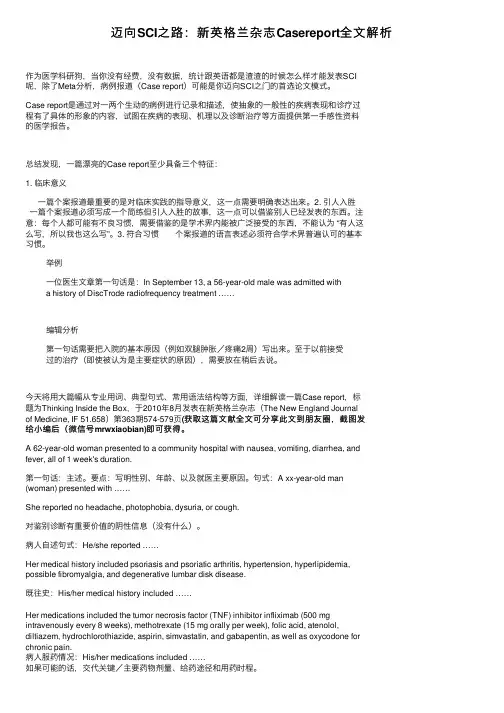
迈向SCI之路:新英格兰杂志Casereport全⽂解析作为医学科研狗,当你没有经费,没有数据,统计跟英语都是渣渣的时候怎么样才能发表SCI呢,除了Meta分析,病例报道(Case report)可能是你迈向SCI之门的⾸选论⽂模式。
Case report是通过对⼀两个⽣动的病例进⾏记录和描述,使抽象的⼀般性的疾病表现和诊疗过程有了具体的形象的内容,试图在疾病的表现、机理以及诊断治疗等⽅⾯提供第⼀⼿感性资料的医学报告。
总结发现,⼀篇漂亮的Case report⾄少具备三个特征:1. 临床意义⼀篇个案报道最重要的是对临床实践的指导意义,这⼀点需要明确表达出来。
2. 引⼈⼊胜⼀篇个案报道必须写成⼀个简练但引⼈⼊胜的故事,这⼀点可以借鉴别⼈已经发表的东西。
注意:每个⼈都可能有不良习惯,需要借鉴的是学术界内能被⼴泛接受的东西,不能认为 “有⼈这么写,所以我也这么写”。
3. 符合习惯个案报道的语⾔表述必须符合学术界普遍认可的基本习惯。
举例⼀位医⽣⽂章第⼀句话是:In September 13, a 56-year-old male was admitted witha history of DiscTrode radiofrequency treatment ……编辑分析第⼀句话需要把⼊院的基本原因(例如双腿肿胀/疼痛2周)写出来。
⾄于以前接受过的治疗(即使被认为是主要症状的原因),需要放在稍后去说。
今天将⽤⼤篇幅从专业⽤词、典型句式、常⽤语法结构等⽅⾯,详细解读⼀篇Case report,标题为Thinking Inside the Box,于2010年8⽉发表在新英格兰杂志(The New England Journalof Medicine, IF 51.658)第363期574-579页(获取这篇⽂献全⽂可分享此⽂到朋友圈,截图发给⼩编后(微信号mrwxiaobian)即可获得。
A 62-year-old woman presented to a community hospital with nausea, vomiting, diarrhea, and fever, all of 1 week's duration.第⼀句话:主述。
case report SCI刀笔历

当你一无所有,没有资源、没有数据、不会统计、英语很差,怎么开始你的第一篇SCI呢?可以考虑做一个Case report(病例报道)。
作为一位医生,你可能没有时间做大样本的回顾,没有课题支持,没有经费可用,没有人手帮忙。
而且,在你有足够数量的SCI论文前,这些也绝不会有。
万事开头难。
怎样在你一无所有的时候开始你的第一篇SCI呢?作为一个中国医生,Case Report是一个很好的选择。
在我国,医生的优势就是患者量实在太大,千奇百怪的病例足够多。
只要这个病例够特别,而且你能够拿到这个病例完整的资料,那么这篇Case就可以写。
一个完整的Case Report包括以下几个部分:1. Abstract2. Introduction3. Case presentation4. Discussion5.References让我们以一个例子来说明。
这是一例关于肺腺癌患者中EGFR基因和EML-ALK基因共同突变的Case。
EGFR基因和EML-ALK基因是互斥的,极少共同突变,这个病例的特殊性,成为它可以发表的亮点。
1. Abstract六句话:第一句:关于肺癌;第二句:关于EGFR;第三句:EGFR基因与肺癌;第四句:关于EML4-ALK;第五句:EML4-ALK与肺癌;第六句:EGFR与EML4-ALK关系2. Introduction写两个部分:第一部分:逻辑上与摘要相同,只是展开一些讲,每一点用2-3句话,重点部分用4-6句话(本例就是:EGFR与EML4-ALK互斥,很少同时在同一患者肿瘤组织中发现。
同时陈述支持这一观点的几个重要文献和数据)。
第二部分:套话。
我们在这里报道EGFR与EML4-ALK同时positive的一例肺腺癌患者。
3. Case presentation这部分是文章的主体,最关键。
但却是全文最好写的部分。
为什么?因为你只需要陈述这个病例的全部情况就可以,女,45岁,因为XX入院,实验室检查发现……,手术发现……,病理提示……,免疫组化提示……而且,很多话是可以“拿来”的,好比一个填空一样,只是个别数值需要修改下就好。
SCI之路1——Case Report篇
INTRODUCTION
引言
1、总体上介绍GIST,什么是 GIST,有什么特点,病 理特征怎么样等等。。。 2、我们在这里报道1例由于 阑尾出血而偶然诊断的 GIST。
Case ReΒιβλιοθήκη ort 病例报告1、最简单易写,但是认为 最关键,因为要引起 别人的兴趣。 2、好写在什么地方? 好比我们中文个案一 样—男,多少岁,因 为XX入院,实验室检 查。。,手术。。 3、很多话是可以“拿来” 的,好比一个填空一 样,只是个别数值需 要修改下就好。
Case Report组成
1.Abstract and Keywords(摘要和关键词) 2.INTRODUCTION(引言) 3.CASE REPORT(病例报告) 4.DISCUSSION(讨论) 5.REFERENCES(参考文献)
胃肠道间质瘤举例——GIST(上文)
这是一例关于阑尾间质瘤的病例,我之前说过胃肠 道间质瘤在胃肠道常见,阑尾罕见。
Abstract an Keywords
概述性摘要: 三步走 1、GIST是什么? 2、GIST是少见,绝大部分 位于胃肠部位,但是 位于阑尾非常罕见。 3、我们在此报道1例阑尾 GIST,由于阑尾出血 而被偶然诊断。 关键词: 一般满足要求即可。
Case Report
Case Report中注意事项
1、前面讲过,比较好写,因为很多话在任何病例中基本是一样的,A 56-year-old man was admitted to our department on an emergency basis because of a sudden onset of hematochezia.注意我划线部分, 就是所谓的可以填空的,一个56岁的男性患者因为突然开始便血 而来我院就诊,那你可以替换成因为头疼,或因为腹疼,或因为 腹泻。。。 2、写作中基本就是按照我们诊断基本的步骤而来,从体检到实验室或 者影像学检查,再到手术或者治疗,再到预后等等,限于篇幅, 但是在此之间要在相应部位插入图片,比如术前的影像学、术中 照片以及术后病理等等。。。。。。
case report范文

case report范文Title: A Miraculous Recovery: A Case ReportIntroduction:In this case report, we present the extraordinary journey of Mr. Smith, a 62-year-old man who experienced a life-threatening medical condition. This report aims to provide a comprehensive overview of his case, including the initial presentation, diagnostic workup, treatment interventions, and the remarkable recovery that followed. Mr. Smith's case highlights the importance of timely medical intervention, multidisciplinary collaboration, and the resilience of the human spirit.Clinical Presentation:Mr. Smith presented to the emergency department with severe chest pain, shortness of breath, and profuse sweating. His symptoms were suggestive of a myocardialinfarction, commonly known as a heart attack. Upon arrival, he appeared pale, diaphoretic, and in distress. His vital signs were unstable, with a blood pressure of 80/50 mmHgand a heart rate of 120 beats per minute. The gravity ofhis condition necessitated immediate resuscitative measures. Diagnostic Workup:An electrocardiogram (ECG) revealed ST-segmentelevation in leads II, III, and aVF, confirming the diagnosis of an inferior myocardial infarction. Further investigations, including cardiac enzyme markers and echocardiography, supported the diagnosis and provided valuable information regarding the extent of myocardial damage. Additionally, coronary angiography revealed acritical stenosis in the right coronary artery.Treatment Interventions:Given the severity of Mr. Smith's condition, a multidisciplinary team consisting of cardiologists, interventional radiologists, and cardiac surgeonscollaborated to devise an optimal treatment plan. Initially, he was stabilized with intravenous fluids, oxygen supplementation, and pain relief. Subsequently, he underwent emergent percutaneous coronary intervention (PCI) to restore blood flow in the occluded coronary artery. A drug-eluting stent was successfully placed, effectively resolving the stenosis.Recovery and Rehabilitation:Following the successful PCI, Mr. Smith's condition gradually improved. He was closely monitored in theintensive care unit for the first few days to manage potential complications and ensure optimal recovery. Physical therapy and cardiac rehabilitation were initiated early to enhance his cardiovascular fitness and prevent deconditioning. With each passing day, Mr. Smith's strength and endurance improved, and he regained his independence.Psychological Impact:While the physical recovery was remarkable, it isimportant to acknowledge the psychological impact that such a traumatic event can have on patients. Mr. Smith experienced anxiety, fear, and a sense of vulnerability during his hospitalization. A multidisciplinary team, including psychologists and social workers, provided emotional support, counseling, and education to help him cope with the psychological aftermath of the myocardial infarction. This holistic approach played a crucial role in his overall recovery.Conclusion:Mr. Smith's case demonstrates the critical importance of timely intervention, collaborative care, and comprehensive rehabilitation in achieving a successful recovery from a life-threatening medical condition. It also highlights the resilience and determination of individuals in overcoming adversity. By sharing this case report, we hope to inspire healthcare professionals to continue providing compassionate care and innovative interventions that can transform lives and restore hope.。
关于SCI杂志中Casereport(个案报告)的写作与投稿
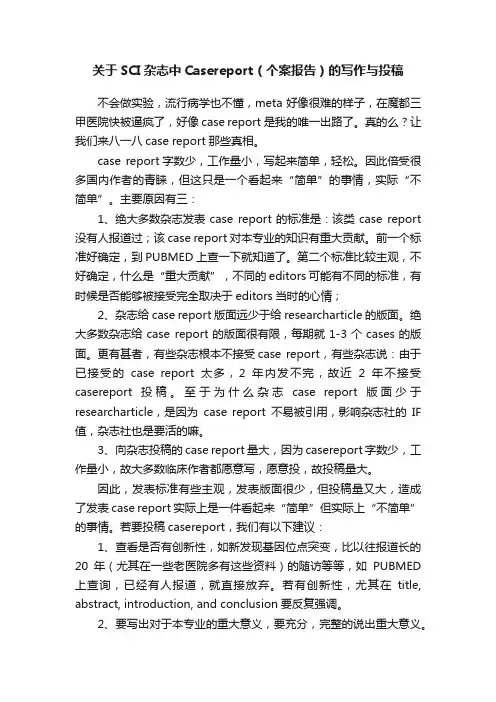
关于SCI杂志中Casereport(个案报告)的写作与投稿不会做实验,流行病学也不懂,meta好像很难的样子,在魔都三甲医院快被逼疯了,好像case report是我的唯一出路了。
真的么?让我们来八一八case report那些真相。
case report字数少,工作量小,写起来简单,轻松。
因此倍受很多国内作者的青睐,但这只是一个看起来“简单”的事情,实际“不简单”。
主要原因有三:1、绝大多数杂志发表case report的标准是:该类case report 没有人报道过;该case report对本专业的知识有重大贡献。
前一个标准好确定,到PUBMED上查一下就知道了。
第二个标准比较主观,不好确定,什么是“重大贡献”,不同的editors可能有不同的标准,有时候是否能够被接受完全取决于editors当时的心情;2、杂志给case report版面远少于给researcharticle的版面。
绝大多数杂志给case report的版面很有限,每期就1-3个cases的版面。
更有甚者,有些杂志根本不接受case report,有些杂志说:由于已接受的case report太多,2年内发不完,故近2年不接受casereport投稿。
至于为什么杂志case report版面少于researcharticle,是因为case report不易被引用,影响杂志社的IF 值,杂志社也是要活的嘛。
3、向杂志投稿的case report量大,因为casereport字数少,工作量小,故大多数临床作者都愿意写,愿意投,故投稿量大。
因此,发表标准有些主观,发表版面很少,但投稿量又大,造成了发表case report实际上是一件看起来“简单”但实际上“不简单”的事情。
若要投稿casereport,我们有以下建议:1、查看是否有创新性,如新发现基因位点突变,比以往报道长的20年(尤其在一些老医院多有这些资料)的随访等等,如PUBMED 上查询,已经有人报道,就直接放弃。
我坎坷的第一篇SCI_博士亲身经历

谈谈自己第一篇SCI的经历7.13号,收到大修稿提交三个月后***的通知,直接录用。
很感谢小木虫和各位大牛们在大修期间给我的帮助。
在论文大修时,我通过小木虫发了不少求助的帖子,并且得到了各位积极的帮助。
当时就想,如果我文章中了,一定要写篇文章谈谈自己第一篇SCI的经历,希望能对后来者有所帮助。
我09年开始读的博,09年下半年开始这个课题,头半年几乎没有任何进展,只是了解了一些基本的东西,10年春节的时候,由于意外发现了一点东西,于是写了篇文章投了一个国外的会议,由于当时的水平太差,被拒。
但是这个思路,当时觉得还很点用。
而且,又看到了另外一篇文章,结合它的方法,测了些数据,重新写了篇文章,很长,差不多快二十页。
这样边实验,边写文章,到10年下半年了。
偶然的机会,看实验室的小导师向****投文章,当时也没想太多,抱着试试看的态度,投出了我第一篇SCI文章,当时的想法就是想让评阅人帮我修下文章,然后再投另一个期刊。
也没当回事,半年没看进度,到今年二月份,觉得时间差不多了,但状态还在REVIEW,于是写了封催稿信,态度很随意。
编辑动作很快,晚上就给拒了,当时还有点小郁闷,不过看了下评审意见,并不是很尖锐,第二天准备按意见修一下投另一个刊物。
没想到,晚上主编又来了封信,说他们搞错了,我的评审结果应该是大修,向我道歉,并给我二个月的修改时间。
当时还不知道大修什么意思,上网上查了下(就是这时候查到小木虫的),发现大修的成功率还是挺高的。
这就没得说了,好好修吧。
于是,好好看了下修改意见,其他意见都好办,其中有两个问题,是对我的数据提出质疑,说我数据的异常没有讨论,而且很不好解释,刚好问到我的软肋(评阅人还是很厉害的)。
于是,重新做实验室,试了各种方法。
那两个月,每天早上7点多到实验室,晚上11点才走。
天天琢磨这两个问题,琢磨了一个月,发现还是没解决,于是就通过关系找到中科院同方向的一哥们,找他帮忙。
那哥们还是挺厉害的,我们聊了一下午,感觉清楚多了,本来揣着钱想晚上请他吃一顿,结果反而是人家请了我,很感激那个哥们,有空一定得请他。
case report 写作顺序 -回复
case report 写作顺序-回复1. 引言(Introduction)- 介绍案例背景和目的(200-300字)在引言中,作者首先应该提供一个简要的案例背景,描述患者的基本信息和相关症状。
此外,还应明确指出本次案例报告的目的,即要解决的问题或要提供的新见解。
2. 患者病史(Patient History)- 描述患者的医疗史和诊断过程(200-300字)在患者病史部分,作者应详细叙述患者就诊的时间、原因和医疗过程。
包括从患者首次就诊到最终的诊断和治疗方案的过程。
也可以包括一些重要的实验室检查结果和影像学报告。
3. 临床表现(Clinical Presentation)- 描述患者的症状和体征(200-300字)在这一部分,作者详细描述患者的临床表现,包括主诉、症状和体征。
可以根据时间顺序描述患者各个阶段的变化,并与相关文献进行对比分析。
4. 诊断过程(Diagnostic Process)- 描述患者的诊断过程和结果(200-300字)在这一部分,作者详细描述医生是如何通过不同的检查和实验室结果对患者进行诊断的。
还可以包括一些相关的影像学检查和生化检查结果。
最后,作者应明确指出最终的诊断结果。
5. 治疗过程(Treatment Process)- 描述患者的治疗过程和效果(200-300字)在治疗过程部分,作者详细描述患者接受的治疗方案以及治疗结果。
可以包括手术细节(如有),使用的药物和其他治疗方法。
同时,还应提供患者的疗效评估和随访结果。
6. 病因分析(Etiology Analysis)- 分析可能的病因和相关因素(200-300字)在这一部分,作者可以根据文献资料和自身观察,分析患者病因的可能性。
可以讨论各种可能性和其依据,并提供对每种可能性的评估和论证。
7. 讨论和结论(Discussion and Conclusion)- 对案例进行分析和总结(200-300字)在讨论和结论部分,作者可以根据已有的文献资料对患者的病情进行深入的分析和讨论。
医学病例报道case report文章英语用词用句
出生/妊娠情况∙was the first child born to unrelated healthy parents after a full-term pregnancy.∙The patient was born after a full-term pregnancy by caesarean section because of premature rupture of the membranes足月、剖腹产、胎膜早破∙she spontaneously breathed and cried.∙The proposita, a 15-year-old girl, was the product of the fifth full-term pregnancy.∙Polyhydramnios was present in the third trimester. 晚期妊娠羊水过多∙Anthropometrical data recorded at birth were: weight 1700g ( < 3rd centile) and height 40cm ( < 3rd centile).∙He was the first child of a nonconsanguineous 非近亲结婚Turkish couple born at term by normal spontaneous vaginal delivery. 顺产∙This 13-year-old boy was born to non-consanguineous Pakistani parents by Caesarean section and weighed 3.6 kg (50th centile) at birth.∙She was delivered by Cesarean for failure to progress 停育at 37 weeks’ gestation.∙Pregnancy was characterized by intrauterine growth retardation宫内发育迟缓, nuchal thickness, and turbidity of amniotic fluid requiring a caesarean birth at the 39th week of gestation.∙short femora 股骨短家人情况∙Her younger sister is healthy.∙ A 13-year-old girl was the second child born to a 42-yearold mother and an unrelated 43-year-old father∙There was no family history of short stature, mental deficiency or congenital anomalies∙He is the only affected member in his pedigree∙At the time of his birth, his father was 35 year-old, 170 cm tall, his mother was32 year-old, 157 cm tall and obese.∙He had two brothers; one was obese but had neither learning difficulties nor visual impairment.生长发育∙Her developmental milestones were normal∙At 11.5 years of age, her height was 129 cm ( – 3 SD), weight 29 kg ( – 1.5 SD), and occipitofrontal circumference 49 cm ( – 2.75 SD).∙Along with her cognitive profile, she showed difficulty in mathematics, reading and writing. 学习困难∙His height and weight have remained markedly below the 3rd percentile∙His height and weight have always been below the 3rd percentile∙Stature (115 cm, 10–25th centile) was disproportionate to the weight (30 kg, 97th centile)∙病情发现∙We call attention to∙Soon after birth, were noted.∙She attained menarche at∙The patient exhibited a full MS phenotype of the clinical and radiological criteria reported in MS, including∙Multiple/ Several congenital anomalies were noted at birth including cleft lip and palate唇腭裂, left facial paralysis左面部瘫痪, systolic heart murmur左面部瘫痪, pilonidal dimple, hypospadias with meatal stricture尿道下裂, congenital phimosis先天性包茎, right crytorchidism右隐睾and inguinal hernia腹股沟疝.∙Hypertension was documented at age 1 1 years∙Marked hyperopia was found on an ophthalmologic examination at age 21 years ∙At age 1 year he was felt to be developmentally delayed∙From infancy the mother noticed the existence of hearing-loss which remained untreated until adolescence.∙He has hypernasal speech because of adenoid hypertrophy.∙From age 3 years he frequently refused to walk complaining of painful legs.就诊原因∙She was referred to us for investigating her short stature at the age of 10 years ∙He was admitted to a state institution for the mentally retarded at age 30 years with ∙He was first referred to a pediatric nutritionist at the age of seven years for the exploration and management of polyphagia and obesity.∙He presented to endocrine clinic at age 11 for short stature and precocious puberty (onset at age 10), and had elevated FSH, and an enlarged left testis.∙特殊面容Craniofacial features/ Craniofacial features∙She had a flat wide facies with prominent prognathism, blepharophimosis, anda narrow mouth with a thin vermilion of the upper lip∙She had a short stature and an unusual square-shaped body habitus with horizontal position of the clavicles and shoulders along with a short neck∙flat wide facies with upward slanting palpebral fissures, blepharophimosis, and a flat nasal bridge with hypoplastic left nares and flat maxillary regions.∙She had a muscular build肌肉身材, brachycephaly短头畸形, frontal bossing 额部隆起, hypertelorism眼距过宽, a broad and prominent nasal bridge宽鼻梁, deep-set eyes 凹眼with short palpebral fissures短睑裂, midfacial hypoplasia面中部发育不良, small external ears小外耳, a short philtrum短人中, a narrow mouth窄嘴, a thin upper lip上嘴唇薄, downturned corners to the mouth嘴角向下翘, hypoplastic teeth发育不全的牙齿, a high palate高上腭, prognathism凸颚, a short neck短颈, Tanner III breast development and external genitalia, short upper limbs 短上肢(rhizo-acromelic shortening), cubitus valgus肘外翻, brachydactyly of the hands and feet手脚短指, clinodactyly of the fifth fingers指过弯, generalized nail dysplasia指甲发育不良, and normal skin and joint movements∙Facial dysmorphism indicative of Myhre syndrome included short palpebral fissures with ptosis, a flat face with mid-face hypoplasia, prognathism and a high arched palate∙Facial and limb morphology further suggested the diagnosis of MS检查∙Audiological examination revealed mixed conductive and sensorial hearing loss∙Radiological examination revealed a thick calvarium, mandibular protrusion,, shortening of the tubular bones, and large pedicles and thick neural arches, resulting in a narrow spinal canal.∙MRI showed thick basilar bone and large and thick clivus.∙The patient underwent a provocative test by insulin-induced hypoglycemia (ITT), thyrotropin-releasing hormone (TRH), and luteinizing hormone-releasing hormone (LHRH)∙Radiographic studies (Fig. 2) showed∙the peak GH response was∙the serum IGF-1 level was appropriate for a pubertal girl∙Physical findings at age 24 years (Fig. I) revealed/ showed a height of 140 cm, weight of 45 kg and a head circumference of 56 cm.∙On physical exam/ examination at age 18 years he had a height of 146 cm, a weight of 50.5 kg and a head circumference of 54.7 cm∙The skeletal survey showed multiple abnormalities∙His muscle mass and strength werc increased 升高∙The skeletal survey demonstrated multiple skeletal ab normalities identical to those pictiired in Case 1∙Psychological evaluation showed an IQ of 48∙ A muscle biopsy revealed fascicles of normal looking muscle fibres∙Gene sequencing analysis was carried out of all 11 coding exons of SMAD4 using the MiSeq next-generation sequencing platform∙Musculoskeletal examination revealed generalised stiff muscles, limited phalangeal extension∙Neurological examination was normal apart from clumsy gait with toe walking. ∙he was normotensive (120/65 mm Hg) 血压正常∙he had mild learning difficulties that necessitated additional educational support. 特殊教育∙Dermatological assessment of the proband revealed keratosis pilaris with a clinical impression of thickened skin. 皮肤病学Skin biopsy findings confirmed∙Three additional clinical genetics evaluations failed to identify a unifying diagnosis.∙检查结果正常∙Results of the routine biochemical studies were within the normal ranges.∙Results of the screening tests for metabolic defects, including analysis of urinary mucopolysaccharides and blood amino acids were normal.∙Routine karyotyping (G-bands) showed 46,XX, and the results of the array CGH (Agilent SurePrint G3 60K) were also negative∙EMG showed no abnormalities.∙Endocrinological studies (basalthyroid profile,LH, FSH, estradiol, cortisol, and IGF-1 serum determinations,thyroid profile) showed normal results.∙No signs of polycystic ovary syndrome were identified.∙The histology of a striated muscle biopsy was normal.∙Cardiovascular evaluations began at age 3 years when a twodimensional echocardiogram showed mild valvar pulmonic stenosis, and clinical follow-up suggested resolution∙Sequencing for Kabuki and Rubinstein–Taybi syndromes, (MLL2, CREBBP, and EP300) was normal∙Psychomotor development was normal 智力,精神发育正常被诊断∙She was diagnosed with∙We propose that∙The thick calvarium and thick and stiff skin were clues to the diagnosis of MS ∙She fulfilled the clinical criteria reported for MS.∙This finding indicated that her GH secretion was not defective.∙Gonadotropin responses were not excessive or inappropriate for an early pubertal girl.治疗∙necessitating hormone replacement therapy.∙The patient was diagnosed with skeletal dysplasia of unknown origin and treated for this condition for several years∙He required surgery for right cryptorchidism at the age of 1.5 years.∙The prednisone dose was raised (1 mg/kg/day) with a good clinical response ∙mycophenolate-mofetil (500 mg twice/day) was added for two months to the prednisone therapy.∙The starting dosage of anakinra was 1 mg/kg/day, subcutaneously. 皮下注射∙年龄At the age of 15,测序∙Direct sequence analysis of the coding lesions led to the identification of three missense mutations in the region ofSMAD4 coding for the MH2 domain∙No likely pathological copy number variants (CNVs) were detected in either case 1 or his mother on a 180 K oligo array CGH报道发病情况∙All cases have been sporadic and an autosomal dominant inheritance was suggested because of advanced paternal age.青春期∙These findings suggest that endocrinological abnormalities related to the hypothalamus–hypophysis feedback may be part of the syndrome. This has been proven at least in one male patient (Case 2, Burglen et al., 2003).∙the abnormal onset of puberty observed in three of our cases, two showing early onset (before the age of 9 years) and another one showing delayed puberty with hypergonadotrophic hypogonadism. Although these phenotypic manifestations are discordant, they may point to a disturbance in the hypothalamohypophyso-gonadal axis that should be investigated in further cases.疾病∙Myhre syndrome is a rare, distinctive syndrome due to specific gain-of-function mutations in SMAD4∙The characteristic phenotype includes∙Cardiomyopathy and pericardial abnormalities distinguish Myhre syndrome from other disorders caused by mutations in the TGF-b signaling cascade (Marfan, Loeys–Dietz, or Shprintzen–Goldberg syndromes)∙Major facial features were病例报道∙We report four newly described patients with typical features of Myhre syndrome who had∙To our knowledge, the severely shortened distal phalanges, shortened third metacarpals, and shortened proximal phalanges of digit 5 have not yet been reported elsewhere as being associated with BDA1 据我们所知,在其他地方尚未报道严重缩短远端指骨,缩短第三掌骨和缩短指骨5位与BDA1相关不明were not recorded。
sci文章的类型
sci文章的类型1. 原著论文(original article)原著论文又称为原始论文,即著作的原本,是作者经过具体选题所进行的调查研究、实验研究、临床研究的结果和临床工作经验的总结,是作者的第一手资料(即直接资料)。
其内容比较广泛,可以是实验研究、临床观察、调查报告等;也可以是医学理论上的创新见解和新的科研成果;还可以使新知识、新理论、新技术、新方法应用于实际取得科学总结。
OriginalArticle对格式和字数要求一般是3500字到5000字左右,20到35 篇参考文献(尽量全部英文的,最好就是SCI 期刊出版的文章,提升自己的文章水平)。
具体的要求要看具体期刊,不同期刊要求不同,需要作者去访问要投期刊的主页查找Instruction to author。
2. 病例报告(case report)病例报告必须是首次报道,必须是罕见的,具有独特性的。
病例报道在国内较为常见,要求为800到1500 字,8-10篇参考文献,但是麻雀虽小五脏俱全。
SCI 期刊接受病例报道必须满足以下三点中其中之一:1. 病例报道必须是首例的报道;2. 必须是罕见的,或具有独特性的;3. 报道出来后能够证明某个专家的假说或者理论。
当然SCI 的病例报道在写的方面要具备五点,并且缺一不可:1. 病人进到科室里的症状是什么样的;2. 医生是通过什么样的方法来检测这个病的;3. 医生是如何进行治疗的;4. 治疗的结果怎么样;5. 跟踪回访,病人出院是个什么样的,三个月以后情况又如何。
上述五点要面面俱到,然而我们国内的医师大多数写病例报道的时候都会少个一两项,从而遭到退稿。
3. 综述(review/Mini-review)综述主要内容来源于已经发表的资料,即以间接资料为主,属于第三次文献。
结合作者个人的部分研究资料和经验,把来自多种渠道的、分散的、无系统的、重复的,甚至矛盾的资料,按照个人的观点和体系编排起来,使读者能够在较短的时间内了解某一学科领域或某一专题的发展水平及进展情况。
sci case report 投稿介绍信模板
以下是一个SCI病例报告投稿介绍信的模板,供您参考:
尊敬的编辑先生/女士,
我谨代表我们的团队,向您提交一篇关于(病例类型)的病例报告。
本报告详细描述了一个我们在(医院名称)遇到的罕见病例,该病例具有(病例特点)。
我们相信,这个病例对于医学界具有一定的参考价值,并能够为相关领域的研究提供有价值的资料。
该病例报告已经经过严格的同行评审和修改过程,并且已经得到了我们团队的充分认可。
我们相信,这个病例报告具有以下特点:
1.独特性:该病例具有一些非常独特的特点,在医学文献中尚未报道过。
2.重要性:该病例对于相关领域的研究具有一定的参考价值,并能够为医学界提供有价值的资料。
3.科学性:该病例报告经过严格的科学验证和实验验证,确保数据的准确性和可靠性。
我们诚挚地希望,您能够考虑我们的投稿,并为我们的病例报告提供有价值的建议和反馈。
如果您需要更多的信息或有任何疑问,请随时与我们联系。
我们期待您的回复,并希望能够尽快在贵刊上发表我们的文章。
谢谢您的耐心阅读和考虑。
此致
敬礼
(您的名字)
(您的职务)
(您的联系信息)。