
中国寓言故事英文版
中国寓言故事英文版
中国寓言故事英文版
1. The Foolish Old Man and the Sons (愚笨的老人和他的儿子们)
In ancient China, there was an old man who wanted to teach his
sons the value of unity. He gathered a bundle of sticks and asked each
of his sons to try and break it. Despite their efforts, none of them
succeeded. Then, the old man untied the bundle and gave each stick to
his sons. As they tried to break the sticks individually, they found it
effortless. The old man explained that unity was their strength, just like
the bundle of sticks.
2. The Clever Monkey (聪明的猴子)
Once upon a time, in a forest, there was a clever monkey who loved
playing tricks. One day, he found a beehive filled with delicious honey.
Instead of eating it all, the monkey decided to trick the other animals.
He called them together and said that a treasure was buried beneath the
beehive. As the animals dug furiously, the monkey enjoyed the honey
all by himself. The animals learned the importance of caution and not
being easily deceived.
3. The Tortoise and the Hare (乌龟和兔子)
In a forest, a tortoise and a hare lived. The hare was always boasting
about his speed, so the tortoise challenged him to a race. The hare laughed, thinking victory was certain. He took a nap during the race,
assuming he would easily win. Meanwhile, the tortoise continued at a
slow and steady pace. When the hare woke up, he found the tortoise
had already crossed the finish line. The tortoise taught the hare that
perseverance and consistency are essential to success.
4. The Greedy Farmer (贪婪的农夫)
Once, there was a farmer who had a magic goose that laid golden
eggs. The farmer became greedy and wanted to get all the golden eggs
quickly. He thought there must be a lot of gold inside the goose. So he
killed the goose, only to find that it was just like any other ordinary
goose. The farmer lost the goose that laid the golden eggs, teaching him
the lesson that greed leads to loss.
5. The Fox and the Grapes (狐狸和葡萄)
A hungry fox spotted a ripe bunch of grapes hanging from a vine.
The fox tried to reach them but couldn't. He kept trying until tired.
Finally, he gave up and said, "Those grapes must be sour and not worth
eating." The fox made himself believe that the grapes were undesirable
rather than admitting his failure. The moral of the story is that it is easy
to despise what we cannot have.
6. The Ant and the Grasshopper (蚂蚁和蝗虫)
In a field, an ant worked hard to collect food for the winter.
Meanwhile, a grasshopper played all day long. When winter arrived, the ant had enough food to survive, while the grasshopper had none.
The ant learned the importance of hard work and planning for the
future, while the grasshopper learned the consequences of laziness.
7. The Fisherman and the Golden Fish (渔夫和金鱼)
A fisherman caught a golden fish that turned out to be a magical
creature. The fish pleaded to be released in return for granting any wish.
The fisherman made extravagant wishes but was never satisfied.
Finally, he realized his greed and asked the fish to return him to his
humble life as a fisherman. The story teaches that contentment brings
true happiness.
8. The Dove and the Ant (鸽子和蚂蚁)
A dove, flying over a river, noticed an ant struggling in the water.
The dove plucked a leaf and dropped it next to the ant, saving its life.
Later, the ant returned the favor by biting a hunter who was about to
shoot the dove. The story highlights the importance of kindness and the
idea that helping others will ultimately benefit oneself.
9. The Boy Who Cried Wolf (撒谎的男孩)
A mischievous boy lived in a village and often lied about a wolf
threatening the flock. The villagers rushed to help him every time, only
to discover he had tricked them. Eventually, when a real wolf appeared,
the boy cried for help, but no one believed him. The moral is that
repeated dishonesty will lead to a loss of trust and credibility. 10. The Lion and the Mouse (狮子和老鼠)
A mighty lion was caught in a hunter's net. A little mouse, moved
by his cries, helped the lion by nibbling through the ropes to set him
free. Later, when the lion fell into a trapper's trap, the mouse returned
the favor and gnawed through the ropes. The story teaches that even the
smallest of creatures can be of great help.
These Chinese fables showcase important morals and life lessons
that have been passed down through generations.
中国寓言故事120字英文
中国寓言故事英文
1
English:
Chinese fables are full of wisdom and charm. They have been passed down
through generations and still hold great value today. For example, the story of "The
Fox Borrowing the Tiger's Ferocity". In this story, the fox tricks the tiger into believing
that it is powerful by walking in front of the tiger and making all the animals run away.
The fox is relying on the power of the tiger to show off, but in reality, it has no real
power of its own. This story warns us about the danger of relying on others' power.
Another classic fable is "Mending the Fold After a Sheep is Lost". A shepherd loses a
sheep because he didn't fix the fence in time. Later, he realizes his mistake and
mends the fence. This story emphasizes the importance of correcting mistakes in
time. Chinese fables not only entertain us with interesting stories, but also teach us
高中英语作文用英语讲中国寓言故事乌鸦喝水

高中英语作文用英语讲中国寓言故事乌鸦喝水
全文共6篇示例,供读者参考
篇1
The Crow and the Pitcher
Hey there! Today I want to share with you one of my favorite
stories from China. It's a really old fable that teaches an
important lesson about being clever and resourceful. Are you
ready? Okay, here goes!
Once upon a time, on a hot and sunny day, a crow was
feeling very thirsty. He flew around looking everywhere for water,
but he couldn't find any rivers, streams, or ponds. The poor little
crow was becoming weak and tired from the heat.
Just when he was about to give up hope, he spotted a tall
pitcher down on the ground. The crow flew down and peeked
over the rim. To his delight, he saw there was a small amount of
water inside! But there was a problem - the pitcher was so tall
and the water line was so low down that the crow couldn't reach
中国寓言故事短篇 英文
The Power of Perseverance: A Chinese Fable
Retold
In the ancient land of China, a fable was told about a
farmer and his seed. One sunny day, the farmer planted a
seed in his fertile field, watered it, and waited patiently
for it to sprout. Days passed, and the seed did not show
any signs of life. The farmer's neighbors mocked him,
saying that the seed was dead and would never grow. But the
farmer refused to give up. He knew that every seed has its
own time to sprout.
Weeks went by, and still, there was no sign of the seed
sprouting. The farmer's family began to doubt him, thinking
he had wasted their precious time and resources. But the
farmer remained unperturbed,坚信自己的决定是正确的。 He
continued to water the soil and care for it, hoping that
one day he would see the fruit of his labor.
Months passed, and the winter winds began to blow. The
有趣的中国寓言故事-夸父追日(中、英文版)
夸父追日
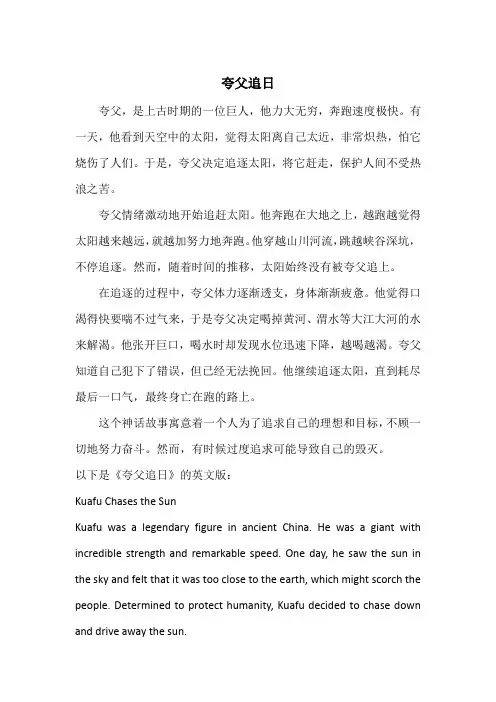
夸父,是上古时期的一位巨人,他力大无穷,奔跑速度极快。有一天,他看到天空中的太阳,觉得太阳离自己太近,非常炽热,怕它烧伤了人们。于是,夸父决定追逐太阳,将它赶走,保护人间不受热浪之苦。
夸父情绪激动地开始追赶太阳。他奔跑在大地之上,越跑越觉得太阳越来越远,就越加努力地奔跑。他穿越山川河流,跳越峡谷深坑,不停追逐。然而,随着时间的推移,太阳始终没有被夸父追上。
在追逐的过程中,夸父体力逐渐透支,身体渐渐疲惫。他觉得口渴得快要喘不过气来,于是夸父决定喝掉黄河、渭水等大江大河的水来解渴。他张开巨口,喝水时却发现水位迅速下降,越喝越渴。夸父知道自己犯下了错误,但已经无法挽回。他继续追逐太阳,直到耗尽最后一口气,最终身亡在跑的路上。
这个神话故事寓意着一个人为了追求自己的理想和目标,不顾一切地努力奋斗。然而,有时候过度追求可能导致自己的毁灭。
以下是《夸父追日》的英文版:
Kuafu Chases the Sun
Kuafu was a legendary figure in ancient China. He was a giant with
incredible strength and remarkable speed. One day, he saw the sun in
the sky and felt that it was too close to the earth, which might scorch the
people. Determined to protect humanity, Kuafu decided to chase down
and drive away the sun. With great excitement, Kuafu began his pursuit. He ran across the land,
feeling that the sun was getting farther away with each step. Undeterred,
中国寓言故事英文文短篇
The Power of Persistence: The Turtle and the
Hare Race
In the ancient Chinese village of Yangzi, there lived a
wise old man named Laozi. One sunny afternoon, he sat
beneath a shady oak tree, watching the world go by.
Suddenly, a hare bounded by, looking arrogant and proud.
The hare stopped to rest and saw Laozi sitting there calmly.
"Old man," the hare said with a sneer, "I challenge you
to a race. I bet I can reach the other end of this field
before you can even finish your pipe of tobacco."
Laozi smiled and shook his head. "You are very fast,
hare, but I am old and slow. You would win easily."
The hare laughed. "Then why don't you accept the
challenge?"
Laozi sighed. "Very well, hare. We will race. But first,
let's find a judge."
The hare agreed, and soon they found an honest farmer
中国寓言故事及启示英语作文
中国寓言故事及启示英语作文
Once upon a time, there was a wise old man in China who
loved to tell fables and stories to teach important life
lessons. Here are some of his favorite fables and the
lessons we can learn from them:
1. The Tortoise and the Hare
In this classic fable, the speedy hare challenges the
slow-moving tortoise to a race. The hare is overconfident
and takes a nap during the race, allowing the tortoise to
win.
Lesson: Slow and steady wins the race. It's important to
take your time and not rush through things, as mistakes can
be made when you're in a hurry.
中文:从这个古老的故事中我们可以得到这样的启示:稳扎稳打,获胜在望。在做事时要认真踏实,不要匆忙行事。
2. The Ant and the Grasshopper
In this fable, the hardworking ant spends the summer
gathering food to prepare for the winter, while the lazy
grasshopper spends his time playing and singing. When winter comes, the grasshopper is hungry and has no food,
中国寓言故事英文简短
中国寓言故事英文简短
In the vast and ancient cultural landscape of China,
fables and parables have always played a pivotal role in
imparting wisdom and moral lessons. These stories, often简短而精悍, pack profound truths into a few sentences or
paragraphs, offering insights into human nature and the
complexities of life.
One such fable that resonates deeply with me is "The
Old Man and His Grandson Riding a Donkey." It tells the
story of an old man and his young grandson traveling on a
donkey. At first, when they set out, the old man rode while
the boy walked alongside. People criticized the old man for
being selfish and not thinking of his grandson. So, the old
man got off the donkey and let the boy ride. Soon, however,
passersby criticized the boy for being disrespectful and
not allowing his grandfather to ride. Confused, the old man
中国长篇寓言故事英文版
中国长篇寓言故事英文版
Chinese culture is renowned for its rich literary heritage which spans
thousands of years. Among the many literary genres that have
flourished in China, the long fable story stands out as a unique and
captivating form of storytelling. These narratives often weave
together elements of morality, philosophy, and social commentary,
providing readers with thought-provoking tales that offer insights
into the human condition.
One of the most celebrated long fable stories in Chinese literature is
the classic tale of "The Peach Blossom Spring" written by the
renowned poet Tao Yuanming during the Eastern Jin dynasty. The
story follows the journey of a fisherman who stumbles upon a
hidden valley where the inhabitants live in a state of harmonious
isolation, untouched by the outside world. The fisherman is
著名的英文版中国寓言故事
著名的英文版中国寓言故事
1 / 1 Staying by a Stump Waiting for More Hares To Come and Dash Themselves
Against It
This story took place more than 2,000 years ago. At that time there was a man
who was famous for staying by a stump waiting for more hares to come and dash
themselves against it.
He was a yong farmer,and his family had been farmers for generations.Year after
year and generation after generation, farmers used to sow in spring and harvest in
autumn,beginning to work at sunrise and retiring at sunset.In good harvest years,they
could only have enough food to eat and enough clothing to wear.If there was a famine
due to crop failure,they had to go hungry.
This young farmer wanted to improve his life.But he was too lazy and too
cowardly.Being lazy and cowardly over everything,he often dreamed of having
中国古代寓言故事英文版
中国古代寓言故事英文版
根据学、心理学的相关理论以及中学历史课程编排特点,历史故事在历史教学中的运用具有极大的可行性与有效性,下面这些是小编为大家推荐的几篇中国古代英文版
中国古代寓言故事英文版:Hide the thief
There is a thief, want to steal something to change some
food. One night, he went to find, those who have a large family
of the door on a big lock, strong, he can not get how to get it.
Turn to go, the thief finally found a family, two door door
broken, not much effort, the thief opened the door into the
house. He was looking through the East and west to see, looking
for valuable things. But this one is in addition to some broken
chairs as pour as a church mouse, rotten rags, simply can not find
the money can be the same thing. The thief had gasped, secretly
crying: Oh, my god! How can I have such a bad luck, the family is
simply too poor, there is nothing to steal, so I wasted so much
time and effort!