
中国成语寓言故事英文版:天帝赐酒
中国成语寓言故事英文版:天帝赐酒
One day, deities from various places came to pay homage to the Emperor of Heaven.
一天,各路神仙都来朝拜天帝。
The emperor gave his minister in charge of wine cups the following order:
天帝命令司筋大臣说:
"Register the names of the deities first, then bestow wine upon them."
“先把他们的名字登记好,再赐给他们酒喝。
”
The minister registered the names of the deities on bamboo slips, and prepared to bestow wine. But he kept on working for 3, 000 years and had not finished the registration yet.
司筋大臣拿着竹简,登记各路神仙的姓名,准备赐酒,不过登记了三千年,还没登记完。
The emperor inquired:
天帝查问:
"Why haven't you finished registering?"
“你为什么还没有登记完?"
The minister reported:
司筋大臣报告说:
"All the deities have brought their sedan-chair carriers."
“各路神仙都带着轿夫。
”
The emperor ordered:
天帝下令:
"Then register the sedan-chair carriers as well."
“轿夫,也登记上吧!”
7, 000 years passed and the registration was still not done.
结果,又登记了七千年,还是没有登记完。
When the emperor inquired again, the minister had no way out but reported:
当天帝再次查问的时候,司筋大臣无可奈何地报告说:
"The sedan-chair carriers of the deities have brought their own carriers too."
“各路神仙的轿夫,又都带着自己的轿夫啊!”
So the wine was not bestowed after all.
赐酒一事,最终还是没有成功。
The Emperor of Heaven remained silent for a long time and then heaved a deep sigh.
天帝沉默了半天,长长地叹息了一声。
成语故事大全英文版
成语故事大全英文版成语故事既能开阔视野、增长知识,又能懂得许多做人做事的道理,更能锻炼人的语言表达能力,下面这些是小编为大家推荐的几篇成语故事大全英文版。
成语故事大全英文版1:子罕拒玉A farmer in the state of Song once got a piece of stone with jade in it.宋国人有个农夫得到一块含宝玉的石头后,将它献给了相国子罕。
He presented this stone to Prime Minister Zi Han. But Zi Han refused to accept it. The farmer explained, “It looks like just a stone, but there is jade inside. It actually is a piece of treasure and suitable for honorable men like you, not for us common people.”子罕拒绝接受这块石头,农夫解释说:“表面上它是块石头,但里面含有宝玉,是个宝物,适合您这样的贵人使用,我们普通百姓用它就不合适了。
”“I know there is jade inside,” Zi Han said,” but I disagree with you. I think to have the virtue of declining things that do not belong to oneself is the real treasure. ”子罕说:“我知道里面是宝玉。
但我的观点和你不同,我认为具有不接受不应得的东西的品德才是真正的宝玉。
”成语故事大全英文版2:讳疾忌医A famous doctor, Bian Que, after seeing Duke Huan of the state of Cai, told him that his illness had intruded into his skin and he needed to be treated immediately.名医扁鹊见到蔡桓公后,告诉桓公他的疾病已入侵皮肤,要赶快治疗。
中华传统的成语典故英语作文
中华传统的成语典故英语作文The Enduring Legacy of Chinese Idioms: A Cultural OdysseyThe Chinese language is a rich tapestry woven with centuries of wisdom, tradition, and cultural nuance. Embedded within this linguistic tapestry are the captivating idioms, or chengyu, that have become an integral part of the Chinese cultural heritage. These concise, yet profound, expressions encapsulate the essence of Chinese philosophy, history, and the human experience, making them a captivating subject for exploration.At the heart of these idioms lies a deep reverence for the past and a profound understanding of the human condition. Each chengyu is a distillation of a complex story or a profound lesson, often drawn from the annals of Chinese history, literature, or mythology. These idioms serve as a bridge between the present and the past, allowing contemporary individuals to connect with the wisdom and experiences of their ancestors.One such example is the idiom "Crossing the River by Feeling the Stones" (摸着石头过河), which speaks to the importance of caution and prudence in the face of uncertainty. This phrase originated fromthe writings of the renowned Chinese philosopher Deng Xiaoping, who used it to describe his approach to economic reform in China. The idiom encourages a measured and cautious approach, where one carefully navigates uncharted waters by relying on the stability of each step, rather than rushing headlong into the unknown.Another iconic chengyu is "Beating the Grass to Startle the Snake" (打草惊蛇), which refers to the act of inadvertently revealing one's true intentions or plans. This idiom finds its roots in ancient military strategies, where soldiers would intentionally rustle the grass to flush out hidden enemies. Today, the phrase is used to caution against the unintended consequences of revealing sensitive information or prematurely exposing one's plans.The richness of Chinese idioms extends beyond their historical origins and into the realm of moral and ethical teachings. The chengyu "Returning Favor with Ingratitude" (负恩图报) serves as a cautionary tale about the perils of betrayal and the importance of gratitude. This idiom condemns the act of repaying kindness with malice, reminding individuals of the sacred bond between benefactor and beneficiary.Interestingly, many Chinese idioms also find their way into the realm of personal growth and self-improvement. The phrase "Cutting Firewood and Carrying Water" (砍柴挑水) encourages a humble anddiligent approach to life, emphasizing the importance of mastering the mundane tasks that form the foundation of personal development. This idiom reminds us that true growth and mastery often come from the consistent application of effort, rather than the pursuit of grandiose achievements.The enduring appeal of Chinese idioms lies not only in their rich cultural heritage but also in their remarkable adaptability to modern contexts. As the world becomes increasingly interconnected, these timeless expressions have found their way into the lexicon of global business, diplomacy, and even popular culture. Multinational corporations have embraced the use of Chinese idioms to convey complex ideas with elegance and precision, while political leaders have leveraged these phrases to communicate nuanced messages to both domestic and international audiences.Moreover, the popularity of Chinese idioms has transcended linguistic boundaries, with scholars and enthusiasts around the world engaging in the study and translation of these captivating expressions. The global fascination with Chinese culture has fueled a growing interest in understanding the deeper meanings and cultural significance behind these idioms, further solidifying their status as a universal language of wisdom and insight.In conclusion, the enduring legacy of Chinese idioms is a testamentto the enduring power of language to capture the essence of human experience. These concise yet profound expressions serve as a window into the rich tapestry of Chinese culture, inviting individuals from all walks of life to engage with the wisdom of the past and apply it to the challenges of the present. As the world continues to grapple with the complexities of modern life, the timeless lessons encoded within Chinese idioms will undoubtedly continue to resonate, guiding us on our collective journey towards a deeper understanding of ourselves and the world around us.。
古代成语英语小故事文字版
【导语】在古代有很多成语=故事⾮常的有意思,相信⼩朋友们都会感兴趣。
下⾯是分享的古代成语英语⼩故事⽂字版。
欢迎阅读参考! 梁上君⼦ One year in the Eastern Han Dynasty, there was a serious famine in I-Jenan. 东汉时的某⼀年,河南⼀带,饥荒严重。
One night, a thief sneaked into Chen Shi's house and hid himself on the beam. When Chen Shi was aware of this, he got out of bed without haste, called his children and grandchildren to his room and said in a stern voice: ⼀天夜⾥,⼀个⼩偷潜⼈陈宴家,躲藏在屋⼦的横梁上。
陈宴觉察到后,不慌不忙地起了床,把⼉⼥⼦孙们都叫到屋⾥,严厉地说: "One must always restrain and encourage oneself no matter under what circumstances. Bad men were not born bad. It is only become they don't restrain themselves that they develop bad habits and turn bad gradually. That gentleman on the beam is just a case in point." “⼀个⼈⽆论在什么情况下,都要克制⾃⼰,勉励⾃⼰。
坏⼈,不是天⽣就坏,⽽是因为平时不克制⾃⼰⽽养成了坏的习惯,才慢慢地变坏的。
那位梁上君⼦就是这样。
” Much ashamed upon hearing this, the thief hiding on the beam promptly jumped down to the ground, kowtowed and begged for forgiveness. 躲在梁上的⼩偷听了,很惭愧,连忙翻⾝落地,磕头求饶。
10篇中国成语故事英文版,经典收藏!
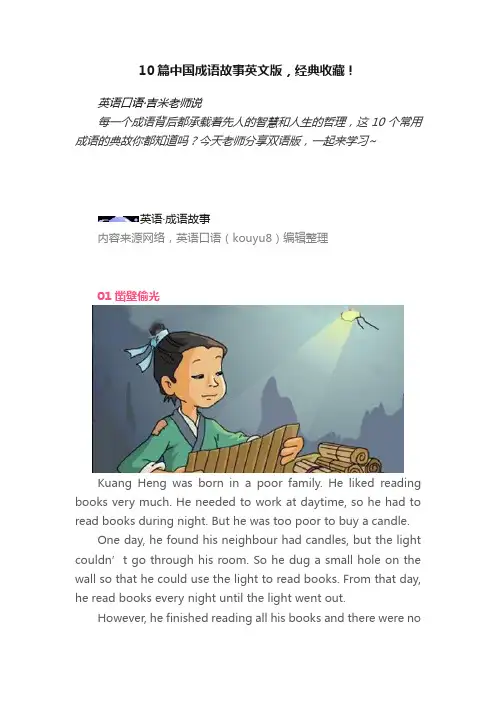
10篇中国成语故事英文版,经典收藏!英语口语·吉米老师说每一个成语背后都承载着先人的智慧和人生的哲理,这10个常用成语的典故你都知道吗?今天老师分享双语版,一起来学习~英语·成语故事内容来源网络,英语口语(kouyu8)编辑整理01 凿壁偷光Kuang Heng was born in a poor family. He liked reading books very much. He needed to work at daytime, so he had to read books during night. But he was too poor to buy a candle.One day, he found his neighbour had candles, but the light couldn’t go through his room. So he dug a small hole on the wall so that he could use the light to read books. From that day, he read books every night until the light went out.However, he finished reading all his books and there were nobooks for him to read. Then he went to a rich man’s house and worked for him with out payment. The rich man asked: “ Why don’t you want the money?” Kuang Heng said: “ Because I only want to borrow your books.” The rich man agreed. Kuang Heng read the books one by one.Finally, he became a great scholar.匡衡勤奋好学,但家中没有蜡烛。
英语成语故事及翻译三篇
【导语】孩⼦们学习成语故事,感受故事中的趣味,更从故事中,学习到很多为⼈处世的道理。
下⾯是分享的英语成语故事及翻译三篇。
欢迎阅读参考! 【后来居上】 Ji Anlived at the time of Emperor Wudi of the Western Han Dynasty (206 B.C.-A.D.24). He was respected for being upright and just and for daring to speak the truth. He did not bother about amall matters in personal behaviour and in being an official. He was particular about actual effects and ,although he did not cause a stir ,he could keep the prefecture he governed in perfect order. Because of this. the imperial court transferred him to the central government from being the perfect of the Donghai Prefecture to being a commander in charge of the appointment and dismissal of the local officals. 汲黯是西汉武帝时代⼈,以刚直正义、敢讲真话⽽受⼈尊重。
他为⼈和做官都不拘⼩节,讲求实效。
虽然表⾯上不那么轰轰烈烈,却能把⼀个郡治理得井井有条,因此,朝廷把他从东海太守调到朝廷当主爵都尉——⼀种主管地⽅吏任免的官职。
Once,Emperor Wudi said that he would implement the policy of benevolence and justice of Confucianism and would do good turns to the people.Emperor Wudi Had hardly finished his remards when Ji An said that there was no need for the emperor to say so.Why should the emperor bother,Ji An said, about pretending to implement the policy of benevolence and justice since he was so greedy and avaricious within himself? This choked the emperor off. The emperor suddenly Changed his countenance and declared the meeting over. All the civilian and military officers at court were breathless with anxiety for fear that Ji An might bring disaster upon himself because of this. After returning, Emperor Wudi said to the people around him that Ji An was a little too rude and too straightforward. 有⼀次,汉武帝说要实⾏儒家的仁义之政,为⽼百姓办好事了。
中国寓言故事-英文版
画蛇添足Once upon a time, there was a nobleman who gave some wine to his servants.The wine was not enough for all.The servants finally decided whoever first finished drawing a snake on the ground would get the cup of wine.One of the servants finished drawing first.He took up the cup and was about to drink the wine when he thought of adding feet to the snake.He went on drawing.Then another servant finished drawing his snake. He snatched the wine cup and drank up the wine saying: “It is I who first finished drawing the snake.What you have drawn is not a snake.A snake doesn't have feet.”杞人忧天In the Spring and Autumn Period, in the State of Qi, there was a man who always let his imagination run away with him. One day he even worried that the sky would fall on his head. He was so worried that he could neither eat nor sleep. Later, someone persuaded him that his fears were ground-less. This idiom satirizes those who worry unnecessarily.东施效颦In the Spring and Autumn Period (春秋时期,770-476 BC), there was a beauty in the State of Yue called Xishi. She often suffered from pains in her chest, and so she would often walk around doubled over and with her brows knitted. There was an ugly girl in the village called Dongshi who envied Xishi. Striving to emulate Xishi, she imitated her stoop, knitting her brows at the same time. She thought that this made her elegant, but in fact, it only made her more ugly. Later, this idiom came to be used to indicate improper imitation that produces the reverse effect.草木皆兵In AD 383, the king of Former Qin (秦朝), Fu Jian (fújiān 苻坚), led a huge army to attack Eastern Jin. After losing the first round of fighting, Fu Jian looked down from a city wall, and was terrified when he saw the formidable battle array of the Eastern Jin army. And then looking at the mountains around, he mistook the grass and trees for enemy soldiers. As a result,when the nervous Fu Jian led his army into battle, it suffered a crushing defeat. This idiom describes how one can defeat oneself by imaging difficulties.塞翁失马Near China's northern borders lived a man well versed in the practices of Taoism. His horse, for no reason at all, got into the territory of the northern tribes. Everyone commiserated with him."Perhaps this will soon turn out to be a blessing," said his father.After a few months, his animal came back, leading a fine horse from the north. Everyone congratulated him."Perhaps this will soon turn out to be a cause of misfortune," said his father.Since he was well-off and kept good horses, his son became fond of riding and eventually broke his thigh bone falling from a horse. Everyone commiserated with him."Perhaps this will soon turn out to be a blessing," said his father.One year later, the northern tribes started a big invasion of the border regions. All able-bodied young men took up arms and fought against the invaders, and as a result, around the border nine out of ten men died. This man's son did not join in the fighting because he was crippled and so both the boy and his father survived.欢迎您的下载,资料仅供参考!致力为企业和个人提供合同协议,策划案计划书,学习资料等等打造全网一站式需求。
英语成语小故事
英语成语小故事英语成语小故事英语成语小故事1Yang Jian was the regent(摄政王) of the last king of Northern Zhou(557-581).His wife advised him: "Northern Zhou is dying. Now it is as if you are riding on the back of a tiger. It will be dangerous to dismount(下马,下车) . You can do nothing but continue."Yang Jian thought this quite reasonable. Later, he founded the Sui Dynasty, and united China once more.This idom is used as a metaphor meaning that one is in a difficult situation and cannot help but ontinue to pursue one's sourse.英语成语小故事2In the Song Dynasty(960-1279) there was a joker called Sun Shan.One year he went to take the imperial examination, and came bottom of the list of successful candidates. Back in his hometown, one of his neighbours asked him whether the neighbour's son had also passed.Sun Shan said, with a smile: "Sun Shan was the last on the list, your son came after Sun Shan."Later, people used this idiom to indicate failing in an examination or competition.英语成语小故事3In ancient times there were no donkeys in Guizhou province. Somebody brought a donkey from somewhere and tied it to a tree at the foot of a mountain.A tiger saw the donkey, and thought that it must be afearsome(可怕的) monster. It hide behind a tree and spied on the donkey.When the donkey brayed(叫) , the tiger was frightened, thinking that the donkey was about to devour(吞食,毁灭) it. After a while, seeing that the donkey had not moved, the tiger approached it and teased it. The donkey became angry, and kicked the tiger.The tiger thought to itself: "Its then all it is capable of?" It then jumped on the donkey and ate it.This idiom is used to mean that one has exhauseted one's skills.英语成语小故事4during the late years of the qi dynasty(221-206bc), xiang yu led a rebellion. after crossing the zhang river, xiang yu ordered his men to sink all their boats and break their cooking pots.he issued each soldier three days' rations(给养) and warned them that there was no way to retreat; the only thing they could do to survive was to advance and fight.after mine fierce battles, the qin army was finally defeated.this idiom is used to indicate one's firm determination to achieve one's goal at any cost.。
成语故事 英语译文
An official of the ancient State of Chu awarded a pot of wine to his men after the ceremony of Spring Sacrifice. One man said,“We have only one pot of wine. It's not enough for all of us but sufficient for one. Let's determine who'll have the wine by drawing a snake on the ground. He who finishes first will have the wine.”The others agreed. Very soon,one man finished his snake. He was about to drink the wine when he saw the others were still busy drawing. He said complacently,“How slowly you are!I still have enough time to add feet to my snke.”But before he finished the feet,another man finished his snke and grabbed the pot from him,saying,“Whoever has seen a snake with feet?Yours is not a snke. So the wine should be mine!”He drank the wine. The man adding the feet to the snake had to give in and could only regret his foolishness.From that story comes the idiom “Draw a snake and add feet to it”。
中国成语故事中英文对照阅读版
中国成语故事中英文对照阅读版中国的成语博大精深,这也可以从侧面中看出我国古代的文化真的是源远流长,影响潜移默化。
今天为大家奉上中国成语英语故事,时间难得,何不深入了解一下让自己的收获更多呢?中国成语英语故事(一)come out of nowhere一鸣惊人In the Warring States Period(战国), Duke Wei of Qi neglectedstate affairs, for the first three years of his reign, giving himself over to dissipation.战国时期,齐威王继承王位已有三年了,可是他整天饮酒作乐,不理朝政。
One of his minister, Chun Yukun(chn y kūn)who had a good senseof humor, said to him:”There is a big bird which has never taken wing nor sung for three years.Your Highness, may you guess what kind of bird is it?”有一个大臣叫淳于髡,很有幽默感,对齐威王说:“臣听说齐国有一只大鸟,三年来不飞也不叫,大王知道这是一只什么鸟?”The dukeanswered, “Once that bird starts to fly and sing, it will astonishthe world.”(其实淳于髡是暗喻齐威王)齐威王答道:“一旦这只鸟开始飞翔高歌,必然震惊世界。
”The duke then devoted himself to his duties and built his state up into a powerfulone.从此齐威王勤于朝政,励精图治,国威大振。
This idiom is used to indicate that a personmay rise from obscurityand achievegreatness.成语“一鸣惊人”比喻平时默默无闻或是无所作为,但一旦认真起来,便一下子干出一番惊人的事来。
中国古典英语成语故事带翻译
中国古典英语成语故事带翻译想要学好英语,一定要懂得学习方法。
有趣的学习方法能让你的英语水平提升得更快,小编在此献上英语故事,希望对你有所帮助。
成语寓言故事:The Turtledove Talks to the Owl斑鸿说袅One day, an owl flew persistently towards the east till it was completely exhausted, so it stopped in a forest to take a rest. It happened that a turtledove was also resting there. Hearing the panting of the owl, it asked:一天,猫头鹰一个劲儿地向东方飞去,飞得精疲力尽,停在树林里休息。
一只斑鸿恰巧也在那里休息,听见猫头鹰呼味呼味地喘气,就对猫头鹰说:"Where are you going in such a hurry?"“你这样急急忙忙地赶路,去哪儿呀?”The owl said:猫头鹰说:"I am moving to the east."“我想到东方去住。
”The turtledove asked closely:斑鸡追问:“Why?”“为什么?”The owl said:猫头鹰说:"The people in the west all say my cry is unpleasant and dislike me I cannot stay there any longer. I must move to a new place."“西边的人,都说我叫的声音很难听,都讨厌我。
在那儿我住不下去了,非换个地方不可!”The turtledove said:"Can you solve your problem by changing a place? In my opinion, no matter where you move to, it won't help."“难道换个地方就可以解决问题吗?我看,不管你搬到哪里去,都没有用!”The owl felt rather angry at the words of the turtledove, but it still asked in surprise:猫头鹰觉得斑坞的话太气人,便惊奇地问:"Can you forecast the future?"“你能未卜先知?”The turtledove said:斑鸡说:"This is very simple. If you don't change your cry, the people in the east will dislike you all the same."“这很简单,如果你不改变你的叫声,那么东边的人也一样会讨厌你的!”成语寓言故事:Chasing a Woman Only to Lose His Wife追女失妻Zhao Jianzi, the famous general of the State of Jin, prepared to attack the State of Qi. He ordered:晋国名将赵简子准备出兵进攻齐国。