
香港注册会计师考师审计笔记试卷_Sep1999
SECTION A:SHORT ANSWER QUESTIONS (Total: 30 marks)Short Question 1James Wong, a CPA with several years experience, has been selected by his firm to be the in-charge auditor of a continuing client. James will supervise three junior auditors, and be responsible for all phases of the audit. The client has a 31 December year end. James intends to do audit planning in September and conduct interim control tests in October.(a) What are the most important uses of the results of the October control tests?(b) What are the issues involved in performing procedures prior to the end of theyear?(3 marks) Short Question 2In auditing the XYZ company cash accounts, you are instructed to obtain bank statements with twelve monthly bank reconciliations, and an independently obtained bank confirmation. Explain the possible uses of both of these types of evidence and indicate whether each constitutes a control test or a substantive procedure.(3 marks) Short Question 3The use of automated processes in accounting systems have both the potential for increasing as well as decreasing the possibility of errors and irregularities. Discuss briefly reasons why computerised accounting may increase the possibility of errors and irregularities, and reasons why computerised accounting may decrease the possibility of errors.(3 marks) Short Question 4The PQR Company hired a new accounting controller to replace the former controller who retired in August. The new controller has experience in the industry, but is not yet familiar with the PQR Company procedures. As the long-time auditor for PQR, you evaluate internal control during October and November.(a) How will having a new controller change your perception of control risk?(b) What actions will you as the auditor need to take as a result of this change in akey client employee?(3 marks) Short Question 5In your audit of the XYZ Company Ltd., you substantively tested the accounts receivable balance by sending out positive confirmations for approximately 30% of the total accounts receivable balance. Upon their return from customers of XYZ, some of the confirmations revealed certain discrepancies.(a) Compare and contrast what the auditor should do if the amount of thediscrepancy is material versus immaterial.(b) What should you do in the following year as a result of the current year'sfindings, and why?(3 marks) Short Question 6Henry is a CPA who has been auditing his client, a publicly traded company, for the past five years. This year the client has experience a change in top management. Henry is not happy with the new desired timing of the audit report and the new fee arrangement, and he wants to resign as the auditor.(a) Explain what Henry must do to resign.(b) Are there any circumstances which he should report when he resigns?(c) Does Henry have an obligation to contact or communicate with the new auditor?(3 marks) Short Question 7The LMN Company has approximately 800 employees, including an accounting department with twenty people, of whom five work solely as internal auditors.Describe the major considerations the external auditor should evaluate before using the work done by the internal auditors.(3 marks) Short Question 8The RST Company Ltd. has been an audit client of your accounting firm for many years, and the firm enjoys a very good relationship with RST. Recently the management of RST has approached your accounting firm for a special one-off consulting engagement. This engagement would be to draw up a new accounting procedures manual and to train the lower-level staff of the RST accounting department. Both RST and the accounting firm intend to continue their relationship as client and auditor outside this prospective consulting engagement.Indicate the concerns that the accounting firm might have about accepting this special engagement.(3 marks) Short Question 9Susan is the manager in-charge of the audit for the Pactrans Company Ltd., which has its headquarters in Hong Kong but also has factories in various parts of Korea. It is customary for Susan's accounting firm to engage local accounting firms to perform certain audit procedures for the factories in Korea. Susan is in charge of planning and evaluating the work of the other auditors.List the issues Susan should consider in her audit planning and her evaluation of the use of audit work carried out by other auditors.(3 marks)Short Question 10Your audit client has operated a very effective manual accounting system since commencement of business many years ago. Recently the company has decided to automate its system in three phases. First it will automate the accounts payable and cash disbursements; shortly afterwards it will proceed with the automation of accounts receivable and cash receipts, and finally it will automate the payroll system. Your accounting firm has been notified that the implementation of automation will take place this year, and the client believes that by the end of the accounting period all three implementations will be completed and in operation.Indicate the advantages and disadvantages of a staged implementation of automation for both the client and for the audit firm.(3 marks)* * END OF SECTION A * *(QUESTIONS)* * *SECTION B:ESSAY STYLE QUESTIONS (Total: 20 marks)Essay QuestionJohn Chan, an audit manager of a medium sized audit firm, has had a meeting with Ms Greta Bo, who is the major shareholder and managing director of The Greta Group. Ms Bo does not want to reappoint the group's existing auditors and has asked John Chan whether his firm would like to submit a proposal for the Group's 1999 audit.The Greta Group is a private group which runs twenty retail jewellery shops. Five of these shops are in the Mainland of the People’s Republic of China and are audited by a local PRC audit firm. Ms Bo does not want to change the auditors of these five shops.The Greta Group had liquidity problems in 1998 and their auditors modified their audit report by stating that the validity of the going concern assumption was dependent on the Group's bankers not withdrawing their credit facilities. The bankers are reviewing and extending their short term loans to the Group on a quarterly basis. Ms Bo wants to provide audited financial statements to the bankers as soon as possible and therefore requires that the 1999 audit be completed three weeks after the year end. Ms Bo is willing to pay an audit fee of $200,000, which John Chan reckons to be on the low side.John Chan knows that Ms Bo is a good friend of the mother of Bruce Lee, the senior audit partner of his firm. John Chan therefore asks Bruce Lee to determine whether the firm should accept the audit engagement.Required:On behalf of John Chan, draft a memorandum to Bruce Lee, the senior audit partner. In the memorandum:(1) You should identify the factors specific to The Greta Group, which Bruce Lee shouldtake into account when considering whether to accept the audit engagement. Y oushould also set out any additional information related to the factors you have identified that Bruce Lee may need to consider in order to make his decision. Your discussion should include, but not be limited to, the ethical issues of changing auditors.(13 marks) (2) With regard to the low audit fees and tight deadline, you should set out the informationto be obtained and arrangements to be agreed with The Greta Group before accepting the engagement.(4 marks) Style and presentation : A maximum of 3 marks will be awarded to candidates for style and presentation of their answers.(3 marks)* * END OF SECTION B * *(QUESTIONS)* * *SECTION C:CASE STUDY (Total: 30 marks)TeleMobile Limited (“TML”) is a subsidiary of a well known international mobile phone manufacturer and it acts as the group’s distribution centre for the greater China region. Taking advantage of industry growth in the region, sales of the company increased significantly over the year. However, it is only marginally profitable due to the group transfer pricing policy under which only a small margin is earned by TML. In addition to the core business, TML also holds listed investments in Hong Kong and China as long term investment. The operation of TML is financed largely by its holding company. The balance sheet of TML as at 30 November 1999 is summarized as follows:-30 November 1999 31 December 1998HK$’000 HK$’000 Fixed Assets 355 420Listed Investment 4,680 4,680Current AssetsInventories 23,795 19,753Accounts receivable 10,950 11,2252,369Cash 1,54533,34736,290Current LiabilitiesDue to group companies 30,670 25,3953,002Other payables 3,25328,39733,923Net Current Asset 2,3674,95010,050Capital Employed 7,402Satisfied by:-Share Capital 5,000 5,0005,050Retained Profits 2,40210,0507,402You are the audit manager in-charge of TML for the year ending 31 December 1999. In addition to your role as statutory auditor for TML, you are also required to report to the auditors of the holding company of TML for group reporting purposes. The group reporting deadline is extremely tight and you are required to issue your opinion to the auditors of the holding company by 15 January 2000.In order to meet the tight reporting deadline your strategy is to perform audit procedures on the accounts for the period ended 30 November 1999 and perform limited additional work for the month of December 1999. From prior year audit experience, you know TML’s internal control system is sufficiently reliable to support this approach. Your team members have completed audit field work for the 30 November 1999 accounts and you have reviewed the work performed. There are a number of outstanding matters but you are satisfied that the file is ready for review by the partner-in-charge. You discuss the issues arising from the audit with the partner who is satisfied that these have been satisfactorily resolved and that the additional work for the remaining one month should be minimal.While waiting for clearance of the outstanding matters and performing additional work on theaccounts for the month of December 1999, including the work on the stocktake which is scheduled to take place on 31 December 1999 and 1 January 2000, certain matters came to your attention which may have an impact on the conclusions previously drawn.Required:Discuss in each of the following situations the audit response and additional work (if any). Where appropriate, indicate also whether and how the wording of the audit report may have to be changed. You should consider each of these situation independently.Case Study Question 1When reviewing the result of the stocktake, you are satisfied that all the test count items agreed with the inventory list prepared by management. However, you noticed that the staff conducting the stocktake did not examine or obtain a copy of the control sheet of count tags from management.(8 marks) Case Study Question 2A major competitor of TML has recently launched a new product on the market which forced TML to lower its selling price substantially to maintain its competitiveness. Approximately 90% of the inventories as at 31 December 1999 would be affected by this price war.(8 marks) Case Study Question 3When performing the preliminary analytical review of the December results, you noted a significant increase in gross margins from 5% to 8%. The reasons given to you for the sudden increase in margins is that the December results included certain adjustments to correct accounting errors in the previous months, including instances where cost of sales was double-counted.(8 marks) Case Study Question 4As at the year end date, the market value of the listed investments of TML were significantly lower than its carrying value. TML’s accounting policy on long term investment is to state the investments at cost less any permanent diminution in value, and management is satisfied that there is no permanent diminution in any of these listed investments. Management has confirmed in the letter of representation that they intend to hold the investment for long term purposes and the temporary fluctuations in market price of these investments does not have any effect on their long term prospect. After reviewing all the available evidence, you concur with management’s view and have issued an unqualified opinion for group reporting purposes.While you are performing a post balance sheet review prior to the sign-off of the statutory accounts in February 2000, you notice that TML has disposed of all the listed investments and incurred a significant loss. You discuss the matter with management immediately and are advised that the disposal was to meet the immediate cash need of the holding company and that it had not been planned in the annual cash flow forecast.(6 marks)* * END OF EXAM PAPER * *(QUESTONS)。
注会考试《审计》考点试题及答案:第九章含答案
注会考试《审计》考点试题及答案:第九章含答案第九章审计证据一、单项选择题1、注册会计师在对财务报表进行审计时,检查了被审计单位销售发票副本上有关人员的签字,这一程序所属的测试类型为()。
A.控制测试B.实质性程序C.了解内部控制D.双重目的测试2、下列有关审计证据的表述中,不正确的是()。
A.被审计单位财务报表的重大错报风险越高,对审计证据的要求也越高B.注册会计师在获取审计证据时,必须要考虑获取审计证据的成本C.如果注册会计师从不同来源获取的不同审计证据相互矛盾时,注册会计师应当追加必要的审计程序D.注册会计师获取的审计证据质量越高,需要的审计证据的数量可能越少3、下列关于审计证据可靠性的说法中,正确的是()。
A.直接获取的审计证据比推论得出的证据更可靠B.口头形式的证据比电子证据更可靠C.非统计抽样得出的结论比统计抽样得出的结论更可靠D.实质性分析程序获取的证据比细节测试获取的证据更可靠4、充分性和适当性是审计证据的两个重要特征,下列关于审计证据的充分性和适当性表述不正确的是()。
A.充分性和适当性两者缺一不可,只有充分且适当的审计证据才是有证明力的B.审计证据质量越高,需要的审计证据数量可能越少C.如果审计证据的质量存在缺陷,仅靠获取更多的审计证据可能无法弥补其质量上的缺陷D.如果审计证据的质量存在缺陷,注册会计师必须收集更多数量的审计证据,否则无法形成审计意见5、下列关于注册会计师评价审计证据的充分性和适当性的说法中,不正确的是()。
A.审计工作通常不涉及鉴定文件记录的真伪,注册会计师也不是鉴定文件记录真伪的专家,但应当考虑用作审计证据的信息的可靠性,并考虑与这些信息生成与维护相关的控制的有效性B.如果在实施审计程序时使用被审计单位生成的信息,注册会计师应当就这些信息的准确性和完整性获取审计证据C.如果从不同来源获取的审计证据或获取的不同性质的审计证据不一致,表明某项审计证据不可靠,注册会计师应当追加必要的审计程序D.注册会计师可以考虑获取审计证据的成本与所获取信息的有用性之间的关系,因此可以减少某些不可替代的审计程序6、注册会计师运用检查有形资产程序主要为()认定提供审计证据。
2024年注册会计师考试审计科目试卷及解答参考
2024年注册会计师考试审计科目自测试卷(答案在后面)一、单项选择题(本大题有25小题,每小题1分,共25分)1、审计师在实施审计程序时,下列哪项程序通常属于控制测试?A、重新计算货币资金日记账的余额B、核实应收账款的款项确已收妥C、对存货进行盘点D、分析财务比率2、审计师在审计过程中,确定下列哪项误差通常会导致重大错报风险?A、零金额发票的遗漏B、个别文件的页码缺失C、时间顺序不一致的凭证D、询证函未按预期时间收到3、下列关于审计证据的相关说法中,正确的是()。
A. 审计证据必须与审计目标相关,但与被审计单位无关B. 审计证据应当具有充分性和适当性,但充分性是核心C. 审计证据的适当性取决于证据的相关性和可靠性D. 审计证据的可靠性取决于证据的相关性和充分性4、下列关于内部控制的说法中,不正确的是()。
A. 内部控制是组织为达到特定目的而建立的一系列制度、程序和方法B. 内部控制的目标包括保证财务报告的可靠性、运营效率和合规性C. 内部控制的有效性取决于内部控制的设计和实施情况D. 内部控制的目标是防止或发现并纠正财务报表重大错报5、注册会计师在审计过程中发现被审计单位可能存在违反法律法规行为,以下做法中不恰当的是()。
A、确定其影响程度,并与管理层进行讨论B、考虑其重要性,并重新评估审计风险C、直接向监管机构报告,无需与管理层沟通D、考虑对审计报告的影响6、在审计过程中,注册会计师采用穿行测试来验证内部控制的有效性。
以下哪种情形表明穿行测试需要进一步的审计程序()。
A、穿行测试表明内部控制得到了有效的执行B、穿行测试表明内部控制存在偏差或缺陷C、穿行测试在所有流程中都得到了顺利执行D、穿行测试符合预期的结果7、在审计过程中,关于应收账款的期末余额,以下哪个审计程序是优先考虑使用的?A. 对应收账款进行函证B. 分析应收账款的账龄结构C. 观察应收账款的账面记录D. 检查销售合同和发运票据8、审计师在审查内部控制时,发现以下哪种情况最有可能表明控制存在缺陷?A. 控制流程复杂,但被所有相关人员遵循B. 控制流程复杂,但有部分员工在操作中违反了规定C. 控制流程简单,且所有相关交易都得到适当记录D. 控制流程简单,但有系统错误导致一些交易未被记录9、审计人员在实施风险评估程序时,以下哪项不是了解被审计单位及其环境的重点内容?A、被审计单位的内部控制B、被审计单位的财务报表编制基础C、被审计单位的风险偏好和承受能力D、被审计单位的法律法规遵循情况 10、审计人员在执行实质性程序时,下列哪项不是控制测试的对象?A、交易B、账户余额C、列报D、披露11、以下哪项不是内部控制中的控制活动?(A)直接材料成本分配(B)未经授权的人员不得接触资产(C)对账与记账的职责分离(D)定期进行存货盘点12、在审计工作中,注册会计师获取审计证据的最直接来源是?(A)第三方机构(B)企业管理层(C)被审计单位的原始凭证和会计记录(D)专业鉴定机构13、关于审计抽样,以下说法错误的是:A. 审计抽样是一种在审计工作中用来收集和评价证据的方法。
1999年注册会计师(会计)真题试卷(题后含答案及解析)
1999年注册会计师(会计)真题试卷(题后含答案及解析)题型有:1. 单项选择题 2. 多项选择题 3. 判断题 4. 计算及会计处理题 5. 综合题单项选择题每题只有一个正确答案,请从每题的备选答案中选出一个你认为最正确的答案,在答题卡相应位置上用2B铅笔填涂相应的答案代码。
答案写在试题卷上无效。
1.导致权责发生制的产生,以及预提、摊销等会计处理方法的运用的基本前提或原则是()。
A.谨慎性原则B.历史成本原则C.会计分期D.货币计量正确答案:C解析:由于会计分期,产生了当期与其他期间的差别,从而出现了权责发生制和收付实现制的区别,进而出现了应收、应付、递延、预提、待摊这样的会计方法。
2.某企业外币业务采用发生时的市场汇率核算。
该企业本月月初持有30000美元,月初市场汇率为1美元=8.3元人民币。
本月15日将其中的10000美元售给中国银行,当日中国银行美元买入价为1美元=8.20元人民币,市场汇率为1美元=8.24元人民币。
企业售出该笔美元时应确认的汇兑收益为()元。
A.-1000B.-600C.-400D.0正确答案:C解析:10000×(8.20-8.24)=-400元。
3.某企业外币业务采用发生时的市场汇率核算。
本月从境外融资租入设备一台,融资租赁合同确定的应付价款总额为50000美元,取得该设备时的市场汇率为1美元:8.24元人民币。
设备运输过程中发生境内运输费用20000元,保险费用10000元;另发生安装调试费用18000元。
该设备的入账价值为()元。
A.460000B.450000C.430000D.412000正确答案:A解析:50000X8.24+20000+10000+18000=460000元。
4.某企业1998年6月20日自行建造的一条生产线投入使用,该生产线建造成本为740万元,预计使用年限为5年,预计净残值为20万元。
在采用年数总和法计提折旧的情况下,1998年该设备应计提的折旧额为()万元。
1999年度注册会计师全国统一考试试题及成绩分析报告(二)

1999年度注册会计师全国统一考试试题及成绩分析报告(二)二、审计科目(一)各题型试题及分值在考试大纲中的分布在1999年的试题中,客观题共43题,计57分;主观题6题,计43分。
具体分布情况见表三(略)。
(二)本科目的试题特点1、测试内容全面。
从表三的各章节试题分布看,试题基本上覆盖教材的重要章节。
2、重点突出。
简答题第1题、第2题、第3题和综合题第2题均是教材中的知识重点,也是考生应该掌握的内容。
3、理论联系实际。
综合题第1题、第2题主要考核考生分析问题和解决问题的能力,试题素材来源于注册会计师执业中遇到的实际问题。
考生解答上述综合题时应具备较好的会计、审计知识和一定的实务经验。
表三审计科目各题型试场及分值在考试大纲中的分布(参见《1999年度注册会计师全国统一考试试题及答案汇篇》第14页)(三)考生得分率较低的试题分析1、单项选择题第4题。
本题主要考核注册会计师如何编制盈利预测审核报告的意见段。
盈利预测审核报告“意见段”应明说明注册会计师关于盈利预测的审核意见:(1)盈利预测依据基本假设是否已充分披露,是否有证据表明这些基本假设是不理的。
(2)盈利预测选用的会计政策与实际采用的相关会计政是否一致。
(3)盈利预测是否按确定的编制基础编制。
注册会顾与被审核单位在上述方面存在异议,且无法协商一致时,应在意见段后增列说明段予以反映。
本题正确答案应为B,但许多考生选择了C,混淆了审计报告和盈利预测报告的基本内容。
全国的抽样统计数据看,本题正确率为50.80%,说明有近一半考生没有掌握盈利预测审核报告的基本内容。
2、单项选择题第7题。
本题主要考核注册会计师如何审查形资产的增减及计价。
注册会计师应取得并核对每一项无形资增加和减少的授权批准文件;以确定无形资产增减业务的合法;不同来源取得的无形资产的计价方法各不相同:购入的无形资产,应按实际成本计价人账;自行研究开发的无形资产,应按研究开发过程中实际发生的支出数记账;接受投资取得的无形资产,应按评估确认或合同约定的价格入账。
香港注册会计师考师审计笔记试卷C_question_Sep2000
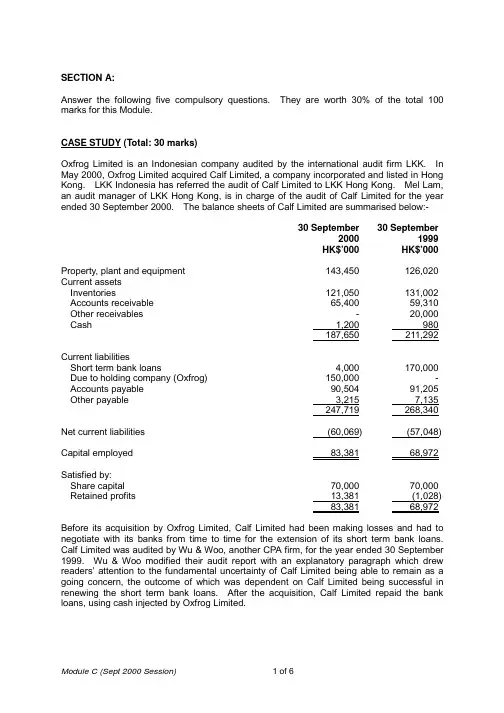
SECTION A:Answer the following five compulsory questions. They are worth 30% of the total 100marks for this Module.CASE STUDY (Total: 30 marks)Oxfrog Limited is an Indonesian company audited by the international audit firm LKK. InMay 2000, Oxfrog Limited acquired Calf Limited, a company incorporated and listed in HongKong. LKK Indonesia has referred the audit of Calf Limited to LKK Hong Kong. Mel Lam,an audit manager of LKK Hong Kong, is in charge of the audit of Calf Limited for the yearended 30 September 2000. The balance sheets of Calf Limited are summarised below:-30 September 30 September1999 2000HK$’000HK$’000Property, plant and equipment 143,450 126,020Current assetsInventories 121,050 131,002Accounts receivable 65,400 59,310Other receivables - 20,000Cash 1,200 980187,650211,292Current liabilitiesShort term bank loans 4,000 170,000Due to holding company (Oxfrog) 150,000 -Accounts payable 90,504 91,205Other payable 3,215 7,135247,719268,340(57,048)Net current liabilities (60,069)68,972Capital employed 83,381Satisfied by:Share capital 70,000 70,000(1,028)Retained profits 13,38168,97283,381Before its acquisition by Oxfrog Limited, Calf Limited had been making losses and had tonegotiate with its banks from time to time for the extension of its short term bank loans.Calf Limited was audited by Wu & Woo, another CPA firm, for the year ended 30 September1999. Wu & Woo modified their audit report with an explanatory paragraph which drewreaders’ attention to the fundamental uncertainty of Calf Limited being able to remain as agoing concern, the outcome of which was dependent on Calf Limited being successful inrenewing the short term bank loans. After the acquisition, Calf Limited repaid the bankloans, using cash injected by Oxfrog Limited.Mel Lam has asked the financial controller of Calf Limited about the nature of the other receivable balance of HK$20,000,000 as at 30 September 1999, and why there was no such balance at 30 September 2000. The financial controller informed Mel Lam that the amount was a loan granted to a third party company many years ago. The borrower repaid the loan in January 2000 by transferring a property to Calf Limited in lieu of cash. The property is a residential flat located in Stanley. The property was included in the 30 September 2000 balance sheet as part of the property, plant and equipment.In addition to the residential flat in Stanley, the balance of property, plant and Mel Lam equipment included various industrial and office buildings. The financial controller told Mel Lam that the company had commissioned a professional valuer to revalue all the company’s properties. The valuer has issued a draft report which shows a revaluation surplus of HK$25,000,000. The surplus has not yet been reflected on the company’s balance sheet. Since this is the first time Calf Limited has appointed LKK as its auditors, Mel Lam has written to Wu & Woo with a request to review Wu & Woo’s working papers for the 1999 audit of Calf Limited.Case Study Question 1Explain to Mel Lam what difficulties he may encounter when he asks to review Wu & Woo’s working papers. Advise him what information he should request from Wu & Woo regarding the opening balances of Calf Limited as at 1 October 1999 and how he should go about making such a request.(6 marks)Case Study Question 2Explain to Mel Lam (i) the auditor's responsibilities regarding the opening balances when the preceding period was not audited by his firm, and (ii) the general audit procedures that should be performed on the opening balances.(6 marks)Case Study Question 3Mel Lam has communicated with the predecessor auditors and decided that he cannot rely on their work. Mel Lam has also performed all necessary general audit procedures regarding opening balances but he is still not completely satisfied with the results. Suggest a list of substantive procedures which Mel Lam might perform with respect to (i) the opening quantities of inventories (valuation is NOT required) and (ii) the opening balance of accounts payable as at 1 October 1999.(6 marks)Case Study Question 4With regard to the going concern assumption, what audit procedures should Mel Lam carry out for the amount due to the holding company (Oxfrog Limited)?(6 marks)Case Study Question 5Assuming that Mel Lam is unable to rely on the work of the predecessor auditors, suggest two reasons why he might not be able to obtain sufficient appropriate audit evidence concerning the opening balance of inventories as at 1 October 1999. Draft the “basis of opinion” and “opinion" paragraphs of LKK’s audit report for Calf Limited’s 2000 accounts, with a qualification regarding the opening balance of the inventories.(6 marks)SECTION B:Answer the following two compulsory questions. They are worth 20% of the total 100 marks for this Module.ESSAY STYLE QUESTIONS (Total: 20 marks)You are W.W. Chan, audit manager for a CPA firm which services a variety of clients from relatively small local businesses to large multinational corporations. As part of your continuing professional development, you have just completed a course to understand recent developments in information management systems, including those which have such a high level of automated processing that they are able to compile financial statements based on the input of raw data, without the intervention of a financial controller or other accountants.As part of your professional duties, you need to be prepared to discuss the merits of automating information systems with your clients, as well as evaluating any system that is already in place. Some clients are contemplating installing information systems, while others have already installed them and are reaping results, either good or bad, based on these implementations. These clients are looking to you as an authoritative voice on the decision of whether or not to implement an information management system, or as a knowledgeable figure who can provide suggestions for improvements or enhancements of existing systems.Questions:(1) Draft a letter to Mr. Wong, the owner of a medium sized wholesaling business(“Wong’s Wholesale”) located in Kowloon, Hong Kong, which is considering adopting an automated information management system. Discuss the general advantages and disadvantages of using automated information systems.Emphasize the effects on accounting controls and management information in your response.(12 marks) (2) Assume that Mr. Wong has already decided that he will implement an automatedinformation management system during the summer months. He has contacted you, as his current auditor, to request consulting services on the design and implementation of such a system. Write a short memorandum to Miss Lee, the managing partner of your CPA firm, discussing the issues the CPA firm should consider before responding to Mr. Wong’s request.(8 marks)* * END OF SECTION B * *(QUESTIONS)* * *SECTION C:Answer the following six compulsory questions. They are worth 30% of the total 100 marks for this Module.SHORT ANSWER QUESTIONS (Total: 30 marks)Short Question 1The Professional Ethics Statements are a fundamental part of the practice of a CPA. Auditors are routinely confronted with ethical issues in their everyday audit activities. Briefly discuss the ethical issues and resolution of these issues that face an auditor who is offered a 15% discount on merchandise sold by an audit client; this is the same amount of discount that the client offers to its own employees.(5 marks)Short Question 2There is a variety of documentation necessary for the performance of a competent audit. One of the forms of documentation required is the engagement letter. Explain very briefly why an engagement letter is a crucial part of the audit, and list four items which must be contained in the letter.(5 marks)Short Question 3The opinion offered at the conclusion of the audit is based on evidence collected by the auditor during the performance of the audit. Evidence can be obtained from tests of controls or substantive tests. Explain in a concise way any requirements of official pronouncements regarding the selection of evidence to be obtained during an audit. How detailed is this official guidance regarding evidence collection? Briefly explain the advantage of the level of detail incorporated in the official pronouncements in the performance of the audit.(5 marks)Short Question 4Internal control is a fundamental part of any audit evaluation.A) Comment briefly on the components of “control environment” and its importance.How does the control environment affect the actual internal control activities?(2 marks)B) No system of internal control is considered to be foolproof. Describe threeinherent limitations of internal control.(3 marks)Short Question 5An important tool in the performance of an audit is the use of analytical procedures. Briefly discuss why analytical procedures are a desirable or necessary function for auditors to perform. Indicate at which stage(s) analytical procedures are required by current professional auditing standards, and also any other stages at which analytical procedures could be utilised. For each of these stages, discuss the purpose of performing analytical procedures at that stage.(5 marks)Short Question 6A client's balance sheet date is 31 December 1999, the audit report date is 22 March 2000, and the financial statements are issued 11 April 2000. A customer with a material outstanding accounts receivable balance declared bankrupt on 19 January 2000 because of a typhoon which destroyed that customer’s factory on 28 December 1999. Describe how the auditor may have learned of this event, and explain whether this situation warrants an adjustment to the financial statements, a disclosure by way of notes but no adjustment, or no action at all.(5 marks)* * END OF QUESTIONS * ** * *。
2023年(CPA)注会考试《审计》备考真题汇编(含答案)
2023年(CPA)注会考试《审计》备考真题汇编(含答案)学校:________ 班级:________ 姓名:________ 考号:________一、单选题(25题)1.下列有关在细节测试中确定样本规模的说法中,错误的是()。
A.误受风险与审计的效果有关,与样本规模呈反向变动B.在既定的可容忍错报下,预计总体错报与样本规模呈正向变动C.总体项目的变异性与样本规模呈正向变动D.为了提高效率,注册会计师通常可以直接考虑按照总体规模的固定百分比确定样本规模2.下列各项,通常不会影响函证可靠性的因素是()。
A.所函证样本的选取方法B.函证的方式C.被询证者易于回函的信息类型D.拟函证信息的性质3.下列关于舞弊的说法中,错误的是()。
A.存在舞弊风险因素表明被审计单位发生了舞弊B.舞弊发生时通常存在舞弊风险因素C.舞弊风险因素分为动机或压力、机会、态度或借口D.存在舞弊风险因素时,注册会计师应特别关注舞弊导致的重大错报风险4.下列有关实质性分析程序的说法中,错误的是()。
A.实质性分析程序达到的精确度低于细节测试B.实质性分析程序提供的审计证据是间接证据,因此无法为相关财务报表认定提供充分、适当的审计证据C.实质性分析程序并不适用于所有财务报表认定D.注册会计师可以对某些财务报表认定同时实施实质性分析程序和细节测试5.下列各项中,注册会计师需要运用实际执行的重要性的是()。
A.评价未更正错报对审计意见的影响B.确定多大金额的错报可能影响财务报表使用者基于财务报表作出的经济决策C.确定明显微小错报临界值D.在运用审计抽样时确定可容忍错报6.下列关于注册会计师针对发现的舞弊事项与管理层、治理层和监管机构的沟通的说法中,错误的是( )。
A.注册会计师针对发现的舞弊事项与治理层的沟通应当采用书面形式B.注册会计师对客户信息负有的保密义务可能妨碍其向被审计单位以外的机构报告舞弊C.在例外情况下,如果对管理层或治理层的诚信或政治情况产生怀疑,注册会计师可能认为征询法律意见以确定适当的措施是适当的D.在某些情况下,当注意到舞弊涉及管理层之外的人员,且不会导致重大错报时,注册会计师可能认为与治理层沟通这一事项是适当的7.下列有关分析程序用作风险评估程序的说法中,错误的是()。
香港注册会计师考师审计笔记试卷考生答
QP Examination Panelists’ Comments(September 1999 Session)Module CI. General CommentsThis was the first examination under the Qualification Programme, which tested thecandidates under a new type of examination. The examination introduced three new elements for the candidates to deal with (a) application and integration of knowledgerather than straight citing of facts or definitions; (b) the open-book format; and (c) apaper split into three sections with all questions compulsory. There are somegeneralisations which can be made from this paper:●The application of knowledge was not clearly demonstrated in many instances.Frequently, candidates appeared not to read or understand the questions. Mostcandidates threw in whatever they knew about the subject matter without regard tothe questions asked.●It appeared that time management was an issue, as many candidates made littleeffort on the case study, although it was a significant percentage of available marks.It should be emphasised to the candidates to approach the questions in a fashionthat considers the potential marks versus the time spent on answering the question.Several candidates spent too much time, and went into too great detail on the shortquestion portion of the examination, to the detriment of their performance on thecase study.●In a similar fashion, it appears that the candidates placed over-reliance on theresources allowed in this open-book format exam. Some candidates wereundoubtedly overly optimistic about their abilities to search for answers from thestudy materials they had brought with them.●There was a widespread tendency to copy verbatim from resource materials in theanswers. This relates to the above point about candidates copying from referencematerials relating to a question without first attempting to isolate what issues thequestion was actually addressing.II. Specific Commentsa. Section A – Short QuestionsOne common failing was to spend too much time and write too lengthy an answerto the short questions. Many, or most, of the short questions could be accuratelyanswered by a well-prepared candidate without resorting to looking upinformation from books or other materials.It is important for the candidate to answer only the question asked, rather thanprovide extraneous information which relates to the topic, but was not required.b. Section B – EssayThe essay question again suffered from candidates not paying attention to thedetails of the question asked. For example, one basic component of the essayquestion was that the response be framed in the style of a memorandum to anaudit partner. Many candidates correctly saw this requirement and adapted theirresponse to it, thereby earning marks. But some candidates did not.In the essay, candidates also appeared to lose focus on the questions asked, andwere prone to copying information directly from their materials into their responseswithout any commentary on how this information related to theirresponse. Indeed, the copied information often did not relate to the question at all.c. Section C - CaseThe case study was in most cases the section where candidates earned least marks.Reasonable speculation would be that this is a result of the students not havingenough time to complete this section of the examination.The case study questions were reasonably set and it was appreciated that thecandidates having no working experience would find them extremely difficult.Again, candidates frequently wrote about what they knew rather than what thecase study asked.III.Conclusion and RecommendationsThe conclusion about this examination is that it was certainly a difficult type ofendeavour for the candidates. This is probably due to the fact that it is an entirelynew type of examination, and no history exists on past efforts which can bescrutinized by the students.A strong recommendation to future candidates would be to read the questioncompletely and ensure that they understand what is required before answering.Recommendation for future examinations would be to be much more attentive toresponding to the questions which are asked, rather than attempting to provide ablanket of knowledge about an entire area. One possible strategy would be to read the entire examination paper carefully during the reading time given beforeattempting to answer any portion of it.Another area that could result in improvement would be to better manage exam time.To this end, it is recommended that candidates consider whether the use of time tosearch information in their materials is warranted.It would be helpful for the candidates to consider the mark value for each questionversus the amount of time that they spend on writing their response.Candidates are advised to choose the order in which they answer questions carefully.Don’t leave case to the last moment.An overall recommendation would be for the students to sit a mock examinationpaper based on a previous paper or the pilot paper provided in the course materials.This effort would be valuable to assess the appropriateness of how they divide theirtime among the three sections.。
香港注册会计师考师审计笔记5
6
3
Overall responses - at the financial statement level. Audit procedures responsive to risks of material misstatement at the assertion level. Evaluating the sufficiency and appropriateness of audit evidence obtained. Documentation
4
2
–
Planning an audit of financial statements (HKSA 300, par 15) A description of the nature, timing and extent of planned further audit procedures at the assertion level for each material class of transactions, account balance, and disclosure, as determined under HKSA 330. The plan for further audit procedures reflects the auditor’s decision whether
3
–
Par 102 states that the auditor determines whether the identified risks of material misstatement relate to: specific classes of transactions, account balances, and disclosures and related assertions (assertion level), or whether they relate more pervasively to the financial statements as a whole and potentially affect many assertions. (risks at the financial statement level)
香港注册会计师考师审计笔记试卷考生表现C_examcom_Sep200
Module C (Auditing and Information Management)Examiners’ Comment on the Module Examination Results for the September 2000 Session General CommentsAs this was only the second examination under the QP, there is not an extensive amount of candidate experiences to draw conclusions from. As in the initial examination, the examination incorporated the following:•application and integration of knowledge rather than straight citing of facts or definitions •the open-book format; and• a paper split into three sections with all questions compulsory.There was a big difference in the amount of open-book resources cited by candidates. Candidates citing open-book resources could be either assisted or penalised - it adds authority when specific HKSA standards were cited and demonstrates that the candidate understood the relationship between official pronouncements and the practice of auditing, but it is detrimental to candidates who simply repeat an inappropriate citation. The comment was made last year that candidates relied too heavily on outside resources, so perhaps this year’s candidates were wary of repeating that strategy. The most successful candidates did refer to official pronouncements, but not extensively exclusively. The outside resource material supported their answers but was not the foundation of the response. As stated earlier, candidates who merely repeated passages from various reference materials without establishing a foundation for those references received poor marks.There was some weakn ess demonstrated by candidates. Although the candidates’ answers were generally thoughtful, they frequently did not answer the specific issues addressed in the question. While answers demonstrated knowledge of auditing, but did not show that the candidate was evaluating the actual questions posed to them.It appears that there is little correlation between what the candidates learnt in the workshops and how they apply such knowledge in tackling the examination questions, in particular under open-book conditions. The answers given by candidates showed that they lack training in handling more practice-related questions, which are usually quite different from what they are familiar with from their tertiary training.Time management has improved as compared with the first examination with candidates answering all sections of the module. This was a better strategy in terms of maximising available marks. There appeared to be a more balanced approach in allocating time to questions in proportion to the value of the possible marks available.Specific CommentsSection A — Case StudyMany candidates failed to identify the key issues. Most answers were general instead of specific and theoretical instead of practical. In addition, most candidates failed to critically analyse the case. For instance, where candidates were asked to draft a modified audit report on the unreliable opening inventory balance, most sought to qualify the financial statements as a whole instead of giving a clean opinion on the balance sheet and a qualified opinion on the income statement and the cash flow statement.Section B — EssayIt is unfortunate that the same comment made about last year’s examination also holds true for thisexamination. Candidates should pay attention to the details of the question asked, ie to phrase their response in the form of a memorandum to a particular person, such as the managing partner of a CPA practice. As in last year’s exam, many candidates adapted their response to this format, but a large number did not. As with a similar shortcoming in the short questions portion of the examination, candidates did not address the specific question asked, rather, they wrote on the topic in general. Section C — Short QuestionsThe general shortcoming was that the candidates did not directly answer the questions. For example, Question 3 asked for an explanation of how detailed an official pronouncement regarding the collection of audit evidence should be. The correct response is to state that the level of detail is low, ie the pronouncement should be very general and the advantage of this is that it gives the auditor great flexibility in evidence collection. Many candidates erroneously listed actual evidence collection procedures, which is not what the question. In a similar fashion, Question 5 asked why analytical procedures were desirable or necessary, but many candidates described actual analytical procedures, which again did not answer the question. In Question 6, most candidates did not recognise that a material receivable should have been confirmed during ordinary audit procedures, and that the audit work on the receivables account should have alerted them to a potential problem. Also, as commented on in the previous examination, candidates should answer only the question directly asked and not provide extraneous information.Conclusion and RecommendationsCandidates are still finding their feet with regard to the new format. Undoubtedly as the supply of archival examination grows, candidates will have a better feel for responding to the types of questions asked.The most valuable recommendation to future candidates is to take a moment to assess the question. Candidates should ask themselves if the question requires an answer about what procedures should be performed, how the procedure should be performed, or wh y the procedures should be performed and whether this would result in more marks being earned.The comment made on the first year’s examination that candidates should restrict themselves to specific answers rather than providing a blanket response about the topic area holds true this year as well. This also relates to the recommendation to assess the question before responding.It was encouraging that candidates appeared to allocate their time according to the marks available for each question, a strategy that should be remembered and employed on future exams.The final overall recommendation is again identical to the recommendation made last year. Students should sit mock examinations, such as the pilot examination and practice drilling for their actual examination. Comparison of their practice answers will highlight areas that need additional work and training, as well as reinforce good examination habits. Liaison with tertiary educational institutions in this respect may also worth consideration.It is understood that most of the candidates are fresh graduates from universities and colleges and accordingly do not possess the necessary knowledge and experience. However, if candidates’ performance in examinations falls short of the expectation set by the Society, this issue must be addressed.。
审计科目注册会计师考试试卷及答案指导(2025年)
2025年注册会计师考试审计科目复习试卷(答案在后面)一、单项选择题(本大题有25小题,每小题1分,共25分)1、以下哪项不是审计的三大基本目标之一?A、确认财务报表的合法性B、确认财务报表的公允性C、确认财务报表的完整性D、确认财务报表的准确性2、审计过程中,下列哪项属于内部控制的构成要素?A、风险评估B、内部审计C、财务报告D、外部审计3、审计师在审查某公司的财务报表时,发现公司存货的计价存在差异。
以下哪种情况最可能表明这种差异是重大的?A. 存货计价差异仅影响公司年度利润的0.5%B. 存货计价差异导致公司年度利润增加2%C. 存货计价差异导致公司年度利润减少1%D. 存货计价差异对公司年度利润无影响4、在执行存货监盘程序时,审计师通常会对以下哪项进行详细审查?A. 存货的购入凭证B. 存货的账面价值C. 存货的盘点记录D. 存货的运输记录5、下列关于审计抽样方法的表述中,错误的是()。
A、审计抽样可以降低审计风险B、审计抽样可以提高审计效率C、审计抽样不能提高审计的可靠性D、审计抽样适用于各类审计业务6、在审计过程中,注册会计师应当对哪些内容进行详细记录?()A、审计计划、审计程序、审计结论B、审计计划、审计程序、审计证据C、审计计划、审计证据、审计报告D、审计证据、审计结论、审计报告7、在审计过程中,下列哪项工作不属于审计程序?A、分析性程序B、观察程序C、询问程序D、函证程序8、审计人员在实施控制测试时,以下哪种情况通常表明内部控制存在缺陷?A、内部控制的设计合理,执行有效B、内部控制的设计合理,但执行不充分C、内部控制的设计不合理,执行有效D、内部控制的设计不合理,执行不充分9、下列关于审计重要性的说法中,正确的是()A. 重要性水平越高,注册会计师需要获取的审计证据越多B. 重要性水平越高,财务报表发生错报的可能性就越大C. 重要性是注册会计师从财务报表使用者的角度进行判定的D. 注册会计师应当合理选用基准确定财务报表整体的重要性 10、在审计过程中,注册会计师发现被审计单位可能存在一项重大错报,该错报与应收账款的确认有关。