
科普版-英语-四年级上册-Lesson 5 What can you see? 名师
四年级上英语教案-Lesson5Whatcanyousee-科普版
四年级上英语教案Lesson 5 What can you see科普版教学内容:本课为科普版四年级上册英语第五课,主题为"What can you see"。
教学内容围绕学生能够看到的物品进行,通过学习本课,学生能够掌握一些基本的日常用品的英语表达,并能用英语进行简单的问答。
教学目标:1. 知识目标:学生能够听懂、会说、会读本课的单词和句子,并能用英语进行问答。
2. 能力目标:学生能够运用所学英语进行日常交流,提高英语口语表达能力。
3. 情感目标:培养学生对英语学习的兴趣,激发学生主动参与课堂活动的积极性。
教学难点:1. 单词的记忆与运用。
2. 句型的构造与问答。
教具学具准备:1. 教师准备:PPT课件、单词卡片、教学录音机。
2. 学生准备:英语课本、练习本、彩笔。
教学过程:1. 导入:教师通过图片或实物展示,引导学生复习已学的日常用品单词,为新课的学习做好铺垫。
2. 新课呈现:教师通过PPT展示本课的单词和句子,引导学生跟读并模仿。
3. 操练:教师组织学生进行单词和句子的操练,如单词接龙、句子问答等,巩固所学知识。
4. 应用:教师创设情境,让学生运用所学英语进行角色扮演或小组讨论,提高学生的英语口语表达能力。
板书设计:1. What can you see2. 单词列表:如pen, pencil, book等。
3. 句型:如What can you see? I can see a pen.等。
作业设计:1. 听力练习:听课文录音,跟读并模仿。
2. 书面练习:完成练习册上的相关练习。
3. 口语练习:与同学进行角色扮演,运用所学英语进行交流。
课后反思:本节课通过图片、实物、PPT等多种教学手段,激发学生的学习兴趣,提高学生的英语口语表达能力。
在教学过程中,注重学生的参与和互动,使学生在轻松愉快的氛围中学习英语。
在今后的教学中,应继续关注学生的学习需求,不断调整教学方法和策略,以提高教学效果。
四年级英语上册素材-Lesson 5 What can you see课文翻译 科普版

Lesson 5 What can you see?第五课你能看到什么?单词表room [ru:m] 房间schoolbag ['sku:lbæg] 书包read [ri:d] 读green [gri:n] 绿色的tree [tri:] 树any ['eni] 一些,任何four [fɔ:] 四they [ðei] 他们sheep [ʃi:p] 绵羊Let's talk 看图学说话This is my room. Please come in.这是我的房间。
请进来。
Thank you.谢谢。
What's in your schoolbag, Eve?你书包里有什么,伊芙?A book.一本书。
Can I read it?我能看看吗?Yes. You can.是的,你可以。
What can you see in the book?你在书中看到了什么?I can see a green tree.我能看到一棵绿树。
Can you see any birds?你能看见鸟儿吗?No, I can see four bees.不,我能看见四只蜜蜂。
They are black and yellow.它们是黑色和黄色的。
Can you see a pig?你能看见一只猪吗?Yes, I can. And I can see a ship, too.是的,我可以。
我也能看到一艘船。
A ship? No, it's not a ship. It's a sheep.一艘船?不,这不是船。
是只羊。
Oh yes!哦是的!Let's learn一起学一学What can you see?你能看见什么?I can see a tree.我能看见一棵树。
Can you see a sheep?你能看见一只绵羊吗?Yes, I can.是的,我看见了。
小学英语科普版四年级上《Lesson5 What can you see》省级名师优质课教案比赛获奖教案示范课教案公开课教案

小学英语科普版四年级上册《Lesson 5 What can you see?》省级名师优质课教案比赛获奖教案示范课教案公开课教案【省级名师教案】1教学目标A.学习重点词汇,要求学生能利用所学单词正确翻译对话,能根据对话内容做简单的会话练习。
B.能抓住重点句,做替换练习。
a. What can you see in the tree? I can see some birds.b. How many can you see? Three.c. Can you see a pig? Yes, I can.C.口语交际。
Can I read the book? Yes, read it, please.能听懂、会说,并能用来进行会话。
2学情分析四年级的学生已经有一年的英语学习基础,但是因为对所学知识不够,所以在新的学年里,学习有点吃力。
不过对生活中英语的表达还是不错的。
3重点难点1、使学生能听懂会说句子What can you see?并能根据实际情况用I can see…作出回答,语音语调正确。
2、使学生能听懂、会说、初步认读这些单词plane, train, jeep, boat.发音正确。
4教学过程教学活动1【讲授】Lesson 5 What can you seeT:Class is begin .M: Stand up, please.T: Good morning, class.S: Good morning, teacher.M: Sit down, please.一、听儿歌,导入课题。
(What can you see?)T:请同学们听儿歌,说一说,你听到歌中有什么?( You say 指名学生回答。
)S: sun(太阳)。
科普版-英语-四年级上册-Lesson 5 同步讲解
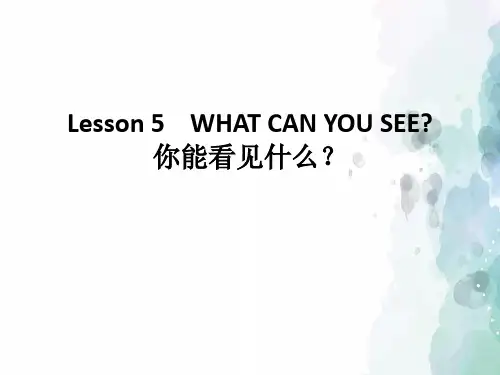
• 例句:Please come here! =Come here,please! 请来这儿! • ◆祈使句的否定形式为“Don‘t+动词原形+其他”。 • 例句:Don't play in class 不要在课堂上玩。 • ②Can I read it?我可以读它吗? • “Can I…?”意思是“我能……吗?”常用来请求别人的许可。肯定
船。
• -A ship?No,it's not a ship.lr:'s a . 一艘轮船?不,它不是一艘轮船。它 是—只绵羊。
• -Oh yes! 哦是的!
• room/ru:m/房间 • 短语:a room -间房 • 例句:I like my room.我喜欢我的房间。 • schoolbag /’sku:lbaag/书包 • 复数:schoolbags • 例句:This is my schoolbag.这是我的书包。 • 口诀记忆:schoolbag小书包,轻轻背起上学校。 • read /ri:d/读 • 短语:read books看书 • 例句:I often read books in the park. 找经常在公园看书。 • green /gri:n/绿色的 • 短语:a green pen -支绿色的钢笔 • 例句:I have a green pen. 我有一支绿色的钢笔。 • tree /tri:/树 • 复数:trees • 形近词:three三 • 例句:Look, there is an apple tree. 看,有一棵苹果树。
四年级上册英语教案-Lesson5《Whatcanyousee》|科普版(三起)
四年级上册英语教案-Lesson 5《What can you see》|科普版(三起)教学内容本课为科普版(三起)四年级上册英语第五课《What can you see》。
教学内容主要围绕询问和描述所看到的物体,以及复习和巩固已学的有关颜色、动物、植物和日常用品的词汇。
课程旨在通过情景交际,让学生在实际语境中运用英语进行沟通,提高他们的英语听说能力。
教学目标1. 能听懂、会说、会读本课的生词和重点句子。
2. 能运用所学句型和词汇询问和描述所看到的物体。
3. 培养学生的观察能力和英语思维能力。
4. 培养学生合作学习的精神和参与课堂活动的积极性。
教学难点1. 正确运用所学句型和词汇进行询问和描述。
2. 部分生词的发音和拼写。
3. 提高学生的听说能力,使他们能在实际语境中运用英语进行沟通。
教具学具准备1. 多媒体设备2. 教学课件3. 图片卡片4. 彩色笔5. 学生练习册教学过程1. 导入:通过图片展示和问答,引导学生复习已学的有关颜色、动物、植物和日常用品的词汇。
2. 新课呈现:通过教学课件,展示本课的主要句型和词汇。
教师引导学生跟读并模仿发音。
3. 情景交际:设置不同的场景,让学生运用所学句型和词汇进行询问和描述所看到的物体。
4. 小组活动:学生分组进行角色扮演,模拟实际生活中的情景,用英语进行沟通。
5. 巩固练习:通过练习册上的练习,巩固本课所学内容。
板书设计课题:Lesson 5《What can you see》重点句型:What can you see? I can see重点词汇:动物、植物、日常用品的名称作业设计1. 听录音,跟读课文。
2. 抄写并默写本课的重点句子。
3. 用英语描述一下自己家里的物品,写下来。
课后反思本节课通过图片展示、教学课件、情景交际等多种教学手段,让学生在实际语境中学习英语,提高了他们的听说能力。
在教学中,教师应注重学生的个体差异,鼓励他们大胆开口说英语,培养他们的自信心。
四年级上册英语教案-Lesson5 Whatcanyousee科普版(三起)

四年级上册英语教案Lesson 5 What can you see 科普版(三起)教学内容本节课主要围绕科普版英语教材四年级上册的第五课《What can you see》展开。
课程内容以情景对话为主,通过展示不同的场景,让学生学习并掌握如何用英语询问和描述所见事物。
具体内容包括:1. 词汇:学习与场景相关的名词,如“公园”、“街道”、“商店”等。
2. 句型:掌握询问“你看到了什么?”以及回答的句型,如“What can you see? I can see”。
3. 对话:模拟真实场景,运用所学句型和词汇进行对话练习。
教学目标1. 知识与技能:学生能够听懂、会说、会读本节课的重点词汇和句型,并能运用所学知识进行简单的情景对话。
2. 过程与方法:通过图片展示、情景模拟等教学活动,培养学生观察、描述事物的能力,提高英语口语表达能力。
3. 情感态度价值观:激发学生对英语学习的兴趣,培养学生合作、交流的良好习惯。
教学难点1. 词汇的发音和记忆:对于四年级的学生来说,掌握一些复杂的名词发音和拼写可能存在困难。
2. 句型的灵活运用:学生需要理解并熟练运用询问和回答的句型,能够在不同的情景中替换相应的词汇。
3. 对话的流畅性:在模拟真实场景进行对话时,学生需要将所学词汇和句型灵活运用,达到自然流畅的交流。
教具学具准备1. 教具:多媒体课件、图片、单词卡片。
2. 学具:学生自备英语课本、练习本、彩笔。
教学过程1. 导入:通过展示一些生动有趣的图片,引起学生的兴趣,导入本节课的主题。
2. 新课内容展示:利用多媒体课件,展示与本节课相关的词汇和句型,让学生跟随课件跟读并模仿。
3. 情景模拟:将学生分成小组,每组分配一个场景,让学生运用所学知识进行情景对话练习。
4. 巩固练习:通过一些游戏和小测验,巩固学生对本节课内容的掌握。
板书设计1. 课程四年级上册英语Lesson 5 What can you see2. 重点词汇:公园、街道、商店等。
科普版小学英语四年级上册《Lesson 5 What can you see?》教学设计
《Lesson 5 What can you see ? 》教学设计一、教学目标、A.能利用所学单词正确翻译对话,能根据对话内容做简单的会话练习。
B.能抓住重点句,做替换练习。
C.能听懂会读单词:room, schoolbag ,read ,anyD.口语交际。
What can you see ?I can you see…Can you see a …Yes , I c an . / No, I can’t .能听懂、会说这些句子,并能用来进行会话。
二、教学内容分析本课的话题是“动物”,通过主题句型“Can you see ...?”“What can you see?”复习已学过的动物名称和引出一些新的动物名称。
齐齐和伊芙的对话中,齐齐误将sheep读成ship,伊芙加以纠正,实际上这也是学生常犯的错误。
通过学习这段对话,可让学生分清[i:]和[i]的区别。
另外,第一段中“Can I read it?”中的can,与后面“What can you see ?”中的can用法是不同的,后者表示“能力”,而前者表示“请求许可”。
can的这种用法将在以后学习,本课中只要求能理解即可。
三、教学理念1.面向全体学生,为学生全面发展和终身发展奠定基础.2.关注学生的情感,营造宽松、民主、和谐的教学氛围.3.倡导“任务型”的教学途径,培养学生综合语言运用能力.四.教学重难点1.教学重点:帮助学生理解句型:“What can you see ?I can you see…”.2.教学难点:如何给学生创设情景,让学生对重点句型进行运用,及单词“any”的理解。
五.教具准备1. 动物图片2.单词卡片。
六.教学过程Step1. Greetings.T:Class begins .(上课。
)M: Stand up, please.(起立。
)T: Good morning ,class.(同学们,早上好。
)S: Good morning, teacher.(老师,早上好。
小学英语科普版四年级上册《Lesson 5 What can you see》教案
Lesson 5 What can you see◆教材分析This is the fifth section of this chapter, on the basis of the previous section. By teaching and practicing, students can use the sentence pattern skillfully to conduct daily communication. "What can you see?" Sentence patterns and their answers, and read the dialogue accurately and fluently.◆教学目标【知识与能力目标】1. Learning words such as tree, sheep, car, pig, ship, panda, box, fox;2. Let the students understand, speak, read and understand correctly.—What can you see? ——I can see a tree.—Can you see a sheep? ——Yes, I can.Master the dialogue and read the dialogue.【过程与方法目标】By teaching and practicing, students can use the sentence pattern skillfully to conduct daily communication.【情感态度价值观目标】In the classroom, the students should develop the habit of expressing themselves actively in English, and be able to use what they have learned in daily communication.◆教学重难点◆【教学重点】"What can you see?" Sentence patterns and their answers, and read the dialogue accurately and fluently.【教学难点】Use sentence patterns in everyday conversation.◆课前准备◆Video, animal pictures, books, power point, etc◆教学过程Step 1. Warming up1. See the video clips before class to learn sing song "What can you see?"2. Draw a tree on the blackboard, there is a sheep under the tree, respectively, with the sentence pattern "What can you see? And can you see a sheep?" To the students to ask questions, to import new lesson. (blackboard writing) timely.Step 2. Listen to the tape(1) Look at the let's learn section.(2) Soft and read, imitate the pronunciation and intonation.(3) Read aloud and imitate the intonation and intonation.(4) Synchronize and read.(5) Read and read.Step 3. Group activities.Self - read: the students themselves read the Let ' s learn content.Read each other: practice reading with each otherGroup reading: the group leader leads the group to read all the sentences first, to make sure that each team member reads the meeting, and then, according to "male-female, group cooperation. Practice reading sentences.Step 4. Group presentationAfter each group is displayed, students should have mutual rectification, or use "Come on". Good; Well done! Great! Good idea! ..." Encourage your partner.1. Group activitiesStudents use their own daily supplies, pictures and other team members to practice. Create a classmate to read a book together.A: Hi, B and C!B&C: Hello!A: Look,I have a new book. Let’s read it together, OK? B&C: OK! Great!A: Look,I can see a monkey. Can you see a monkey, B?B: Yes, I can. What can you see, C?C: I can see a bear.A: Can you see a panda over there?C: Yes, I can. It is so cute.A&B: Yes!Use physical objects, actions, pictures, etc. to ask what you see. It can be set up in the display, which can be used to express the language in a comprehensive way. For the display of language errors, the group still hasn't pointed out the situation after the group evaluation.Step 5. Homework1. Write the words five times.2. Read the dialogues and use sentence patterns to make dialogues.◆教学反思略。
四年级上册英语教案-Lesson 5《What can you see》|科普版
Teaching topic: Lesson 5 What can you see ?①Teaching material analysic:(教材分析)In this test , let the students must learn:(1)What colour is it?(2) Sorry.(3)That’s OK.(4)Good morning.Goal request: ( 教学目的)(1) (1)What can you see? I can see …(2)How many can you see?I can see…(3)Can you see …?Yes , I can . /No, I can’t.(4)Can you see …?Yes , I can . /No, I can’t.Key difficulty: (重点难点)(1)[ ] [ ] [ ](2)What can you see? I can see …(3)How many can you see?I can see…(4)Can you see …?Yes , I can . /No, I can’t.Teaching times:( 教学时间)13Teaching method:(教学方法) three doubts three searchesTeaching preparation and methord :( 教学工具) radio cardsTeaching process: ( 教学过程)Step 1 Warmer(5 minutes)Do you remember these words (review)read please see green tree many three sheep meetAsk some students try to read these words,then practice :b e week tea thick shallwe beef team thin shopeve meet meat maths shelfthese green clean three wishIn these words , we must attention :[ ] [ ] [ ]Step 2 设疑自探(10 minutes)(1)what is this ?(bag )This is a bag .look at here , what’s in it ?It’s a book.Can I read it ?Yes ,please.(2)This is a bag .What can you see in it ?I can see a book.(3)What can you see in the book?I can see some folowers.(4)What can you see in the book?I can see a tree.(5)This is a box .What can you see in the box?I can see a pen .(6)What can you see in the box ?I can see a ruler.Ok , look at here , use these words make dialogues :cup box book bagStep 3 解疑合探(10 minutes)(1)What is this ?This is a cup .What’s in it ?It’s a pen .What can you see in it ?I can see a pen .(2)What’s that ?That is a box .What’s in it ?It is a book.What can you see in the book?I can see a tree.(3)What is it ?It’s a book.Guess!what can you see in it ?I can see a bird .(4)What can you see in the box?I can see some books .Step 4质疑再探(5 minutes)Look ,what is this ?This is a can you see in it ?I can see a bird .How many can you see ?Only one . .What’s this ?This is a box.What can you see in it ?I can see some birds.How many can you see ?Three .Ok ,look at these words :box bag cupLet the students to practice them .Step5拓展运用(10 minutes)(1)In this text ,let the students mast the new words .(2)let the students know how to use them ,and make a dialogue .What is this ?This is a box .What can you see in it ?I can see a book.What can you see in it ?I can see some books .How many can you see ?Three.Bb writting design:( 板书设计)What can you see ? What can you see in it ?I can see a …What can you see in it ?I have see some birds.How many can you see ?Three.。