
牛津译林版七年级下册(新)英语学案:7BUnit1Study skills 学案
Unit1 Dream homesStudy Skills班级姓名【学习目标】1.复习如何描述梦想家园和电话用语的用法;2.学习单词音节的重读。
【重难点】重点词汇:stress take turnscou n·try po·ta·to Hal·low·een【学法指导】1. 复习课本P13-P14,熟练掌握电话用语的用法2. 自主学习本课单词音节的重读,听磁带模仿练习。
【学习过程】A.课前预习:1.预习本课,在书上用铅笔,直尺划出重难点并标注疑点。
2.完成P15,A B两项练习。
3. 标出下列单词的重读音节. 例:p a‵tatoanyone breakfast body doctor dutyherself along bamboo remember amazingfamiliar favorite dictionary opportunity informationB.课后拓展一、从下列四个选项中选出所给单词的正确读音( ) 1.set A [set] B [sit] C [sәt] D [sæt]( ) 2.court A [kut ] B [kәut ] C [kɔ:t] D [sit]( ) 3.better A [΄betз:] B [΄bætә] C [be΄ta:] D [΄betә ]( ) 4.duck A [dΛk] B [dæk] C [duk] D [du:k]( ) 5.tank A [sæŋk] B [tiŋk] C [teŋk] D [tæŋk ]( ) 6.mouse A [maus] B [mәus] C [mus ] D [mΛs]( ) 7.cry A [srai] B [krai] C [kri ] D [ krei]( ) 8.where A [wiә ] B [wi:] C [ heә] D [weә ]( ) 9.deep A [di:p] B [dip] C [dep] D [dәp]( ) 10.echo A [ә΄kәu ] B [΄ekә] C [΄ekәu ] D [æ΄kәu]二、选择题﹙﹚1.Anna’s aunt works _______ a nurse in the Children’s Hospital . Anna would like to be a nurse _________ her aunt .A. as , likeB. like , asC. like , likeD. as , as﹙﹚2.You to the meeting this Saturday if you are busy .A. needn’t to comeB.don’t need comeC. don’t need comingD. needn’t come﹙﹚3.---Mum , I think I’m _______ to go back to school .--- But the doctor says you must stay in bed for two more days .A. enough wellB. well enoughC. so gooodD.good enough﹙﹚4.Would you please tell them next , Mr Black ?A. what should they doB. they should do whatC. what they shouldD. should they do what﹙﹚5.---Your spoken English is much better now .--- Thank you . Our English asks me _____ speak English as ______ as I can .A. to speak , manyB. to speak , muchC.not to speak , manyD. not to speak , much﹙﹚6.I don’t have enough money .Could I ______ some more from you ?A.lendB. borrowC. to borrowD. to lend﹙﹚7.Madee lives on the second floor . I live on the fifth floor . So she lives ___ me and I live ____ her .A. above , aboveB. over , overC. above , overD. over , above﹙﹚8.We can’t wait ________ our foreign friends .A. seeB. to seeC. seeingD. saw﹙﹚9.Page _______ means the ________ page .A. Nineteen , nineteenthB. Nineteen , NineteenthC. Nineteen , nineteenD. Nineteenth , nineteenth﹙﹚10.Are you free the night of June 1 ?A. onB. atC. ofD. to﹙﹚11.I don’t like this style . Would you like to show me _______ one ?A. otherB. the otherC. anotherD. each other﹙﹚12.You can’t believe it unless (除非) you hear with ________ eyes .A. you ownB. own youC. ownD. your own﹙﹚13.Why not do the homework and listen to the music ________ ?A. all the timeB. at the same timeC. all the sameD. at that time﹙﹚14.There is usually _______ rain in summer in Yangzhou . It often rains a lot .A. manyB. muchC. a lotD. a lots﹙﹚15.The two girls are sitting _______ each other . They are chatting .A. betweenB. onC. oppositeD. with三、用所给词的适当形式填空16.Thailand is a ________ ( rain ) country . It often rains _________ ( hard ) there .17.Would you like ________ (plan) May Day together with us ?18.How many ___________ ( bookshelf ) are there in our school library ?19.Susan came ___________ (two) in the English exam .20.You look ______________ (worry) . What’s wrong with you ?21.The children can’t wait ___________ (open) their presents from their parents .22.Madee’s house is made of __________ (wood) and it’s ___________ (wood) .23.The Chinese are ___________ (friend) to foreign visitors .24.He cost at ___________ (little) 1,000 yuan yesterday .25.There are ________ (many) than 500 __________ (million) Museums in China .四、选用所给句子完成对话A: Hi , Bob . I hear you come from The USA .B: _________ . It’s very big .A: __________ .B: It has 12 rooms .A: Oh , it’s bigger than my flat .B: It has a dining room , a bath room , two bedrooms ,and a living room .A: Who do you live with ?B: _______ . Which is your favourite place ?A: ________ .B: I hope I can visit your flat one day .五、改错26.Who’s the foreign man beside Mr Lee ? He maybe our new teacher . _________ 27.There is going to have a film called Titanic in Red Star Cinema . _________ 28.Is there a bathroom in the second floor ? _________ 29.He must very tired after a day’s shopping . _________ 30.The girl called Anna travels a lot of places in France . _________ 31.Jack , together with his classmates are going to visit the museum. _________ 32.One of the students are from Thailand . _________ 33.He has so many furnitures in his bedroom . _________ 34.This is the my first time to visit the Slender West Lake . _________ 35.Our school is quite different of theirs . _________六、完成句子37. I live in a house. It has ten rooms. (改为同义句)I live in a ________ _______ ten rooms.38. Elsa lives two floors below Mary. (改为同义句)Mary lives two floors _______ _______ .39. Your printer is not the same as mine. (改为同义句)Your printer _______ _______ _______ mine.40. Jim lives on the ninth floor. (对划线部分提问)_____________________________________________________41. Kitty and her sister use the same bedroom. (改为同义句)Kitty _______ the bedroom _______ her sister.42. Which room do you like best? (同上)Which is _____ ______ room?43. The new house has a lot of rooms. (同上)______ ______ ______ rooms in the new house.七、翻译句子44. 西蒙住在有个大花园的楼房里。
新版牛津译林英语七年级下册7BUnit1导学案

新版牛津译林英语七年级下册7BUnit1导学案初一英语学科导学案课题:7下Unit 1 Dream homes 第1教时 wele 班级: 姓名: 得分:一、学习目标1、能认读课本中六个国家及其标志性景点得名称。
、2、能用英语介绍这些国家及其首都。
3、谈论自己得理想居所思考不同得居住环境。
二、自主学习一、英汉词组互译。
1、梦想家园 _____________2、一家饭店隔壁_______________3 、在不同得国家___________ 4、法国得首都_____________________5 、二十个在城镇得饭店______________6、住在一座宫殿里___________ 7 、我最喜欢得城市_________8 、您想住在什么地方_____________二、选词填空:France Russia the USA Japan Canada the UK1、 Mount Fuji is in _________、2、 The CN Tower is in _________、3、 The Statue of Liberty is in _________、4、 The Eiffel Tower is in ___________、5、 Big Ben is in____________、6、 Red Square is in __________、三、合作交流师生对话:T:There are about 200 countries in the word、Which countries do you know of?Ss: 、T: These countries are very famous and quite beautiful、Ihave some pictures of them、 Do you know of them?Ss: 、T: Which country is this photo from?S: It is from Canada、T: Where is it ?S: It is in Toronto、T: Is it the capital of Canada?S: No, it isn’t、四、点拨拓展1、next to就是英语中得常用短语,可用作介词,意为“靠近;旁边”,可以用beside不替换。
初中英语 牛津译林版七年级下册7BUnit 1 Integrated skills 教案

Send a email and help Simon complete his email.
4. Read the email together.(ABC)
2.Ability objectives:(AB)
(1) To know the different things in different rooms.
(2) To make a call in a correct way.
3.Value objectives:(AB)
(1) To develop students’ right attitude to life
3. Learn more useful expressions.(ABC)
4.Work in pairs and make asimilarphone call.(AB)
让学生先听,然后读和模仿,学会如何打电话,以及打电话的常用语句和习惯用法。
Step5: Conclusion(AB)
Where there is a love, tp6: Homework
1.Review what we’ve learned today.(ABC)
2.Write something about your own home and try to make a phone call.(AB)
3.Recite the new words ,phrases and sentences(C)
通过复习再次帮助学生了解不同地方不同区域的不同事物。通过两段听力的训练,使得重点词组、句型及语言点的教授也在此环节自然完成。
牛津译林版英语七年级下册Unit1Studyskills教学设计
2.学生在听说能力方面表现较好,但在阅读和写作方面存在一定的困难,尤其是对于文章结构和逻辑关系的理解。
3.学生在合作学习中表现出较强的团队意识,但部分学生在讨论和表达观点时,仍显得不够自信和积极。
a.自我评价,包括优点和不足;
b.本节课学到的学习方法及如何应用;
c.今后在学习中如何调整和改进。
三、教学重难点和教学设想
(一)教学重难点
1.重点:掌握本章节的核心词汇和句型,如goal, study, improve等,并能运用到实际场景中;学会制定学习目标和运用有效的学习方法。
难点:提高阅读理解能力,尤其是对文章结构、逻辑关系的把握;以及在写作中运用所学知识表达个人观点。
2.重点:培养学生良好的学习习惯和合作精神。
2.教师展示一组图片,包括学生在学习、阅读、做笔记等场景,引导学生观察并思考:“Can you guess what we will learn today?”学生发表观点后,教师揭示主题:“Today we will learn how to develop good study skills and set learning goals.”
3.教师对本节课的学习情况进行总结,强调学习方法和目标设定的重要性,鼓励学生养成良好的学习习惯。
4.教师布置课后作业,如:编写个人学习计划、阅读英语文章等,巩固所学知识,提高学生的自主学习能力。
五、作业布置
为了巩固本章节所学知识,培养学生的自主学习能力和学习兴趣,特布置以下作业:
1.编写个人学习计划:学生结合本节课所学内容,为自己制定一个切实可行的学习计划,包括学习目标、具体方法和时间安排。要求计划具有针对性和可操作性,能够帮助自己提高英语学习效果。
2024年牛津译林版七年级下册7BUnit1教案

2024年牛津译林版七年级下册7B Unit 1教案一、教学内容本节课选自2024年牛津译林版七年级下册7B Unit 1,主要内容包括:Grammar: present continuous tense; Vocabulary: words and phrases related to daily routines; Reading: understanding a passage about daily routines and habits; Listening and speaking: describing daily routines and habits.1. Section A: Present Continuous Tense2. Section B: Reading A Healthy Lifestyle3. Section C: Listening and Speaking What's He Doing?二、教学目标1. To help students understand and use the present continuous tense to describe daily routines and habits.2. To expand students' vocabulary about daily routines and habits.3. To improve students' reading and listening skills understanding a passage and a dialogue about daily routines and habits.三、教学难点与重点1. 教学难点:Present continuous tense的构成及用法;日常作息时间相关词汇的运用。
2. 教学重点:学会用现在进行时描述正在进行的动作;掌握日常作息时间相关词汇。
2024年牛津译林版7BUnit1Studyskills教案

2024年牛津译林版7BUnit 1 Study skills教案一、教学内容二、教学目标1. 让学生掌握快速阅读的技巧,提高阅读效率。
2. 培养学生运用词汇学习策略,扩充词汇量。
3. 提高学生的口语交流能力,增强课堂互动。
三、教学难点与重点1. 教学难点:快速阅读技巧的运用,词汇学习策略的实践。
2. 教学重点:口语交流能力的培养,课堂互动的加强。
四、教具与学具准备1. 教具:多媒体设备,PPT,黑板,粉笔。
2. 学具:教材,笔记本,字典。
五、教学过程1. 导入:通过展示一组图片,引导学生进行快速阅读,激发学生学习兴趣。
2. 快速阅读技巧讲解:讲解快速阅读的方法,如略读、扫读等,并举例说明。
3. 词汇学习策略:介绍词汇学习策略,如联想记忆、同义词替换等,并进行实践操作。
4. 口语交流技巧:通过角色扮演、小组讨论等形式,让学生在实际语境中运用所学知识。
5. 例题讲解:结合教材,讲解典型例题,分析解题思路。
6. 随堂练习:设计相关练习题,让学生巩固所学知识。
六、板书设计1. 快速阅读技巧略读扫读2. 词汇学习策略联想记忆同义词替换3. 口语交流技巧角色扮演小组讨论七、作业设计1. 作业题目:根据快速阅读技巧,阅读一篇短文,回答相关问题。
列出本节课所学的词汇,并运用词汇学习策略进行记忆。
编写一段对话,运用所学口语交流技巧进行表演。
2. 答案:略略略八、课后反思及拓展延伸2. 拓展延伸:布置课后阅读任务,提高学生的阅读能力。
组织课后口语交流活动,提高学生的口语水平。
推荐相关学习资料,帮助学生拓展学习。
重点和难点解析1. 快速阅读技巧的讲解与实践2. 词汇学习策略的介绍与应用3. 口语交流技巧的培养与课堂互动4. 作业设计与答案解析5. 课后反思与拓展延伸详细补充和说明:一、快速阅读技巧的讲解与实践1. 略读:指导学生快速浏览文章,抓住关键词、主题句,了解文章大意。
2. 扫读:要求学生在短时间内寻找特定信息,如人名、地名、数字等。
牛津译林版七年级下册(新)英语教案:7B Unit1 Task
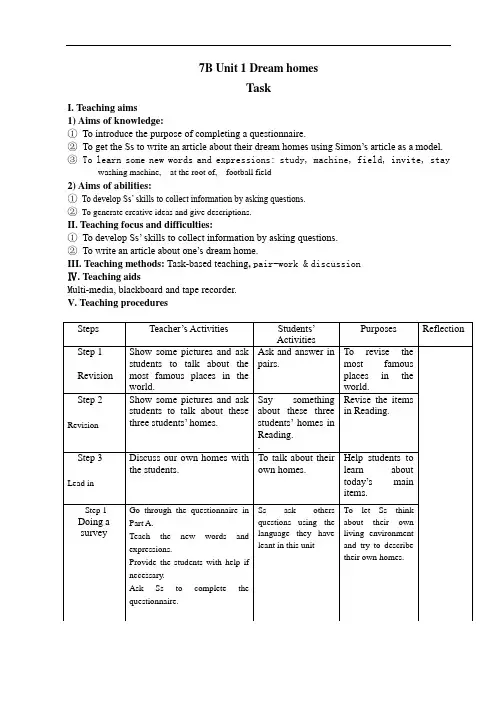
7B Unit 1 Dream homesTaskI. Teaching aims1) Aims of knowledge:①To introduce the purpose of completing a questionnaire.②To get the Ss to write an article about their dream homes using Simon’s article as a model.③ To learn some new words and expressions: study, machine, field, invite, staywashing machine, at the root of, football field2) Aims of abilities:①To develop Ss’ skills to collect information by asking questions.②To generate creative ideas and give descriptions.II. Teaching focus and difficulties:①To develop Ss’ skills to collect information by asking questions.②To write an article about one’s dream home.III. Teaching methods: Task-based teaching, pair-work &discussionⅣ. Teaching aidsM ulti-media, blackboard and tape recorder.V. Teaching proceduresSteps Teacher’s Activities Students’ActivitiesPurposes ReflectionStep 1 Revision Show some pictures and askstudents to talk about themost famous places in theworld.Ask and answer inpairs.To revise themost famousplaces in theworld.Step 2 Revision Show some pictures and askstudents to talk about thesethree students’ homes.Say somethingabout these threestudents’homes inReading..Revise the itemsin Reading.Step 3 Lead in Discuss our own homes withthe students.To talk about theirown homes.Help students tolearn abouttoday’s mainitems.Step 1 Doing a survey Go through the questionnaire inPart A.Teach the new words andexpressions.Provide the students with help ifnecessary.Ask Ss to complete thequestionnaire.Ss ask othersquestions using thelanguage they haveleant in this unitTo let Ss thinkabout their ownliving environmentand try to describetheir own homes.VI. Homeworka. Write an article about themselves.b. Finish the exercises on the book VII. Blackboard designUnit1 TaskV ocabulary:Language points: Develop:Step 2 DiscussingGet Ss to read the article about Simon’s d ream home in Part B. Provide the students with some questions.Teaching the new words and expressions .Ss read through the article and try to answer the questions.To develop Ss’ reading skills. Step 3 Reading Prepare for them some more questions.Encourage them to talk about what they like and what they do not like intheir dream homes.Read the article about Simon’s dream home again. Discuss Simon’s dream home in pairs. To let Ss have a betterunderstandingStep 4 Listening and readingPlay the tape recording for the first time. Play the tape recording again.Ss read the article after the tape. Ss try to retell it.Let Ss pay attention to the useful expressions.Step5 Drawing List out the following questions. Ask Ss to draw their dream homes on the paper and encourage them to colour them if time allows.Ss think about their own dream homes. Ss write their outlines.To let Ss try to imagine somethinginteresting andamazing.Step 6 Writing Ask Ss to write their articles according to their outlines. Checktheir grammars and vocabulary.To develop Ss’writing skills.。
牛津译林版七年级下册(新)英语教案:7B Unit1 Welcome to the unit doc
7B Unit 1 Dream homesComic strip and welcome to the unitI. Teaching aims1) Aims of knowledge: Students will be able to:1)know some other countries about their names,capitals and famousattractions.2)use the useful expressions like would you liketo..., I’d like to...2) Aims of abilities: Students will be able to :1)know some information about different countries.2)talk about where they would like to visit best.3) Aims of emotion: Students will have general understanding of dream homes.II. Key points of teachingStudents will be able to know some information about different countries anddescribe them.III. Teaching difficulties:How to read the names of the countries and capitals correctly.IV. Teaching and learning methods:Watching,listening, act ing describing and discussingPair work, group workV. Teaching aids:PPT, blackboardTeaching procedures:Steps Teacher’sactivities Student s’activitiesPurposes of thedesignReflection andthe second designStep 1 Warming-up Greetings andfree talksGet ready forthe period.Create theatmosphere of thetheme.Step 2 Lead-in Ask somequestions aboutcountries in theworldAnswer thequestions andshow theirideas.Review somerelevant contentsand pave the way.Step 3 Presentation Show somepictures aboutfamousattractions insome othetcountriesTry to find thenames of thecountries bywatchingrelevantpictures.Recognize andlearn some othercountries and theirmost famousattractions.Step 4 Practice Give somemore picturesMatch thepictures withPractice matchingdescribing.Giveabout other countries and relevant countries. the countries.Find moreinformationstudents someexpandinginformation aboutmore countries.Step 5 Further learning Present picturesAbout thecapitals of othercountries.Match thecapitals with theCountries,readand remember.Learn furtherinformation aboutother countries.Step 6Comic strip Play the tape,questions andexplanations. Learn thedialogue,somewords andphrases.Learn key wordsand usefulexpressions.Step 7I Acting Act thedialogue outwith a studentand tell othersto imitate.Pair work andtry to act thedialogue outPractice speakingwith the usefulexpressions.Step 8 Discussion Give thestudents amodelconversationDiscuss wherethey would liketo visit best.Cooperate topractice what welearnt.Step9 Homework Read and try to remember the names of the countries and capitals.Make dialogues with the following useful expressions,and Write them on Your exercise books.Blackboard designUnit 1 Dream homes dream palace capitalWould you like to...?I’d loke to...the capital of。
牛津译林版七年级下册7BUnit1教案(1)
牛津译林版七年级下册7B Unit 1教案一、教学内容本节课选自牛津译林版七年级下册7B Unit 1,具体内容包括:Reading(篇章阅读)、Grammar(语法)、Vocabulary(词汇)和Writing(写作)四部分。
篇章阅读主要讲述了如何描述人物和事物,语法部分主要学习一般现在时态,词汇涉及人物、职业、爱好等描述,写作则要求学生运用所学知识进行人物介绍。
二、教学目标1. 能够正确理解和运用一般现在时态描述人物和事物。
2. 掌握本节课的词汇,并能运用它们进行简单的对话和写作。
3. 培养学生的阅读理解能力和写作能力,提高他们的语言表达能力。
三、教学难点与重点1. 教学难点:一般现在时态的运用,人物和事物的描述。
2. 教学重点:词汇的掌握,阅读理解和写作能力的培养。
四、教具与学具准备1. 教具:PPT,黑板,教材。
2. 学具:练习本,笔。
五、教学过程1. 导入:通过展示一组人物图片,引导学生用英语描述他们的外貌、职业和爱好,激发学生的学习兴趣。
2. 阅读理解:学生阅读教材中的篇章,教师提问,检查学生对篇章内容的理解。
3. 语法讲解:结合篇章内容,讲解一般现在时态的用法,并举例说明。
4. 词汇学习:学习本节课的词汇,让学生用这些词汇进行小组讨论,进行角色扮演。
5. 例题讲解:讲解一般现在时态的练习题,指导学生正确运用该时态描述人物和事物。
6. 随堂练习:让学生根据所给情景,运用所学知识进行写作练习。
六、板书设计1. 7B Unit 12. 内容:词汇:人物、职业、爱好等描述词汇语法:一般现在时态写作:人物介绍七、作业设计1. 作业题目:请运用一般现在时态,用英语介绍你的一个好朋友。
2. 答案示例:My best friend is Li Ming. He is 12 years old. He is a student in our school. He likes playing football and reading books. He is very friendly and helpful.八、课后反思及拓展延伸1. 课后反思:关注学生对本节课内容的掌握情况,针对学生的薄弱环节进行针对性辅导。
新版牛津译林英语七年级下册7BUnit1Speak up Study skills
It’s 5557 2188.
2020/12/1
7
Work in pairs to make a phone call. Use the conversation as a model.
2020/12/1
8
May I speak to sb., please? 我可以和某人通电话吗?
This is sb.. / This is sb. speaking. / Speaking. 我就是。
2020/12/1
6
Listen and answer.
1. Where is Simon calling from? He is calling from his new home.
2. Is Daniel at home? No, he isn’t.
3. What is Simon’s new telephone number?
重读的音节声音听起来更响亮些。一个 单词的重音能在第一、中间或最后一个 音节上。
2020/12/1
12
Listen to A and repeat the words.
Stressing the first syllable 1. beau·ti·ful 2. coun·try 3. pal·ace Stressing the second syllable 1. ex·pen·sive 2. po·ta·to 3. tSot·rmesors·irnogwthe last syllable 1. be·tween 2. en·joy 3. Hal·low·een
always comes _fi_r_s_t _ (one).
4. I’m _c_a_ll_in_g_ (call) from my new flat.
牛津译林版7BUnit1Studyskills教案
牛津译林版7BUnit 1 Study skills 教案一、教学内容本节课选自牛津译林版7B Unit 1 Study skills,主要涉及教材的Chapter 1和Chapter 2。
教学内容包括:Chapter 1中的单词学习策略,如词根、词缀、近义词、反义词等;Chapter 2中的句子学习策略,如句子成分、句子类型、句型转换等。
二、教学目标1. 掌握基本的单词学习策略,如词根、词缀、近义词、反义词等,并能运用到实际学习中。
2. 理解句子成分、句子类型和句型转换等句子学习策略,提高句子构建能力。
三、教学难点与重点教学难点:单词学习策略的运用,句子学习策略的理解。
教学重点:词根、词缀、近义词、反义词的识别与运用;句子成分、句子类型和句型转换的掌握。
四、教具与学具准备1. 教具:PPT、黑板、教学卡片等。
2. 学具:笔记本、教材、词典等。
五、教学过程1. 导入:通过一个实践情景,引出本节课的主题——学习策略。
2. 新课内容展示:a. Chapter 1 单词学习策略:讲解词根、词缀、近义词、反义词等概念,并通过例题进行讲解。
b. Chapter 2 句子学习策略:讲解句子成分、句子类型和句型转换等,结合例题进行分析。
3. 随堂练习:针对新课内容,设计相关练习,让学生当堂巩固所学知识。
4. 小组讨论:让学生分组讨论学习策略在实际学习中的应用,并分享心得体会。
六、板书设计1. Chapter 1 单词学习策略:a. 词根、词缀b. 近义词、反义词2. Chapter 2 句子学习策略:a. 句子成分b. 句子类型c. 句型转换七、作业设计1. 作业题目:a. 请运用所学单词学习策略,找出下列单词的词根、词缀,并写出其近义词和反义词。
b. 根据所学句子学习策略,将下列句子进行句型转换,并说明转换后的句子类型。
2. 答案:见附件。
八、课后反思及拓展延伸1. 课后反思:对本节课的教学过程进行反思,分析学生的掌握情况,及时调整教学方法。