
Lesson4课件2021-2022学年冀教版英语七年级下册
Lesson 37 Seasons Weather 教案2021-2022学年冀教版英语七年级上册
1
Lesson37 Seasons and Weather
1.Teaching Aims(教学目标)
1)Knowledge Objective(知识目标):
学习和掌握季天气及活动、星期一到星期四等词汇;学习并运用谈论天气和星期几的句型。
2)Ability Objective(能力目标):
能够运用所学的单词和句型描述四季天气,说出最喜欢的季节,并且说出在不同季节中可从事的各种活动,询问星期几的问答方法。
3)Moral Objective(情感目标):
学生就自己喜欢的内容进行交际,能养成用英语交际的良好习惯;通过谈论自己最喜欢的季节这个话题,培养学生积极参与课堂教学活动,养成乐于完成任务的好习惯;培养学生热爱大自然、热爱活动的良好情感态度。
2. Analysis For Students(学情分析 )
本教学设计针对西藏农牧区初一阶段学生,听说读写基础较差,但思维活跃,对贴近日常生活的内容更感更感兴趣。因此,现在最重要的是要培养他们学习英语这门语言的兴趣。只有激发了学生的兴趣,调动了学生的学习热情,才能收到良好的学习效果。
3.Important and Difficult Points(重点、难点 )
Important Points(教学重点):
1)单词:
天气形容词:rainy;snowy;sunny; windy; cloudy; snowy
活动:go skating; go swimming
2)句型:
How is the weather? It’s……
What day is it today? It’s…… 2
Difficult Points(教学难点):
培养学生运用所学知识进行有效交际的能力:运用所学的单词和句型描述四季天气;说出最喜欢的季节;说出在不同季节中可从事的各种活动;询问星期几的问答方法。
4.Teaching Methods(教学方法):
2021-2022学年冀教版六年级英语上册Lesson 7 On the School Bus教案
1 课 题 Lesson 7 On the School Bus 课 型 New
主备人 成 员
教学目标 1. 学习并掌握always, sometimes, often, never等表示频度的词汇。
2. 掌握四会词汇:dry/ wet ,umbrella 。
3.学生能用所学词汇、句型谈论日常生活的一些话题。
4.培养学生养成良好的生活习惯,关注健康、关心他人的品质。
教学重点 重点:四会单词。
教学难点 频度副词:always often sometimes never的理解和运用。
教学方法 启发、合作、探究
教学准备 多媒体、图片
课时安排 共 1 课时 第 1 课时 授课时间
项目 预设教学过程 二次备课
教
学
过
程
1.问候
2.复习常用短语:
eat breakfast watch TV go to the
park ,go to school by bus …可以出示卡片,进行复习。
3.Key Concepts
Always / usually /sometimes / never的教学。
Danny Jenny Steven LiMing 一周吃早餐的图表学习单词: Sunday Monday Tuesday
Wednesday Thursday Friday Saturday Danny
donut donut donut donut donut donut
donut.Danny eats a donut every day .He
2
always eats donuts for breakfast .(教师放慢速度,并板书这句话) 板书:He always
eats breakfast .A-L-W-A-Y-S always较抽象,所以教师可以利用上面的图示帮助学生认读并熟记单词,有必要让学生说说这四个单词的区别,从而让他们理解并能灵活运用。) 设计意图:通过这个环节的设置可以形象、直观地让学生明白这四个单词的意思.
Lesson 46 Canada 教案 2021-2022学年冀教版英语七年级上册

Lesson46 Canada and the U.S.教学设计
一. 教学目标
知识目标:熟练掌握 French,.Ottawa,leaf,beaver, Niagara
Falls, Rocky Mountains,waterfalls,
stripe,eagle,statue,liberty , White House, Statue of Liberty,
New York
能力目标:运用所学的语言知识,在创设情景中进行交际,并在此基础上能将其运用于日常生活中。
情感目标:激发学生的学习兴趣,帮助学生树立学习英语的自信心,并在成功中体会英语学习的乐趣。
德育目标:通过本课学习培养学生合作学习,互相帮助以及勇于表现自己,在大众面前的独立表现能力。
2.教学重点
熟练掌握本课的四会生词及主要句型。
3. 教学难点。
能区分并应用名词及相应的形容词。
二.课前准备
多媒体课件 投影仪
三.教法
传统教学与多媒体结合
四.学法
自主学习 探究学习 合作学习
五.教学过程
1.复习上一课学过的内容。
China’s flag
The Palace Museum
The Great Wall
Panda
I know about our country, China.
2.新授
A. Canada
a map of Canada
Questions:
1. What country is this?
2. Who knows about Canada?
3. Who lives in Canada?
4. What language do they speak in Canada?
5. What is the capital city of Canada?
6. What country is south of Canada?
Canada’s flag
1. What’s this in English?
2020-2021学年冀教版七年级英语下册Lesson 14答案
1
Lesson 14 Jenny's School Life
核心单词:1. middle 2. grade 3. 木头;木材 4. print 5. guitar 6.
fair 7. 蠕虫
单词变形:
printed printed
核心短语:
1. play the guitar 2. use…to do sth.
3. make…from… 4. on one's own 5. a piece of
6. in groups 7. have a science fair
重点句型:
1. play the guitar
2. use to make 3. in groups
4. on your own helped
5. a piece of paper
Lesson 45 China 教案 2021-2022学年冀教版英语七年级上册
Lesson 45:China
教学目标
1.掌握单词:language,else,flag,palace,lovely
短语:a map of China,know about,a lot,live in,speak Chinese,five
yellow stars,have a long history,etc.
2.掌握和运用关于介绍国家的句型:
—What do you know about China?
—I know a lot about China.
—What language do people speak in China?
—They speak Chinese.
—What is the capital city of China?
—Beijing.
—What countries are east of China?
—Canada and the U.S.are east of China.
—China’s flag is red.
—This is the Palace Museum.
—It is famous around the world.
—Pandas live in China.
3.能用本课词汇、短语和句型正确造句,并根据情景正确运用。
4.掌握特殊疑问词的用法。
5.能了解中国的一些情况。
6.认识中国的国旗、名胜和国家动物,激发同学们的爱国热情。
教学内容
1.学会运用关于中国的词或短语:
language,else,flag,palace,lovely,a map of China,know about,a
lot,live in,speak Chinese,five yellow stars,have a long history。 2.学会运用关于中国的句型:
—What do you know about China?
Unit 5 检测题2021-2022学年冀教版七年级英语上册
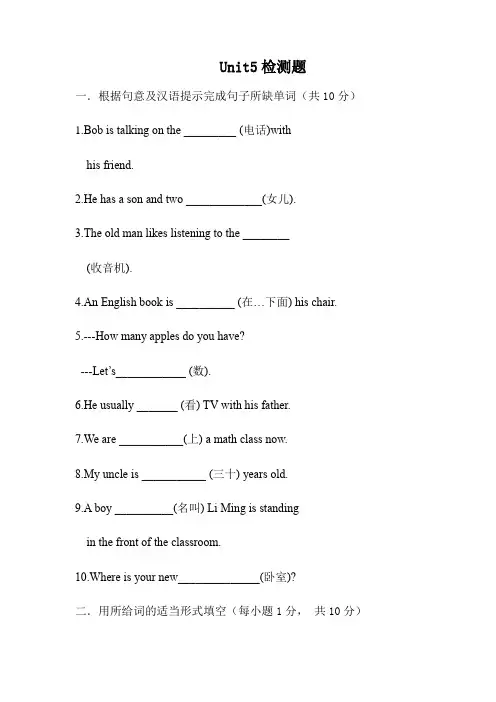
Unit5检测题
一.根据句意及汉语提示完成句子所缺单词(共10分)
1.Bob is talking on the _________ (电话)with
his friend.
2.He has a son and two _____________(女儿).
3.The old man likes listening to the ________
(收音机).
4.An English book is __________ (在…下面) his chair.
5.---How many apples do you have?
---Let’s____________ (数).
6.He usually _______ (看) TV with his father.
7.We are ___________(上) a math class now.
8.My uncle is ___________ (三十) years old.
9.A boy __________(名叫) Li Ming is standing
in the front of the classroom.
10.Where is your new______________(卧室)?
二.用所给词的适当形式填空(每小题1分, 共10分) 11.Jenny is my friend, she ____ (live) in China.
12.It’s time for breakfast. Please ____ (get ) up.
13.Will you _____ (give) me a book?
14.Don’t ______ (watch) TV now.
15.---What is Li Ming doing?
---He _______ (brush) his teeth.
16.Look! They ________ (work) together.
2022年七年级下册英语冀教版第五单元25课笔记
第 1 页 共 3 页 2022年七年级下册英语冀教版第五单元25课笔记
冀教版7年级英语下册第25课知识点以及课后习题
Lesson25A Phone Friend
一 重点句式以及知识点:
1.She wants to practice her English with a foreign friend,but she
doesn’t have any.
对应知识点:
(1)practice 动词--练习
practice doing sth “练习做某事”
(2)foreign 形容词--外国的;foreigner 名词--外国人
2.Can I speak to Jenny,please?
对应知识点:
(1)打电话场景,回答:Yes.This is Jenny speaking. “我是Jenny.”
(2)talk----talked talk to/with sb “和某人交流”
talk about sth “谈论某事”
speak 动词--spoke 说+语言
tell 动词--told 告诉:
tell sb to do sth “告诉某人去做某事”
say 动词--said 说+说的具体内容
3.I’m happy to talk with you .
对应知识点:
(1)be happy to do sth “做某事是开心的” 第 2 页 共 3 页 be +形容词+to do sth “做某事是怎样的”
4.I can’t hear you very well.
对应知识点:
(1)hear “听”hear of 听说 hear from 收到...来信
5.Can I speak more loudly?
对应知识点:
(1)loudly 大声地 speak loudly “说话大声”
Unit2L7ArrivinginBeijing(教案)-2021-2022学年冀教版英语五年级下册
Lesson7 Arriving in Beijing
教学目标:
1.知识与技能:
掌握单词:arrive way hotel great park child kite
children football Tai Ji basketball music
掌握句型:_____(人物)arrive in _______(地名)at _______(钟表)in the _____ .
2.情感态度与价值观:
能用英语正确表达出他们正在做什么。
3. 方法与过程:
采用举例、自主探究的方法
教学重、难点:
1.单词:arrive way hotel great park child kite
children football Tai Ji basketball music
2.准确运用句型: _____(人物)arrive in _______(地名)at _______(钟表)in the _____ .
教学工具:
教科书、教案、资料书
教学过程:
Part1. Class Opening and Review
亲爱的同学们:上一个单元我们学的知识大家掌握得怎么样?
读一读,连一连。
1.Please don’t run. A. I’m reading a book.
2.What are you doing? B.The girl is singing.
3.Would you like some milk? C. Okay. I’m sorry.
4.What would you like to drink? D. Yes, please.
5.Who is singing? E. I’d like some tea.