
陕旅版五年级英语下册教案Unit 6 Part B教案
Unit 6 My HolidayPart B◆教材分析能在实际生活中灵活自如地运用一般将来时态的各种句型谈论自己或他人的假期计划,达到学以致用的目的。
◆教学目标【知识与能力目标】能听懂Let’s talk部分中与旅行相关的词汇。
【过程与方法目标】能听、说、熟读对话,语音语调准确自然。
【情感态度价值观目标】能运用What is the ... like? It is ... There are many ... in it.谈论名胜的特点。
◆教学重难点◆【教学重点】能运用May Day is coming. Where will you go on the holiday? I will go to ... with ... We can visit many places of interest there. I will enjoy my visit there.谈论将来某一假期的旅行计划。
【教学难点】能运用What is the ... like? It is ... There are many ... in it.谈论名胜的特点。
◆课前准备◆图片,PPT◆教学过程课程导入(Leading In)(1)课前复习教师可仍以情景教学模式带领学生复习上节课所学的词汇,说一说在去旅游途中都参观了哪些景点,然后大家尽情享受在旅游中。
教师注意观察并找出反应最快的学生,适当给予精神或物质奖励。
(2)新课导入1. 师生会话,引导学生复习之前所学月份的单词:T: How many months are there in a year?Ss: There are twelve months in a year.T: What are they? Do you know?Ss: Yes! They are January, February, March, April, May, June, July, August, September, October, November and December.T: So what’s the date today?Ss: It’s...(1)新课展示Part B Let’s learn more1. 教师承接上一环节,继续运用一般将来时态与学生进行问答,并逐步引导学生了解一般将来时态的更多特殊疑问句型和一般疑问句及其回答。
(1) T: Summer holiday is coming. What will you do this summer? Will you travel this summer?出示杭州西湖的图片引导学生回答:T&Ss: Yes, I will. I will visit the West Lake.温馨提示:教师讲授新句型What will you do this summer?并向学生说明该句型与句型Where will you go this summer?的不同。
Where will ... go? 指将要去哪里,强调的是地点。
What will ... do? 指将要做什么,强调的是活动。
板书并领读功能句:Will you travel this summer?Yes, I will.What will you do this summer?I will visit the West Lake.(2) 继续师生问答:T: Do you want to know what I will do this summer?(出示长城的图片引导学生提问)T&Ss: Will you visit the Great Wall?教师再换成杭州西湖的图片回答:T: No, I won’t. I will travel to Hangzhou. I will go by train. Do you know Hangzhou? Do you know the places of interest in Hangzhou?在上一环节所板书的一般疑问句后添加否定回答No, I won’t. 并领读:之后,教师可引领学生多做几组练习,加深其记忆。
如:T: Will you visit the Great Wall?Ss: Yes. I will. / No. I won’t. I will travel to...提示:travel to “去......旅行”,to后面应接地点名词。
(3) 师生继续会话,练习应用travel to并继续引入更多的新授内容:T: What will you do this summer, S1?S1: I will travel to Xi’an.T: How will you go?S1: I will go by plane / train.T: It is fast.提示:fast(形容词)“快速的”。
其反义词为slow(形容词)“慢的”。
T: Why not go by car? The car is slow, but you can enjoy the beautiful places along the way.板书、领读并解释:enjoy“欣赏”。
along(介词)“沿着”。
along the way “沿途”。
教师举例帮助学生理解,并练习运用。
如:They will travel to Tibet by train and enjoy the beautiful places along the way.2. 教师出示Let’s learn more部分的教学挂图,让学生仔细观察图片;之后,播放本部分的录音或课件,让学生整体感知对话。
在播放录音之前,教师可提出一些问题,启发学生思考。
问题可参考如下:(1) What will Miss White do this summer?(2) How will she go?(3) Will Miss White visit the West Lake by plane? Why?(4) Who will go with Miss White?教师播放录音之后,抽选几位学生回答上述问题,并提醒学生注意运用完整的句子作答,必要时可予以补充。
(2)巩固活动1. 教师再次播放录音,要求学生模仿录音中人物的语音语调跟读Let’s leam more部分的对话。
2. 教师将全班分为两大组,进行对话练习;集体练习之后可让学生两两一组再次进行练习,教师巡视指导。
(1)新课展示Part A: Let’s talk1. 进行到本单元时,应该接近五一假期。
教师可以承接上一环节学生对日期的回答就即将到来的五一小长假展开会话,引出本节课的新授内容:T: May Day is coming. Are you going to travel?Ss: Yes. / No. What about you, Mr. / Miss...?T: I’m going to travel on the holiday. I will go to Hangzhou with my parents. We can visit many places of interest there. The West Lake is wonderful.同前画回答Yes的同学继续会话:T: Where will you go on the holiday, S1? (引导学生尝试说一说)T&S1: I will go to...板书、领读、讲解功能句:Where will you go on the holiday?I will go to Hangzhou with my parents.We can visit many places of interest there.2. 讲解疑难点(1) May Day (名词)“五一劳动节”。
May Day是专有名词,每个单词的首字母都要大写。
(2) holiday (名词)“假期”。
如:summer holiday “暑假”;winter holiday“寒假”。
(3) May Day is coming.这是一个用现在进行时表示一般将来意义的句子,其意义在于表达五一节就要来临,有兴奋、开心之意,含一定的感情色彩。
如:The bus is coming.公共汽车快来了。
这里用此时态是为了提醒大家注意车要来了。
3. 对话理解(1) 教师出示本部分的教学挂图,引导学生观察图片:T: What can you see in the picture?Ss: I can see the Palace Museum.T: What is the Palace Museum like? (引导学生回答)Ss: It is large.(2) 板书并新授句型What is ... like?这是一个在询问某物的特点的句型,如:—What is your school like?—It is large and very beautiful.这里的like和以前所学的like含义不同,以前所学是动词“喜欢”的意思,常用搭配为:like to do/like doing “喜欢做某事”。
如:I like to dance. / I like dancing.而这里的like是介词“像……”如:He looks like his father教师讲授单词large (形容词) “巨大的、宏作的”。
如:This is a large building.4. 教师播放Let’s talk部分的录音或课件,让学生认真听录音,整体感知对话内容。
教师也可以自己设计一些问题引导学生结合挂图及听力内容理解对话。
问题可参考如下:(1) Where will Alice go on May Day?(2) Who will go to Beijing with Alice?(3) What can Alice visit in Beijing?(4) What is the Palace Museum like?(5) Will Alice enjoy her visit in Beijing?(2)巩固活动1. 教师播放录音,引导学生模仿录音中人物的语音语调跟读Let’s talk部分的对话。
2. 学生齐读对话,教师注意纠正错误的语音语调。
3. 将学生分成两大组,分角色齐读对话。
(3)Part B Read and report教师和学生合作完成如下内容:1. 学生读表格,了解主人公都是谁。
2. 教师引导学生仔细观察表格里的疑问词:where在哪里,when什么时候,what做什么,how怎么样,with whom和谁一起。
最新陕旅版英语小学五年级下册Unit 6 My Holiday优质课教案

(1)我不喜欢旅行。
(2)I will go to Qingdao on holiday.
(3)你喜欢你的旅行吗?
盘点收获
(2)分
说说你有哪些收获?
环 节
学习过程
预习导学
(10)分
Warmingup
Step1:Free talk
Step2:同桌互读一下词汇:travel, enjoy, place of interest, the Palace Museum, the Great Wall, the West Lake.
要求:大声朗读后,同桌比比谁能背会。
预习导学
(10)分
一)课前热身
1、Free talk
2、Part A Warming up: Think and answer
3、学生试读单词。
travel, enjoy, place of interest, the Palace Museum, the GreatWall, the West Lake.
2、能听说熟读对话,语音语调准确自然。
3、完成Part B中的的Look and talk部分的活动。
重 点
1、能用Let’s learn more中的句型谈论未来假期的旅行计划。
2、能听说熟读对话,语音语调准确自然。
难 点
1、能在实际生活中灵活自如运用一般将来时时态的各种句型谈论自己或他人的假期计划。
学习准备
教学挂图
环 节
学习过程
预习导学
(10)分
Warmingup
Step1:Free talk
Step2: Part A Warming up中的tick and talk部分活动。
五年级下册小学英语第六册教案(陕西旅游版)
五年级下册小学英语第六册教案(陕西旅游版)Lessn12 A sprts eeting你们一定开过运动会吧。
运动会上那激烈的比赛还记得吧。
我们看看这场运动会上都进行什么比赛。
这一学生要学会说一些有关比赛的句子: The rela rae has begun hat sprt are u in? hih lass ill in? e are ne and ne ith lass 1学会这些词汇:a sprts eeting in ne and ne the arathn plaer教学目的:1会说会用这些句子:The rela rae has begunhat sprt are u in?hih lass ill in?2会说会用会写这些单词:a sprts eeting in ne and ne the arathn plaer3了解一般将时态的构成和意义。
前准备:1教师准备一个运动场上接力赛的。
对话如句型词汇学习中所设计。
2:准备greens eler herries nie and seat 的单词卡片。
3.准备更多的体育运动的单词卡片。
如:滑雪,滑旱冰,游泳,跑步,划船比赛,自行车赛等。
教学过程:12热身(aring up)师生对话引出话题:T:D u lie sprts?SS:esT:hat is ur favurite sprt?SA:I lie…bestSB:I lie… best Plaing… is hbbT:I lie sprts ,tPlaing ping-png is hbbI ish I an tae part f the lpi Gaes in Beiing2 新展示(Ne Presentatin)播放,熟悉词汇和基本句型:SA: LThe rela rae has begunhih lass ill in?SB:I’sure ur lass ill inSA:hat lass are u in?SB:I’in lass 2L! e are ne and ne ith lass 1e n,lass 2!SA:Gd lu t u!SB:Thans1)a sprts eeting 运动会召开运动会我们说:have a sprts eeting2)LThe gaes have begunhave/has begun 已经开始begun是begin的过去分词,同助动词have/has连用构成现在完成时态,用表示某事已经开始了。
陕旅版五年级英语下册Unit 6 My Holiday单元教案与反思
Unit6 My Holiday举世不师,故道益离。
柳宗元煌固学校陈道元第一课时教学目标:1.学习“四会”单词: travel, enjoy the visit, place of interest, the Palace Museum, the Great Wall, the West Lake.2.了解一般将来时。
教学重点:能听懂、会写、会读、会说:travel, enjoy the visit, place of interest, the Palace Museum, the Great Wall, the West Lake.教学难点:了解一般将来时。
教法:高效课堂教学模式学法:自主探究合作交流教具准备:小黑板单词卡片录音机教学环节:✓学习目标出示学习目标:学习“四会”单词:travel, enjoy the visit, place of interest, the Palace Museum, the Great Wall, the West Lake.✓自主学习(一)温故知新师生问答:Part A: Think and answer1. What are you going to do this evening?2. What is your father going to do tomorrow morning?3. What is your grandma go to do next Sunday?4. What is your friend going to do next week? (二)阅读方法自学单词,做到会读,会拼,会写,不会的画出来。
(三)互助释疑同桌间或小组内轮流读单词,探讨单词的读音和写法。
(四)探究出招同桌间练习书写,可以互相检查拼写。
✓展示交流(一)小组展示:相互读写单词(二)班级展示小组上讲台做表演,通过表演练习介绍单词。
✓点拨升华(一)教师放录音,学生跟读,纠正读音。
五年级下册英语教案Unit 6 My Hoiday Part B 陕旅版三起
Unit 6 My Holiday Part A教案教学内容:陕西旅游英语(三起)五年级下册Unit 6 My Holiday Part A部分内容。
教学目标(Objectives):1.确保学生认识和理解一些基本单词的意义和简单口头运用(To learn the meaning and simple usages of some words and phrases)。
2.学习使用本单元重点句型及表达(To use the typical sentences to express)。
3.鼓励学生大胆发言及表达(To encourage the students to express bravely)。
4.培养学生对英语学科的兴趣(To make the students interest in English learning)。
教学重点(Key Points):在学习了单词的基础上,以单词为载体,进行主要句型的学习,根据具体情境,学会交流对话,侧重句型学习,交际意向和课外拓展为重点。
教学方法:游戏,音频,情景教学法,Pair-work两人小组活动,Group-work小组活动,多媒体辅助教学。
教学难点:学生处于小学阶段,对一些事物的认知尚且模糊,对部分单词的感知和理解可能存在问题,对于五年级下学期学生的要求重点是会读会说,敢于模仿表达,其次能掌握一些基本单词的拼写和造句,在此基础上与人进行简单沟通。
教学准备:课件、照片素材、音频文件、单词卡片,教学道具。
教学设计:Step1. GreetingStep2.Warm-up/Leading(热身/课程导入)Warm-up Activities:1) How did you spend you last holiday?Discuss with your partner!...2)Game (游戏环节)操练方式:准备好小黑板,教师将之前课程中所学的单词写在小黑板上,让学生读熟、认熟这些单词,然后小黑板背对学生,让学生复述出黑板上有哪些单词,答对一个一分,错答没分,答越多分越高。
新陕旅版小学五年级下册英语全册教案
Unit1 How Are You Feeling Now?第一课时教学目标:学习“四会”单词:feel happy, feel sad, feel tried, feel angry, go out to play, make a snowman. 用所学单词和句型描述自己或他人的感受。
教学重点:能听懂、会写、会读、会说feel happy, feel sad, feel tried, feel angry, go out to play, make a snowman。
教学难点:通过学习,能够用英语指出自己的感受。
教法:高效课堂教学模式学法:自主探究合作交流教具准备:小黑板单词卡片教学环节:•学习目标(2分钟)(一)出示学习目标:学习“四会”单词:feel happy, feel sad, feel tried, feel angry, go out to play, make a snowman. 用所学单词和句型描述自己或他人的感受。
(二)学习How are you feeling now? I’m ... 句型并学会如何表达。
•自主学习(15分钟)(一)温故知新同桌讨论并写出学过的表示感受的形容词。
(二)阅读方法对照课本第二页,边看边练习拼写描述感受的单词。
(三)互助释疑同桌间一边做出各种表情,一边读出单词,交流不会读的单词。
(四)探究出招同桌间练习书写,可以互相检查拼写。
•展示交流(10分钟)(一)小组展示小组内练习用英语描述感受(二)班级展示指名小组上讲台做游戏,用英语描述自己或者他人的感受。
•点拨升华(8分钟)(一)教师放录音,学生跟读,纠正读音。
(二)学生开火车读单词。
(三)用句子How are you feeling now? I’m ... 同桌相互问答。
•课堂作业(5分钟)•作业当堂清1.单词拼写feel h___ppy feel s___ d feel t_____ed feel ang___2. 英汉互译感到快乐_____________ feel sad ____________感到累______________ 感到生气_____________go out to play _______________ 堆雪人______________•挑战自我扮演表情完成对话How are you feeling now?I’m ...板书设计:Unit 1 How Are You Feeling Now?happyfeel sadtried,angry,go out to play, make a snowman第二课时教学目标:1、学习主系表结构的句型:主+系+表,即:人称+am/is/are+形容词2、句型学习How are you feeling now? I’m ...教学重点:熟练掌握句型,并进行简单的对话。
陕旅版五年级下册英语lesson6电子备课教案
She comes from…
She likes……
3、自由对话展示
四、运用拓展
1、课本Let’s practice
2、学生自己收集不同国家、地方的饮食图片和资料,并介绍给大家。
五、检测与评价
1、做活动手册第三题,参考答案:1、A 2、A 3、A
2、第六题,根据图片提示对话。
3、复习并记背本课对话和词汇。
教学难点国家与人民词汇转化教学准备教师地图不同国家人物图片学生课本教学过程学生学习活动教师教学活动个性思考部分一自主学习1让学生朗读背诵对话复习单词
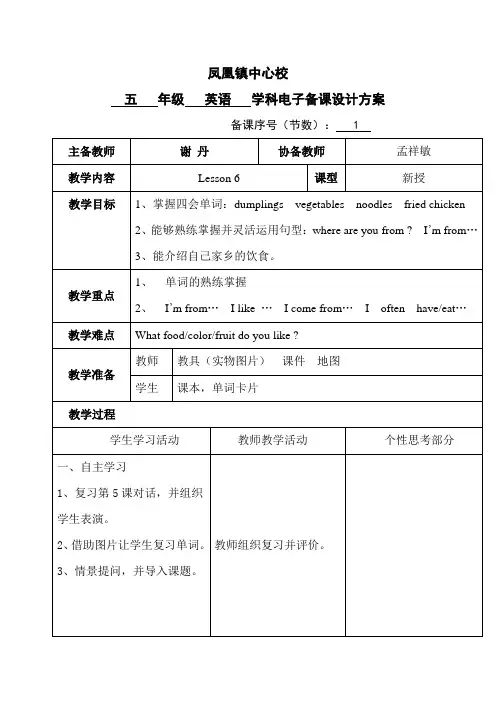
凤凰镇中心校
五年级英语学科电子备课设计方案
备课序号(节数):1
主备教师
谢丹
协备教师
孟祥敏
教学内容
Lesson 6
课型
新授
教学目标
1、掌握四会单词:dumplings vegetables noodles fried chicken
2、能熟练应用句型:He comes/wants/likes…They /we…
教学难点
国家与人民词汇转化
教学准备
教师
地图、不同国家人物图片
学生
课本
教学过程
学生学习活动
教师教学活动
个性思考部分
一、自主学习
1、让学生朗读、背诵对话,复习单词。
2、让学生两人组用单词卡片练习对话;getables noodles fried chicken
句型:-what food do you like?
-I like…
-Where are you from?、
-I am/come from……
教学反思
凤凰镇中心校
五年级英语学科电子备课设计方案
陕旅版小学英语五年级下册教案全册
教材分析一、教材简况本套英语教材由陕西旅游出版社出版,是教育部审定的义务教育教科书。
根据教育部颁布的《全日制义务教育普通高级中学英语课程标准(实验稿)》规定的小学毕业应达到二级水平的要求精心编写的。
本教材供五年级使用。
本套教材吸取了最先进的外语教学理念和经验,从学生的学习兴趣、生活经验和认知水平出发,通过体验、实践、参与、合作与交流等学习方式,发展学生的综合语言运用能力,具有较强的科学性。
教材围绕最常用、最基本的英语词汇、句型和会话等编写,好教易学,具有较强的活动性和趣味性。
本教材根据小学生的年龄、心理特点和生活实践编写,同时注重激发和培养学生的学习语言的兴趣和信心。
有了兴趣和信心,学生们就有了积极进取的学习态度。
在本套教材中,提供了大量的生活情景,目的就是同学们可以在听听,做做,说说,玩玩,演演中学习单词,说句子,然后再将所学知识积极地运用到生活中去。
通过本教材的学习,一定能为将来的学习打下良好的基础。
新| 课|标|第| 一| 网本套教材中,我们设计了很多很实用的会话、有趣的游戏活动和故事、好听的歌曲和歌谣,并配上了精美的图画。
还有调皮的小精灵们会为大家的英语学习带来更多欢乐。
这些都会有利于培养学生的学习兴趣。
二、学生状况1.少数学生对英语有兴趣,口语运用自如、熟练。
2.大部分学生对英语学习有很大的自信心。
3.由于社会因素和家庭条件的影响,学生学习英语的环境不够理想。
三、教学重点1.教材共有8单元,每单元中都有要求学生熟记的单词和句型操练,力求在教学中熟练掌握。
2.听、说练习贯穿了整个教材,激发了孩子们在玩中听、说英语,是教材与教者共同始终追求的目标。
四、教学难度新课标第一网1.对单词和短语的熟记和完全掌握。
2.每个单元中出现的重点句型会说会用。
3.在学习过程中了解中西方文化的差异,大胆运用英语相互交流,进行简单对话。
4.激发学生的学习兴趣,加强学生听、说、读、写等基本技能。
学情分析教学总目标及任务第一单元How Are You Feeling Now? 学习“四会”单词:feel happy, feel sad, feel tried, feel angry, go out to play, make a snowman. 并用所学单词和句型描述自己或他人的感受。
陕旅版英语五年级下册《 Unit 6 第三课时》教学课件
Unit 6 My Holiday
陕旅版(三年级起点)五年级下册
Part A Tick and talk
Part B Let's learn more Look and talk Read and report
Warm-up/Revision
slow
/sləʊ/ 慢的;慢地
【反义词】 fast 快的 【短语】 slow down 减速 【例句】We can go as slow as you want. 你想要多慢我们就可以走多慢。
视频
点击“Let's learn more”, 跟我一起读吧!
Let's learn more
Let's learn more
visit next travel with 1. He will __t_r_a_v_e_l ___ to Suzhou. 2. Will your parents go ___w_i_th_____ you? 3. I will go to Shanghai ___n_e_x_t____ sunday. 4. I'm going to ___v_i_s_it____ the West Lake.
【详解】这是用来询问交通方式及回答的句型。by意为“(指交通等)
乘;用”,其用法为: by + 交通工具(中间不用冠词)。 句型结构: How will + 主语 + go(+ 地点)? 回答: 主语 + will go(+ 地点)by + 交通工具.
注意:其后接地点名词时,要用to,接地点副词时,不接to。
新陕旅版五年级英语下册Unit 6 My holiday
Unit 6MyHoliday
教
学
目 标
知识与能力
1、能听、说、读、写词汇:travel, enjoy the visit, place of interest, the Palace Museum, the Great Wall, the West Lake。
2、能在实际情景中灵活运用以上词汇。
作业设计:抄写并背诵Let’s learn more部分对话。
教学反思及思想教育成效:
.
(1)引导学生仔细观察本部分的八幅图片,并分别说出相应的地点和交通方式。
(2)教师引导学生讨论一下以什么方式去这四个地点比较合理,并将相应的地点和交通方式连起来。
(3)学生勾出自己打算去的地点及相应的交通方式组合,结合本部分的对话句型示范进行问答。
(4)学生之间互相练习问答。
二、课程展示(Presentation)
三、当堂练习(Practice Activities)
1、情景操练
教师背起所准备的旅行背包,引出情景对话。
2、猜一猜
教师选一位学生上台,然后悄悄告诉该学生一个单词或词组,让其他学生猜是什么?猜对的学生可上台换下台上的学生,游戏继续。
板书设计:
Unit 6 My Holiday
travel enjoy the visit place of interest
I will go to...with...We can visit many places of interest there.
I will enjoy my visit there.
作业设计:让学生用will写句子,体会一般将来时的含义。
教学反思及思想教育成效:
课题
Unit 6MyHoliday
陕旅版五年级英语第六单元教案
第六单元主题:感官内容:听、看、闻、尝、摸导入:1. 用五感器官介绍英文单词,如:eye、ear、nose、tongue、hand。
2. 学生自由发挥,用英文介绍自己的五感器官,并描述一下最喜欢使用的感官。
听力训练:1. 听音乐,让学生用英文描述听到的音乐的特点,比如:快、慢、悠扬、响亮等。
2. 播放录音,让学生听到录音中的英文句子,并进行句子理解、回答问题等练习。
视觉训练:1. 准备图片卡片,包括动物、自然景物、城市建筑等,让学生用英文描述图片中的内容。
2. 带领学生观察周围的环境,用英文描述他们所看到的事物。
嗅觉训练:1. 准备各种香味物品,如香水、清香剂、花香等,让学生用英文描述他们所闻到的味道。
2. 在教室内或学校周围采集各种特殊气味,让学生用英文进行描述。
味觉训练:1. 为学生准备各种不同口味的小食品,如巧克力、辣味食品、酸味食品等,让学生用英文描述所吃到的味道。
2. 分组进行口味测试,让学生用英文进行讨论和描述。
触觉训练:1. 准备一些触感相对复杂的物品,如面料、纸张、细沙等,让学生用英文描述触摸到的感受。
2. 采用触摸游戏的方式进行训练,学生用英文描述他们所触摸到的物品的特点。
综合训练:1. 播放视频或录制音频,内容包括各种感官训练中学生所学到的英文词汇和句子,让学生进行听力理解、口语跟读练习。
2. 分组进行小对话练习,让学生在对方的引导下描述某种感官的感受。
拓展活动:1. 给学生布置任务,让他们在课外使用英文描述自己日常生活中或周围环境中的感官体验,并在下节课上进行共享。
2. 安排实地考察活动,如到市场、花园、音乐厅等地方进行感官训练,让学生用英文进行全程交流。
总结:本单元通过感官训练,旨在提高学生的英文听、说、读、写能力,同时加深对五感器官的理解和运用。
通过多种感官刺激,激发学生对英语学习的兴趣,提高学习效果。
Unit 6: The Five SensesTheme: Sensory PerceptionContent: Hearing, Sight, Smell, Taste, TouchIntroduction:1. Introduce English words for the five senses, such as: eye, ear, nose, tongue, hand.2. Students freely describe their own sensory organs in English and describe their favorite sense to use.Hearing Training:1. Play music and have students describe the characteristics of the music they hear in English, such as: fast, slow, melodious, loud, etc.2. Play recordings of English sentences for students to listen to and practice sentenceprehension, answering questions, etc.Vision Training:1. Prepare picture cards including animals, natural scenery, city buildings, etc., and have students describe the contents of the pictures in English.2. Lead students to observe their surroundings and describe what they see in English.Smell Training:1. Prepare various scented items, such as perfumes, air fresheners, and flower scents, and have students describe the smells they perceive in English.2. Collect various specific scents inside or around the school and have students describe them in English.Taste Training:1. Provide students with various snacks of different flavors, such as chocolate, spicy foods, sour foods, etc., and have them describe the tastes in English.2. Conduct taste tests in groups, allowing students to discuss and describe the flavors in English.Touch Training:1. Prepare some items with relativelyplex textures, such as fabrics, paper, sand, etc., and have students describe thesensations they feel in English.2. Use touch games to train students to describe the characteristics of the items they touch in English.Comprehensive Training:1. Play videos or record audio containing the English vocabulary and sentences learned in the sensory training for students to practice listeningprehension and oral recitation.2. Conduct small group dialogues, allowing students to describe sensory experiences under the guidance of each other.Extension Activities:1. Assign tasks to students to use English to describe their sensory experiences in their daily lives or the environment around them, and have them share during the next class.2. Arrange field trips to places such as markets, gardens, and concert halls for sensory training, allowing students tomunicate in English throughout the activities.Conclusion:This unit aims to enhance students' English listening, speaking, reading, and writing abilities through sensory training while deepening their understanding and application of the fivesenses. By stimulating multiple senses, the goal is to inspire students' interest in learning English and improve learning oues.。