
必修三 unit2 healthy eating 教学设计
一堂高中英语任务型阅读教学课的设计
—BOOK 3 Unit 2 Healthy eating
【教学内容介绍】
该课时是根据高一英语必修三第二单元Healthy eating学生用书中的阅读内容“come and eat here(1)”而设计的一节课,课文主要讲述了王鹏和咏慧这两家饭店之间的竞争,同时
阐述了所谓健康饮食的概念。
通过整个单元的学习,学生将了解各种食物对人体的作用,与
此同时,教师也将引导学生关注平衡膳食,促使学生养成健康饮食的习惯。
【教学设计思路】
《全日制义务教育普通高级中学英语课程标准(实验稿)》把基础教育阶段英语课程的目标设定为以学生语言知识、语言技能、情感态度、学习策略和文化意识的发展为基础,培养学生英语综合语言运用能力。
同时,也指出:“高中英语课程的设计与实施要有利于学生优化英语学习方式,是他们通过观察、体验、探索等积极主动的学习方式,充分发挥自己的学习潜能,形成有效的学习策略,提高自主学习的能力。
”应《标准》的要求,我将在培养学生听说读写四个能力的基础上通过对教学情境的创设,采用role playing, quiz, discussion, brainstormi ng等多种方式来进行对本单元的教学。
【学习任务分析】
本单元的中心是围绕健康饮食展开的。
该篇文章通过阐述两家饭店之间的竞争来引出健康饮食这一概念。
本课题的学习不仅是能让学生了解什么是健康的饮食,同时也能引导其调整自身的饮食习惯,做到健康饮食。
本堂课的教学内容为“come and eat here(1)”,是在学生掌握了该单元的词汇下展开的,这篇文章是整个单元的重点。
这是一篇记叙文。
学生可以以地点的转换为线索来进行对本篇文章的学习。
考虑到单元的整体进度,我将Warming up作为Re ading的导入部分,把Pre-reading、Reading 和Comprehending整合在一起作为一堂“精读课”。
【学习者分析】
本课的授课对象是瑞安中学高一(3)班的学生,作为省一级重点高中的学生,他们的英语基础普遍比较扎实。
学生们也都具备一定的听说读写的能力和一定的词汇量,而且该班
学生上课气氛活跃,能积极配合教师的指令,表现出较高的学习积极性。
但同时作为刚进入高中的学生,他们还没有养成自主学习的意识,阅读技巧和口语表达能力都有待提高。
【教学目标】
1.知识与技能
①学会正确运用本单元的一些重点单词和词组,如:diet, curiosity, customer,
balance, get tired of, throw away etc. ;
②了解各种食物对人体的作用并能区别哪些属于健康饮食,哪些不是;
③能针对自己周围遇到的实际问题发表自己的看法和建议;
④能自己制定一份合理的健康菜单。
2.过程和方法
①能运用skimming扫读课文,查找课文中的相关信息,处理信息,根据课文内容
回答有关问题;
②能运用scanning寻读课文,查找课文中的特定信息,并能对是非判断理解题作出
正确选择;
③能用自己的话复述课文,并能就自己所了解的关于健康饮食的知识与同学展开讨
论,表达自己的观点;
3.情感,态度和价值观
①了解健康饮食的正确概念,形成良好的饮食习惯
【教学重难点】
教学重点:
①学会正确运用本单元的一些重点单词和词组;
②了解各种食物对人体的作用并形成要健康饮食的意识;
③学生能合理运用不同的阅读策略,理解和分析课文。
教学难点:
①学生能合理运用不同的阅读策略,理解和分析课文
②能针对自己周围遇到的实际问题发表自己的看法和建议
【教学过程设计】
Ⅰ. Warming up
Warming up by competition
将全班分成4个大组对食物的英语名称进行竞猜比赛--------教师将食物的图片一一呈现在PPT上,让学生自由抢答,答对一个得1分,最后分数多的组获胜。
其食物名称都是单词表上,并且是在学生上课前记过的基础上,进行竞猜。
其食物名称有:pea, cucu mber, barbecue, mushroom, eggplant, cola, nut, peach, carrot, garlic.
Warming up by brainstorming and speaking
让学生将自己最喜欢的食物列在本子上,将其与同桌进行对比,并让他们讨论这些食物是否健康。
同时教师还让学生回答以下问题:
What are the three essential elements for us human beings to survive on the earth?
(Water, air, food)
what is healthy diet in their mind?
Healthy diet : a the diet that is balanced and neither too rich in fat, sugar and salt nor too poor and laking in essential nutrients.
Decide which food is junk food or healthy food and give reason. Use the following expression to speak it.
I think…is junk food because…
I think…is healthy food because…
(be rich in; be low in)
What will happen if you do not eat a balanced die?
最后,教师将这些学生所列的食物进行分类。
分成:Energy-giving food, body-building food 和protective food 三类。
并向学生说明这三类食物的区别和具体作用,同时在PPT 上呈现食物金字塔(如下)
Ⅱ. Reading
✧Skimming for general idea
教师引导学生快速浏览课文,然后根据课文内容回答相关问题,是学生掌握课文大意。
a)Why Wang Peng feels frustrated?
b)Why Yong Hui’s restaurant was so popular with customer?
c)What will Wang Peng do to win his customer back?
✧Scanning for detail information
①教师要求学生把课文再仔细读一篇,并根据P11 exercise1 T or F 和exercise3的
练习到文中查找相关信息。
在T or F题目中,无论学生作出什么判断,都要求其在文章中找到相应的句子,并大声读出来。
②在对文章有了深入了解之后,教师要求学生找出王鹏和咏慧两家餐馆的不同之处,
同时完成P11 exercise3。
✧Role play for understanding
教师将学生分成8个小组,让每个小组以王鹏和咏慧不合理的菜单为鉴制定一份他们心目中的健康菜单,然后请两个小组成员上去扮演两个饭店的老板向同学和老师推荐自己的菜单。
用自己的口才说服同学和老师去光顾他们的店。
最后让学生选出最佳菜单和最差菜单。
✧Predicting the ending
教师要求学生根据文章的结尾句,自己预测接下来的故事情节,并与同学进行讨论,
最后请小组代表给出本组的构思。
Ⅲ. Retelling to close down
学生以4人为一小组,根据教师提供的线索和词汇网络,相互讨论,组织语
言,然后教师请2个小组的代表来复述课文,同时及时予以修改和评价。
其词汇网络为:
Wang Peng frustrated Li Chang(regular customer)
library Slimming restaurant Yong Hui
Ⅳ. Homework
①上网或到图书馆查找关于均衡饮食的内容,并作记录,同时制定一份自己的
饮食计划,在第二天上课时跟同学进行讨论,并到讲台上进行汇报自己所找
到的资料和自己计划制定的原因。
②完成课后P12 Ex.1 和Ex.2的练习
③收集有关饮食的英语名言和谚语,如:人如其食(you are what you eat)。
人教版 必修三 Unit 2 Healthy eating(语法与写作)教案-最新教学文档
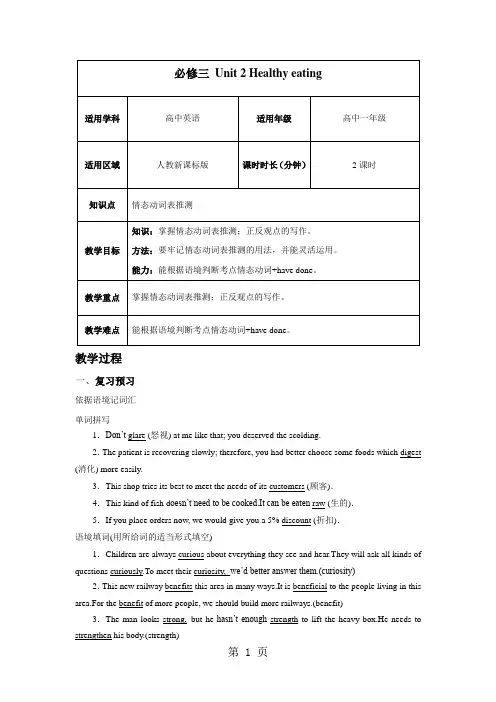
教学过程一、复习预习依据语境记词汇单词拼写1.Don’t glare (怒视) at me like that; you deserved the scolding.2.The patient is recovering slowly; therefore, you had better choose some foods which digest (消化) more easily.3.This shop tries its best to meet the needs of its customers (顾客).4.This kind of fish d oesn’t need to be cooked.It can be eaten raw (生的).5.If you place orders now, we would give you a 5% discount (折扣).语境填词(用所给词的适当形式填空)1.Children are always curious about everything they see and hear.They will ask all kinds of questions curiously.To meet their curiosity,_we’d better answer them.(curiosity) 2.This new railway benefits this area in many ways.It is beneficial to the people living in this area.For the benefit of more people, we should build more railways.(benefit)3.The man looks strong,_but he hasn’t enough strength to lift the heavy box.He needs to strengthen his body.(strength)二、课堂导入复习上节课情态动词概念概念:在动词(一般动词)之前形成动词的否定,疑问,时态,语态,语气或表示特殊意义的动词叫做助动词,其中具有感情色彩一些助动词叫做情态动词。
必修三 Unit 2 Healthy eating 教学设计与反思
必修三 Unit 2 Healthy eating 教学设计与反思一、教学设计:(一)指导思想高中英语课程应根据高中学生认知特点和学习发展需要,在进一步发展学生基本语言运用能力的同时,着重提高学生用英语获取信息、处理信息、分析和解决问题的能力;逐步培养学生用英语进行思维和表达的能力;为学生进一步学习和发展创造必要的条件。
高中英语课程的设计与实施有利于学生优化英语学习方式,使他们通过观察、体验、探究等积极主动的学习方法,充分发挥自己的学习潜能,形成有效的学习策略,提高自主学习的能力。
(二)学情分析饮食方面的话题是从实际出发、从自身体验出发的一个话题,学生应该非常感兴趣,而且就该话题让学生做Reading,Talking和Discussion等活动,学生们会有参与的热情、会有发言的冲。
Reading部分是一个故事性很强的叙事性文章,学生做起来并不会有太大的难度,而且Reading中富有戏剧性的变化让学生可以从中感受故事的趣味性。
(三)教学方法本单元的中心话题是“健康饮食”。
通过单元教学让学生了解饮食与健康方面的有关知识,并了解各种事物对人体的作用,引导学生关注平衡膳食,促使学生养成健康饮食的习惯并能在生活中改善饮食结构,丰富饮食文化,从而保持身体健康。
另外,要引导学生针对现实中遇到的实际问题发表自己的看法。
通过合作式、探究式学习方式,激发学生的学习兴趣,使学生由被动变主动,积极参与学习过程。
(四)教材分析1. Warming Up is to tell students how different kinds of food are grouped. This is important as it enables us to talk about the value of particular foods to our health. We want students to appreciate what a balanced diet is. The teacher can have a free talk with students, let them work in pairs to read through the chart and discuss the questions.2. Pre-reading contains two more general questions about food for discussion. Students can be encouraged to discuss these questions in pairs. Then they are asked to look at the title of the reading passage and the pictures to predict what the passage is about. This part is very useful for the next part Reading.3. The reading passage Come and Eat Here introduces students to two unbalanced diets through the restaurants of Wang Peng and Yong Hui. Food at Wang Peng’s restaurant contains too much fat while Yong Hui’s restaurant offers little energy-giving food. After reading, students are required to do the exercises in Comprehending to see how much they have understood the reading passage. The teacher can let them work in pairs or in groups to find the answers cooperatively, and then check their answers with the whole class.(五)教学目标知识目标1.Get students to learn the useful new words and expressions in this part: diet, nut, bean, pea, cucumber, eggplant, pepper, mushroom, peach, lemon, balance, barbecue, mutton, roast, fry, ought, bacon, slim, curiosity, hostess, raw, vinegar, lie balanced diet, ought to, lose weight, get away with, tell a lie, win. . .back2. Let students learn the knowledge of balanced diet and nutrition.能力目标1. Develop students’ reading ability and let them learn different reading skills.2. Enable students to talk about different kinds of food, problems with diet and balanced diet.情感目标1. Stimulate students’ sense to form a healthy eating habit.2. Develop students’ sense of c ooperative learning.(六)教学重点与难点教学重点1. Let students learn more about problems with a diet, a balanced diet and nutrition.2. Get students to learn different reading skills.教学难点1. Develop students’ reading ability.2. Enable students to talk about different kinds of food and balanced diet.(七)教学过程→Step 1 Leading-inHave a free talk with students. Ask them the following questions:1. Everybody has to eat, but do you eat a healthy diet?2. What do you usually have for breakfast/lunch/supper?3. What kind of food do you like best?4. Why are you so strong/weak/fat/thin? Does it have anything to do with your diet?5. Do you think you are eating a balanced diet?→Step 2 Warming up1. Let students turn to Page 9. Ask them to look at the pictures, name the foods in them and then fill in the form.Healthy food Unhealthy food2. Do you know that the food you eat helps you grow in different ways?Food that provides energy(e. g. energy-giving food) Food that helps growbones and muscles(e. g.body-building food)Food that helps the body fight diseases(e.g. protective food)rice noodles spaghetti bread potatoes chocolate butter cream oils nuts meat eggs cheesemilktofuMost vegetables(e. g. beans, peas,cucumbers, eggplants, peppers,mushrooms, cabbages)and fruit(e. g.apples, peaches, oranges, lemons)→Step 3 Pre-readingLet students turn to Page 10, look at the title of the reading passage and the pictures and predict what the passage is about. Then have them read the passage quickly to see if they are right.→Step 4 Reading1. Fast readingAsk students to skim the reading passage and then answer the following questions:1)Who are mentioned in the story?2)Where did the story happen?Three minutes later, check the answers with the whole class.Suggested answers:1)Wang Peng, Yong Hui and Li Chang.2)It happened in the two rest aurants: Wang Peng’s restaurant and Yong Hui’s restaurant.2. Intensive readingAllow students to read the passage carefully this time to understand the main idea of each paragraph and the important details, and then finish the following:1)Use the information from the reading passage to tick out the correct statements and give reasons for your answers.(1)Usually Wang Peng’s restaurant was full of people.(2)Yong Hui could make people thin in two weeks by giving them a good diet.(3)Wang Peng’s regular cus tomers often become fat.(4)Yong Hui’s menu gave customers more energy-giving food.(5)Wang Peng’s menu gave customers more protective food.(6)Wang Peng decided to compete with Yong Hui by copying her menu.2)The passage can be divided into 3 parts. Give the main idea in each part.Part Main ideaPart 1Part 2Part 33. Reading and discussionRead the passage a third time and then work in pairs to do the following:1)Write out your answers.(1)The weakness of the diet in Wang Peng’s restaurant was t hat it did not give ______________.(2)The strength of the diet in Wang Peng’s restaurant was that it provided ______________.(3)The weakness of the diet in Yong Hui’s restaurant was that it did not give ______________.(4)The strength of the diet in Yong Hui’s restaurant was that it provided ______________.4. ExplanationHelp students analyze some difficult, long and complex sentences and guess themeanings of some new words. Encourage them to try to deal with the language points in the context.Discuss and explain in your own words the following important sentences or parts of sentences taken from the passage.1)Wang Peng sat in his empty restaurant feeling very frustrated.2)Nothing could have been better.3)Something terrible must have happened if Li Chang was not coming to eat in his restaurant as he always did.4)He could not have Yong Hui getting away with telling people lies!5)Perhaps with a discount and a new sign he could win his customers back.→Step 5 Homework1. Learn the useful new words and expressions in this part by heart.2. Read the reading passage again and try to retell the story.(八)板书设计Unit 2Healthy eatingCome and eat here(1)True or false Key sentences1. Usually Wang Peng’s restaurant was full of people.2. Yong Hui could make people thin in two weeks by giving them a good diet.3. Wang Peng’s regular customers often become fat.4. Yong Hui’s menu gave customers more energy-giving food.5. Wang Peng’s menu gave customers more protective food.6. Wang Peng decided to compete with Yong Hui by copying her menu.1. Wang Peng sat in his empty restaurant feeling very frustrated.2. Nothing could have been better.3. Something terrible must have happened if Li Chang was not coming to eat in his restaurant as he always did.4. He could not have Yong Hui getting away with telling people lies!5. Perhaps with a discount and a new sign he could win his customers back.二、教学反思:(1)自己对本课的反思:本课堂设计了若干活动及任务,并提供了一些必要的学习资料,旨在让学生积极参与学习活动,在活动中学习,在任务下进步。
高一英语人教版课标必修3unit2healthyeating教案2
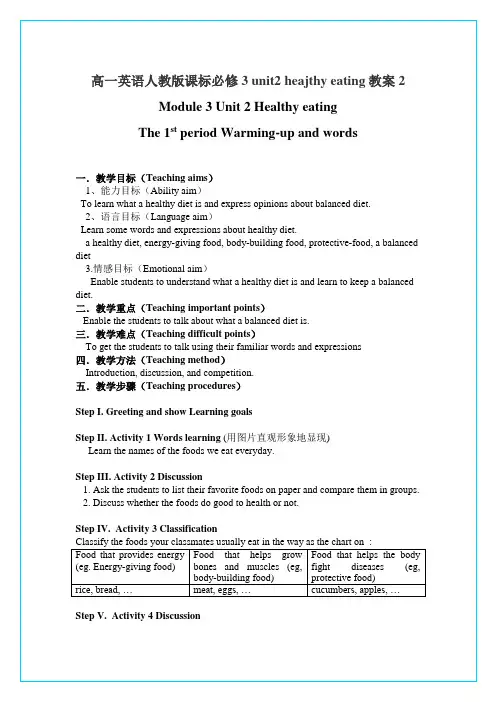
Food that provides energy (eg. Energy-giving food)
Food that helps grow bones and muscles (eg, body-building food)
2、语言目标(Language aim)
Learn some words andexpressionsabout healthy diet.
a healthy diet, energy-giving food, body-building food,protective-food,a balanced diet
1.Ask the students to listtheirfavorite foods on paperandcomparethemin groups.
2.Discuss whether the foodsdogood to health or not.
Step IV.Activity 3Classification
三.教学难点(Teaching difficult points)
To get the students to talk using their familiar words and expressions
四.教学方法(Teaching method)
Introduction, discussion, and competition.
StepVI. Activity 5 Competition
Let the students to take part in a competition of making up balanced meals to see which group can make the best meals for our daily life.The teacher also gives his/her choice of foods for a balanced meal.
必修3-unit-2-healthy-eating教学设计

Book 3 Unit 2 Healthy eat ing i.单元教学目标川.教材分析与教材重组1.教材分析本单元以“健康饮食”为中心话题,通过单元教学让学生了解各种食物对人体的作用,引导学生关注平衡膳食,促使学生养成健康饮食的习惯。
针对现实中遇到的实际问题发表自己的看法。
最后让学生运用所学知识,两人一组研究中餐,设计食谱。
WARMING U是本单元一个重要的组成部分。
让学生看图讨论不同食物对人体的作用,了解饮食与人体健康的关系。
通过几个设问激发学生思考自己的饮食习惯是否合理,运用已有的知识经验思考什么是Healthy Eating.PRE-READING!过一个表格和一个排序题引导学生对比不同食物中哪些食物富含脂肪、纤维素、维生素和糖份。
可添加讨论如何在烹饪中保持食物营养,从而有利于健康。
READING#述王鹏伟和咏慧开饭店的不同风格和顾客对不同食品的反应,反映了现代人对饮食的关注和对时尚的追求。
但王鹏伟和咏慧都没有提供平衡的膳食,经过一段时间的磨合,他们决定合作,提供既有能量又有纤维的食品。
戏剧性的结尾增添了故事的趣味性。
!过阅读丰富学生的饮食文化,教会他们如何改善饮食习惯;在现实生活中碰到麻烦时,如何正确处理矛盾,解决问题。
COMPREHENING用判断和回答问题的形式考查学生对课文细节的理解,对比两家饭店所提供膳食的优缺点重考查词性的变化,课文中重点词汇在语篇中的熟练运用及情态动词的不同功能,并设计连线和情景对话两个题型予以巩固。
LEARNING ABOUT LANGUA E Comprehe ndi ng之后的又一指导性练习。
注USINGLANGUAG体现了学以致用的目的,从Listening, Reading, Speaking, Writing 四方面训练学生,完成语言的输入性学习和输出性训练的过程,结合生活实际,让学生两人一组研究中餐设计食谱。
2.教材重组精读把Warming up 作为Reading 的导入部分,把Pre-reading 、Reading 和Comprehe ndi ng整合在一起作为一堂“精读课”。
高中英语_必修3 Unit 2 Healthy Eating教学设计学情分析教材分析课后反思

Unit 2 Healthy EatingCome and eat here (1)教学设计:ⅠTeaching aims:1. Ss can get the main idea of the passage, and understand the importance of healthy eating by comparing Wang Peng’s restaurant with Yong Hui’s restaurant.2. Ss can choose the proper food in their daily life and live a healthy life after learning the passage.Ⅱ Teaching important points1. Identify different groups of foods and talk about healthy eating.2. What kind of food did they provide for their customers, healthy or unhealthy? Why?Ⅲ Teaching difficult points1. Understand the real meaning of healthy eating.2. How was the competition going on? Who would win?Ⅳ Teaching methods:1. Fast and careful reading.2. Asking-and-answering activity to check the Ss’ understanding of the text.3. Individual, pair or group work to finish each task.4. Discussion.Ⅴ Teaching aidsA recorder, a computer and a projector.Ⅵ Teaching procedures & waysStep one:RevisionReview key words and phrases that appear in the text.Translation(1)1. 节食on a diet2. 平衡膳食balanced diet3. 应该ought to4. 减肥lose weight5. 不受惩罚get away with6. 削减;删节cut downTranslation (2)1. tell a lie 说谎2. win…back 赢回3. earn one’s living 谋生4. in debt 欠债5. put on weight 增加体重6. before long 不久以后Step two: Leading inTeacher and Ss make a conversation, and then watch a video, leading to the topic of unit 2 -----Healthy Eating.After watching the video, Ss answer “What can we learn from the video?”You now, there are two restaurants in our local area, one is Wang Peng’s restaurant, and the other is Yong Hui’s restaurant. Please come and eat here.Step three: Reading (Skimming)The main idea of the text is____A The two restaurants provided the healthy diet.B The reason why YongHui’s restaurant was so popular with customers.C How the competition took place between Wang Peng and Yonghui.ScanningPart 1 A. Wang Peng follows his friend to a newly openedrestaurant which is very popular.Part2 B. Wang Peng does some research in the library to win hiscustomers back.Part3 C. Wang Peng is worried because his restaurant is not full asusual.TRUE or FALSE1. Usually Wang Peng’s restaurant was full of people.2. Yong Hui’s regular customers often became thin.3. Yong Hui’s menu gave customers more energy-giving food.4. Wang Peng decided to compete with Yong Hui by copying her menu.Step four:Careful readingWang peng’s menuFood:____________________________________________________Drink ____________Price_____________Yong hui’s menuFood_______________________________________Drink____________Price____________Wang Peng’s dietThe weakness of the diet in Wang Peng’s restaurantwas that it gave _____________The strength of the diet in Wang Peng’s restaurantwas that it provided _________________________Yong Hui’s dietThe weakness of the diet in Yong Hui’s restaurantwas that it didn’t give ________________________The strength of the diet in Yong Hui’s restaurantwas that it provided ___________________________Step five:DiscussionIf you are hungry, which restaurant do you prefer to go to? Wang Peng’s,Yong Hui’s restaurant or neither of them and give your reasons.Useful sentence patterns1. I prefer to go to… because…2. I’d like to go to… because…3. I want to go to… because…4. I like neither of them, because…Step six:SummaryWang Peng is _______ because his customers are not coming to his restaurant __ _____.He follows his friend to a newly open restaurant which offers food to make people ______. At last, he does some research and tries to ____ his customers _____.Step seven:HomeworkThe competition between Wang Peng and Yong Hui has begun. What will happen next?Please preview the next part on page 14.板书设计Unit 2 Healthy EatingCome and eat here(1)ReadingWang Peng’s restaurantYong Hui’s restaurantUseful sentence patterns1. I prefer to go to… because…2. I’d like to go to… because…3. I want to go to… because…4. I like neither of them, because…Unit 2 Healthy EatingCome and eat here (1)学情分析:本班共有30名学生,11名男生,19名女生,学生初中英语基础很薄弱,所以学生想在此基础上进行阅读,很是困难;好在学生对英语的学习逐步有了兴趣,俗话说“兴趣是最好的老师”,对英语产生了兴趣,下一步教育教学就有了可能和希望。
高中英语必修三:Unit+2+Healthy+eating【教案2】.doc

Unit 2 Healthy eatingPart 1 Teaching Design第一部分教学设计Period 2 A sample lesson plan for Learning about Language(Modal verbs: ought to / ought not to / have to / don’t have to / mustn’t / needn’t) IntroductionIn this period students will be first helped by the teacher to warm up by having a dictation. Then they go on to discover useful words and expressions and learn about grammar. Some ready used materials for Modal verbs: ought to / ought not to / have to / don’t have to / mustn’t / needn’t will be offe red.ObjectivesTo learn about Modal verbs: ought to / ought not to / have to / don’t have to / mustn’t / needn’tTo discover and learn to use some useful words and expressionsTo discover and learn to use some useful structuresProcedures1. Warming up by reading aloud the text COME AND EAT HERE (1)We promote reading aloud to students and by students in order to encourage a love of English books and a desire to become a fluent English speaker. So Read aloud the text before we learn about the grammar.2. Discovering useful words and expressionsIn pairs do the exercises on page 12. You must finish them in 5 minutes.3. Reading and identifyingRead the text COME AND EAT HERE (1), discovering all the sentences which contain any of the modal verbs: ought to / ought not to / have to / don’t have to / mustn’t / needn’t.4. Consolidating by doing exercisesTo consolidate your understanding you will be given 10 minutes togo over exercises on page 13. You may just write in your text book. I mean the student’s b ook you are working by.5. Reading the ready used materials for Modal verbs: ought to / ought not to / have to / don’t have to / mustn’t / needn’t(用原版)For reference: (用原排版)6. Closing down by doing a quiz品味人生1、不管鸟的翅膀多么完美,如果不凭借空气,鸟就永远飞不到高空。
必修三 unit2 healthy eating 教学设计
一堂高中英语任务型阅读教学课的设计—BOOK 3 Unit 2 Healthy eating【教学内容介绍】该课时是根据高一英语必修三第二单元Healthy eating学生用书中的阅读内容“come and eat here(1)”而设计的一节课,课文主要讲述了王鹏和咏慧这两家饭店之间的竞争,同时阐述了所谓健康饮食的概念。
通过整个单元的学习,学生将了解各种食物对人体的作用,与此同时,教师也将引导学生关注平衡膳食,促使学生养成健康饮食的习惯。
【教学设计思路】《全日制义务教育普通高级中学英语课程标准(实验稿)》把基础教育阶段英语课程的目标设定为以学生语言知识、语言技能、情感态度、学习策略和文化意识的发展为基础,培养学生英语综合语言运用能力。
同时,也指出:“高中英语课程的设计与实施要有利于学生优化英语学习方式,是他们通过观察、体验、探索等积极主动的学习方式,充分发挥自己的学习潜能,形成有效的学习策略,提高自主学习的能力。
”应《标准》的要求,我将在培养学生听说读写四个能力的基础上通过对教学情境的创设,采用role playing, quiz, discussion, brainstormi ng等多种方式来进行对本单元的教学。
【学习任务分析】本单元的中心是围绕健康饮食展开的。
该篇文章通过阐述两家饭店之间的竞争来引出健康饮食这一概念。
本课题的学习不仅是能让学生了解什么是健康的饮食,同时也能引导其调整自身的饮食习惯,做到健康饮食。
本堂课的教学内容为“come and eat here(1)”,是在学生掌握了该单元的词汇下展开的,这篇文章是整个单元的重点。
这是一篇记叙文。
学生可以以地点的转换为线索来进行对本篇文章的学习。
考虑到单元的整体进度,我将Warming up作为Re ading的导入部分,把Pre-reading、Reading 和Comprehending整合在一起作为一堂“精读课”。
【学习者分析】本课的授课对象是瑞安中学高一(3)班的学生,作为省一级重点高中的学生,他们的英语基础普遍比较扎实。
人教版高中英语必修3《Unit2Healthyeating》教案
人教版高中英语必修3《Unit2Healthyeating》教案人教版高中英语必修3《Unit 2 Healthy eating》教案【一】教学准备教学目标1. Get students to learn the useful new words and expressions in this part: cucumber, eggplant, pepper, mushroom, peach, lemon, nut, pea, spaghetti, diet, curiosity, customer, discount, ought to, lose weight, get away with, tell a lie, win…back.2. Let students have a better understanding of the reading passage.教学重难点mportant points1. Let students have a good understanding of the passage.2. Get students to learn different reading skills.◆ Difficult pointsGive students some guidance about how to choose the correct answers of the multiple choices according to some key words and key sentences.教学过程一学生课外学习活动设计:任务一:学生调查问卷:(1)What does a balanced diet should contain?(2) Why are you so strong/weak/fat/thin? Does it have anything todo with your diet?任务二:Making a diet for yourdinner.根据泛读学到的健康饮食的知识,为自己的家庭涉及晚餐食谱,分析食谱里包含哪些种类的食物,判断其能否提供均衡的营养,并分析原因。
必修3-Unit-2-Healthy-eating 教学设计
Book 3 Unit 2 Healthy eatingⅢ. 教材分析与教材重组1. 教材分析本单元以“健康饮食”为中心话题,通过单元教学让学生了解各种食物对人体的作用,引导学生关注平衡膳食,促使学生养成健康饮食的习惯。
针对现实中遇到的实际问题发表自己的看法。
最后让学生运用所学知识,两人一组研究中餐,设计食谱。
WARMING UP 是本单元一个重要的组成部分。
让学生看图讨论不同食物对人体的作用,了解饮食与人体健康的关系。
通过几个设问激发学生思考自己的饮食习惯是否合理,运用已有的知识经验思考什么是Healthy Eating.PRE-READING 通过一个表格和一个排序题引导学生对比不同食物中哪些食物富含脂肪、纤维素、维生素和糖份。
可添加讨论如何在烹饪中保持食物营养,从而有利于健康。
READING 讲述王鹏伟和咏慧开饭店的不同风格和顾客对不同食品的反应,反映了现代人对饮食的关注和对时尚的追求。
但王鹏伟和咏慧都没有提供平衡的膳食,经过一段时间的磨合,他们决定合作,提供既有能量又有纤维的食品。
戏剧性的结尾增添了故事的趣味性。
通过阅读丰富学生的饮食文化,教会他们如何改善饮食习惯;在现实生活中碰到麻烦时,如何正确处理矛盾,解决问题。
COMPREHENING 利用判断和回答问题的形式考查学生对课文细节的理解,对比两家饭店所提供膳食的优缺点。
LEARNING ABOUT LANGUAGE 是继Comprehending之后的又一指导性练习。
注重考查词性的变化,课文中重点词汇在语篇中的熟练运用及情态动词的不同功能,并设计连线和情景对话两个题型予以巩固。
USING LANGUAGE 体现了学以致用的目的,从Listening, Reading, Speaking, Writing 四方面训练学生,完成语言的输入性学习和输出性训练的过程,结合生活实际,让学生两人一组研究中餐设计食谱。
2.教材重组精读把Warming up作为Reading 的导入部分,把Pre-reading、Reading 和Comprehending整合在一起作为一堂“精读课”。
必修三-unit2-healthy-eating-教学设计
一堂高中英语任务型阅读教学课的设计—BOOK 3 Unit 2 Healthy eating【教学内容介绍】该课时是根据高一英语必修三第二单元Healthy eating学生用书中的阅读内容“come and eat here(1)”而设计的一节课,课文主要讲述了王鹏和咏慧这两家饭店之间的竞争,同时阐述了所谓健康饮食的概念。
通过整个单元的学习,学生将了解各种食物对人体的作用,与此同时,教师也将引导学生关注平衡膳食,促使学生养成健康饮食的习惯。
【教学设计思路】《全日制义务教育普通高级中学英语课程标准(实验稿)》把基础教育阶段英语课程的目标设定为以学生语言知识、语言技能、情感态度、学习策略和文化意识的发展为基础,培养学生英语综合语言运用能力。
同时,也指出:“高中英语课程的设计与实施要有利于学生优化英语学习方式,是他们通过观察、体验、探索等积极主动的学习方式,充分发挥自己的学习潜能,形成有效的学习策略,提高自主学习的能力。
”应《标准》的要求,我将在培养学生听说读写四个能力的基础上通过对教学情境的创设,采用role playing, quiz, discussion, brains torming等多种方式来进行对本单元的教学。
【学习任务分析】本单元的中心是围绕健康饮食展开的。
该篇文章通过阐述两家饭店之间的竞争来引出健康饮食这一概念。
本课题的学习不仅是能让学生了解什么是健康的饮食,同时也能引导其调整自身的饮食习惯,做到健康饮食。
本堂课的教学内容为“come and eat here(1)”,是在学生掌握了该单元的词汇下展开的,这篇文章是整个单元的重点。
这是一篇记叙文。
学生可以以地点的转换为线索来进行对本篇文章的学习。
考虑到单元的整体进度,我将Warming up作为Reading的导入部分,把Pre-reading、Reading 和Comprehending整合在一起作为一堂“精读课”。
【学习者分析】本课的授课对象是瑞安中学高一(3)班的学生,作为省一级重点高中的学生,他们的英语基础普遍比较扎实。