
八年级英语上册Unit10作业设计新版人教新目标版
Unit 10 If you go to the party,you’ll have a great time
Section A (Grammar Focus-3c)
总分:30分时间:20分钟
Ⅰ.用括号内所给单词的适当形式填空。
(本题包括5小题,每题2分,共10分)
1.She'll look younger if she (wear) this new dress.
2.If you help me,I will (finish) the work soon.
3.If we get up late,we will (have) no time for breakfast.
4.If possible,I will (visit) her grandparents the day after tomorrow.
5.Don't wait for me if I (be) late this afternoon.
Ⅱ.汉译英。
(本题包括5小题,每题2分,共10分)
6.不要带来自其他学校的朋友来参加派对。
(bring)
7.如果你不给保罗打电话,他将会待在家里。
(if)
8.如果布莱克先生过来学生们会做什么呢?(what)
9.你不会得到高分除非你努力学习。
(unless)
10.我不确定怎么去那个派对。
(be sure)
Ⅲ.阅读理解。
(本题包括5小题,每题2分,共10分)
In the United States,sixteen is the special age when teenagers can begin driving.There's often a special celebration(庆祝) for a girl's 16th birthday—a big party called the Sweet-16.
About a month before the party,the girl's family sends out invitations to the guests.The guests must buy special presents for the birthday girl and find good clothes to wear.A Sweet-16 present usually costs $40 to $60.This is about $20 more than the usual cost of a birthday present.
The party itself is not held at someone's house.The family rents(租用) a big hall for the event.Food,cakes and a DJ are provided(提供).At around 6 o'clock in the evening,guests arrive and greet the birthday girl.Then the girl and her father have a special father-daughter dance.After that,guests dance for about 30 to 45 minutes.
Then there is the most important part of the Sweet-16 party,the candle-lighting ceremony(仪式).The Sweet-16 girl stands behind 16 unlit candles and gives each candle to her friends,family,and anyone that she feels is important to her.A lot of crying and hugging(拥抱) goes on at this time.After that,
people sit and eat.Most guests begin leaving at around 11 o'clock.
I have been to two Sweet-16s this year.I am one of the youngest in my grade.I'll have to wait another year before I can have my own special Sweet-16 party.I can't wait for it!It is like a wedding reception(结婚晚宴) in the number of guests and presents handed out.
11.The guests have to ________ for the birthday girl.
A.send out the invitations B.provide food and cakes
C.buy special presents D.rent a big hall
12.The most important part of the Sweet-16 party is ________.
A.greeting B.Dancing C.eating D.lighting candles
13.Which of the following is TRUE?
A.The girl was very sad at that time. B.The party is held in a big hall.
C.The girl dances with all the guests. D.A girl before sixteen can drive in the USA.
14.From the last paragraph,we learn that the writer is ________ years old.
A.14 B.15 C.16 D.17
15.The best title of this passage is “________”.
A.A Sweet-16 Birthday Party
B.A Family Get-together
C.A Father-daughter Dance
D.A Candle-lighting Ceremony
参考答案
Ⅰ.1.wears 2.finish 3.have 4.visit 5.am
Ⅱ.6.Don't_bring_friends_from_other_schools_to_the_party. 7.Paul_will_stay_at_home_if_you_don't_call_him.
8.What_will_the_students_do_if_Mr.Black_comes?
9.You_won't_get_good_grades_unless_you_study_hard.
10.I_am_not_sure_how_to_go_to_that_party.
Ⅲ.11.C 12.D 13.B 14.B 15.A。
八年级英语上册Unit10Ifyougototheparty,you’llhaveagoodtime学案1人教新目标版
八年级英语上册Unit10Ifyougototheparty,you’llhaveagoodtime学案1人教新目标版’llhaveagoodtime学案1人教新目标版’llhaveagoodtime学案1人教新目标版班级姓名编号 NO. 1 日期主备______审稿________【学习内容】Unit 10 If you go to the party you’ll have a great time !Section A 1a--1c【学习目标】1.学习if 引导的条件状语从句,如:If you do, you will have a great time。
能用“I think I’ll go to …”来表达作出的决定,如:I think I’ll go to the party with Karen掌握have a great/good time, let…in, 的等短语。
【自主学习】一、翻译下列词组1.玩得开心 ____________________2.让你进___________3. 去参加聚会______________4.穿牛仔裤__________5.呆在家里_________6.难过___________7.迟到_______________二、观察1a中的图画,默读1a中的句子,并进行匹配。
并大声朗读1a句子。
1. 听1b中的录音,完成1a句子中的答语。
2. 再听一遍1b的录音并跟读,和同伴说一下你们听到的表“假设”的句子。
看看谁说得多!(可参考1a的内容)观察与思考:观察1a中含有if的句子,你发现主句和从句的特点吗?if引导的是一个条件句,主句用__________(时态),从句用__________(时态)。
注意:在与if条件句连用的主句中我们一般用will 表示将来时,而不用be going to 表示将来时。
3.Pairwork: 看1a中的图片,仿1c的内容编对话。
人教版新目标八年级上Unit10导学案

八年级上册Unit10----3a导学案学习目标:1.理解课文内容2会用下列知识结构:词汇:buy\ job \want\ dreamgrow up \hold art exhibitions\ all over the world\ a year or twoat the same time\ somewhere interesting句子:I am going to do what I want to do.Paris sounds like a city that I could enjoy.学习重点:理解课文内容\ be going to do…结构学习难点:理解感悟知识结构的用法。
学习过程:一.准备练习:回顾学过的职业名词:大声读出下列单词并思考其用法:want enjoy retire save travel rich somewhere job dream 二.尝试练习一:限时五分钟读日记,并写出问题的答案要点1.What is Tian Tian’s dream job?2.How is he going to do that?(写出关键词)⑴⑵⑶3.What else is he going to do?⑴⑵三.尝试练习二:限时10分钟分组完成两任务翻译本篇短文:四.尝试练习三:从文中找下列汉语的对应英语单词或短语,写出并试用黑体字短语造句:理想的工作________ 有趣的地方________ 全世界________一两年______________ 同时________ 举行艺术展________为父母买房子________找一份兼职工作___________长大________当我长大时___ _____五.尝试练习四:观察黑体字在文中的使用,完成下列各题:I want ______ (be) a teacher when I grow up.My sister is looking for ______ job.(a \an\不填)She is going to be ______ artist.(a\an\the\不填)She bought his mother a big house.(改为同义句)I am going to move _____( 新环境或新的地方)六.反馈练习:翻译下列句子:1.当我长大时我想当一名医生2.我姐姐正在找一份兼职工作3.元旦我打算为你买一份礼物七.课堂小结:从单词、短语、句子三方面回顾本节课所学内容。
【人教】新目标八年级英语上册Unit10单元教案
Unit 10If you go to the party,you'll have a great time!本单元以“If you go to the party,you'll have a great time!”为话题,通过“Talk about consequences”来学习if引导的条件状语从句,掌握用be going to 表示将来的时态,正确使用情态动词should。
从学生熟悉的party出发到对未来职业选择的探讨,鼓励学生作出自己的决定,并对这一决定所带来的结果进行讨论和评判。
该话题贴近学生生活,鼓励学生对未来的生活展开丰富的想象。
其中,对于生活中重要内容的探讨和为慈善活动寻找新点子设计海报等不失为德育教育的好素材。
第一课时Section A(1a-2d)Teaching Goals【教学目标】Key words & phrases:meeting,video,organize,chocolate,go to the party,have a great time,stay at home,take the bus,watch a video,potato chipsKey sentences:1. If you go to the party,you'll have a great time.2. I think I'll go to the party with Karen and Anna.3. If we ask people to bring food,they'll just bring potato chips and chocolate because they'll be too lazy to cook.Teaching Key Points【教学重点】The vocabulary:meeting,organize,have a great timeTarget language:—I think I'll go with Karen and Anna.—If you do,you'll have a great time. If we have it today,half the class won't come.If we ask people to bring food,they'll just bring potato chips and chocolate because they'll be too lazy to cook.Teaching Difficult Points【教学难点】1. Future tense with “will”.2. If-adverbials,conditional adverbials.Teaching Aids【教学工具】An English textbook,a tape recorder,CAI or courseware.Teaching Steps【教学过程】★Step 1Leading in1.Greet to the class and check the homework.2.Sing a song “If you are happy” together.3.Show a picture of a robot. Ask the students “If you have a robot,what will you do?” Write down students' answers.★Step 2Pre-taskPage 73,1a.1.Call attention to the chart in 1a. Ss read the four statements in the left column.2.Match the statements with the pictures a—d.3.Ask a student to give his or her answers.4.Check the answers.Page 73,1b.1.Turn to 1b. Call attention to Responses column.2.Listen to the recording. Complete the responses in 1a.3.Ask Ss to give their answers.4.Check the answers.★Step 3While-taskPage 73,1c.1.Point to the example in the box.2.Pair-work:Ask Ss to do a practice with partners.3.Ask some pairs to act.Page 74,2a & 2b.1.Read the instructions. Make sure the students know what to do.2.Play the recording. Ss listen and write down their answers.3.Correct the answers.★Step 4Post-taskPage 74,2c.1.Ask two students to read the sample dialogue.2.In pairs,get the students to role-play the conversation between Nelly and Mark.3.Ask a few pairs of students to practice their conversations for the class.Page 74,2d.1.Ss read the conversation in 2d.2.Lead Ss to practice reading the conversation. Meanwhile,explain the following pattern sentences to the class:(1)For the party next week,should we ask people to bring food?(2)If we ask people to bring food,they'll just bring potato chips and chocolate because they'll just bring potato chips and chocolate because they'll too lazy to cook.(3)If we do that,more people will want to play the games.3.Pair-work. Ss work in pairs to role-play the conversation. In this part,student A will be Jeff. Student B will be Ben. As they talk,move around to monitor their work. Offer language or pronunciation support as needed.4.Ask some pairs to present the conversation to the class.★Step 5Homework1.Practice reading the conversation in 2d.2.Do the exercises on Page 67 in students' book.Board Design板书设计Unit 10If you go to the party,you'll have agreat time!The first period Section A(1a-2d)1.Key vocabulary:meeting,video,organize,chocolate,have a great time,watch a video,potato chips2.Target language:①A:I think I'll go to the party with Karen and Anna.B:If you go to the party,you'll have a great time.②A:Are you going to the party tomorrow night?B:Yes,I am.A:Who will you go with?B:I think I'll go with Karen and Anna.A:If you do,you'll have a great time.第二课时Section A(GF-3c)Teaching Goals【教学目标】Key words & phrases:upset,taxi,advice,give sb. some advice,get up late,make some friends,get enough exerciseKey sentences:1.—I think I'll take the bus to the party.—If you do,you'll be late.2.—What will happen if they have the party today?—If they have it today,half the class won't come.3.—Should we ask people to bring food?—If we ask people to bring food,they'll just bring potato chips and chocolate.Teaching Key Points【教学重点】The vocabulary:upset,advice,give sb. some adviceTarget language:I think I'll stay at home. If you do,you'll be sorry. What will happen if theyhave the party today?If they have it today,half the class won't come. Should we ask people to bring food?If we ask people to bring food,they'll just bring potato chips and chocolate.Teaching Difficult Points【教学难点】1. Future tense with “will”.2.If-adverbials,conditional adverbials.Teaching Aids【教学工具】An English textbook,CAI or courseware.Teaching Steps【教学过程】★Step 1Leading in1.Check the homework by asking 2 or 3 Ss to read the conversation in 2d on Page 74.If the students fluently read it out and have an accurate pronunciation,praise them.2.Ask some students to make sentences with “if”.★Step 2Pre-taskPage 75,Grammar Focus.1.Review the grammar focus. Ask Ss to say the statements and responses.2.Ask Ss to work in small groups. Ask each group to write down as many sentences like those in the grammar focus as they can.3.Ask some groups to share their sentences with the class.★Step 3While-taskPage 75,3a.1.Call attention to 3a.Read the instructions to the class.2.Ask Ss to read the letter for the main idea quickly.3.Ss complete the task in 3a on their own. Fill in the blanks with the correct forms of the verbs in brackets.4.Check the answers.Page 75,3b.1.Turn to 3b.Read the instructions to the class.2.Ss scan the contents before the blank lines. Then complete the sentences on their own.3.Ask 2 or 3 Ss to present their answers.4.Correct the mistakes if there are some in their answers.★Step 4Post-taskPage 75,3c.1.Call attention to 3c.2.Read the instructions and then have a student read the example. Make sure everyone knows what to do.3.Ask the whole class to practice doing the exercise together.4.Group-work. Ask Ss to work in groups of five or six. Then let several groups to say their stories to the class.★Step 5Homework1.Have Ss write their sentences with “if” on their exercise books.2.Do the exercises on Page 68 in students' book.Board Design板书设计Unit 10If you go to the party,you'll have agreat time!The second period Section A(GF-3c)1.Key vocabulary:upset,taxi,give sb. some advice,get up late,make some friends,get enough exercise2.Target language:①A:I think I'll stay at home.B:If you do,you'll be sorry.②A:What will happen if they have the party today?B:If they have it today,half the class won't come.③A:Should we ask people to bring food?B:If we ask people to bring food,they'll just bring potato chips and chocolate.第三课时Section B(1a-1d)Teaching Goals【教学目标】Key words & phrases:travel,agent,go to college,get an education,travel around the world,make a lot of moneyKey sentences:1.If you join the Lions,you'll become a great soccer player.2.What do you think I should do?Can you give me some advice?Teaching Key Points【教学重点】The vocabulary:travel,go to college,give sb. some advice,make a lot of money,travel around the worldTarget language:What do you think I should do?Can you give me some advice?I think you should go to college. But if I go to college,I'll never become a great soccer player.Teaching Difficult Points【教学难点】1.Future tense with “will”.2.If-adverbials,conditional adverbials.Teaching Aids【教学工具】An English textbook,a tape recorder,CAI or courseware.Teaching Steps【教学过程】★Step 1Leading in1.Greetings.2.Check the homework.★Step 2Pre-taskPage 76,1a.1.Ask Ss to complete the work on their own.2.Then do a quick check to see which things are the most important to Ss in the class.★Step 3While-taskPage 76,1b & 1c.1.Read the instructions and play the recording.2.Ss listen and write down their answers.3.Correct the answers.★Step 4Post-taskPage 76,1d.1.Read the instructions to the class. Make sure they know what to do.2.Get Ss to work in pairs to make conversations according to the information in Activity 1c.3.Ask some pairs to present their conversations.★Step 5Homework1.Have Ss write their conversations on their exercise books.2.Do the exercises on Page 69 in students' book.Board Design板书设计Unit 10 If you go to the party,you'll have a great time!The third period Section B(1a-1d)1.Key vocabulary:travel,agent,go to college,travel around the world,make a lot of money,get an education2.Target language:A:What do you think I should do?Can you give me some advice?B:I think you should go to college.A:But if I go to college,I'll never become a great soccer player.第四课时Section B(2a-2e)Teaching Goals【教学目标】Key words:expert,teenager,normal,unless,certainly,wallet,worried,mile,angry,understanding,careless,mistake,himself,careful,advise,solve,step,trust,experience,elseKey phrases:worry about,keep…to oneself,have problems with sth.,in the end,make careless mistakes,run away from,in halfKey sentences:1.Unless we talk to someone,we'll certainly feel worse.2.If people have problems,they should talk to other people.Teaching Key Points【教学重点】The vocabulary:teenager,normal,unless,certainly,wallet,worried,mile,angry,understanding,careless,mistake,himself,careful,advise,solve,step,trust,experience,else,keep…to oneself,in the end,in half,run away fromTarget language:If I tell my parents,they'll be angry!Unless we talk to someone,we certainly feel worse. It's best not to run away from our problems. In English,we say that sharing a problem is like cutting it in half. So you are halfway to solving a problem just by talking to someone about it!Teaching Difficult Points【教学难点】1. 条件状语从句“If+will”。
人教新目标英语八年级上册unit10 Section A(Grammar Focus-3c) 教案

人教新目标英语八年级上册Unit 10 If you go to the party ,you’ll have a great time!Section A( grammar Focus-3c)Teaching aims and demands:1) Go on learning adverbial clause of condition..2)Master the important words and phrases.Important Points in Teaching1) Go on learning adverbial clause of condition..2)Master the important words and phrases.Difficult Points in Teaching: Part 3aTeaching aidsa recorder;a blackboardMain Procedures in Teaching1、Lead in.T : Dear students,if we have a party ,what will happen on Sunday?S :I think … S :If you do ,you’ll…2、Show learning goals.1) Go on learning adverbial clause of condition..2)Master the important words and phrases.3、Let the students listen to tape first then read the text after the tape.4、Then try your best to ask some questions according to the title and learninggoals .(一)The students comment.(二)The teacher gives some advice and explanation.1. tell sb to do sth 告诉某人(不要)做某事The policewoman tells us to get out of the car .2. advice n. 劝告。
八年级英语上册Unit10 教案新版人教新目标版

自主学习方案1.自学生词,并记住拼读及拼写。
2.预习课本,找出重点短语和句子。
(见学案自学导练内容)3.读记后完成自学导练内容。
课堂导学方案Step 1 情景导入(1分钟)Teacher: Hello, everyone, are you happy? I’m very happy. If I am happy,I willlisten to the tape. Do you want to listen? Now let’s listen to If You Are Happy together.(播放歌曲 If You Are Happy)环节说明:用歌曲If You Are Happy导入新课,让学生在歌声中轻松的进入学习状态,且切入学习主题,并在歌声中提前感知if的用法。
Step 2完成教材1a—1c的任务1.学生认真观察1a图片,将句子与图片搭配,集体核对答案。
(2分钟)2.大声朗读1a中的小对话,为听力做好准备。
(2分钟)3.认真听录音,完成1a中的句子,集体核对答案,完成课本上1b的听力任务。
(3分钟)4.教师让学生根据1a提供的信息编写对话,练习新的目标句型(If you do,you will …)。
(5分钟)eg:A:How are you going to the party?B:I think I will go to the party by bus.A:If you take the bus to the party,you will have to walk a long way to the house.5.小结训练。
(2分钟)(1)If he goes(go) to the movies, he won’t finish his work.(2)If I become(become) a doctor, I can help others.环节说明:听说结合,第一时间向学生传达语言目标,通过结对对话练习和小结训练,使语言目标得以强化。
最新人教版新目标英语初二上册第十单元全套教案(精心整理很实用)
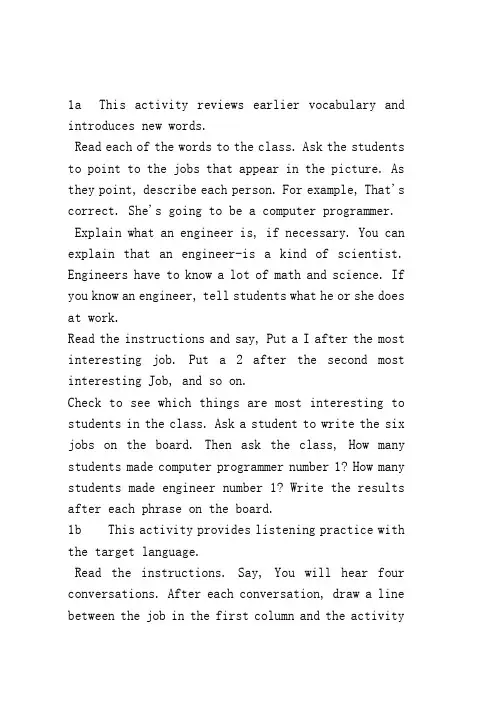
1a This activity reviews earlier vocabulary and introduces new words.Read each of the words to the class. Ask the students to point to the jobs that appear in the picture. As they point, describe each person. For example, That's correct. She's going to be a computer programmer. Explain what an engineer is, if necessary. You can explain that an engineer-is a kind of scientist. Engineers have to know a lot of math and science. If you know an engineer, tell students what he or she does at work.Read the instructions and say, Put a I after the most interesting job. Put a 2 after the second most interesting Job, and so on.Check to see which things are most interesting to students in the class. Ask a student to write the six jobs on the board. Then ask the class, How many students made computer programmer number 1? How many students made engineer number 1? Write the results after each phrase on the board.1b This activity provides listening practice with the target language.Read the instructions. Say, You will hear four conversations. After each conversation, draw a line between the job in the first column and the activityin the second column.Point out the sample answer and read it to the class. Play the recording the first time. Students only listen.Play the recording again. Ask students to draw lines connecting the jobs and the activities.Check the answers.1 c This activity provides guided oral practice using the target language.Read the instructions. Tell students they will be working with a partner.Point out the example in the box. Ask two students to Read it to the class.Say, Now work with a partner. Start by reading the conversation in the box with your partner. Then look at the other jobs in activity la and have conversations about these jobs.As students talk, move around the room checking their work. Offer language support as needed.Ask several pairs of students to say their conversations to the class.2a This activity provides listening practiceusing the target language.Read the instructions and point to the picture. Ask students to say what they see. They may say things such as, He's in high school He's a teacher. He's an actor. Point to the white box on each picture . Say, Listen to the recording and check the things Cheng Han is going to do.Play the recording. Students only listen the first time.Play the recording again. Ask students to check the pictures of the things Cheng Han is going to do.Check the answers.2b This activity provides listening and writing practice using the target language.Read the instructions and point out the sample answer. Ask a student to read the sample question and sample answer to the class.Play the recording again. Ask students to write their answers in the chart. You may wish to pause the tape after key lines to allow students to finish writing their answers.Correct the answers.2c This activity provides guided oral practice using the target language.Read the instructions.Point out the sample conversation. Ask two students to read it to the class.Point to the questions and answers in activity 2b. Say, You can make different questions and answers using the information in activity 2b.Say, Now work with a partner. Make a conversation about Cheng I fan.As the pairs talk, move around the room checking their work. Offer language support as needed.After several minutes, ask several pairs to say their conversations to the class.Grammar FocusReview the grammar box. Ask students to say the questions and answers.Make a grid on the board and write these pairs of sentencesin it.Ask a student to read each pair of sentences to the class. Ask another student student to point out thedifferences. (The first sentence in each pair use the words taking and moving. The other sentence uses the words going to take and going to move)Explain that these are two different ways of saying the same thing.3a This activity provides reading practice using the target language.Call attention to the diary entry. Read the paragraph to the class or have a student do it.Then read the instructions to the class. Say, Please underline all the things that Tian Tian is going to do.Ask students to finish the activity on their own. Correct the answers.3b This activity provides listening, speaking, and practice using the target language.Read the instructions. Then say, This activity has two Parts. First you write answers about yourself. Then you tell your partner about your plans.Point to the questions. Say, Answer these questions. tell the truth about your life. What do you plan to do? As students write, move around the room offeringhelp if it is needed.Point out the sample conversation. Ask two students to read it to the class. Then say, Now talk to a partner Have a conversation about your future plans. Use the Question words and the answers you wrote.After students practise, ask some pairs to say their conversations to the class.4 This activity provides speaking and writing practice using the target language.Write the year 2008 on the board. Ask the class why that is an important date for Beijing and China (China is hosting the Olympic Games in 2008).Write going to on the board. Ask the class, What are you going to do to help make the Olympics a success? Elicit a few answers. If the answers do not contain going to, point to going to on the board and encourage the students to include it in their answers.Divide the class into small groups. Ask them to talk about what they are going to do for the Olympics and make a list.Walk around the class offering language support where necessary.Optional activityInstead of pretending to do the job they chose, you can have students draw a picture of someone doing thejob on the board. The rest of the class tries to guess what the job is by looking at the drawing ,this is a good activity to use when students are tired and you need to do something relaxing and different.1 a This activity introduces some new key vocabulary.Ask students to tell when New Year's Day is. Ask what they do on New Year's Eve (the night before New Year's Day). Ask the students if they promise themselves to change something about their lives in the new year. Do they decide to exercise more, study more or clean their rooms every week? Explain that promises you make to yourself at New Year are called New Year's resolutions.Point to the resolutions and ask different students to explain in their own words what each one means. They can give an example or say a sentence or two showing what the phrase means. To explain learn to play an instrument, a student might say, I'm going to learn to play the piano. I'm going to take piano lessons. To illustrate get a part-time job, a student might say, I'm going to get a part-time job after school. ThenI will have money to buy a new bicycle. If students can't explain a phrase, give sentences of your own. Then read the instructions. Point out the box next to each picture where students can write in the number of the phrase that matches that picture. Point out the sample answer.Ask students to match the phrases and pictures on their own.Check the answers.1b This activity provides guided oral practice using the target language.Read the instructions. Ask some students to say some things they are going to do next year. Write two of these suggestions on the board.Point out the sample conversation. Ask two students to read it to the class. Then point to the two suggestions on the board. Ask two other students to make a conversation using the phrases on the board. Ask students to find partners and have a conversation. As they work, move around the room offering help if needed.Ask several pairs of students to say their conversationsto the class.2a This activity provides listening practiceusing the target language.Read the instructions and point out the phrases in the list in activity la. Say, You will hear Lucy, Kim, and Manuel talking about their New Year's resolutions. On the list in activity la, circle the resolutions you hear the people talk about.Play the recording the first time. Students only listen.Play the recording again. This time students circle the phrases on the list in activity la that they hear on the recording.Check the answers.2b This activity provides listening and writing practice using the target language.Read the instructions. Say, Listen to the conversation again. Write down one way each person is going to make their resolution work.Play the recording again. Ask students to write their answers on the blank lines after each person's name. Check the answers. Ask three students to write one answer each on the board.2c This activity provides listening, speaking, reading, and writing practice using the target language.Ask students to work with a partner. Help studentsfind partners.Read the instructions to the class. Say, This activity has two parts. First you each write down your resolutions.Then you read the resolutions to your partner and talk about these resolutions.Point out the sample conversation. Ask two students to read it to the class.Then ask students to work with their partners. As they work, move around the room checking progress.3a This activity provides reading practice using the target language.Call attention to the magazine article. Read it to the class or have a student do it.Then read the instructions to the class. Say, Please make a list of the New Year's resolutions in this article.Ask students to finish the activity on their own. Check the answers.3b This activity provides reading and writing practice use the target language.Read the instructions. Have students turn back topage 62 and call on some individuals to say each person's name and what that person's resolution was. Then ask some other students to tell how each person was going to make his or her resolution work. Point to the magazine article in activity 3a. Say Now write an article like this one. Tell about Lucy's, Kim's, and Manuel's resolutions. Tell how they are going to make their resolutions work.3c This activity provides writing practice using the target language.Ask some students to tell the class about their New Year's resolutions. Write some of the resolutions on the board, leaving a space underneath each.Then point to one of the resolutions on the board. Ask different students to say one way the person could make this resolution work. Write one suggestion on the board under each resolution.Ask students to "write about their resolutions on their own. Move around the room offering help as needed.4 This activity provides speaking and writing practice using the target language.Ask a student to read the instruction and the example answer for the class. Ask the class, What else are you going to do to make the city cleaner? Make surestudents are using going to correctly in their answers.Divide students into small groups to do the activity. Walk around the class offering language support where necessary.Write some of the group plans on the board. You might want to extend the activity by choosing six common answers and then having the class debate their importance from I (most important) to 6 (least important).1 This activity focuses on vocabulary introduced in the unit.Ask students to fill in the blanks on their own. In some cases, students may need to use another form of the word, for example adjusting for tense or subject/ verb agreement. Tell them that they can find all the words in the preceding unit.Check the answers.Ask students to make their own sentences with the words, preferably sentences that are meaningful. Write a number of students' answers for each word on the board. Underline any mistakes (it is not necessary to say which student made the mistake) and ask studentto suggest how to correct the mistake.2 This activity provides speaking and writing practice using the target language.Read the instruction and the sample answer to the class. Elicit a few more examples.Divide the class into small groups to do the activity. Walk around the class offering language support where necessary.Ask the groups to tell you their lists. Write any common problems on the board. Elicit where the problems are and how to correct them.Just for Fun!This activity provides reading practice with the target language.Ask students why they think the mouse wants to be a pilot.1 This activity focuses on vocabulary introduced in the unit.Ask students to fill in the blanks on their own. In some cases, students may need to use another form of the word, for example adjusting for tense or subject/ verb agreement. Tell them that they can find all thewords in the preceding unit.Check the answers.Ask students to make their own sentences with the words, preferably sentences that are meaningful.Write a number of students' answers for each word on the board. Underline any mistakes (it is not necessary to say which student made the mistake) and ask student to suggest how to correct the mistake.2 This activity provides speaking and writing practice using the target language.Read the instruction and the sample answer to the class. Elicit a few more examples.Divide the class into small groups to do the activity. Walk around the class offering language support where necessary.Ask the groups to tell you their lists. Write any common problems on the board. Elicit where the problems are and how to correct them.Just for Fun!This activity provides reading practice with the target language.Ask students why they think the mouse wants to be a pilot.。
八年级英语上册Unit10IfyougotothepartyyoullhaveagreattimeSectionA2a2d教案新版人教新目标版
4.
过程与
方法
采取听前读题,带着问题听,听后模仿范例用目标句型输出的方式感知巩固目标句型。在真实的情景中模仿对话2d,感知巩固目标句型.后检测,总结本节课看目标达成的情况
情感态度与价值观
学生积极的参与英语学习活动,体验成功,提高学习兴趣
四、教学
重点
难点
7.Conclusion.
8.Homework.
I.活跃气氛,迅速进入学习状态。
运用听前读题,预测,带着问题听的技巧完成听力任务
在说中感知巩固if…will 目标句型
在真实的情景中体会运用目标句型。
6.Exercise .
1.Ifyou _shout at the library ,you ______ (have) to leave.
2.ifgo to college, I______ (be) a college student.
3. ifyou bring food to the classroom,teachers__(take) it away.
2. 2a.Listen and circle the correct answer to complete the sentences below.
Ask them to read it first then listen, becauseit’seasy , we only need to listen once.
5.2c. pairwork.
A:when is a good time to have the party?
B:Let’s have it today.
A:if we have it today, half the class won’t come
新目标人教版八年级英语上Unit_10_学案
Unit 10 I’m going to be a basketball player.姓名:第1课时Section A 1a-2c【学习目标】1、词汇: 记忆本课7个单词及2个短语2、句型: 熟练运用句型-What are you going to be……?-I'm going to be ……谈论将来意向,运用句型-How are you going……?--I'm going to …….谈论实现方式。
.3、技能目标: 熟练谈论将来意向及实现方式。
4、情感目标: 通过对人生的讨论,树立自己的人生理想。
【学习重点】学习运用(一般将来时)描绘自己的人生理想和表达奋斗的想法【学习难点】动词一般将来时及时间状语从句的使用【学习过程】Task 1. 自主学习通过自学能写出下列有关职业名词:程序师___________ 工程师____________ 飞行员_____________教师_____ _ 演员___________ 篮球运动员_____________电脑程序员______________短语:学习计算机科学_______________ 每天练习篮球______________努力学习数学_________________ 学习表演课程______________完成高中学业______________________Task 2. 探究学习学习谈论将来意向及实现方式1、记忆并练习下列对话:-What are you going to be when you are grow up?-I'm going to be a basketball player.-How are you going to do that?-I'm going to practice basketball every day..“be going to+动词原形"表示计划、打算要做或即将发生的事,be有人称和数的变化。
人教版新目标八年级英语上册Unit 10集体备课教案设计
Unit 10集体备课教案首备人八年级组复备人课型听说课课时第一课时授课人授课时间授课班级备课组课题Unit 10 If you go to the party, you’ll have a great time!第一课时Section A(1a~2d) 二次备课学习目标1. 语言知识目标:1) 能掌握以下单词:meeting, video, organize, potato chips, chocolate, upset, taxi, advice能掌握以下句型:①─I think I’ll go to the party with Karen and Anna.─If you go to the party, you’ll have a great time!②─What will happen if they have the party today?─Half the class won’t come.2) 能了解以下语法:掌握含if条件状语从句的主从复合句的用法。
3) 能用if 引导的条件状语从句作出假设,用will谈论结果。
2. 情感态度价值观目标:学习因果关系的表达和做出合理的建议。
谈论自己的感受,同时使学生在英语交流中注意并观察他人的情感。
由于本单元话题贴近学生生活,符合他们热爱休闲的心理,可以提高他们学习英语的兴趣,积极参与英语实践活动。
重点难点. 教学重点、难点:(1)重点句型:—I think I’m going to go to the party with Karen and Ann.—If you do, you’ll have a great time.(2)正确使用if 引导的条件状语从句教法学法情景教学法任务型教学法教学过程Ⅰ. Warming upAsk some questions.T: If you are happy, what will you do?S: If I am happy, I will smile.T: If you become sad, what will you do?S: If I become sad, I will cry.T: What will happen if you are going to do too much work?S: If I am going to do too much work, I will get tired. Ⅱ. Presentation1.Think the following situation and answer the questions.(1) I’d love to go to my brother’s 18th birthday教 学 过 程教party. What will happen if I give him a new suit? (2) I look forward to attending my friend’swedding. What will happen if I sing a song —all good things come to an end?2. Work on 1a, match the statements with the pictures [a-d].1. ___ I think I’ll wear jeans to the party.2. ___ I think I’ll stay at home.3. ___ I think I’ll take the bus to the party.4. ___ I think I’ll go to the party with Karen and Anna. Ⅲ. Listening Work on 1b:1. Point out the statements and the responses in activity 1a. Tell Ss to listen to the recordings and complete the responses.If you do, the teachers won’t ________ If you do, you’ll _______________ If you do, you’ll _______________学过程If you do, you’ll _______________2. Play the recording for the first time, Ss only listen.3. Play the recording again the try to complete the responses.4. Check the answers.5. Listen to the tape pay attention to the important sentences.Ⅳ. Pair work1. Let Ss read the model with a partner.2. Look at the pictures above. Use the information in 1b. Ask and answer with a partner.3. Let some pairs ask and answer about the pictures. Ⅴ. New wordsLearn some new words: video, potato chips, chocolate, meeting, organizeⅥ. ListeningWork on 2a:1. The students are talking about having a party. Guess what they will discuss.2. Let Ss read the two sentences below. Make sure they know what to do.The students are talking about when to have (a class party/ a class meeting / a birthday party).They plan to have it on (Friday evening /Saturday afternoon/ Saturday evening).3. Play the recording for the Ss to listen and circle the right answers.4. Play the recording again to check the answers.Work on 2b:1. Let Ss read the phrases and questions below. Tell Ss that they should answer the questions with the proper phrases.1) What will happen if they have the party today?2) What will happen if they have the party tomorrow?3) What will happen if they watch a video at the party?4) What will Mark organize?5) What will Nelly do?2. Play the recording for the Ss to write the correct answers.3. Play the recording again to check the answers.4. Read the conversation after the tape. Pay attention to the pronunciation,intonation and sentence stress.Ⅶ. Pair work1. Tell Ss role-play a conversation between Nelly and Mark.2. Give a model to the Ss.3. Ss work in pairs and practice the conversation.4. Ask some pairs to act out their conversations. Ⅷ. Role-play1. Discuss the following question: If you are going to hold a party, how will you prepare for it?2. Listen to the conversation and answer the question.What are Jeff and Ben talking about, regarding the party preparations?3. Read the conversations and answer the questions below.(1) What will happen if we ask people to bring food?___________________________________(2) What will happen if we give people some small gifts if they win?____________________________________4. Practice the conversation with their partner. Then let some pairs to act out the conversation.5. Explain some new words and main points in the conversation.ⅨExercises根据汉语意思完成英语句子,每空一词。
人教新目标英语八年级上册Unit10全单元导学案 单元练习题(含答案)
人教新目标英语八年级上册Unit 10 If you go to the party, you’ll have a great time!第一课时(Section A 1a-1c)教师寄语:Where there is a will, there is a way. 有志者事竟成。
【Learning objectives】Knowing :a. 掌握if引导的条件状语从句b. 学习重点词语have a great time, stay at home,Habit----forming:a. 谈论因果关系b. 提高学生的语言交际能力和与他人交往的能力 .Practicing:a. 培养学生相互理解的能力b. 培养学生养成健康、乐观、向上的人生观【Important points】掌握if 引导的条件状语从句【Difficult points】if引导的条件状语从句,主句用一般将来时,从句用一般现在时【Learning process】一、自主学习Ⅰ.仔细观察下列例句,然后总结归纳关于if 引导的条件状语从句的用法。
1.If it rains next Sun day, we won’t go for a picnic.如果下周日下雨,我们就不去野餐了。
2.If you go to the party, you will meet Uncle Zhang.如果你去参加聚会,就会遇到张叔叔。
3.I’ll ask the teacher for help if I don’t understand.如果我有不懂的知识,就会向老师求助。
4.We’ll plant trees in the mountains if it is fine tomorrow.如果明天天气睛朗,我们就要去山上植树。
5.Put up your hand if you have any questions to ask.如果你有问题,请举手。