
【精品】外研版三起英语五年级上册:m1-m2知识归纳
一、疑问词(放在句首)
when什么时候where在哪里who谁what什么how怎样,如何
二、(用什么提问,用什么回答)(疑问句直接回答)
Did you wal to school?(你步行去学校么?)Yes, I did. No, I didn’t
Did they go home by bie?(他们骑自行车去学校么?)Yes, they did. No, they didn’t.
外研五英上M1--M2知识归纳
重点单词及短语
be bac from从…回come bac回live in住在loo at看come with与…一起hurry up赶快wait for等待by bus乘坐公交车shopping list购物单how many多少(可数名词复数)half a ilo半公斤how much多少(不可数名词)one ilo of noodles一公斤面条mae a list做一个清单go to the supermaret去超市the first thing第一项Here you are.给你all right好吧
run-ran see-saw send-sent eat-ate have-had do-did
五、
how many +可数名词+do you want?你想要多少…呢?对可数名词的数量提问。例:How many bananas do you want?
how much +不可数名词+ do you want?对不可数名词的数量进行提问。例:How many mil do you want?
(常见的不可数名词:mil, juice, water, meat, rice, bread, cae, cheese)
When did you come bac with Sam?(你和Sam什么时候回?)
I came bac with Sam yesterday.(昨天我和Sam回的。)
三、with加某人放在后面。如:I went to school with Sam.(我同Sam去学校)
四、过去式:
come-came go-went t-met buy-bought drop-dropped
外研版五年级英语上册Module 1--Module 2知识归纳

五、
how many +可数名词+do you want?你想要多少…呢?对可数名词的数量提问。例:How many bananas do you want?
how much +不可数名词+ do you want?对不可数名词的数量进行提问。例:How many milk do you want?
(常见的不可数名词:milk, juice, water, meat, rice, bread, cake, cheese)
When did you come back with Sam?(你和Sam什么时候回来?)
I came back with Sam yesterday.(昨天我和Sam回来的。)
三、with加某人放在后面。如:I went to school with Sam.(我同Sam去学校)
四、过去式:
come-came go-went meet-met buy-bought drop-dropped
重点句型
一、疑问词(放在句首)
when什么时候where在哪里who谁什么how怎样,如何
二、(用什么提问,用什么回答)(疑问句直接回答)
Did you walk to school?(你步行去学校么?)Yes, I did. No, I didn’t
Did they go home by bike?(他们骑自行车去学校么?)Yes, they did. No, they didn’t.
外研五英上M1--M2知识归纳
重点单词及短语
be back from从…回来come back回来live in住在look at看come with与…一起来hurry up赶快wait for等待by bus乘坐公交车shopping list购物单how many多少(可数名词复数)half a kilo半公斤how much多少(不可数名词)one kilo of noodles一公斤面条make a list做一个清单go to the supermarket去超市the first thing第一项Here you are.给你all right好吧
外研版(三起)英语五年级上册全册知识点汇总复习
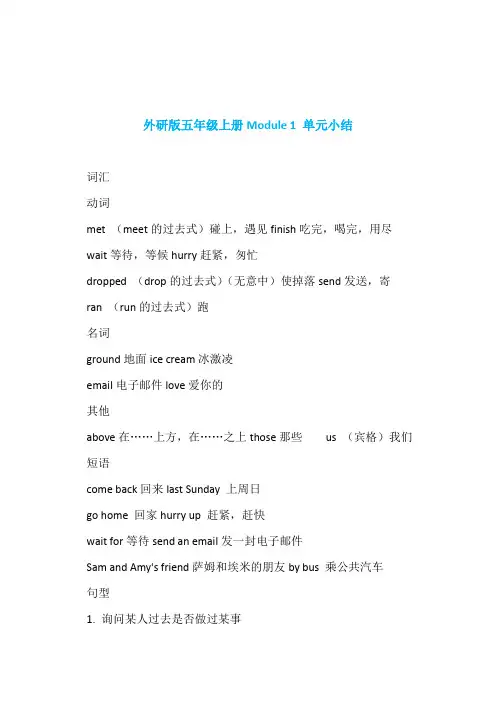
外研版五年级上册Module 1 单元小结词汇动词met (meet的过去式)碰上,遇见finish吃完,喝完,用尽wait等待,等候hurry赶紧,匆忙dropped (drop的过去式)(无意中)使掉落send发送,寄ran (run的过去式)跑名词ground地面ice cream冰激凌email电子邮件love爱你的其他above在……上方,在……之上those那些us (宾格)我们短语come back回来last Sunday 上周日go home 回家hurry up 赶紧,赶快wait for等待send an email发一封电子邮件Sam and Amy's friend萨姆和埃米的朋友by bus 乘公共汽车句型1. 询问某人过去是否做过某事—Did+主语+动词(短语)原形+表示过去的时间?—Yes, 主语+did./No, 主语+didn't.·—Did you come back yesterday? 你们昨天回来的吗?—No, we didn't. 不,我们不是昨天回来的。
2. 描述某人过去的动作主语+动词(短语)过去式+其他.·We came back last Sunday. 我们上周日回来的。
3. 描述某人过去的状态主语+was/were+描述状态的词+其他.·I was very sorry. 我非常抱歉。
外研版五年级上册Module 2 单元小结词汇名词list清单cheese 奶酪bottle 瓶子;一瓶的容量kilo千克动词need需要can 可以lost (lose的过去式)丢失use使用其他er哦,嗯,呃first首先,第一;最先的,第一(次)的any一些,一点,若干half 一半短语make a shopping list 列一份购物清单half a kilo半千克a lot of许多的over there 在那边at the supermarket 在超市how much 多少句型1. 询问他人买了什么东西的句型及其答语—What did+主语+buy?—主语+bought+物品.·—What did you buy? 你们买了什么?—We bought some apples. 我们买了一些苹果。
新外研版五年级上册英语 Module 1和Module 2 知识点重难点知识小结

Module 1一、核心词汇1. 名词: ground 地面hurry赶紧,匆忙email 电子邮件ice cream 冰激凌love爱你的2. 动词: met (meet的过去式)碰上,遇见finish 吃完,喝完,用尽wait 等待,等候dropped (drop的过去式)(无意中)使掉落send 发送,寄ran (run的过去式)跑3. 代词: those 那些4. 宾语: us (宾格)我们5. 介词: above 在……上方,在……之上二、拓展词汇动词的过去式: came (come的过去式)回来went (go的过去式)去bought (buy的过去式)买did (do/does的过去式)做was (is/am的过去式)是were (are的过去式)是lived (live的过去式)居住waited (wait的过去式)等visited (visit的过去式)参观finished (finish的过去式)吃完三、核心句型1. — Did you come back yesterday? 你们昨天回来的吗?— No, we came back last Sunday. 不是,我们上周日回来的。
解读:此句是由did引导的一般过去时的一般疑问句,询问对方过去是否做过某事。
回答时要用“Yes”或“No”。
举一反三: — Did she meet John in the park? 她在公园里遇到约翰了吗?— Yes, she met John in the park. 是的,她在公园里遇到约翰了。
— Did she come back to China? 她回到中国了吗?— No, she came back to Canada. 不,她回加拿大了。
2. We bought ice creams. 我们买了冰激凌。
解读:此句用的是一般过去时态,表示过去某一时刻或某一段时间所发生了的事情或存在的状态。
【精品】外研版三起英语五年级上册:m1-m2知识归纳

重点单词及短语
be bac from从…回come bac回live in住在loo at看come with与…一起hurry up赶快wait for等待by bus乘坐公交车shopping list购物单how many多少(可数名词复数)half a ilo半公斤how much多少(不可数名词)one ilo of noodles一公斤面条mae a list做一个清单go to the supermaret去超市the first thing第一项Here you are.给你all right好吧
重点句型
一、疑问词(放在句首)
when什么时候where在哪里who谁what什么how怎样,如何
二、(用什么提问,用什么回答)(疑问句直接回答)
Did you wal to school?(你步行去学校么?)Yes, I did. No, I didn’t
Did they go home by bie?(他们骑自行车去学校么?)Yes, they did. No, they didn’t.
run-ran d do-did
五、
how many +可数名词+do you want?你想要多少…呢?对可数名词的数量提问。例:How many bananas do you want?
how much +不可数名词+ do you want?对不可数名词的数量进行提问。例:How many mil do you want?
(常见的不可数名词:mil, juice, water, meat, rice, bread, cae, cheese)
When did you come bac with Sam?(你和Sam什么时候回?)
外研社(三起)五年级英语上册1-4模块知识点
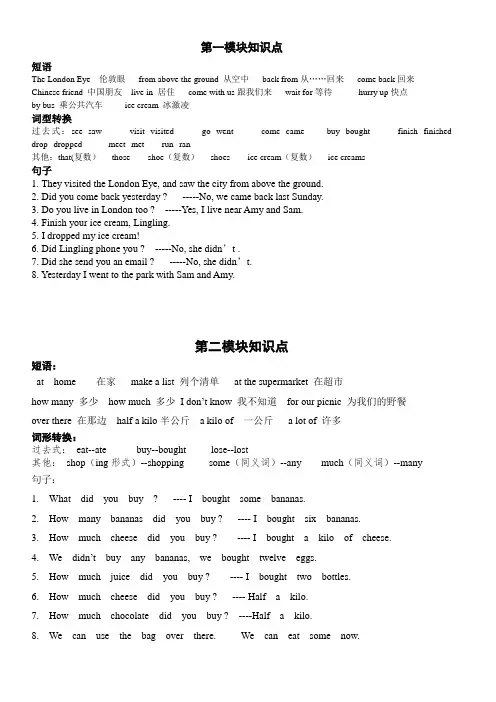
第一模块知识点短语The London Eye 伦敦眼from above the ground 从空中back from从……回来come back回来Chinese friend 中国朋友live in 居住come with us跟我们来wait for等待hurry up快点by bus 乘公共汽车ice cream 冰激凌词型转换过去式:see--saw visit--visited go--went come--came buy--bought finish--finished drop--dropped meet--met run--ran其他:that(复数)----those shoe(复数)----shoes ice cream(复数)----ice creams句子1. They visited the London Eye, and saw the city from above the ground.2. Did you come back yesterday ? -----No, we came back last Sunday.3. Do you live in London too ? -----Yes, I live near Amy and Sam.4. Finish your ice cream, Lingling.5. I dropped my ice cream!6. Did Lingling phone you ? -----No, she didn’t .7. Did she send you an email ? -----No, she didn’t.8. Yesterday I went to the park with Sam and Amy.第二模块知识点短语:at home 在家make a list 列个清单at the supermarket 在超市how many 多少how much 多少I don’t know 我不知道for our picnic 为我们的野餐over there 在那边half a kilo半公斤 a kilo of 一公斤 a lot of 许多词形转换:过去式:eat--ate buy--bought lose--lost其他:shop(ing形式)--shopping some(同义词)--any much(同义词)--many句子:1. What did you buy ? ---- I bought some bananas.2. How many bananas did you buy ? ---- I bought six bananas.3. How much cheese did you buy ? ---- I bought a kilo of cheese.4. We didn’t buy any bananas, we bought twelve eggs.5. How much juice did you buy ? ---- I bought two bottles.6. How much cheese did you buy ? ---- Half a kilo.7. How much chocolate did you buy ? ----Half a kilo.8. We can use the bag over there. We can eat some now.第三模块知识点短语tell me 告诉我the British Museum大英博物馆Big Ben大本钟the London Eye伦敦眼the bus ride坐公共汽车take a boat trip划船旅行along the river沿着河one hour and twenty minutes一小时二十分钟have a good day过得愉快the Great Wall 长城at the weekend 在周末by bus 乘公共汽车at ten o’clock在十点钟in the morning 在早晨for one hour 达一小时lots of people 许多人take a photo照相take photos照相词型转换过去式: take--took have--had arrive--arrived walk--walked like--liked复数: place--places this--these minute--minutes photo--photos mountain--mountains flower--flowers plant--plants people--people其他:good(最高级)--best our(同音词)--hour句子1.Where did you go ? -----I went to the Great Wall.2.How did you go ? ----I went by bus.3.What did you do ? ----I took some photos.4.We went to the British Museum, and we visited Big Ben and the London Eye.5.We took a boat trip along the river. It took us one hour and twenty minutes.6.You had a good day.7.Daming and his father went to the Great Wall at the weekend.8.They arrived there at ten o’clock in the morning.9.There were lots of people.10.Daming took a photo of his father.第四模块知识点短语A pair of 一双Don’t argue 别吵 a new T-shirt一件新T恤on the line 在绳子上That’s OK 没关系so cute这么可爱sports shoes 运动鞋on the school bus在校车上词型转换过去式:buy--bought take--took wash--washed find--found lose--lost复数:short--shorts cloth--clothes trouser--trousers shoe--shoes that--those this--these其他:I(物主代词)--my you(物主代词)--your I(宾格)--me they(宾格)--them句子1.What’s the matter ? ----Sam took my T-shirt.2.Mum bought a new T-shirt for me .3.Your red T-shirts are on the line .4.Did you wash Lingling’s T-shirt ? ----No, I didn’t.5.Let’s go and fly it .6.What’s the matter with Daming ? ----He lost his bag .7.I found this bag on the school bus .8.These new sports shoes were in it.。
外研版(三起)英语五年级上册全册知识点汇总复习
外研版五年级上册Module 1 单元小结词汇动词met (meet的过去式)碰上,遇见finish吃完,喝完,用尽wait等待,等候hurry赶紧,匆忙dropped (drop的过去式)(无意中)使掉落send发送,寄ran (run的过去式)跑名词ground地面ice cream冰激凌email电子邮件love爱你的其他above在……上方,在……之上those那些us (宾格)我们短语come back回来last Sunday 上周日go home 回家hurry up 赶紧,赶快wait for等待send an email发一封电子邮件Sam and Amy's friend萨姆和埃米的朋友by bus 乘公共汽车句型1. 询问某人过去是否做过某事—Did+主语+动词(短语)原形+表示过去的时间?—Yes, 主语+did./No, 主语+didn't.·—Did you come back yesterday? 你们昨天回来的吗?—No, we didn't. 不,我们不是昨天回来的。
2. 描述某人过去的动作主语+动词(短语)过去式+其他.·We came back last Sunday. 我们上周日回来的。
3. 描述某人过去的状态主语+was/were+描述状态的词+其他.·I was very sorry. 我非常抱歉。
外研版五年级上册Module 2 单元小结词汇名词list清单cheese 奶酪bottle 瓶子;一瓶的容量kilo千克动词need需要can 可以lost (lose的过去式)丢失use使用其他er哦,嗯,呃first首先,第一;最先的,第一(次)的any一些,一点,若干half 一半短语make a shopping list 列一份购物清单half a kilo半千克a lot of许多的over there 在那边at the supermarket 在超市how much 多少句型1. 询问他人买了什么东西的句型及其答语—What did+主语+buy?—主语+bought+物品.·—What did you buy? 你们买了什么?—We bought some apples. 我们买了一些苹果。
外研版(三起)五年级英语上册全册知识点汇总复习
Module 1一、核心词汇1. 名词: ground 地面hurry赶紧,匆忙email 电子邮件ice cream 冰激凌love爱你的2. 动词: met (meet的过去式)碰上,遇见finish 吃完,喝完,用尽wait 等待,等候dropped (drop的过去式)(无意中)使掉落send 发送,寄ran (run的过去式)跑3. 代词: those 那些4. 宾语: us (宾格)我们5. 介词: above 在……上方,在……之上二、拓展词汇动词的过去式: came (come的过去式)回来went (go的过去式)去bought (buy的过去式)买did (do/does的过去式)做was (is/am的过去式)是were (are的过去式)是lived (live的过去式)居住waited (wait的过去式)等visited (visit的过去式)参观finished (finish的过去式)吃完三、核心句型1. —Did you come back yesterday? 你们昨天回来的吗?—No, we came back last Sunday. 不是,我们上周日回来的。
解读:此句是由did引导的一般过去时的一般疑问句,询问对方过去是否做过某事。
回答时要用“Yes”或“No”。
举一反三:—Did she meet John in the park? 她在公园里遇到约翰了吗?—Yes, she met John in the park. 是的,她在公园里遇到约翰了。
—Did she come back to China? 她回到中国了吗?—No, she came back to Canada. 不,她回加拿大了。
2. We bought ice creams. 我们买了冰激凌。
解读:此句用的是一般过去时态,表示过去某一时刻或某一段时间所发生了的事情或存在的状态。
常与过去时间yesterday (昨天), this morning (今天早上), just now (刚才), a moment ago (刚才), in May (在五月), last night (昨天晚上)/year(去年)/week(上周), once upon a time (从前), the other day (前几天), in the past (在过去)等连用。
外研版三起五年级英语上册1-4模块重点内容汇总
五年级上册第一模块重点内容汇总一、短语1、come back 回来2、in London在伦敦3、be back from……从…回来4、be home回家5、last Sunday 上星期日6、our Chinese friend 我们的中国朋友7、live in 住在….地方8、live near….住在…附近9、look at those ice creams 看那些冰激凌10、go home 回家11、come with sb.和某人一起来(走)12、hurry up 快点13、wait for sb.等某人14、come from …来自….. 15、go to the park with sb.和某人去公园16、meet sb. in the park在公园遇见某人17、Sam and Amy's friend 萨姆和艾米的朋友18、by bus 乘公共汽车19、run to the bus跑向公共汽车20、walk to the bus 走到公共汽车那儿21、drop one's sth.掉了某人的东西22、an ice cream一个冰激凌23、lots of 许多24、not… at all一点也不(一点也没有)25、have a lovely time 过得很愉快(玩得很高兴)26、walk to school步行去学校27、吃米饭have rice 28、go home 回家29、from above the ground 从地面上方二、按要求填空。
1.Amy的名词所有格2.bought的动词原形e的对应词4. love的形容词形式三、写出下列动词的过去式。
come meetdrop seehave buyrun goeat do第二模块重点短语汇总一、短语1、how many+可数名词的复数多少2、go to the supermarket去超市3、need food for our picnic我们的野餐需要食物4、at the supermarket在超市5、read sth. to sb.给某人读......6、shopping list 购物单7、the first thing第一件事(东西)8、What's next?下一个/接下来是什么?9、how much+不可数名词多少10、half a kilo 半公斤11、one/a kilo of noodles 一斤面条12、five yuan 五元13、one kilo of...一公斤的...14、Here're your oranges. 这是给你的橘子。
外研版小学英语(三起)五年级上册Module1Unit2基础知识解析(A)
外研版小学英语(三起)五年级上册Module1Unit2
基础知识解析
Module1Unit2基础知识解析
Module1Unit2 We bought ice creams.我们买了冰激凌。
1.Look,listen and say.看一看,听一听,说一说。
——Did Lingling phone you?玲玲给你打电话了吗? ——No,she didn ’t.不,她没有。
——Did she send you an email?
——No,she didn ’t.不,她没有。
——Here ’s a postcard from Lingling.It ’s for you.
这里有一张来自玲玲的明信片。
它是给你的。
2.Listen and read.听一听,读一读。
Dear Daming,
亲爱的大明: Yesterday I went to the park with Sam 昨天我和萨姆、埃米去公园了。
and Amy.We met John in the park.He ’s 我们在公园里遇见了约翰。
他 Sam and Amy ’s friend.We bought ice 是萨姆和埃米的朋友。
我们买了 creams.Then we went home by bus. 冰激凌。
然后我们乘公共汽车回 “Here 来自……”,表示由某人发出或给出,其后可以跟表示人的名词或代词,如果是代词须用其宾格形式。
例如: 那位男士是我的英语老师。
我有一本他给我的书。
外研版(三年级起点)五年级上册全册重点知识及默写本
一.单词1.met (meet的过去式)碰上,遇见2.above在……上方,在……之上3.ground 地面4.those那些5.ice cream冰激凌(宾格)我们7.finish吃完,喝完,用尽8.wait等待,等候9.hurry赶紧,匆忙10.hurry up 赶紧,赶快11.dropped(drop的过去式)(无意中)使掉落12.send 发送,寄13.email 电子邮件14.ran (run的过去式)跑15.love 爱你的二.短语e back 回来st Sunday上周日3.live in 住在4.ice cream冰激凌5.go home 回家6.wait for等待7.hurry up赶紧,赶快8.watch TV看电视9.send an email发送电子邮件10.go to the park去公园11.run to the bus朝公共汽车跑去walk to school步行去学校12.by bus乘公共汽车by plane乘飞机by train乘火车13.have rice吃饭14.be back from从…回来(be指的是am,is,are)三.句子1.---Did you come back yesterday? 你们是昨天回来的吗?---No.we came back last Sunday. 不是,我们是上星期日回来的。
2.---Did she send you an email?她给你发电子邮件了吗?---No,she didn’t.不,她没有。
3.Yesterday I went to the park with Sam and Amy.昨天我跟萨姆和埃米一起去了公园。
4. We met John in the park.我们在公园里遇到了约翰。
5.We’re going home now,John.约翰,我们现在要回家了。
6.Here’s a postcard from Lingling.这是一张来自玲玲的明信片。