
一般现在时-一般过去时-一般将来时-现在完成时综合练习
一般过去时,一般将来时,一般现在时,现在进行时,现在完成时综合练习
一.按要求填空.
1. He has been to the amusement park for three times.
否定句:
一般疑问句:
肯定、否定回答:
2. She is going to cook meals tonight.
否定句:
一般疑问句:
3. Cao Yiqin went to the mountains last summer.
否定句: _
一般疑问句:
肯定、否定回答:
划线部分提问:
4. Cao Yiqin will go to Shanghai next year.
否定句:
一般疑问句:
肯定、否定回答:
5.I often play football.
否定句:
一般疑问句:
肯定、否定回答:
6. Cao Yiqin often goes to bed at 10:30 at night.
否定句: 一般疑问句:
肯定、否定回答:
7.写出下列动词的现在分词、过去式和过去分词.
buy ______ ______ ______ cut______ ______ ______ drink______ ______ ______
eat_______ _______ _______ fall_______ _______ _______
feel _______ _______ _______
fight______ ______ ______ find______ ______ ______ get ______ ______ ______
give______ ______ ______ go______ ______ ______hear______ ______ ______
learn______ ______ ______ lose______ ______ ______meet______ ______ ______
pay______ ______ ______read______ ______ ______
run _________ _________ _________
say______ ______ ______send______ ______ ______ sit______ ______ ______
sleep______ ______ ______stand______ ______ ______swim______ ______ ______
teach______ ______ ______tell______ ______ ______think______ ______ ______
二.选择题.
1. -- How long has Eliza been a nurse? -- _______
A. Since 2002. B. Four years ago. C. In 2002.
2.--May I speak to Tom?--Sorry, he is not at home. He _________ to Shanghai.
A. has been B. has gone C. goes
3. —How was your weekend on the farm?
—Great! We with the farmers.
A. enjoy ourselves B. went fishing C. will work D. make friends
4. — you ever to the United States?
—Yes, twice.
A. Have: gone B. Have: been C. Do: go D. Were: going
5. They have been in this city _________ three years ago. A. for B. about C. since
6. ― have you been learning English?
―I have been learning English for six years.
A. How long B. How often C. How far
7.--Where is Zhang Ming?-- Oh, he _____ to Beijng and he will be back tomorrow. A. has been B. has gone C. goes
8. The Greens____supper now. A:is having B:are;having C:is haveing
9. ____you usually _____to school with classmates?
A. Do, comes B. does, come C. Do, come
10.Mr Green usually______newspapers after supper every day.
A. read B. reading C. reads
11.______Helen____________(wash )clothes? Yes ,she is .
A. Is, washing B. Does , wash C. Is, washes
12. There ________ a dolphin show in the zoo tomorrow evening.
A. was B. is going to have C. will have D. is going to be
13. He ________ her a beautiful hat on her next birthday.
A. gives B. gave C. will giving D. is going to giving
14. There __________ a meeting tomorrow afternoon.
A. will be going to B. will going to be C. is going to be D. will go to be
三.填空题.
1.我母亲通常在星期日打扫卫生、洗衣服。
My mother usually _______some cleaning and _______________ on Sundays.
2.在今晚的聚会上我们肯定会玩得痛快。
We're _______to have __________________ at the party this evening.
3. He _________ (study) English every day .
4. We often _______ (play) the violin in the park. 5. Mr. Li _________ (teach) us maths last term.
6. -- What are you______ (do), Helen?-- I’m ______(sit) on the football.
7. I ________(leave)in a minute. I ________(finish)all my work before I _____(leave).
8. —How long _____ you _____(study)in our country? –For two years.
9. I ______(be)tired now. I ______(go)to bed early tonight.
10. Mary’s birthday is next Monday, and her mother _____(give)her a present.
四、时态填空:
1.Are you sure you _______________(lose) the book?----Yes, I ___________(look) for it
everywhere, but I still can’t find it.
2.We ___________ already ___________(copy)
these words.
3. Jim _______________(just, watch) a football match. He is so tired and hungry.
4. ___________you ever _____________(travel) on a train?
5. ---______ they _______(see) the film yet?
---Yes.They_____________(see) it already.
----When______they______(see) it? ----They _______(see)it just now.
6.---- ________ her sister ____________(be) to Nanning?
----No,she_________( never,be) there before.
六、现在完成时与一般过去时练习
1. --- Where __you __ (put) the book? I can’t see it anywhere.
--- I ___(put) it right here. But now it’s gone.
A. did ; put; put B. have; put; put C. did; put; have put D. have; put; have put
2. We haven’t heard from Jane for a long time. What do you suppose _______ to her?
A. was happening B. happens C. has happened D. happened
3. Hello, I ____ you were in London. How long _________ here?
A. don’t know; were you B. hadn’t known; are you
unit5一般现在时表将来专练
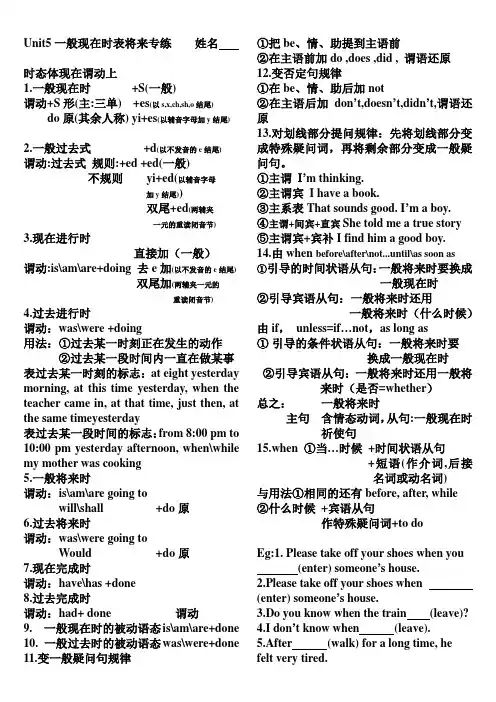
Unit5一般现在时表将来专练 姓名
时态体现在谓动上
1.一般现在时 +S(一般)
谓动+S形(主:三单) +es(以s,x,ch,sh,o结尾)
do原(其余人称) yi+es(以辅音字母加y结尾)
2.一般过去式 +d(以不发音的e结尾)
谓动:过去式 规则:+ed +ed(一般)
不规则 yi+ed(以辅音字母
加y结尾))
双尾+ed(两辅夹
一元的重读闭音节)
3.现在进行时
直接加(一般)
谓动:is\am\are+doing 去e加(以不发音的e结尾)
双尾加(两辅夹一元的
重读闭音节)
4.过去进行时
谓动:was\were +doing
用法:①过去某一时刻正在发生的动作
②过去某一段时间内一直在做某事
表过去某一时刻的标志:at eight yesterday
morning, at this time yesterday, when the
teacher came in, at that time, just then, at
the same timeyesterday
表过去某一段时间的标志:from 8:00 pm to
10:00 pm yesterday afternoon, when\while
my mother was cooking
5.一般将来时
谓动:is\am\are going to
will\shall +do原
6.过去将来时
谓动:was\were going to
Would +do原
7.现在完成时
谓动:have\has +done
8.过去完成时
谓动:had+ done 谓动
英语动词时态以及动词的适当形式讲解与训练

中考动词时态以及动词的适当形式讲解与训练
动词时态以及动词的适当形式讲解与训练
动词时态是中考必考考点,有一般现在时,一般过去时,一般将来时,过去将来时,现在完成时。
一、一般现在时。
构成:
a.主语+be的某种形式
b.主语+V原
c.主语(第三人称单数)+Vs/es
动词第三人称变化规则:
规则 动词原形 第三人称单数形式
一般在词尾加-s,(清辅音后读∕s∕,在浊辅音后读∕z∕;在t后读∕ts∕,在d后读∕dz∕。) play
leave
swim plays
leaves
swims
以字母s,x,ch,sh,o结尾的词加-es,读∕iz∕,如果动词原形词尾已有e,则只加-s。 pass
fix
teach passes
fixes
teaches
以辅音字母加y结尾的词,先变y为i, 再加-es,读∕z∕。 study
carry
fly studies
carries
flies
2.一般现在时的用法
①表示经常性或习惯性的动作或存在的状态。与often,always,usually,sometimes,once a
week,everyday等表示频率的副词或时间状语连用。
I often go to school by bike.
②表示客观事实或普遍真理。
The earth goes around the sun.
③在时间,条件状语从句中,用一般现在时表将来。
If it rains tomorrow, we won’t go to the park.
④在某些以here,there开头的句子里,用一般现在时表示正在发生的动作。
Here comes a bus.
3.一般现在时的时间标志词:
①表示频率的副词often, usually, always,sometimes,
②时间状语 every day/week, on Sunday, in the morning/afternoon/evening等。
一般现在时,一般过去时,一般将来时,现在完成时练习
一般现在时,一般过去时,现在进行时,一般将来时练习
一、 用动词的正确形式填空
1. I ________ (do) my homework every evening.
2. My mother _____________ (clean) our room on Sundays.
3. Tom ____________(play) the piano every Saturday. Now he____________ (play).
4. She ___________(like) swimming. She _____________ (swim) last weekend.
5. Usually my mother ________(wash) the dishes after lunch. But she _________(not wash) today.
6. Look at the man! He ____________ (read) a magazine.
7. Listen! My aunt ____________ (sing) in the room.She is a singer. She __________ (like) singing. She _____________(have) a music show. She is excited.
8. Tom and Mike always ______________ (swim) in the river. They ___________ (swim) in the
swimming pool three days ago. Look! They ________________ (swim).
9. What ____ you usually ______ (do) in the evening? I ______ (play) computer games.
牛津上海版8A语法时态综合讲解及练习(有答案)

1 / 10 语法:时态语态综合
初中阶段考查8种时态,分别是一般现在时、一般过去时、一般将来时、现在进行时、过去进行时、现在完成时、过去完成时和过去将来时。今天我们涉及6个时态,分别是一般现在时、一般过去时、一般将来时、现在进行时、过去进行时和现在完成时。
英语的语态分为主动语态和被动语态,主动语态表示主语是动作的执行者。被动语态表示主语是动作的承受者,目前中考主要考查一般现在时、一般过去时、一般将来时和现在完成时这四种时态的被动语态以及含情态动词的被动语态。只有及物动词才有被动语态。它的基本结构为:be动词+及物动词的过去分词。所有的时态变化在be动词 上。
动词时态:
时态 常用的提示语
一般现在时
(1)be(am/is/are)
(2)do(does) always, usually, sometimes, often, every, once a week, in the morning, in December,
in spring, on Mondays 等。
一般过去时
(1)be(was/were)
(2)did ago, just now, before 2010, yesterday, last Friday, once, the other day, those days,
come upon a time, long before 等。
一般将来时
will do tomorrow, the coming… , in the future, next Tuesday, in tow hours, some day, soon,
before long, this evening 等。
现在进行时
am/is/are doing now, at the moment, look, listen, be quite, these days, still 等。
过去进行时
英语时态专练
中考英语时态专项
英语中的八个基本时态,即:一般现在时、一般过去时、一般将来时、过去将来时、现在进行时、
过去进行时、现在完成时、过去完成时。
一、定义
时态是一种动词形式,表示经常、反复发生的动作或行为,不同的时态用以表示不同的时间与方式。
在语法里,时或时态表示行为发生的时间和说话时的关系。一般分为过去式、现在式、将来式,通常也
有与表示动作进行或终止的进行式和完成式等体貌一起相连用的情况。
二、用法规律:
谓语动词对应的形式
一般现在时:原型/单三
一般过去时:过去式
一般将来时:will/be going to+动原
现在进行时:am,is,are+现在分词
过去将来时:would/was、were going to+动原
过去进行时:was/were+现在分词
现在完成时:have/has+过去分词
过去完成时: had+过去分词
三、具体概念
一、 一般现在时
1.概念:经常、反复发生的动作或行为及现在的某种状况。
2.时间状语: always, usually, often, sometimes, every week (day, year, month„), once a week, on
Sundays,
3.基本结构:动词 原形 (如主语为第三人称单数,动词上要改为第三人称单数形式)
4.否定形式:am/is/are+not;此时态的谓语动词若为行为动词,则在其前加don't,如主语为第三人称
单数,则用doesn't,同时还原行为动词。
5.一般疑问句:把be动词放于句首;用助动词do提问,如主语为第三人称单数,则用does,同时,
还原行为动词。
6.例句:. It seldom snows here.
He is always ready to help others.
Action speaks louder than words..
二、 一般过去时
1.概念:过去某个时间里发生的动作或状态;过去习惯性、经常性的动作、行为。
中考英语时态综合练习题20题(带答案)
中考英语时态综合练习题20题(带答案)
1. My sister ______ English every morning.
A. reads
B. read
C. is reading
D. has read
答案解析:A。一般现在时表示经常或习惯性的动作。这里“every
morning”表明是每天早上做的事情,是经常性的动作,主语“my sister”是第三人称单数,所以动词要用第三人称单数形式reads。选项B是动词原形,不能用于第三人称单数作主语的一般现在时句子;选项C是现在进行时,表示正在进行的动作,不符合语境;选项D是现在完成时,表示过去发生的动作对现在造成的影响或结果,与题意不符。
2. I ______ a movie last night.
A. watch
B. watched
C. am watching
D. will watch
答案解析:B。一般过去时表示过去某个时间发生的动作。句中的“last night”是昨晚,是过去的时间,所以动词要用一般过去式watched。选项A是一般现在时的形式,不符合句子的时间要求;选项C是现在进行时,用于现在正在进行的动作,与“last night”不匹配;选项D是一般将来时,用于表示将来要发生的动作,也不符合题意。
3. Look! The boys ______ football on the playground.
A. play
B. played
C. are playing
D. were playing
答案解析:C。现在进行时表示此时此刻正在进行的动作。句中的“Look!”表示看的动作正在进行,提示后面的动作也是正在发生的,所以要用are playing。选项A是一般现在时,不能表示正在进行的动作;选项B是一般过去时,用于过去的动作;选项D是过去进行时,用于过去某个时刻正在进行的动作,这里没有涉及过去的时间,所以不符合。
初中六大时态时态综合复习
初中六大时态
目标一:时态区分
目标二:时态互换
目标三:综合训练
【目标一:时态区分】
➢ 中文时态考题
经过一个月的努力,我们的法语水平有 很大的提高。
A.过 B.了 C.着 D.的
➢ 汉译英
➢ 英文主要用谓语动词来表示时间上的变化。 他昨天走了。
他今天走了。
他明天走。 中文是怎么表示时间上的变化?
英文是怎么表示时间上的变化?
时间规定动作规定时态
➢ 英语时态,首先要正确掌握各种时态的形式构成,以work为例,在对应时态的方框里填入谓语结构。
一般 进行 完成
现在
过去
将来
➢ 然后着重掌握不同时态形式背后的意义表达。
意义 核心意义 例句 说明 类比 一般 进行 完成
现在 一般现在时 现在进行时 现在完成
过去 一般过去时 过去进行时
将来 一般将来时
一般时态 完整、不变 John lives in Foshan. 没有进一步发展和变化的可能。 静态的油画
进行时态 不完整、未完成 John is living in Foshan. 存在发生变化的可能。 动态的沙画
➢ 各时态用法
练一练:单项选择
1. Don’t turn on the TV. Grandma ________ now.
A. is sleeping B. will sleep C. slept D. sleeps
2. We were in Beijing last week and ________ great fun there.
A. will have B. have had C. had D. have
3. Hello! Can I speak to Alice? ------ Sorry. She isn’t here right now. She ________ to the shop.
动词时态标志词
动词时态标志词
动词时态标志词
1.一般现在时
(1) always, usually, often, sometimes
(2) every day, every morning, every Saturday, every time
(3) in the morning, on Saturdays
(4) once a week, three times, a day, twice a year
2.一般过去时
(1) yesterday, the day before yesterday, yesterday morning
(evening, afternoon)
(2) last time, last Friday, last term, last month
(3) 2 hours ago, a week ago, 3 years ago
(4) just now = a moment ago
(5)in 1989
(6)at the age of 5, one day, long long ago, once upon a
time (7)in the past
3.现在进行时
(1).now.Look.Listen.
(2).these days
(3).at that time.at that moment.this time yesterday
evening 4.过去进行时
(1).at that time.at that moment.this time yesterday
evening (2)以when引导的谓语动词是一般过去时的时间状语
5.一般将来时
(1) tomorrow, the day after tomorrow, tomorrow morning
(evening, afternoon)
(2) next time, next Friday, next term, next month
一般过去时一般将来时一般现在时过去进行时现在进行时现在完成时综合练习
一般过去时,一般将来时,一般现在时,过去进行时,现在进行时,现在完成时综合练习
一.按要求填空.
1. He has been to the amusement park for three times.
否定句:_____________________________________________________________________
一般疑问句:_________________________________________________________________
肯定、否定回答:_____________________________________________________________
划线部分提问:_______________________________________________________________
2. She was doing the dishes when Mr. Li came in.
否定句:_____________________________________________________________________
一般疑问句:_________________________________________________________________
肯定、否定回答:_____________________________________________________________
划线部分提问:_______________________________________________________________
3. Cao Yiqin went to the mountains last summer.
否定句:_____________________________________________________________________
六年级英语一般过去时与现在完成时对比练习题40题(答案解析)
六年级英语一般过去时与现在完成时对比练习题40题(答案解析)
1.I ______ my homework yesterday.
A.finished
B.have finished
C.will finish
D.am finishing
答案解析:A。“yesterday”是一般过去时的标志词,所以用“finished”。B 选项“have finished”是现在完成时;C 选项“will finish”是一般将来时;D 选项“am finishing”是现在进行时。
2.She ______ to the park this morning.
A.went
B.has gone
C.goes
D.will go
答案解析:A。“this morning”可以作为一般过去时的标志,所以用“went”。B 选项“has gone”是现在完成时,表示去了还没回来;C 选项“goes”是一般现在时;D 选项“will go”是一般将来时。
3.We ______ a great time at the party last weekend.
A.had
B.have had
C.will have
D.are having
答案解析:A。“last weekend”是一般过去时的标志词,所以用“had”。B 选项“have had”是现在完成时;C 选项“will have”是一般将来时;D
选项“are having”是现在进行时。
4.They ______ the movie already.
A.saw
B.have seen
C.will see
D.see
答案解析:B。“already”是现在完成时的标志词,所以用“have
seen”。A 选项“saw”是一般过去时;C 选项“will see”是一般将来时;D 选项“see”是一般现在时。
5.I ______ my room and it looks very clean now.