
一般现在时、一般过去时、一般将来时 (优选.)
2.表示现在的状态,能力,性格,个性。e.g. My father teaches maths.
Lin Yan dances well.
3.表示普遍真理或客观事实。e.g. The earth moves around the sun.
The sun rises in the east.
【注意】此用法如果出现在宾语从句中,即使主句是过去时,从句谓语也要用一般现在时。如:Our physics teacher said that light travels much faster than sound. 我们的物理老师说光的传播速度比声音的传播速度快得 多,在时间、条件、比较等状语从句中,用现在时表示将来的动作,从句的谓语动词用一般现在时。
C. doesn’t get
D. don’t get 3 / 19
精品 word.仅供参考
4. John ____ football.
A. likes playing B. likes play
C. like play
5. Frank usually ____ in touch with his primary school teachers by email.
11. go—went—gone
第六组 ABB
1. make—made—made
精品 word.仅供参考
B. 一般疑问句:Do ( Does ) +主语+动词原形+其它。 ---Do you often play football? --- Yes, I do. / No, I don't. --- Does she go to work by bike? --- Yes, she does. / No, she doesn't.
例 5. Our geography teacher told us that the earth ____ the sun.
A. went around
B. goes around
C. is going around
D. was going around
【课堂练习】
1. Look! A dog ____ a blind man across the road.
例 1. ——Who is that lady?
——She’s Miss Green. She ____ us music, and she is so good.
A. taught
B. teaches
C. will teach
例 2. ——I think I’ll take a bus to the meeting.
精品 word.仅供参考
wo 最新文件---------------- 仅供参考--------------------已改成-----------word 文本 --------------------- 方 便更改
rd
教学内容
知识点一:一般现在时 【知识梳理】
(1)一般现在时的基本结构和变化
1.一般现在时的结构 ①be 动词:主语+be(am, is, are)+其它。 e.g. I am a boy.我是一个男孩。 ②行为动词:主语+行为动词(+其它)。一般现在时主要用动词的原形表示,如果主语是第三人称单数,则在
B. improves
C. improved
例 4. We don’t know if our friend ____. If he ____, we’ll let you know.
D. will improve
A. comes; comes
B. comes; will come
C. will come; comes
C. 特殊疑问句:疑问词+一般疑问句。How does your father go to work? (注意回顾动词第三人称单数形式变化规则)
一般情况下在词尾加 s help→helps, clean→cleans, play→plays, wear→wears, give→gives; 以 s, x, ch, sh 结尾 的动词在词尾加 es dress→dresses, fix→fixes, watch→watches, finish→finishes;以“辅音字母加 y”结尾的动 词,把 y 变为 i,再 study→studies, carry→carries, fly→flies )
a. He was busy yesterday. (肯定句) 他昨天很忙。 4 / 19
精品 word.仅供参考
b. He was not busy yesterday. (否定句) 他昨天不忙。 c. Was he busy yesterday? (疑问句) 他昨天忙吗? d. There weren’t any boys in the room.房间里没有男孩儿。 e.g. There weren’t any boys in the room.房间里没有男孩儿。 Were there any boys in the room? 房间里有男孩儿吗? ②行为动词的否定式和疑问式: A. 否定式:行为动词前加上 did not 或缩略式 didn’t, 并把这个行为动词改为动词原形。
A. leads
B. lead
C. is leading
D. led
2. They usually ____ TV in the evening.
A. watch B. will watch C. are watching
D. watches
3. He hardly ____ up early.
A. gets B. get
动词原形后加"-s"或"-es" e.g. He gets up early in the morning.
2.否定句和疑问句的变化 ①be 动词的变化: A.否定句:主语+ be + not +其它。 He is not a worker.他不是工人。 B. 一般疑问句:Be +主语+其它。 ---Are you a student? ---Yes. I am. / No, I'm not. C. 特殊疑问句:疑问词+一般疑问句。 Where is my bike? ②行为动词的变化: A.否定句:主语+ don't( doesn't ) +动词原形(+其它)。 I don't like bread. / He doesn't like bread. 1 / 19
词,先变 y 为 i,再在词尾加 carry → carried
-ed。
过去式(be 动词) (不规则变化)
重读闭音节动词且词尾只有 stop → stopped 一个辅音字母,先双写词尾的 shop → shopped 辅音字母,再在词尾加-ed。
am / is → was are → were do → did
• (2)规则动词的变化
过去式(规则变化)
一般情况下,直接在动词词尾 watch → watched
加-ed。
plant → planted
以不发音字母 e 结尾的动词 like → liked
5 / 19
精品 word.仅供参考
在词尾加-d。
move → moved
以“辅音字母 + y”结尾的动 study → studied
如:I will e-mail you as soon as I get to Beijing.
我一到北京就给你发邮件。
If you come this afternoon, we will have a meeting. 如果你今天下午能来,我们就开会。
【例题精讲】
2 / 19
精品 word.仅供参考
4. steal—stole—stolen
5. wake—woke—woken
6. forget—forgot—forgotten
7.take—took—taken
8.give—gave—given
9.hide—hid—hidden
10. drive—drove—driven 11. write—wrote—written 12. rise—rose—risen
D. is teaching
——The bus? If you ____, you will be late.
A. do
B. have done
C. will do
例 3. Unless the weather ____, we will have to cancel the picnic.
A. improve
a. I called Lin Tao yesterday afternoon. →I did not / didn’t call Lin Tao yesterday afternoon.
b. I borrowed a book from Sun Yang last Sunday. B. 一般疑问式:若在陈述句中只有行为动词的过去式, 那就得在句首加上一个助动词 did 来帮助提问, 然后 把句中的行为动词由过去式改为动词原形, 并在句末打上问号。回答时别忘了还用 did。
a. We stayed there for 10 days last month. → Did you stay there for 10 days last month? Yes, we did. / No, we didn’t.
b. Mary had a delicious dinner yesterday evening. → Did Mary have a delicious dinner yesterday evening? Yes, she did. / No, we didn’t.
闽教版小学英语六年级三大时态(一般现在时、一般过去时、一般将来时..
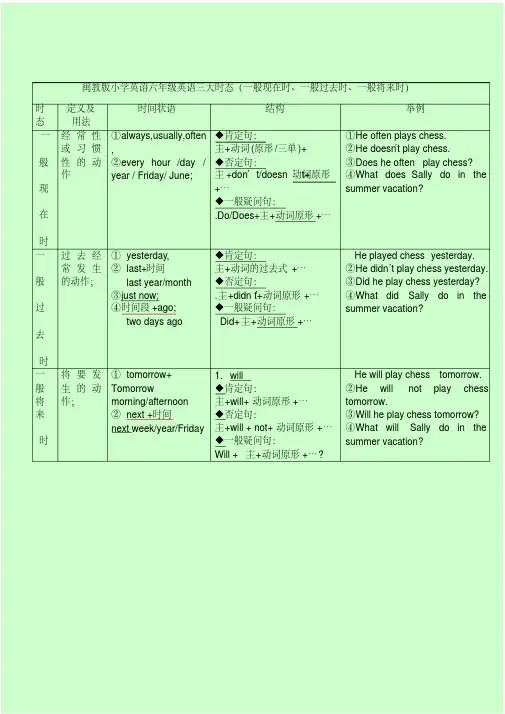
闽教版小学英语六年级英语三大时态(一般现在时、一般过去时、一般将来时)时态定义及用法时间状语结构举例一般现在时经常性或习惯性的动作①always,usually,often,②every hour /day /year / Friday/ June;◆肯定句:主+动词(原形/三单)+◆否定句:主+don’t/doesn’t+动词原形+…◆一般疑问句:.Do/Does+主+动词原形+…①He often plays chess.②He doesn’t play chess.③Does he often play chess?④What does Sally do in thesummer vacation?一般过去时过去经常发生的动作;①yesterday,②last+时间last year/month③just now;④时间段+ago;two days ago◆肯定句:主+动词的过去式+…◆否定句:.主+didn’t+动词原形+…◆一般疑问句:Did+主+动词原形+…He played chess yesterday.②He didn’t play chess yesterday.③Did he play chess yesterday?④What did Sally do in thesummer vacation?一般将来时将要发生的动作;①tomorrow+Tomorrowmorning/afternoon②next +时间next week/year/Friday1.will◆肯定句:主+will+动词原形+…◆否定句:主+will + not+动词原形+…◆一般疑问句:Will + 主+动词原形+…?He will play chess tomorrow.②He will not play chesstomorrow.③Will he play chess tomorrow?④What will Sally do in thesummer vacation?一、选择题( ) 1.Ben usually at 6:40. A.got up B.get up C.gets up ( ) 2.In the past my mother my bed. A.make B.made C.makes ( ) 3.Where you in the summer vacation?A.areB.isC.were( ) 4.Did you a good time in the USA?’tA.have; Yes,I didB.had; Yes,I didC.have; No,I don( ) 5.Do you often do housework at home?A.Yes,I does.B.No,I don’t.C.Yes,I am.( ) 6.Does he clean his room now?’t.A.Yes,she does.B.Yes,he does.C.No,he don( ) 7.li Hong usually at 6:30 in the morning.But this morning she at 7:00.A. get;gotB. gets;getC.gets;got( ) 8. How Mike go to school every day?A.doB.isC.doesD.are( ) 9. The students the football match now.A.watchB.to watchC.are watchingD.watching( ) 10. Did you your room yesterday?A.cleanB.cleansC. cleanedD.cleaning二、填空题1.Listen,there are many students (sing)in the classroom.2.. Look! Sarah is (dance).3. My mother often (wash)clothes on the weekends.4. He (buy) a present for his mother yesterday.5. John (visit)Qingdao next Sunday.6.He usually____(go) to school on foot.7.Does she_____(go) to school on foot?8.Did she ____(go) to school on foot?9.They_____(go) to school on foot yesterday.10.____ she going to school on foot?助动词do,does,did或者它们的否定形式的使用1) you like this magazine?2) The girl like bread for breakfast.3) ---What she at the weekends?---She usually plays games with her friends.4) ---What you do last Sunday? ---I wrote to my friend.5) -- He not visit a farm last National Day holiday.6) They not like playing volleyball.7) --- Jim have a picnic with his family every Saturday?---Yes, he8) Helen with Yang Ling go to school by bike every day? 9) [Do/Does]______ you go to school everyday? No, I don’t. 10) [Do/Does]______ Jack and Peter like apples?11)[Do/Does]______ he watch TV at night? Yes he does. 三.连词成句(请注意大小写)1. the summer you where were in vacation2.did do yesterday what youA good did have time the you in a4. Wang Tao his yesterday did make bed?5. does often housework home Sally at do6.will where you for the go holidays7. to bookstore yesterday he went the.。
一般现在时,现在进行时,一般过去时,一般将来时练习题(无答案)
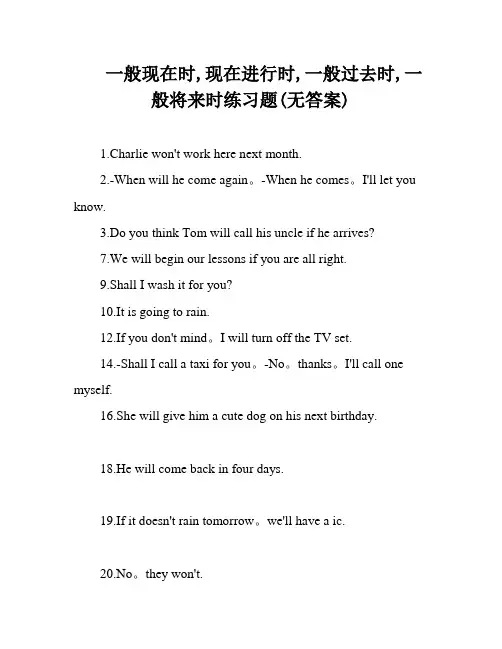
一般现在时,现在进行时,一般过去时,一般将来时练习题(无答案)1.Charlie won't work here next month.2.-When will he come again。
-When he comes。
I'll let you know.3.Do you think Tom will call his uncle if he arrives?7.We will begin our lessons if you are all right.9.Shall I wash it for you?10.It is going to rain.12.If you don't mind。
I will turn off the TV set.14.-Shall I call a taxi for you。
-No。
thanks。
I'll call one myself.16.She will give him a cute dog on his next birthday.18.He will come back in four days.19.If it doesn't rain tomorrow。
we'll have a ic.20.No。
they won't.21.Who will we go XXX?22.We will do the homework this way next time.23.Tomorrow he will fly a kite。
and then go boating.24.The day after tomorrow he is going to watch a volleyball match.25.There will be a birthday party this Monday.26.There is going to be a XXX.27.Mr。
一般现在时,一般过去时,一般将来时及现在进行时

动词时态一(一般现在时,一般过去时,一般将来时及现在进行时)【用法讲解】考试要求:英语的动词的时态共有十六种,但是中考常考的主要有八种,一般现在时、一般过去时、一般将来时、现在进行时、现在完成时、过去进行时、过去将来时,过去完成时等时态的构成和用法。
本节先讲述一下一般现在时,一般过去时、一般将来时和现在进行时。
1. 一般现在时一般现在时的构成:一般现在时主要用动词原形表示,如果主语是第三人称单数,一般在动词原形后加-s或-es。
例如:I have breakfast at 7 every morning. 我每天早晨7点吃早餐。
He goes swimming on Sundays. 每周日他都去游泳。
一般现在时的用法:(1)表示经常发生的动作或者经常存在的状态。
经常和表示时间的状语often,always,usually,sometimes,every day等连用。
例如:My sister usually goes to school on foot.我姐姐经常步行去上学。
We often come to school at six in the morning.我们经常在早上六点到学校。
(2)表示某种习惯或者能力,也可以表示职业、特征等。
例如:My mother often gets up very early in the morning.我的妈妈经常在早上起床很早。
This kind of car runs very fast.这种小汽车跑得非常快。
(3)表示客观事实、客观规律或者客观真理。
例如:This kind of trees never grows in the desert.这种树从来不在沙漠里生长。
Do you know that knowledge is power?你知道知识就是力量吗?(4)在时间、条件、让步等状语从句中,表示将来的动作。
例如:They’ll be so happy when I tell them.我告诉他们时,他们会很高兴的。
一般过去时,一般现在时和一般将来时

一般过去时,一般现在时和一般将来时一般过去时,一般现在时和一般将来时一般过去时表示(1)过去某个特定时间发生,并且一下子就完成了的动作(即:非持续性动作),也可以表示(2)过去习惯性的动作。
一般过去时不强调动作对现在的影响,只说明过去。
(1) I had a word with Julia this morning.今天早晨,我跟朱丽亚说了几句话。
(2) He smoked many cigarettes a day until he gave up. 他没有戒烟的那阵子,烟抽得可凶了。
一般过去时常与表示过去的时间状语或从句连用,如:yesterday, last week, in 1993, at that time, once, during the war, before, a few days ago, when 等等。
一般过去时的基本用法1 带有确定的过去时间状语时,要用过去时如:yesterday(昨天)、two days ago…(两天前…… )、last year…(去年…)、the other day(前几天)、once up on a time(过去曾经)、just now (刚才)、in the old days(过去的日子里)、before liberation(解放前…)、When I was 8 years old(当我八岁时…)①Did you have a party the other day?前几天,你们开了晚会了吗?②Lei Feng was a good soldier.雷锋是个好战士。
注意1.在谈到已死去的人的情况时,多用过去时。
2 表示过去连续发生的动作时,要用过去时这种情况下,往往没有表示过去的时间状语,而通过上下文来表示。
一般现在时、一般过去时、一般将来时练习题

一般现在时、一般过去时、一般将来时练习题编辑整理:尊敬的读者朋友们:这里是精品文档编辑中心,本文档内容是由我和我的同事精心编辑整理后发布的,发布之前我们对文中内容进行仔细校对,但是难免会有疏漏的地方,但是任然希望(一般现在时、一般过去时、一般将来时练习题)的内容能够给您的工作和学习带来便利。
同时也真诚的希望收到您的建议和反馈,这将是我们进步的源泉,前进的动力。
本文可编辑可修改,如果觉得对您有帮助请收藏以便随时查阅,最后祝您生活愉快业绩进步,以下为一般现在时、一般过去时、一般将来时练习题的全部内容。
时态专项复习(一般现在时、现在进行时、一般过去时)一、用动词的正确形式填空1. I ________ (do) my homework every evening.2。
My mother ___________ (clean) our room on Sundays.3. Tom ____________(play) the piano every Saturday。
Now he____________ (play)。
4. Look at the man! He ____________ (read) a magazine。
5. Listen! My aunt ______________ (sing) in theroom.She is a singer. She ____(like) singing. She_________(have) a music show in two days。
6。
Tom and Mike always ____________ (swim) in the river。
They _____ (swim) in the swimming pool three days ago。
Look! They ________________ (swim).7。
A: What _______ he _______ (do) now?B: He _____________ (dance)。
六年级英语语法之一般现在时、过去时、将来时,现在进行时
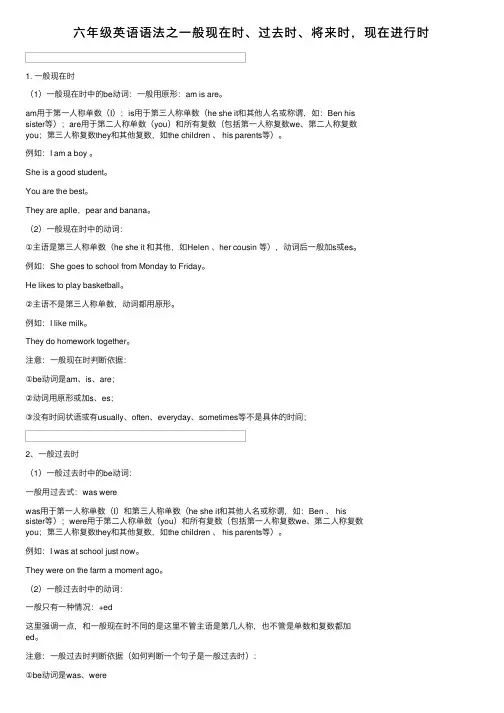
六年级英语语法之⼀般现在时、过去时、将来时,现在进⾏时1. ⼀般现在时(1)⼀般现在时中的be动词:⼀般⽤原形:am is are。
am⽤于第⼀⼈称单数(I);is⽤于第三⼈称单数(he she it和其他⼈名或称谓,如:Ben hissister等);are⽤于第⼆⼈称单数(you)和所有复数(包括第⼀⼈称复数we、第⼆⼈称复数you;第三⼈称复数they和其他复数,如the children 、 his parents等)。
例如:I am a boy 。
She is a good student。
You are the best。
They are aplle,pear and banana。
(2)⼀般现在时中的动词:①主语是第三⼈称单数(he she it 和其他,如Helen 、her cousin 等),动词后⼀般加s或es。
例如:She goes to school from Monday to Friday。
He likes to play basketball。
②主语不是第三⼈称单数,动词都⽤原形。
例如:I like milk。
They do homework together。
注意:⼀般现在时判断依据:①be动词是am、is、are;②动词⽤原形或加s、es;③没有时间状语或有usually、often、everyday、sometimes等不是具体的时间;2、⼀般过去时(1)⼀般过去时中的be动词:⼀般⽤过去式:was werewas⽤于第⼀⼈称单数(I)和第三⼈称单数(he she it和其他⼈名或称谓,如:Ben 、 hissister等);were⽤于第⼆⼈称单数(you)和所有复数(包括第⼀⼈称复数we、第⼆⼈称复数you;第三⼈称复数they和其他复数,如the children 、 his parents等)。
例如:I was at school just now。
一般过去时_一般现在时_一般将来时
3. They likes like playing games.
4. Daming watches watchs TV in the evening.
5. Does he usually have has a party?
6. What do they on doSunday? on Sunday
What do the elephants like eating?
4. He sends two emails every week.
How many emails does he send every week?
How often does he send two emails?
5.He has lunch at school.
句型转换:
1 Mr Li invited her to the party.(改为一般疑问句) Did Mr Li invite her to the party?
2 They asked the teacher a question.(改为否定句) They didn’t ask the teacher a question.
4、There was some orange in the cup.(变一般疑问句)
_____ Was there _____ any orange in the cup?
The Simple Future Tense
一般将来时
一般将来时主要表示: ①将要发生的动作; ②将要存在的状态; ③计划、打算做某事; 1.will/shall+动词原形 shall 只用于第一人称(I/we),常被will 所代替;will 在陈述句中用于各人称, 在征求意见时常用于第二人称。 2.be going to +动词原形 1)主语的意图,即:将做某事。例: 2)计划,安排要发生的事。例: 3)有迹象要发生的事(天气)。例: 3.有些词用“现在进行时”表示按计划即将发生的动作,如: 【go, come, start, move, sail, leave, arrive, stay】等。
动词时态规则
动词时态规则动词时态是指动词在不同时间点所表示的动作或状态的形式。
根据英语语法规则,动词时态分为以下几种:一般现在时、一般过去时、一般将来时、现在进行时、过去进行时、将来进行时、现在完成时、过去完成时、将来完成时、现在完成进行时、过去完成进行时、将来完成进行时等。
本文将介绍这些动词时态的规则以及其用法。
一、一般现在时 (Simple Present Tense)一般现在时表示经常发生或普遍存在的动作、状态或观点。
一般现在时的构成为:主语 + 动词原形。
1. 行为动词的一般现在时:a. 第三人称单数主语,动词要加-s或-es。
例如:He plays football every Sunday.(他每个星期天踢足球。
)b. 非第三人称单数主语,动词使用原形。
例如:I like to read books.(我喜欢读书。
)2. 非行为动词(状态动词)的一般现在时:非行为动词指表示状态,感官或存在等的动词。
在一般现在时中,它们保持不变。
例如:She feels happy when she sings.(她唱歌时感到非常快乐。
)二、一般过去时 (Simple Past Tense)一般过去时表示过去发生的具体动作、状态或习惯动作。
一般过去时的构成为:主语 + 动词过去式。
1. 行为动词的一般过去时:a. 所有人称主语,动词使用过去式。
例如:They watched a movie last night.(他们昨晚看了一部电影。
)b. 动词过去式为不规则动词的规则形式。
例如:She went to school yesterday.(她昨天去上学了。
)2. 非行为动词(状态动词)的一般过去时:非行为动词在一般过去时中,仍保持不变。
例如:I knew the answer to the question.(我知道问题的答案。
)三、一般将来时 (Simple Future Tense)一般将来时表示将要发生的动作、事件或存在的状态。
一般现在时、一般过去时、一般将来时
教学内容e.g. I go to school every day except Saturdays and Sun days. My mother often gets up at 6 o ' clock. 2. 表示现在的状态,能力,性格,个性。
Lin Yan dances well. 3. 表示普遍真理或客观事实。
e.g. The earth moves around the sun. The sun rises in theeast.【注意】此用法如果出现在宾语从句中,即使主句是过去时,从句谓语也要用一般现在时。
如: Ourphysics teacher said that light travels much faster than sou nd.我们的物理老师说光的传播速度比声音【例题精讲】例 1. ----- Who is that lady?---- She ' s Miss Green. She _____ u s music, and she is so good. A. taughtB. teachesC. will teachD. is teach ing例 2. ----- I think I ' ll take a bus to the meeting.---- The bus? If you ____ , you will be late. A. doB. have do neC. will do例 3. Un less the weather ___ , we will have to can cel the picnic.A. improveB. improvesC. improvedD. will improve例 4. We don ' t know if our friend _____ . If he ___ , we ' ll let you know.A. comes; comesB. comes; will comeC. will come; comes例 5. Our geography teacher told us that the earth ____ the sun.A. went aroundB. goes aroundC. is going aroundD. was going arounde.g. My father teaches maths.的传播速度快得多,在时间、条件、比较等状语从句中, 现在时。
一般现在时现在进行时一般将来时一般过去时知识点总结
一般现在时现在进行时一般将来时一般过去时知识点总结一般现在时、一般将来时、一般过去时、现在进行时知识总结一、一般现在时一般现在时表示经常性或惯性的动作,常与表示频度的时间状语连用,如often, usually, always, sometimes, never, seldom, every week/day/year/month...,once a week, on Sundays等。
动词用原形。
当主语为第三人称单数时(he, she, it,一个人名),动词变为三单形式。
Be动词肯定句主语+am/is/are+其它I am a boy.否定句一般疑问句Am/is/are+主语+其它Are you a boy? Yes, I am.No, I am not.Do+主语+动词原形+其它?Do you play basketball after school everyday? Yes, we do. / No, we don't.Does+主语+动词原形+其它。
Does he swim well ? Yes, he does. / No, XXX't.非凡疑问句疑问词(where/what/ when/who/why/how)+am/is/are+主语+别的Where are you?疑问词+do+主语+动词真相+别的?What do you do afterschool everyday?主语+am/is/arenot+别的I am not aXXX.第一人主语+动词原形(+主语+don't+行称I、第其它)。
We play动词原形(+其它)。
wedon’t为二人称basketball afteryou、XXX.playbasketball动复数after schoolXXX.词第三人主语+动词三单主语+称单数式(+别的)。
doesn’t+动词真相(+其XXX.它)。
XXX’tswim well.疑问词+does+主语+动词原形+其它。