
人教版七年级英语下册Unit 4 Section A 教案
Unit4Don’teatinclass.
SectionA(1a-2d)
一、教学目标:1.语言知识目标:
1)能掌握以下单词:rules,arrive,late,hall,dinninghall,listen,listento,fight,sorry
2)能掌握以下句型:
①Don’teatinclass.
②Youmustbeontime.
③Eatinthedininghall.2.学会用英语表达一些标志的含义。
3.熟练使用目标语言谈论对某些规章制度(校规、家规等)的看法
3.情感态度价值观目标:
能用英语表达和制定一些简单的规则,理解没有规矩不成方圆;无论是在学校
时还是在家庭中以及以后走上社会都应当遵守规则,按规则办事。
二、教学重难点1.教学重点:
1)肯定祈使句是省略掉主语的原形动词开头;
2)否定祈使句则是在肯定祈使句前加上“don’t”。
3)情态动词must及haveto在用法上的区别。
2.教学难点:
掌握祈使句的用法,并能听懂、会说一些简单的祈使句。
三、教学过程Learningobjectives
1.TolearntouseImperatives:
Don’t…
2.Tolearntousecanforpermission:
Canwebringmusicplayerstoschool?
3.Tolearntousemodalverbshaveto,must:
Wemustbeontime.
Wealwayshavetoweartheschooluniform.4.Tolearntotalkaboutschoolrules.
Ⅰ.Warmingupandrevision
教师进教室后,使用祈使句请学生们完成一系列动作:Pleasestandup/sitdown.Closethedoor,please.Lookatmeandlistentome.
Don’topenyourbooks.Don’ttalk.Let’sbeginourclass.
学生听教师的指令完成各种动作,教师也可将指令写到黑板上,让学生从视觉上
考察祈使句的特点。
Ⅱ.Presentation
教师出示书上1a的图片,向学生提问。
指着图上奔跑的男孩提问T:What’stheboydoing?S:He’srunning.
T:Whereisherunning?S:He’srunninginthehallways.(板书,教读)
T:Canyouruninthehallways?S:No,Ican’t.
T:Sopleasedon’truninthehallways.(板书,教读)
(=Youcan’truninthehallways.)
学生跟读数遍,明白祈使句和“can”的表达含意。T:Whyisherunninginthehallways?S:He’slate.
T:Oh,he’slateforclass.(板书,教读)
Youcan’tarrivelateforclass.(板书,教书)=Don’tarrivelateforclass.
…
Ⅲ.1aT:Now,Lookatthepictureonyourtextbook.Eachofthestudentsisbreakingoneof
theserules.
Pleasefinish1a.
学生看图,完成1a的内容,检查答案并大声朗读校规。1.Don’tarrivelateforclass.Youmustbeontime.
2.Don’truninthehallways.
3.Don’teatintheclassroom.Youmusteatinthedininghall.
4.Don’tlistentomusicinclass.
5.Don’tfight.
Ⅳ.Listening1.T:Nowlet’slisten!Whatrulesarethesestudentsbreaking?Writethenumbersafter
names?
2.学生们听录音,完成1b,选出四位学生都违反了哪条校规;听之前,学生要读
会英文名。Peter______Amy______Mike______
3.Checktheanswers:
4.Listenagainandcompletetheconversation.
Ms.Clark:Hey,Peter.Youknowtherules.Don’t_________________.
Peter:Sorry,Ms.Clark.
Mr.Smith:Amy,don’t_______________________.
Amy:Oh,sorry,Mr.Smith.
Mr.Smith:Hey,Mike,don’t______________inclass.Mike!
Boy:Hecan’thearyou,Mr.Smith.
Ⅴ.Pairwork
请两位学生朗读1c部分的句型;要求学生两人一组对话表演,SA扮演外校转来
新生,SB告知本校校规。(学生可经过讨论,多说出他们想到的校规,不必只限
于书上;教师应给予帮助)A:Whataretherules?
B:Well,wecan’tarrivelateforclass.Wemustbeontime.
…
Ⅵ.Listening1.Workon2a:
First,let'sreadthesentencesin2atogether.
T:Now,let'slistentotherecording.ChecktheactivitiesAlanandCindytalkabout.
Sslistentotherecordingandchecktheactivitiestheyhear.1.___listentomusicintheclassroomorhallways
2.___listentomusicinmusicroom
3.___listentomusicoutside
4.___eatintheclassroom
5.___eatinthedinninghall
6.___eatoutside
7.___wearahat
8.___fight
PlaytherecordingagainfortheSstochecktheanswers.
2.Workon2b:
MakeSureSsknowwhattheyshoulddo.
Listentotherecordingagain.CanAlanandCindydotheseactivities?Circlecanor
can'tabove.
1.___listentomusicintheclassroomorhallwayscancan’t
2.___listentomusicinmusicroomcancan’t
3.___listentomusicoutsidecancan’t
4.___eatintheclassroomcancan’t
5.___eatinthedinninghallcancan’t
6.___eatoutsidecancan’t
7.___wearahatcancan’t
8.___fightcancan’t
3.Checktheanswers:
Ⅶ.Pairwork1.SupposeyouareAlanandyourpartnerisCindy.Talkabouttherulesin2a.
2.Letsomestudentscometothefrontandactouttheconversations.
Ⅷ.Reading1.2dListenandanswerthequestions.
1)WhatareJohnandAlicetalkingabout?
2)HowmanyrulesdoesAlicemention?
2.Readtheconversationandanswerthequestions.
1)IsJohnnewatschool?2)Aretheremanyrulesatschool?
3)Canhebringmusicplayerstoschool?
4)Dotheyhavetoalwaysweartheschooluniform?
3.Whatrulesdoestheschoolhave?
Dos
Weartheschooluniform
Bequietinthelibrary.
Don’ts
Don’tbelateforschool.
Don’tbringmusicplayerstoschool.
4.Role-playtheconversation.
IX.Languagepoints
1.Don’tarrivelateforclass.
arrivevi.到达=get(to)arrive后接表示地点的副词时,则不需要用介词。
e.g.Sheoftenarriveshomeat7:30intheevening.
她经常晚上7:30到家。arrive要表示“到达某地”,后需加介词at(一般用于较小的地点)或in(一般用于较
大的地点)。e.g.They___________Beijingatsix他们六点钟到的北京。
Weusually__________thetrainstationinthemorning.
我们通常在早上到达。
【链接】getto也可表示“到达某地”。e.g.Iusually______________bybike.我通常骑自行车上学。
注意:arrive和get后接here,there,home之类的副词时,不加介词。e.g.Whendoyouusuallyarrive/gethome?
Iusuallyarrive/gethereatnoon.
根据句意选用get或arrive填空,有的需要变换形式。1.David_____toLondonlastweek.
2.Yesterdaytheman__________attheairportontime.
3.We____________hereatfiveo’clockyesterday.
2.Don’t______________inclass.
人教版英语七年级下册Unit4_Section B (3a~3c)教案与反思
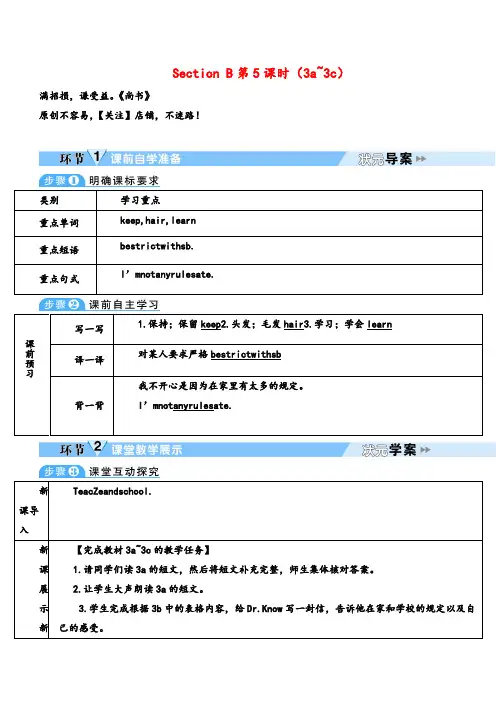
Section B第5课时(3a~3c)
满招损,谦受益。《尚书》
原创不容易,【关注】店铺,不迷路!
类别 学习重点
重点单词 keep,hair,learn
重点短语 bestrictwithsb.
重点句式 I’mnotanyrulesate.
课前预习 写一写 1.保持;保留keep2.头发;毛发hair3.学习;学会learn
译一译 对某人要求严格bestrictwithsb
背一背 我不开心是因为在家里有太多的规定。
I’mnotanyrulesate.
新课导入 TeacZeandschool.
新
课
展
示
新 【完成教材3a~3c的教学任务】
1.请同学们读3a的短文,然后将短文补充完整,师生集体核对答案。
2.让学生大声朗读3a的短文。
3.学生完成根据3b中的表格内容,给Dr.Know写一封信,告诉他在家和学校的规定以及自己的感受。 课 展 示
4.学生进行写作练习。(教师进行写作指导)
典例参考:
DearDr.Know,
Tanyrulesateandscorning.Afterbreakfast,Iustlistentotusicandeatlunc.Afterscyclassmates.Imustdomyeworkfirst.AftersupperIhavetoreadabookforhalfanhour.Ican’twatchTVonschoolnights.
活学活练 (C)—IsyourmotB.gymC.kitc
布置作业:教师引导学生课后完成本课时对应练习,并预习下一单元内容。
教学反思 本课时主要通过听、说、读、写相结合的教学方式巩固重点知识,既加深了学生对课文内容的理解,又提升了学生的综合能力。 教学过程中老师的疑问:
教师点评和总结:
教学说明:
这一环节通过读写的训练,有助于学生写作水平的提高,巩固所学的知识。
【素材积累】
阿达尔切夫说过:“生活如同一根燃烧的火柴,当你四处巡视以确定自己的位置时,它已经燃完了。”有选择就会有错误,有错误就会有遗恨,但即使第一步错了,只要及时地发现并纠正,未必步步都错下去。峰回路转,柳暗花明,路断尘埃的时候,自己给自己一双翅膀;厄突降的时候,自己给自己一个微笑;雨雪连绵的时候,自己给自己一份责任和梦想。天下路都是相连的,沿着心中的路坚定地走下去,同样能抵达你想要去的地方。
人教版初中英语七年级下册全册英教案(全英文版)
人教版初中英语七年级下册教案 新目标人教版英语七下
全册教案
(全英文版)
Unit 1 Wheres your pen pal from?
Language goals:
• In this unit students learn to talk about countries, nationalities and Ian
guages.
• Ask and tell where people live.
New languages:
• Where's he / she from?
• He / She is from Australia / England / China / France / Singapore / Australia.
• Where does he / she live? He / She lives in Sydney.
• What language do you speak? I speak English.
• What's your / his / her favorite subject?
• My / His / Her favorite subject is English.
• Does he / she have any brothers and sisters? Yes, he/ she does. / No, he /
she doesn't. 人教版初中英语七年级下册教案
Difficult points:
1. Liste ning for the in formation about cou ntries, natio nalities and Ian guages.
Write an e-mail about on eself. Describe the new stude nts in class.
2. Where questions with from
人教版七年级英语下册全套教案

1
Unit 1 Where’s your pen pal from?
一、单元教材分析
本单元的中心话题是pen pals。主要语言功能项目是talk about countries, cities and
languages。语法结构为 Where…from; Where…live and what language…speak。先以Activity1复习语言与国家的配对练习入手,Activity2a, 2b一个综合的听力训练来展示学生的听力能力,并以听力内容为基础,通过Activity2c中假设的两人对话操练来培养学生的交流能力,同时也引导学生多沟通与多交流。Activity3a是一篇email形式的阅读文章,并有相关问题由学生在阅读后进行回答Activity3b 是根据提供的信息进行填空的写作练习,Activity3c是一篇模仿写作,让学生给自己的笔友写一封关于本人信息的email。我在各课时教学中设计各种各样的小活动,通过Discussion,Classifying,Guessing等不同方式让学生掌握本单元的知识点,用学会的知识与外国的笔友自如的交谈是学习本单元的目的。
二、教学目标分析
1、语言目标
a. 重点词汇:
Countries: Canada, China, France, Japan, the United States, Singapore, Australia,
The United Kingdom, Paris.
Cities: Sydney, New York, Toronto, Toyo, London
Languages: English, French, Japanese, Chinese.
b. 重点句型: -Where…from? -She’s/He’s from…
-Where does…live? -She/He lives in …
人教版初中英语七年级下册Unit4SectionA教材全解
- 1 - 人教版初中英语七年级下册Unit4SectionA教材全解
Unit 4 Don’t eat in class.
Unit 4 Section A教材全解
1.Don’t arrive late for class.上课不要迟到.
【重点注释】①这句是祈使句的否定形式(Don’t +行为动词原形+其他),用于表达命令、请求等.祈使句可以表达说话人的意愿、请求、叮嘱、号召、命令或建议,它的主语(听话人)通常省略,谓语动词用原形,句子末尾用感叹号或句号.例如:Don’t throw the ball like that。不要那样扔球.
②arrive late for与be late for同义,都表示“做某事迟到”.arrive late for侧重到达的时间晚,be late for侧重状态。例如:Don’t arrive late for the meeting next time。=Don't be late for the meeting next time.下次开会别迟到了。
③arrive不及物动词,意为“到达,抵达,来到”,不能直接跟名词作宾语,但可以接介词at或in,构成短语“arrive at/in+地点(at+小地方,arrive at the bus stop;in+大地方,arrive in Beijing)”,意为“到达……”;arrive后若是here,there,home等地点副词,则不需要加in或at等介词(arrive here/there/home).例如:He arrives at
the bus stop at 8 o’clock every morning。他每天早晨8点到达公共汽车站.When
did you arrive in Beijing?你什么时候到北京的?I arrive home at 4:00 in the
afternoon.我下午4点钟到家。
人教版七年级英语下册第四单元教案
1 / 7
Unit4 Where’s my schoolbag ?
第一课时Section(1a--2c)
教师:周小绢
Language Goal:Talk abou things around the house
本单元主要内容是谈论物品的所在位置,通过这一话题,训练学生的听、说、读、写四项基本技能,让学生通过询问物品的位置,学习一些物品的单词,及方位介词 on , in , under ,behind 等的用法;使学生学会基本句型 “Where’s +物品名词(单数)?
It’s …”及“Where're+物品名词(复数)? They're …”,进一步体会“Where…? Yes/No”疑问句的用法;学会运用方位介词"on/in/under/behind/next to"表达物品的位置。理解连词and在句子中的用法。
教学目标
知识与能力
(1)学习和掌握有关询问物品位置的句型:
Where’s my schoolbag? It’s on/in/under the
dest.
(2)学习和掌握有关家具类的单词:table,bed,schoolbag,sofa,chair,schoolba...
(3)学会三个方位介词的用法:on,in,under
过程与方法
利用教学图片来展开课堂Pair work 问答式的口语交际活动, 2 / 7
使学生学会基本句型“ Where’s my schoolbag ? ”It’s
under the chair.及方位介词
情感态度价值观
这部分学习内容贴近学生的生活,谈论的主题是学生最关心的问题,促使学生了解自己的家居环境,热爱自己的家。
教学重点
(1)方位介词:in, on,under的用法;
(2).Where的特殊疑问句
(3)新单词:chair,bed,table,bookcase,radio,sofa,head...
教学难点
人教版七年级英语下册Unit 4 Don't eat in class教学设计
1
Unit 4 Don’t eat in class.
Learning Objectives
一、Topics(话题):
Rules
二、Functions (功能)
Talk about rules
三、Structures (结构)
1. Imperatives (Don’t)
2. Can for permission
3. Modal verbs have to, must
四、Target Language (目标语言)
Don’t eat in the classroom!
We can’t arrive late for class.
We must be on time.
Can we wear a hat in class?
Yes, we can./No, we can’t.
We have to clean the classroom.
We have to follow the rules.
五、Vocabulary (词汇)
rule, dish, night, luck, hair, arrive, listen, fight, wear, bring, practice,
relax, read, feel, remember, follow, keep, learn, quiet, noisy, dirty, terrible,
strict
2
arrive late for class, be on time, listen to music, do the dishes, make
your bed, be strict with …, follow the rules
六、Skills (技能)
Listening for key information
Scanning in reading
七、Recycling (复习巩固)
Unit 4教案2021-2022学年人教版英语七年级下册
课题名称:Unit 4 How do you make a banana milk shake?
Section A 1a-1c
一、教学设计指导思想和理论依据
《英语新课程标准》注重培养学生学习英语的兴趣,树立自信心,培养学生良好的学习习惯,运用有效的学习策略培养学生自主学习能力和小组合作精神。遵循学生的认知规律,从单词——句子——情景对话入手,围绕目标语言,由浅入深、由易到难的完成教师设计的任务,使学生在完成任务的过程中不仅从听说等方面掌握目标语言,而且在这过程中不断思考、有所创新。利用多媒体和网络技术为学生创设真实可视的英语学习环境,激发学生积极参与的欲望,体现了学生的主体地位。努力实现《英语新课程标准》语言教育理念是:知识用于行动,强调语言应用,培养创新实践能力,发展学习策略。
二、教学背景的分析
1.教学内容分析
本课是新目标英语七年级下册第四单元第一课时,教材以How do you make
a banana milk shake?为中心话题。本单元是一个有兴趣,愉悦的话题,无疑还会提高学生运用英语的兴趣和交际能力。本节课是围绕“如何制作香蕉奶昔”为话题展开的,我们在前面已经学习了一些祈使句的用法,因此本单元是对祈使句的深化和延深,通过讲述制做过程和步骤,如何听懂指令、通过听与说的训练,学会准确地判断指令,有序地处理事情,学习运用顺序词,通过动手实际操作,培养和锻炼学生生活能力。
2.学情分析
本课的教学对象为七年级46名学生,女生所占比重较大,女生英语学习水平总体较男生好,但男生课堂活动参与度较高,有一部分学生在英语学习上还有很大困难,因此在课堂上有部分学生不敢举手或者很少回答老师的问题,因此在课堂活动中分配小组成员时注重男女比例和分层教学。七年级学生对英语感到有趣好奇,上课时我多以简单的口语知识作为切入点,让学生更易接受,从熟悉的内容转到新内容的学习,做到过渡自然。对于学过的内容也可能没有完全掌握,则可以花时间较完整地复习学过内容,然后才学习新知识。提问时针对学生程度给与不同难度的问题以增强学生英语学习的兴趣和信心。利用学 生热情好奇的这一特点,从日常生活中的口语出发,尝试用英语与学生对话,引发他们的兴趣,使学生对本课程产生兴趣,注意听力与口语的训练。经过一学期的新课程理念的熏陶及实践,有了初步的自主、合作、探究、实践的能力。
新人教版初一下册英语 Unit4 单元全套教案(教学设计)
精品文档 用心整理
资料来源于网络 仅供免费交流使用 Unit 4 Don’t eat in class.
Section A 1a-2c
【课型】听说课
学习目标
1.能熟练掌握本课重点词汇:rule, arrive ,hall, listen, sorry, outside, fight ,wear。
能初步口头掌握祈使句 Don’t run in the hallways.
2.能基本听懂含有本课重点词汇和目标语言的听力材料。初步了解听前预测的技巧,并在听的过程中做到有目的地获取有效信息。
3.能理解遵守规则是每个学生的义务,并掌握Don’t eat in the classroom./We
can’t eat in the classroom. Don’t listen to music in class./We can’t listen to music
in class.并能运用目标语言谈论校规。
学习过程
【自主学习】
请在课前会拼读下面的单词,并熟记。
rule, arrive, hall ,listen ,sorry ,outside, fight, wear
【新课导入】
Step 1:Free talk
T: How to be a good student?
What can we do at school or in the classroom?
What can’t we do?...
S: We can’t...
S: We can...
【新知呈现】
Step 2:Presentation
1.根据图片提示,学习本课新词汇和句型。
Don’t eat in the classroom.
Don’t arrive late for class.
Don’t run in the hallways.
Don’t play sports in the classroom.
(word完整版)人教版七年级英语下册第四单元教案
UNIT 4 Don ’teat in class.
Section A 第 1 课时( 1a~ 1c)
自主学习方案
1.自学生词,并记着拼读及拼写。
2.预习课本找出要点短语及句子。 (见教案自学导练内容)
3.读记后达成自学导练内容。
讲堂导学方案
Step 1 情形导入
Show the students the picture of fighting.
T:Look at the two boys. What are they doing?
Ss:(Help Ss) :They are fighting.
T : Can we fight?
Ss:No,we can't.
T : What should we say to the boys?
Ss:We should say to them: Don't fight.
环节说明:经过师生对话引出新知识—祈使句。
Step 2 达成教材 1a_1c 的任务
1.学习 la 中的学校规定,高声朗诵这些规定,而后将这些规定的序号填在相对应的人
物旁边。(3 分钟)
2.认真听录音,找出 Peter, Amy 和 Mike 违犯了哪些规定,在 lb 中的横线上写出 la
中的数字,师生共同查对答案。 (2 分钟)
3.再听一遍录音,同时跟读。 (2 分钟)
4.练习 lc 中的对话。而后编写新对话,小组内进行对话练习,并进行组与组之间的比
赛,教师评论。 (5 分钟)
5.小结训练。(3 分钟)
把以下祈使句改成否认形式。
(1)Eat in the hall.
(2)Talk loudly.
Don't eat in the hall.
Don't talk loudly.
环节说明:听闻联合,第一时间向学生传达语言目标, 经过结对对话练习和小结训练,
学生能够娴熟掌握祈使句。
Step3 问题研究
1.arrive 的用法
用 arrive,arrive in/at 填空。
人教版七年级英语下册全套教案 2
(此文档为word格式,下载后您可任意编辑修改!)
Unit 1 Where’s your pen pal from?
一、单元教材分析
本单元的中心话题是pen pals。主要语言功能项目是talk about
countries, cities and languages。语法结构为 Where…from; Where…live
and what language…speak。先以Activity1复习语言与国家的配对练习入手,Activity2a, 2b一个综合的听力训练来展示学生的听力能力,并以听力内容为基础,通过Activity2c中假设的两人对话操练来培养学生的交流能力,同时也引导学生多沟通与多交流。Activity3a是一篇email形式的阅读文章,并有相关问题由学生在阅读后进行回答Activity3b 是根据提供的信息进行填空的写作练习,Activity3c是一篇模仿写作,让学生给自己的笔友写一封关于本人信息的email。我在各课时教学中设计各种各样的小活动,通过Discussion,Classifying,Guessing等不同方式让学生掌握本单元的知识点,用学会的知识与外国的笔友自如的交谈是学习本单元的目的。
二、教学目标分析
1、语言目标
a. 重点词汇:
Countries: Canada, China, France, Japan, the United States,
Singapore, Australia, The United Kingdom,
Paris.
Cities: Sydney, New York, Toronto, Toyo, London
Languages: English, French, Japanese, Chinese.
b. 重点句型: -Where…from? -She’sHe’s from…