
人教七年级英语unit4 Section A
Don’t fight with your classmates.
Don’t listen to music in the classroom.
Don’t arrive late for school.
Don’t eat in the classroom. You must eat in the dining hall.
2. Don’t draw on the wall.
3. Don’t watch TV after school . 4. Don’t play football in the street . 5. You must get up early. ……
We can’t rule the country without rules. 没有规章制度就不能治理好国家。
Don’t listen to music in class. Don’t fight.
2a. Listen. Check the activities Alan and Cindy talk about.
Activity 1. ___ listen to music in the classrooms or hallways
Don’t smoke. (No smoking) 不准吸烟. / 禁止吸烟!
We have to wear a uniform at school.
We have to clean the classrooms everyday.
What else do you have to do ?
1. Don’t forget to turn off the light when you leave.
keep rules break rules school rules class rules family rules library rules dining rules 遵守规则 违反规则 校规 班规 家规 图书馆规则 就餐规则
1a. Write the number of the rule next to the student.
Alice: No, we can’t. And we always have to wear the school uniform. John: I see. Alice: Oh, and we also have to be quiet in the library.
2d Read the conversation in 2d and answer the questions.
选词填空: in, at, to
1. My mother usually get ___ to school at 7:40 in the morning. 2. When do you usually arrive ____ at the bus station? 3. Jenny’s uncle usually arrives ___ in Shanghai in the evening.
Don’t fight.
不准打架.
Don’t arrive late for class. Don’t be late for school. 不准上课迟到.
Don’t listen to music in the classroom.
Don’t run in the hallways.
Don’t eat in the classroom.
√ 8. ___ √ fight
2c. Pairwork
A: Can we listen to music, Cindy? B: We can’t listen to music in the hallways, but we can listen to it outside.
What are the school rules, Alan?
Practice
Can we …?
Yes ,we can .
• • • • • eat in class listen to music outside wear hats in school fight in class speak loudly in the library
No, we can’t.
1. ___ listen to music in the classrooms or hallways 2. ___ listen to music in the music room 3. ___ listen to music outside 4. ___ eat in the classrooms
√
Activity
can
can
can’t
can’t
√ √ √ √ eat in the dinning hall 5. ___
6. ___ eat outside 7. ___ wear a hat
can can can can can can
can’t can’t can’t can’t can’t can’t
Don’t run in the hallways.
1c. Pair work
Talk about the rules above.
A: What are the rules? B: Well, we can’t arrive late for class.
What are the rules?
3 4
2
1b. Listen. What rules are these students breaking? Write the numbers after the names.
Peter _____ 2
Amy _____ 3 Mike _____ 4
2
3
4
Tell your classmate what the rules should be.
2. listen 的用法;
1) listen 听;用来提醒某人注意,后面不 跟事物。 Listen! Who’s singing in the classroom? 听!谁在教室里唱歌? 2) 如果后面跟要听的事物,应跟介词to 再跟事物。 Listen to our teacher carefully. 认真听老师讲。
2. ___ listen to music in the music room 3. ___ listen to music outside 4. ___ eat in the classrooms
√ √
2b. Listen again. Can Alan and Cindy do these activities? Circle “can” or “can’t” above.
√
can can can can can can can can
can’t can’t can’t can’t can’t can’t can’t can’t
√ √ √ √ eat in the dinning hall 5. ___
6. ___ eat outside 7. ___ wear a hat 8. ___ fight
Oh, can we wear a hat in class?
No, you can’t. What else? Oh, you can’t fight with your classmates. That makes the teachers really unhappy.
I see.
2d. Role-play the conversation.
John: Hi, my name’s John. It’s my first day at school. Alice: Hi, John. I’m Alice. This is a great school, but there are a lot of rules. John: Really? What are some of the rules? Alice: Well, don’t be late for the class. This is very important. John: OK, so we must be on time. Can we bring music players to school?
Don’t wear a hat in school.
Don’t talk in class. Don’t talk with each other in class.
Stop talking.
不准在上课讲话.
Please keep quiet in the library.
Don’t speak loudly in the library.
Well, we can’t arrive late for class. We must be on time.
Don’t run in the hallways.
What are the Don’t eat in the classroom other rules? You must eat in the dining hall.
3. fight 打架,争吵
1) 作动词用 Jack never fights with his brother. 杰克从不和他的弟弟打架。 2) 作名词,意为“打架;争吵”; 常用词 组have a fight“打架;吵架” Did you have a fight with her? 你和她吵过架吗?
Well, we can’t listen to music in the classroom or hallways. But we can listen to music in music room.
Uh-the classroom, but we can eat in the dining hall.
Unit 4 Don't eat in class Section A 七年级英语(人教版)

1b Listen. What rules are these students breaking? Write the numbers after the names.
Peter___2___ Amy___3___ Mike___4___
Listen and read. Ms. Clark: Hey, Peter. You know the rules. Don’t run in
But we can listen to it outside or in the music room. Cindy: Uh-huh. Alan: And we can’t eat in the classroom, but we can eat in the dining
hall.
Cindy: Oh. And can we wear a hat in class? Alan: No, we can’t. What else? Oh, you can’t fight with your
2. You must be on time. 你必须准时。(教材P19 1a) on time 准时
on time 按时;准时 指按规定或指定的时间
in time 及时
指不迟到或接近规定的时间
➢ The plane takes off on time. 飞机按时起飞。
➢ An ambulance arrived in time. 一辆救护车及时赶到。
the hallways.
Peter: Sorry, Ms. Clark.
Mr. Smith: Amy, don’t eat in the classroom. You must eat
in the dining hall.
人教版英语七年级下unit4SectionA1a--2d
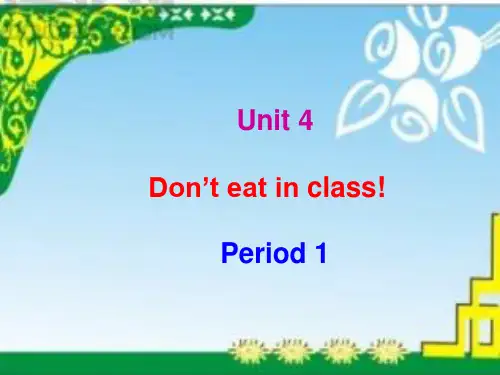
We can’t_____
What else can’t we do at school?
•get up late. •play basketball in the classrooms. •talk to others in class. •ride a bike on campus •bring mobile phones to school. •break school things. …
Report
To make our school nicer, in our _____, we have to do following things: 1. Don’t_______________________________ 2. We can _____________________________ 3. We have to __________________________ But we don’t have to _____________________ we can’t _________________________, either. We should try to obey these rules and be a good student and make our school nicer!
Group work: Different places have different rules! Please make more rules to propose(倡议) students to help make our school nicer.
Class rules
dining hall rules
I think we should obey the school rules.
人教版七年级上册英语Unit4SectionA1a2c说课稿
(二)新知讲授
在新知讲授阶段,我将逐步呈现知识点,引导学生深入理解:
1.呈现词汇:通过展示与天气相关的图片,引导学生学习词汇,如sunny、cloudy、rainy、windy等,并注意纠正发音,让学生在实际语境中理解词汇。
难点:
1.词汇的拼写和发音,特别是“sunny”、“cloudy”、“rainy”等。
2.句型的运用,尤其是疑问句和陈述句的转换。
3.学生在口语交流中,能够灵活运用所学词汇和句型描述天气。
二、学情分析导
(一)学生特点
本节课面向的是七年级学生,他们大多处于青春期早期,具有强烈的好奇心和求知欲。在认知水平上,他们已经具备了一定的英语基础,能够进行简单的听、说、读、写活动。然而,他们的英语词汇量和句型掌握程度有限,尤其对于描述天气的词汇和句型还不够熟悉。
(二)媒体资源
我将使用以下教具、多媒体资源和技术工具辅助教学:
1.教具:天气预报卡片、词汇卡片、世界地图等,用于直观展示和辅助教学。
2.多媒体资源:与天气相关的歌曲、视频、PPT等,用于创设情境、激发兴趣和提供视觉支持。
3.技术工具:投影仪、电脑、平板等,用于展示多媒体资源,实现课堂互动。
这些媒体资源在教学中的作用包括:提供丰富的教学情境,激发学生学习兴趣;直观展示教学内容,便于学生理解和记忆;实现课堂互动,提高教学效果。
3.小组合作:鼓励学生进行小组合作,互相询问和描述天气,提高口语表达能力,增强团队协作能力。
4.成功体验:及时给予学生肯定和表扬,让他们感受到学习英语的成就感,激发学习兴趣和动机。
三、教学方法与手段
人教版七年级英语上册Unit4SectionA(1a1c)优秀教学案例
三、教学策略
(一)情景创设
1.结合学生的生活实际,创设贴近生活的情境,如描述自己的日常活动、询问时间等,让学生在真实的环境中感受和运用英语。
2.学生能够熟练地运用一般现在时态描述自己的日常习惯,如“I get up at 7 o'clock every morning.”。
3.学生能够理解日常交流用语的表达方式,并在实际情境中运用,提高日常英语交流能力。
4.学生能够通过课内外阅读,拓展词汇量,增强语感,提高阅读理解能力。
(二)过程与方法
2.讨论内容:让学生围绕选定的主题,用英语进行讨论,如谈论自己的上学路线、购物习惯等。
3.小组展示:各小组代表上台展示讨论成果,其他学生进行评价和补充。
(四)总结归纳
1.课堂小结:教师引导学生对所学内容进行总结,梳理核心词汇和句型,巩固学习成果。
2.语言规律:总结一般现在时态的用法,让学生掌握一般现在时描述日常习惯的构成和用法。
人教版七年级英语上册Unit4SectionA(1a1c)优秀教学案例
一、案例背景
本案例背景以人教版七年级英语上册Unit4 SectionA (1a-1c)为载体,该单元主要围绕日常生活场景展开,让学生掌握基本的日常交流用语,提高学生的英语听说能力。通过学习本节课,学生能够掌握描述日常活动、询问时间等相关词汇和句型,如“What time do you get up?”, “I usually go to school by bus.”等。同时,本节课还涉及到一般现在时态的用法,引导学生理解并运用一般现在时描述自己的日常习惯。
Unit 4 Section A(1a-1d)教学设计人教版(2024)七年级英语上册
Unit 4My Favourite SubjectPeriod 1 Section A(1a-1d)一、教材分析What: 本课时主要包含包含两个小对话。
通过Fu Xing和Ella以及Peter和老师Ms Gao的交流,Ella和Peter分别表达了对不同学科的感受和喜好以及各自的原因。
Why: 通过本节课的学习帮助学生在面对不同的学科时,发表自己的看法,并能理解不同学科的价值。
How: 活动1a-1d是一个完整的听说任务链,其中1a是听前活动,呈现了后续活动需要的学科名称;1b和1c是听中活动,1b通过听对话,找出提及的学科名称,1c是需要深入了解Ella和Peter 对不同学科的喜好和感受,选出对应的形容词;1d是听后活动,呈现了本部分的核心句式,让学生模仿听力对话,与同伴交流彼此喜欢的学科及原因。
二、教学内容1. 本课时的重点单词,短语和句型。
2. 询问和回答个人最喜欢的学科及原因的句式。
三、教学目标1. 掌握以下重点单词:art,geography,biology,history,Chinese,maths,IT,music,English,PE,hard,boring,fun,important,boring,useful,exciting2. 掌握下列句型:①—What's your favourite subject?—My favourite subject is...②—Why do you like...?—Because it's...③Ella doesn't like...because it's...④Ella's favourite subject is...because it's...3. 学会清晰地表达自己对某一学科的喜好及其原因,表现出良好的语言组织和表达能力。
4.通过对喜欢的学科的阐述,了解不同学科所包含的文化背景和历史发展,树立正确的学习观。
初中英语新人教版七年级上册Unit4 Section A 课文讲解(2024秋)
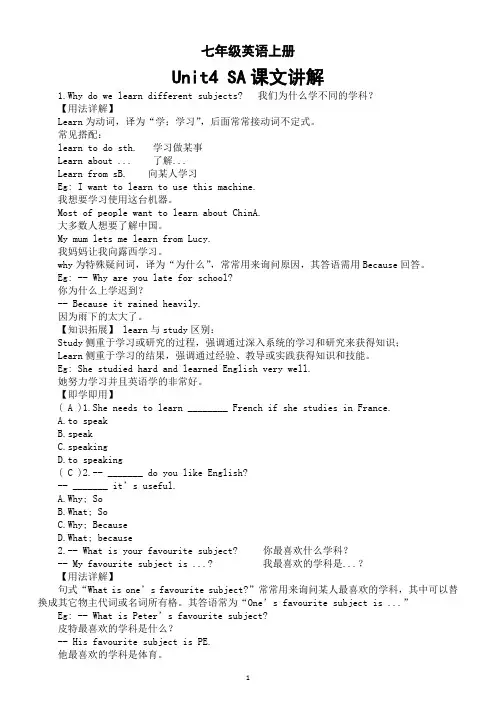
七年级英语上册Unit4 SA课文讲解1.Why do we learn different subjects? 我们为什么学不同的学科?【用法详解】Learn为动词,译为“学;学习”,后面常常接动词不定式。
常见搭配:learn to do sth. 学习做某事Learn about ... 了解...Learn from sB. 向某人学习Eg: I want to learn to use this machine.我想要学习使用这台机器。
Most of people want to learn about ChinA.大多数人想要了解中国。
My mum lets me learn from Lucy.我妈妈让我向露西学习。
why为特殊疑问词,译为“为什么”,常常用来询问原因,其答语需用Because回答。
Eg: -- Why are you late for school?你为什么上学迟到?-- Because it rained heavily.因为雨下的太大了。
【知识拓展】 learn与study区别:Study侧重于学习或研究的过程,强调通过深入系统的学习和研究来获得知识;Learn侧重于学习的结果,强调通过经验、教导或实践获得知识和技能。
Eg: She studied hard and learned English very well.她努力学习并且英语学的非常好。
【即学即用】( A )1.She needs to learn ________ French if she studies in France.A.to speakB.speakC.speakingD.to speaking( C )2.-- _______ do you like English?-- _______ it’s useful.A.Why; SoB.What; SoC.Why; BecauseD.What; because2.-- What is your favourite subject? 你最喜欢什么学科?-- My favourite subject is ...? 我最喜欢的学科是...?【用法详解】句式“What is one’s favourite subject?”常常用来询问某人最喜欢的学科,其中可以替换成其它物主代词或名词所有格。
人教英语七年级上册Unit4Section A(2a-2d) (共28张PPT)
After reading,answer them!
• 1.Where is Jack’s bag? • 2.Is Jack’s hat on the chair?
2d Role-play the conversation.
Mom: Come on, Jack! Jack: Oh, no! Where’s my bag? Mom: Hmm…is it on your desk? Jack: No. And it’s not undet the
A: Are the books on the sofa?
B: Yes, they are.
A: Are the books on the table?
B: No, they aren’t. They’re in the bookcase.
Where’s the eraser?
• Is it on the table? • No, it isn’t.
Conclusion
(总结本课内容)
Where’s the baseball?
• Is it on the table? • No, it isn’t.
• Is it under the table? • Yes, it is.
Where’s the schoolbag?
• Is it under the table? • No, it isn’t.
• Is it under the table? • Yes, it is.
Where’s the schoolbag?
• Is it under the table? • No, it isn’t.
• Is it on the table? •re’s the baseball? Is it under the table?
人教版英语七年级上册 Unit 4 Section A教案
Unit 4 Where’s my schoolbag?Section A (1a-2d)Pre-listening➢Ask Ss to see the picture and finish different tasks.Ask Ss to observe the picture and say the things in the picture.T: Look! There are many things in this picture. What can you see? (This part is about words, so T can encourage B level Ss to answer easy questions to build their confidence. )1a➢Ask Ss to match the words with the things in the picture in 1a. (Ask Ss to share the words one by one to make sure they can say the school things correctly and can spell the words correctly.)Answers: b e h g d a f c➢Ask Ss to see pictures and answer questions one by one.(Ask Ss to use the sentence pattern: —Where is …? —It’son/in/under…T must correct Ss grammar mistakes when they share their conversation in class. T can make a summary about the sentence pattern: —Where is …? T should also give examples about the sentence pattern: Where are … They are …)Language points:➢Get Ss to look at the picture of 1a again and ask them to answer the questions:Where’s my computer game?Where are my books?Where’s my pencil box?While-listening1b➢Ask Ss to listen and number the things [1-4] in 1b.T: We have talked about so many school things. Now let’s listen and number the things [1-4] in 1b.Answers: 1. books 2. pencil box 3. computer game 4. keys➢Step 2: Ask Ss to listen again and complete the conversation on P18.(When all the Ss have finished the exercise, T can ask them to read the conversation together. Then, T can show Ss the video of this conversation.)Post-listening1c & Pair work➢Ask Ss to practice the conversation in 1a with their partners. Tell Ss that they can make their own conversations using the words in the box in 1c.Native speakers do not always speak in complete sentences. This is especially true when they are responding to questions. Therefore, T may wish to have Ss practice the short answers to questions in addition to the long responses (e.g. under the table).1) come是不及物动词,其反义词为go,意为“去”。
人教版初中英语七年级下册Unit4SectionA教材全解
人教版初中英语七年级下册Unit4SectionA教材全解Unit 4 Don’t eat in class.Unit 4 Section A教材全解1.Don’t arrive late for class.上课不要迟到.【重点注释】①这句是祈使句的否定形式(Don’t +行为动词原形+其他),用于表达命令、请求等.祈使句可以表达说话人的意愿、请求、叮嘱、号召、命令或建议,它的主语(听话人)通常省略,谓语动词用原形,句子末尾用感叹号或句号.例如:Don’t throw the ball like that。
不要那样扔球.②arrive late for与be late for同义,都表示“做某事迟到”.arrive late for侧重到达的时间晚,be late for侧重状态。
例如:Don’t arrive late for the meeting next time。
=Don't be late for the meeting next time.下次开会别迟到了。
③arrive不及物动词,意为“到达,抵达,来到”,不能直接跟名词作宾语,但可以接介词at或in,构成短语“arrive at/in+地点(at+小地方,arrive at the bus stop;in+大地方,arrive in Beijing)”,意为“到达……”;arrive后若是here,there,home 等地点副词,则不需要加in或at等介词(arrive here/there/home).例如:He arrives at the bus stop at 8 o’clock every morning。
他每天早晨8点到达公共汽车站.When did you arrive in Beijing?你什么时候到北京的?I arrive home at 4:00 in the afternoon.我下午4点钟到家。
Unit 4 Section A(Grammar Focus-3c)课件 人教版七年级英语上册
Where is my bag?
It is on the sofa.
Where is my hat?
It’s on your head.
Where are my shoes? They are under the bed.
Where are my socks?
They’re in the drawer.
3b Ask and answer questions about the things on the right.
A: Where are the books? B: They are …… A: Where is……? B: It’s ……
A: Where is the clock? B: I don’t know. A: Is it on the wall? B: No, it isn’t.
B: No, it’s __u_n_d_e_r _ the chair.
A: Where __a_r_e___ the pencils?
2
B: I don’t know. ___A_r_e_ they in the _s_c_h_o_o_lb_a_g__?
A: Yes, they我are不. 知道
3
Grammar Focus
Grammar Focus 你了解方位介词in, on, under的意思和用法吗?
英语中,方位介词不能单独使用,一般用于名词或代词前。
on
在……上 一个物体在另一个物体的表面上,且两个物体之间有接触。
in
在……里
一个物体在另一个物体或某一空间的内部。
under
在……下面
on the sofa, under one’s bed/table, on one’s head 2. 学习方位介词on, in, under的用法,能用方位介词描述物品的位 置,They are on the table. It is in his schoolbag. It’s under the chair. 3.借助图片和句型 Where’s / Where are…? It’s/ They’re… 对物品的