
六年级下册英语教案Module 5 Travel abroad Unit 9 Where will you go_教科版(广州深圳)
Module 5 Travel abroad
这个工作可让学生分组负责收集整理,登在小黑板上,每周一换。
要求学生抽空抄录并且阅读成诵。
其目的在于扩大学生的知识面,引导学生关注社会,热爱生活,所以内容要尽量广泛一些,可以分为人生、价值、理想、学习、成长、责任、友谊、爱心、探索、环保等多方面。
如此下去,除假期外,一年便可以积累40多则材料。
如果学生的脑海里有了众多的鲜活生动的材料,写起文章来还用乱翻参考书吗? Unit 9
Where will you go?
语文课本中的文章都是精选的比较优秀的文章,还有不少名家名篇。
如果有选择循序渐进地让学生背诵一些优秀篇目、精彩段落,对提高学生的水平会大有裨益。
现在,不少语文教师在分析课文时,把文章解体的支离破碎,总在文章的技巧方面下功夫。
结果教师费劲,学生头疼。
分析完之后,学生收效甚微,没过几天便忘的一干二净。
造成这种事倍功半的尴尬局面的关键就是对文章读的不熟。
常言道“书读百遍,其义自见”,如果有目的、有计划地引导学生反复阅读课文,或细读、默读、跳读,或听读、范读、轮读、分角色朗读,学生便可以在读中自然领悟文章的思想内容和写作技巧,可以在读中自然加强语感,增强语言的感受力。
久而久之,这种思想内容、写作技巧和语感就会自然渗透到学生的语言意识之中,就会在写作中自觉不自觉地加以运用、创造
和发展。
教案
“教书先生”恐怕是市井百姓最为熟悉的一种称呼,从最初的门馆、私塾到晚清的学堂,“教书先生”那一行当怎么说也算是让国人景仰
甚或敬畏的一种社会职业。
只是更早的“先生”概念并非源于教书,最初出现的“先生”一词也并非有传授知识那般的含义。
《孟子》中的“先生何为出此言也?”;《论语》中的“有酒食,先生馔”;《国策》中的“先生坐,何至于此?”等等,均指“先生”为父兄或有学问、有德行的长辈。
其实《国策》中本身就有“先生长者,有德之称”的说法。
可见“先生”之原意非真正的“教师”之意,倒是与当今“先生”的称呼更接近。
看来,“先生”之本源含义在于礼貌和尊称,并非具学问者的专称。
称“老师”为“先生”的记载,首见于《礼记?曲礼》,有“从于先生,不越礼而与人言”,其中之“先生”意为“年长、资深之传授知识者”,与教师、老师之意基本一致。
教学内容:教育科学出版社英语三起六年级下册Module 5 Unit 9 Where will you go部分内容。
教学目标(Objectives):
1.确保学生认识和理解一些基本单词的意义和简单口头运用(To learn the meaning and simple usages of some words and phrases)。
需要掌握的单词:travel, country, nature, mountain, forest,opera, modern, robot, abroad, capital, maple, the USA, the UK, New Zealand, Canada[来源:学。
科。
网]
2.学习使用本单元重点句型及表达(To use the typical sentences to express)。
需要掌握的句型:
Where will you go?
正在进行时、一般将来时、一般过去时
3.鼓励学生大胆发言及表达(To encourage th e students to express bravely)。
4.培养学生对英语学科的兴趣(To make the students interest in English learning)。
5.增强学生听说读写译的能力(To strengthen the ability of listening, speaking, reading, writing and translating)。
教学重点(Key Points):
在学习了单词的基础上,以单词为载体,进行主要句型的学习,并了解其中的语法现象,根据具体情境,学会交流对话,侧重句型语法学习,交际意向和课外拓展为重点。
教学方法:
游戏,音频,情景教学法,Pair-work两人小组活动,Group-work小组活动,多媒体辅助教学。
教学难点:
学生处于小学阶段,对英语有了初步了解,词汇储备较少,对于三年级下学期学生的要求重点是在会读会说的基础上,能掌握一些基本单词的拼写和造句,了解一定的语法内涵,与人进行简单沟通交流。
教学准备:
课件、照片素材、音频文件、教学道具。
教学设计:[来源:学.科.网]
Step1. Greeting
Step2.Warm-up/Leading(热身/课程导入)
Warm-up Question
1)你最喜欢哪个国家?
2)Survey:
Where will you go?
Step3.Presentation(呈现新课)
1.Words Learning!
1)老师放映课件,用中文询问同学看到了什么?同学们会看到课件上呈现的图画。
2)教师拿出单词卡片,进入重点新词汇学习环节,向同学展示图片,结合PPT上放映的内容,带领同学学习一些新单词。
2. Pronunciation Part!
1)老师介绍本单元重点单词读音及重点音标,带领同学大声朗读。
2)然后老师带领同学进行拓展学习,介绍一些该音标构成的其他单词。
3)巩固训练:
If you can travel to any country in the world, where will you go?
I think I will go to South Africa. I love nature and in South Africa I can see many beautiful mountains and forests.
I will choose Australia. I’d like to see the Sydney Opera House and the Harbour Bridge.
I want to go to Japan. Tokyo is so modern and it’s a great place to go shopping, too. I’d like to buy a robot there.
Where will you go, Jim?
If I can travel abroad I will go to France, of course. I love food and people say that Paris is the food capital of the world!
3.Vocabulary Part!
Travel
Country
Nature
Mountain
Forest
Opera
Modern
Robot
Abroad
Capital
Maple
the USA
the UK
New Zealand[来源:学§科§网]
Canada
4. Listening Part!
请听对话材料,完成书中所附听力练习!
Listen to the interview and complete Steve's schedule.[来源:学§科§网] Listen to the interview again. Circle the letters on the survey.
5. Reading Part!
教师立足于课本,引导学生课本上的短篇课文。
[来源:]
教师向同学解释对话内容,并让学生反复听读,学习模仿。
Listen to the tape, and read aloud these sentences!
Step4.小结(Summary)
学生自我总结今天上课所学内容
Step5.Homework!
请课后认真复习本单元语法内容,并朗诵课文对话!。
六年级下册英语教案Module5TravelabroadUnit9Wherewillyougo_教科版(广州深圳)
and translating) 。
教学重点( Key Points) :
在学习了单词的基础上,以单词为载
体,进行主要句型的学习,并了解其中的语法现象,
根据具体情境,学会交流对话,侧重句型语法学习,交际意向和课外拓展为重点。
教学方法:
游戏,音频,情景教学法, Pair-work 两人小组活动, Group-work 小组活动,多媒体辅助教 学。
Country
2/3
Nature Mountain Forest Opera Modern Robot Abroad Capital Maple the USA the UK New Zealand Canada 4.Listening Part! 请听对话材料,完成书中所附听力练习! Listen to the interview and complete Steve's schedule. Listen to the interview again. Circle the letters on the survey. 5. Reading P art! 教师立足于课本,引导学生课本上的短篇课文。 教师向同学解 释对话内容,并让学生反复听读,学习模仿。 Listen to the tape, and read aloud these sentences! Step4.小结( Summary ) 学生自我总结今天上课所学内容 Step5.Homework! 请课后认 真复习本单元语法内容,并朗诵课文对话!
Whe呈现新课)
1.Words Learning!
1)老师放映课件,用中文询问同学看到了什么?同学们会看到课件上呈现的图画。
2)教师拿出单词卡片,进入重点新词汇学习环节,向同学展示图片 容,带领同学学习一些新单词。
Module5Travelabroad复习(讲义)教科版(广州)英语六年级下册
2022-2023学年广州市六年级英语下册复习内容Module 5 Travel abroadUnit 9一、根据中文写单词二、根据情境及内容提示补全对话(每空填一词)Ms White:If you can __________ to any __________ in the __________, __________ willyou go?(如果你能到世界上任何一个国家旅行,你会去哪里?)Ben:I __________ I will go to __________ __________. I love __________ and in__________ __________ I can __________ many __________ __________and __________.(我想我会去南非。
我热爱大自然,在南非我能看到许多美丽的山和森林。
)Janet:I will __________ Australia. I'd like to __________ the Sydney Opera Houseand the Harbour Bridge.(我会选择澳大利亚。
我想看看悉尼歌剧院和海港大桥。
)Xiaoling:I want to __________ to Japan. Tokyo is so __________ and it's a ____________________ to go __________, too. I'd like to __________ a __________there.(我想去日本。
东京非常的现代化,也是购物的好地方。
我想在那里买一个机器人。
)Ms White:__________ will you go, Jiamin? (家民,你要去哪里?)Jiamin:If I can __________ __________ I will go to __________, ____________________. I love __________ and people say that Paris is the food__________ of the world!(当然,如果我能出国旅游的话,我当然是去法国。
Module5TravelAbroad(教案)教科版(广州)英语六年级下册2

学会通过分析游记以及小组争论得出结论,通过体验对文化冲突进行思索。
【文化品行】
在模拟场景中直观体验英语语用环境,体验文化冲突,在模拟熬炼中提高英语运用自信。本课也让同学对英语佳作学会鉴赏和赏析,提高英语的文化素养。
教学理念及策略
本课教学理念主要表达在三个方面:1.英语语用学习。选取旅游中互动性最强的场景进行文化冲突开展提升:①归纳和整理力量:运用思维导图整理所学学问;②鉴赏和学习力量:对游记和写作范例进行赏析;③思辨力量:探讨如何应对文化冲突;3.信息技术帮助:运用AIVR技术,进行智能人工对话,让同学实际体验外国场景和英语对话,亲身体验文化差异。
Where did you go?
What did you do?
How/When did you go there?
Who did you go there with?
Why did you choose there?
Howdid youfeel?How was the…?
2.Group work:share you travel experiences with themind mapin your group〔5mins〕
教学目标
【语言力量】
〔一〕语言学问目标
1、娴熟把握询问和答复旅游经受的的句型5W+1H;
2、复习旅行话题下可能用到的动词过去时变化,如:
规那么变化:enjoyenjoyed askasked
直接+d:likeliked loveloved
双写词尾+ed:robrobbed
改y为ied:trytried
Sum up
Homework
〔2mins〕
1.Sum up:Travel helps us know moreabout this big big world!
Unit9 Where will you go
Module 5 Travel abroadUnit 9 Where will you go? 第一课时,词汇课刘祝华附件:教学设计方案模版Module5Travel abroadUnit 9 Where will you go? (词汇课教学反思)刘祝华本模块的话题是travel abroad(国外旅游), 内容与学生的现实生活很贴近,很多学生们都会利用周末,小假日,和寒暑假去进行一些实践活动,而旅游就是孩子们最喜欢的活动。
旅游不但可以增进知识,了解各国的文化和习俗,更重要的是可以提高孩子们的生活实践能力,拓展视野。
因此,旅游是一个很受学生欢迎的话题。
本节课是Unit9的第一课时,主要是学习一些国家、首都、国旗和景点的单词。
并理解运用Where will you go ? I will go to…/I want to go to…./I will choose…/I can see….there./I love…等句型。
信息量较多,涉及到一些外国的文化知识。
因此,老师在课前就布置学生查找相关信息,并在教学过程中,注重让学生用自主构建的方式进行学习,并通过拼读、图片、歌曲、游戏和小诗等形式来学习新词汇。
与听说读写相结合,由“词”自然过渡到“句”,在对话中操练句型,在交流中运用句型。
这样就最大程度地发挥了词汇的作用,丰富了学生对语言的综合运用。
另外,六年级学生学习兴趣浓厚,求知的欲望比较强烈,思维活跃。
因此教师在课堂中多以活动为课堂教学的主要形式,设计丰富多彩的教学活动,让学生在乐中学、学中用,从而保证学生英语学习的可持续性发展。
本单元是学习有关到国外旅游的内容,这是个比较贴近我们生活的话题,也是学生比较感兴趣的话题。
老师在操练句型时,利用投影,视频等多媒体辅助教学,让学生用小记者的形式对同学进行采访,了解他们如果能。
教科版六年级英语下册Module5TravelabroadUnit9《Wherewillyougo》教案
Unit9 Where will you goStep1:检查作业,讲解习题,复习上节课内容。
Step2: Warm up热身Free talk. Step 3:复习Unit91)写单词和词组2)重要句型If you can travel to in the world, where will you go?如果你可以去世界上任何一个国家旅游,你将会去哪里呢?it's a to go shopping.那是个购物的好地方。
to buy a robot there.我想在那里买个机器人。
If I can I will go to France.如果我可以去国外旅游,我想去巴黎。
I love food and people say that pairs is the of the world!我喜欢食物,人们说巴黎世界上的美食之都。
3)知识考点回顾【知识点一】can aux. 能;能够;可以;可能【知识点二】choose 选择过去式:第三人称单数:【知识点三】 abroad 国外的去国外旅游去国外学习【知识点四】the capital of ….的首都【知识点五】I‘d like to ……我想做…..【知识点六】 If I can do ……, I will do ….Step 4:课堂练习一、选出划线部分读音与其余三个不同的单词()1. A. study B. subject C. pupil D. Sunny()2. A. south B.other C. weather D. three()3. A. season B. last C. because D. thousand()4. A. cool B.food C. foot D. soon()5. A. stayed B. helped C. washed D. asked二、单选( ) 1. He goes to school _______ taxi.A. byB. onC. takeD. in( ) 2. Did you ______ to the supermarket _____ Sunday morning.A. go, inB. went, onC. go, at( ) 3. Henry is very lazy and he does ______ at home.A. anythingB. everythingC. nothingD. something( ) 4. Do you have ______ to say ?A. something important C. important anythingB. important something D. anything important( ) 5. Jenny often ____ to school early, but this morning she ___ to school late.A. go; wentB. went; goesC. goes; wentD. goes; goes ( ) 6.My father _____ to America last week.A. flewB. flyedC. fliedD. flies( ) 7.Would you like to have fun with us ?A. Yes, I‘d love.B. No, I wouldn’t.C. Yes, I ’d loveto.( ) 8._________she going to ___________a letter ?A. Does, writeB. Is, writeC. Is, writing( ) 9. I‘m going to____ homework tomorrow.A. doesB. doC. did( ) 10.He _________free today, but he ______busy tomorrow.A is, isB is going to be ,isC is, is going to be ( ) 11. Where are you going to travel holiday?A. inB. onC. at( ) 12.All of will enjoy the party.A. weB. usC. they( )13. If you can travel to country in the world.A anyB someC anythingD something三,句型转换。
六年级下U9第1课时 Module 5 Travel abroadPeriod 1Unit 9 Where will you go
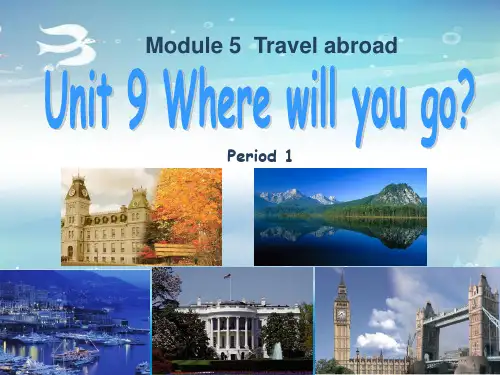
People say that Paris is the food capital of the world!
I want to go to Japan.
It’s a great place to go shopping
Harbour Bridge
Sydney Opera House
I will choose Australia
I love nature and in South Africa I can see many beautiful mountains and forests.
I will go to South Africa
Let's learn.
Fill in the blank.
I love nature and in South Africa I can
Try to read
capitals
Beijing
Paris
Washington D.C. London
Tokyo
Canberra Wellington Ottawa
将国家与该首都搭配起来。
Paris
Beijing
Washington D.C.
London Tokyo
Beijing Washington D.C.
food and people say that Paris is the food capital of the world !
We should pay attention
to personal safety, We should be polite .
But we shouldn’t leave litter and draw everywhere.
Unit 5 Traveling Abroad 教学设计新部编版
教师学科教案[ 20 – 20 学年度第__学期]任教学科:_____________任教年级:_____________任教老师:_____________xx市实验学校Unit 5 Traveling AbroadPeriod 1 Warming up and SpeakingTeaching Goal:Enable the Ss to talk about traveling and studying abroadEnable the Ss to talk about probability and improbability with the target language Teaching important and difficult pointsPractice expressing probability and improbabilityTeaching methods:Task-based method; Discussing; Brainstorming and SpeakingTeaching AidA projector and computerTeaching Procedures:Step 1 Warming up1).Talk about questions below:Did you watch the TV series about four Chinese students who live and study in Canada?How will you describe their life there?Do you want to study abroad like them?2). Traveling abroad and studying abroad are very popular nowadays, as many people can afford to travel and study in a foreign country. If you could go anywhere in the world, which country would you like to visit and why? Turn to Page 37. Work in groups discuss and answer the questions in Warming-up.After discussion, ask several Ss to report their answers to the class.3). What kind of thing would you learn best by being a tourist in the country you talked about and what would you learn best by working or studying there?4). Suppose you are going to spend two years in America, how difficult or easy doyou think it is to adjust to living there? What kind of difficulties might you experience? And how will you overcome them?Step 2 SpeakingDeal with Speaking Task in the workbook. Let the Ss practice expressing probability and improbability.“Well, we talked about the things that we could learn while traveling or studying in a foreign country. Then, what kind of problems or dangers could happen while traveling in a foreign country? Now list the dangers and problems on a piece of paper. Possible answers: have difficulty communicating with the local people; lose your way; get robbed; have your money stolen; traffic accident; get sick; race discrimination—Let the Ss speak out the problems and dangers they have written and write all of them on the Book.Then ask them discuss which situations could possibly happen and which are very unlikely to happen. You can use expressions in Activity 2 in your discussion. Let’s go through the expressions first.After discussion, let the Ss to rank the situations on their lists 1-3 from unlikely to very possible.Ask them go give suggestions respectively.Step 4 TalkingDeal with talking task in the workbookIt’s very important t o know how to deal with problems while traveling in a foreign county, It is important to make good preparations before you go there. Here is a question: How do you find information that is helpful for your trip? Think about it. (travel agency, search on the Internet)Good idea, if you don’t have enough money for overseas trip, how would you arrage your trip? ____--- youth hostelsNowadays many young people manage to travel around the world with limited amount of money. The youth hostels make it possible. Have you heard about it? What kind of service do they offer? Let’s find more information about it. Turn to page 78. Mei Jie is planning a three-week holiday in Ital and France. She has been using the Internet to find out information for her trip. Look at the web page. It is from theweb site where she searched for information. Read the web page carefully and discuss the questions in groups.Check them orallyStep 5 AssignmentAsk Ss read the passage on page 38. Look up the new words in the dictionary.Period 2 & 3Reading and l earning about languageTarget language:Keep it up, fit in, board, cafeteria, lecture, qualification, preparation, shopkeeper, comfort, substitute, academic, requirement, essay, tutor, numb, acknowledge, as far as one is concerned, feel at home, occupy, hopefully, enterprise, succeedXie Lei, who is 21years old, has come to our university to complete a business qualification.It’s not just study that’s difficult. You have to get used to a whole new way oflife, which can take up all your concentration in the beginning.I have been so occupied getting used to everything that I haven’t had time forsocial activities.I’m going to join a few university clubs and hopefully I’ll meet some people Ihave things in common with.Teaching Goals:Enable the Ss to learn about Xie Lei’s school life in LondonHelp The Ss learn how to deal with problems that they would face whenstudying in a foreign country.Teaching important and difficult points:Help Ss to summarize the benefits and difficulties of living in a foreigncountry.Teaching methodSkimming, scanning, task-based method and discussionTeaching AidsA recorder, a projector, and a computerTeaching Procedures:Step1 Revision“We’ve talked about traveling abroad in the last period. Have you ever traveled in another country? Who’d like to tell us your experience?” (To lead in the difficulties when traveling abroad. If no one goes abroad before, just share points according to a familiar TV series telling the story of Chinese students in Canada.)Step2. Pre-readingTalk about studying in a foreign country. First present two pieces of news to start with.Show the news on the screen.(What can you learn from the two news items?) --- security problems while studying abroad.News 1On Dec 6tth 2005, two Chinese overseas students were killed in Ottawa, Canada. They were shot at a bar, one was shot dead at once, the other died during the way to the hospital. It was said the murder was Vietnamese. News 2Xinhua News Agency) A car accident happened to a group of Chinese overseas students in New Zealand on Sep 7th, 2005. New Zealand police said that the car accident happened in the early morning, one student, Xiao Ding, died on the spot, the other four students were hurt. Now two of them are still in hospital.As we know, now more and more people live or study abroad, even some senior or junior high school students are sent to study abroad. Do you know why?(Learn advanced tech; know more different cultures, enlarge knowledge andimprove ability)Besides the security problems, what are other problems they might meet in their study and daily life? Now let learn a text about a Chinese girl studying in London. First, please turn to page37, look at the pictures and discuss the questions above them.Advantage & disadvantage respectivelyStep3 readingI.Skimming to find the main idea of each paragraph and answer thequestions in Comprehending 1.1.What is Xie Lei in England for? How long has she been in England?Xie Lei is an England for a degree course. She has been in England forsix month.2.Why is she doing a preparation course first?Xie lei’s preparation course can help her to get used to academicrequirements of a Western university.3.Why did Xie Lei feel like a child when she first arrived in England?Because she had to learn how to do everyday things like using atelephone, paying on a bus, finding her way around a strange city;understanding English as spoken in real life; learning how to writeessays acceptable to her British lecturer.4.Which two types of people have helped Xie Lei most since she came toEngland?Her host family and her teachers.5.Why has Xie Lei decided to join a few clubs?Because she thinks it’s important to have a balance between study anda social life, and she wants to make new friends.II.Read again. Look at some detailed information of the text, for difficulties / benefits. And then finish Comprehending 2BenefitsDifficultiesThen let the Ss discuss the questions in Exercise 3.(group discussion is OK). Suggested answers:I think Xie Lei is a diligent and hard-working girl. She is brave to face difficulties and challenges both in life and stud.I think the reporter used some direct speech in the article in order that people who read this article can directly feel the difficulties and the benefits living in a foreign country.It is possible that this article might have been published in China daily. Because she had to learn almost everything again. She didn’t know how to deal with some simple things.Because she thinks it is important to make a balance between study and life. Step 4 DiscussionWe have talked about the difficulties and benefits of studying in a foreign country. Now let’s list the problems that Xie Lei had when she first went to England, and try to add two or three other problems that she might have and summarize what you would do if you had the same problems. Work in groups. Possible problems and solution:Step 5 Homework1. Finish exercises in LEARNING ABOUT LANGUAGE2. Suppose you are Xie Lei, write a letter to your parents or friends in China, telling them about your present life according to what you have learned form the text.Period 4 Using languageTarget language:agent, travel, parallel, abundant, govern, destinationWe could…You might…It would be possible to …It isn’t possible to …… w ould be a perfect place for us.I don’t think you’d enjoy …… would probably suit youTeaching Goals:Through listening, enable the Ss to acquire detailed information about Peru. Enable the Ss to express likes and improbability with the target languageEnable the Ss to write about problems they might experience while traveling. Teaching important and difficult points:Talk about tours in and around Cuzco with functional items given.Teaching methodListening, fast reading, and speakingTeaching AidsA recorder, a projector, and a computerTeaching Procedures:Step1 RevisionCheck the homework ( Ask a Ss to read the letter)Sample letter:Dear mom and dad,How is everything going? I miss you very much.I have got used to my new life her. My English has improved a lot since I came here. So I don’t have any difficulty in communicating with the local people. You know at that beginning, I even had difficulty in using the phone and paying on the bus. I was encouraged by my tutor to give my own opinions in the essay. And now I get really good marks. I feel so confidentI enjoy living with my host family. They helped me a lot with my everyday life and understanding of local customs. They are very kind and warm-hearted. So don’t worry about me.Send my love to grandpa and grandma.Your love,Xie LeiStep2. ListeningDeal with listening in Using Language“Today we will travel to Peru. First, let’s look at the map of South America on page 42. Find the cities of Liam and Cuzco and the Andes Mountains.Who can describe t heir locations according to the map?”Lima, Capital City, lies on the west coastCuzco, in the South Mountainous area, the site of ancient capital of Inca civilizationAndes Mountain, runs parallel to Pacific Ocean, the longest mountain in the worldEtc.Listen and do Exercise 2.Listen again and do Exercise 3&4 on page 42.If necessary, listen to it several times.Step3 Reading“OK, after listening, we have known about Lia’s travel plan. Would you like to take a tour there? Before you go, let’s learn some thing about this country. Now look at the reading passage in Reading and speaking. Read the text and underline the places mentioned in it.”The Ss are supposed to underline: costal belt, the Andes Mountains, high flat plains, Lake Titicaca, Lima, Cuzco, Machu Picchu.Several minutes later.Ask questions:1. Why is Cuzco popular with tourists?Cuzco is a popular tourist destination as it is close to the famous Inca ruins of the city of Machu Picchu. It’s a city where both Indian and Spanish culture and art can be seen.2 . What is special about Lake Titicaca?It is the highest navigable lake in the world.3. What do you think the official languages of Peru are?They are Indian and Spanish.“ Very good. The text is a brief introduction of Peru. If you want to travel in Peru, you should know more detailed information. What are the most populartours in Peru? Any ideas? Turn to page 43. Read the brochure at the bottoms of this page and on the next page. Work with your partners and answer the questions in Exercise 2.”Suggested answers:1.I think Tour 1 would be. Because on Tour 1 people can experience thejungle and its diverse wildlife close up during four-day walking tour, they also can enjoy the wonderful scenery of mountain and the ancient ruins. 2.I think Tour 2 would suit people who like to travel by boat and get close toIndian culture and learn more about their life.3.We could visit Machu Picchu on Tour 1 and Tour 3.4.Maybe Tour 2 would be best to do last. Because on Tour2, after travelingwe could return to Puno for our flight back to LimaStep4 SpeakingGet the Ss to talk about tours in and around Cuzco with the expressions given. First show the following expressions on the Bb.I like/ don’t like doing/ to do---I prefer to---I enjoy/ love / hate doing---“What would you like to do when you are on holiday?Discuss with your partner, using the expression on the Bb.After discussion, ask some Ss to tell their ideas. One student gives one sentence.“now imagine your group plans to spend eight days in and around Cuzco. Discuss which two tours you will like. You’d better use the following usful expressions.We would---You might---It would be possible to------It isn’t possible to------ would be a perfect place fro us.I don’t think you’d enjoy---Some minutes later, ask several groups to share their ideas with other others. Possible Version:If we have eight days to travel around Cuzco, Tour 1 and tour 2 would suit us. We could make walking tour on Tour1, experience the jungle and its wildlife. It would be possible for us to enjoy the mountain scenery and the ancient ruins. Then on the fourth day we could arrive at the ruins of the ancient Inca city then we could catch the train back to Cuzco. On the fifth day, we could begin our trip from Cuzco to Puno by road. We could enjoy the fantastic views of the high land countryside, and then we would travel by boat across Lake Titicaca. We could see the beautiful scenery of the Lake; also we could stay with the local family and learn more about their life. It would be a perfect place for us. Then on the eighth day we could return to Puno for our flight back to Lima. “Excellent! Ok, so much for today’s travel in Peru. I think you all had a wonderful journey, right? If you are interested in this country, you can find more information about it after class. Some information about Peru and its cities is included in the appendix.Step 5. HomeworkIn the reading passage, we learned about X ie Lei’s life in London. We learned that she has to overcome many difficulties and face many challenges, because she has to get used to a whole new way of life. Now imagine your American pen friend has decided to come to China to study Chinese culture and language at a university near you . Homework for today: write a letter to him or her giving information about what life will be like. Include things like this:What he/she will find different in China( include things like food, study, transport, accommodation, et);How easy or difficult it will be to make friends;The best way to learn Chinese and about Chinese culture.Things you can do to help him/her settle in.Sample Letter:Dear Andy,I’m glad to hear you are coming to China for university study. Here I’ d like to offer you some tips in order that you will have a great time during your study in China. As you know, China is a lot different form your country especially the culture, so you must try your best to adapt to the new environment. First, you must get used to Chinese food. This may not be the biggest challenge for westerners. Second, you had better be aware of the education system and make new plans for your university study. In addition, you should also be familiar with the transportation and accommodation.On your first arrival in China, you may get a culture shock as well. The best way to overcome it is to make more local friends and to learn more about Chinese culture. Try to be easy-going and sociable with you .After some communication with the local people, it will be rather easy for you to adapt to the new culture.Of course you could turn to me for help at any time. I will be pleased to be your guide here in China, so please don’t hesitate if you have any trouble. Wish you a wonderful time in China.Yours,Fiona。
六年级下册英语教案Module5TravelabroadUnit9Wherewillyougo_
Step2.Warm-up/Leading (热身 /课程导入) Warm-up Question 1)你最喜欢哪个国家? 2) Survey:
Where will you go? Step3.Presentation(呈现新课)
1.Words Learning!
1)老师放映课件,用中文询问同学看到了什么?同学们会看到课件上呈现的图画。
教师立足于课本,引导学生课本上的短篇课文。
[来源 :]
教师向同学解 释对话内容,并让学生反复听读,学习模仿。
Listen to the tape, and read aloud these sentences! 教育资源
教育资源 Step4.小结( Summary ) 学生自我总结今天上课所学内容 Step5.Homework! 请课后认 真复习本单元语法内容,并朗诵课文对话!
教学难点:
学生处于小学阶段, 对英语有了初步了解, 词汇储备较少, 对于三年级下学期学生的要求重
点是在会读会说的基础上,能掌握一些基
本单词的拼写和造句,了解一定的语法内涵,与
教育资源
教育资源
人进行简单沟通交流。
教学准备:
课件、照片素材、音频文件、教学道具。
教学设计:
[来源: 学科 网]
Step1. Greeting
maple, the USA, the UK, New Zealand, Canada [来源 学。科。网]
2.学习使用本单元重点句型及表达( 需要掌握的句型:
To use the typical sentences to express)。
Where will you go? 正在 进行时、一般将来时、一般过去时
food capital of the world!
六年级下册Module5 Travel abroad (会江实验学校)
第6课时Module5Travel a broad拓展课教学设计会江实验学校徐亚秋一、教学内容分析本课主题是Travel a broad,即谈论是国外旅游。
本节课是一节阅读拓展课,主要通过介绍瑞士和阅读美国旅游计划,灵活运用所学的知识,提高学生的跨文化知识,拓展学生的国家文化视野。
本课读写结合,让学生领会阅读得技巧,提高阅读能力,为学生输出做好铺垫,从而提高学生的综合运用能力。
二、教学对象分析六年级的学生经过了几年的英语学习,有了一定的英语知识听说读写基础,对英语仍保持着强烈的好奇心,本课前五课学习一些国家的名称、首都、名胜物,以及国家的特色、食物等,能简单制定旅游计划,教师要引导学生掌握阅读技巧理解短文,提高综合运营能力。
三、教学目标(一)语言能力目标1. 知识与技能目标(1)能描述表达国家(2)能制定国外旅游计划2. 语用目标(1)能阅读短文并形成阅读策略(2)能制定国外旅游计划并且书写出来(二)学习能力目标1.能灵活运用所学知识理解短文2.能掌握阅读技巧(三)思维品质目标1.鼓励学生积极参与学习活动,喜欢用英语与他人交流,在交流中培养热爱大好河山的情感,把所学语言知识与实际生活紧密结合,提高在实际中运用英语的能力。
2.通过学习、合作、交流,激发学生的学习动机,培养学生学习的兴趣,使学生乐于学习,树立信心。
(四)文化品格目标能提高跨文化知识,拓展国际文化视野四、教学重、难点(一)教学重点1.能阅读短文并形成阅读技巧2.能制定国外旅游计划并且书写出来(二)教学难点能制定国外旅游计划并且书写出来五、教学理念及策略1.通过老师旅游的经历、旅游计划创设情境教学,以图片、音乐等增加学生的兴趣。
2.两个国家不同文化的冲击,提高学生的跨文化知识,拓展国际文化视野。
3.通过思维导图,提取信息,形成知识网络,并引导学生的阅读技巧。
六、教学媒体PPT、研学案、CD七、教学过程I. Preparation1.Ps watch the video and sing the song.2.Ps talk about the country where will they go.3.Ps sum up how to talk about a country.【设计意图:通过谈论自己想去的国家,为下文做好铺垫,同时让学生初步形成描述国家的思维导图】II. Input1.Set up a scene: T went to Switzerland last summer holiday.2.Ps watch a video of Switzerland.3.Ps talk something about Switzerland.【设计意图:通过介绍瑞士,提高学生的跨文化知识,拓展国际文化视野,同时进一步让学生形成描述国家的思维导图】III. Internalization1. Set up another scene: Summer holidays is coming soon. T plan to visit USA.【设计意图:通过教师去美国的旅游计划,调动学生的积极性,增强学生的求知欲】2. Step1: SkimingA trip to3. Step2: ScaningI can choose.4. Step3: Detailed readingI can fill the blank.5. Sum up reading skills【设计意图:通过三个不同的阅读任务,让学生形成略读、扫读、精读的阅读策略】IV. Output1.Ps sum up how to write a travel plan in groups.2.Ps talk a travel plan with partner.【设计意图:通过小组合作,互相交流,集思广益】3.Ps write down a travel plan.4.Share in the class.【设计意图:通过写出旅游计划,灵活运用知识,输出语言】IV. Assessment八、教学流程图九、板书设计Module5 Travel a broad十、作业布置完A 本写出旅游计划,并且和家人分享。
部编版六年级英语下册第五单元《英语天地五》教案设计
部编版六年级英语下册第五单元《英语天地五》教案设计教学目标1. 通过研究本单元,学生能够掌握有关职业的词汇,如doctor, teacher, police officer等。
2. 学生能够运用所学职业词汇进行简单的交流,如介绍自己或他人的职业。
3. 培养学生的听、说、读、写等综合语言运用能力。
教学准备1. 课文《Our Dream Jobs》的课件和录音机。
2. 职业图片卡片,包括各种职业的图片和相关单词。
3. 职业相关的道具,如白衣、医生工具箱、教师黑板、警察帽子等等。
4. 学生练本、笔、纸等。
教学流程Step 1: 导入新课1. 利用职业相关的图片卡片,引导学生猜测和说出每个职业的名称。
2. 让学生观察图片,并回答相关问题,如"What's this?" "Whatdo they do?"等。
Step 2: 听力训练1. 播放课文《Our Dream Jobs》的录音,要求学生跟读。
2. 分段播放录音,让学生听并完成相关练,如填空、选择题等。
Step 3: 听、说、读综合训练1. 让学生在教师的指导下进行角色扮演,模拟不同职业的场景。
2. 提供一些常用的句子模板,如"What do you want to be?" "I want to be a ..."等,帮助学生进行对话练。
3. 将学生分成小组,让他们互相介绍自己或他人的理想职业。
Step 4: 语言运用1. 给学生分发练册,让他们完成相关的练题目。
2. 教师检查练册并进行讲解,解答学生的疑问。
Step 5: 总结1. 教师引导学生进行本节课的总结,复所学的职业词汇和相关句子。
2. 鼓励学生自由发言,让他们展示所学的成果。
教学延伸1. 鼓励学生做更多的职业研究,了解不同职业的特点和要求。
2. 邀请一些职业人士来校进行讲座,让学生从第一手资料中了解真实的职业情况。