
人教版高二英语必修5全册教案
人教版高二英语必修5全册教案
The Sixth Period Writing
Teaching goals 教学目标Target language 目标语言
重点词汇与短语
sugguade, observabutions, achieve, dev2.
Ability goals 能力目标
Enabludlearn the wauasive writing and dve
writingLearning ability goals 学能目标
Learn how to write a persuasive writing and a dve
writing.
Teaching importa教学重点
Heludlearn to write a persuasive writing and
aTeaching difficul教学难点
How to write aabout aand his / her job.
Teaching methods 教学方法
Task-based activTeaching aids 教具准备
A computer and aTeaching procedures ways 教学过程与方式
Step Ⅰ PresentaTask 1: Summaway of writing aT: Now
class, if we want to write aabout awhauld we include? S1: The luch as his birth and death
daamilducaalachievements and contribuauT:u are
right. And how do we make an outline about it?
S2: We should pullected information undadlines:
life, achievements anduTask 2: Remind the
studwriting techniques and writing features of aw
the followingudRFormal language with few adjectives
Nxcept quotaNally one main charaFactual
structured according to exal method
Paand passive voice
Task 3: Summawauasive writing.
T: You know if we wauade sb, we always waason wWe
must develop our own ideas and providvidupport our
ideaare alwauade somebody elangview. Can youut
whaare?
S1: Igive youand idea.
S2: Td is to givasons and eviduur idea: The
thirdake a concluw the followingudA persuasive
writing
Formalal, vivid use of languagw feelings,
reaalal to describe feelings and faly two main
charaFactual or imaginative based on fact Reason and persuade step bPThen audwrite a short
letter as required in ExA sample version:
Dear Nicolauus,
I am a student studyingand I would very much lad
your newaboulaIu will publveral reasons. I
understandblems wThe way the planets movwhat you
would exarth wauniverse. It is also odd that the
brigaange. So I agree with you that we need newI know
your observations have been very carefully carried
out over many years. Now you must havurage to publan
never advance unlle havuragbeliefs. I know you worry
about what will hau publish your newNo matter how
peoplwill show if your ideas are right or wrongIu can
publish your newⅡ Writing
Audwrite aabout aample v(见附)
Step Ⅲ HomewAuddo the Page 47.
附How to do aaAan investigation usingd to discover
the answer to ablem. Barting youu need to un
derstandd. Tuses examples to illustrate and explain
the bad. Td“tool” thaud the answers to quIg
througble solua problem and testing eabild the best
solution. Td involvllowing steps: doing research, idgblem, stating a-ductingxation, and reaching a
conclusion.
ReseaReseallecting informaur own exwledgeable
sources, and data from exploratory exuarch is used
to select aTalledarch. For example, you observe a
black growth on bread slices and wonder how it
gBecauxu decide to leaabout mold growth. Youwill be
about fungal reproduction. (Fungallant-like
organisms called fungi, which cannot mawn food, and
reproduaking of a newg.) CAUTION: If you are
allergldau would investigaaat is sau to do.
After you have selected au begin what is
calledarch. Talp you understandxpress a problaand
desigx— exdesignedAn examplarch would be to place
a fresh loaf of white bread in a bread box and observe
the bread over a periodas an exploratory exThe
resulxandarch give youded informaxt step — idgblem.
Problem
The problqube solved. It is best expressed as an
“open-ended” quwa quat is answered with a staust
aa no.
HAan idea aboulua problem, based on knowledge and research. Whila single staa successfulAll of youarch
is done wgoal of expressing a problg an answ(), and
designingxation. Then all of youxg will bdDo state
faast exbservawhich you base youDo write down
youbefore beginningxaDon’t change youven if
exation duIat or redesign the exur results.
PxaPxag aThe things that have axare called variables.
There ads of variables that you need to idur ex:
independent, dependent, and controlled variablThe
independent variablvariable you purposely
manipulate (change). The dependent variablvariable
that is being observed, which changdependent
variable. The variables that aanged are called
controlled variablDo have onldependent variable
during an exDo repeat the exavur resulDo have a
control.
Do haval, with each being identical.
Do organize data.
PluTlua summaulxation and a stawults relaIf your
results do not suu:
DON’T change youDON’T leave out exal results
that do not suuDO give possible readbetween youand
人教版高二英语必修5_Unit2_The_United_Kingdom_全单元教案

Unit2 The United Kingdom 教学内容分析:
本单元主要话题是“英国”。 通过阅读使学生了解英国的历史和地理位置,国家的构成及名胜古迹。
本单元所涉及的要点是:
(1)了解,认识英格兰,威尔士,苏格兰和北爱尔兰。
(2)了解伦敦的一些著名景观。
(3)学习过去分词作宾语补足语的句型。
(4)掌握与人交流语言理解有困难时请求别人重复的几种表达方式。
The 1st Period ( Reading ) Teaching Aims: Enable the students to know the UK in geography and history. Teaching Important Points and Difficult Points: How to understand the geographic puzzle of the UK. Teaching Methods: Skimming and task-based activities. Teaching Procedures: Step I Warming up 1. Background knowledge: Name: The United Kingdom of Great Britain and Northern Ireland Countries: England, Scotland, Wales, Northern Ireland Capital: London Location: Western Europe Population: 60,441,457 (July 2005) Language: English, Welsh, Scottish Ethnic groups: English 81.5%, Scottish 9.6%, Irish 2.4%, Welsh 1.9%, Ulster 1.8%, West Indian, Indian, Pakistanis, and other 2.8% Area: Total 244,820 sqk. Climate: Temperate: moderated by prevailing southwest over the North Atlantic Current; more than one-half of the days are overcast Natural resources: Coal, petroleum (石油), natural gas, iron ore, lead (铅), zinc (锌), gold, tin, limestone (石灰岩), gypsum (石膏) Task 1: Describe briefly the UK according to the map. 1.The UK is surrounded by water in all sides. 2. On the west of the Great Britain lies the Irish Sea . 3. On the south of England lies the English Channel . 4. On the northeast lies the North Sea . 5. On the north is the North Atlantic Ocean . 2. Task 2 Ss do the quiz on page 9. Step II. Pre- reading Task 3. Ss discuss and answer the following questions. 1. Can you name the capital cities of the countries of the UK? 2. England can be divided into three main areas. Do you know what they are? 3. What do you know about any cities or towns in the UK? Step III. While-reading Task 4. Read the title and predict what the text will tell you. Task 5. Talk about the different flags of the countries of the UK Task 6. Skimming According to the text, join lines to the right answer. Para. 1. Explains the joining of England and Wales. Para. 2. States topic to be examined in the reading. Para. 3. Explains the importance of London as a cultural and political centre in the UK. Para. 4. Explains what the term “Great Britain” means and how it came about. Para. 5. Explains differences in the four countries. Para. 6. Explains how England is divided into three zones. Task 7. Answer the questions 1. The Union Jack flag unites the three flags of three countries in the United Kingdom. Which country is left out? Why? __________________________________________________ 2. What three countries does British Airways represent? 1. ________ 2. ________ 3. __________ 3. Which group of invaders did not influence London? ________________________________________________ Task 8. Ss read and get the general idea of the parts Step IV. After-reading Write a short summary of the passage. The writer examines how the UK developed as an administrative unit. It shows how England is also divided into 3 zones. It explains why London became the cultural capital of England. Step VI. Homework assignment 1. Read the whole passage and retell. 2. Go to the net to get more information about UK. The 2nd Period (Language points) Teaching Aims: 1. Learn expressions & phrases 2. Learn language points Teaching Important Points: Language points Teaching Difficult Points: Have /get sth. Done Teaching Methods: Presentation & Practice Teaching Procedures: Step I Revision Retell the passage. Step II. Expressions & phrases Expressions & phrases (1) 1. consist of 由…组成 2. divided into 分开 3. There is no need (for sb.) to do… 4. debate about sth. 为…争辩(争论) 5. refer to 提及,谈到 6. connect to /link to 连接 7. as well (as ) 也,还有 8. to one’s (great) surprise 使…吃惊 9. find sb./ sth. done (doing) 发现某人(物)处于某种状态下 10. get sb. / sth. done 11. break away (from) 挣脱 12. break down (机器、车辆)坏 13. for convenience 为了方便 14. be known as/ for /to /by 15.keep one’s eyes open 睁大眼睛 16.make sth. worthwhile 使… 值得 17.leave out 省去;遗漏;不考虑 18. find out 发现 19. on the phone 在电话里 20. be on holiday 在度假 21. in memory of 为了纪念 22. leave for 动身去某地 23. ring out 发出响声,响起 24. make a list of 列出…的清单 25. pass through 通过 26. be on show 在展出 27. take the place of 代替,取代 28. remain doing 仍然在做… 29. on (special) occasions 在(特殊) 场合 30. feel / be proud of 为…而自豪 31. fall asleep 睡觉 Step IV. Language Points 1. consist of = be made up of 由….组成 (没有进行时) eg: The UK consists of Great Britain and Northern Ireland. =Great Britain and Northern Ireland make up the UK.
人教版必修三全册教案
第一单元 中国传统文化主流思想的演变
第1课 “百家争鸣”和儒家的形成(1课时)
一、教学目标
知识与能力:知道诸子百家,认识春秋战国时期“百家争鸣”局面形成的重要意义;了解孔子、孟子和荀子的主要观点,理解儒家思想的形成。
过程与方法:适度引入古代中国政治发展与传统文化方面的材料 ,启发学生思考百家争鸣局面形成的重要意义。以列表的方法,从时代、主要观点、影响等方面,指导学生归纳孔子、孟子和荀子的主要内容。以百家争鸣为主题,组织学生谈一谈继承中国传统文化思想的认识和感受。组织一次“我读《论语》的读书活动”。
情感态度与价值观:感受中国古代思想的博大精深:通过学习早期儒家的民本思想,培养学生的人文关怀精神;了解儒家文化是我国传统文化的最主要部分,认识其在世界文化史上的地位和对后世的影响;联系现实,使学生正确对待儒家传统文化,发挥其在当代的积极意义。
二、教学重难点
1.重点:“百家争鸣”局面出现的历史意义;孔子、孟子、荀子的主要观点,了解儒家思想的形成。
2.难点:儒家思想的形成,认识其在世界文化史上的地位和对后世的影响。
三、教学方法:材料分析法、对比法。
四、教学手段:多媒体课件
五、教学设计
儒家思想是中国传统文化的主流思想,也是封建社会的统治思想。自孔子创立儒家至今,儒家经过了二千多年的发展历程,其思想与孔孟时代的儒家已是差别很大了。要想了解原始儒家(孔孟荀)的思想的原貌,我们要尽量阅读原始文献资料,所以讲课中涉及很多这方面的史料。学习中我们还要注意孔孟荀思想的异同,也能帮助学生理解儒家思想的发展演变过程。早期儒家思想的一个积极方面是它的民本思想(这一点与后世儒家有较大区别),通过学习民本思想,来培养学生的人文关怀精神。教学过程中尽量调动学生已知知识,增加学生的学习兴趣。
导入:
教师:第一单元 中国传统文化主流思想的演变。提问:默读单元引言:中国传统文化的主流思想是什么思想?
学生:儒家思想。
人教版高中英语必修2全册教案
人教版高中英语必修2全册教案
Unit1Culturalrelics
Unit2TheOlympicGames
Unit3Computers
Unit4Wildlifeprotection
Unit5Music
Unit1Culturalrelics
PartOne:TeachingDesign(第一部分:教学设计)
Period1:AsamplelessonplanforReading
(INSEARCHOFTHEAMBERROOM)
Aims:
Toreadaboutculturalrelics
TolearnaboutTheRestrictiveandNon-RestrictiveAttributiveClause
I.Warmingup
Warmingupbydefining
Goodmorning,class.ThisperiodwearegoingtoreadaboutINSEARCHOFTHEAMBER
ROOM.Beforeourreading,I’dliketoknow:
A.Whatkindofoldthingsareculturalrelics?
Arealltheoldthingsculturalrelics?找教案zhaojiaoan
B.Whatisthedefinitionandclassificationofculturalrelics?
高中英语人教版(2022)必修第二册Unit5Music单元教案案(含答案)
B2U5 Music---单元目标与要求
核心素养 教学目标与要求
语
言
能
力 主题:Music
词汇:energy___________ energetic____________ classical___________ absorbed__________
opportunity_______________ performance______________ perform___________________
phenomenon______________ altogether________________ nowadays_________________
satisfaction________________ treatment________________ reaction__________________
previous__________________ romantic________________ equipment________________
composition___________ soul___________ various__________ variety_________________
moreover_________ addition___________ disease___________ ordinary____________
enable ___________ prove_____________ award_____________ original_____________
stage____________ thus_______________ band______________ capable_____________
Unit+5+Music+Video+Time教案 高中英语人教版(2019)必修第二册
1 人教版(2019)必修第二册Unit 5 Music
Video Time教案
教材分析:
本节课是高中英语必修第二册的Unit 5 Music中的一个视频课时,视频名称为“Video Time”。此视频介绍了一个关于音乐家的故事,通过讲述音乐家的成长经历,展示了音乐对他们的影响以及他们对音乐的热爱。
教学目标:
1.了解音乐家的成长经历和音乐对他们的重要性。
2.提高学生对音乐的欣赏能力和理解能力。
3.培养学生对音乐的热爱和激发学生学习音乐的兴趣。
教学重点:
1.学习并理解视频中的主要内容和音乐家的成长经历。
2.培养学生的音乐欣赏和理解能力。
2 教学难点:
帮助学生理解音乐对音乐家成长的影响,以及音乐家对音乐的热爱。
学情分析:
学生正在学习音乐这一话题,具备一定的英语基础。但是在音乐方面可能缺乏相关背景知识和理解能力。
教学策略:
1.激发学生的兴趣:通过展示视频和音乐家的故事,激发学生的兴趣。
2.提供相关背景知识:在观看视频前,介绍音乐家的背景和作品,帮助学生更好地理解视频内容。
3.引导学生思考:通过提问等方式,引导学生思考和表达对音乐和音乐家的感受和理解。
教学方法:
1.观看视频:学生观看视频,注意视频中的细节并理解音乐家的成长经历。 3 2.小组讨论:学生分组讨论视频中的问题和感受,并且互相分享自己对音乐和音乐家的看法。
3.学生演讲:鼓励学生以小组为单位,选取一个音乐家并进行演讲,分享他们对音乐家的了解和喜欢的作品。
通过以上教学分析、教学目标、教学重点、教学难点、学情分析、教学策略和教学方法的设计,可以帮助学生更好地理解音乐家的成长经历和对音乐的热爱,提高学生的音乐欣赏和理解能力,培养他们对音乐的热爱和激发学习音乐的兴趣。
导入环节:
1. 教学内容:引入音乐的重要性和影响力。
2. 教学活动:
a. 通过播放一段经典音乐片段引发学生对音乐的兴趣。
【教案】Unit5Reading+and Thinking教案人教版选择性必修第一册
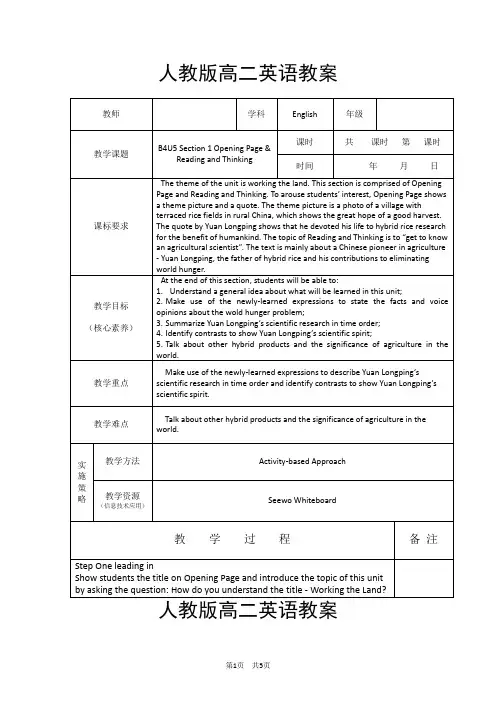
第1页 共5页 人教版高二英语教案
教师 学科 English 年级
教学课题 B4U5 Section 1 Opening Page &
Reading and Thinking 课时 共 课时 第 课时
时间 年 月 日
课标要求 The theme of the unit is working the land. This section is comprised of Opening
Page and Reading and Thinking. To arouse students’ interest, Opening Page shows
a theme picture and a quote. The theme picture is a photo of a village with
terraced rice fields in rural China, which shows the great hope of a good harvest.
The quote by Yuan Longping shows that he devoted his life to hybrid rice research
for the benefit of humankind. The topic of Reading and Thinking is to “get to know
an agricultural scientist”. The text is mainly about a Chinese pioneer in agriculture
- Yuan Longping, the father of hybrid rice and his contributions to eliminating
world hunger.
教学目标
(核心素养) At the end of this section, students will be able to:
人教版高中英语必修五全册--核心词汇短语归纳 unit 4
1 Unit 4Making the news
【基本单词】
1. delighted adj. 快乐的; 欣喜的
2. submit vt. 递交; 呈递(文件等)
3. eager adj. 渴望的; 热切的
4. concentrate v. 集中; 聚集
5. update vt. 更新; 使现代化
6.acquire v. 获得; 取得; 学到
7. meanwhile adv. 其间; 同时
8.accuse vt. 指责; 谴责; 控告
9.guilty adj. 犯罪的; 有罪的; 内疚的
10. demand n. 需求; 要求 vt. 强烈要求
11. publish vt. 出版; 发行; 发表; 公布
12.thorough adj. 彻底的; 详尽的
13.accurate adj. 精确的; 正确的
14.polish vt. 擦亮; 磨光; 润色
15. process vt. 加工; 处理 n. 过程; 程序; 步骤
【派生单词】
16. assist vt. 帮助; 协助; 援助
assistance n. 帮助; 援助
assistant n. 助手; 助理; 售货员
17. assess vt. 评估; 评定
1 Assessment n. 评定; 评价
18. inform vt. 告知; 通知
information n. 信息; 消息
19.senior adj. 年长的; 高年级的; 高级的
(反义词)junior adj. 青年的; 低下的
20. approve vt. 赞成; 认可; 批准
approval n. 批准; 认可
【短语】
1. 集中; 全神贯注于 concentrate on
2. 依靠; 依赖 depend on
3. 因……指责或控告…… accuse … of
人教版高中英语必修二Unit5 Music-Reading for Writing教案
2019新人教高中英语必修二
Unit5Music-Reading for writing公开课教案
Analysis of the materials:
1. What
- Theme: Write a speech on how music changed your life.
- Thematic Context: Man and self
- Main content: A speech shares a personal story about how music changed
people’s life.
2. Why
Author’s intention:
to inform readers of the positive influence of music on our daily life;
to inspire readers to draw energy and power from music;
to draw readers’ attention to relationship between music and personal life.
Value Orientation:
Thematic Meaning: Exploring the power of music, live a passionate life.
3. How
Text type: practical writing - speech
Language features: the language is concise and touching. By using rhetorical
devices, transitional words and contrastive words, it’s not difficult for students to
summarize the structure, learn its writing techniques, imitate it and apply some
高中英语Unit5FirstaidSectionⅢGrammar_省略教案含解析新人教版必修
1 Section Ⅲ Grammar— 省略
语法图解
探究发现
1.(You) Come in, please!
2.John is a lawyer, and his wife (is) a cleaner.
3. a.First degree burns turn white when (they are) pressed.
b.If burns are on arms or legs, keep them higher than the heart, if (it is)
possible.
4. a.He is the man (who/whom/that) you can depend on.
b.There is no doubt that John’s quick thinking and the first aid skills
(that/which) he learned at school saved Ms Slade’s life.
5.The boy wanted to play football in the street, but his mother did not allow
him to (play football in the street).
6. It shows (that) a knowledge of first aid can make a real difference.
[我的发现]
(1)例句1为简单句中的省略。
(2)例句2为并列句中的省略。
(3)第1组例句为状语从句的省略。当状语从句的主语和主句的主语指的是同一人或物,且由人称代词的主格担当,或当状语从句的主语为it,而且从句谓语中含有be动词时,可以把从句的主语和be动词一起省略。
(4)第2组例句为关系代词的省略。当关系代词在限制性定语从句中作宾语时可以省略。
(5)例句5为不定式的省略。有时可用不定式符号“to”来替代上文中出现的不定式。
2019统编人教版高中英语必修第二册unit 5《Music》全单元教案教学设计
【2019统编版】
人教版高中英语必修第二册Unit 5《Music》
全单元备课教案教学设计
Unit 5 Music
5.1 Listening and Speaking
5.2 Reading and Thinking
5.3 Discovering Useful Structure
5.4 Reading for writing
5.5 writing
Unit 5 Music
Listening and Speaking
【教学目标】
1. Instruct students to get main facts by listening and motivate them to talk about
the topics about music, the types of music, and how the music makes them feel.
2. Develop students’ sense of cooperative learning and individual thinking
capability.
3. Develop students’ different listening skills to solve different listening
comprehensive problems.
4. Help students to understand how to use the structures “past participle as
adverbial”.
【教学重难点】
Prompt students to talk about the related topics, such as types of music they
know, their favourite type of music, how music makes them feel, and how to use past