
ChangeControl-变更控制
White Paper:Change Control – Continuous Quality Improvement in FDA and ISO EnvironmentsIntroductionGlobalization of the marketplace has greatly intensified competition. It has increased the pressure on manufacturers to develop innovative, high-quality products faster and at a lower cost. To stay competitive, manufacturers must be quick to meet customer demands and even quicker in adapting to changing market conditions.The situation could not be more acute than in the FDA and ISO environments, where manufacturers must contend not only with cutthroat competition and a dynamic market, but also stringent regulatory requirements. Consider the fiercely competitive pharmaceutical industry. Only one of every 10,000 potential medicines investigated by American research-based pharmaceutical companies makes it through the rigorous FDA approval process, according to the Pharmaceutical Research and Manufacturers of America. It takes about 15 years at a cost of more than $800 million before a new medicine is approved.The road toward product development — and FDA approval or ISO certification — is clearly long, arduous, and costly. After a product is launched in the market, the manufacturer must continue to comply with regulatory requirements to stay in business. Regulations exist to ensure the safety and reliability of products. In this context, any change that affects the “purity” and effectiveness of the approved product is critical.Definition of ChangeIn the manufacturing environment, change refers to any modification in equipment, manufacturing materials, facilities, utilities, design, formulations, processes, packaging/labeling, computer systems, and all associated documentation (SOPs, quality manual, etc.).A change may be a simple adjustment brought on by a new customer specification, or an updated document, or a part replacement, or other production needs. It may be caused by a deviation from an approved regulatory filing or written procedures. A change may be temporary or permanent, routine or emergency, innocuous or serious enough to shut down production.The fact that change is inevitable makes control a critical factor, especially in FDA and ISO-environments, where inappropriate or “uncontrolled” changes could affect the safety and reliability of products and directly impact public health and safety.Here’s an example. On Oct. 24, 2005, the FDA announced a voluntary recall of certain models of Omron instant thermometers because the thermometer tips could potentially overheat and pose risk to young children using the device. The FDA noted that the overheating was a result of a change in the manufacturing process. The agency’s press release was brief and did not describe the circumstances of the change that caused the quality problem, but it illustrates the critical implications of change in the manufacture of medical devices in this case, or any other product for that matter. Whether it’s a car or a computer or a pacemaker, the goal of regulatory bodies is to protect public safety by ensuring the highest quality standards. For this reason, the concept of change control is closely interweaved with FDA and ISO compliance.Regulatory RequirementsChange control requirements for medical device companies are outlined in FDA’s 21 CFR Part 820.30 (design changes), 820.40 (document changes), and 820.70 (production and process changes). 21 CFR Part 820 requires that manufacturers establish written change control procedures, which describe company-approved procedures.For pharmaceutical companies, written procedures are considered part of Current Good Manufacturing Practice (CGMP) outlined in 21 CFR Part 210-211. Any changes in production and processes must be controlled — meaning recorded, reviewed, and approved by the quality control unit. CGMP requirements are meant to prevent harm by building quality into the development and production of medicines.Manufacturers certified to ISO 9000:2000 and ISO 13485 standards are required to ensure that any changes affecting the quality management system (including product requirements, design, and development changes) should be controlled.The underlying message in these regulations is that all changes should be made according to approved (approval implies successful testing or thorough review/investigation) written company policies and procedures. Change control procedures have to be written as a way of standardizing instructions. Written procedures are also more reliable compared with passing on information verbally. “Uncontrolled” change in this context refers to modifications made without review and approval of the quality control unit and other departments affected by the change.In the FDA and ISO environments, strict adherence to approved policies and procedures is key in keeping manufacturing operations in a state of control and it is what makes change control crucial.Elements of Change ControlChange is typically introduced by an initiator or originator. Depending on the company and industry, the initiator mayor may not be the person who will carry the change through implementation. Initiating a change usually involves filling in a change request form, which then moves through a process or system of review and approval. Most organizations have a change control committee or board, which may be a single entity for an entire company, or there may be onefor a company’s every manufacturing site. The committee usually includes representatives from different departments involved in production, such as quality, manufacturing, regulatory affairs, and engineering. Depending on the change, the committee may also involve legal, sales, or marketing departments.For pharmaceutical companies, the CGMP requires that all changes should be reviewed and approved by the quality control unit. In these companies, there may be a “change administrator,” a role usually assumed by the quality unit. Change control records usually cover: identification of the item/entity being changed, a description of the change, identification of the affected documents, signatures of the approvers, approval date, and effective date.In the medical device industry, each modified device, accessory, labeling, packaging, and process must be thoroughly verified and or/validated by the appropriate department. The change control committee then reviews the test results and other pertinent information.ChallengesA change control system is necessary to prevent inappropriate modifications. While this sounds simple, implementation can be complex and an inadequate system can cause internal confusion, noncompliance, or worse, a product recall or a product liability lawsuit.What makes change control so challenging? There are many factors, but the following are the most common issues: Poor Communication – Lack of communication between departments, failure to follow up or escalate change requests, and delayed or inappropriate notification of changes made by suppliers are some of the communication-related issues that impact the change control process. Companies using a paper-based change control systemare likely to rely on face-to-face exchanges, such as change control board meetings, to discuss changes. Theeffectiveness of these meetings depends on their frequency and the availability of members to meet as emergency changes arise.Poor Turnaround – Timeliness can make or break a product’s chances of succeeding in the market. Companies that rely on a manual system to generate data and to route and track submissions and change orders are likely to have poor turnaround for change implementation because the system requires more time and effort. The problem becomes worse when there is an unexpected change — a deviation — and supporting data is not generated in atimely manner. Delays may also result because of failure to recognize the urgency of a change and absence of a contingency plan for certain types of changes.Ineffective Documentation – A manual system makes it more difficult to update documentation, including revision history, and to find/retrieve necessary data to support a change. The proposed change may be delayed when an outdated record does not show revision history, or testing may be duplicated because documentation has not been updated with results of a previous testing.Training not Integrated with Change – Adequate training of personnel is a prerequisite in both FDA and ISO environments. When training control is not connected to the rest of the quality process (such as in manual systems), keeping training current with procedures that have changed can be difficult. Training tasks can easily fall through the cracks if employees are not as vigilant in seeking them.The MasterControl Solution MasterControl Change Control™ is a robust solution designed to simplify the change control process by automating and effectively managing every step of the way, from submission through actual implementation, verification, and close of project. Here’s how MasterControl’s powerful features address major challenges in change control:Improved Communication – Communication breakdown is likely to happen in companies that rely on tools and processes that are not connected. MasterControl is an integrated solution that connects different departments with each other and with data and processes under a secure and centralized system. This connectivity vastly improves communication and increases efficiency through automatic task assignment, routing, scheduling, notification, and escalation of overdue tasks. MasterControl is Web-based, so even suppliers and others outside the company (off-site or traveling employees) who need to participate in change control can do so from virtually anywhere. Faster Turnaround – MasterControl integrates and streamlines the entire change control process for faster turnaround.A pre-configured, multi-page form helps collect and track data from submission through close of project. The form incorporates priority level by identifying the change as routine or temporary or emergency. It prompts risk assessment by asking the initiator to evaluate the change in terms of training, validation, and regulatory requirements.MasterControl’s Organizer, similar to Windows Explorer, is an easy-to-use tool for search and retrieval of documents. All SOPs and other documents related to a particular change can be grouped together. Users can create virtual folders within Organizers that will automatically retrieve documents based on pre-defined queries.MasterControl’s reporting capabilities provide real-time status for all change control tasks. Effective Documentation – MasterControl automates documentation and reporting functions for increased efficiency and effectiveness.It automatically provides revision history through the InfoCard, a MasterControl tool that provides basic information about a document. The InfoCard also provides the document’s approval history. All changes made to the InfoCard of every document are tracked, including reason(s) for every change.MasterControl maintains a secure, time-stamped audit trail as required by FDA’s 21 CFR Part 11. The audit trail documents the identity of anyone who creates or modifies an electronic record, when the action occurred, and the changes made to the record.•••••Integrates Training with Change Control – With MasterControl, the change control process can be integrated with training control. Any change to a document or process that warrants new training will automatically invoke training tasks upon approval of the change. MasterControl can automate the process of distributing online exams with the training, and even includes automatic grading.ConclusionIn this Age of the Internet, consumers worldwide have become more aware about product quality. In response, manufacturers are changing their business philosophy. Customer satisfaction and continuous improvement of product quality have become the objectives not only of regulatory bodies, but manufacturers themselves. At the operational level, the focus is moving from detection to prevention. Companies recognize that it’s their primary responsibility to determine if a proposed change could significantly affect safety or effectiveness of a product — and not for the FDA inspector or ISO auditor to spot. Manufacturers increasingly realize that effective change control is integral to continuous quality improvement, which can ultimately help them increase customer satisfaction and prevent product recalls, product liability actions, and regulatory violations.About MasterControl Inc.MasterControl Inc. has been at the forefront of providing quality management software solutions since 1993. Hundreds of companies worldwide use MasterControl to help ensure compliance with FDA regulations such as 21 CFR Parts 11, 210-211, 820, 606; ISO quality standards such as ISO 9000, ISO 13485, ISO 14000; and Sarbanes-Oxley Act requirements. In addition to providing off-the-shelf products, MasterControl also offers comprehensive technical and customer support, including product training, implementation, and validation services.For additional industry white papers about automating quality and regulatory processes, visit , or call, 800-825-9117.MasterControl’s integrated quality management system helps connect quality processes enterprise-wide. The solution provides automatic triggers to ensure tasks for handling quality-related incidents don’t fall through the cracks. MasterControl’s integrated architecture ensures that the completion of one system process automatically launches the next quality sub-system until the process loop is closed. Managers have analytical and reporting capabilities at their fingertips to track and manage each quality process through completion.© 2006 MasterControl Inc. All rights reserved.Page White PaperMasterControl Inc.0 S. 000 E. Suite 1 0 Salt Lake City, UT 8 1 1 P. 800.8 .9117F. 801.9 .7088。
变更控制管理流程

变更控制管理流程背景在业务和项目管理中,变更是一种常见的现象。
为了确保变更能够被有效地管理和控制,变更控制管理流程被引入。
本文将介绍一个标准的变更控制管理流程,以帮助组织和团队在实施变更时更加高效和有序。
目标- 确保所有变更都被审查、评估和批准,以避免未经授权或未经评估的变更对业务或项目带来风险和问题。
- 确定变更的影响范围和风险,在变更实施前进行充分的准备工作,以降低不必要的风险和影响。
- 提供透明和可追踪的变更控制过程,便于审计和追踪变更历史。
- 促进有效的沟通和协作,在变更实施过程中各方能够及时获得相关信息和决策。
流程步骤1. 变更请求- 发起人提交变更请求,并提供详细的变更描述和理由。
- 变更请求应包括所涉及的业务或项目范围、影响和风险评估。
2. 变更评估- 变更评估小组(Change Assessment Group)对变更请求进行评估。
- 评估包括变更的商业影响、技术可行性和资源需求。
- 评估结果将用于确定变更是否应被批准、拒绝或需要进一步的审查。
3. 变更批准- 变更委员会(Change Control Board)对变更请求进行审议和决策。
- 变更委员会由相关利益相关方组成,包括业务代表、项目经理、技术专家等。
- 变更委员会根据评估结果和变更的优先级等因素,决定是否批准变更。
- 批准的变更将进入下一步骤,否则将结束变更流程。
4. 变更计划- 变更计划包括变更的详细实施计划、资源分配和沟通计划等。
- 变更计划应充分考虑风险管理和变更影响管理。
5. 变更实施- 根据变更计划进行变更实施。
- 变更实施过程中需确保变更的正确性和可追溯性。
- 变更实施后,进行验证和确认,确保变更的预期效果和质量。
6. 变更关闭- 在变更实施后进行变更关闭。
- 特定文件和记录将被归档和存档,便于审计和追踪。
总结变更控制管理流程提供了一种系统化、透明和可控的方式来管理和处理业务和项目中的变更。
通过严格遵循这个流程,组织和团队可以更有效地处理变更,并减少变更可能带来的风险和问题。
软件配置管理
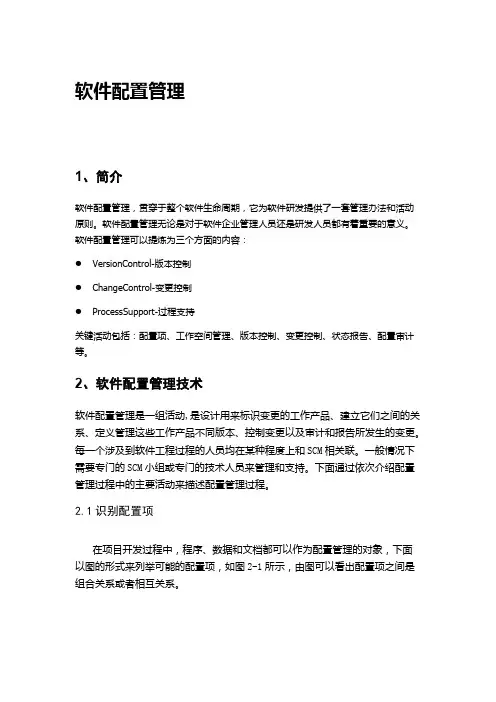
软件配置管理1、简介软件配置管理,贯穿于整个软件生命周期,它为软件研发提供了一套管理办法和活动原则。
软件配置管理无论是对于软件企业管理人员还是研发人员都有着重要的意义。
软件配置管理可以提炼为三个方面的内容:●VersionControl-版本控制●ChangeControl-变更控制●ProcessSupport-过程支持关键活动包括:配置项、工作空间管理、版本控制、变更控制、状态报告、配置审计等。
2、软件配置管理技术软件配置管理是一组活动,是设计用来标识变更的工作产品、建立它们之间的关系、定义管理这些工作产品不同版本、控制变更以及审计和报告所发生的变更。
每一个涉及到软件工程过程的人员均在某种程度上和SCM相关联。
一般情况下需要专门的SCM小组或专门的技术人员来管理和支持。
下面通过依次介绍配置管理过程中的主要活动来描述配置管理过程。
2.1识别配置项在项目开发过程中,程序、数据和文档都可以作为配置管理的对象,下面以图的形式来列举可能的配置项,如图2-1所示,由图可以看出配置项之间是组合关系或者相互关系。
图2-1可能的配置项2.2基于配置项版本控制版本控制是将规程和工具相结合来管理在软件工程过程中所创建的配置对象的不同版本,通过“属性元组”等其它技术来控制完整版本中的“变体”,采用不同的工具不同的技术,版本控制的机制会有一些不同。
2.3变更控制变更在软件开发过程中是不可避免的,但过于频繁的变更也会对项目的开发产生负面的影响,如影响项目的进度、浪费人力物力,因此需要对变更进行控制。
变更控制可以依照如下的步骤来进行:(1)提交变更请求;(2)审核变更请求;(3)分配和确定任务;(4)提取变更项;(5)执行变更;(6)审核变更;(7)更新配置管理库。
整个变更控制的产物主要是变更请求单、变更报告单、工程变更单或变更确认单等。
2.4配置审计配置审计一般包括两种,一种是正式的技术评审,另一种是软件配置审计。
在正式的技术评审中,将关注已经被修改的配置项的正确性,配置项的评估配置项,以确定它与其他一致性、遗漏及潜在的副作用。
变更控制Change control WHO

13
PRINCIPLES OF CHANGE CONTROL
• Change control is not department-specific, but encompasses the whole company.
The change control • monitors all types of changes, which can influence the process or product quality and • states the measures necessary for implementing the change or • decides that a change should not be implemented.
8
LIFE CYCLE
CHANGES AND APR
OOS
Deviations Audits Complaints
Changes in materials
Improvement (equipment, systems, procedures, etc.)
Root Cause Analysis CAPA proposal Risk assessupferman, Industry Pharmacist
Alain Kupferman
Pharmacist (ULB, Brussels, Belgium) Industry Pharmacist (Qualified Person)
比利时
Alain Kupferman
11
The task of change control
PRINCIPLES OF CHANGE CONTROL
• In the WHO-GMP guideline glossary there is the definition of the term “change control”:
gmp 中的名词解释
gmp 中的名词解释在制药行业中,Good Manufacturing Practice(GMP)是一项非常重要的质量管理体系,旨在确保药品的质量与安全性。
为了帮助读者更好地理解GMP体系,并加深对其中涉及的各个名词的理解,本文将对GMP中的一些重要名词进行解释。
一、操作规程(Standard Operating Procedure, SOP)操作规程是GMP体系中非常重要的一部分,它详细规定了生产、检验和验证过程中所需采取的步骤。
通过制定操作规程,能够确保生产流程的稳定性和一致性,最大程度地减少产品质量问题的发生,并对生产环境、设备和人员进行规范管理。
二、验证(Validation)验证是指通过一系列系统性的测试和分析,确认过程、设备和方法能够按照预期目标进行操作并生成符合要求的产品。
验证的目的在于评估生产过程中的关键环节,以确保产品的质量和安全性,并且验证结果必须进行记录和确认。
三、记录(Documentation)GMP体系中的记录是指生产和质量控制过程中所涉及的各种文件、记录和报告。
记录能够帮助跟踪和追溯产品的历史数据,并为质量控制和合规审计提供可靠的依据。
因此,记录的准确性和完整性对于GMP的执行至关重要。
四、纯化(Purification)纯化是制药过程中的一项重要操作,它旨在从混杂物中分离出所需的化合物或活性成分。
通过纯化,可以提高药品的纯度和质量,并确保药物的安全性和疗效。
纯化方法包括物理方法(如过滤、结晶等)和化学方法(如溶剂萃取、冷凝等)。
五、风险评估(Risk Assessment)风险评估是GMP体系中的一个重要环节,它通过系统分析和评估潜在风险,以确定可能对产品质量和安全性造成威胁的因素,并根据评估结果制定相应的控制措施。
风险评估能够帮助制药企业更好地识别和管理各类风险,从而提高产品质量和安全性。
六、再验证(Revalidation)再验证是在生产工艺、设备或方法发生重大改变后进行的一项验证活动。
Change control变更控制

Pharmaceutical Services Corporation 美国医药服务有限公司Change Control变更控制Topics题目•What is change?什么是变更?•What is change control?什么是变更控制?•Why do we need change control?为什么需要变更控制?•What should be covered by change control?变更控制应包括什么?•What are the requirements of the change control process?变更控制过程的要求是什么?Definition定义•What is change?什么是变更?•To alter, to become different改变,变得不同•Changes can be either planned or unplanned 变更可能是有计划的,也可能是没有计划的What is Change Control?什么是变更控制?• A formal system for evaluating all changes that may affect the quality, safety and efficacy of the product一个正式的系统,用于评价所有可能影响产品质量、安全和效力的变更。
Why?为什么?•It is a regulatory requirement法规要求•It is a way in which the correct personnel can be made aware of impending changes能够使合适的人员知道即将发生变更的一种途径•It is a way of identifying the work needed to support a change识别为支持变更所需要进行的工作的一种途径•It prevents constant trivial “evolutionary”change 防止不断的没有价值的“进化”变更•Raw materials, specifications, analytical methods, facilities, support systems, equipment (including computer hardware), processing steps, labeling and packaging materials, and computer software原料、标准、分析方法、厂房、支持系统、设备(包括计算机硬件)、工艺步骤、标签、包装材料和计算机软件•Must include:必须包括:–Identification of changes subject to change control 确认需要经过变更控制进行的变更–Documentation of proposed changes提议变更的文件–Evaluation by Quality质量部的评估–Work required to support change支持变更所需要进行的工作–Record of changes变更记录–Audits of Change Control system变更控制系统的审计EU GMP•The basic requirements of GMP are that:GMP的基本要求是–(ii) critical steps of manufacturing processes and significant changes to the process are validated要对生产工艺的关键步骤和工艺的重要变更进行验证•Regular periodic or rolling quality reviews of all licensed medicinal products should be conducted and should include:对所有注册药品要进行定期或周而复始的质量审核,其包括:–A review of all changes carried out to the processes or analytical methods对所有工艺或分析方法进行的变更要进行审核FDA Oral Solid Dosage guidanceFDA口服固体制剂指南•As with other dosage forms, it is important for the firm to carefully control how changes are made in the production of topical products. Firms should be able to support changes which represent departures from approved and validated manufacturing processes.同其他制剂一样,企业认真地控制外用药产品生产的变更是十分重要的。
中译文 变更控制Change control WHO

为大家提供优质的药品
变更控制定义和审批 示例变更
示例 等级
按比例放大批次大小
清洗材料-产品接触 服装-无菌 电脑系统 承包实验室 承包制造商 对等的设备 不同的设备 工作时间 工艺规程-变更 配制方法
2
2 1 2 2或3 3 1 2 1 3 2或3
包装(不同材料的主要成分)
3
为大家提供优质的药品
变更控制定义和审批 示例变更
• •
修正 •审核 •提供文档进行佐证
•
示例
制造商变更:原始 •更换装置(其为同 材料的其它合成路线 种设计的一部分) (其它杂质) •地面清洁剂的变更 •将工艺转移至另一 •工作服洗衣室的变 个工作场址; 更(无菌的或抗菌 •产品成分的变更 的区域) •工艺参数的变更
工作时间的变 更
•
在行政区域安 装空调
• 鉴于变更控制被视作为药品质量保证系统必不可少的一部 分,那么对其质量保证承担部分责任则应当是符合逻辑的 。(质量保证代表和质量保证主任)
10
为大家提供优质的药品
变更控制的原则 • 变更控制的范围并非仅局限于某个专门的部门, 而是覆盖整个公司的。
变更控制 • 监控可能会影响工艺或产品质量的所有变更类型 ;以及 • 称述执行变更所必需的措施;或 • 决定不应当执行某个变更。
为大家提供优质的药品
变更控制项目
•
公司为何种以及多少变更种类进行了分级不是决定性的 ,但是公司是如何保证这些需要控制的变更则是被公认 为具有决定性的并且应当按照定义的程序进行实施。
23
为制造商和药品生产质量管理规范检查员 精选的药品生产质量管理规范主题 内罗比,2011年5月9日-12日
为大家提供优质的药品
PMP实施变更的五个步骤
PMP实施变更的五个步骤引言项目管理(Project Management)是指通过运用知识、技能、工具和技术,对项目中各种活动的规划、组织、指挥和控制,以达成项目的目标。
在项目执行过程中,难免会遇到需求变更、项目范围变更等情况,因此,实施变更管理是项目管理中的重要环节之一。
本文将介绍PMP实施变更的五个步骤。
第一步:变更识别变更识别是变更管理的第一步,主要是通过对项目进度、质量、成本、范围等方面进行分析,确定项目变更的识别点。
变更识别要点: - 审查项目相关文档,如项目计划、需求文档、设计文档等,找出可能引起变更的因素。
- 针对项目执行过程中出现的问题和风险,进行主动的分析和评估,识别出可能需要变更的部分。
- 当项目执行过程中出现需求变更时,要及时与项目干系人进行沟通,确保变更的合理性和可行性。
第二步:变更评估变更评估是对变更需求进行评估,包括变更的成本、进度、风险等方面进行分析,并对其影响进行评估。
变更评估要点: - 确定变更需求的具体内容和范围。
- 分析变更对项目成本、进度、质量、范围等方面的影响。
- 评估变更带来的风险,并制定相应的应对措施。
- 针对变更需求进行优先级排序,以确定变更实施的优先顺序。
第三步:变更决策变更决策是对变更需求进行决策,并在变更管理委员会(Change Control Board)的指导下,确定是否批准变更。
变更决策要点: - 组织变更管理委员会,明确变更决策的流程和角色。
- 召开变更管理委员会会议,对变更需求进行讨论和决策。
- 根据变更管理委员会的决策结果,对变更需求进行批准或否决。
- 如果变更需求被批准,更新项目计划、需求文档等相关文档。
第四步:变更实施变更实施是根据变更需求和变更决策的结果,对项目进行调整和改进。
变更实施要点: - 更新项目计划,包括调整项目进度、里程碑等。
- 修改需求文档,确保新的变更需求得到充分记录和传达。
- 与项目干系人沟通,确保他们对变更后的项目目标和计划有清晰的认识。
变更控制Change control
1、目的Purpose贯彻实施正式的书面的变更控制程序是为了有计划地评价所有变更可能对中间体、最终产品质量和SHE带来的影响。
A formal, written change control procedure will be implemented and followed that is designed to evaluated all changes that may affect the SHE, the quality of intermediates and final product.2、范围Scope2.1本规程适用于司。
This procedure is applicable to Xinhua-Chemferm.2.2该程序适用于公司各部门对已确立的所有程序所进行的变更。
This procedure is applicable to all departments’ established document for changing.2.3该规程适用于对产品质量或SHE有影响的工序或系统的变更, 包括, 但不限于:This procedure applies to the changes that involve effects to the products quality or the SHE aspects in the following process and /or systems, including, but not limited:2.3.1原料和供应商, 标准和有效期, 工艺过程, 分析方法, 标签和包材, 设备, 设施, 辅助系统, 计算机的硬件和软件Raw materials and suppliers, Specifications and valid date, Process steps, Analytical methods, Labeling and packaging materials, Equipment, Facilities,内部使用Internal use 正式文件OfficialSupport systems,Computer hardware and software.3、职责Responsibility3.1 总经理负责批准本程序。
变更控制管理规定
变更控制管理规定建立变更控制管理程序,对所有影响产品质量的变更进行评估和管理,以保证公司生产质量管理体系的持续稳定、合理和有效性。
第一条:定义:变更是指即将准备上市或已获准上市的药品在生产、质量控制、使用条件等诸多方面提出的涉及来源、方法、控制条件等方面的变化。
这些变化可能影响到药品安全性、有效性和质量可控性。
包括药品生产、质量控制、使用在内的整个药品生命周期内任何与原来不同规定和做法。
第二条:变更的分类2.1次要变更:是指变更范围对质量没有影响或用验证结果支持过程或确认的变更,没有影响或影响甚微,但对质量与变更前有等效性的变更。
次要变更主要包括但不限于下述内容:物料质量标准中检测项目的增加或生产工艺过程中检测项目的增加;关键工序进行的同类型或相似的设备的变更;缩小参数限度;工艺控制参数变更至更严格的范围;生产辅助设备(动力中心、计量器械)的变更;非关键物料供应商的改变;其他不涉及生产过程中的参数或质量标准的轻微调整。
2.2主要变更:直接影响产品内在质量(安全性、有效性)或涉及注册标准改变的变更。
一般包括下列内容:主要工艺路线、原料及处方的改变;使用的起始物料和关键原料的改变(包括关键供应商的变更);关键设施和设备的改型;产品内包材种类的变更;外包装材料的变更;关键工艺条件和参数的改变;关键原材料、半成品、成品以及过程产品的分析方法作重大的增补、删除或修改;产品有效期(复验期)的变更;产品质量标准的变更(包括各国药典或国家标准升级改版);产品储存条件的变更;厂房或生产地址的变更;其他对半成品及成品质量有较大影响的变更。
2.3对于其他未包括在以上范围内的变更,根据质量管理部评审结果确定。
第三条:变更控制总体要求任何可能影响产品质量或重现性的变更都应得到有效控制,未通过变更控制管理程序不得擅自进行变更。
所有的变更信息均应传递至变更涉及部门。
第四条:变更控制程序1变更申请部门需填写《变更控制表》,详细说明变更内容及变更理由,然后将《变更控制表》交到质量管理部QA办公室。
change of control条款
change of control条款
“Change of Control条款”一般指“控制权变更条款”,是指当特定事件发生,公司可以选择以面额的100%赎回债券,或在下一个付息日将票息上调300个基点(+3个百分点)。
“控制权变更”事件可能包括公司被收购、重组、主要股东变更等。
该条款的目的是保护债券持有人的利益,防止控制权变更可能导致的风险。
例如,如果公司被收购,债券持有人可能会担心新股东不愿意履行债务,或者改变债券的条款。
因此,“控制权变更条款”可以确保公司在这种情况下赎回债券,或者提高票息,以保护债券持有人的利益。
需要注意的是,“控制权变更条款”的具体内容和执行方式可能因发行人、债券类型和市场情况等因素而有所不同。
在进行债券投资时,投资者应该仔细阅读相关的条款和条件,了解该条款的具体规定和潜在影响。