
八年级英语下册Unit2Water教案(新版)牛津上海版 (1)
Unit 2 Water1教学目标Language learning objectivesTo learn the new words and phrasesTo be familiar with water’s journeySkill and ability objectiveTo develop listening and speaking skillsInstructional objectiveTo be aware of the preciousness of water2学情分析我任教的是本校一个普通班级,在过去的两年多时间里,充分利用好教材(牛津教材)所提供的丰富教学资源,我认真解析文本、创设语言学习环境、设计和实施教学活动,学生的英语听说读写的能力得到了有效的训练和提升。
3重点难点本课教学内容是牛津教材8B Chapter 6,是一篇关于水的科普性短文。
文章较长,且有一定难度,无法在30分钟时间内完成对整篇文章的教学,所以我选择文章中介绍水流程的一段。
原因是:1)这部分相对独立,意思完整;2)这部分是课文学习的教学重点;3)这部分包含了本课的重点词汇。
本课作为第一教时,我希望能突破教学的重点和难点,为后面的教学打好基础,消除障碍。
4教学过程学时重点Language learning objectivesTo learn the new words and phrasesTo be familiar with water’s journeySkill and ability objectiveTo develop listening and speaking skillsInstructional objectiveTo be aware of the preciousness of water学时难点作为科普性文章,单词有一定难度,需要进行图片,实物等引入帮助学生理解单词全文围绕水的旅程展开,对重要句型的运用有较高要求,需要进行铺垫教学活动活动1【导入】课文导入:Do you want to know more about water? Do you want to talk with water? Can wat er talk? In today’s le sson water can really talk. I am a drop of water today. You can call me Miss water. Look at the title “Water Talk”I will talk with you. It is a good chance for you to ask me some questions. Go ahead!How do you come here?Where can we see you?通过问题--“What does the sound make you think of?”,导入主题,活跃气氛,同时检测学生已有知识。
创设情景,明确师生角色。
教师作为一滴水和学生展开对话。
启发学生发问,激发学生的求知欲望,真正体现了学生的学习主体性。
以解决问题为主线开展教学是这节课的主要特点。
这节课的教学围绕三个主要问题展开:1)Where are you (water)? 2)What do you(wate r) do there? 3)How do you (water) come here?活动2【讲授】单词教授和巩固Learning the new words and phrasesLead-in the new words and phrasesYou will see me in the cloud, waterfall, pipes.You can see me in the cloud. And I am floating comfortably in the sky. Can you guess the Chinese float?You can see me in the waterfall. What is waterfall? I am speeding down the moun tain into the river. That is waterfall. Speed here is a verb, means move quickl y. Speed –sped –sped.You can see me in the pipes. How do I come to your bathroom from the pipes?People pump me into the bathroom. Pump can also be used as a verb. It means pus h by machine.Practising the new wordsNow you’ve learned new words, try to learn them by heart.(a game-hot seat)I need chairs. Which game will we play?Let’s play the game hot seat as usual! You can use b ody language.float--- stay on top of a liquid or air.speed --- move quicklythorough --- completepump--- push by machineA water treatment works---- a place where water can be cleaned before it is u sed.活动3【讲授】课文学习Learning the text of the water’s journey(1) Listening to the text and answering the questionsWhat’s the next question ?How do you come here?It is a difficult question. I had a long journey before I came to you. You ca n find the answer in your text.Listening carefully about the text, I have two questions for you.How long is my journey?-----24 daysWhat do you think of the journey? I have been to a lot of places, such as(2) Reading the textLet’s find the places in our text . Open your books. Page 75 . From…to…First, read it together!(3) Watching the flashThen watch the flash!After that we will try to complete the map. There is a map on page 77. It shows my journey.Complete the blanks. You can discuss with your partner.活动4【讲授】课文巩固4) Retelling the text group by group (competition)Now you are familiar with the journey. Let’s have a competition among groups.I ‘d like you to say out the journey step by step.Let’s find out which group gets the most scores. Who’d like to be my assistan t? . Congratulations!(5) Doing a quiz on water’s journeyNow have you got the answer to the question “How do you come here?”We have answered this question. But I think you still have some questions about water. So let’s do a quiz on water’s journey. Now what you are going to d o i s ,first, think of more questions , second, share your ideas with your group me mbers. Then I will leave you some time to raise your questions. The questions a re mainly about the water’s journey.I want to invite some students to come here to answer the questions form us. Wh o’d like to be the drops of water?是以课文学习为重点,希望通过扎实有效的训练,真正体现学生学习的过程。
课文教学主要有以下几个步骤:1)听录音回答问题;2)读课文纠正发音;3)观看flash短片,加深对课文的理解;4)填写地点;5)动词配对练习;6)造句练习串联过程;7)小组竞赛复述水的流程。
活动5【活动】拓展训练Post-task activities:Talking about water againAfter such a long journey, I came to you at last. And we have talked a lot abou t water. Now what do you think of me ? What should you do to me?Precious means very valuable. Water is very precious. I know you don’t like it, but you have to .本节课的三个高潮分别是1)猜词竞赛活动;2)水流程接龙竞赛;3)有关水的quiz活动。
牛津上海版(三起)英语六年级下册Module 1 Unit 2 单元测试卷 (含答案)
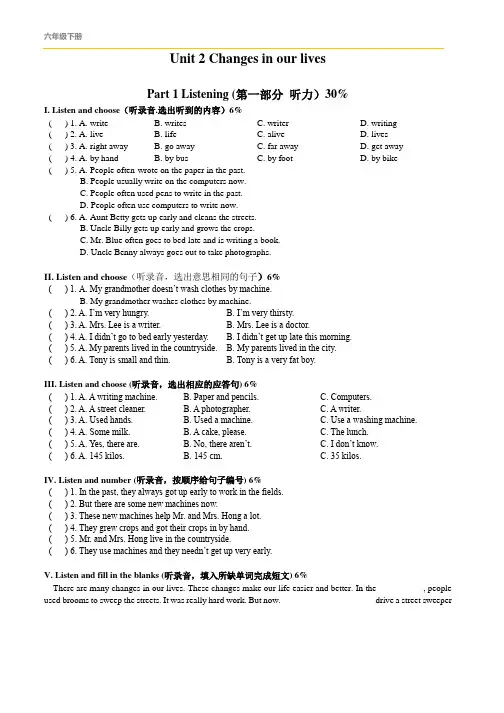
Unit 2 Changes in our livesPart 1 Listening (第一部分听力)30%I. Listen and choose(听录音.选出听到的内容)6%( ) 1. A. write B. writes C. writer D. writing( ) 2. A. live B. life C. alive D. lives( ) 3. A. right away B. go away C. far away D. get away( ) 4. A. by hand B. by bus C. by foot D. by bike( ) 5. A. People often wrote on the paper in the past.B. People usually write on the computers now.C. People often used pens to write in the past.D. People often use computers to write now.( ) 6. A. Aunt Betty gets up early and cleans the streets.B. Uncle Billy gets up early and grows the crops.C. Mr. Blue often goes to bed late and is writing a book.D. Uncle Benny always goes out to take photographs.II. Listen and choose(听录音,选出意思相同的句子)6%( ) 1. A. My grandmother doesn’t wash clothes by machine.B. My grandmother washes clothes by machine.( ) 2. A. I’m very hungry. B. I’m very thirsty.( ) 3. A. Mrs. Lee is a writer. B. Mrs. Lee is a doctor.( ) 4. A. I didn’t go to bed early yesterday. B. I didn’t get up late this morning.( ) 5. A. My parents lived in the countryside. B. My parents lived in the city.( ) 6. A. Tony is small and thin. B. Tony is a very fat boy.III. Listen and choose (听录音,选出相应的应答句) 6%( ) 1. A. A writing machine. B. Paper and pencils. C. Computers.( ) 2. A. A street cleaner. B. A photographer. C. A writer.( ) 3. A. Used hands. B. Used a machine. C. Use a washing machine.( ) 4. A. Some milk. B. A cake, please. C. The lunch.( ) 5. A. Yes, there are. B. No, there aren’t. C. I don’t know.( ) 6. A. 145 kilos. B. 145 cm. C. 35 kilos.IV. Listen and number (听录音,按顺序给句子编号) 6%( ) 1. In the past, they always got up early to work in the fields.( ) 2. But there are some new machines now.( ) 3. These new machines help Mr. and Mrs. Hong a lot.( ) 4. They grew crops and got their crops in by hand.( ) 5. Mr. and Mrs. Hong live in the countryside.( ) 6. They use machines and they needn’t get up very early.V. Listen and fill in the blanks (听录音,填入所缺单词完成短文) 6%There are many changes in our lives. These changes make our life easier and better. In the __________, people used brooms to sweep the streets. It was really hard work. But now. __________ __________ drive a street sweeperto clean the streets. I usually watched programs on TV, but now I never watch them on TV, because I can __________different programs on my __________. I’m a writer. I also write my books on it. Computers make my life fantastic. I __________in the future there will be more new things and t hey’ll help people a lot.Part 2 Reading and Writing (第二部分读写)60%I. Read and judge (判断下列各组单词划线部分的发音是否相同,相同的打“√”,不同的打“×”) 6%1. blow coat ( )2. house flower ( )3. hole crop ( )4. new grow ( )5. digital green ( )6. machine chair ( )II. Look and write (根据图意,填上适当的单词完成句子) 61. Little Match Girl is a p_____ girl. She has nothing to eat.2. The s_____ are very quiet in the early morning.3. Snow White and the seven dwarfs (矮人) had a happy 1_____4. I really like tennis. I am a tennis f_____.5. Do you want to go to the t_____ w ith me?6. My uncle d_____ a bus every day.III. Read and write (用所给单词的适当形式填空) 8%1. In the past, there __________ (be) a river near my home. Now there __________ (be) some tall buildings.2. __________ you __________ (sweep) the floor yesterday?3. __________ (farm) Wang grows vegetables.4. I’m tired. I would like to __________ (take) a rest.5. Don’t use that cup. It’s __________ (my).6. Sam usually __________ (go) to bed early, but yesterday he__________ (go) to sleep late.IV. Read and choose (选择填空) 10%( ) 1. The machine is helpful. It can clean the floor______.A. in the pastB. in a short timeC. in a long time( ) 2. I don’t like machines. I always do the washing ______.A. every dayB. by handC. by machine( ) 3. Long long ago, there ______ a lot of wild birds here.A. areB. wereC. is( ) 4. — How much do you weigh? —______A. 5 kilos.B. 500 kilos.C. 50 kilos.( ) 5. In the story, a fairy is ______.A. a beautiful ladyB. an ugly womanC. a handsome man( ) 6. — Helen, this new computer is for you. — ______A. How fun!B. How fantastic!C. How exciting( ) 7. I can’t find my broom, but it ______ here.A. wereB. wasC. is( ) 8. —How do you go to work every day? —______A. Take a bus.B. In the morning.C. On a bus.( ) 9. What do you usually do ______?A. nowB. after workC. yesterday( ) 10. I like using the digital camera, because______.A. it can take photosB. I can see the photos right awayC. it’s a good oneⅤ. Read and write(用适当的介词填空)6%1. Please take the photos ______ your new camera.2. My parents smiled ______ each other.3. I like washing my clothes ______ hand.4. We always enjoy ourselves ______ the weekend.5. My friend Peter has a house ______ a swimming pool.6. Would you like to go there ______ foot?Ⅵ. Rewrite the sentences (按要求改写下列句子) 7%1.People wrote letters on paper in the past. (改成一般疑问句)___________________________________________________________________________________________________ 2. Mr. White is a photographer. (对划线部分提问)___________________________________________________________________________________________________ 3. I was 100 days old in this photo. (对划线部分提问)___________________________________________________________________________________________________ 4. There was a lake in the village before. (对划线部分提问)___________________________________________________________________________________________________ 5. A street sweeper can clean the streets quickly. (对划线部分提问)___________________________________________________________________________________________________ 6. I would like to see a film. (另写一句,但意思不变)___________________________________________________________________________________________________ 7. Mr, apples, Lee, a, to, knife, cut, use, the (连词成句)___________________________________________________________________________________________________ VII. Read and match (读一读,把问答句配对) 6%( ) 1. Does your mother wash clothes by hand? A. I don’t know. But maybe they use a machine.( ) 2. You can make a wish on your birthday day. B. Yes. And I also take photos with my mobile (手机). ( ) 3. How does a farmer plant and get in crops? C. No. But there was a nice river outside the city.( ) 4. Was there a beautiful lake in the city? D. I don’t need any wishes, but thank you anyway.( ) 5. Do you take photographs with a camera? E. Usually. I rarely use pens and paper now.( ) 6. So you write on your computer? F. Oh, no. She used hands to wash clothes in the past. VIII. Read and choose (读一读,选择适当的句子完成对话) 5%Sam: Hi, Peter. ___1___Peter: Yes, it was a wonderful film.Sam: Really? What is the film about?Peter: ___2___Sam: Sounds interesting! So what changes did the film tell?Peter: A lot. For example, people rode horses or walked to a far place.Sam: ___3___Peter: Yes. There weren’t any mobile phones before.Sam: But now we can talk, read and watch TV on a mobile phone.Peter: ___4___ Inventions change our life.Sam: And make our life better! I want to see the film too!Peter: ___5___Sam: I think so.IX. Writing (请你写一写生活中,过去和现在有什么不一样,不少写六句) 6%In the past, people watched black and white TV. Now people watch color TV._______________________________ ___________________________________________________________________________________________________ ___________________________________________________________________________________________________ ___________________________________________________________________________________________________ ___________________________________________________________________________________________________ ___________________________________________________________________________________________________Part 3 Speaking (第三部分口语)10%I. Read aloud (朗读下列句子) 5%1. A photographer takes photos with digital cameras now.2. Fred and Doris smiled at each other and went away.3. I wish you a happy Spring Festival.4. There’s a poor farmer called Henry.5. Mrs. Hong got her crops in by hand in the past.II. Answer the question (回答问题) 5%1. Were you thin in the past?2. Do you live in the city or in the countryside?3. How does your mother wash dishes?4. What does a photographer do?5. What did people use to write in the past?Unit2 Changes in our livesPart 1 Listening (第一部分听力)I. Listen and choose (听录音, 选出听到的内容)1. In the future, I want to be a write. (C)2. There are a lot of changes and the life is better. (B)3. I will give you the book right away. (A)4. In the past, people usually went to work by bike. (D)5. People often use computers to write now. (D)6. Mr Blue often goes to bed late and is writing a book. (C)II. Listen and choose (听音,选出意思相同的句子)1. My grandmother likes washing clothes by hand. (A)2. I would like a glass of water. (B)3. Mrs Lee writes stories for children. (A)4. I went to bed very late last night. (A)5. My parents liked their old home. There were rivers and hills nearby. (A)6. Tony is 145 cm tall and weighs 60 kg. (B)III. Listen and choose (听录音,选出相应的应答)1. What did people use to write in the past? (B)2. Mr Wang drives a street sweeper. What’s his job? (A)3. How does your mother wash clothes? (C)4. What would you like to eat? (B)5. Are there many changes in our lives? (A)6. Alice is 10 years old. How much does Alice weigh? (C)IV. Listen and number (听录音,按顺序给句子编号)Mr and Mrs Hong live in the countryside. In the past, they always got up early to work in the fields. They grew crops and got their crops in by hand. But there are some new machines now. These new machines help Mr and Mrs Hong a lot. They use machines and they needn’t get up very early.(2,4,5,3,1,6)V. Listen and fill in the blanks (听录音,填入所缺单词完成短文)There are many changes in our lives. These changes make our life easier and better. In the past, people used brooms to sweep the streets. It was really hard work. But now, street cleaners drive a street sweeper to clean the streets. I usually watched programs on TV, but now I never watch them on TV, because I can watch different programs on my computer. I’m a writer.I also write my books on it. Computers make my life fantastic. I wish in the future there will be more new things and they’ll help people a lot.Part 2 Reading and writing (第二部分读写)I. 1. ✓ 2. ✓ 3. ✕ 4.✕ 5.✕ 6.✕II. 1. poor 2. streets 3. life 4. fan 5. theatre 6. drives III. 1. was, are 2. Did, sweep 3. Famer 4. take 5. mine 6. goes, went IV. 1. B 2. B 3. B 4. C 5. A 6. B7. B 8. A 9. B 10. BV. 1. with 2. at 3. by 4. at 5. with 6. onVI. 1.Did people write letters on paper in the past?2. What is Mr White?/What does Mr White do?/What is Mr White’s job?3. How old were you in this photo?4. How many lakes were there in the village before?5. What can a street sweeper do?6. I want to see a film.7. Mr Lee uses a knife to cut the apples.VII. 1. F 2. D 3. A 4. C 5. B 6. EVIII 1. E 2. A 3. D 4. B 5. C六年级下册。
上海版牛津英语8A Unit2ppt课件
校网杰邵
.
单词解析
词组辨析
语法夯实
8. sell v.卖;出售
give sth. to sb. who pays money for it
She sold her old bicycle to me.
sell out 售完 seller n.卖方
a bookseller, the buyer and the seller
The new manager is a real whizz-kid.
.
单词解析
词组辨析
语法夯实
校网杰邵
2. top adj. 最好的;最成功的
best or most successful
Tom is the top student of his class.
n. the highest part or surface of something.顶端 n. something such as a lid that covers a box, bottle, etc.盖 子 Don't forget to put the top back on the bottle. adj. in the highest position 最高的 The bowls are on the top shel.f.
单词解析
词组辨析
语法夯实
3. several adj.&pron 几个,少许
more than two but not many; some
Everyone works several hours each day.
校网杰邵
.
单词解析
词组辨析
语法夯实
4.successful adj.成功的
2020-2021学年牛津译林版英语八年级下册Unit2阅读理解课课练1(含答案)

8B Unit2阅读理解训练一、完形填空When I was a junior high school student in 1980, God gave me a gift. It was happiness.One weekendI went to visit my grandparents. On my way home a car ran over me and cut off my1 because of its high speed.Several days later when I woke up at the hospital, I realized I had to spend the rest of my life2 arms. How sad I felt at that time!3 slowly I knew I had to face the fact and got over it. I couldn't get my arms back even though I4 every day.However, it's easier 5 than done. It took me nearly half a year to get out of the sadness completely. I got so much from my past story. From then on, I could treat my life with a normal mind. But in our daily life, I often see my classmates get 6 about little things:They get a bad grade on a test; they don't have a mobile phone but 7 have, and so on. But I just 8 life. Iam lucky to realize from an accident ; It is a waste of our life to focus on(集中于)what you have lost. We should always think of what we have. So why are so many people unhappy? Someone may say, "My whole life would be better 9 I have a new car." But when you get the car and what 10 ? For a whole week, you are walking on air. Then you go right back to being unhappy.Happiness depends on what we have! It is in your heart. It's a state of mind. Even though youown the whole world, you may still feel unhappy. Happiness comes from mastering the art of appreciating and taking pleasure in what you really have.1. A. feet B. legs C. arms D. ears2. A. with B. without C. for D. on3. A. Or B. But C. So D. Once4. A. cried B. laughed C. sat D. stood5. A. dreamed B. acted C. called D. said6. A. excited B. nervous C. happy D. worried7. A. the other B. one another C. other D. others8. A. hate B. dislike C. enjoy D. save9. A. because B. since C. if D. whether10. A. happens B. happened C. used D. uses二、阅读理解AMy first home was a beautiful meadow(牧场) with a pond of clear water. There were some large trees near the pond. On one side of the meadow was a field and on the other was the house of our master, Farmer Grey. He was a kind man.My mother and I had a happy life. She worked during the day. I played with the other young horses and had great fun. At night I lay next to her.One day, my master sold me to Squire Gordon. He lived with his family in a big house.“You are a beautiful horse,” he said. “You have a beautiful coat. I shall call you Black Beauty.”I learned to carry my master on my back and pull a coach. I learned to wear reins(疆绳)and a bit in my mouse. I did not like them, but all the horses had to wear them.My master had two horses. One of them was Merrylegs. He was very friendly. The other was Ginger. She was not friendly. She bit and kicked people.Ginger told me about her life when she was young. She told me, “My master was not kind to me.My reins and bit hurt me. My master did not care.”Squire Gordon went on a long journey. John went with him and I pulled the coach. The weather was rainy and windy. Mr. Gordon and John could not see well in the rain. We came to a bridge. I stopped. “Something is wrong.” I thought. I did not want to go on to the bridge. Mr. Gordon and John wanted me to go on to the bridge. I did not move. Just then a man saw us. “Hey there!stop!” he cried.“What is it?” shouted Squire.“The bridge is broken in the middle,” he answered. “If you go on to it, you are going to drown in the river.”“Thank God!” said Squire. “Thank you, Beauty!” said John. We turned around and went along the road by the river. For a long time no one said anything. Then John said, “Black Beauty saved our lives. He knew the bridge was dangerous.”When we returned home, Squire told Mrs. Gordon:“We are all safe, thanks to Black Beauty!”That night, I was glad, though I was very tired.1. Who named the horse Black Beauty?A. Farmer Grey.B. Squire Gordon.C. Mrs Gordon.D. John.2. What does the underlined word "drown" mean in the passage?A. To die because you are under water too long and you can not breathe.B. To make something very wet or to cover something in water.C. To be louder than other sounds so that you can not hear them.D. To be in a light sleep or almost asleep.3. Which of the following is TRUE according to the passage?A. Black Beauty lived a hard life with Mum.B. Ginger was unhappy when she was young.C. Some horses did not wear reins or bits.D. Mr. Gordon went on a long journey alone.4. How did Black Beauty save his master's life?A. By fixing the bridge.B. By asking other horses for help.C. By crossing the bridge.D. By refusing to step onto the bridge.5. What might happen that night from the passage?A. Black Beauty was sent away from home.B. Mr. Gordon sold Black Beauty to others.C. Black Beauty got good food and a nice bed.D. Mr. Gordon had Black Beauty do some more work.BTwo little boys had two little toys Each had a wooden horse. Joyfully they played each summer's daySoldiers (士兵) both, of course. Long years past, war came so ▲ Bravely they marched away.Guns roared loud and in the mad crowdWounded and dying lie1. What happened to Jack’s toy horse?A. Its head was broken off.B. It was taken by soldiers.C. It was broken by Joe.D. It was lost in the war.2. What do you think of Joe?A. Sad and careless.B. Afraid and helpless.C. Brave and helpful.D. Happy and hopeful3. Which is the best word for ▲ ?A. fastB. hardC. slowD. quick4. What is the song mainly about?A. Dangerous war.B. Interesting games.C. Happy summer.D. True friendship.三、阅读填空A huge disaster takes place and destroys (毁灭) nearly everything on Earth, and only a few people are still alive. A father and his son are trying their best to live on, travelling south on the road as they fight with a terrible winter.This is the plot (情节) of the novelThe Road . Written by US writer Cormac McCarthy. The book came out in 2006 and won the Pulitzer Prize (普利策奖) in 2007. In the book, McCarthy shows man’s true nature, which I think is the high point of the book.The main character (人物) is a great father —he has a strong will to live and keep his child safe. During their journey, he is really tired, but he tries to find food anywhere he can.Finally, he finds a place to hide in with lots of food inside. There is enough for them to eat for days. He is a selfless (无私的) father, always making sure his child has something to eat.But sometimes, the man becomes emotional (情绪化的) and starts to think deeply about his past. His memories of the past do nothing but let him down when he wakes up and sees the real world around him.In a word, this novel is a great read. The man is not a perfect hero, but all of us can see a little of ourselves in him. Love always wins, in stories or real life. This book makes us learn to love others and一、完形填空1. C2. B3. B4. A5. D6. D7. D8. C9. C 10. A二、阅读理解1. B2. A3. B4. D5. C1. A2. C3. A4. D三、阅读填空1. Writer2. starts/begins3. food4. cares5. alone。
Unit2练习 牛津上海版英语八年级上册
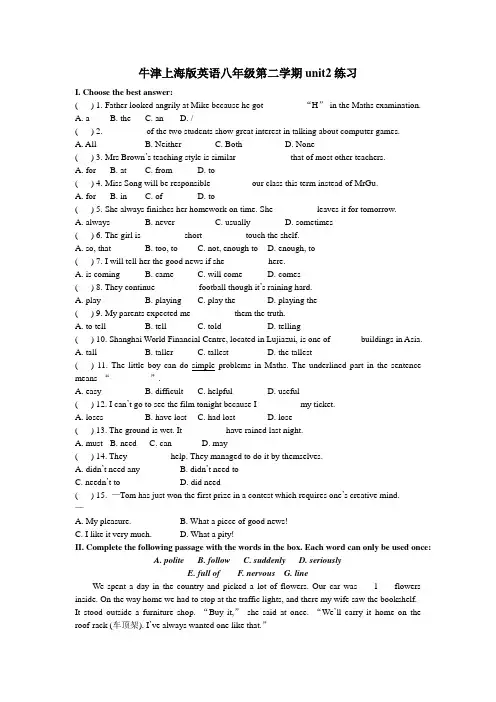
牛津上海版英语八年级第二学期unit2练习I. Choose the best answer:( ) 1. Father looked angrily at Mike because he got _________“H”in the Maths examination. A. a B. the C. an D. /( ) 2. _________ of the two students show great interest in talking about computer games.A. AllB. NeitherC. BothD. None( ) 3. Mrs Brown’s teaching style is similar _________ that of most other teachers.A. forB. atC. fromD. to( ) 4. Miss Song will be responsible _________our class this term instead of MrGu.A. forB. inC. ofD. to( ) 5. She always finishes her homework on time. She _________ leaves it for tomorrow.A. alwaysB. neverC. usuallyD. sometimes( ) 6. The girl is _________ short _________ touch the shelf.A. so, thatB. too, toC. not, enough toD. enough, to( ) 7. I will tell her the good news if she _________ here.A. is comingB. cameC. will comeD. comes( ) 8. They continue _________ football though it’s raining hard.A. playB. playingC. play theD. playing the( ) 9. My parents expected me _________ them the truth.A. to tellB. tellC. toldD. telling( ) 10. Shanghai World Financial Centre, located in Lujiazui, is one of ______ buildings in Asia.A. tallB. tallerC. tallestD. the tallest( ) 11. The little boy can do simple problems in Maths. The underlined part in the sentence means “_________”.A. easyB. difficultC. helpfulD. useful( ) 12. I can’t go to see the film tonight because I _________ my ticket.A. losesB. have lostC. had lostD. lose( ) 13. The ground is wet. It _________ have rained last night.A. mustB. needC. canD. may( ) 14. They _________ help. They managed to do it by themselves.A. didn’t need anyB. didn’t need toC. needn’t toD. did need( ) 15. —Tom has just won the first prize in a contest which requires one’s creative mind.—_________A. My pleasure.B. What a piece of good news!C. I like it very much.D. What a pity!II. Complete the following passage with the words in the box. Each word can only be used once:A. politeB. followC. suddenlyD. seriouslyE. full ofF. nervousG. lineWe spent a day in the country and picked a lot of flowers. Our car was ___1___ flowers inside. On the way home we had to stop at the traffic lights, and there my wife saw the bookshelf.It stood outside a furniture shop. “Buy it,”she said at once. “We’ll carry it home on the roof-rack (车顶架). I’ve always wanted one like that.”Ten minutes later I was twenty dollars poorer, and the bookshelf was tied on to the roof-rack. As it was getting darker, I drove slowly. Other drivers seemed more ___2___ than usual that evening. The police even stopped the traffic to let us through. Carrying furniture was a good idea. After a time my wife said, “There’s a long ___3___ of cars behind. Why don’t they overtake (超车)?”Just at that time a police car did overtake. The two officers inside looked at us ___4___ when they went past. But then, with a kind smile they asked us to ___5___ their car through the busy traffic. The police car stopped at our village church. One of the officers came to me.“Right, Sir,” he said. “Do you need any more help now?”I didn’t quite understand. “Thanks, Officer.”I said. “You’ve been very kind.”He was looking at our things: first at the flowers, then at the bookshelf. “Well, well,”he said and laughed. “It’s a bookshelf you’ve got there! We thought it was—er, something else.”My wife began to laugh. I ___6___ understood why the police drove here. I smiled at the officer, “Yes, it’s a bookshelf but thanks again.”I drove home as fast as I could.III. Complete the sentences with the given words in their proper forms:1. We congratulated them on the _________ completion of the project. (succeed)2. Life in a small town could be deadly _________. (bore)3. I have _________ known some good friends andgood teachers here!(luck)4. Miss Lin is _________ for our class. (response)5. How high was the plane when the engine_________? (fail)IV. Rewrite the following sentences as required:1. Rita does her homework before dinner every day. (改为否定句)Rita __________________ her homework before dinner every day.2. Shanghai seldom rains in winter. (改为反意疑问句)Shanghai seldom rains in winter, __________________?3. Mr White is in charge of sales in his company. (保持句意基本不变)Mr White is __________________ sales in his company.4. I always go to school in our family car. (对划线部分提问)__________________ you always go to school?5. continue, I, then, go to, working on, my office, and, my games. (连词成句)______________________________________________________V. Reading comprehension:A. Choose the best answer: ★Do you want to be the most popular person in the class? You don’t need to change your character (性格); you just need to improve your personality. In fact, the most popular people are trusted(信任) and loved because they stay normal but still have something that makes them different from the rest of us. Here are some pieces of advice about becoming the most popular person in the class.If you want others to like and respect you, you have to start by liking and accepting yourself. Do not change yourself in order to please others.Be helpful to everyone and do it happily. Being nice to people is almost like helping them, too, because by being nice you make others happy.Be active and have a positive attitude towards life. Develop confidence in yourself.Stay clean and wear fresh clothes. Do not try to follow fashion to look like someone else.Respect cannot be bought with big words or power. You have to get it by being honest. It also helps your personal growth. You must be a person that can be trusted to get respect.( ) 1. _________ you can be the most popular person among your classmates.A. By being honestB. By trusting othersC. By using big wordsD. By following the fashion( ) 2. Which of the following best describes the most popular person?A. He is always the centre among his friends.B. He respects others and likes to dress up like stars.C. He has something special internal (内在的) to attract other people.D. He often changes his character and personality.( ) 3. The underlined sentence shows that_________.A. you should be nice to othersB. you should be polite when you help othersC. helping others means saying nice wordsD. you can help others only by being nice( ) 4. The writer thinks a person who is liked by the whole class must be _________.①confident ②positive ③good-looking ④helpful ⑤fashionableA. ①②③B. ②③④C. ③④⑤D. ①②④( ) 5. To be the most popular person in the class, you need to _________.A. change your characterB. trust and love othersC. be the same as othersD. improve your personality( ) 6. What’s the best title for the passage?A. How to Please Others.B. How to Be the Favourite.C. How to Be Trusted by Others.D. How to Develop Confidence.B. Choose the words or expressions and complete the passage: ★Sometimes you may not understand your parents. One minute they’re friendly, the next minute they’re shouting and screaming. So who makes them so ___1___? You, probably!Even though you may not realize it, your parents have bought you many clothes. But they’re not buying themselves new things. The simple reason is that there are more ___2___ things to spend money on, like the electricity bill and food.You may hate missing a party to visit some boring old relatives. They may always talk about what a sweet baby you were. You have no choice but to listen. Even if you ___3___, your parents won’t change their minds. Parents like to show off their family. The best thing you can do is to help entertain your relatives. Your parents will be so pleased with you afterwards that they’ll probably allow you to go to the next two ___4___.You might not want to eat, but think of it from the parents’ point of view. If you cook two meals a day, it means 730 meals a year. Can you imagine how boring this can get? Imagine how your parents feel when you say you’re not really hungry. ___5___, your parents are probably worried that you aren’t eating enough.Eat fewer snacks and leave your room for meals. Finally, offer to ___6___ after the meal. Your offer may not be accepted, but your parents will be pleased.(___) 1. A. friendly B. lonely C. changeable D. comfortable(___) 2. A. interesting B. difficult C. important D. surprising(___) 3. A. agree B. complain C. listen D. win(___) 4. A. concerts B. meetings C. classes D. parties(___) 5. A. In addition B. In return C. At most D. At first(___) 6. A. do the cooking B. lay the table C. buy some snacks D. wash the dishes C. Read the passage and fill in the blanks with proper words: ★★Rebecca is a camera woman and she was filming a documentary (纪录片) for the BBC in the Pacific Ocean when she saw something that m___1___ her cry—hundreds of birds had died because they had eaten some of the plastic that is thrown into the sea each year. Beaches on Pacific Islands that should have been some of the most beautiful p___2___ in the world were covered with plastic toys, drinks bottles, pens, cigarette lighters—every plastic thing you can think of.Rebecca decided she had to do something. Back at home she thought about what she could do to help solve the problem. In her hometown Modbury, she asked local shopkeepers if they could do just one s___3___ thing to help. She asked them to stop using plastic bags in their shops.Plastic bags are used everywhere in Britain. The numbers are amazing. Britain uses n___4___ 17 million plastic bags each year. And the bags can take hundreds of years to break down (降解).To Rebecca’s s___5___, the shopkeepers agreed and Modbury became the first plastic bag free town in Britain. Instead, shops offered reusable cotton bags.Other towns followed Modbury’s e___6___. More and more towns around Britain and around the world are becoming plastic bag free. It won’t solve all of the world’s environmental problems, but it shows that people are becoming active and starting to think about how the little things in their daily lives can have a big effect. It also shows us that there is something we can do and that one person can make a big c___7___ with a strong enough belief.D. Answer the questions: ★★Mark Twain was a famous American writer. He wrote many stories and many of them were funny stories. Besides writing, he also liked hunting and fishing very much, so one year he went to Maine (缅因州) for a holiday and spent three pleasant weeks in the woods there.When he had to go back home, he drove to the station with his baggage(行李). There he asked a porter(搬运工) to put it into the train. Then he got into the smoking car and sat down in one of the comfortable seats there. The car was empty when he got in, but a few minutes later, another man got in and sat down on the seat opposite his. Mark Twain looked at the man and thought that this man looked quite unpleasant. However, it would be impolite to say nothing in that situation, so he said good morning to the man, and they began to talk.First they talked about the weather and then they talked about Maine. The stranger said, “We have some beautiful woods in Maine. It would be a pity to come to Maine without spending some time there. I suppose you have been in our woods, haven’t you?”“Yes, I have,”answered Mark Twain. “I’ve just spent three weeks there and I had a very good time, too. And let me tell you something. Although fishing isn’t allowed in Maine at this season, I’ve got two hundred pounds of beautiful fish with my baggage on t his train. I like to eat fish. May I ask who you are, Sir?”The stranger looked at Mark Twain for several seconds and then answered, “I’m a police officer. My job is to catch the people who hunt and fish during the wrong seasons. And who are you?”Mark Twain was surprised and frightened when he heard this. He thought quickly and then answered, “Well, I’m the man who tells the biggest lies in America.”1. What did Mark Twain like besides writing?_________________________________________________________ 2. Mark Twain left Maine by train, didn’t he?_________________________________________________________ 3. Who did Mark Twain meet in the smoking car?_________________________________________________________ 4. How long did Mark Twain stay in the beautiful woods in Maine?_________________________________________________________ 5. What might happen to Mark Twain and the stranger?_________________________________________________________参考答案I. CCDAB BDBAD ABAABII. EAGDBCIII. 1. successful 2. boring 3. luckily 4. responsible 5. failedIV. 1. doesn’t do 2. does it 3. responsible for 4. How do 5. Then I go to my office and continue working on my games. / I go to my office and then continue working on my games.V. A. ACADDB B. CCBDADC. 1. made 2. places 3. small / simple 4. nearly 5. surprise 6. example 7. change / contributionD. 1. Besides writing, he also liked hunting and fishing very much.2. Yes, he did.3. A police officer.4 For three weeks.5. Any reasonable answer can be accepted.。
沪教版牛津英语2B教案Unit5Washwithwater(1-2)

2B Unit 5 Wash with water【单元分析(UNIT ANALYSIS)】一、教材地位(UNIT POSITION)1、本单元的主题是“水”,教学中要充分利用“水”这一话题,开展讨论,使学生了解水的重要性,提高学生节约用水的环保意识。
2、词汇方面是学习一些有关日常生活用品的英语表达:towel, soap, toothbrush, toothpaste…,学习介词with在句中的用法: wash with water 等等。
3、继续学习祈使句的英语表达法,学习用一般现在时描述日常进行的动作:I wash my handswith water. I brush my teeth with toothpaste.4、能认读字母Vv, Ww,掌握这两个字母在单词中的基本发音。
5.通过歌曲和游戏( A miming game ) 帮助学生进一步掌握祈使句和一般现在时的英语表达法。
二、学习目标(LEARNING OBJECTIVES)1、围绕“水”这一主题,让学生在学习过程中感知生活中处处离不开水,体会到水的重要性,并意识到必须从小事做起,养成节约用水的好习惯。
在学习过程中提高学生环保意识。
2、能认读字母Vv, Ww,掌握这两个字母在单词中的基本发音。
3. 能够看图认读或拼读单词towel, soap, wash, dirty…,学习介词with在句中的用法: wash withwater …,初步了解turn on /off 与open/close 的区别。
4、能根据听到的口令做出正确的反应,并能让学生在特定的情景中运用祈使句表达一些简单的请求与命令:Turn on the tap. Wash your towel…5、能用一般现在时描述日常进行的动作:I wash my hands with water. I brush my teeth withtoothpaste. This is the way I wash my face in the morning.6、通过“A miming game”让学生听听、做做,在学习新知的同时,帮助学生归纳、整理以前所学的内容,将新、旧知识有机整合起来。
Module4Unit2Wind(教案)牛津上海版(试用本)英语五年级上册
2. 风的基础知识讲解(10分钟)
目标: 让学生了解风的基本概念、组成部分和原理。
过程:
讲解风的概念,包括其主要组成元素或结构。
详细介绍风的组成部分或功能,使用图表或示意图帮助学生理解。
3. 风案例分析(20分钟)
目标: 通过具体案例,让学生深入了解风的特性和重要性。
4. 学习策略:
- 能够通过本节课的学习,学生能够运用有效的阅读策略,如预测、略读和精读,提高学生的自主学习能力;
-ห้องสมุดไป่ตู้能够通过小组讨论,培养学生的自主学习和合作学习能力;
- 能够通过课后作业,巩固学习效果,提高学生的自主学习能力。
七、教学反思与总结
在教学风这一主题时,我采用了情境教学法、任务驱动法和合作学习法,力求激发学生的学习兴趣和主动性。在教学手段上,我充分利用了多媒体设备、教学软件等现代化教学手段,提高了教学效果和效率。然而,在实际教学过程中,我也发现了一些不足之处。
3. 教授阅读策略,如预测、略读和精读,帮助学生提高阅读效率和理解能力;
4. 鼓励学生提问和思考,引导学生深入理解风的不同形式和作用,培养学生的思维品质。
四、教学方法与手段
1. 教学方法:
(1) 情境教学法:通过创设与风相关的实际情境,如模拟风的作用、风与人类生活的关系等,激发学生的学习兴趣,引导学生主动参与课堂活动。
(2) 任务驱动法:设计一系列与风相关的任务,如描述风的特点、分析风的作用等,让学生在完成任务的过程中,运用所学知识,提高学生的实践能力。
(3) 合作学习法:将学生分成小组,组织学生进行讨论、交流和合作,培养学生的团队协作能力和沟通能力。
2. 教学手段:
上海版牛津英语1a教案Unit2
Respond.
Listen and follow in their books.
Say and act with the cassette.
Count number from 1 to 6 together.
Handwriting on the blackboard
Teaching steps
& Time
Teacher’s activities
Students’ activities
Revise and supplement
Warming up
1 minute
Revision
2 minutes
Presentation
1 minute
New Structure Learning
a. Divide the class into 6 groups. Add on or take away objects but always keep the number within the range of 1 to 6.
b. Listening activity: every student is given 6 sweets. Read out a number within the range of 1 to 6. Walk around the classroom and check.
Topic
Unit 2 Number
Period
1
Purpose
Knowledge purpose: Numbers from 1 to 6
Ability purpose: Using numerals to count from one to six.
Unit2同步教案牛津上海版八年级上册英语
Unit2 Work and play同步教案一、知识框架二、知识梳理Ⅰ. Important words and phrases:Words:1. adj.成功的adv成功地n.成功v.成功【重点】成功做某事succeed in doing sth.= be successful in doing sth.= be able to do sth.= manage to do sth. 2. adj.幸运的,有好运的adv幸运adv.不幸地n.运气【拓展】a lucky dog 幸运儿3. n .销售,出售n. 销售额销售量n.(男)店员,4. adj.简单的,容易的adv.简单地,容易地5.v. 收集Ⅱ.重点词汇拓展12. drive v.驾驶;驱使drive sb. to sp. 开车送某人去某地drive sb. to do sth. 驱使某人去某地13.attend, join, join in, take part in辨析attend+会议attend the meeting/ classjoin+个人/团体join us, join the Party入党join in/ take part in+活动join in/ take part in activities 14.similar adj.相似的A be similar toB A和B相似A andB are similar inC A和B在C方面相似【形近词】familiar adj.熟悉的sb. be familiar with sth. 某人对某物熟悉的sth. be familiar to sb. 某物对于某人而言是熟悉的15.expect v.期待expect sth. expect (sb.) to do sth. 期待(某人)做某事look forward to doing sth. 期待做某事expectation n.期待16.popular adj.流行的be popular with/ among 在……中是流行的17.continue v.继续continue to do sth. 继续做某事(另一件事)continue doing sth. 继续做某事(原来的事)carry on= go on= continue 继续18.explain v.解释explain sth. to sb.向某人解释某事explanation cn.解释make an explanation to sb. 给某人一个解释19.energy n. 能量energetic adj.精力充沛的power n.权力powerful adj.强大的resource n.资源20.force n.(物理)力v. 强迫force sb. to do sth. 强迫某人做某事21.heat n.热,热度v. 加热【课堂小练】Ⅰ. 用所给单词的适当形式填空(错误率:掌握情况:)1. The bank refuses to accept _______________ for the mistake. (responsible)2. They were proud of their children’s _______________. (achieve)3. The children quickly got _______________ with staying indoors. (boring)4. It is _______________ to start a speech by thanking everybody for coming. (usually)5. Tom was still on his way to school, because he ______________ to catch the first bus. (failure)6. Tickets are on _______________ from the booking office. (sale)7. She is very clever and often do well in her _______________. (exam)8. The teacher _______________ the answers on the board yesterday. (write)Phrases:1. ride a motorcycle 骑摩托车2. play the piano 弹钢琴3. one of the top students in the city 市里优秀生之一4. have written several successful computer games已经写了几个成功的电脑游戏5. the manager of the company 公司的经理6. be responsible for sales 负责销售7. make phone calls to our clients on the way 在路上打电话给我们的客户8. some boring work 一些无聊的工作9. achieve A grades in all my subjects 各门学科都得A10. discuss the business over breakfast 早餐期间讨论公司业务11. fail an exam 考试不及格12. collect me from school 到学校接我13. attend Computer Club meetings 出席电脑俱乐部会议14. ask me to assist them 请我帮助他们15. continue doing sth. 继续做某事16. It is time for lessons. 上课的时间到了。
Unit 2教案 2022-2023学年牛津上海版英语八年级下册
2022-2023学年牛津上海版英语八年级第二学期unit two教案Material: Oxford English 8B Unit 2 WaterLesson type: Reading Water talk (1)Teaching objectives:By the end of the class, the students are expected to1. 通过文本阅读理解部分核心词汇的含义及用法,知道部分拓展词汇的含义,并在作业中加以巩固。
2. 通过阅读理解文本的主旨(water’s journey),通过扫读理解文本主要话题内容(生活用水的来源、加工及污水处理) 和相关细节信息。
Focus on learning:通过阅读理解文本的主旨,通过扫读理解文本主要话题内容(生活用水的来源、加工及污水处理) 和相关细节信息。
Potential difficulties in learning:通过阅读理解文本的主旨,通过扫读理解文本主要话题内容(生活用水的来源、加工及污水处理) 和相关细节信息。
Teaching procedureStages Learning activities PurposesThink in mind Look at the pictures and finish task 1.To set up a situation andconsolidate the key words Look andlearnLook at the pictures and learn the new words.Look and predict Read the title and pictures and predict.∙Who are having a talk?∙What are they talking about?To predict what informationmay be read.Read and find out Read through the passage and get the mainidea.∙Is this an informational article or a story?∙Where does the story take place?∙Who are the main characters in the story?∙What is the story mainly about?To help students read forgeneral idea.Read and find out Read the story from line1 to line 11. Find theanswers to these questions.∙Why did the water drop start talking toDaisy?∙Where was the water going when Daisy wasbrushing her teeth?Read the story from line 12 to line 29. Find outthe places the water drop went to on its journeyand circle them in your textbooks.T o develop students’ abilities ofreading.Read and answer Read the story and find the answers.∙What was the water drop doing in thecloud?∙How did it travel from the cloud to thestream?∙How did it travel from the stream to theYangtze River?∙How long did the water drop stay in thecloud?∙Where did the water drop go after it ran intothe Huangpu River?∙How did the water treatment works clean upthe water drop?∙Where was the water drop before it came toDaisy’s bathroom?∙Where did the water drop go after it leftDaisy’s bathroom?To develop students’ abilities ofreading.∙What did the sewage plants do to the water drop?∙Was the sea the last place of its journey?Read and find out Complete Exercise D1 on page 19.To help students furtherunderstand the text.Read and write Find proper words in the story to complete the flow chart of a water drop’s journey. Use the simple past tense.AssignmentsCopy the new words and phrases you learnedin today's lesson. Then read them aloud after therecording.Correct the answers in Task 2 on yourWorksheet.Complete Exercises C (C1, C2 and C3) andD2 on pages 18 and 19 of your Student's Book.Read the story aloud after the recording.To consolidate what is learnt inclass.Material: Oxford English 8B Unit 2 WaterLesson type: Reading Water talk (2)Teaching objectives:By the end of the class, the students are expected to1. 运用恰当的词汇,描述水的旅程;2. 分析小说类文本写作手法在描述科学概念中的作用;3. 增强节约用水和合理用水的意识。
Unit 1 第1课时 词汇-八年级英语下册(牛津上海版)
Trees
Episode 1
牛津上海版 英语 八年级 第二学期
牛津上海版 英语 八年级 第二学期
本节课讲解词汇部分
第1节
Words and expressions
Ⅰ. Words. 1. fighter 斗士;战士
e.g. She won't give up easily; she's a real fighter. 她不会轻易放弃 的,她是一个真正的斗土。
6. release v. 释放,解放 e. g. I released the horse and it ran away. 我放了这匹马,让它跑了。
Four prisoners were released. 四名犯人被释放了。 【知识拓展】 release n. 释放;解脱 e.g. She can expect an early release from prison. 她有望早一点儿出 狱。
in the front of 在...(内部)的前面
She stands in the front of the classroom. 【拓展2】 force sb. to do sth. 强迫某人做某事
3. Sometimes you may not understand your parents because
2. He is always adding "e" in front of the letter "t" when he
spells the word "ninth", so his English teacher forced him to copy "ninth" one hundred times. 当他拼ninth这个单词的时 候,总是在 t前加e,所以他的英语老师强迫他把ninth这个 单词抄写一百遍。 【拓展1】 in front of 在...的前面