
仁爱英语七年级上册unit1知识点+习题
he 他isn’t=is not Japan 日本we 我们who 谁they 他(她,它)们aren’t = are not zero 零one 一,一个two 二three 三four 四five 五six 六seven 七eight 八nine 九ten 十telephone 打电话number 号码;数,数字;数量it 它重点语法:1.be动词的用法。
2. 人称代词。
重点句型:What’s your name?你叫什么名字?---- My name’s …(人名)Where +be动词+主语+from 某人来自哪里?Where are you from? 你来自哪里?-----I’m from…(国名或地名)Who is she? 她是谁?---She is…(人名)Who are they? 他们是谁---They are…(人名)and …(人名)Are you from Canada? 你来自加拿大吗?---Yes, I am. No, I’m not.What’s your telephone number?你的电话号码是多少?----回答:My telephone number is…(数字)It’s…(数字)或者直接回答数字。
重点详解:1、Excuse me,are you Jane?请问,你是简吗?excuse me是日常生活中人们向对方提出请求、询问情况或打搅他人时所常用的客套语,以示歉意或礼貌。
2、—What’s your name?你叫什么名字?—My name’s Sally.我的名字叫莎莉。
What’s your name ?本对话用来询问姓名。
用于询问对方的姓名,常用在上级对下级、长者对年轻人、同学或平辈之间。
这里的name因为是单数形式,所以be动词也用单数形式is,这里的name’是name is 的缩写。
3、Where are from?你来自哪里?(1)be from 从……来,来自,be动词的形式随着主语人称变化而变化,它的近义词组是come from…,例子:I am from China .= I come from China. 我来自中国。
(2)以where 开头的特殊疑问句,是对地点提问,其答语通常是含有一个地点的词或词组。
Where+be+主语+from?某人来自哪里?例子:---Where is she/he from ? 她/他来自哪里?---She/He is from England. 她/他来自英格兰。
are----’re they are=they’re we are=we’re you are = you’re练习题:1. What’s _____(you) name?2. Sarah and Anna______( be ) from England. They_____( be ) very nice.3. Da Ming and I ______( be ) from China. They_____( be ) good friends.4. Excuse_____( I ) , ______( be ) you Bill?5.Liu Ying ______( be ) from China and Jones ______( be ) from the U.S.A.2.人称代词的用法。
表示“我”、“你”、“他/她/它”、“我们”、“你们”、“他们”的词叫做人称代词。
人称代词的主格和宾格之分,主格做主语,宾格作宾语。
单数复数第一人称:I我we我们第二人称:you你you你们第三人称:he他she她it它they他(她、它)们人称代词在句子中做主语,放句首。
例子:I am a teacher. 我是一名教师。
(I是主语)You are 10 years old. 你10岁了。
(You 是主语)He is my friend. 他是我的朋友。
(He是主语)It is hot today. 今天天气热。
(It是主语)练一练:选出括号中正确的词,在正确的词上打勾1. This is(my / I)mother.2. Nice to meet (your / you).3.(He / His)name is Mark.4. Wh at’s(she / her)name?5. Excuse(me / my / I).6. Are(your / you)Miss Li?7.(I/ My)am Ben. 8.(they/he) are from Japan.Topic3 How old are you?重点短语:eleven 十一twelve 十二thirteen 十三fourteen 十四fifteen 十五sixteen 十六seventeen 十七eighteen 十八nineteen 十九twenty 二十year 年old ……岁的,老的,旧的year(s) old ……岁How old...? ……多少岁?class 班级;课;同一个班的学生in 在……里(内,上),用……(表达) grade 年级that 那;那个English 英语(的),英国(人)的in English用英语(表达) an 一(个,件……)eraser 黑板擦,橡皮spell 拼写 a 一(个,件) map 地图can 可能;能够;可以please 请pencil 铅笔apple 苹果double 两倍的toy 玩具;玩物desk 书桌,办公桌pen 钢笔ruler 尺子,直尺book 书orange 橙子,橘子;橙色的;橘黄色的car 矫车,小汽车egg 蛋;卵blackboard 黑板these 这些those 那些schoolbag 书包cake 蛋糕;糕点,饼bus 公共汽车box 盒子,箱子--- They’re oranges. 他们是橘子。
在英语中,名词按其所表示的事物性质分为可数名词和不可数名词,可数名词有单数和复数两种形式。
如:an egg, two eggs , a pen., three pens.。
不可数名词一般没有复数形式。
如water, some water。
10.Thank you./Thanks.谢谢。
-That’s Ok./You’re welco me.不用谢。
在英语句表示感谢用Thank you.或Thanks.而接受了感谢后,用英语说是“That’s OK.或“You’re welcome.意为“不用谢”,“没什么”。
11.Now she is in Beijing Ren’ai Internatio nal School.现在她就读于北京仁爱国际英语学校。
句子中的“北京仁爱国际英语学校”是专有名词。
专有名词是表示人、地方、机构等专有的名称,每个单词的第一个字母必须大写。
如:NBA,CCTV。
若是由普通名词构成的专有名词,其前一般要加定冠词the。
如:The Graet Wall in China.长城在中国。
【拓展】与学习有关的一些名词:primary school小学secondary school(美国)中学junior high school(美国) 初中senior high school(美国)高中middle school(中、日等)中学college(分科、学科)大学,专科学校university 综合性大学12.They are not in the same class, but they are good friends.他们不在同一个班,但他们是好朋友。
(1)same adj.意为“同样的;同一的”。
使用same时,习惯在其前面加定冠词the.如:We are good friends and we study in the same school.我们是好朋友,我们在同一所学校念书。
(2)but 意为“但是,可是”,表示转折关系的连词,而前面学过的and 表示并列关系。
注意区别使用。
如:I’m 14 years old,but he is 13.我14岁,可是他才13岁。
I’m fr om China and she is from China,too.我来自中国,她也来自中国。
语法讲解:1.a和an的用法。
It’s a car. 它是一辆汽车It’s an orange.它是一个橘子a, an 是不定冠词,意为“一个(件,张……),名词前用a 还是an ,不以单词的开头字母是元音字母还是辅音字母来决定,而是以开头字母的音素来决定。
a用在以辅音音素开头的词前,an 用在以元音音素开头的词前。
如:an apple / an orange / an erase /an egg 一个苹果/橘子/一块橡皮擦/鸡蛋an English book一本英语书an old bag一个旧书包a pen/pencil 一支钢笔/铅笔 a car一辆小汽车练一练:1._____class 2._______English name 3.______telephone4.______evening5._____old box6.____desk2.可数名词复数规则变化:在这个话题中,我们学到的apple,map,desk,orange等名词可以用来计数,我们把它们称为可数名词,个体名词和集合名词一般都是可数名词。
可数名词有单数和复数两种形式。
单数名词前面可用冠词a/an,复数名词有词形变化。
如:①一般情况下,在词尾加-s。
s在元音及浊辅音后读[z];在清辅音后读[s];在ce,se,ge,ze后读[iz]。
例如:bag→bags书包day→days白天desk→desks书桌book→books 书map→maps 地图coat→coats上衣bed→beds床boot→boots靴子②以-s,-x,-ch,-sh结尾的名词,加-es,读[iz]。
例如: s→buses 公共汽车class→classes 班级box→boxes 箱子watch→watches 手表wish→wishes 希望brush→brushes 刷子③以“辅音字母+y”结尾的名词,先变y为i再加-es,读[z]。
例如:family→families 家庭factory→factories工厂baby→babies→婴儿party→parties 聚会city→cities 城市story→stories 故事④以o结尾的名词,一般在词尾加-s,读[z]。
例如:piano→pianos 钢琴radio→radios 收音机photo→photos 照片特例: hero→heroes 英雄Negro→Negroes 黑人potato→potatoes 土豆tomato→tomatoes 西红柿黑人英雄爱吃西红柿和土豆⑤以f或fe结尾的名词,一般要先变f或fe为v,再加es,读[vz]。
仁爱版七年级[上册]英语Unit1单元测试题和答案解析
![仁爱版七年级[上册]英语Unit1单元测试题和答案解析](https://360docs-1393072327.cos.ap-beijing.myqcloud.com/771c4394910ef12d2bf9e70c.webp)
仁爱版七年级上册英语Unit1单元测试题及答案第一部分听力(20分)Ⅰ.听单词,选择你所听到的单词。
每个单词读两遍。
(5分)()1.A.morning B.afternoon C.from()2.A.she B.me C.he()3.A.China B.Canada C.Japan()4.A.six B.seven C.ten()5.A.what B.how C.whereⅡ.听句子,选择正确图片。
每个句子读两遍。
(5分)A.6.____7.____8.____9.____10.____Ⅲ.听句子,选择正确答语。
每个句子读两遍。
()1.—()2.—()3.——No,she____.A.isB.isn’tC.aren’t()4.—____,areyouMr.Wang?—Yes,Iam.A.FineB.PleaseC.Excuseme()5.—AretheyfromCanada?—No,they____.A.areB.aren’tC.isn’t()6.—What’s____telephonenumber?—It’s8265-3412.A.youB.yourC.my()7.—____arethey?—TheyareXiaoLiandJane.A.WhoB.WhatC.Where ()8.Mary____fromCuba.A.isB.amC.are ()9.“Oneonezero”表示____。
A.火警B.匪警C.急救中心()10.—IsheLiPing?—Yes,____.A.I’mB.he’sC.heis Ⅱ.情景交际。
(15分)Ⅲ.看图填空。
(10分)根据图片内容补全对话。
26.—____ishe?—He____XiaoMing.27.—Isshe____Japan?—No,she____.28.—____aretheyfrom?—Theyarefrom____.29.—What’s____QQnumber?—30.—____sheJane?—____,sheis.Ⅳ.阅读理解。
仁爱版七年级英语上册(Unit1-4)知识点汇总
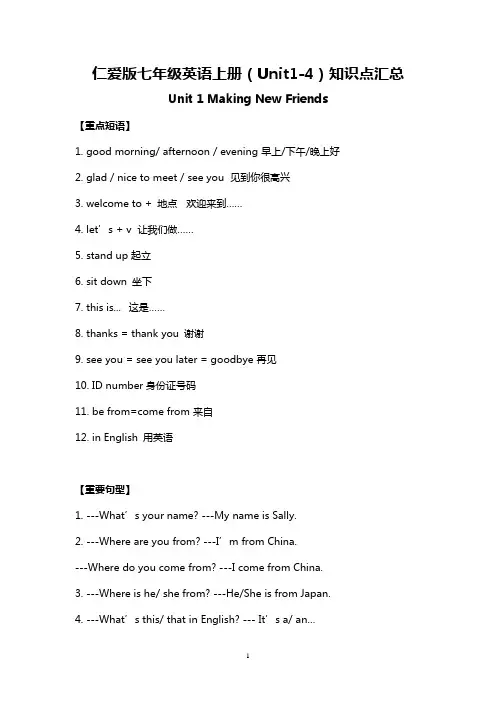
仁爱版七年级英语上册(Unit1-4)知识点汇总Unit 1 Making New Friends【重点短语】1. good morning/ afternoon / evening 早上/下午/晚上好2. glad / nice to meet / see you 见到你很高兴3. welcome to + 地点欢迎来到……4. let’s + v 让我们做……5. stand up 起立6. sit down 坐下7. this is... 这是……8. thanks = thank you 谢谢9. see you = see you later = goodbye 再见10. ID number 身份证号码11. be from=come from 来自12. in English 用英语【重要句型】1. ---What’s your name? ---My name is Sally.2. ---Where are you from? ---I’m from China.---Where do you come from? ---I come from China.3. ---Where is he/ she from? ---He/She is from Japan.4. ---What’s this/ that in English? --- It’s a/ an…5. ---What’re these/ those in English? ---They’re…6. ---How do you spell it? ---E-R-A-S-E-R, eraser.7. ---Can you spell it? ---Yes, M-A-P, map.8. —How old are you/ is he/ are they?—I’m/ He is/ They are eleven.9. —What’s your telephone number?—It’s 4567967.10. —What class/ grade are you in?—I’m in Class Ten, Grade Seven.(注意大小写)11. Good morning/ afternoon/ evening.12. —Hello!/Hi! —Hello!/Hi!13. —Nice/Glad to see/meet you. —Nice/Glad to see/meet you, too.14. —Welcome to China/my home. —Thanks.15. —How do you do? —How do you do?16. —How are you? —Fine, thank you. And you? —I’m OK.17. —See you then/ later. —See you.18. —Goodbye. —Bye.19. —Thank you. —You’re welcome./That’s OK./Not at all.【重点语法】1. 元音字母:Aa Ee Ii Oo Uu包含有以下元音的字母:[e] Aa Hh Jj Kk[i:] Ee Bb Cc Dd Gg Pp Tt Vv[aɪ] Ii Yy[ju:] Uu Qq Ww[e] Ff Ll Mm Nn Ss Xx Zz2. 大小写句首字母,人名,地名,称呼语,专有名词,星期的首字母要大写,引人注意。
仁爱英语七年级上册Unit 1 Topic 3练习题及答案解析
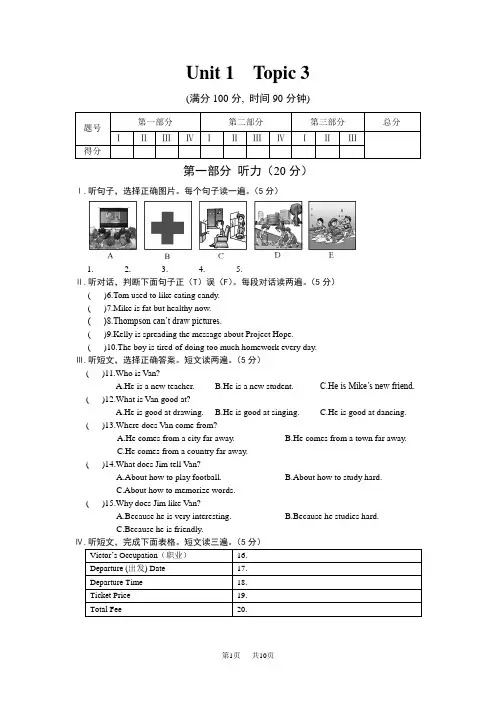
Unit 1 Topic 3(满分100分, 时间90分钟)第一部分听力(20分)Ⅰ.听句子,选择正确图片。
每个句子读一遍。
(5分)1._____2._____3._____4._____5._____Ⅱ.听对话,判断下面句子正(T)误(F)。
每段对话读两遍。
(5分)( )6.Tom used to like eating candy.( )7.Mike is fat but healthy now.( )8.Thompson can’t draw pictures.( )9.Kelly is spreading the message about Project Hope.( )10.The boy is tired of doing too much homework every day.Ⅲ.听短文,选择正确答案。
短文读两遍。
(5分)( )11.Who is Van?A.He is a new teacher.B.He is a new student.C.He is Mike’s new friend.( )12.What is Van good at?A.He is good at drawing.B.He is good at singing.C.He is good at dancing.( )13.Where does Van come from?A.He comes from a city far away.B.He comes from a town far away.C.He comes from a country far away.( )14.What does Jim tell Van?A.About how to play football.B.About how to study hard.C.About how to memorize words.( )15.Why does Jim like Van?A.Because he is very interesting.B.Because he studies hard.C.Because he is friendly.Ⅳ.听短文,完成下面表格。
仁爱英语七年级上册unit1知识点+习题
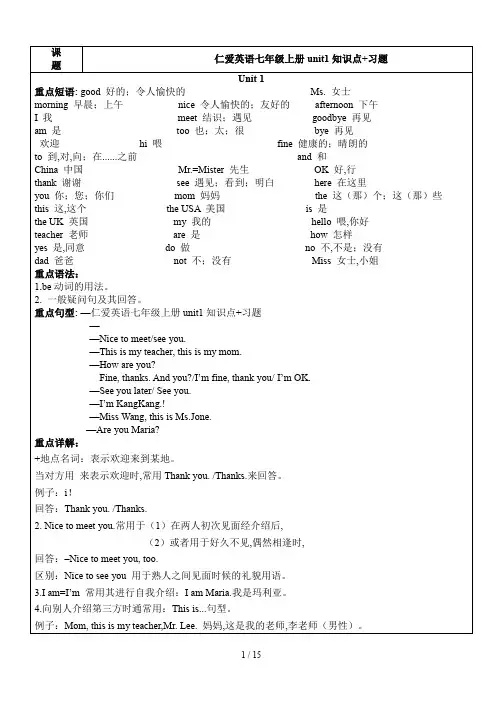
课仁爱英语七年级上册unit1知识点+习题题Unit 1重点短语: good 好的;令人愉快的Ms. 女士morning 早晨;上午nice 令人愉快的;友好的afternoon 下午I 我meet 结识;遇见goodbye 再见am 是too 也;太;很bye 再见欢迎hi 喂fine 健康的;晴朗的to 到,对,向;在......之前and 和China 中国Mr.=Mister 先生OK 好,行thank 谢谢see 遇见;看到;明白here 在这里you 你;您;你们mom 妈妈the 这(那)个;这(那)些this 这,这个the USA 美国is 是the UK 英国my 我的hello 喂,你好teacher 老师are 是how 怎样yes 是,同意do 做no 不,不是;没有dad 爸爸not 不;没有Miss 女士,小姐重点语法:1.be动词的用法。
2. 一般疑问句及其回答。
重点句型: —仁爱英语七年级上册unit1知识点+习题——Nice to meet/see you.—This is my teacher, this is my mom.—How are you?Fine, thanks. And you?/I’m fine, thank you/ I’m OK.—See you later/ See you.—I’m KangKang.!—Miss Wang, this is Ms.Jone.—Are you Maria?重点详解:+地点名词:表示欢迎来到某地。
当对方用来表示欢迎时,常用Thank you. /Thanks.来回答。
例子:i!回答:Thank you. /Thanks.2. Nice to meet you.常用于(1)在两人初次见面经介绍后,(2)或者用于好久不见,偶然相逢时,回答:–Nice to meet you, too.区别:Nice to see you 用于熟人之间见面时候的礼貌用语。
仁爱英语七年级上册unit1知识点+习题

the U.S.A=the United States of America 美国she 她he 他isn’t=is not Japan 日本we 我们who 谁they 他(她, 它)们aren’t = are not zero 零one 一, 一个two 二three 三four 四five 五six 六seven 七eight 八nine 九ten 十telephone 打电话number 号码;数, 数字;数量it 它重点语法:1.be动词的用法。
2.人称代词。
重点句型: What’s your name?你叫什么名字?---- My name’s …(人名)Where +be动词+主语+from 某人来自哪里?Where are you from? 你来自哪里?-----I’m from…(国名或地名)Who is she? 她是谁?---She is…(人名)Who are they? 他们是谁---They are…(人名)and …(人名)Ar.yo.fro.Canada.你来自加拿大吗...---Yes..am..No.I’.not.What’s your telephone number? 你的电话号码是多少?----回答: My telephone number is…(数字)It’s…(数字)或者直接回答数字。
重点详解:1.Excuse me,are you Jane?请问, 你是简吗?excuse me是日常生活中人们向对方提出请求、询问情况或打搅他人时所常用的客套语, 以示歉意或礼貌。
2.—What’s your name?你叫什么名字?—My name’s Sally.我的名字叫莎莉。
What’s your name ?本对话用来询问姓名。
用于询问对方的姓名, 常用在上级对下级、长者对年轻人、同学或平辈之间。
这里的name因为是单数形式, 所以be动词也用单数形式is, 这里的name’是name is 的缩写。
仁爱版七年级英语上册Unit1_Topic1 核心知识点精讲精练
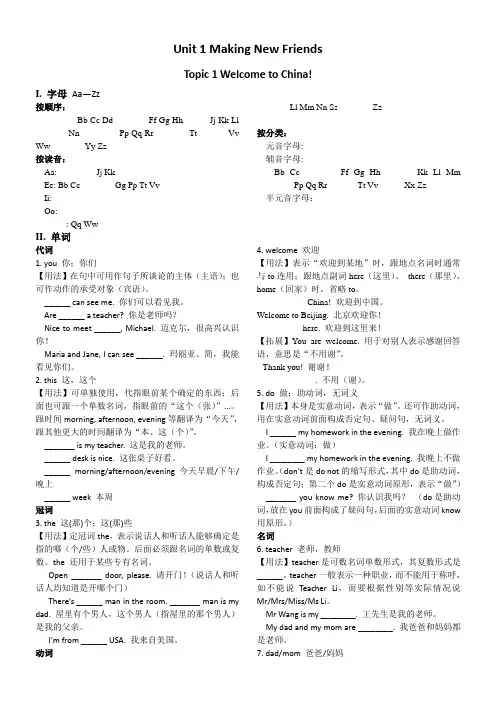
Unit 1 Making New FriendsTopic 1 Welcome to China!I. 字母Aa—Zz按顺序:_______ Bb Cc Dd _______ Ff Gg Hh _____ Jj Kk Ll _______ Nn ________ Pp Qq Rr _______ Tt ______ Vv Ww _______ Yy Zz按读音:Aa: ________ Jj KkEe: Bb Cc _______ Gg Pp Tt VvIi: ________Oo:______: Qq Ww______ Ll Mm Nn Ss _______ Zz_______按分类:元音字母: ______________________辅音字母:Bb Cc _______ Ff Gg Hh ______ Kk Ll Mm ________ Pp Qq Rr ______ Tt Vv _____ Xx Zz半元音字母:________II. 单词代词1. you 你;你们【用法】在句中可用作句子所谈论的主体(主语);也可作动作的承受对象(宾语)。
______ can see me. 你们可以看见我。
Are ______ a teacher? 你是老师吗?Nice to meet ______, Michael. 迈克尔,很高兴认识你!Maria and Jane, I can see ______. 玛丽亚、简,我能看见你们。
2. this 这,这个【用法】可单独使用,代指眼前某个确定的东西;后面也可跟一个单数名词,指眼前的“这个(张)”…。
跟时间morning, afternoon, evening等翻译为“今天”,跟其他更大的时间翻译为“本、这(个)”。
_______ is my teacher. 这是我的老师。
______ desk is nice. 这张桌子好看。
______ morning/afternoon/evening 今天早晨/下午/晚上______ week 本周冠词3. the 这(那)个;这(那)些【用法】定冠词the,表示说话人和听话人能够确定是指的哪(个/些)人或物。
七年级英语上册Unit1Makingnewfriends基础知识整理(新版)仁爱版
七年级英语上册:Unit 1 Topic1 Our country has developed rapidly. 一·词组。
take place 发生,进行①keep in touch with…跟…保持联系②get in touch with…与…取得联系reform and opening-up 改革开放make progress 取得进展succeed in doing sth. 成功地做某事take photos 照相learn…from…向学习……put on 举办,上演,展出more than 超过,多于see sth. oneself 亲眼目睹某物have the chance to do sth. 有机会做某事far away 遥远的play a/an…part 起……作用,有……影响in one's spare time 在某人空闲时间be happy/glad/pleased to do sth. 高兴做某事have a good summer holiday 过一个快乐的暑假a group of old people 一群老人be crowded into sp. 挤在一个地方receive a good education 接受好的教育not only … but also 不仅…而且satisfy people's needs 满足人们的需求enjoy good medical care 享受好的医疗照顾①remember the past 记住过去②live in the present 立足现在③dream about the future 展望未来make a tour abroad 出国旅游used to do sth. 过去常做某事be/get used to doing sth. 习惯做某事have no time to do sth. 没有时间做某事in the 1960s 在二十世纪六十年代in a short time 在短时间内二.句子1.Where have you been? 你已经去过哪了?I have been to Mount Huang with my parents. 我和我的父母去了黄山。
七年级上册仁爱英语教材讲解Unit1知识点击
Unit 1 Topic 1 Section ANew wordsNew phrasesUseful expressions知识点击1. Good morning!早上好!此句为早上或上午见面互相打招呼时所用的问候语。
它的答语仍然用“Good morning!”。
如:—Good morning, Kangkang!早上好,康康!—Good morning, Michael!早上好,迈克尔!在非正式场合,朋友和家人之间,可以省略good,只用morning问候。
如:Morning, Mom!早上好,妈妈!【拓展】其他时间段的问候语还有:Good afternoon!下午好!Good evening!晚上好!Good night!晚安!以上三个问候语也用同样的句子来回答。
【注意】“Good night!”不是问候语,而是人们在晚上分别时或睡觉前的道别用语,意为“晚安!",答语仍然是"Goodnight!"2.I’m Kangkang,我是康康。
英语中常用I'm...句型进行自我介绍。
如:I'm Maria,=I am Maria.我是玛丽亚3.—Welcome to China!欢迎到中国来!—Thank you.谢谢你。
Welcome to Beijing!欢迎到北京来!Welcome here!欢迎到这里来!当对方用welcome表示欢迎时,常用"Thanks./Thank you./Thanks a lot.”来回答。
如:—Welcome to Shanghai, Kangkang!康康,欢迎你到上海来!—Thanks.谢谢。
【拓展】“you’re welcome.”意为“不客气。
”如:—Thank you.谢谢你。
—You're welcome.不客气。
4.Hello!/ Hi!你好!“Hello!”和“Hi!”一般用于熟人之间互相打招呼,语气比较随意,常用于非正式场合,使用时不受时间限制。
仁爱版英语七年级上册Unit1-Unit2单元重点复习题附答案
仁爱英语七年级1-2单元重点习题一、句型转换1.IamJane.(变否定句)2.I’mJim变.一(般疑问句)3.Iamfine.Thankyou.(同义句转换)Iam____.____.4.Iam_fine_.(对划线部分提问)5.MynameisJane.(对划线部分提问)_____________yourname?6.HeisYukio.(改为一般疑问句)_______________?7.I'mZhouWeilun.(改为同义句)__________________ZhouWeilun.8.IssheWangMei?(作肯定回答)_________,_____________.9.Mypantsareblack.(对画线部分提问)________areyourpants?10.Mikehasblondhairandblueeyes.(对画线部分提问)________Mikelooklike?11.Thisisanorange.(改为复数句)____________oranges.12.AreyoufromChina?(作肯定回答)____,I______.13.I’mLiHua同义.(句转换)____________isLiHua.14.ThesearedesksinEnglish.(对画线部分提问)____________theseinEnglish?15.IaminGradeSeven.(改为一般疑问句)____________inGradeSeven?16.LiMingandLiLeilookthesame.(同义句转换)LiMing________LiLei.17.Pleasegiveherthepen.(同义句转换)Pleasegivethepen________.18.Thoseapplesarered.(同义句转换)Thoseare________.19.Theyaremybooks.(对画线部分提问)________arethey?20.Shehasblackhair.(改为一般疑问句)____she____blackhair?21.Herskirtisyellow.(对画线部分提问)________isherskirt?22.Tom’sfaceisround同.(义句转换)Tom________roundface.23.DoesMaryhavearoundface?(作肯定回答)____,she____.二、填空(一)用be(is,am,are)的适当形式填空。
七年级上册英语仁爱版unit1知识点
七年级上册英语仁爱版unit1知识点七年级上册英语仁爱版Unit 1知识点Unit 1是七年级上册英语仁爱版的第一个单元,主要内容是介绍英语基础知识,包括字母、数字、问候语、自我介绍和简单的对话。
下面是本单元的知识点:一、字母英语字母有26个,分别是A、B、C、D、E、F、G、H、I、J、K、L、M、N、O、P、Q、R、S、T、U、V、W、X、Y、Z。
其中,有些字母在发音时需要注意,例如W的发音是“双重U”。
二、数字英语数字与中文数字一样,都是用阿拉伯数字表示。
在英语中,数字1到9的名称是one、two、three、four、five、six、seven、eight、nine,而10到90则是用组合方式表示,例如10是ten、20是twenty,30是thirty,以此类推。
三、问候语英语中问候别人的方式有多种,常见的有:1. Good morning/afternoon/evening!(早上/下午/晚上好!)2. Hi!/Hello!(你好!)3. How are you?(你好吗?)四、自我介绍在英语中,自我介绍通常包括自己的姓名、年龄、国籍、所在地和爱好等方面的内容。
例如:Hi!My name is Tom. I'm 13 years old. I'm from China. I live in Beijing. My hobbies are playing basketball and watching movies.五、简单对话在英语对话中,常用的表达方式有:1. What's your name?(你叫什么名字?)2. How old are you?(你几岁了?)3. Where are you from?(你来自哪里?)4. Nice to meet you!(见到你很高兴!)五、总结本单元主要介绍了英语的基础知识,包括字母、数字、问候语、自我介绍和简单对话等方面。