
小升初专题复习--四种基本时态
小升初专题复习--四种基本时态一般现在时1、含义:表示经常、习惯性动作、爱好、客观事实、真理等。
2、典型句子:What do yo u usually do …? —I usually play basketball。
What does he/she usually do…? —She usually goes to the park。
3、标志词(频度副词)4. 人称表格复习※一般现在时中,第三人称单数作主语时,谓语动词的变化规则:1.一般情况下,直接加s,例如:get→gets.2.以o、sh、ch结尾的动词,加es . 例如:do→does.3.辅音字母加y结尾,改y为i,加es. 例加:study→studies.一般过去时1、含义:表示过去发生的动作与状态2、典型句子:I went to the zoo yesterday. Mary didn’t go to sc hool yesterday.What did he/she do…? What did you do…? Did you see Lucy last night?3、表示过去的时间状语(标志词)just now, a moment ago, yesterday, last week, last night, last weekend, last year, last month,two weeks ago, five years ago, this morning.※一般过去时中,动词过去式的构成规则1.一般情况下,直接加ed. 例如: visit→visited.2.以不发音字母结尾,加d. 例如:live→lived.3.以辅音字母+y结尾,把y改为i, 加ed. 例如:study→studied.4.重读闭音节结尾的词,双写末尾字母加ed 例如:stop→stopped.5.不规则变化例如:go→went. cut→cut.teach→taught一般将来时1、含义:表示将要发生的动作与状态2、典型句子:What are you going to do…?I am going to play football tomorrow.What is he/she going to do…?I will go to shanghai tomorrow3、一般将来时标志词tomorrow、soon、next week/ month/ year/ summer/holiday、in+时间段.4、结构表现在进行时1、含义:表示正在发生的动作或现阶段正在发生的动作(强调动作的持续性)2、典型句子:What is he/she doing now?What are you doing these days?Listen! Someone is playing the piano.Look! Lucy (sleep).3、标志词(牢记)4、结构表※现在进行时中,现在分词的构成规则:1.一般情况下,直接加ing.例:go→ going. carry- play fly go2.以不发音字母e结尾,去e加ing.例:live→ living. have→ having take →come →3.以1个元音字母+1个辅音字母结尾的单词,双写末尾字母加ing,例:stop→stopping. swim→swimming. st op → stopping. run→ running.sit→ put→ cut→ get→强化练习一.选择题。
()1. She usually__________ her friends. They often ___________ tea.A. visit; drinkB. visits; drinksC. visits; drink()2. They__________ basketball this morning.A. is playingB. playedC. playing()3. Xiao Ling__________ many pictures yesterday.A. takesB. tookC. taked()4. Ben often__________ pictures at home. He __________ a car now.A. draws; is drawingB. draw; drawC. draws; draw ()5. Mrs. Webb__________ sea food very much.A. likeB. likesC. is like()6. _______he _______to the park at 6:30 in the morning? No, he________.A. Does; goes; doesB. Does; go; doesn’tC. Does; go; does ()7. What color _______ you _______ this picture? I _________ it pink.A. are; going to paint; am going to paintB. do; paint; paintC. did; paint; painted?()8. Yesterday was my birthday. My dad__________ a present for me.A. boughtB. buysC. buyed()9. My grandfather usually__________ newspaper after dinner.A. readB. readsC. readingD. is reading ()10. Miss White often__________ to the cinema on Saturday evenings.A. goB. goesC. is goingD. are going()11. The old man usually_______ up at six and _______sports in the garden.A. gets, dosB. gets, doesC. get, doesD. gets, do()12. --- What is Tom doing in the classroom? He___________.A. drawsB. drawC. is drawingD. are drawing ()13. He usually_______ the dishes at night, but tonight he ________ clothes.A. wash; washB. washes; is going to washC. is washing; washes ()14. Look! Two cats__________ across the wall.A. runB. runsC. are running()15. My uncle__________ a doctor two years ago.A. will beB. isC. was二.用动词的适当形式填空。
1.The children______________________(stay) in Beijing next week.2.Look! The plane______________________(fly) over the building.3.He often___________________(go) to Shenzhen in December.4.What___________ Ben___________(do) in his bedroom now?5.__________you_________(meet) your friends in Hong Kong next Tuesday? 6.My mother______________________(clean) our rooms on Sundays. 7.What _______ she_______________(do) in Beijing yesterday.8.How____________ your father_____________(go) to work every day? 9.Look! They______________________(swim) .10.Next week we______________________(visit) the Great Wall.11.A:___________ you___________(like) running?B: No, I____________. I like ____________(swim), but my brother___________(like).12.They often______________ (go) to the farm.13.The moon___________________ (go) around the earth.14.It________________ (rain) hard now.15.The kite____________(be ) broken last week.16.My brother_______________ (go) to Shanghai next week.17.What_______ (do) you do last Sunday?I__________(pick) apples on a farm.18.Liu Tao_________________ (fly) kites yesterday.19.It’s six o’clock. They are_______________ supper. (have)20.Hurry up! Everybody_______________ (wait) for you.作业一、选择题()1. Open the window, Please. Look! He__________ it.A. opensB. is openingC. are opening()2. I usually_______ some milk every day. But I ________coffee yesterday.A. drink; drankB. is drinking; drinkC. drank; am drinking()3. She__________ tea, but he___________.A. likes; doesn’tB. like; don’tC. like; doesn’t()4. The old man__________ playing sports in the park. He ___________ morning exercise now.A. likes; is doingB. likes; doesC. like; doing()5. Mr. Green often__________ his newspapers at night. But he ___________ an interesting book tonight.A. reads; readsB. reads; readC. reads; is going to read ()6. Where________ the boy _______? He__________ across the river now.A. does; swim; swimsB. is; swimming; is swimmingC. is; swimming; swimming()7. __________ you ___________ to music now?Yes, we___________.A. Do; listen; doB. Did; listen; didC. Are; listening; are ()8. Put on you coat, please. OK. I__________ it on.A. am puttingB. am going to putC. put()9. __________ you ___________ coffee?Yes, I ___________.A. Do; like; doB. Did; like; didC. Are; like; am.()10. __________ you___________ fishing yesterday?No, we___________.A. Does; go; doesn’tB. Did; go; didn’tC. Do; go; don’t()11. What__________ you usually ___________ in the evening?A. do, doB. do, doesC. does, did()12. Mr. Green usually__________ his newspaper in the evening, but he and his wife ___________ television yesterday evening.A. reads; watchesB. reads; is going to watchC. reads; watched()13. Where are the man and the woman? They__________ near the tree.A. sitB. satC. are sitting()14. _____ your father_____ swimming?No, he _____. He _____running.A. Does; like; doesn’t; likesB. Does; likes; doesn’t; likeC. Do; like; don’t; likes。
小升初英语四种时态讲解

时态
定义
构成
状语
例句
一般现在时
表示经常发生或习惯性发生的事情。
1.主语是非第三人称单数时,动词用原形。2.主语是第三人称单数,动词用第三人称单数形式。
Often always
Sometimes
1.Weoftenlisten tomusic
At home.
2.She /Healwaysmakes
cardson Sunday.
amoment ago
1.Helistened tomusicyesterday .
2.Wevisitedthe Summer Palacelast year .
一般将来时
表示在将来某时间将要发生或打算去做的事情。
be going to do sth
Tomorrow
Next year next wek
现在进行时
表示说话时,正在进行或正在发生的事情。
助动词be加上动词的现在分词形式
nngto music now .
2.Theyare makingcards .
一般过去时
表示在过去某时间发生或存在的事情。
动词用过去式形式
yesterday .last year
Last week
小升初英语四大时态表
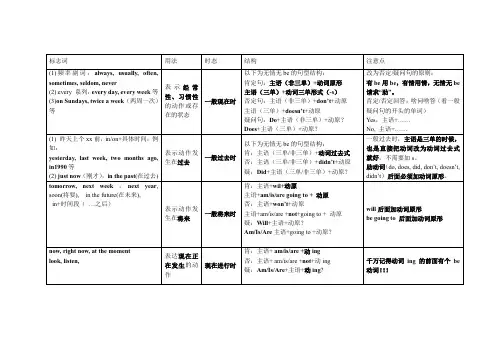
表示动作发 生在过去
表示动作发 生在将来
一般过去时 一般将来时
以下为无情无 be 的句型结构: 肯定句:主语(非三单)+动词原形 主语(三单)+动词三单形式(-s) 否定句:主语(非三单)&doesn’t+动原 疑问句:Do+主语(非三单)+动原? Does+主语(三单)+动原?
标志词
用法
时态
结构
(1) 频 率 副 词 : always, usually, often,
sometimes, seldom, never
表示经常
(2) every 系列:every day, every week 等 性、习惯性
(3)on Sundays, twice a week(两周一次) 等
now, right now, at the moment look, listen,
表达现在正 在发生的动 现在进行时 作
肯:主语+ am/is/are +动 ing 否:主语+ am/is/are +not+动 ing 疑:Am/Is/Are+主语+动 ing?
注意点 改为否定/疑问句的原则: 有 be 用 be,有情用情,无情无 be 请求“助”。 肯定/否定回答:啥问啥答(看一般 疑问句的开头的单词) Yes,主语+…… No, 主语+…… 一般过去时,主语是三单的时候, 也是直接把动词改为动词过去式 就好,不需要加 s。 助动词(do, does, did, don’t, doesn’t, didn’t)后面必须加动词原形。
will 后面加动词原形 be going to 后面加动词原形
小升初四大时态 讲义

一般现在时一. 意义:表示经常发生的事情,动作或存在的状态二. 构成及变化1.be动词的变化。
肯定句:主语+be(am,is,are)+其它。
如:I am a boy.我是一个男孩。
否定句:主语+ be + not +其它。
如:He is not a worker.他不是工人。
一般疑问句:Be +主语+其它。
如:-Are you a student? -Yes. I am. / No, I'm not.特殊疑问句:疑问词+一般疑问句。
如:Where is my bike?2. 行为动词的变化。
当主语为第一,二人称及复数时,助动词为do肯定句:主语+动词原形(+其它)。
如:We often play basketball after school.否定句:主语+ don't+动词原形(+其它)。
如:we don’t play basketball after school.一般疑问句:Do +主语+动词原形+其它?如:Do you often play basketball after school l? Yes, we do. / No, we don't.特殊疑问句:疑问词+以do开头的一般疑问句?如:What do you often do after school ?当主语为第三人称单数时,助动词为does肯定句:主语+动词三单式(+其它)。
如:He swims well.否定句:主语+ doesn’t+动词原形(+其它)。
如:He doesn’t swim well..一般疑问句:Does +主语+动词原形+其它。
如:Does he swim well ? Yes, he does. / No, he doesn't.特殊疑问句:疑问词+以does开头的一般疑问句?如:How does your father go to work?三.第三人称单数的动词变化规则(只有在第三人称为主语的肯定句中,动词才用三单式)(1)多数动词直接加s:runs gets likes collets takes plays climbs…….(2)结尾是s, x, sh, ch, o,前为辅音字母,结尾加es :watches teaches goes does washes crosses mixes brushes(3)动词末尾y前为辅音:将y改为i加es: study→studiesfly→flies carry→carries cry→cries但在y前如果为元音则直接加s:buys says四.时间标志:always , usually , often , sometimes ,every…现在进行时一.意义——当表示现在正在进行的动作或正在发生的事。
202X年小升初英语四大时态总结
千里之行,始于足下。
202X年小升初英语四大时态总结在202X年的小升初英语考试中,四大时态依然是重要的考点。
以下是对四大时态的总结:1. 简单现在时(Simple Present)- 表示经常性、习惯性的动作或状态。
- 动词原形加s/es。
- 常用的时间状语:always, usually, often, sometimes, never等。
例句:I go to school every day.(我每天去学校。
)2. 简单过去时(Simple Past)- 表示过去某个时间发生的动作或状态。
- 动词过去式形式。
- 常用的时间状语:yesterday, last week, two days ago等。
例句:He lived in that city five years ago.(他五年前住在那个城市。
)3. 现在进行时(Present Continuous)- 表示现在正在进行的动作。
- 动词be的现在分词形式(ing形式)。
- 常用的时间状语:now, at the moment等。
例句:They are playing football in the park.(他们正在公园里踢足球。
)4. 将来时(Future)- 表示将来发生的动作或状态。
- 一般将来时:will/shall + 动词原形。
第1页/共2页锲而不舍,金石可镂。
- 现在进行时表示将来:be going to + 动词原形。
- 常用的时间状语:tomorrow, next week, in two days等。
例句:I will visit my grandparents next Sunday.(我下个星期天去看望我的祖父母。
)在考试中,要注意根据句意和上下文选择适当的时态。
掌握四大时态的用法和常用时间状语可以帮助我们更准确地表达自己的意思。
记得通过大量的练习来巩固这些知识点,提高语言运用能力。
四个基本时态-句型转换精讲及练习-适合小升初
4个基本时态:、、、。
一、一般现在时:描述兴趣、爱好、客观事实、普遍真理、性格、能力、特征等…(1)当主语是第一人称或复数时,肯定句主语+动词原形+其他I go to school at 7:00 every morning.否定句主语+don't+动词原形+其他.一般疑问句Do+主语+动词原形+其他?(2)当主语是,肯定句主语+动词的第三人称单数+其他Lily goes to school at 8:00 every morning.否定句主语+doesn't+动词原形+其他.一般疑问句Does+主语+动词原形+其他?二、一般过去时:表示过去某个时间里发生的动作或状态;过去习惯性、经常性的动作、行为;过去主语所具备的能力和性格。
基本结构:主语+动词过去式+其他;否定形式①was/were+not;②在行为动词前加didn't,同时还原行为动词;一般疑问句Did+主语+do+其他?动词规那么变化:1.直接加ed:work——,2.以e结尾的单词,直接加d:live ——3 以辅音字母+y结尾的,变y为i加ed:study——4以元音字母+y结尾的,直接加ed:enjoy ——5 以重读闭音节结尾的,双写最后的辅音字母+ed:stop——动词不规那么变化---略三、现在进行时:表示动作发生的时间是“现在”,动作目前的状态是“正在进行中”。
基本结构:主语+be+V.ing〔现在分词〕形式The teacher is speaking right now.否定句:主语+be(is/am/are)+not+现在分词.一般疑问句:be(is/am/are)+主语+现在分词.特殊疑问句:特殊疑问词+相应be动词+主语+现在分词+Sth?.动词加ing的规那么(1)直接在谓语动词后加ing. 例如:go- , start- , work- .(2)去掉词尾不发音的e,再加ing. 例如leave- ,dine- .注意:如果单词结尾的e发音,那么不能去掉,也直接加ing. 例如:see - /agree - .另外,有少数动词比较特殊,请用心记住:例如:lie – lying/die – dying/tie – tying/picnic - picnicking.(3) 对于重读闭音节词,双写末尾字母再加ing. 例如:sitting, beginning四、一般将来时:表示将来某一时刻的动作或状态,或将来某一段时间内经常的动作或状态。
小升初英语总复习四大时态综合课件
基本用法 1.表示现在正在进行的动作和产生的事 e.g. -What are you doing?
-I am reading a book.
2.有时表示现阶段正产生的事,但此刻动作不一定 正在进行
e.g. He is teaching at the school. We are learning Unit 5 these days.
1.一般现在时
(1)表示经常产生或习惯性的动作或状态 We often write to each other. 常与always,usually,often,sometimes…连用。
(2)表示主语现在的性情、特征、能力 He works hard.他努力工作
(3)表示客观事实或普遍用法 The XXX rises in the east. Light goes faster than sound
动词过去式变化规则
• 1.一般在动词末尾加-ed; 如:work-worked, cook-cooked
• 2.结尾是e加d; 如:live-lived
• 3.末尾只有一个元音字母和一个辅音字母的重 读闭音节,应双写末尾的辅音字母,再加-ed; 如:stop-stopped
• 4.以“辅音字母 y”结尾的,变y为i,再加-ed。 如:study-studied
【No. 2】一般现在时的变化
• 1. be动词的变化 • 否定句:主语+be not+其它. • He is not a worker.他不是工人。 • 一般疑问句:Be+主语+其它?-Are you a student? • -Yes. I am. / No, I'm not. • 特殊疑问句:疑问词+一般疑问句? • Where is my bike?
小升初重点英语语法“四大时态”
小升初重点英语语法“四大时态”小学英语主要是如下的四大时态:一般现在时、现在进行时、一般过去时、一般将来时。
一般现在时一、标志词always(总是) usually(通常) often(经常) sometimes(有时) never(从不) every(每一)二、基本用法1.表示事物或人物的特征、状态。
2.表示经常性、习惯性的动作。
3.表示客观现实。
三、构成1.be动词:主语+be动词(am isare)+其它.2.行为动词:主语+行为动词+其它。
四、句型肯定句:A. be 动词:be+主语+其它。
B. 行为动词:主语+动词(注意人称变化)+其它。
否定句:A.be动词:主语+be+not+其它。
B.行为动词:主语+助动词(do/does)+not+d动词原形+其它一般疑问句:A.be动词:be+主语+其它。
B.行为动词:助动词(Do/Does)+主语+动词原形+其他.特殊疑问词:疑问词+一般疑问句现在进行时一、标志词now(现在), look(看),listen(听)二、基本用法表示现阶段正在进行的动作三、基本结构1.肯定句:主语+be动词+动词现在分词(ing)+其它。
2.否定句:主语+be动词+not+动词现在分词(ing)+其它。
3.一般疑问句:be动词+主语+现在分词(ing)+其它。
4.特殊疑问句:疑问词+一般疑问句。
一般将来时一、标志词tomorrow(明天),soon(不久),will(将要=be going to)二、基本用法表示在在将来某个时间要发生的动作或存在的状态。
三、基本结构1.肯定句:主语+ be going to + 动词原形。
主语+will+动词原形。
2.否定句:主语+ be going to +动词原形。
主语+won’t + 动词原形3.一般疑问句:Be + 主语+ going to+动词原形Will + 主语+ 动词原形4.特殊疑问句:疑问词+一般疑问句一般过去时一、标志词yesterday(昨天),ago(以前),before(在...之前)二、用法1.表示过去某个时间发生的动作或存在的状态,常和表示过去的时间状语连用。
小升初英语重点归纳语法知识(英语动词4种时态)
小升初英语重点归纳:语法知识(英语动词4种时态)英语在小升初考试中占有一定比重,新学期的改变,应该从了解英语的知识点开始。
下面为大家分享英语重点归纳语法知识,供大家参考!语法知识:(一)英语动词4种时态:1、一般现在时:常与表示程度或频度的词连用,如:often(经常),usually(通常,一般),sometimes(有时),always(总是,一直),never(从不),表示经常性或习惯性的动作,表示现在的特征或状态,表示普遍真理。
用动词原形表示,第三人称单数后,动词要在词尾加s(或es,或变y为i再加es)。
如:Ioftengetupat7:00.Heoftengetsupat7:30.2、现在进行时:表示现在或现在这一阶段正在进行的动作。
用am/is/are加动词ing形式表示,如:Whatareyoudoing?Iamreadingabook.Whatishedoing?Heissinging.3、一般将来时:常与表示将来的时间连用,如:tomorrow,nextweek,nextyear等,表示将要发生的动作或情况。
用am/is/are加goingto形式表示,如:Whatareyougoingtodotomorrow?I;;mgoingtorideahorse.用will加动词原形表示,如:WhatwillyoudonextSunday?Iwillgoshopping.用am/is/are加动词ing形式表示,如:Whatareyoudoingtomorrow?I;;mgoingbowling.4、一般过去时:经常与表示过去的时间连用,如:yesterday,lastnight 等,表示过去某时发生的动作或情况。
动词要用动词的过去式。
如:Whowasfirst?Kenwasfirst.Wherewereyouyesterday?Iwasathome.Whatdidyoudoyesterday?Iwenttoschool.以上是为大家分享的英语重点归纳语法知识,希望对大家有所帮助!2017精选小升初英语知识点讲解:名词备战小升初英语名词复数规则语法考点。
2020小升初英语总复习时态
☆时态☆小学阶段一共学了四种时态,分别是:一般现在时,一般将来时,现在进行时,一般过去时。
下面我们一一进行总结。
1、一般现在时A、表示不受时限的客观存在如:He is a boy. She is a student. My mother is a nurse.This is a dog. I have a story-book.B、表示现在的习惯动作,即指现在经常发生的动作,一般现在时常用来表示现在时间里某种动作的经常性和习惯性。
它常与表示程度或频度的词连用,如:often(经常), usually(通常,一般), sometimes (有时), always(总是,一直), never(从不)如:I often go to school on foot. My father works in a school.Mike watches TV every day.I usually play computer games on the weekend.C、表示现时的状态和现在瞬间动作如:How are you? You look happy.What’s the matter with you? I have a headache.What do you have for lunch? I have some chicken.☆注意☆英语动词的现在时与原形同形。
但当主语是第三人称单数时,须在词尾加-s 或 -es。
例如:I have a fish for dinner. Her mother works in a hospital.Amy often goes to school by bike. Mr. Liu teaches us English.加-es 的动词必须是以“sh , ch , o ”等字母结尾的。
如:watches , teaches , goes , washes2、现在进行时表示说话时正在进行的动作或现阶段一直在进行的动作。
英语四种时态总结
英语四种时态总结英语有四种基本时态:一般现在时(Simple Present)、一般过去时(Simple Past)、一般将来时(Simple Future)、现在进行时(Present Continuous)。
1. 一般现在时(Simple Present):主要用于描述现在的状态、习惯、经常性的动作或普遍真理。
句子结构为主语+动词原形(也可在第三人称单数加上-s或-es)。
例句:- I play soccer every weekend.(我每个周末踢足球。
)- He goes to bed early.(他早睡。
)- The sun rises in the east.(太阳从东方升起。
)2. 一般过去时(Simple Past):主要用于描述过去发生的事情或状态。
句子结构为主语+动词过去式。
例句:- She studied English in high school.(她在高中学习英语。
)- We visited London last year.(我们去年参观了伦敦。
)- They ate dinner at a fancy restaurant.(他们在一家高档餐厅吃晚餐。
)3. 一般将来时(Simple Future):主要用于描述将来会发生的动作或事件。
句子结构为主语+will+动词原形。
例句:- I will go to the gym tomorrow.(我明天会去健身房。
)- She will take the exam next week.(她下周会参加考试。
)- We will have a party on Friday.(我们星期五会举办一场派对。
)4. 现在进行时(Present Continuous):主要用于描述当前正在进行的动作。
句子结构为主语+be动词(am/is/are)+动词的ing形式。
例句:- They are watching a movie now.(他们正在看电影。