
六年级英语上册知识点总结-复习提纲
六年级英语上册知识点总结-复习提纲 Unit 1 how do you go to school?
How do you go to school? 你怎么去上学?
Usually I go to school on foot.
通常我走路去学校
Sometimes I go by bike. 有时我骑车去。
How can I get to Zhongshan Park?
我怎么才能到中山公园?
You can go by the No.15 bus.
你可以乘15路公交车。
on foot by bike by bus by train by plane by ship go to school get to traffic light traffic rule stop wait
Unit 2 where is the science museum?
Where is the cinema, please?电影院在哪儿?It’s next to the hospital. 在医院旁。
Turn left at the cine ma, then go straight. It’s on the left.
在电影院左转,然后直走,它就在左边
library post office hospital cinema bookstore where please next t o turn right turn left go straight then
Unit 3 what are you going to do?
What are you going to do on the weekend?
周末你准备去哪儿?
I’m going to visit my grandparents this weekend. 这个周末我要去看望我祖父母。
Where are you going this afternoon?
今天下午你去哪儿?
I’m going to the bookstore. 我要去书店。
What are you going to buy? 你要去买什么?I am going to buy a comic book..
我要去买一本漫画书。
next week this morning this afternoon this evening comic book newspap er buy post card
Unit 4 what’s your hobby?
What’s your hobby? 你的爱好是什么?
I like collecting stamps. 我喜欢集邮。
He likes collecting stamps, too.他也喜欢集邮
Does she teach English? No, she doesn’t.
她教英语吗?不。
Does she teach you math? Yes, she does.
她教你数学吗?是的。
hobby ride a bike dive play the violin make kites collect stamps live te aches watches goes does doesn’t=does not
Unit 5 what does your mother do?
What does your mother do?
你妈妈是干什么的?
She is a TV reporter. 她是一个电视播音员。
Where does she work? 她在哪儿工作?
She works in a school. 她在学校工作。
How does she go to work? 她怎么去工作?She goes to work by bus.
她乘公交车去工作。
Singer writer actor actress artist TV reporter engineer accountan
t policeman cleaner salesperson work
Unit 6 where does the rain come from?
Where does the rain come from? 雨来自哪?
It comes from the clouds. 它来自云.
How do you do that? 你是怎么做的?
What should you do then? 然后你应做什么?
rain cloud sun stream come from seed soil sprout plan t
1.周末你打算做什么?我打算去看望祖父母。
2.你的爱好是什么?我喜欢拉小提琴。
3.你妈妈是做什么的?她是工程师。
4.接着你该怎么做?把种子放进土里。
5.她怎么去工作?她乘公共汽车去工作。
六年级下册
Unit 1 how tall are you?
How tall are you? I’m 164 cm tall.
你多高? 我164厘米高.
You’re shorter than me. 你比我矮.
You’re 4 cm taller than me. 你比我高四厘米.
How heavy are you? I’m 48 kg.
你多重? 我48公斤.
I’m thinner and shorter than you.
我比你更瘦更矮
Taller shorter stronger older younger bigger heavier longer thinner smaller
Unit 2 what’s the matter, Mike?
W hat’s the matter?怎么了?
My throat is sore. 我嗓子疼
My nose hurts. 我鼻塞.
How are you, Liu Yun? You look so happy.
你好吗,刘云? 你看起来好高兴.
You look sad today. 你今天看起来很忧伤.
have a fever have a cold have a toothache have a headache have a sore throa t hurt matter tired excited angry happy bored sad
Unit 3 last weekend
What did you do last weekend?
上个周末你干什么?
I played football. 我踢足球.
Did you read books? 你看书了吗?
Yes, I did. / No, I didn’t.是的/没有
watch–watched play-played wash–washed clean-cleaned visit-visited do-di d last weekend go-went read–read went fishing went hiking
Unit 4 my holiday
Where did you go on your holiday?
你假期去哪儿了?
I went to Xinjiang. 我去新疆了.
How did you go there? 你怎么去的?
I went by train. 我坐火车去的.
Eat(ate)good food have – had get(got) to
Take(took) pictures sing–sang dance–danced
Row(rowed) a boat Buy(bought) presents
Climb(climbed) a mountain learn–learned
See(saw)elephants went skiing went ice-skating
1.你感觉怎样?你看上去很难过。
2.你上个周末做什么?我去公园。
3.我比你瘦,而且矮。
4.怎么了?我喉咙疼。
5.你周末读书了么? 没有.。
(完整版)六年级上册英语-各单元知识点总结
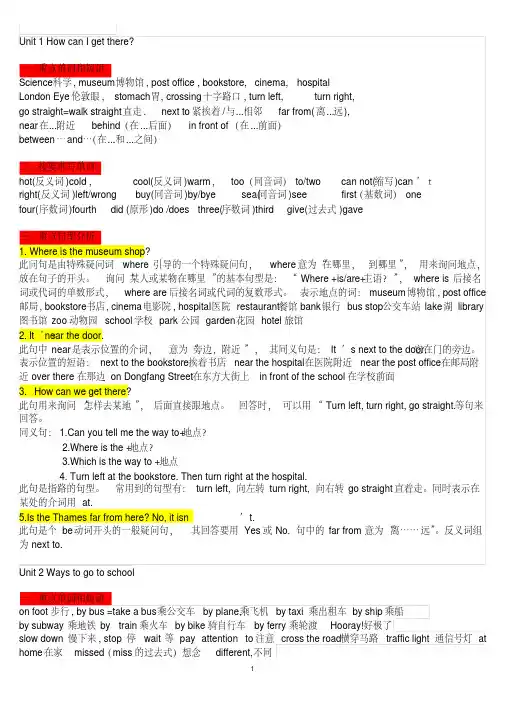
Unit 1 How can I get there?一:重点单词和短语Science科学, museum博物馆, post office , bookstore, cinema, hospitalLondon Eye伦敦眼, stomach胃, crossing十字路口, turn left, turn right,go straight=walk straight直走. next to紧挨着/与...相邻far from(离...远),near在...附近behind(在...后面)in front of(在...前面)between…and…(在...和...之间)二:按要求写单词:hot(反义词)cold , cool(反义词)warm,too(同音词)to/two can not(缩写)can’tright(反义词)left/wrong buy(同音词)by/bye sea(同音词)see first(基数词)onefour(序数词)fourth did (原形)do /does three(序数词)third give(过去式)gave三:重点句型分析1. Where is the museum shop?此问句是由特殊疑问词where 引导的一个特殊疑问句,where意为“在哪里,到哪里”,用来询问地点,放在句子的开头。
询问“某人或某物在哪里”的基本句型是:“ Where +is/are+ 主语?”,where is 后接名词或代词的单数形式,where are 后接名词或代词的复数形式。
表示地点的词:museum博物馆, post office 邮局, bookstore书店, cinema电影院, hospital医院restaurant餐馆bank银行bus stop公交车站lake湖library 图书馆zoo动物园school学校park公园garden花园hotel旅馆near the door.2. It’s它在门的旁边。
完整版)人教版六年级英语上册知识点汇总总结提纲
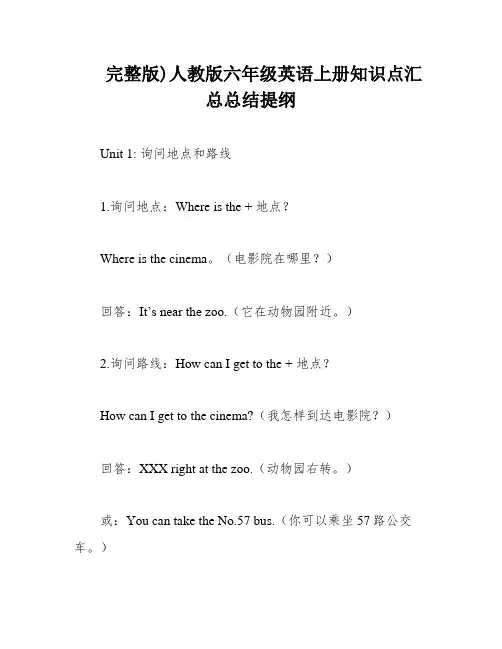
完整版)人教版六年级英语上册知识点汇总总结提纲Unit 1: 询问地点和路线1.询问地点:Where is the + 地点?Where is the cinema。
(电影院在哪里?)回答:It’s near the zoo.(它在动物园附近。
)2.询问路线:How can I get to the + 地点?How can I get to the cinema?(我怎样到达电影院?)回答:XXX right at the zoo.(动物园右转。
)或:You can take the No.57 bus.(你可以乘坐57路公交车。
)Unit 2: 交通方式1.询问某人怎样去某地:How do某人go(come) to + 地点?How do you go to school?(你怎么去学校?)回答:I go to school on foot.(我走路去学校。
)2.规定某人必须做某事:某人 + must + 动词原形XXX.(骑自行车的人必须戴头盔。
)I must pay n to the traffic XXX.(我必须注意交通信号灯。
)Unit 3: 打算做某事某人 + be going to + do(动词原形)She is going to see a film.(她打算去看电影。
)My uncle is planningXXX to go to the supermarket。
In this unit。
there are several types of ns that we can use to XXX。
For example。
we can ask "What are you going to do (+time or place)?" or "When are you going (+place)?" to get an XXX may include phrases such as "I am going to the cinema tomorrow" or "They are going to Nanjing next week."Similarly。
人教版六年级上册英语知识点汇总
一、人教版六年级上册英语知识点概述1.1 单词1.1.1 常用日常用语1.1.1.1 问候语1.1.1.2 表示感谢1.1.1.3 表示道歉1.1.2 基础词汇1.1.2.1 数字1.1.2.2 颜色1.1.2.3 学科名称1.2 语法1.2.1 动词时态1.2.1.1 一般现在时1.2.1.2 一般过去时1.2.1.3 一般将来时1.2.2 代词和人称代词1.2.2.1 主格和宾格1.2.2.2 物主代词1.2.3 形容词和副词1.2.3.1 比较级和最高级1.2.3.2 副词的用法1.3 句型1.3.1 简单句1.3.1.1 肯定句1.3.1.2 否定句1.3.1.3 疑问句1.3.2 复合句1.3.2.1 并列句1.3.2.2 定语从句1.3.2.3 状语从句二、人教版六年级上册英语知识点详解2.1 单词2.1.1 常用日常用语2.1.1.1 问候语问候语是指在英语日常交际中用于打招呼和示好的常用词汇,包括Hello、Hi、Good morning、Good afternoon等等。
2.1.1.2 表示感谢表示感谢的常用词汇有Thank you、Thanks a lot、Thank you very much等,用于表达对别人的帮助或礼物表示感激之情。
2.1.1.3 表示道歉表示道歉的词汇包括I'm sorry、Excuse me、Pardon等,在日常生活中,用于向别人道歉或请求对方让步的场合。
2.1.2 基础词汇2.1.2.1 数字数字是英语基础词汇的重要部分,包括基本的数字表达方式和计量单位,如one、two、three等,以及hundred、thousand等。
2.1.2.2 颜色颜色是描述事物外观的重要词汇,在日常交流中也经常用到,包括red、blue、yellow等常见颜色词汇。
2.1.2.3 学科名称学科名称涉及到人们日常生活和学习工作的方方面面,包括mathematics、music、art等,是学习英语时必须掌握的词汇。
部编版六年级上册英语全册知识点考点归纳

部编版六年级上册英语全册知识点考点归纳一. Unit 1: Greetings and Introductions- 主要知识点:问候语和自我介绍的表达方式、对话中的礼貌用语等。
- 考点:熟练运用问候语和自我介绍的句型进行实际对话。
二. Unit 2: Daily Routines- 主要知识点:日常活动及时间的表达法、动词的第三人称单数形式、频度副词等。
- 考点:能够描述自己和他人的日常活动,并用适当的频度副词表达频率。
三. Unit 3: Hobbies and Interests- 主要知识点:各类爱好和兴趣的词汇,运动动词的搭配等。
- 考点:能够谈论自己的爱好和兴趣,并用动词的适当形式表达。
四. Unit 4: School Life- 主要知识点:学校生活相关的词汇、句型及日常用语。
- 考点:根据提供的情境,能流利用英语进行交流,描述学校生活的一般情况。
五. Unit 5: Family and Homes- 主要知识点:家庭成员及房屋相关的词汇、形容词的比较级和最高级等。
- 考点:描述家庭成员和房屋的外貌、特点及家人之间的关系,掌握形容词的比较级和最高级的使用。
六. Unit 6: Daily Life- 主要知识点:购物和衣物相关的词汇、句型及日常用语等。
- 考点:能够根据给定的情境,进行购物和衣物方面的交流,描述自己和他人的穿着。
七. Unit 7: Food and Drinks- 主要知识点:食物和饮料相关的词汇、数量词、可数名词和不可数名词等。
- 考点:能够描述所喜欢的食物和饮料,并用数量词正确表达数量。
八. Unit 8: Festivals and Celebrations- 主要知识点:节日和庆祝活动的词汇、句型及常用表达方式等。
- 考点:能够流利描述不同节日和庆祝活动,并参与与之相关的英语对话。
以上是部编版六年级上册英语全册的知识点和考点归纳。
希望对你的学习有帮助!。
最新(新版)新起点小学英语六年级上册知识点复习提纲

Red Square
Tokyo
Japan
Asia
Japanese
Tokyo tower
Toronto
Canada
North America French and English CN Tower
Cairo
Egypt
Africa
?
the pyramids
二、句型。
1. Where would you like to go this winter vacation? I’d like to go to Beijing.
Chinese
1864-1957
painted shrimps
Hans Andersen a writer
Danish
1805-1875
wrote stories for children
Beethoven
a musician German
1770-1827
composed music
Thomas Edison an inventor American
invent a small plane
What will the future be like in 50 years?
There will be
no wars. more peace. more cars. no pollution.
take trips to Mars.
eat pills for meals
Europe
French
the Eiffel Tower
New York America North America English
the Disneyland
Sydney
六年级英语上册重点知识归纳
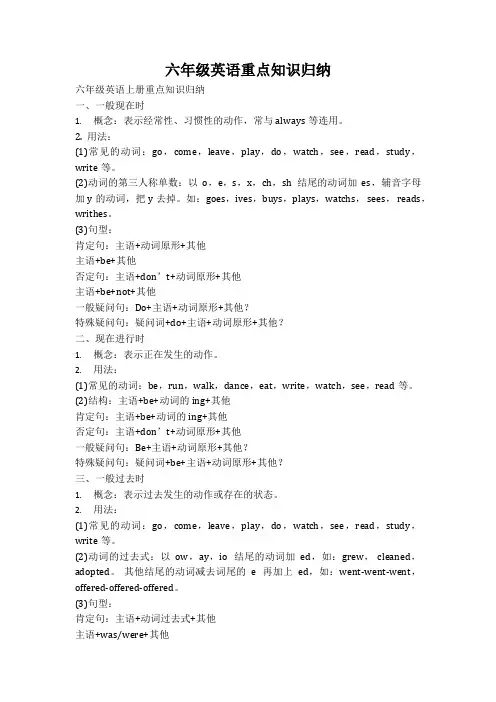
六年级英语重点知识归纳六年级英语上册重点知识归纳一、一般现在时1.概念:表示经常性、习惯性的动作,常与always等连用。
2. 用法:(1)常见的动词:go,come,leave,play,do,watch,see,read,study,write等。
(2)动词的第三人称单数:以o,e,s,x,ch,sh结尾的动词加es,辅音字母加y的动词,把y去掉。
如:goes,ives,buys,plays,watchs, sees, reads,writhes。
(3)句型:肯定句:主语+动词原形+其他主语+be+其他否定句:主语+don’t+动词原形+其他主语+be+not+其他一般疑问句:Do+主语+动词原形+其他?特殊疑问句:疑问词+do+主语+动词原形+其他?二、现在进行时1.概念:表示正在发生的动作。
2.用法:(1)常见的动词:be,run,walk,dance,eat,write,watch,see,read等。
(2)结构:主语+be+动词的ing+其他肯定句:主语+be+动词的ing+其他否定句:主语+don’t+动词原形+其他一般疑问句:Be+主语+动词原形+其他?特殊疑问句:疑问词+be+主语+动词原形+其他?三、一般过去时1.概念:表示过去发生的动作或存在的状态。
2.用法:(1)常见的动词:go,come,leave,play,do,watch,see,read,study,write等。
(2)动词的过去式:以ow,ay,io结尾的动词加ed,如:grew, cleaned,adopted。
其他结尾的动词减去词尾的e再加上ed,如:went-went-went,offered-offered-offered。
(3)句型:肯定句:主语+动词过去式+其他主语+was/were+其他否定句:主语+don’t/didn’t+动词原形+其他主语+was/were+not+其他一般疑问句:Did+主语+动词原形+其他?特殊疑问句:疑问词+did+主语+动词原形+其他?四、现在完成时1.概念:表示过去发生的动作对现在造成的影响或结果。
六年级上册英语知识点复习提纲
六年级英文上册知识点Unit 1 How do you go to school?主要单词:by plane 坐飞机 by ship 坐轮船 on foot步行 by bike 骑自行车 by bus 坐公共汽车 by train 坐火车 traffic lights 交通灯traffic rules交通规则Stop at a red light 红灯停 Wait at a yellow light 黄灯等 Go at a green light 绿灯行主要句子:How do you go to school?你怎么去上学?Usually I go to school on foot. Sometimes I go by bus.通常我步行去上学。
有时候骑自行车去。
How can I get to Zhongshan Park ?我怎么到达中山公园?You can go by the No. 15 bus.你可以坐15路公共汽车去。
知识点:1、There are many ways to go somewhere.到一个地方去有许多方法。
这里的ways一定要用复数。
因为there are是There be句型的复数形式。
2、get to到达.关本单元我们还要学习与get相关的短语:get on 上车 get off下车3、on foot 步行乘坐其他交通工具大都可以用介词by…, 但是步行只能用介词on 。
4、go to school的前面绝对不能加the,这里是固定搭配。
5、USA 和 US 都是美国的意思。
另外America也是美国的意思。
6 go to the park前面一定要加the.如果要去的地方有具体的名字,就不能再加the , 如果要去的地方没有具体名字,由要在前面加the. go to school 除外。
7、How do you go to …?你怎样到达某个地方?如果要问的是第三人称单数,则要用:How does he/she…go to …?8、反义词:get on(上车)---get off(下车) near(近的)—far(远的) fast(快的)—slow(慢的) because(因为)—why(为什么)same(相同的)—different(不同的)9、近义词:see you---goodbye sure---certainly---of course10、频度副词:always 总是,一直 usually 通常 often经常 sometimes 有时候 never 从来不Unit 2 Where is the science museum?主要单词:library 图书馆 post office 邮局 hospital医院 cinema 电影院 bookstore书店 science museum科学博物馆 turn left向左转 turn right 向右转 go straight 直行 north北 south南 east东 west西主要句子:Where is the cinema, please? 请问电影院在哪里?It’s next to the hospital. 它与医院相邻。
六年级上册英语知识点归纳
六年级上册英语知识点归纳:
一、词汇和语法
1. 动词的过去式和过去分词:如go-went-gone,do-did-done等。
2. 情态动词:如can,may,must,should等。
3. 常用短语和表达:如“what time is it?”,“it's time to…”等。
4. 句型转换:如“what's the time?”转换为“what time is it?”。
5. 形容词的比较级和最高级:如“big-bigger-biggest”。
6. 常用介词:如“in”,“on”,“under”,“behind”等。
7. 代词:如“I”,“you”,“he”,“she”等。
8. 序数词:如“first”,“second”,“third”等。
二、阅读理解
1. 阅读并理解短文,能够回答与短文内容相关的问题。
2. 根据上下文猜测生词的意思。
3. 分析并理解作者的观点和态度。
三、写作
1. 根据题目要求写出相应的短文或对话。
2. 能够使用正确的语法和词汇进行表达。
3. 注意标点符号和大小写的使用。
四、听力和口语
1. 听懂英语对话或短文,并能够回答相关问题。
2. 能够流利地朗读英语课文或短文。
3. 能够用英语进行简单的日常交流。
以上是六年级上册英语知识点的大致归纳,你可以根据教材内容进行补充和完善。
希望对你有所帮助!。
英语六年级上册重点知识总结
英语六年级上册重点知识总结
以下是六年级上册英语的一些重点知识总结:
1. 词汇:掌握六年级上册要求掌握的词汇,包括名词、动词、形容词、副词等各类实词和虚词。
2. 语法:掌握简单句的基本结构,理解并运用主语、谓语、宾语、状语等句子成分,学习并掌握一些常见的句型结构,如陈述句、疑问句、感叹句等。
3. 时态:掌握一般现在时、现在进行时、一般将来时等时态的用法,理解并运用相关的时间状语,如always、usually、sometimes等。
4. 口语交际:能够运用所学知识进行简单的日常口语交流,包括问候、介绍、感谢等常见场景。
5. 阅读理解:能够理解并回答一些简单的阅读问题,如选择题、填空题等,提高阅读速度和阅读理解能力。
6. 写作:能够根据要求写一些简单的短文,如日记、书信等,注意语法和拼写的准确性,以及标点符号的使用。
7. 听力:能够听懂一些简单的英语对话和短文,理解其主要内容,提高听力理解和反应速度。
以上是六年级上册英语的一些重点知识总结,学生需要全面掌握并运用所学知识,提高英语语言运用能力。
人教版六年级上册英语各单元知识点汇总及提纲
Unit1 How can I get there?一、词汇。
1.听说读写下列词汇(必背★)science museum 科学博物馆post office 邮局bookstore书店cinema 电影院hospital 医院crossing 十字路口turn转弯turn left 向左转turn right 向右转go straight 直行in front of在...前面behind在...后面beside在...旁边near在附近next to 紧挨着between...and...在...和...之间above 在...上方2.能够掌握下列词汇(看到单词,能够说出中文意思。
)ask问sir先生interesting有趣的Italian意大利的restaurant餐馆pizza比萨饼street街道get到达BDS北斗卫星导航系统tell告诉gave(give的过去式)提供,交给feature特点follow跟着far远的二、句型。
1.听说读写下列句型(必背★)。
(1)--Where is the museum shop? 博物馆的商店在哪里?--It’s near the door.在大门附近。
(2)--How can we get there? 我们怎么到那儿?--Turn left at the bookstore.Then...(go straight...) 到书店左转,然后... (3)--Where is the Italian restaurant? 意大利饭店在哪里?--It’s next to the the park on Dongfang street.它紧挨着公园,在东方街道上。
(4)--Is there a cinema near here? 这附近有电影院吗?--Yes, there is./ No, there isn’t.(5)--Are there any trees in the village?(村庄里有树吗?)--Yes, there are./No, there aren't.-Where is the hospital?-It’s in front of the cinema.-Where is the cinema?-It's in front of the hospital.2.听说认读下列句子(能够认读,理解中文意思)。